
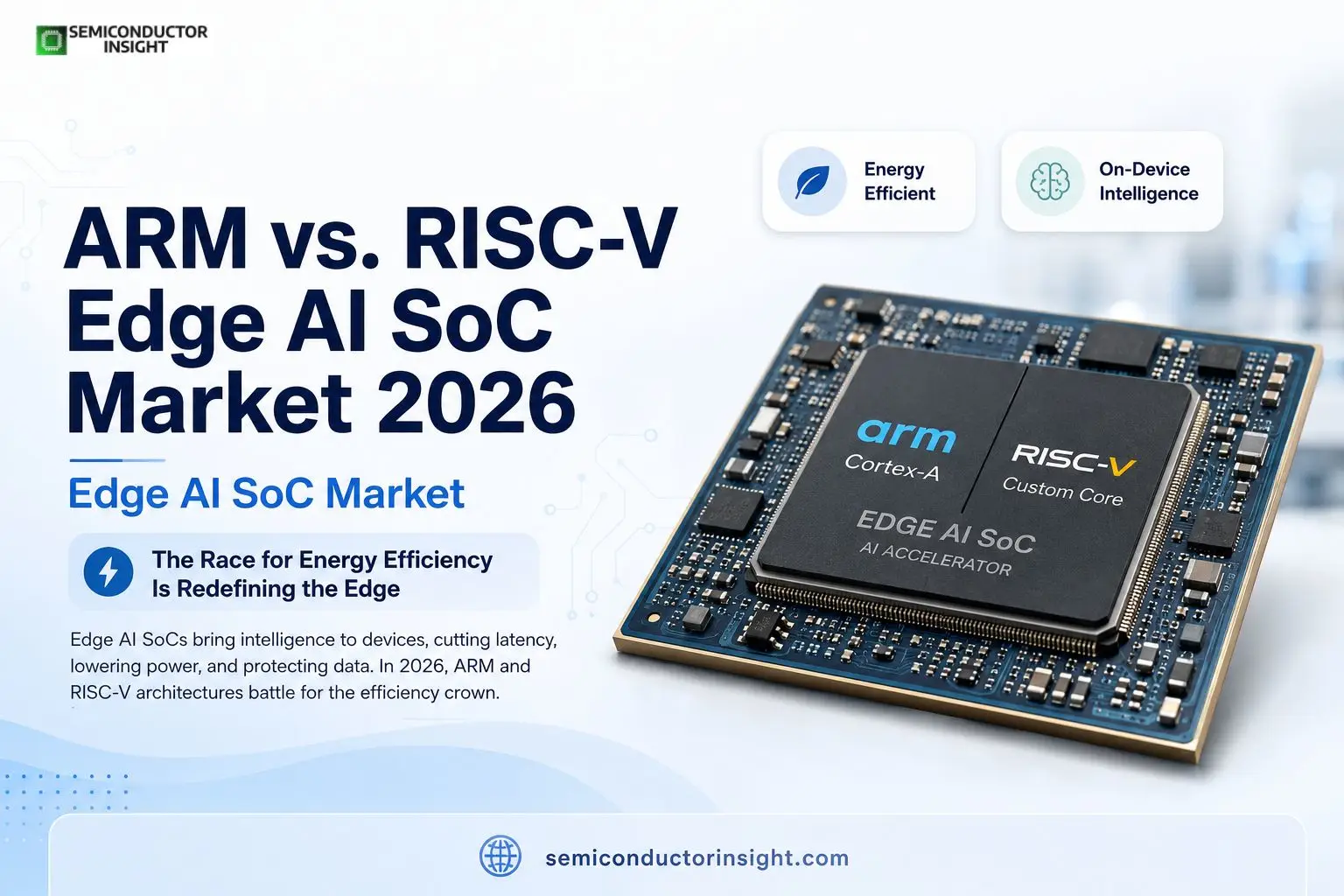
ARM vs. RISC-V Edge AI SoC Market 2026: Which Wins Energy Efficiency?
The semiconductor world is racing toward smarter, more compact chips that deliver artificial intelligence capabilities right at the device level. Edge AI system on chip solutions pack processors, memory, and accelerators together to enable instant decision making in everything from phones and drones to factory sensors and medical wearable.
This approach cuts reliance on distant cloud servers, lowering latency while addressing growing concerns around power consumption and data privacy.
- Heterogeneous Core Designs Taking Centre Stage
- Edge AI SoCs blend different processing elements on one die to handle varied workloads efficiently.
- CPU cores manage general tasks, while specialised neural units accelerate machine learning operations like object detection or speech recognition.
- Technical overviews from IEEE Spectrum and academic papers describe how these setups optimise data flow to minimise energy waste during constant operation.
- High-Impact Enterprise Use Cases
- In consumer gadgets, these chips power features such as live photo editing and always-listening voice commands without draining batteries quickly.
- Automotive manufacturers embed them in camera systems for immediate hazard recognition during drives.
- Industrial users apply them in vibration monitors that predict equipment failures on the spot, reducing downtime in manufacturing plants.
- Government-backed test beds, including those referenced on NIST resources, explore similar uses in secure communication devices for critical infrastructure.
What Are the Most Energy-Efficient SoCs?
Design teams constantly evaluate options to find the sweet spot between performance and power draw. ARM-based platforms frequently appear in mobile and embedded scenarios for their mature ecosystem and fine-tuned power management. Certain variants achieve strong inference rates while staying within tight thermal envelopes suitable for handheld tools.
RISC-V architectures gain attention for their open source flexibility, allowing custom tweaks that trim unnecessary overhead in specialised IoT applications. Public case studies from university labs show these designs excelling in scenarios needing extreme efficiency, sometimes operating effectively in sub-watt ranges for intermittent sensing tasks.
Neuromorphic chips add another layer by mimicking biological neural firing patterns that only activate when needed. Intel’s research releases on Loihi generations highlight dramatic drops in energy use for sparse data patterns common in real-world edge environments.
Efficiency Comparison Overview
Different architecture types are designed to serve different workload needs, and their power profiles reflect that purpose. ARM Neural Focused systems typically operate in the 5–12W range and are best suited for balanced inference tasks, making them a strong fit for smartphones and tablets. RISC-V Custom architectures usually work within the milliwatt to low-watt range, offering tailored efficiency for low-duty-cycle applications such as remote sensors and wearables. Neuromorphic architectures are designed for ultra-low, event-driven power use and excel at sparse pattern recognition, which makes them ideal for always-on monitoring devices.
Want to learn more about the report? Check out our latest updated version for free: https://semiconductorinsight.com/report/edge-ai-soc-system-on-chip-market/
Edge Intelligence and Energy-Efficient Processing in Real-World Applications
- The growing adoption of Edge AI SoCs is being driven by their ability to deliver intelligent processing while maintaining low power consumption across a wide range of connected devices. In smart home environments, these chips enable security cameras to analyze video feeds locally, detect unusual activities, and send alerts without continuously transmitting data to the cloud.
- Healthcare wearables and monitoring patches use on-device AI processing to track vital signs in real time, allowing immediate notifications when abnormal conditions are detected. Similarly, agricultural drones leverage Edge AI SoCs to perform in-flight crop analysis, enabling rapid adjustments based on visual observations collected during operations.
- To support these demanding workloads within battery-powered and resource-constrained devices, modern Edge AI SoCs incorporate advanced power management capabilities. Technologies such as dynamic voltage and frequency scaling automatically adjust processing performance according to workload requirements, while sleep modes and power gating deactivate unused circuit blocks to conserve energy.
- These optimizations help extend device operating life while maintaining responsive AI performance. As the number of connected intelligent devices continues to expand globally, energy-efficient edge computing architectures are becoming increasingly important for balancing computational capability, operational reliability, and sustainable power consumption.
Ongoing Research and Collaboration Efforts
University and industry teams work on 3D stacking methods to boost density without spiking heat output. Open source communities around RISC-V share implementations that accelerate development for niche edge uses. Government programs supporting semiconductor innovation provide frameworks for testing new materials that could further improve efficiency metrics.
Expanding Uses in Specialised Fields
Autonomous robots in warehouses navigate using local vision processing powered by these chips. Traffic management systems analyse flow patterns at intersections to optimise signals without central overload. Environmental monitoring stations process climate data on-site to deliver timely insights to researchers.
This Edge AI SoC space highlights a shift toward distributed computing that respects real-world constraints around energy and connectivity. As more devices incorporate intelligence at the edge, the focus remains on architectures that deliver capable performance through thoughtful design choices and practical implementations.

Comments (0)