Edge Computing Infrastructure Semiconductor Market Insights
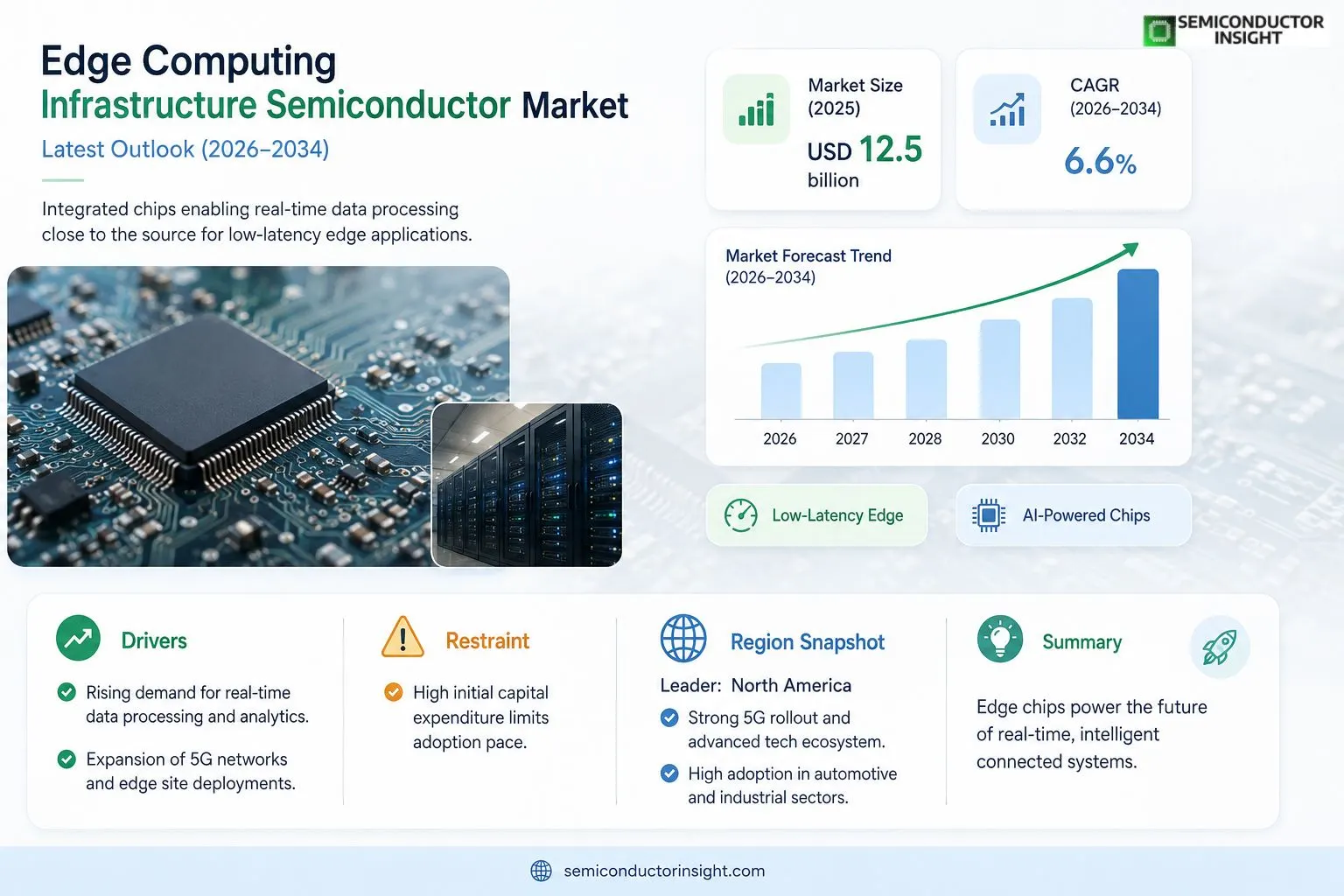
Global edge computing infrastructure semiconductor market size was valued at USD 12.5 billion in 2025. The market is projected to grow from USD 13.8 billion in 2026 to USD 22.3 billion by 2034, exhibiting a CAGR of 6.6% during the forecast period.
Edge computing infrastructure semiconductors are purpose‑built integrated circuits that enable data processing close to the source of generation. They include AI accelerators, system‑on‑chips (SoCs), field‑programmable gate arrays (FPGAs) and application‑specific integrated circuits (ASICs) designed for low‑latency, high‑throughput workloads in IoT gateways, autonomous vehicles and distributed cloud nodes.The market is accelerating because enterprises are investing heavily in low‑latency services while telecom operators expand 5G edge sites and manufacturers embed intelligence in devices. Furthermore, rising demand for real‑time analytics and stringent data‑privacy regulations drive adoption of on‑premise processing solutions. Key players such as NVIDIA, Intel, Qualcomm, AMD and Xilinx are expanding their portfolios through strategic partnerships and advanced node deployments to capture this growth.
MARKET DRIVERS
Rising Demand for Real‑Time Data Processing
The proliferation of IoT sensors and autonomous systems is forcing enterprises to move computation away from centralized clouds. By 2025, analysts expect that over 40% of new data workloads will be processed at the edge, driving strong demand for high‑performance Edge Computing Infrastructure Semiconductor Market solutions that can deliver low‑latency AI inference.
Expansion of 5G and Private Networks
5G roll‑outs are creating bandwidth‑rich environments where latency becomes the primary performance metric. Semiconductor vendors that embed advanced power‑management and security features into edge processors are gaining traction, as operators seek to monetize edge sites in factories, smart cities, and retail locations.
➤ “Edge‑centric semiconductor designs are projected to capture more than 30% of total chip revenue in the communications segment by 2026.”
These trends are reinforced by rising enterprise budgets for digital transformation. Companies are allocating up to 15% of their IT spend to edge‑enabled platforms, which directly fuels growth in Edge Computing Infrastructure Semiconductor Market.
MARKET CHALLENGES
Integration Complexity Across Heterogeneous Devices
Edge environments often involve a mix of legacy hardware, diverse operating systems, and fragmented software stacks. Achieving seamless integration of new semiconductor solutions while maintaining security posture remains a costly and time‑consuming effort for many adopters.
Other Challenges
Thermal Management Constraints
Compact edge nodes operate in confined spaces with limited cooling capacity. Manufacturers must balance high compute density with low power envelopes, a trade‑off that can delay product launches.
MARKET RESTRAINTS
High Initial Capital Expenditure
Deploying cutting‑edge edge processors requires significant upfront investment in hardware, firmware development, and integration testing. For many mid‑size enterprises, the return‑on‑investment horizon exceeds typical budgeting cycles, limiting rapid market adoption.
MARKET OPPORTUNITIES
AI‑Accelerated Edge Analytics
Emerging use cases such as predictive maintenance, real‑time video analytics, and localized AI inference present a sizable opportunity. Semiconductor firms that embed dedicated neural‑processing units (NPUs) into edge‑grade chips can capture premium pricing and expand market share.
Edge Computing Infrastructure Semiconductor Market Trends
Growing Demand for Low‑Latency Processing
Edge Computing Infrastructure Semiconductor Market is being reshaped by a surge in applications that require immediate data processing at the source. Enterprises across manufacturing, logistics, and smart city projects are prioritizing architectures that reduce round‑trip latency to sub‑millisecond levels. This shift is driven by the need for real‑time analytics in autonomous vehicles, industrial IoT gateways, and distributed cloud nodes, where traditional centralized data centers cannot meet performance thresholds. As 5G rollouts expand the density of edge sites, semiconductor manufacturers are delivering purpose‑built chips that balance power efficiency with high‑throughput capabilities, reinforcing the market’s trajectory toward pervasive, low‑latency services.
Other Trends
AI Accelerators and System‑on‑Chips
AI accelerators and system‑on‑chips (SoCs) have become central to Edge Computing Infrastructure Semiconductor Market because they integrate compute, memory, and networking functions on a single die. These solutions enable edge devices to execute complex inference workloads locally, mitigating data transfer costs and ensuring compliance with emerging data‑privacy regulations. Companies such as NVIDIA, Intel, and Qualcomm are embedding heterogeneous cores that support both general‑purpose processing and specialized tensor operations, facilitating a seamless transition from cloud‑centric AI models to edge‑native intelligence. The convergence of AI acceleration with low‑power design methodologies also supports battery‑operated edge sensors, extending their operational lifespan while delivering actionable insights in real time.
Strategic Partnerships and Advanced Node Deployments
Strategic collaborations between semiconductor vendors and telecom operators are accelerating the deployment of edge‑ready silicon across 5G infrastructure. Partnerships focus on co‑designing ASICs and FPGAs that are optimized for the unique power and thermal envelopes of distributed edge locations. Simultaneously, advanced process nodes—ranging from 7 nm to 5 nm—are being leveraged to pack greater functionality into smaller footprints, addressing space constraints in edge cabinets and roadside units. These joint initiatives not only shorten time‑to‑market for next‑generation edge solutions but also create ecosystems where hardware, software, and network services are tightly integrated, reinforcing the overall growth momentum of Edge Computing Infrastructure Semiconductor Market.
COMPETITIVE LANDSCAPEKey Industry Players
Edge Computing Infrastructure Semiconductor Market Competitive Landscape Overview
Edge Computing Infrastructure Semiconductor Market is currently dominated by a handful of large integrated‑circuit manufacturers that leverage advanced process nodes and AI‑centric design architectures. NVIDIA leads with its AI‑accelerated GPUs and the emerging EGX platform, while Intel capitalizes on its Xeon Scalable processors and adaptable FPGA portfolio. AMD, now encompassing Xilinx’s FPGA capabilities, offers a unified solution stack that targets high‑throughput, low‑latency workloads at the network edge. Qualcomm’s Snapdragon Edge series extends mobile‑grade compute to IoT gateways, and Broadcom’s ASICs provide specialized networking functions for 5G edge sites. These incumbents benefit from deep R&D resources, extensive IP libraries, and strategic partnerships with cloud providers and telecom operators, establishing a tiered market structure where premium performance solutions command the upper segment and cost‑optimized parts serve broad adoption across distributed edge nodes.Niche yet influential players are expanding the competitive set with differentiated technologies. MediaTek is introducing cost‑efficient SoCs aimed at consumer‑grade edge devices, while Marvell focuses on high‑speed Ethernet and storage controllers for edge data centers. Samsung Electronics brings advanced memory‑centric dies and custom ASICs for automotive edge applications. Taiwan Semiconductor Manufacturing Co. (TSMC) serves as a pure‑play foundry enabling bespoke designs from emerging startups. Huawei’s HiSilicon continues to develop AI‑focused chips for private‑cloud edge deployments, and Google’s Edge TPU offers a cloud‑native inference accelerator. Apple’s in‑house silicon, particularly the M‑series derivatives for edge‑ready Macs, adds a proprietary dimension to the market, reflecting a growing diversification of specialized edge compute solutions.
List of Key Edge Computing Infrastructure Semiconductor Companies Profiled
- NVIDIA
- Intel
- AMD
- Qualcomm
- Broadcom
- MediaTek
- Marvell Technology
- Samsung Electronics
- Texas Instruments
- Taiwan Semiconductor Manufacturing Co.
- Huawei (HiSilicon)
- Apple
- Xilinx
- Microsoft
Segment Analysis:
| Segment Category | Sub-Segments | Key Insights |
| By Type |
|
AI Accelerators
|
| By Application |
|
Distributed Cloud Nodes
|
| By End User |
|
Telecommunications Operators
|
| By Architecture |
|
Monolithic SoC
|
| By Performance Tier |
|
High‑Performance
|
Regional Analysis: North America
North America
North America is poised to be a dominant force within Edge Computing Infrastructure Semiconductor Market. This region benefits from a mature technological ecosystem, significant investment in digital transformation across industries, and a high propensity for early adoption of advanced semiconductor solutions. The confluence of robust 5G deployments, proliferation of IoT devices, and increasing demand for real-time data processing are key drivers fueling market growth. Furthermore, the presence of leading semiconductor manufacturers and a strong research and development infrastructure contribute significantly to North America’s leadership position. The focus on secure and reliable edge deployments within sectors like automotive, healthcare, and industrial automation is creating substantial opportunities for innovative semiconductor solutions tailored to these demanding applications. The emphasis on low-latency connectivity and localized data processing enhances operational efficiency and enables new revenue streams for businesses across the continent.
The North American Edge Computing Infrastructure Semiconductor Market is experiencing significant shifts driven by the increasing need for distributed computing power. Key trends include the rise of specialized processors optimized for edge workloads, advancements in power efficiency, and the growing adoption of open-source platforms. Focus on AI at the edge is also a prominent trend, requiring dedicated semiconductor capabilities.
Companies operating in Edge Computing Infrastructure Semiconductor Market in North America are employing strategic partnerships, focused product development, and aggressive market penetration strategies to gain a competitive edge. Vertical integration is also a growing trend as companies seek to control the entire value chain, from semiconductor design to system integration. Innovation in security features is paramount to address increasing threats at the edge.
The North American landscape is populated by established semiconductor giants like Intel, NVIDIA, and AMD, alongside emerging players specializing in edge-specific solutions. Collaboration between these companies and system integrators is vital for successful market deployment. Intel is heavily investing in its edge computing portfolio. NVIDIA continues to lead in AI-accelerated edge platforms. AMD is gaining traction with its versatile processor offerings.
Significant opportunities exist in the automotive sector, with the increasing adoption of autonomous vehicles requiring robust edge computing capabilities. The healthcare industry is also witnessing a surge in demand for edge-enabled medical devices and remote patient monitoring systems. Industrial automation, smart cities, and retail are further contributing to the growth of Edge Computing Infrastructure Semiconductor Market in the region.
Europe
Europe represents a significant and steadily growing market for Edge Computing Infrastructure Semiconductor Market. Driven by stringent data privacy regulations and a strong emphasis on industrial automation and smart infrastructure, the region is witnessing increasing adoption of edge solutions. The European Union’s investments in digital infrastructure and the rise of 5G networks are key catalysts. Concerns around data sovereignty are influencing semiconductor choices. The automotive sector in Europe, particularly in Germany and France, is actively embracing edge computing for autonomous driving and connected car services. The focus on energy efficiency and sustainable technologies also creates opportunities for innovative semiconductor designs.
Asia-Pacific
Asia-Pacific is the largest and fastest-growing market for Edge Computing Infrastructure Semiconductor Market. Fueled by rapid industrialization in countries like China and India, coupled with a massive increase in IoT deployments and 5G infrastructure rollout, the region offers immense growth potential. Increasing demand from manufacturing, logistics, and retail sectors is driving adoption of edge computing solutions. China is a dominant force, investing heavily in both semiconductor manufacturing and edge infrastructure. The region is also witnessing a surge in innovation from local semiconductor companies. However, geopolitical tensions and supply chain disruptions pose challenges.
South America
South America presents a nascent but promising market for Edge Computing Infrastructure Semiconductor Market. Growing investments in telecommunications infrastructure and increasing adoption of IoT in industries like agriculture, mining, and logistics are driving initial demand. The region is gradually embracing edge computing to address challenges related to latency and bandwidth limitations. Brazil and Argentina are key markets with significant growth potential. Government initiatives promoting digital infrastructure are expected to further accelerate market growth.
Middle East & Africa
The Middle East & Africa (MEA) region offers significant long-term growth opportunities for Edge Computing Infrastructure Semiconductor Market. Increased investments in smart cities, industrial automation, and infrastructure development are fueling demand for edge computing. The UAE and Saudi Arabia are leading the way in adopting digital technologies and edge solutions. The expanding 5G network coverage and growing IoT deployments are further driving market growth. Challenges include infrastructure limitations and regulatory uncertainties in some countries.
Report Scope
This market research report provides a comprehensive analysis of the Edge Computing Infrastructure Semiconductor Market , covering the forecast period 2026–2034. It offers detailed insights into market dynamics, technological advancements, competitive landscape, and key trends shaping the industry.
Key focus areas of the report include:
- Market Overview: The report begins with an overview outlining its current market scenario, key growth indicators, and industry transformation drivers. It discusses macroeconomic factors, demand–supply balance, regulatory landscape, and the strategic role of semiconductors in powering advancements across industries such as automotive, telecommunications, consumer electronics, and industrial automation.
- Market Size & Forecast: Historical data and future projections for revenue, unit shipments, and market value across major regions and segments.
- Segmentation Analysis: Detailed breakdown by product type, technology, application, and end-user industry to identify high-growth segments and investment opportunities.
- Regional Insights: Insights into market performance across North America, Europe, Asia-Pacific, Latin America, and the Middle East & Africa, including country-level analysis where relevant.
- Competitive Landscape: Profiles of leading market participants, including their product offerings, R&D focus, manufacturing capacity, pricing strategies, and recent developments such as mergers, acquisitions, and partnerships.
- Technology Trends & Innovation: Assessment of emerging technologies, integration of AI/IoT, semiconductor design trends, fabrication techniques, and evolving industry standards.
- Market Drivers & Restraints: Evaluation of factors driving market growth along with challenges, supply chain constraints, regulatory issues, and market-entry barriers.
- Stakeholder Insights: Insights for component suppliers, OEMs, system integrators, investors, and policymakers regarding the evolving ecosystem and strategic opportunities.
Primary and secondary research methods are employed, including interviews with industry experts, data from verified sources, and real-time market intelligence to ensure the accuracy and reliability of the insights presented.
FREQUENTLY ASKED QUESTIONS:
What is the current market size of Edge Computing Infrastructure Semiconductor Market?
-> Edge Computing Infrastructure Semiconductor Market was valued at USD 12.5 billion in 2025 and is expected to reach USD 22.3 billion by 2034.
Which key companies operate in Edge Computing Infrastructure Semiconductor Market?
-> Key players include NVIDIA, Intel, Qualcomm, AMD, and Xilinx.
What are the key growth drivers?
-> Key growth drivers include enterprise investments in low‑latency services, telecom operators expanding 5G edge sites, manufacturers embedding intelligence in devices, rising demand for real‑time analytics, and stringent data‑privacy regulations.
Which region dominates the market?
-> The reference does not identify a single dominant region; growth is observed across North America, Europe, and Asia‑Pacific.
What are the emerging trends?
-> Emerging trends include AI accelerators, system‑on‑chips (SoCs), field‑programmable gate arrays (FPGAs), application‑specific integrated circuits (ASICs) for edge workloads, and the integration of AI/IoT with 5G edge deployments.

Get Sample Report PDF for Exclusive Insights
Report Sample Includes
- Table of Contents
- List of Tables & Figures
- Charts, Research Methodology, and more...
 Download Sample Report PDF