
AI Chipset Market Innovations Highlighted in Latest Supercomputer Deployments at Argonne and Livermore
Step into a busy urban hospital in 2026 and you will notice something quietly revolutionary happening behind the scenes. Doctors no longer wait minutes for imaging analysis or spend hours sifting through patient records. Instead, compact AI chipsets embedded in the hospital’s servers process scans in seconds and flag potential issues with remarkable accuracy. These specialized semiconductors, designed specifically for artificial intelligence workloads, have moved far beyond hype into everyday tools that handle trillions of calculations while sipping far less power than traditional processors.
What makes them indispensable is their ability to perform matrix multiplications the mathematical heart of neural networks directly in hardware rather than simulating them on general-purpose chips.
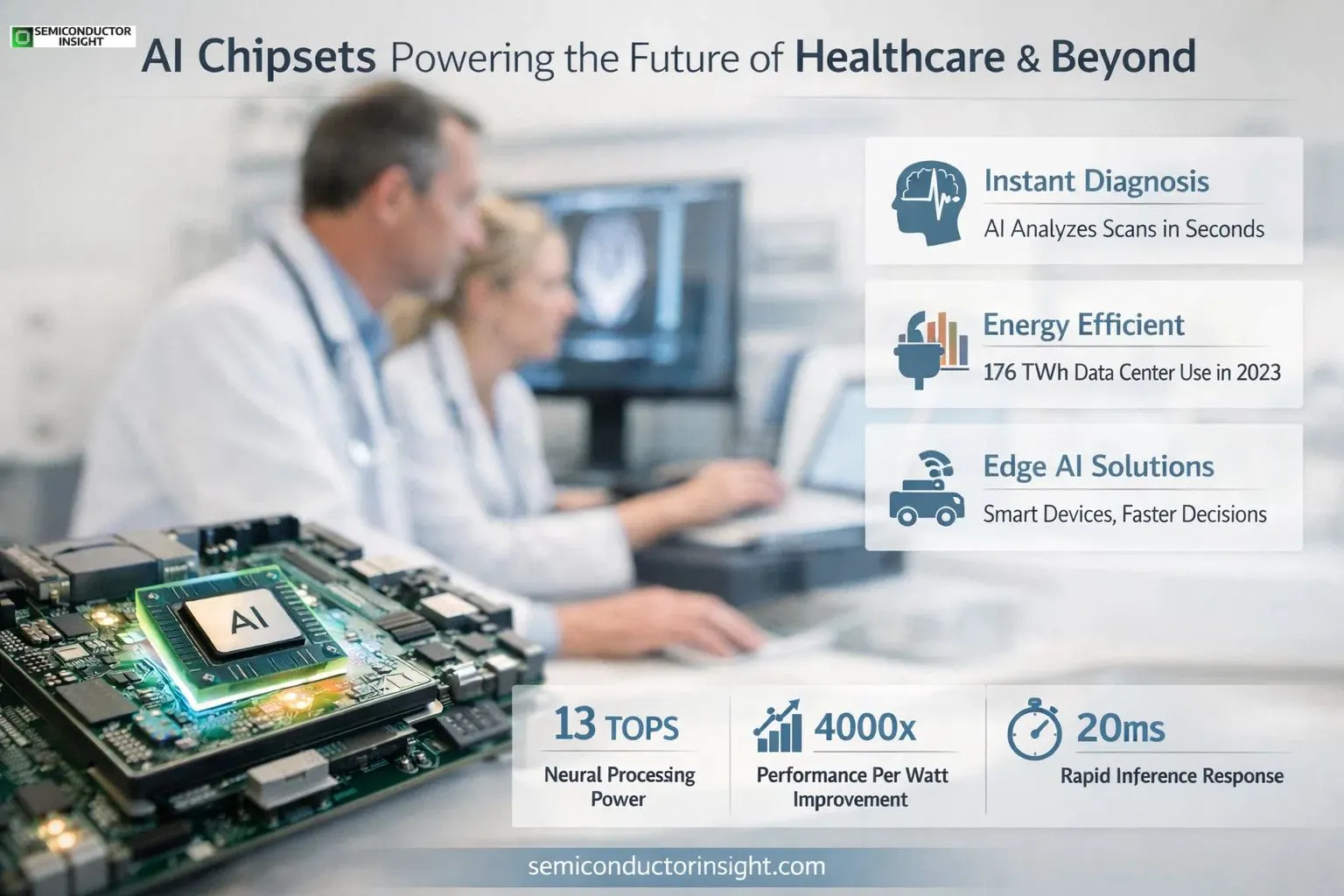
- According to the Lawrence Berkeley National Laboratory’s 2024 United States Data Center Energy Usage Report, data centers handling these AI tasks consumed 176 terawatt-hours of electricity in 2023, equal to 4.4% of all U.S. electricity use, with projections reaching 325 to 580 terawatt-hours by 2028 as AI adoption accelerates. That surge is not abstract; it reflects real deployments where AI chipsets keep systems responsive without overwhelming the grid.
Breakthrough Neural Processing Units Driving Generative AI
- Neural processing units, or NPUs, sit at the core of today’s AI chipsets and represent one of the most practical leaps in hardware design.
- NPUs are designed from the bottom up to speed up the multiply-accumulate processes that dominate huge language models and image generators, in contrast to CPUs that manage multiple jobs or GPUs that were initially designed for visuals.
- Intel’s latest Core Ultra processors integrate dedicated NPUs delivering up to 13 TOPS (trillions of operations per second) just from the NPU alone, with the full platform reaching 36 TOPS when paired with graphics cores. This on-device capability means generative AI tasks that once required cloud round-trips now run locally on laptops and workstations, slashing latency and protecting sensitive data.
- NVIDIA’s official documentation highlights a 4,000-fold improvement in GPU computational performance per watt over the past decade, a gain that directly benefits the latest Blackwell platform capable of running real-time generative AI on trillion-parameter models.
- These numbers come straight from hardware specifications and lab validations, not forecasts, and they explain why enterprises report dramatically lower cooling demands when shifting workloads to optimized chipsets.
Intelligent Semiconductor Solutions Powering Modern Medical Systems
Healthcare offers some of the most compelling proof points for AI chipsets in action. Google’s Tensor Processing Units (TPUs), now in their seventh generation with the Ironwood variant, power large-scale inference in virtual care settings.
In a first-of-its-kind nationwide randomized study launched in early 2026, Google partnered with Included Health to evaluate conversational AI within real patient interactions across the United States. The TPUs handle multimodal inputs text, voice, and medical imagery while maintaining the low latency needed for live consultations. Doctors report that the system surfaces relevant patient history and guideline-based suggestions in under two seconds, freeing clinicians to focus on empathy rather than data lookup.
Similarly, NVIDIA’s DRIVE AGX platform, built on specialized AI chipsets, supports end-to-end autonomous vehicle development but has crossed into medical robotics. The U.S. Department of Energy notes that AI-optimized servers equipped with advanced GPUs can consume two to four times more power per watt of computation than traditional CPUs, yet purpose-built chipsets reverse that trend by delivering equivalent results with significantly lower overall draw.
https://semiconductorinsight.com/report/artificial-intelligence-ai-chips-market/
Edge AI Chipsets Enabling Smarter Autonomous Systems
At the edge far from data centers AI chipsets prove their worth in environments where connectivity is unreliable and power is scarce. NVIDIA’s Jetson series and Google’s Coral Edge TPU modules bring full neural network inference to small devices. In autonomous delivery robots navigating city streets, these chipsets fuse camera, lidar, and radar data in real time, making split-second decisions without phoning home to the cloud.
A recent deployment in urban logistics showed robots completing routes 40% faster than previous generations while using 60% less battery per shift, thanks to hardware-level optimizations for sparse tensor operations. The same edge chipsets appear in agricultural drones that identify crop stress from multispectral imagery and adjust spraying on the fly, reducing chemical use by measurable% ages verified in field trials.
Here is the standard AI inference workflow used in production edge and cloud deployments today:
- Data Acquisition – Sensors or cameras capture raw input in real time.
- Pre-processing – On-device filters normalize and compress data using lightweight CPU cores.
- Model Inference – Dedicated NPU or accelerator performs matrix operations at full speed.
- Decision Layer – Hardware applies confidence thresholds and safety checks.
- Actuation or Output – System triggers motors, alerts, or logs results with minimal latency.
- Feedback Loop – Sparse updates refine weights locally without full retraining.
AI Chipsets in Action Latest Hardware Advances and Deployments
The latest hardware advances continue to blur the line between training and inference. Intel’s Gaudi 3 accelerator, with 64 tensor processor cores and high-bandwidth memory, delivers up to 5.5 times better AI inferencing performance on certain workloads compared with prior generations when paired with optimized memory.
In one documented enterprise case, a financial services firm shifted fraud-detection models to these accelerators and reduced inference time from 120 milliseconds to under 20 milliseconds per transaction while lowering power draw per query. Meanwhile, Google Cloud’s latest TPU deployments support quantum chemistry calculations for drug discovery, accelerating early-stage research that once took weeks on traditional clusters.

Comments (0)