
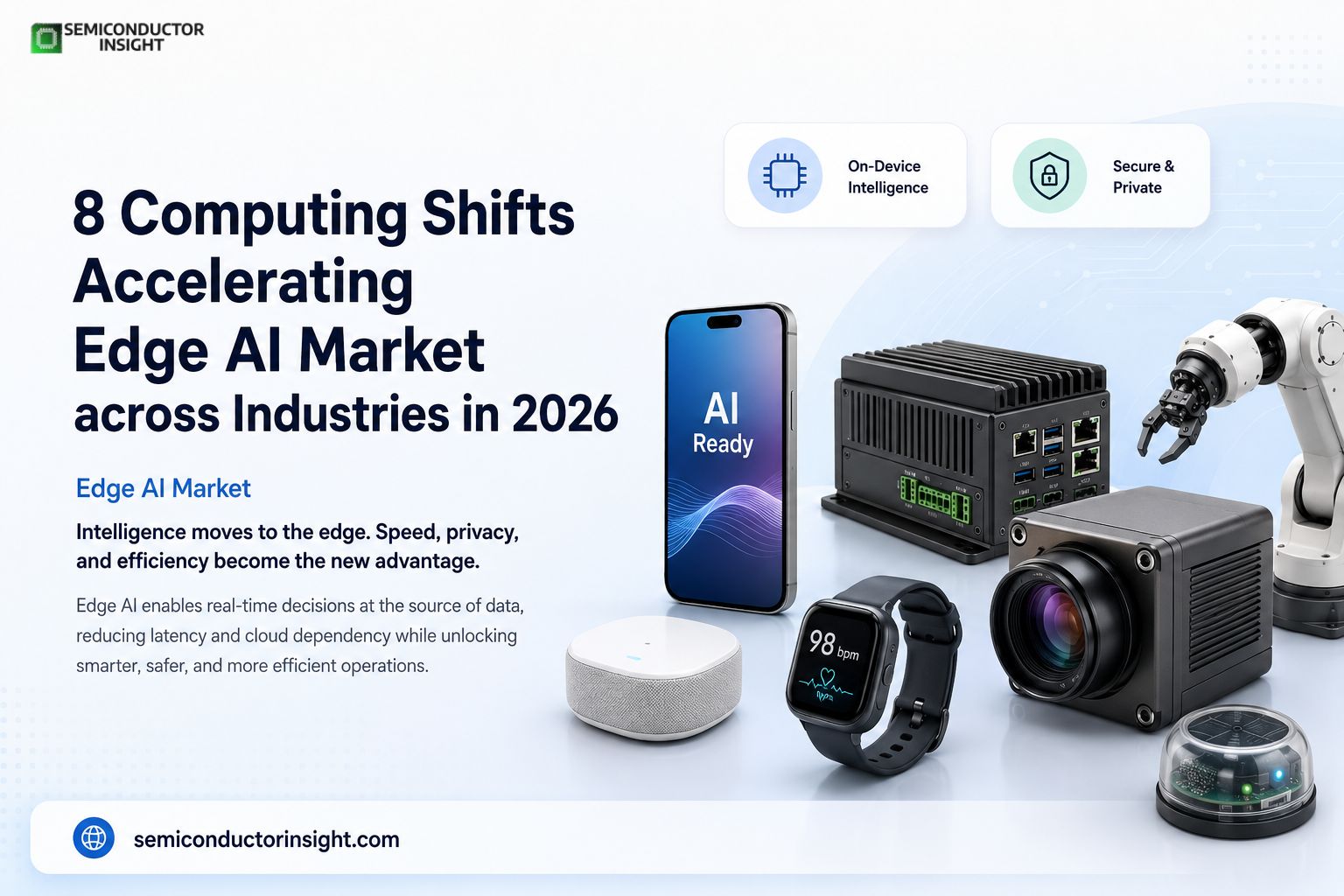
8 Computing Shifts Accelerating Edge AI Market across Industries in 2026
Artificial intelligence is no longer confined to large data centers. A growing share of AI workloads is now being executed directly on smartphones, industrial equipment, vehicles, cameras, robots, and personal computers. This shift is giving rise to Edge AI Market, where intelligence moves closer to the point of data generation instead of relying exclusively on cloud infrastructure.
For semiconductor companies, Edge AI represents a significant architectural transition. Rather than transmitting every piece of information to remote servers, devices are increasingly equipped with specialized processors capable of making decisions locally in milliseconds.
The Journey from Data Creation to Instant Decisions
Traditional AI systems operate through a cloud-first model. Edge AI introduces a different pathway by enabling data processing directly within the device.
Sensor Data Generated
↓
Local AI Chip Processing
↓
Instant Analysis
↓
Automated Decision
↓
Action Executed
↓
Optional Cloud Synchronization
This approach reduces latency, minimizes bandwidth requirements, and enhances privacy by keeping sensitive information closer to the source.
Why Semiconductor Designers Are Reworking Device Architectures?
The rapid adoption of Edge AI is increasing the need for neural processing units, AI accelerators, and energy-efficient chipsets. As connected devices continue to multiply and data volumes surge, industries are placing greater value on processing information locally rather than relying entirely on centralized servers. This shift is especially important because it helps reduce latency, improve efficiency, and support real-time decision-making across smart devices and digital systems.
The scale of this transformation is reflected in industry indicators such as more than 1.2 billion smartphone shipments annually, over 18 billion connected IoT devices worldwide, and the generation of hundreds of exabytes of data every day. In addition, tens of millions of AI-enabled PCs are expected to enter commercial rollout each year. Together, these figures show why local AI processing is becoming essential, as sending all data to remote servers is increasingly costly and operationally inefficient.
The New Semiconductor Feature Consumers Rarely Notice
For years, processing power was measured primarily through CPU and GPU performance. Today, device manufacturers are highlighting AI capabilities as a core hardware feature.
Recent examples include:
- AI-powered smartphones performing image enhancement directly on-device
- Laptops featuring dedicated NPUs for productivity tools
- Smart security cameras detecting objects without cloud connectivity
- Industrial sensors identifying anomalies in real time
- Automotive systems processing driver assistance functions locally
The semiconductor content inside these products is becoming increasingly AI-centric rather than solely compute-centric.
A Look inside Emerging Edge AI Workloads
Not all Edge AI applications are alike. Different sectors are creating distinct semiconductor requirements.
Edge AI Application Matrix;
Local AI functions are being applied across a wide range of industries, reflecting their growing importance in real-world use cases. In smart manufacturing, they support equipment monitoring; in consumer electronics, they enable voice and image recognition; and in healthcare devices, they assist with vital sign analysis.
They are also proving valuable in autonomous systems for object detection, in retail technology for inventory monitoring, and in smart cities for traffic optimization. This broad range of applications is encouraging chipmakers to develop application-specific AI accelerators designed to handle different workloads more efficiently.
The Rise of Tiny AI Models
One of the most important developments in Edge AI Market is the emergence of compact AI models designed specifically for local deployment.
Evolution of AI Deployment
Large Cloud Models
↓
Model Compression
↓
Parameter Optimization
↓
Tiny AI Models
↓
Edge Device Deployment
Instead of requiring massive computational resources, these optimized models can operate efficiently within cameras, wearable devices, industrial controllers, and battery-powered sensors.
This shift is expanding the addressable market for AI-enabled semiconductors far beyond traditional computing platforms.
Take a Quick Glance at Our In-Depth Analysis Report: https://semiconductorinsight.com/report/edge-ai-market/
Where Edge AI Is Appearing in Everyday Life
✓ Real-time language translation on smartphones
✓ AI-assisted photography processing directly within mobile devices
✓ Intelligent noise cancellation in premium audio products
✓ Predictive maintenance systems inside factories
✓ Driver monitoring systems in next-generation vehicles
✓ Smart home devices responding without cloud delays
These applications demonstrate how intelligence is becoming embedded into physical products rather than remaining centralized in distant data centers.
Power Efficiency Becoming the New Performance Metric
As Edge AI expands, semiconductor innovation is increasingly focused on achieving more AI operations with lower energy consumption.
Device Priorities Ranking
Manufacturers are now competing on more than just raw processing power. The real differentiators are how efficiently AI tasks can be handled within strict power limits, while also improving response speed, protecting data privacy, reducing connectivity-related costs, and enabling greater device autonomy.
Edge AI and the Semiconductor Design Cycle
Edge AI Market is reshaping the semiconductor industry from the device outward. AI capabilities are no longer optional enhancements; they are becoming foundational hardware requirements across consumer electronics, industrial systems, healthcare equipment, transportation platforms, and connected infrastructure.
As billions of devices gain local intelligence, Edge AI is emerging as one of the most influential forces driving the next generation of semiconductor innovation, creating a world where decisions happen instantly at the source of data rather than somewhere far away in the cloud.

Comments (0)