

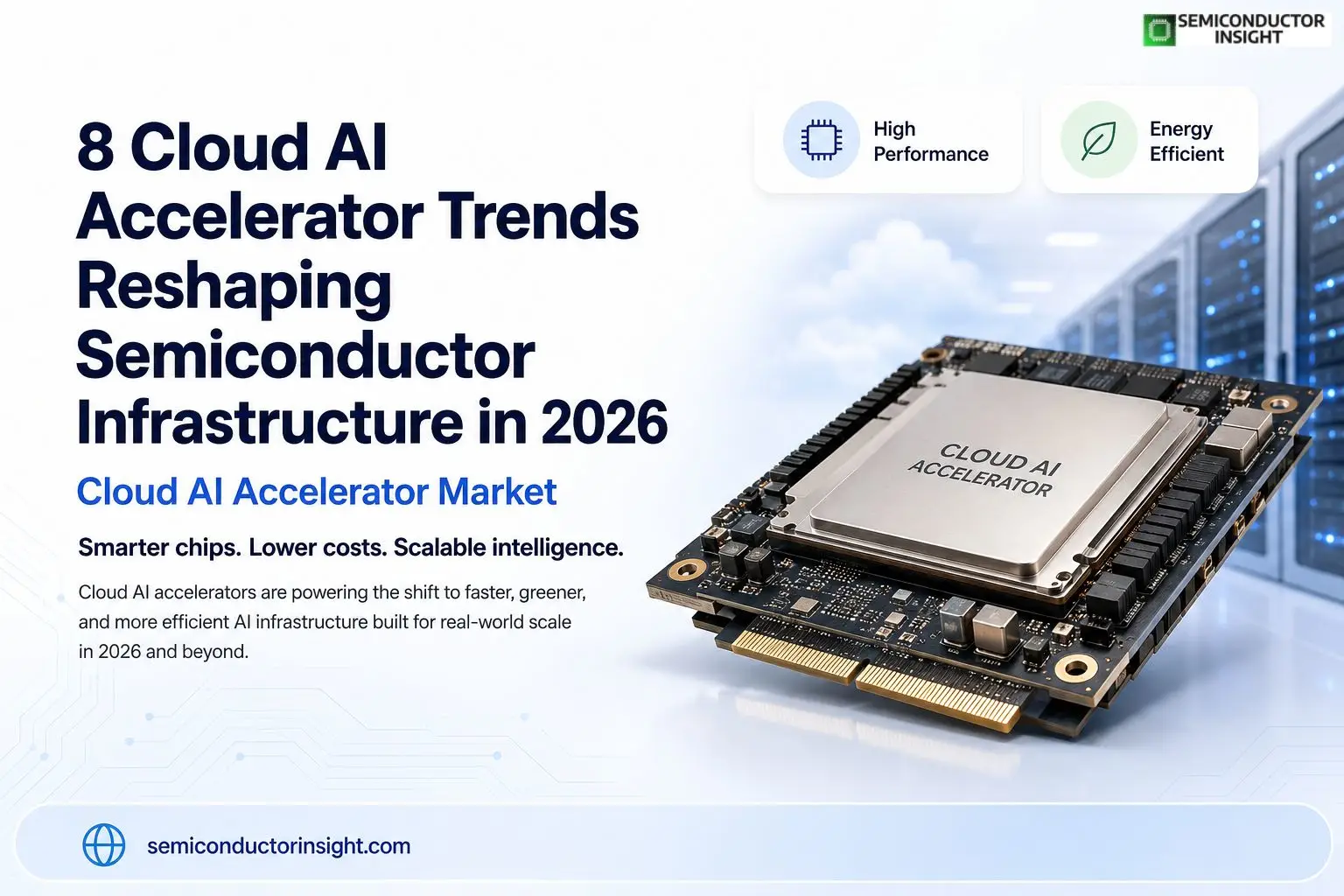
8 Cloud AI Accelerator Trends Reshaping Semiconductor Infrastructure in 2026
The cloud has become the primary battleground for artificial intelligence workloads, where specialized hardware now determines who can train models faster, serve inferences cheaper, and scale without melting the power grid. Cloud AI accelerators chips designed specifically to handle the massive parallel computations of neural networks sit at the heart of this transformation.
Why Cloud AI Accelerators Matter More Than Ever?
Modern AI systems devour compute. Training a single large language model can require thousands of specialized processors running continuously for weeks. General-purpose CPUs struggle with these tensor operations, which is why hyperscale cloud providers and chip designers have poured resources into accelerators optimized for matrix multiplications and low-precision arithmetic.
These accelerators now power everything from recommendation engines on e-commerce sites to real-time language translation in global communication platforms. The shift represents more than incremental improvement it marks a fundamental rethinking of how computing infrastructure supports intelligence at scale.
Inside the Architecture Revolution
- Cloud AI accelerators come in several flavors, each addressing different parts of the AI lifecycle. Graphics Processing Units (GPUs) from NVIDIA still dominate many training clusters due to their mature software ecosystem and parallel processing strengths. Yet custom Application-Specific Integrated Circuits (ASICs) are gaining serious traction for inference and specific workloads.
- Google’s Tensor Processing Units (TPUs) excel at the matrix operations common in deep learning, delivering strong performance per watt in Google’s cloud environment. Amazon Web Services offers Trainium chips built specifically for training large models and Inferentia for high-throughput inference. These custom designs often deliver better price-performance for cloud customers running steady, predictable workloads.
- Microsoft has entered the fray with its Maia accelerator, while start-ups like Groq and Cerebras push boundaries with novel architectures, including wafer-scale engines that keep entire AI models on a single massive chip to minimize data movement bottlenecks.
You can freely browse our most recent updated report to learn more about it before scrolling further: https://semiconductorinsight.com/report/cloud-ai-accelerator-market-2/
Real-World Deployments Shaping the Industry
Major cloud providers are deploying these accelerators at unprecedented scale. AWS has integrated Trainium and Inferentia across its infrastructure, with companies like Snap using Inferentia instances to cut costs on computer vision workloads by up to 70% while maintaining performance.
Google Cloud’s TPUs power internal services and are available to customers for everything from scientific research to production AI applications. One notable example involves large genomics projects where custom accelerators dramatically speed up model training on massive biological datasets.
NVIDIA’s GPUs remain central to many cutting-edge projects. The company’s collaboration with AWS on Project Ceiba aims to create one of the world’s largest AI supercomputers in the cloud, focused on advancing research in natural language processing and computer vision.
Energy Efficiency Takes Centre Stage
As AI clusters grow, power consumption has become a critical constraint. Traditional data centres face limits on electricity availability and cooling capacity. Modern cloud AI accelerators address this through architectural innovations that deliver more computations per watt.
Designers now optimize for lower precision calculations moving from 32-bit to 16-bit or even 8-bit where acceptable which dramatically reduces energy needs without sacrificing model accuracy in many applications. New interconnect technologies also minimize data movement, one of the biggest energy hogs in distributed training.
Government initiatives worldwide support domestic semiconductor capabilities partly for these efficiency reasons. Programs focused on strengthening local supply chains help ensure stable access to advanced chips while encouraging innovation in sustainable computing designs.
The Software-Hardware Symbiosis
- Hardware alone doesn’t deliver results. The real power emerges from tight integration between accelerators and the software frameworks that developers use daily. CUDA remains the dominant platform for many GPU-based workloads, creating a rich ecosystem of libraries and tools.
- However, cloud providers work hard to abstract these complexities. Customers increasingly access accelerators through managed services that handle orchestration, scaling, and optimization automatically. This democratization allows smaller teams to leverage cutting-edge hardware without building massive infrastructure teams.
- Open-source efforts and frameworks that support multiple accelerator types are growing in importance, reducing dependency on single vendors and giving organizations more flexibility in their cloud strategies.
Emerging Use Cases beyond Traditional AI
While large language models grab headlines, cloud AI accelerators support diverse applications. Autonomous systems simulation, climate modelling, drug discovery, and financial risk analysis all benefit from accelerated computing.
In healthcare, researchers use cloud accelerators to process medical imaging and genomic data at speeds impossible with traditional infrastructure. Financial institutions run complex Monte Carlo simulations for portfolio optimization across thousands of accelerator instances simultaneously.
Edge-to-cloud workflows represent another frontier. Models trained on powerful cloud accelerators deploy to edge devices for real-time inference, with accelerators handling the heavy lifting during development and periodic retraining.
What Lies Ahead for Cloud Infrastructure?
The next wave involves heterogeneous computing environments where different accelerator types work together seamlessly. Organizations will mix GPUs for training flexibility with custom ASICs for cost-efficient inference, all orchestrated through sophisticated cloud management layers.
- Advances in chiplet designs, 3D stacking, and new materials promise continued performance gains while addressing power and thermal challenges. The integration of AI accelerators with quantum computing elements or novel memory technologies could open entirely new computational paradigms.
- Cloud AI accelerators have moved from specialized tools to foundational infrastructure supporting the digital economy. Their continued evolution will determine how quickly organizations can deploy intelligent systems and how sustainably computing can scale to meet growing demands.
As these technologies mature, the focus shifts toward accessibility, efficiency, and responsible deployment. The winners will be those who balance raw performance with practical considerations around cost, energy, and environmental impact while keeping innovation accessible to a broad range of users and applications.

Comments (0)