

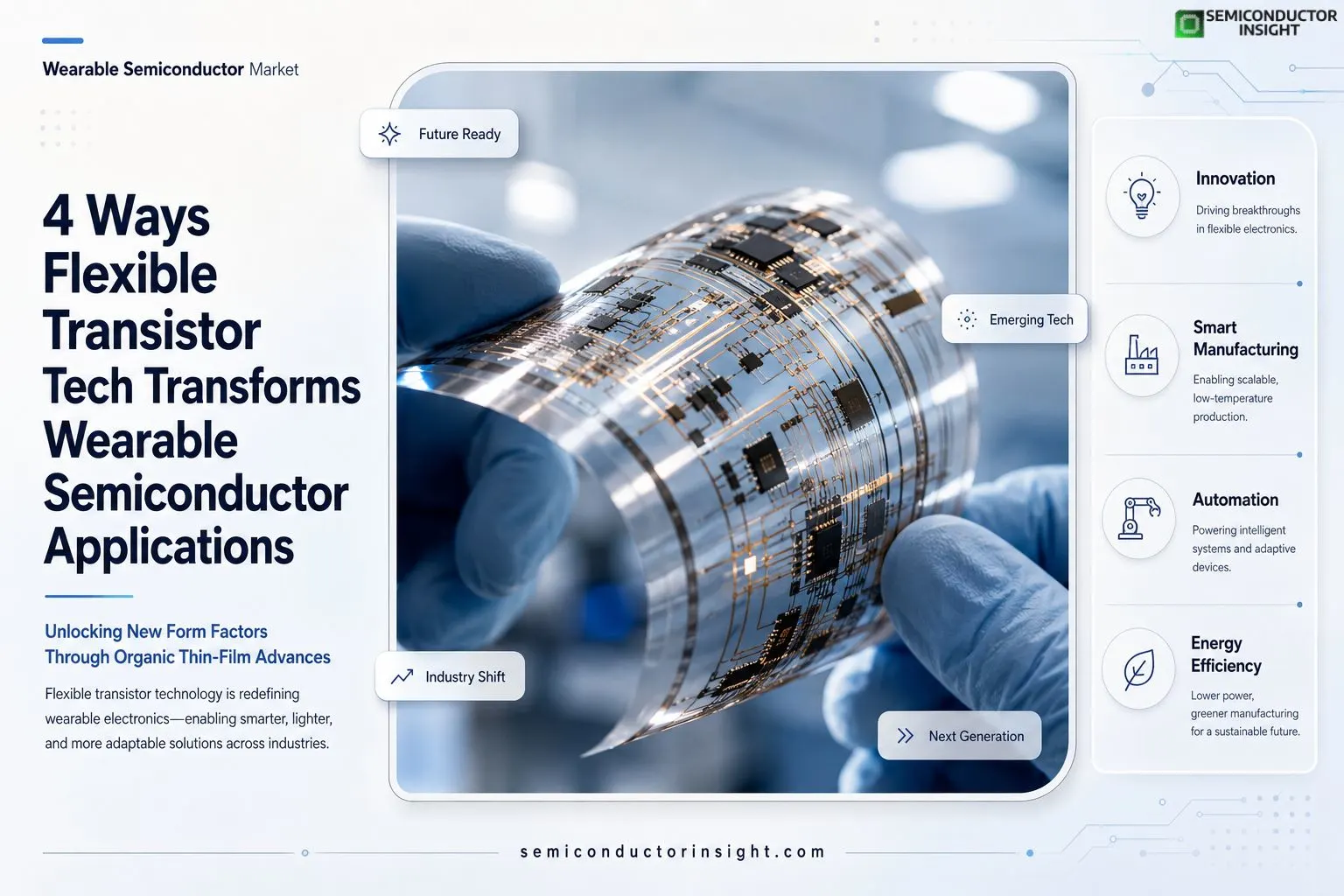
4 Ways Flexible Transistor Tech Transforms Wearable Semiconductor Applications
Flexible transistors sit at the heart of a quiet revolution in electronics, enabling devices that bend, fold, and conform without losing performance. This semiconductor segment blends organic, oxide, and hybrid materials to push boundaries far beyond rigid silicon chips.
As industries seek lighter, more adaptable components, these transistors power everything from curved displays in everyday gadgets to advanced sensors that mimic human skin.
Unlocking New Form Factors Through Organic Thin-Film Advances
- Organic thin-film transistors, often called OTFTs, have moved from lab curiosity to real-world production. Companies like FlexEnable developed processes running below 100°C, allowing integration onto plastic substrates that traditional high-heat silicon methods cannot handle. This low-temperature approach supports roll-to-roll manufacturing, similar to printing newspapers but for electronics.
- A standout example is the Ledger Stax crypto wallet, the first mass-produced consumer product featuring OTFT backplanes in its ePaper display. The screen wraps around a 180-degree curve, something previously unattainable with standard display tech. Production partners DKE and Giantplus now ship these units, demonstrating scalable output for flexible formats.
- Such transistors deliver mechanical compliance while maintaining useful electrical traits, including decent charge mobility for switching and amplification tasks. Researchers continue refining materials like C8-BTBT or rubrene-based semiconductors, which show strong performance under bending stress.
Material Science Shifts Enabling Bendable Circuitry
Transition metal dichalcogenides such as monolayer molybdenum disulfide (MoS2) offer another path. Stanford-led work created flexible nanoscale FETs with channel lengths down to 60 nm and on-state currents reaching 470 μA/μm at 1V drain-source voltage. These match or exceed some rigid counterparts while surviving repeated flexing on polyimide films.
Indium gallium zinc oxide (IGZO) transistors also shine here. In 2021, engineers fabricated the first flexible 32-bit microprocessor using IGZO on polyimide, highlighting potential for complex logic in wearable or implantable formats. Wikipedia notes IGZO supports higher refresh rates and lower power draw compared to older amorphous silicon options.
Solution-processed techniques, including inkjet printing and spray coating, lower costs and enable large-area coverage. These methods avoid vacuum equipment, opening doors for printed electronics on paper or foil substrates.
Practical Implementations in Various Sectors
Healthcare benefits immensely. Flexible transistor arrays support conformable sensor skins that monitor vital signs or deliver targeted therapy while moving with the body. Pressure and strain sensors built from these devices amplify signals directly at the source, reducing noise in wearable ECG systems or prosthetic feedback loops.
- In consumer electronics, rollable or foldable screens rely on active-matrix backplanes where each pixel has its own transistor for fast, stable imaging.
- Automotive applications explore in-mold electronics and structural integration, embedding controls into curved dashboards or seats.
Smart packaging and RFID tags represent high-volume opportunities. Bendable smart cards with integrated circuits store data securely while resisting daily wear. Printed transistor arrays on flexible substrates enable low-cost identification and tracking solutions for logistics.
Fabrication Techniques Driving Scalability
Direct-write electron-beam lithography achieves nanoscale features on flexible PEN substrates, producing low-voltage p- and n-channel devices with channel lengths around 200 nm. This precision supports denser integration for analog and digital circuits.
Hybrid approaches combine printed organic layers with silicon components for the best of both worlds flexibility where needed and high performance in critical paths. Government and university labs, including those at the University of Wisconsin-Madison, developed simple transfer processes for single-crystalline silicon ribbons onto plastic, achieving high-speed flexible transistors suitable for wireless communication.
Lastly, for more in-depth information, don’t forget to read our most recent exclusive report: https://semiconductorinsight.com/report/flexible-transistor-market/
Emerging Integration with Broader Ecosystems
- Artificial electronic skin prototypes use transistor arrays to detect touch, temperature, and even self-heal. These systems mimic biological feedback, crucial for next-generation robotics and prosthetics.
- Active optics for AR glasses represent a growing niche. Ultra-thin, light-dimming films based on OTFTs adjust transparency dynamically, improving comfort and battery life in headsets.
- Energy efficiency stands out as a key advantage. Low-temperature OTFT production consumes far less energy than silicon fabs, aligning with sustainability goals in manufacturing.
Path Forward in Semiconductor Evolution
Flexible transistors bridge traditional rigid electronics and fully conformable systems. From IGZO microprocessors to organic displays in shipping products, the technology delivers practical wins today while promising broader transformation.
As fabrication matures and materials improve, expect deeper integration into wearables, medical tools, smart environments, and beyond fundamentally changing how electronics interact with the physical world.

Comments (0)