Flexible transistor market Insights
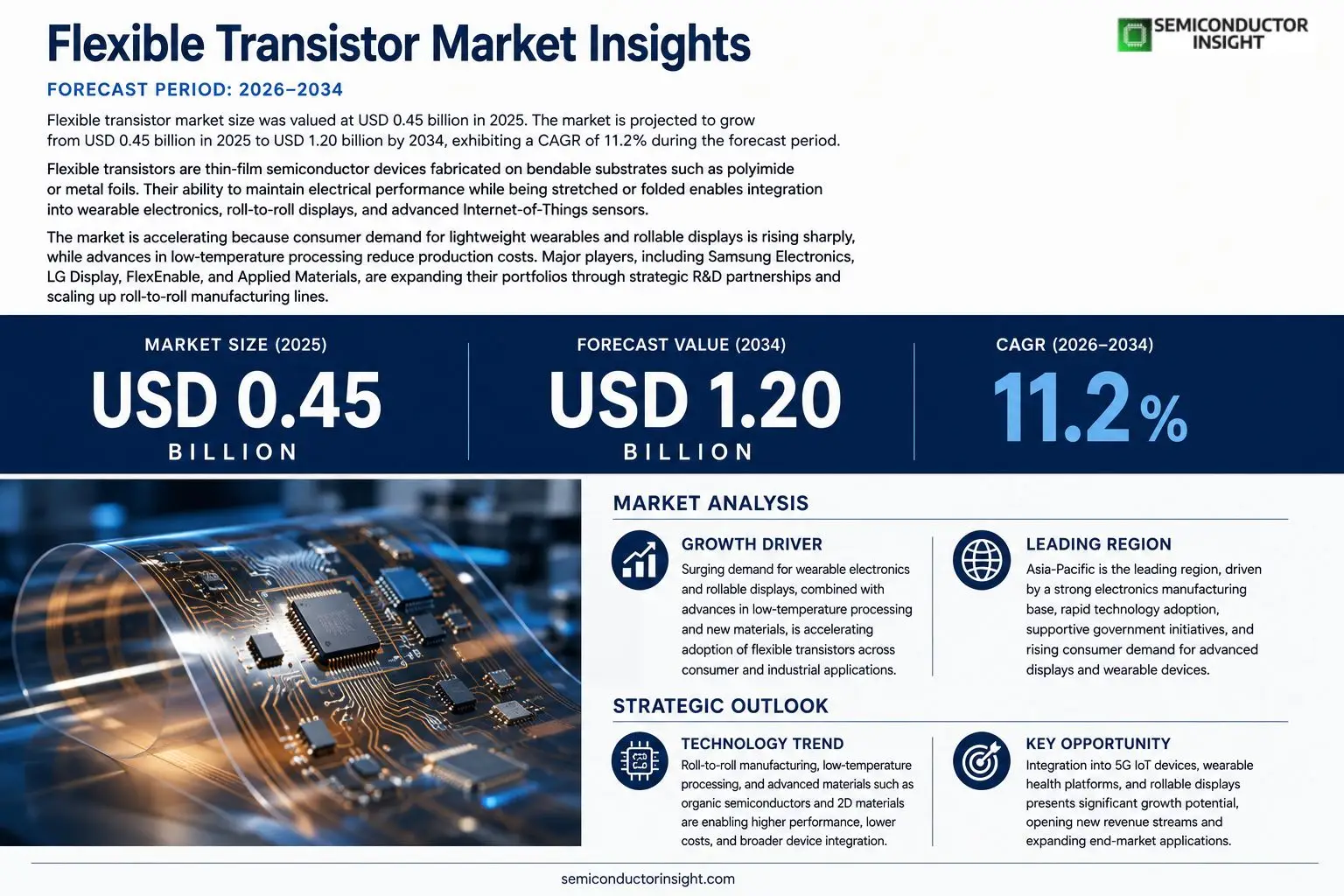
Flexible transistor market size was valued at USD 0.45 billion in 2025. The market is projected to grow from USD 0.45 billion in 2025 to USD 1.20 billion by 2034, exhibiting a CAGR of 11.2% during the forecast period.
Flexible transistors are thin‑film semiconductor devices fabricated on bendable substrates such as polyimide or metal foils. Their ability to maintain electrical performance while being stretched or folded enables integration into wearable electronics, roll‑to‑roll displays, and advanced Internet‑of‑Things sensors.The market is accelerating because consumer demand for lightweight wearables and rollable displays is rising sharply, while advances in low‑temperature processing reduce production costs. Major players,including Samsung Electronics, LG Display, FlexEnable, and Applied Materials,are expanding their portfolios through strategic R&D partnerships and scaling up roll‑to‑roll manufacturing lines.
MARKET DRIVERS
Rising Demand for Wearable Electronics
Flexible transistor market is being propelled by a surge in wearable devices such as health monitors, smart textiles, and flexible displays. Consumers are seeking comfort and functionality, driving manufacturers to adopt bendable circuitry that integrates seamlessly with fabric and skin. This trend is expected to generate a compound annual growth rate (CAGR) of around 12% through 2032.
Advancements in Materials Science
Breakthroughs in organic semiconductors, graphene, and metal‑oxide thin films have lowered the operating voltage and increased the durability of flexible transistors. These material innovations enable high‑performance devices that can endure repeated bending cycles without performance degradation, making them attractive for both consumer and industrial applications.
➤ Industry analysts predict that flexible transistor integration will become a baseline requirement for next‑generation IoT skins, expanding market size by billions of dollars.
Investment from major electronics firms in research and development further validates the market’s growth trajectory, reinforcing confidence among investors and accelerating product‑to‑market timelines.
MARKET CHALLENGES
Manufacturing Complexity
Producing flexible transistors requires precision roll‑to‑roll processing, stringent temperature control, and contaminant‑free environments. Small deviations can cause defects that compromise yield, leading to higher unit costs compared with rigid silicon counterparts.
Other Challenges
Supply Chain Constraints
The reliance on specialized raw materials such as high‑purity organic inks and flexible substrates creates bottlenecks. Limited supplier diversity can delay product rollout and increase exposure to price volatility.
MARKET RESTRAINTS
High Production Costs
Despite performance gains, the cost of equipment retrofitting and material procurement remains a significant barrier. Many manufacturers find the capital expenditure required to transition from rigid to flexible processes prohibitive, slowing broader adoption.
Limited Standardization
Absence of universally accepted testing protocols and design standards hampers interoperability across devices and platforms. This lack of standardization discourages OEMs from committing large volumes until clearer guidelines emerge.
MARKET OPPORTUNITIES
Integration with 5G IoT Devices
The rollout of 5G networks creates a fertile environment for ultra‑low‑latency, high‑bandwidth flexible transistor applications. Wearable sensors and smart fabrics can now transmit data in real time, unlocking new revenue streams for Flexible transistor market.
Emerging Medical Sensor Platforms
Flexible transistors are enabling conformal biomedical patches that monitor vital signs continuously. The projected growth of telehealth and remote patient monitoring is expected to drive substantial investment in flexible electronic modules, presenting a lucrative opportunity for market participants.
Flexible transistor market Trends
Accelerating Consumer Demand for Wearable Electronics
Flexible transistor market is being reshaped by a sharp rise in consumer interest for lightweight, adaptable wearable devices. As smartphones evolve into health‑monitoring platforms, manufacturers require semiconductor components that sustain performance while conforming to curved and flexible form factors. This demand drives design teams to prioritize thin‑film transistors that can be integrated into stretchable bands, smart textiles, and next‑generation fitness trackers. The resulting product pipelines reinforce the market’s momentum, encouraging suppliers to expand capacity and streamline low‑temperature fabrication processes.
Other Trends
Advancements in Roll‑to‑Roll Manufacturing
Roll‑to‑roll (R2R) production methods have matured to a point where large‑area flexible substrates can be processed continuously, reducing per‑unit cost and improving yield. Flexible transistor market benefits from these efficiencies, as manufacturers can now scale from prototype batches to high‑volume lines without compromising device uniformity. Automation of coating, patterning, and annealing stages further shortens time‑to‑market, allowing brands to respond quickly to seasonal wear‑ables releases.
Strategic Partnerships and Portfolio Expansion
Major industry players are deepening collaborative R&D initiatives to broaden the functional scope of flexible transistors. Partnerships between semiconductor fabs and display manufacturers accelerate the integration of flexible logic layers into rollable screens, while joint ventures with material specialists introduce novel polymer substrates that enhance durability. These strategic moves not only diversify product portfolios but also create cross‑sector ecosystems where sensors, displays, and power management units share a common flexible platform. Consequently, Flexible transistor market experiences a virtuous cycle of innovation, where each partnership unlocks new application scenarios and stimulates further investment.
COMPETITIVE LANDSCAPEKey Industry Players
Flexible transistor market Competitive Landscape
Samsung Electronics dominates the flexible transistor segment through its aggressive roll‑to‑roll thin‑film processing platform and deep integration with consumer‑grade wearable devices. Leveraging its massive R&D budget, Samsung has scaled production lines that combine low‑temperature deposition with high‑throughput wafer handling, allowing it to capture a disproportionate share of early‑adopter contracts in rollable displays and smart‑textile sensors. The overall market structure is characterized by a handful of multinational semiconductor giants that control end‑to‑end manufacturing, while a growing cohort of specialized firms supplies niche substrates, inks, and encapsulation technologies. This dual‑layer hierarchy creates high entry barriers for new entrants but also opens collaborative opportunities for joint‑development programs that can accelerate time‑to‑market for emerging IoT applications.Beyond Samsung, a constellation of established and emerging players intensifies competition. LG Display has rapidly expanded its flexible substrate portfolio, targeting large‑area rollable panels for automotive heads‑up displays. FlexEnable and Applied Materials focus on innovative low‑temperature processes and equipment, respectively, enabling cost‑effective scaling for midsize manufacturers. Intel and Texas Instruments are investing in flexible logic integration, while STMicroelectronics and NXP Semiconductors bring advanced analog front‑ends to the ecosystem. Sony, TSMC, Fujitsu, Qualcomm, Broadcom, Analog Devices, and IBM round out the landscape, each contributing differentiated technologies such as high‑frequency RF modules, advanced packaging, or AI‑optimized silicon that enhance the functional breadth of flexible transistors.
List of Key Flexible transistor market Companies Profiled
- Samsung Electronics
- LG Display
- FlexEnable
- Applied Materials
- Intel
- Texas Instruments
- STMicroelectronics
- NXP Semiconductors
- Sony
- TSMC
- Fujitsu
- Qualcomm
- Broadcom
- Analog Devices
- IBM
Segment Analysis:
| Segment Category | Sub-Segments | Key Insights |
| By Type |
|
Organic Flexible Transistors
|
| By Application |
|
Wearable Health Monitors
|
| By End User |
|
Consumer Electronics
|
| By Substrate Material |
|
Polyimide Films
|
| By Manufacturing Process |
|
Roll‑to‑Roll Deposition
|
Regional Analysis: North America
North America
The integration of flexible transistors in consumer electronics, such as foldable smartphones and smartwatches, is witnessing considerable traction. This trend is expected to accelerate with ongoing innovation in display technology and the demand for more versatile and aesthetically appealing devices.
The adoption of flexible transistors in industrial sensors and automotive displays is gaining momentum. Their durability and adaptability to challenging environments make them ideal for a wide range of industrial applications, while their potential in next-generation automotive displays is a significant growth driver.
Government initiatives and funding programs across North America are playing a crucial role in fostering innovation and development in Flexible transistor market. These efforts are supporting research institutions and startups, contributing to technological breakthroughs and market expansion.
North America benefits from a robust and well-established supply chain for flexible transistor components. This includes a strong network of manufacturers, distributors, and research organizations, ensuring a reliable and efficient flow of materials and products.
Europe
Europe represents a strong and competitive market for flexible transistors, characterized by a focus on high-quality manufacturing and advanced technological applications. The region’s strengths lie in its established semiconductor industry, particularly in countries like Germany, France, and the United Kingdom. Key application areas include advanced displays, wearable devices, and automotive electronics. European players are actively involved in research and development, particularly in areas such as organic electronics and printed electronics. The regulatory landscape in Europe emphasizes sustainability and environmental responsibility, which is influencing the development of eco-friendly flexible transistor solutions.
Asia-Pacific
Asia-Pacific is poised to be the largest and fastest-growing market for flexible transistors ly. The region’s growth is driven by a combination of factors, including a large and rapidly expanding electronics manufacturing base, increasing consumer spending, and supportive government policies. China is emerging as a dominant force in this market, with significant investments in flexible display technology and IoT devices. Other key markets in the region include Japan, South Korea, and Taiwan, which possess advanced technological capabilities and strong manufacturing ecosystems. The demand for flexible transistors is being fueled by the growth of smartphones, tablets, wearable devices, and foldable displays.
South America
South America presents a relatively nascent market for flexible transistors, but with significant potential for growth. The region’s growing consumer electronics market, coupled with increasing industrialization, is driving demand for flexible display applications in areas such as automotive and industrial control systems. Brazil and Argentina are the primary markets in the region, with a focus on affordability and value-added solutions. Challenges include limited local manufacturing capabilities and a less developed infrastructure compared to other regions. However, increasing investments in technology and infrastructure are expected to foster growth in the coming years.
Middle East & Africa
The Middle East and Africa represent a smaller but increasingly promising market for flexible transistors. The region’s growing economies, rising disposable incomes, and increasing adoption of consumer electronics are driving demand for flexible displays in areas such as automotive, healthcare, and entertainment. The construction and infrastructure sectors are also contributing to growth, with applications in smart buildings and industrial sensors. While challenges exist, such as limited technological infrastructure and regulatory complexities, the long-term growth potential remains significant.
Report Scope
This market research report provides a comprehensive analysis of the Flexible transistor market , covering the forecast period 2026–2034. It offers detailed insights into market dynamics, technological advancements, competitive landscape, and key trends shaping the industry.
Key focus areas of the report include:
- Market Overview: The report begins with an overview outlining its current market scenario, key growth indicators, and industry transformation drivers. It discusses macroeconomic factors, demand–supply balance, regulatory landscape, and the strategic role of semiconductors in powering advancements across industries such as automotive, telecommunications, consumer electronics, and industrial automation.
- Market Size & Forecast: Historical data and future projections for revenue, unit shipments, and market value across major regions and segments.
- Segmentation Analysis: Detailed breakdown by product type, technology, application, and end-user industry to identify high-growth segments and investment opportunities.
- Regional Insights: Insights into market performance across North America, Europe, Asia-Pacific, Latin America, and the Middle East & Africa, including country-level analysis where relevant.
- Competitive Landscape: Profiles of leading market participants, including their product offerings, R&D focus, manufacturing capacity, pricing strategies, and recent developments such as mergers, acquisitions, and partnerships.
- Technology Trends & Innovation: Assessment of emerging technologies, integration of AI/IoT, semiconductor design trends, fabrication techniques, and evolving industry standards.
- Market Drivers & Restraints: Evaluation of factors driving market growth along with challenges, supply chain constraints, regulatory issues, and market-entry barriers.
- Stakeholder Insights: Insights for component suppliers, OEMs, system integrators, investors, and policymakers regarding the evolving ecosystem and strategic opportunities.
Primary and secondary research methods are employed, including interviews with industry experts, data from verified sources, and real-time market intelligence to ensure the accuracy and reliability of the insights presented.
FREQUENTLY ASKED QUESTIONS:
What is the current market size of Flexible transistor market?
-> Flexible transistor market was valued at USD 0.45 billion in 2025 and is expected to reach USD 1.20 billion by 2034.
Which key companies operate in Flexible transistor market?
-> Key players include Samsung Electronics, LG Display, FlexEnable, and Applied Materials, among others.
What are the key growth drivers?
-> Key growth drivers include rising consumer demand for lightweight wearables and roll‑to‑roll displays, and advances in low‑temperature processing that reduce production costs.
Which region dominates the market?
-> Regional dominance is not specified in the provided reference data.
What are the emerging trends?
-> Emerging trends include integration of flexible transistors into wearable electronics, roll‑to‑roll displays, and advanced IoT sensors.

Get Sample Report PDF for Exclusive Insights
Report Sample Includes
- Table of Contents
- List of Tables & Figures
- Charts, Research Methodology, and more...
 Download Sample Report PDF