

Why 22TB Hard Drives Market Are Becoming the Backbone of Data Centers?
The surge in global data creation is no longer incremental it is exponential. With AI models, video streaming, IoT ecosystems, and enterprise analytics generating massive datasets, storage infrastructure is under pressure to scale rapidly. This is where 22TB hard drives are stepping in as a critical solution.
Enterprise storage environments now prioritize density over volume count. Instead of deploying multiple smaller drives, organizations are consolidating storage using fewer, higher-capacity units. Industry observations indicate that over 60% of large-scale storage deployments now favor drives above 18TB, signaling a strong transition toward ultra-high-capacity solutions.
Why 22TB Drives Are Becoming the Enterprise Standard?
The adoption of 22TB HDDs is not just about capacity it’s about operational efficiency. These drives reduce rack space, power consumption per terabyte, and overall infrastructure complexity.
Recent deployment insights highlight that:
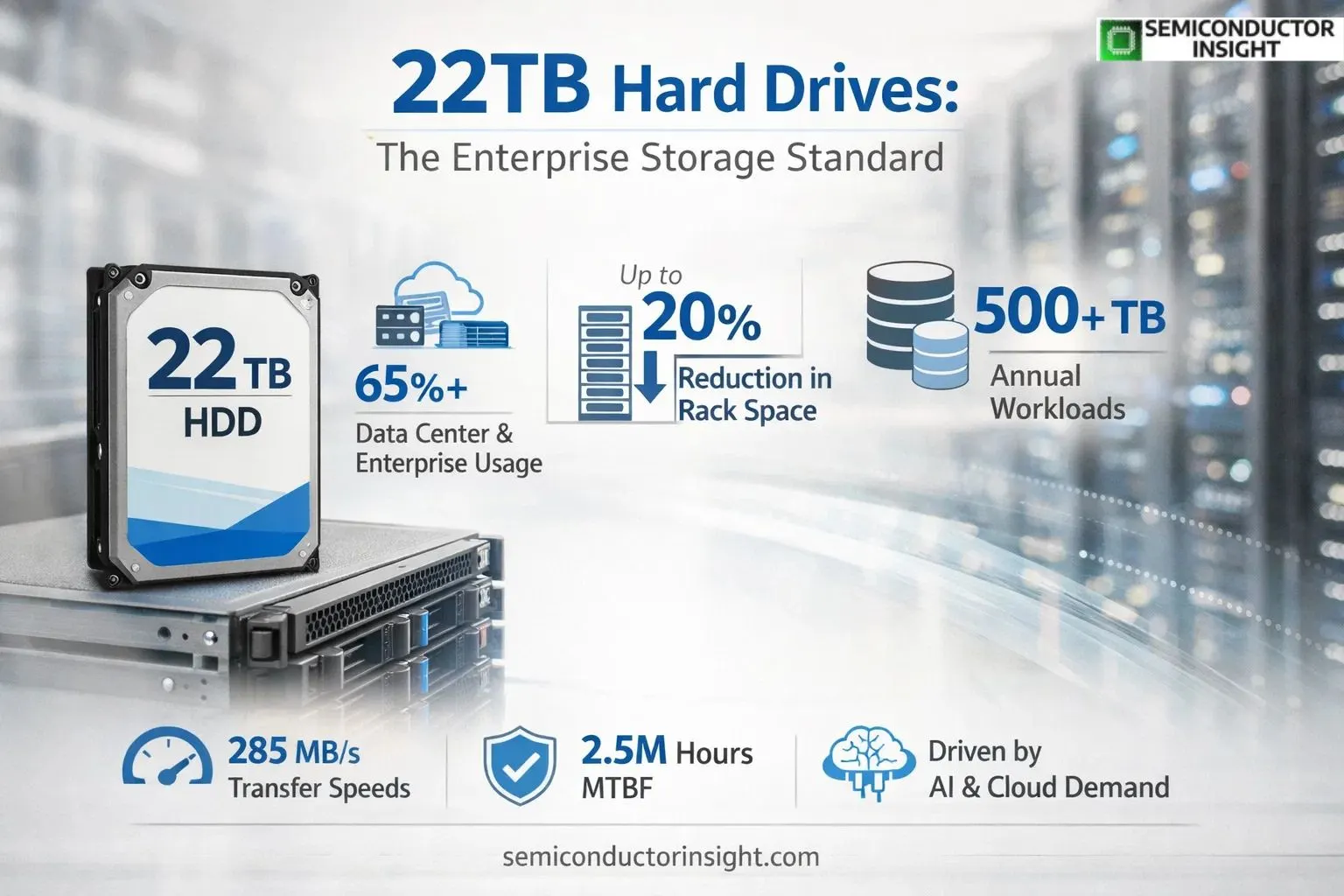
- Enterprise and data center applications account for nearly 65-70% of total high-capacity HDD usage
- Transitioning from 18TB to 22TB drives can reduce storage footprint by up to 20% in large server environments (industry deployment estimates)
- High-capacity HDDs support workloads exceeding 500TB per year, enabling continuous heavy data operations
This shift is particularly visible in hyperscale data centers where efficiency directly impacts cost and scalability.
Technology Evolution behind the 22TB Milestone
The journey to 22TB has been enabled by innovations in magnetic recording technologies. Techniques such as helium-filled drive architecture and advanced platter density have significantly increased storage capacity without compromising reliability.
Modern 22TB drives now deliver:
- Data transfer speeds reaching up to ~285 MB/s for enterprise workloads
- Reliability benchmarks of 2.5 million hours MTBF, nearly double older generation drives
- Enhanced vibration control systems for stable multi-drive environments
These improvements are not incremental they represent a structural leap in how storage devices are engineered for large-scale computing.
Take a Quick Glance at Our In-Depth Analysis Report: https://semiconductorinsight.com/report/22tb-hard-drive-market/
AI Infrastructure and Cloud Demand Are Reshaping Supply Dynamics
The rapid expansion of AI infrastructure is significantly influencing the HDD ecosystem. Data centers supporting AI model training and cloud computing require massive storage pools, pushing demand for high-capacity drives like 22TB.
Recent developments show that:
- Hard drive prices have surged by up to 46% since late 2025, driven by AI-related demand spikes
- Enterprise customers now dominate HDD consumption, while consumer share has dropped to single-digit percentages in some cases (industry insights)
- Major manufacturers are prioritizing enterprise supply, with capacity allocations increasingly locked through long-term contracts
This clearly signals that 22TB drives are no longer a niche product they are central to digital infrastructure expansion.
Practical Deployment Scenarios in Different Fields
- There are more and more uses for 22TB hard drives that go beyond just storage:
- Cloud Platforms: Used for cold storage and backup layers in multi-tier systems
- Media and Entertainment: Supporting streaming libraries and 4K/8K video archives
- Healthcare Data Systems: Handling big imaging files like MRIs and CT scans, where one dataset might be more than a few terabytes.
- Financial Institutions: Keeping logs of high-frequency transactions and compliance data
- Digital imaging use in healthcare alone has raised data storage needs by more than 30% in large institutions, which has sped up the need for archiving solutions with more store space.
- New platforms are extending storage limits to 44TB and beyond, and in large deployments, they are almost 47% more energy efficient.
- 32TB drives are coming out on the market. They have the same reliability ratings but are denser.
- Most of the products on the market now are enterprise-grade drives, and about half of all modern hard drives are made for data centers.
- These changes make it even more clear that 22TB drives are a step toward increasingly bigger storage systems.
A Shift from Consumer Storage to Infrastructure Backbone
The role of hard drives has fundamentally changed. While SSDs dominate speed-sensitive applications, HDDs especially 22TB variants are becoming the backbone of large-scale storage due to their cost efficiency per terabyte.
Consumer usage is shrinking, but enterprise reliance is growing stronger. Today, high-capacity HDDs are less about personal storage and more about powering the invisible infrastructure behind cloud services, AI systems, and global data networks.

Comments (0)