22TB Hard Drive Market Insights
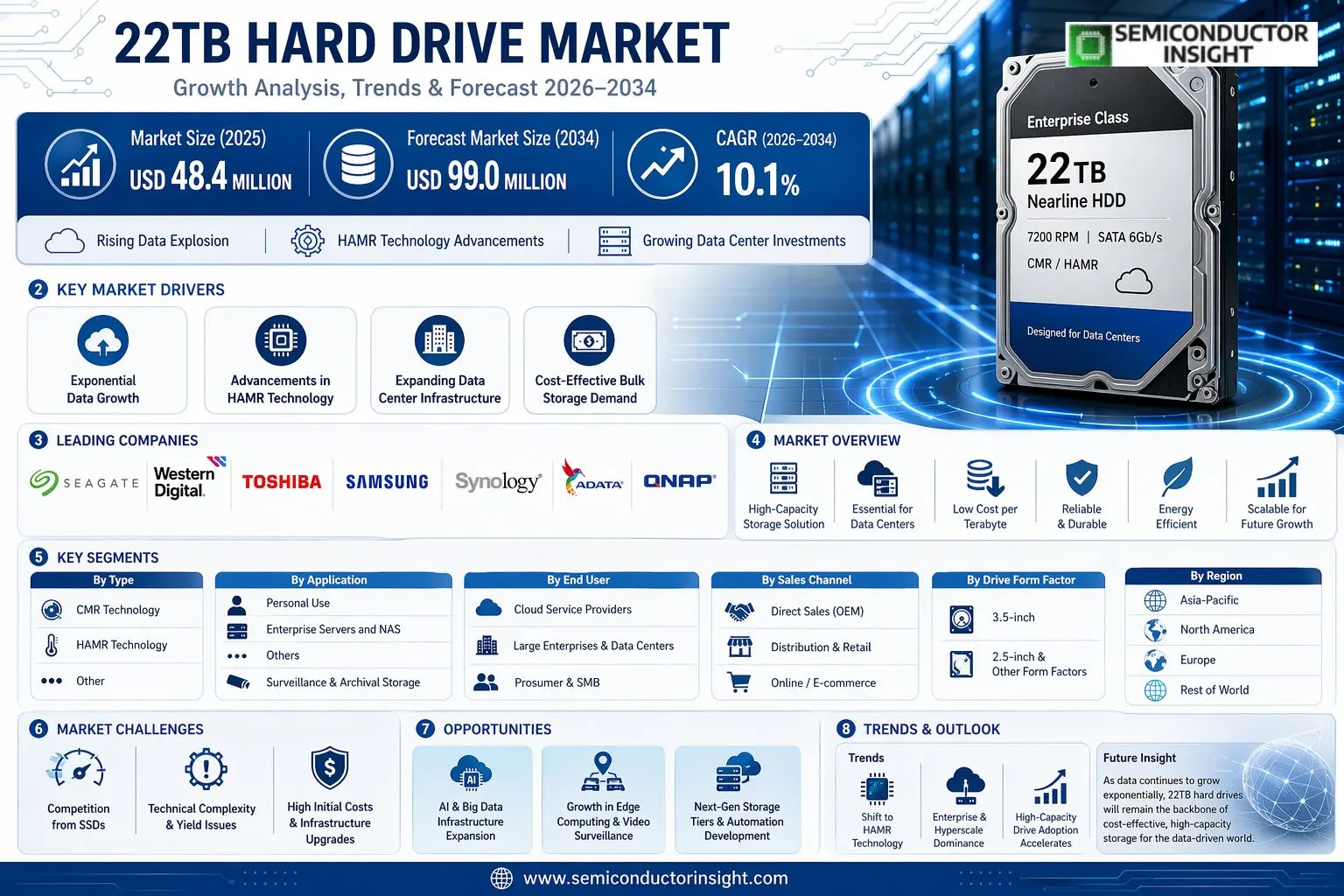
Global 22TB hard drive market size was valued at USD 48.4 million in 2025. The market is projected to grow from USD 53.2 million in 2026 to USD 99 million by 2034, exhibiting a CAGR of 10.1% during the forecast period.
A 22TB hard drive is a high-capacity storage device that can provide 22 terabytes (or approximately 22,000 gigabytes) of storage space and is primarily used to store vast amounts of data. It is typically a mechanical hard disk drive (HDD) utilizing advanced recording technologies like Conventional Magnetic Recording (CMR) or Heat-Assisted Magnetic Recording (HAMR) to achieve this density.
The market growth is being driven by the exponential rise in data generation from cloud computing, hyperscale data centers, and enterprise applications requiring cost-effective bulk storage solutions. While solid-state drives (SSDs) offer speed advantages, the cost-per-terabyte benefit of high-capacity HDDs like the 22TB models remains compelling for archival and cold storage. Furthermore, key industry players such as Western Digital, Toshiba, and Seagate are actively advancing their product portfolios; for instance, Seagate began shipping its first commercially available HAMR-based drives at this capacity in late 2023, signaling a significant technological milestone that supports future capacity scaling and market expansion.
MARKET DRIVERS
Insatiable Data Growth in Cloud and Hyperscale Data Centers
The primary engine for 22TB hard drive market is the exponential growth of unstructured data from cloud storage, AI training datasets, and video surveillance archives. Hyperscale operators require massive, dense, and cost-effective storage, making high-capacity drives like the 22TB models essential for reducing total cost of ownership and physical data center footprint.
Advancements in Recording Technology (HAMR)
The commercial rollout of Heat-Assisted Magnetic Recording (HAMR) technology is a critical driver, enabling the areal density breakthroughs necessary to viably produce 22TB and larger hard drives. This technological leap allows manufacturers to increase capacity without proportionally increasing the physical size or power consumption, maintaining the hard drive’s value proposition for bulk storage.
➤ The transition to 22TB hard drive market solutions represents a pivotal step in bridging the gap between performance needs and cost-per-terabyte efficiency for massive-scale cold and warm storage tiers.
Furthermore, the increasing use of Network-Attached Storage (NAS) and enterprise backup systems for small and medium businesses is creating demand for higher-capacity drives to consolidate storage and simplify data management, supporting growth in 22TB hard drive market segment.
MARKET CHALLENGES
Competitive Pressure from Solid-State Drives (SSDs)
While dominant in capacity, 22TB hard drive market faces intense competition from declining SSD prices, particularly for performance-sensitive applications. The performance and latency gap remains significant, pushing hard drives further into primarily bulk, sequential, and cold storage deployments where absolute capacity is paramount.
Other Challenges
Technical Complexity and Yield Rates
The sophisticated manufacturing processes for HAMR and similar advanced technologies present production challenges. Achieving high yields for reliable 22TB hard drive market units requires precision engineering and significant R&D investment, which can constrain supply and affect time-to-market for new generations.
Extended Product Qualification Cycles
Enterprise and data center customers subject new high-capacity drives like 22TB models to lengthy qualification and testing periods to ensure reliability. This slow adoption cycle in mission-critical environments can delay revenue realization for manufacturers following a product launch.
MARKET RESTRAINTS
High Initial Adoption Costs and Economic Sensitivity
The premium price point of newly launched 22TB hard drives can restrain broader market adoption, particularly among cost-sensitive smaller enterprises and during periods of reduced IT spending. The total cost of upgrading existing infrastructure to support these higher-capacity drives can also be a significant barrier.
Legacy Infrastructure Limitations
Many existing data center and storage system architectures were designed for lower-capacity drives. Integrating 22TB hard drives may require upgrades to backplanes, controllers, and software to manage the increased data density and potential rebuild times, adding complexity and cost to deployment.
MARKET OPPORTUNITIES
Expansion of AI and Big Data Analytics Infrastructure
The training of large language models and the analysis of massive datasets require vast repositories for raw data. 22TB hard drive market is poised to capitalize on this trend as the most economical solution for storing the petabytes of information needed for AI development and big data lakes.
Growth in Edge Computing and Video Surveillance
The proliferation of edge data centers and high-resolution, always-on video surveillance systems generates enormous amounts of data that need local storage before processing or transfer. High-capacity, reliable 22TB hard drives are ideal for these edge storage appliances, creating a significant growth avenue.
Development of Next-Generation Storage Tiers
As storage architectures evolve, there is a growing opportunity to position 22TB and higher-capacity drives as the backbone of new, automated tiered storage systems. These systems can intelligently move data between flash, high-capacity HDDs, and tape, optimizing for both performance and cost, with 22TB drives serving a crucial role.
Trends
Transition to Advanced Recording Technologies
22TB hard drive market is being fundamentally shaped by the industry-wide shift from Conventional Magnetic Recording (CMR) to Heat-Assisted Magnetic Recording (HAMR). This technological transition is critical for enabling continued areal density gains necessary to reach and surpass the 22TB capacity point. HAMR technology allows manufacturers to store more data on each platter, improving overall efficiency and cost per terabyte. While CMR-based 22TB drives are currently available, future roadmaps from leading vendors indicate HAMR will become the dominant platform for the highest-capacity enterprise drives, influencing both product development timelines and competitive positioning within 22TB hard drive market.
Other Trends
Enterprise and Hyperscale Dominance
Demand for 22TB hard drives is overwhelmingly concentrated in enterprise and hyperscale data center applications. The primary drivers are the relentless growth of cloud storage, big data analytics, and archival needs, where high capacity and favorable cost-per-gigabyte are decisive factors. For enterprise servers and NAS systems, the adoption of 22TB drives enables higher storage density per rack unit, reducing physical footprint, power consumption, and total cost of ownership. This trend solidifies high-capacity HDDs as a core component of tiered storage architectures, complementing faster SSD storage.
Consolidated Competitive Landscap
The competitive environment for 22TB hard drives is characterized by high consolidation, with Western Digital, Toshiba, and Seagate constituting Global market. Innovation cycles and production scale are critical barriers to entry, reinforcing the dominance of these established players. Competition within this group is intense, focusing on technology leadership, reliability metrics, and securing volume contracts with major cloud service providers. This competitive dynamic drives rapid iteration in 22TB hard drive market, with vendors continuously advancing their platforms to secure a larger share of enterprise and data center revenue.
COMPETITIVE LANDSCAPE
Key Industry Players
An Oligopoly Driven by Technological Innovation and Scale
Global 22TB hard drive market is characterized by a highly concentrated competitive landscape, dominated by a long-established oligopoly of three major manufacturers: Western Digital, Toshiba, and Seagate. In 2025, Global top five players accounted for a commanding share of revenue, underscoring the significant barriers to entry related to advanced R&D, capital-intensive manufacturing, and expansive global supply chains. Competition within this tier is fierce, pivoting on technological leadership in areal density. The adoption of next-generation technologies like Heat-Assisted Magnetic Recording (HAMR) and innovative Conventional Magnetic Recording (CMR) platforms, particularly for the high-value enterprise servers and NAS segment, is a primary differentiator. Market strategies are heavily focused on securing long-term contracts with hyperscale data center operators and OEMs, making sales volume and supply reliability as critical as product specifications.
Beyond the dominant trio, the ecosystem includes several significant players who compete in specialized niches or through alternative business models. These include component suppliers, specialized storage solution integrators, and companies focusing on specific regional markets or vertical applications. While they do not challenge the core HDD manufacturing hegemony, they play crucial roles in the value chain, offering customized solutions, certification services, and competitive pricing in secondary markets. The market is also influenced by adjacent storage technologies, with NAND flash storage posing a long-term competitive threat for certain workloads, thereby pressuring HDD manufacturers to continuously advance capacity and reduce cost-per-terabyte to maintain relevance in the bulk storage tier.
List of Key 22TB Hard Drive Companies Profiled
- Seagate Technology PLC
- Western Digital Corporation
- Toshiba Electronic Devices & Storage Corporation
- Samsung Electronics (Storage Solutions Division)
- Kingston Technology Company, Inc.
- Synology Inc.
- ADATA Technology Co., Ltd.
- Lenovo Group Limited
- LaCie (A Seagate Brand)
- G-Technology (A Western Digital Brand)
- QNAP Systems, Inc.
- Buffalo Americas, Inc.
- Innodisk Corporation
- Viking Technology (A Division of Sanmina Corporation)
- ToughTech by CRU
Segment Analysis:
| Segment Category | Sub-Segments | Key Insights |
| By Type |
|
CMR Technology remains the established and cost-effective workhorse for many data center and enterprise applications, valued for its proven reliability and lower price point compared to newer technologies. However, HAMR Technology represents the critical innovation frontier for the ultra-high-capacity segment, enabling future density increases and is heavily invested in by leading manufacturers as the pathway to surpassing current storage limits, though it faces challenges related to thermal management and production scalability. |
| By Application |
|
Enterprise Servers and NAS is the primary and most significant application area, driven by the relentless growth of unstructured data, big data analytics, and archival storage needs in cloud infrastructure and large corporations. These drives are essential for building cost-effective, high-density storage arrays and Network-Attached Storage solutions where performance-per-terabyte and total cost of ownership are paramount considerations over absolute speed. |
| By End User |
|
Cloud Service Providers and Large Enterprises & Data Centers collectively form the dominant end-user bloc, characterized by massive, scalable procurement and a relentless focus on storage density and operational efficiency to manage exabytes of user and operational data. The demand from this segment is tightly linked to global internet traffic growth, content creation, and regulatory data retention policies, making it the core driver for technology roadmaps and capacity planning among hard drive manufacturers. |
| By Sales Channel |
|
Direct Sales (OEM) channels are critical for this market, involving high-volume contractual agreements directly with major system integrators, server OEMs, and large cloud companies, which allows for customization, tighter integration, and competitive bulk pricing. Meanwhile, the Online/E-commerce channel is gaining importance for reaching prosumers, smaller IT departments, and niche markets, offering broader accessibility and competitive retail pricing for single-unit or small-batch purchases. |
| By Drive Form Factor |
|
3.5-inch drives are the absolute standard and leading segment for 22TB capacities, as this larger form factor is essential for housing the multiple platters and advanced mechanics required to achieve such high storage density reliably and cost-effectively. This dominance is entrenched in data center design and rackmount server architecture, where maximizing petabytes per rack unit is a primary objective, leaving smaller form factors focused on lower capacity tiers or specialized applications where space is a greater constraint than raw capacity. |
Regional Analysis: Global 22TB Hard Drive Market
North America
North America’s dominance in Global 22TB hard drive market is driven by its advanced technological infrastructure and the presence of leading enterprise and hyperscale data center operators. The region sees high adoption of high-capacity storage solutions due to the immense data generation from cloud computing, artificial intelligence workloads, and enterprise digital transformation initiatives. The competitive landscape is intensified by the presence of major Hard Disk Drive manufacturers and integrators who prioritize 22TB SATA and Nearline SAS drives for dense storage racks. Strategic partnerships between storage solution providers and major cloud service firms in the United States and Canada are accelerating deployment. The market is highly responsive to evolving business strategies focused on total cost of ownership and energy efficiency in massive data storage environments. This focus ensures sustained investment in the high-capacity storage segment, solidifying North America’s position as the leading region.
Hyperscale data centers in North America are the primary consumers of 22TB hard drives, deploying them at scale to handle exabytes of user and application data. The drive towards building more efficient, high-density storage pods underpins procurement strategies, directly influencing regional market volume and technological roadmaps set by manufacturers.
Large enterprises across financial services, media, and research sectors are systematically upgrading legacy storage arrays with 22TB HDDs. This trend is part of broader business strategies to consolidate physical storage footprints, reduce operational complexity, and improve data center power utilization while meeting escalating archival and cold storage needs.
The region benefits from a mature ecosystem for storage innovation, with R&D centers focused on HAMR and EAMR technologies that enable 22TB capacities. Local supply chain integration for critical components and strong logistics networks ensure reliable availability for large-scale data center builds and time-sensitive upgrades.
Long-term agreements between North American cloud providers and 22TB hard drive manufacturers dictate production volumes and feature development. These partnerships are central to market dynamics, often leading to custom firmware and qualification processes that set de facto standards for performance and reliability in the high-capacity drive segment.
Europe
The European 22TB hard drive market is characterized by rapid adoption within enterprise and colocation data centers, driven by stringent data sovereignty regulations and sustainability mandates. Germany, the UK, and the Nordic countries are key growth engines, with investments in green data centers favoring high-density, energy-efficient storage like 22TB HDDs. The market sees a balance between upgrading existing infrastructure for big data analytics and deploying new cold storage archives, with business strategies focused on meeting GDPR compliance through local, high-capacity storage solutions.
Asia-Pacific
The Asia-Pacific region represents a high-growth market for 22TB hard drives, fueled by massive data center expansion in China, Japan, Singapore, and India. The demand stems from local cloud service growth, increased internet penetration, and government digitalization initiatives. Procurement strategies by large technology firms emphasize scaling storage capacity cost-effectively, making 22TB drives a preferred choice for new hyperscale campuses. Market dynamics are also influenced by a strong local manufacturing base for electronics, which facilitates regional supply chains.
South America
Adoption of 22TB hard drives in South America is emerging, centered primarily in major financial and technology hubs in Brazil and Chile. The market growth is linked to increasing investments in national data infrastructure and the localization of cloud services. Business strategies for storage involve a gradual transition from lower-capacity drives to 22TB models to achieve better storage density in space-constrained data centers, though market dynamics are tempered by longer technology refresh cycles and economic variability.
Middle East & Africa
22TB hard drive market in the Middle East & Africa is developing, with strategic investments in large-scale data centers in the Gulf Cooperation Council countries and South Africa. Market dynamics are shaped by sovereign cloud initiatives and digital transformation projects in sectors like oil & gas and telecommunications. The adoption of high-capacity drives is part of business strategies to establish the region as a global data hub, though current volumes are modest compared to more mature markets, focusing on future-proofing storage infrastructure.
Report Scope
This market research report provides a comprehensive analysis of the 22TB Hard Drive Market , covering the forecast period 2026–2034. It offers detailed insights into market dynamics, technological advancements, competitive landscape, and key trends shaping the industry.
Key focus areas of the report include:
- Market Overview: The report begins with an overview outlining its current market scenario, key growth indicators, and industry transformation drivers. It discusses macroeconomic factors, demand–supply balance, regulatory landscape, and the strategic role of semiconductors in powering advancements across industries such as automotive, telecommunications, consumer electronics, and industrial automation.
- Market Size & Forecast: Historical data and future projections for revenue, unit shipments, and market value across major regions and segments.
- Segmentation Analysis: Detailed breakdown by product type, technology, application, and end-user industry to identify high-growth segments and investment opportunities.
- Regional Insights: Insights into market performance across North America, Europe, Asia-Pacific, Latin America, and the Middle East & Africa, including country-level analysis where relevant.
- Competitive Landscape: Profiles of leading market participants, including their product offerings, R&D focus, manufacturing capacity, pricing strategies, and recent developments such as mergers, acquisitions, and partnerships.
- Technology Trends & Innovation: Assessment of emerging technologies, integration of AI/IoT, semiconductor design trends, fabrication techniques, and evolving industry standards.
- Market Drivers & Restraints: Evaluation of factors driving market growth along with challenges, supply chain constraints, regulatory issues, and market-entry barriers.
- Stakeholder Insights: Insights for component suppliers, OEMs, system integrators, investors, and policymakers regarding the evolving ecosystem and strategic opportunities.
Primary and secondary research methods are employed, including interviews with industry experts, data from verified sources, and real-time market intelligence to ensure the accuracy and reliability of the insights presented.
FREQUENTLY ASKED QUESTIONS:
What is the current market size of 22TB Hard Drive Market?
-> Global 22TB Hard Drive Market was valued at USD 48.4 million in 2025 and is projected to reach USD 99 million by 2034, growing at a CAGR of 10.1% during the forecast period.
Which key companies operate in 22TB Hard Drive Market?
-> Key players include Western Digital, Toshiba, and Seagate, among others.
What are the key growth drivers?
-> The key growth drivers for the market are the rising demand for high-capacity data storage solutions for enterprise servers, network-attached storage (NAS), and personal use due to increasing data generation.
Which region dominates the market?
-> While specific regional dominance is under analysis, significant market activities are noted in North America (e.g., the U.S.) and Asia (e.g., China), with both regions being key contributors to market size and growth.
What are the emerging trends?
-> Emerging trends include the advancement of recording technologies such as CMR (Conventional Magnetic Recording) and HAMR (Heat-Assisted Magnetic Recording) to achieve higher storage capacities, and the expanding application in enterprise data centers.

Get Sample Report PDF for Exclusive Insights
Report Sample Includes
- Table of Contents
- List of Tables & Figures
- Charts, Research Methodology, and more...
 Download Sample Report PDF