Key Statistics
Key Takeaways
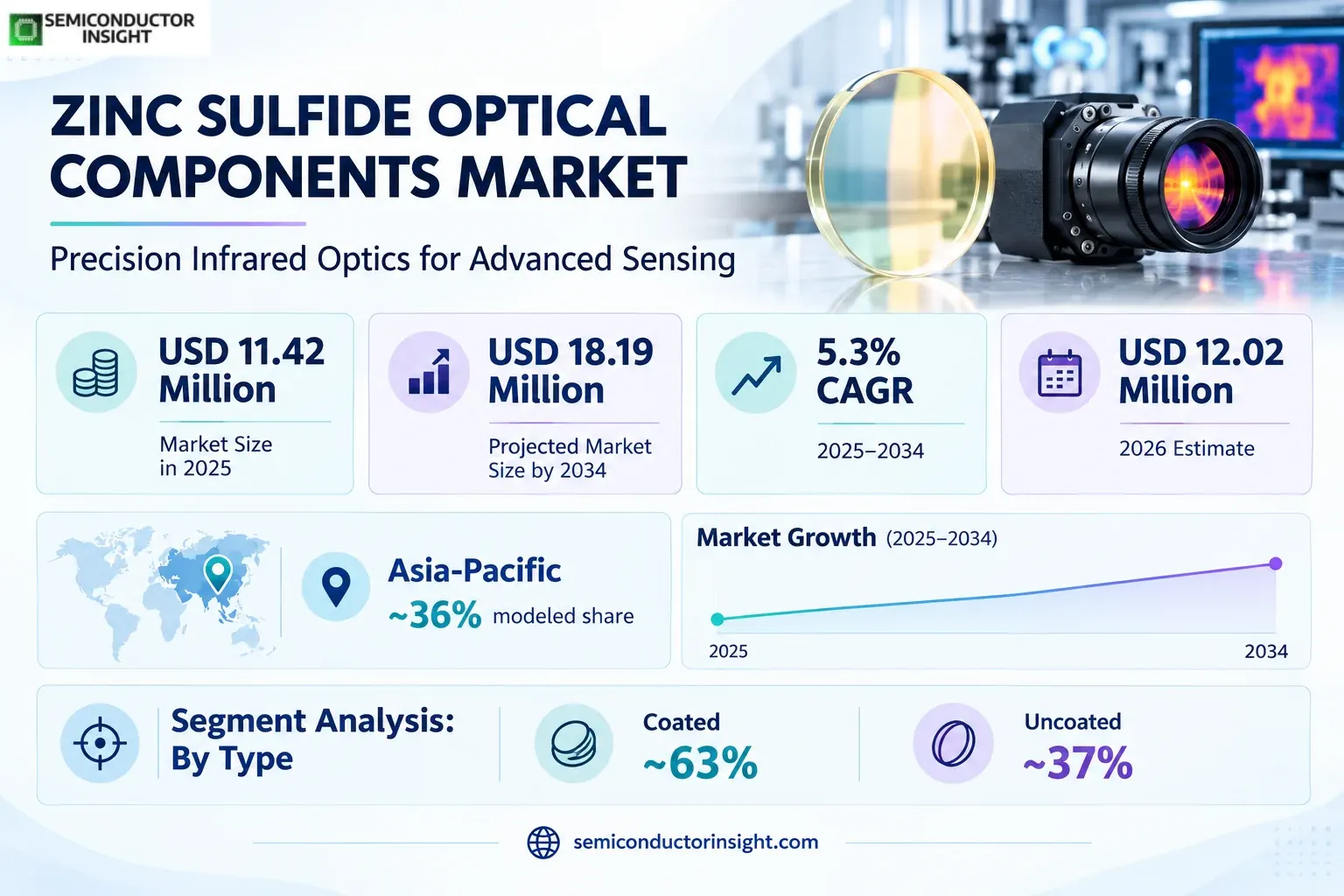
- Market baseline: The finished zinc-sulfide optics category represented USD 11.42 million in 2025, with window assemblies and other precisely polished infrared elements serving imaging, inspection and measurement equipment rather than bulk chemical consumption.
- Forecast trajectory: Demand is projected to reach USD 18.19 million in 2034, corresponding to 5.3% annualized growth from the 2025 base as infrared instrument makers increase qualification of multispectral and weather-resistant entrance optics.
- Coating mix: Coated products lead type revenue at an estimated ~63% share in 2025 because optical thin films, inspection and environmental finishing add more value to a delivered part than an otherwise comparable bare surface.
- Application concentration: Thermal radiation measuring instruments account for an estimated ~39% of 2025 demand, ahead of infrared spectrometers at ~27%, medical instruments at ~19% and other applications at ~15%.
- Regional leadership: Asia-Pacific represents the modeled largest regional market at ~36%, with North America ~26%, Europe ~25%, South America ~8% and the Middle East and Africa ~5% of the 2025 revenue pool.
- Technology driver: Water-clear multispectral grades enable one aperture to support visible alignment and infrared sensing; demanding optical transmission and coating adhesion specifications raise the value of precision-processed ZnS components.
- Competitive structure: Specialist optical fabricators compete through polishing yield, spectral coating capability, custom diameter and thickness tolerances, inspection documentation and dependable batch-to-batch optical performance.
- Study coverage: The assessment covers 2025 as base, 2026 as estimate and 2034 as forecast, with segmentation by coated versus uncoated type and four application groups across five geographic regions.
Zinc Sulfide Optical Components Market Overview
Zinc sulfide optical components market stood at USD 11.42 million in 2025 and is projected to reach USD 18.19 million by 2034, advancing at a 5.3% CAGR over 2025–2034. Asia-Pacific is the modeled largest regional market at ~36% of the base-year value, reflecting concentrated precision-optics processing and downstream infrared equipment supply.
Zinc sulfide is a polycrystalline optical material used when equipment must transmit infrared energy while protecting a sensitive detector or optical train from its environment. Chemical-vapor-deposited material is subsequently cut, ground and polished into windows, lenses, wedges or domes. The finished component, not the unprocessed chemical feedstock, creates the relevant sales transaction. Depending on grade, the same ZnS element can serve thermal wavelengths near 8–12 micrometres or extend transmission toward the visible spectrum for combined imaging and alignment.
The commercial boundary includes finished coated and uncoated zinc-sulfide windows and qualifying precision elements purchased by thermal measurement, spectroscopy, medical and adjacent instrument manufacturers. It excludes raw zinc sulfide powders, unmachined deposition blanks, zinc selenide substitutes, complete thermal cameras, military platforms and installation contracts. This distinction matters because a supplier may sell several infrared materials alongside ZnS, but the addressable revenue here belongs to fabricated optical parts with specified surface quality, transmission and mechanical fit.
Material grade influences the optical design before the first purchase order. Crystran describes multispectral zinc sulfide as a hot-isostatically-pressed grade with transmission spanning 0.37–13.5 micrometres, while its FLIR grade is selected for infrared use where visible clarity is less important. A buyer must balance absorption, scattering, refractive index, surface finish and expected operating temperature rather than treating all ZnS blanks as interchangeable. This makes qualification data and documented optical performance central to supplier selection.
Coatings can materially change the economics of an otherwise identical window. Edmund Optics offers uncoated multispectral ZnS as well as broadband antireflection treatment covering 3–12 micrometres, while Knight Optical lists protective diamond-like-carbon and broadband optical options for harsh-environment designs. These finishing steps require process control, spectral testing and handling precautions, and they create additional inspection risk that may raise selling prices even when the substrate diameter and thickness remain unchanged.
The demand profile is specialized rather than mass consumer electronics. Infrared thermometers, thermal inspection modules, laboratory spectrometers and imaging assemblies buy comparatively small lots whose dimensions are tied to instrument drawings. Engineers often require stable transmission after cleaning, vibration, humidity and temperature cycling, which lengthens design-in cycles but supports replacement purchases and multi-year supply agreements. Suppliers that can move from prototype quantities to reproducible production lots gain an advantage over firms offering only catalogue dimensions.
The base-to-forecast expansion is moderate compared with many electronic-device categories because optical elements have long service lives and are often reused across equipment generations. However, a multispectral aperture can replace a more complicated multi-window design, and miniaturized thermal sensors increase the number of qualified assemblies that need reliable protective optics. Competition therefore depends on delivering consistent physical specifications rather than simply on reducing the price of bulk zinc-sulfide material.
Segment Analysis: By Type
By type, finished zinc-sulfide optics are divided into Coated and Uncoated products. Coated units lead with a modeled ~63% share in 2025 and an indicative ~5.7% annual expansion rate, reflecting added thin-film processing and the need to control reflection in multi-element instruments. Uncoated parts account for ~37% and remain important in prototypes, laboratory setups and optical assemblies that apply a separate protective treatment after integration.
| Type | Technical role | Commercial outlook |
|---|---|---|
| Coated | Optical finishing may combine broadband antireflection films with mechanically protective surface treatments. The useful coating stack depends on whether the instrument operates in the 3–5 micrometre band, the 8–12 micrometre band or a wider multispectral interval. Surface cleanliness, pinhole control, adhesion and reflected-light testing become essential acceptance parameters after the substrate has been polished. | Largest type, modeled ~63% of 2025 sales. Value per component reflects coating deposition, yield losses, inspection records and handling as well as raw window geometry. Suppliers able to specify broadband antireflection response and environmental durability can serve industrial thermal systems that reject unprotected optical faces. The indicative growth path of ~5.7% is a model allocation rather than a measured manufacturer segment rate. |
| Uncoated | Bare polished zinc-sulfide parts preserve design flexibility for optical laboratories and manufacturers that optimize the complete lens stack at system level. Their transmission still depends on material grade, refractive index, surface roughness, thickness and internal scattering, but the buyer can decide later whether to apply a proprietary film or retain untreated surfaces for testing. | Modeled ~37% of 2025 revenue. The absence of a deposited film reduces finishing cost and can shorten replenishment lead times, although high-quality polishing and dimensional control remain necessary. Uncoated pieces are common in experimental benches, small production series and customers that coat in-house; a modeled ~4.6% growth rate reflects slower value addition than coated variants. |
Coated Zinc Sulfide Optics
The coated category is defined by the finished optical function, not merely by a film added for cosmetic protection. Edmund Optics describes broadband antireflection ZnS products in the 3–12 micrometre interval, while Knight Optical offers application-specific broadband and protective options. Optical designers select these treatments to reduce unwanted reflections, manage ghost images and preserve sensor signal quality when multiple windows, filters or detector surfaces sit in the same path.
In a demanding thermal instrument, the coating specification becomes part of the approved component drawing. A change in deposition supplier can alter wavelength response, humidity performance or cleaning tolerance even if the mechanical substrate remains identical. Qualification consequently favors traceable coating batches and measured spectral curves; the estimated ~63% share captures the value premium associated with this control rather than an audited global shipment mix.
Uncoated Zinc Sulfide Optics
An untreated ZnS window still demands exacting polishing because scratches, wedge errors and surface contamination scatter radiation before it reaches the detector. Standard catalogue diameters make such components useful for quick instrument development, but engineering customers may request nonstandard thickness, edge treatment or clear-aperture dimensions. Uncoated designs avoid one processing step while preserving the ability to test multiple external coatings during optical optimization.
The modeled ~37% contribution should not be read as a count of all raw ZnS blanks manufactured worldwide. This category covers saleable finished optical parts, and its economics are shaped by polishing throughput, inspection rejection rates and lot size. A customer that buys a bare window and later deposits its own film remains within the uncoated sales category at the initial supplier transaction.
Segment Analysis: By Application
Application demand is distributed across Medical Instruments, Thermal Radiation Measuring Instrument, Infrared Spectrometer and Others. Thermal radiation measurement is the largest modeled category at ~39% of 2025 revenue because a protective infrared entrance window must preserve radiometric accuracy under repeated use. Spectroscopy follows at ~27%, with medical instruments at ~19% and miscellaneous scientific and industrial assemblies at ~15%.
| Application | Demand characteristics |
|---|---|
| Thermal Radiation Measuring Instrument | Largest application, modeled ~39% share. Thermal imagers, process-temperature monitors and calibrated radiometers depend on consistent long-wave infrared throughput and predictable emissivity corrections. A front window protects sensitive internal optics from dust, contact and ambient conditions, while a protective coating may be required in exposed installations. Qualification emphasizes transmission stability, repeatable surface cleaning and compatibility with the instrument calibration procedure; an indicative ~5.5% expansion reflects recurring industrial inspection demand. |
| Infrared Spectrometer | Modeled ~27% of base-year revenue. Analytical systems use ZnS components as transmission windows, wedges and custom optical interfaces where the required spectral band overlaps the material response. Optical laboratories often specify low scatter, flatness and exact thickness rather than maximum ruggedness. The purchasing cycle follows new instrument platforms, replacement optics and maintenance of installed spectrometers; an indicative ~5.1% growth rate reflects steady scientific and process-analysis applications. |
| Medical Instruments | Modeled ~19% contribution. Medical sensing and laboratory instruments can incorporate infrared windows when noncontact measurements or optical analysis are required. Suppliers must provide consistent surface finish and cleaning compatibility, and the device manufacturer remains responsible for validating its final medical application. The modeled ~5.0% trajectory reflects a narrower pool of qualified devices than industrial thermal monitoring, without assuming that every medical optical component uses ZnS. |
| Others | Modeled ~15% contribution. This residual category includes research assemblies, specialist inspection equipment and qualified protective optics that do not fit the three named applications. Purchases are irregular and often engineered to order, so the market may respond to single-program changes more sharply than standardized thermal windows. An indicative ~5.7% growth assumption reflects selected higher-value custom designs, not a measured category-level forecast. |
Application segmentation is useful because two windows made from the same substrate can command very different prices. A laboratory buyer may prioritize flatness and transmission certificates, whereas a field-installed thermal sensor may require abrasion resistance, sealed mounting and cleaning durability. Procurement therefore follows the operating environment and optical system architecture, with part qualification taking precedence over the generic name of the substrate material.
Regional Analysis
Asia-Pacific is the modeled largest region with ~36% of 2025 zinc-sulfide optical-component revenue, ahead of North America at ~26% and Europe at ~25%. The remaining demand is divided between South America at ~8% and the Middle East and Africa at ~5%. These allocations reflect where precision optics are fabricated, where instrument makers qualify parts and where specialized infrared equipment is deployed; they are modeled shares, not audited sales by country.
How do the five regions differ in zinc sulfide optical component procurement?
The regional pattern is shaped by the location of finishing shops and the specifications imposed by equipment integrators. Asia-Pacific combines broad component fabrication capability with growing infrared equipment production; North American buyers often specify traceability and custom optical performance; European laboratories and machine builders require consistent coating and metrology documentation. Smaller markets commonly import finished components through distributors, so lead time, packaging and service support can matter as much as the underlying optical material.
| Region | Position | Growth outlook | Demand profile | What decides supplier selection |
|---|---|---|---|---|
| Asia-Pacific | Largest (~36%) | Modeled ~5.8% CAGR | Precision fabrication and infrared equipment | Coating yield, export support and batch consistency |
| North America | Second (~26%) | Modeled ~4.7% CAGR | Industrial and scientific systems | Optical documentation, custom fit and traceability |
| Europe | Third (~25%) | Modeled ~5.1% CAGR | Metrology, research and thermal imaging | Qualification history and specialist polishing |
| South America | Fourth (~8%) | Modeled ~5.7% CAGR | Imported industrial measurement optics | Distribution access and replacement lead times |
| Middle East & Africa | Fifth (~5%) | Modeled ~6.0% CAGR | Infrastructure inspection and scientific optics | Heat exposure, service logistics and coating durability |
Key Zinc Sulfide Optical Component Manufacturers and Competitive Landscape
Competition is fragmented among catalogue optics distributors, specialist infrared-material processors and custom polishing or coating houses. The relevant differentiators are material grade, finished geometry, spectral certification and dependable optical coating rather than wafer-fab scale. Thorlabs, Crystran, Edmund Optics, Knight Optical, Shanghai Optics, Alkor Technologies, Hyperion Optics, EKSMA Optics and TYDEX are among the companies named in the supplier landscape.
An optical-component supplier can participate at several points in the value chain without manufacturing the chemical-vapor-deposited ZnS itself. One business may buy a substrate blank, polish it to a customer drawing and apply a broadband film; another may distribute finished stock windows under its own catalogue. Buyer diligence therefore focuses on the origin of optical test data and the ability to repeat a qualified process, not simply on whether the seller lists zinc sulfide in its materials portfolio.
Edmund Optics competes through detailed catalogue specifications and custom manufacturing support, making it accessible to engineers who need a documented window for early prototypes. Crystran publishes optical constants and differentiates multispectral from FLIR grades, which helps customers select the material before finishing. Knight Optical offers custom geometries, coating options and metrology, positioning it for specialized OEM designs that cannot be fulfilled by a standard disc alone.
TYDEX describes both infrared and multispectral CVD ZnS products, while Alkor Technologies provides windows and wedges for infrared applications. Shanghai Optics and Hyperion Optics address custom component fabrication; EKSMA Optics offers broader optical polishing and coating services. These companies have different degrees of direct ZnS exposure, so their total company turnover should not be treated as revenue from this narrow market.
Procurement teams compare the total risk of a component over its instrument lifetime. A low initial quote can be offset by poor coating adhesion, inconsistent clear aperture, dimensional rejects or repeated calibration work. Conversely, a supplier that provides spectral plots, surface-quality certificates and reliable replacement batches can remain on an approved vendor list even when the product itself is a relatively inexpensive component within a complex thermal system.
Tier structure
| Tier | Companies | Basis of competition |
|---|---|---|
| Catalog and precision suppliers | Edmund Optics, Thorlabs, Crystran, Knight Optical | Broad stock or custom offerings with technical specifications, quality control and design assistance. The buyer benefits from ready-to-order windows, documented material properties and established purchasing processes, although highly unusual shapes may still need an engineering quotation. |
| Custom infrared specialists | Alkor Technologies, TYDEX, Shanghai Optics, Hyperion Optics | Fabrication of infrared windows, wedges, lenses or other tailored elements. Differentiation comes from handling uncommon diameters, controlling polishing quality and matching a customer-defined spectral or environmental requirement rather than selling the highest number of standard catalogue units. |
| Broader optical ecosystem | EKSMA Optics, Intrinsic Crystal Technology, Ecoptik, Harrick Scientific Products | Optical processing, distribution or scientific-instrument channels that may participate in adjacent component demand. A company belongs in the competitive landscape only to the extent that it offers relevant finished infrared optics, and its unrelated instruments or other optical materials are excluded from ZnS market revenue. |
Key companies profiled
- Edmund Optics (United States)
- Crystran (United Kingdom)
- Knight Optical (United Kingdom)
- Thorlabs (United States)
- Shanghai Optics (China)
- Alkor Technologies
- TYDEX
- Hyperion Optics
- EKSMA Optics
- Intrinsic Crystal Technology
- Ecoptik
- Harrick Scientific Products
- Sherlan Optics
- Pleiger Laseroptik
Zinc Sulfide Optical Components Production and Quality Capacity Analysis
Manufacturing capacity is measured less by tonnes of ZnS and more by the number of polished, coated and inspected parts that can meet an optical drawing. CVD substrate availability is only the first stage; high-value output depends on polishing yield, coating-chamber scheduling, clean handling and the precision of final metrology. Stock and bespoke products consequently have different lead-time and cost profiles.
Zinc-sulfide material is commonly formed through chemical-vapor deposition, then cut into blanks before precision grinding and polishing. Multispectral material may undergo hot-isostatic pressing to improve visible transparency, according to Crystran. Every additional operation can affect throughput: a rejected surface, excessive wedge or internal scatter may force rework or scrapping. Manufacturing comparisons should therefore distinguish substrate capacity from finished-optics yield and from the number of qualified geometries a plant can produce.
Coating capability can be the bottleneck for demanding orders. A broadband antireflection treatment must meet a spectral target across the required wavelengths, and a protective film must remain attached after the customer’s specified environmental tests. Suppliers may combine coating and polishing internally or subcontract one stage, but the buyer ultimately evaluates the finished optic. A factory with large blank inventory does not automatically have sufficient coating capacity for a particular instrument program.
Inspection equipment includes optical metrology for thickness, flatness, wedge, scratch-and-dig quality and spectral transmission. Knight Optical emphasizes its metrology laboratory and bespoke component service, while catalogue suppliers publish standard dimensions to reduce engineering ambiguity. Smaller orders may be made with flexible workshop capacity, whereas repeat OEM production benefits from dedicated process instructions, controlled packaging and documented changes to coating materials or deposition settings.
For optical design, Crystran publishes a detailed dispersion series for multispectral ZnS. Its refractive-index pairs begin at 0.4047 micrometres with 2.54515, 0.4358 with 2.48918, 0.4678 with 2.44918, 0.4800 with 2.43691, 0.5086 with 2.41279, 0.5461 with 2.38838, 0.5476 with 2.36789, 0.6438 with 2.34731, 0.6678 with 2.34073, 0.7065 with 2.33073, 0.7800 with 2.31669, 0.7948 with 2.3148, 0.8521 with 2.30659 and 0.8943 with 2.30183. These wavelength-dependent values explain why a component drawing must specify the spectral operating band rather than relying on a single generic index.
The same optical reference continues through 1.0140 micrometres at index 2.29104, 1.1287 at 2.28172, 1.5297 at 2.27166, 2.058 at 2.2642, 3.000 at 2.25772, 3.500 at 2.25498, 4.000 at 2.25231, 4.500 at 2.24955, 5.000 at 2.24661, 8.000 at 2.22334, 9.000 at 2.21290, 10.00 at 2.20084, 11.25 at 2.18317, 12.00 at 2.17101 and 13.00 at 2.15252. A lens designer uses these constants to predict focal shift and surface reflection across a broadband detector response; they are engineering properties rather than estimates of component revenue.
Crystran also reports a density of 4.09 grams per cubic centimetre, thermal conductivity of 27.2 watts per metre-kelvin at 298 kelvin, thermal expansion of 6.5 × 10^-6 per degree at 273 kelvin, specific heat of 515 joules per kilogram-kelvin, Young modulus of 74.5 gigapascals, elastic stiffness coefficient C11 of 89.2 gigapascals and a Poisson ratio of 0.28. Its published transmission data include an absorption coefficient of 0.2 per centimetre at 10.6 micrometres, 0.006 at 9.27, 0.0006 at 3.8 and 0.0001 at 2.7. These quantities guide mount stress, optical loss and thermal-stability calculations.
Knight Optical publishes custom ZnS capabilities including a diameter range extending from below 5 millimetres to above 100 millimetres, a typical surface-form error below 0.25 waves at 633 nanometres, centration or parallelism below 1 arcminute, scratch-dig quality better than 60/40 and broadband antireflection options over 2–14 micrometres. Edmund Optics separately lists stock diameters from 12.5 to 50.80 millimetres with thickness choices of 2, 3 and 4 millimetres, and it offers coatings across 3–12 micrometres. These catalogue specifications demonstrate why stock geometry and bespoke manufacturing occupy distinct commercial niches.
Zinc Sulfide Optical Components Market Dynamics: Drivers, Restraints and Opportunities
Growth reflects wider use of thermal sensing, value-added multispectral coatings and replacement demand for qualified infrared entrance windows. These forces are offset by high precision-finishing costs, material and coating yield constraints, and substitution by other infrared substrates where their optical properties are sufficient. The impact allocation below is a transparent modeled contribution to the 5.3% headline rate, not a set of directly observed company revenue shares.
MARKET DRIVERS
Drivers Impact Analysis*
| Market Drivers | Impact Rank | CAGR Contribution (%) | 2026–2028 | 2029–2031 | 2032–2034 |
|---|---|---|---|---|---|
| Thermal inspection and radiometric equipment demand | High | +2.20% | High | High | Medium |
| Multispectral imaging and visible alignment integration | High | +1.80% | Medium | High | High |
| Value-added antireflection and protective coatings | Medium-High | +1.30% | High | Medium | Medium |
| Scientific infrared spectroscopy replacement cycles | Medium | +0.90% | Medium | Medium | Medium |
| Custom OEM geometry and qualification retention | Low-Medium | +0.70% | Low | Medium | High |
| Others (specialist medical sensors and laboratory prototyping) | Low | +0.50% | Low | Low | Medium |
Thermal measurement creates durable replacement demand
Industrial temperature measurement depends on a stable optical path between the monitored surface and the detector. Protective ZnS windows help isolate the sensing element from contamination, but they can be scratched, coated with deposits or damaged during maintenance. Replacement purchases follow the installed base of qualified instruments, giving specialist suppliers a continuing sales channel even when new equipment orders slow.
Multispectral grades simplify combined-sensor architectures
Water-clear ZnS supports optical designs that require visible alignment and infrared observation through a common aperture. Crystran describes a broad 0.37–13.5 micrometre transmission range for its multispectral material, while optical-system performance still depends on thickness and coating. Integrators may favor a single qualified front element over multiple apertures when space, alignment and sealing are constrained.
Coating specifications raise revenue per delivered optic
Antireflection treatments can reduce unwanted reflected energy, while protective films can improve field suitability for exposed optical surfaces. The commercial benefit comes from finishing labor, inspection and qualification, not an assumed change in raw ZnS chemistry. Customers that need both a controlled spectral response and mechanical durability may accept higher component prices to reduce system-level rework and downtime.
Analytical instruments support smaller recurring orders
Infrared spectrometers and scientific benches require windows and wedges with controlled optical characteristics. A damaged element or an upgraded experimental configuration can prompt a new purchase even when the instrument chassis remains in service. This demand is spread among laboratories and equipment manufacturers, making orders less concentrated than a single high-volume consumer electronics product cycle.
MARKET RESTRAINTS
Restraints Impact Analysis*
| Market Restraints | Impact Rank | CAGR Contribution (%) | 2026–2028 | 2029–2031 | 2032–2034 |
|---|---|---|---|---|---|
| High finishing and coating rejection costs | High | -0.90% | High | Medium | Medium |
| Competition from alternative infrared materials | Medium-High | -0.70% | Medium | High | High |
| Long qualification and limited order sizes | Medium | -0.40% | Medium | Medium | Low |
| Others (handling, logistics and cleaning constraints) | Low | -0.10% | Low | Low | Low |
Precision processing can constrain usable output
A substrate blank becomes commercial inventory only after the finished component meets its optical drawing. Surface defects, unwanted wedge, coating nonuniformity and contamination may lead to rework or rejection, especially for parts used in calibrated measurement instruments. Smaller custom batches spread setup and inspection costs across fewer units, limiting the benefit of raw-material scale economies.
Substitute materials compete in selected wavelength bands
Zinc selenide, germanium, silicon and other infrared materials can meet particular optical requirements, although their transmission, density, environmental behavior and visible clarity differ. Engineers choose a substrate for the complete system rather than by a single catalogue property. When an alternative offers adequate performance at lower delivered cost, ZnS suppliers must defend their position through durability, multispectral functionality or established qualification.
Customer approvals slow supplier changes
An infrared window may appear mechanically simple, yet changing its surface finish or coating can alter the signal reaching a detector. Instrument makers therefore test a replacement source against optical, thermal and cleaning requirements before production approval. This protects established suppliers but lengthens the sales cycle for newcomers and can keep order quantities small during initial engineering trials.
MARKET OPPORTUNITIES
Custom protective optics for harsh service
Environmental monitoring, outdoor thermal imaging and industrial inspection create openings for precisely shaped ZnS parts with suitable protective coatings. A supplier that can document both spectral performance and surface durability can address applications where generic uncoated windows are inadequate. The strongest opportunities involve collaboration with instrument engineers before the optical drawing is frozen.
Integrated polishing, coating and inspection services
Customers often prefer a finished, tested component from one accountable supplier rather than coordinating substrate sourcing, polishing and coating across multiple workshops. Integrated capability can shorten qualification loops and reduce uncertainty over the cause of defects. The opportunity is particularly relevant for low-volume instruments where a delayed custom optic can hold up an entire equipment shipment.
Zinc Sulfide Optical Component Supply Chain and Procurement
The supply chain runs from chemical-vapor-deposited material to hot-isostatic pressing where required, then cutting, polishing, coating, inspection and delivery to an instrument integrator. Commercial responsibility is often divided among several specialist companies. The revenue boundary used here is the finished ZnS optic at the component sale, not the aggregate turnover of every upstream and downstream participant.
Upstream material. Chemical-vapor-deposited zinc sulfide is not a finished infrared window. Material producers must control inclusions, scattering and grade suitability, while downstream fabricators determine whether a blank can meet the customer’s final optical tolerance. Multispectral processing adds another decision point because the target visible and infrared performance can differ substantially from standard FLIR material.
Fabrication and finishing. Polishing shops convert blanks into specified apertures, wedges or lenses and may add broadband or protective coatings. The commercial risk is concentrated at the finishing stage, where a dimensional or spectral failure can consume already-processed material. Customers commonly request measured transmission, surface-quality evidence and controlled packing before accepting a custom optical batch.
Channel and end user. Scientific catalogues make standard components available to laboratories, while larger OEMs may buy direct from custom optical manufacturers. A distributor can provide technical support and replenishment stock without performing every production step itself. End users purchase the component for a defined optical system, so replacement compatibility and documented specifications influence repeat orders more than generic material marketing.
Recent Product and Technical Developments in Zinc Sulfide Optical Components
- 27 October 2026 Catalogue checked
Edmund Optics continued to list its multispectral zinc-sulfide window family with uncoated and broadband antireflection options for 3–12 micrometre operation. The catalogue identifies low absorption and scatter over a wider 0.4–12 micrometre interval. This verified product availability illustrates the commercial importance of stock configurations that help instrument developers compare coating choices before committing to custom production. Source - 27 October 2026 Specification checked
Crystran maintained a technical materials listing for water-clear multispectral zinc sulfide, including its hot-isostatic-pressing process and transmission range of 0.37–13.5 micrometres. The published optical constants support engineering calculations involving reflection, temperature behavior and detector throughput. This is a current technical catalogue observation, not a claim that the material or process was newly invented in 2026. Source - 27 October 2026 Custom offering checked
Knight Optical described bespoke zinc-sulfide windows and lenses in both multispectral and FLIR grades, with broadband antireflection and other finishing options. Its listed optical metrology and custom component capabilities reinforce the role of drawing-based qualification in specialist infrared procurement. The observation concerns an available supplier service rather than a dated factory expansion or an independently measured increase in market sales. Source - 27 October 2026 Product detail checked
Edmund Optics listed an uncoated 50 millimetre diameter ZnS window with a nominal 3 millimetre thickness, giving engineers a concrete stock-part specification for prototype selection. An uncoated catalogue option is useful when a system maker intends to evaluate several surface treatments or requires a bare reference optic. The listing is evidence of product availability, not evidence of global shipment volumes. Source - 2023 handbook Technical reference
Crystran’s published materials handbook documented optical and physical properties of infrared substrates, including zinc-sulfide grades and relevant handling considerations. Such data support grade selection and thermal design calculations for a finished window. The handbook is a reference publication rather than a new product launch; its continued use demonstrates why optical suppliers compete partly through dependable, accessible engineering documentation. Source - 27 October 2026 Supplier offering checked
TYDEX described CVD zinc-sulfide optics in infrared and multispectral grades and discussed transmission and fabrication capabilities. This supplier information supports the view that specialist manufacturers can serve customers requiring dimensions outside common catalogue discs. The verified offering adds competitive context, but no inference is made about its order backlog, revenue growth or the share of worldwide ZnS optical-component sales. Source
REPORT SCOPE & SEGMENTATION
| Attribute | Details |
|---|---|
| Study Period | 2023–2034 |
| Base Year | 2025 |
| Estimated Year | 2026 |
| Forecast Year | 2034 |
| Historical Reference | 2023–2024 |
| 2025 Market Size | USD 11.42 million |
| 2026 Estimated Size | USD 12.03 million |
| 2034 Market Size | USD 18.19 million |
| Growth Rate | CAGR of 5.3% over 2025–2034 |
| Currency | USD million, finished component sales |
| Segmentation | By Type, By Application and By Region |
| By Type | Coated · Uncoated |
| By Application | Medical Instruments · Thermal Radiation Measuring Instrument · Infrared Spectrometer · Others |
| By Region | Each region assessed by component type, application and representative buying countries North AmericaUnited States, Canada, Mexico EuropeUnited Kingdom, Germany, France, Italy, Nordic Countries, Rest of Europe Asia-PacificChina, Japan, India, South Korea, Southeast Asia, Rest of Asia-Pacific South AmericaBrazil, Argentina, Chile, Colombia, Rest of South America Middle East & AfricaUnited Arab Emirates, Saudi Arabia, South Africa, Rest of Middle East & Africa |
| Key Companies Profiled | Edmund Optics, Crystran, Knight Optical, Thorlabs, Shanghai Optics, Alkor Technologies, TYDEX, Hyperion Optics, EKSMA Optics, Intrinsic Crystal Technology, Ecoptik, Harrick Scientific Products, Sherlan Optics, Pleiger Laseroptik |
| Customization Scope | Additional country detail, component specifications, end-use instrument mapping and qualified supplier comparisons may be tailored to a buyer’s engineering or commercial requirements. |
Frequently Asked Questions
What is the market size for zinc sulfide optical components?
Finished zinc-sulfide optics generated an estimated USD 11.42 million in 2025, and the modeled 2034 market reaches USD 18.19 million. These figures describe component sales rather than the value of thermal cameras, medical instruments or raw optical-material production. Growth depends on the mix of custom infrared windows, coatings, replacement purchases and qualified instrument programs.
Which region has the largest zinc sulfide optical-component market?
Asia-Pacific leads the modeled 2025 regional allocation at ~36% because optical processing capacity and infrared equipment supply are concentrated across several Asian manufacturing centers. North America follows at ~26%, and Europe represents ~25%. These percentages are transparent modeled market allocations, not independently published regional revenue figures from a single audited supplier database.
What is the main distinction between coated and uncoated ZnS optics?
A coated component has a deposited optical or protective film applied to the finished surface, while an uncoated part retains its polished substrate face. The former can improve spectral throughput or field durability but adds qualification and inspection steps. Coated optics lead modeled value at ~63%, while uncoated optics remain important for laboratory trials and systems that finish parts internally.
Which application accounts for the greatest demand?
Thermal radiation measuring instruments are the largest modeled application at ~39% of base-year revenue. They need entrance windows that protect the detector and maintain predictable transmission in the selected infrared band. Infrared spectrometers, medical instruments and other specialist uses form the balance, with each group buying components to different optical drawings and maintenance schedules.
What does multispectral zinc sulfide mean?
Multispectral ZnS is a processed optical grade that can transmit visible as well as infrared radiation, making it useful for systems combining alignment and thermal imaging. Crystran attributes its water-clear grade to hot-isostatic pressing after chemical-vapor deposition. Engineers must still evaluate surface reflection, thickness, scattering and coatings, because material transmission alone does not guarantee system-level optical performance.
How do manufacturers qualify a zinc sulfide optical window?
Qualification typically compares the finished part with a drawing specifying clear aperture, thickness, wedge, surface quality and spectral transmission. Coated products may also need adhesion, environmental and cleaning tests. A successful approval depends on repeatable manufacturing records and inspection results, particularly where changing the window would alter the calibration of a thermal or analytical instrument.
Which companies supply finished ZnS optical components?
Specialist names include Edmund Optics, Crystran, Knight Optical, TYDEX, Alkor Technologies, Shanghai Optics and Hyperion Optics, alongside broader optical distributors and fabricators. Their roles differ: some publish stock-window catalogues, others focus on bespoke polishing or coating. Their total company sales should not be equated with revenue from this narrowly defined component market.
Why can zinc sulfide be selected instead of zinc selenide?
Selection depends on the optical band, expected handling, environmental exposure and the overall system design. Multispectral ZnS offers visible-to-infrared transmission that can be useful in combined-sensor equipment, while alternative materials may be appropriate for other wavelength or cost targets. The engineering comparison should use actual grade-specific properties and coating specifications, not a generic claim that one substrate is always superior.
What limits growth in this specialist optical market?
Polishing yield, coating rejection, lengthy OEM qualification and small custom order sizes constrain the rate at which suppliers can expand finished-part revenue. Some instruments can substitute different infrared materials, and a qualified ZnS window may remain in service for many years. These characteristics make demand steadier and more specialized than the fast-moving semiconductor device markets often discussed alongside it.
What does the forecast cover and exclude?
The forecast uses 2025 as its base, 2026 as its estimate and 2034 as its endpoint. It includes saleable zinc-sulfide optical components in coated and uncoated forms for thermal measurement, spectroscopy, medical and other named applications. It excludes raw deposition feedstock, complete cameras, full analytical systems, unrelated infrared substrates and installation or maintenance service revenue.
Research Sources & Evidence Base

Get Sample Report PDF for Exclusive Insights
Report Sample Includes
- Table of Contents
- List of Tables & Figures
- Charts, Research Methodology, and more...
 Download Sample Report PDF