XG(S)-PON Chip Market Insights
Global XG(S)-PON Chip market size was valued at USD 897 million in 2025. The market is projected to reach USD 1,823 million by 2034, exhibiting a CAGR of 10.9% during the forecast period.
XG(S)-PON chips mainly include XGS-PON (symmetrical) and XG-PON (asymmetrical). XG PON is the abbreviation of 10 Gigabit Passive Optical Network, designed to deliver higher transmission rates and longer distances than GPON, with downstream speeds up to 10 Gbps and upstream up to 2.5 Gbps. In contrast, XGS PON provides symmetrical 10 Gbps bidirectional speeds, making it ideal for high-bandwidth applications like video conferencing and cloud services. Its multi-wavelength technology enables wavelength division multiplexing, boosting network capacity and flexibility.
The market is experiencing rapid growth driven by surging demand for ultra-broadband, widespread FTTx deployments, and upgrades from legacy GPON networks to support 5G backhaul and streaming services. Additionally, advancements in optical networking technologies are accelerating adoption. Key players, including Broadcom, Cortina Access (Realtek), Microchip, Sanechips, Airoha Technology (MTK), Fisilink (Fiberhome), Semtech, and MaxLinear, are innovating with advanced chipsets to capture market share.
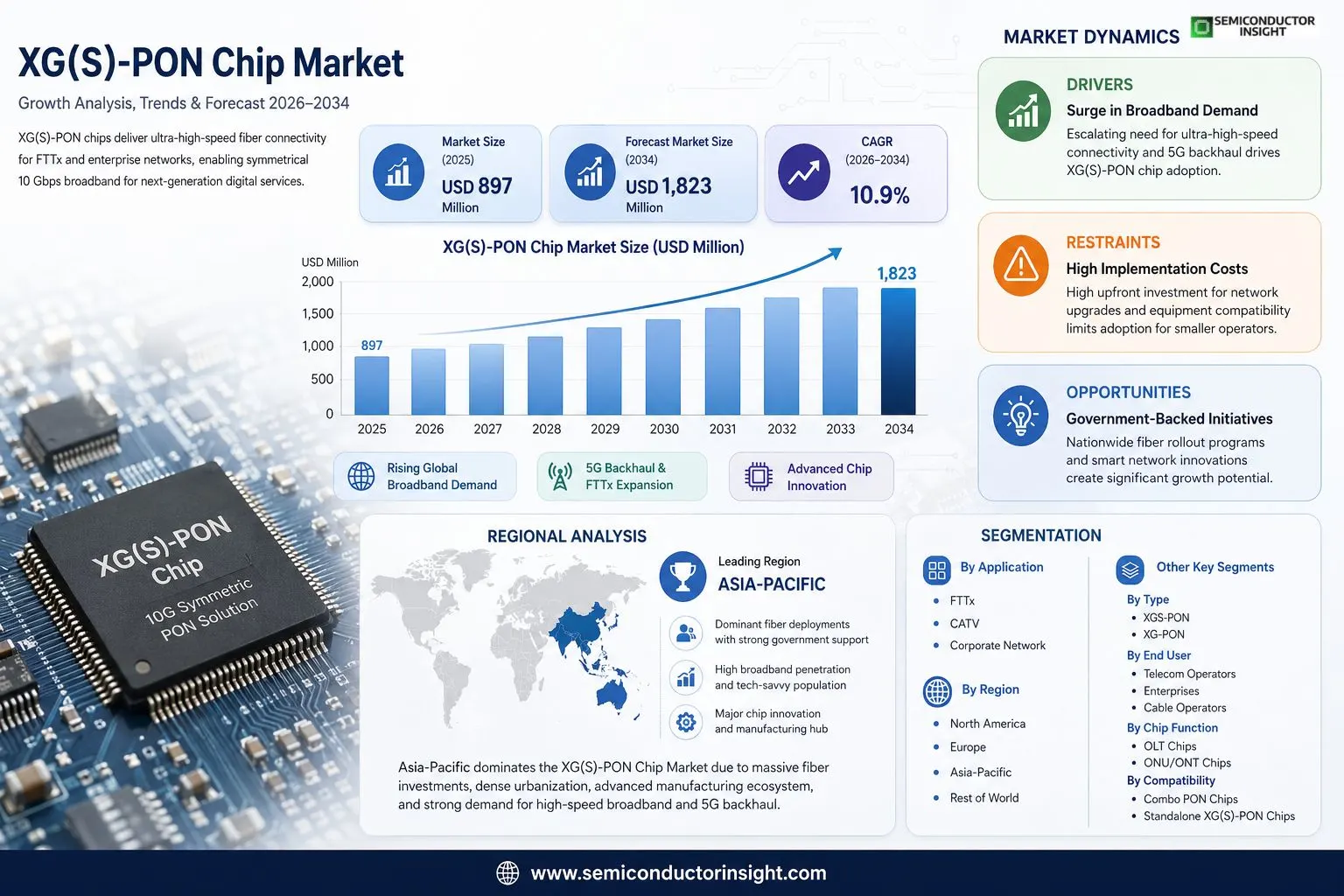
MARKET DRIVERS
Surge in Broadband Demand
XG(S)-PON Chip Market is propelled by escalating global demand for ultra-high-speed internet connectivity. With the proliferation of 4K/8K streaming, cloud gaming, and remote work, service providers are upgrading to 10G PON architectures. In 2023, global fixed broadband subscriptions exceeded 1.4 billion, pushing operators toward XG(S)-PON chips for symmetric 10 Gbps speeds.
5G Backhaul and Enterprise Needs
Integration with 5G networks amplifies the need for high-capacity PON chips, as mobile backhaul requires low-latency, high-throughput solutions. Enterprises adopting edge computing and IoT further drive adoption, with XG(S)-PON chips enabling efficient fiber-to-the-business deployments. Market projections indicate a CAGR of over 25% through 2030 for these chips in telecom infrastructure.
➤ Key deployments in North America and Asia-Pacific account for 60% of global XG(S)-PON Chip Market growth, fueled by government broadband initiatives.
Technological advancements in silicon photonics reduce power consumption in XG(S)-PON chips, making them viable for mass deployment and enhancing overall market momentum.
MARKET CHALLENGES
High Implementation Costs
XG(S)-PON Chip Market faces hurdles from substantial upfront investments required for network upgrades. Replacing legacy GPON infrastructure demands costly ONTs and OLTs compatible with XG(S)-PON chips, straining budgets of smaller operators. Average deployment costs per home passed can exceed $1,000 in urban areas.
Other Challenges
Interoperability Issues
Ensuring seamless compatibility across multi-vendor XG(S)-PON chip ecosystems remains complex, leading to integration delays and increased testing expenses for operators worldwide.
Supply Chain Disruptions
Geopolitical tensions and semiconductor shortages have intermittently hampered XG(S)-PON chip availability, impacting rollout timelines in key markets like Europe and Southeast Asia.
MARKET RESTRAINTS
Regulatory and Standardization Delays
Regulatory approvals and evolving standards for XG(S)-PON Chip Market slow widespread adoption. Bodies like ITU-T continue refining specifications, causing hesitation among operators awaiting mature ecosystems. In regions with stringent spectrum policies, fiber deployments face additional bureaucratic obstacles.Competition from alternative technologies, such as DOCSIS 4.0 cable upgrades, restrains pure fiber PON chip growth in hybrid networks. Cable operators leverage existing coax infrastructure, delaying full XG(S)-PON transitions.High power and heat dissipation in early XG(S)-PON chip designs limit scalability in dense urban PON splits exceeding 1:128 ratios, constraining market expansion in high-density scenarios.
MARKET OPPORTUNITIES
Government-Backed Fiber Initiatives
XG(S)-PON Chip Market holds promise from nationwide fiber rollout programs worldwide. Initiatives like the U.S. BEAD program and EU’s Gigabit Society target gigabit connectivity, creating demand for advanced PON chips with over $100 billion in allocated funding.Expansion into underserved rural and suburban areas offers untapped potential, where symmetric 10G speeds via XG(S)-PON chips can bridge digital divides effectively.Innovations in disaggregated PON architectures enable flexible, software-defined networks, positioning XG(S)-PON chips for smart city and industrial IoT applications with projected market share growth beyond 30% by 2028.
XG(S)-PON Chip Market Trends
Rise of Symmetrical XGS-PON Technology
XG(S)-PON Chip Market is witnessing accelerated adoption of XGS-PON chips, which offer symmetrical 10 Gbps downstream and upstream speeds, surpassing the asymmetrical profile of XG-PON with 10 Gbps downstream and 2.5 Gbps upstream. This shift addresses surging demands for balanced bandwidth in bandwidth-intensive applications such as high-quality video conferencing and cloud computing, positioning XGS-PON as a cornerstone for next-generation fiber-optic networks.
Other Trends
Advancements in Multi-Wavelength Technology
In XG(S)-PON Chip Market, multi-wavelength technology stands out as a key innovation, particularly in XGS-PON implementations. This approach enables wavelength division multiplexing over optical fibers, significantly boosting network capacity and operational flexibility. Network operators leverage this to support denser deployments in urban areas, enhancing overall XG(S)-PON Chip Market efficiency without extensive infrastructure overhauls.
Growing Application in FTTx and Enterprise Networks
Demand within XG(S)-PON Chip Market is propelled by expanding Fiber-to-the-x (FTTx) deployments alongside corporate networks and CATV systems. FTTx remains the dominant application, driven by global broadband upgrade initiatives that favor XG(S)-PON’s higher transmission rates and extended distances compared to legacy GPON. Leading manufacturers like Broadcom, Cortina Access, and Microchip are intensifying R&D to refine chipsets for seamless integration, fostering competition that lowers barriers for widespread adoption in regions such as North America, Europe, and Asia. Challenges persist in supply chain dynamics and standardization, yet surveys of industry experts highlight robust demand trends fueled by 5G backhaul synergies and remote work persistence.
COMPETITIVE LANDSCAPE
Key Industry Players
Top XG(S)-PON Chip Manufacturers and Market Leaders
XG(S)-PON Chip Market is dominated by a handful of established semiconductor leaders, with Broadcom holding a significant market share due to its advanced silicon solutions for symmetric and asymmetric PON deployments. The market structure is moderately concentrated, where the top five players collectively account for a substantial portion of global revenue, driven by demand for high-speed optical access in FTTx and enterprise networks. Intense R&D investments in multi-wavelength and 10Gbps symmetric technologies position these leaders to capture growth in fiber broadband expansions, particularly in Asia and North America.
Beyond the frontrunners, niche players contribute through specialized offerings in cost-effective chips for emerging markets and integrated solutions for OLT/ONU applications. Companies like Sanechips and Fisilink focus on asymmetric XG-PON variants tailored for cost-sensitive deployments, while innovators such as MaxLinear and Semtech emphasize power-efficient designs for symmetrical XGS-PON. This fragmented tail of the market fosters competition via partnerships with telecom OEMs, enabling rapid adoption in CATV and corporate networks amid the projected CAGR of 10.9% through 2034.
List of Key XG(S)-PON Chip Companies Profiled
- Broadcom
- Cortina Access (Realtek)
- Microchip Technology
- Sanechips
- Airoha Technology (MediaTek)
- Fisilink (Fiberhome)
- Semtech
- MaxLinear
- MACOM Technology Solutions
- Centec Networks
- Risecomm Technology
- Himax Technologies
- GM Technology
- InterOptic
- Accelink Technologies
Segment Analysis:
| Segment Category | Sub-Segments | Key Insights |
| By Type |
|
XGS-PON leads the market due to its symmetrical high-speed capabilities.
|
| By Application |
|
FTTx dominates deployments across fiber access networks.
|
| By End User |
|
Telecom Operators represent the primary adopters across global markets.
|
| By Chip Function |
|
ONU/ONT Chips hold leading position in volume deployments.
|
| By Compatibility |
|
Combo PON Chips prevail for their versatility in mixed deployments.
|
Regional Analysis: XG(S)-PON Chip Market
Asia-Pacific
Rapid uptake of XG(S)-PON chips stems from mature FTTH ecosystems, where operators upgrade legacy GPON to 10G variants for future-proofing. Innovations in silicon photonics enhance chip performance, supporting multi-wavelength operations and reducing power consumption in dense deployments.
Domestic leaders like Huawei and ZTE dominate, producing integrated XG(S)-PON chips for OLTs and ONUs. Collaborations with global firms bolster chip interoperability, driving customized solutions for regional carriers focused on high-density urban PON networks.
Government-led initiatives prioritize fiber-deep architectures, embedding XG(S)-PON chips to enable gigabit-to-the-home services. Urban renewal projects integrate PON chips into edge computing, supporting smart grids and surveillance with resilient, high-throughput connectivity.
Supply chain resilience amid geopolitical shifts spurs local fab investments. Opportunities lie in green PON chips for energy-efficient networks, aligning with sustainability goals and opening avenues for XG(S)-PON Chip Market expansion in rural digitalization.
North America
North America exhibits steady growth in XG(S)-PON Chip Market, propelled by major telcos transitioning to next-gen PON for competitive edge. Operators like AT&T and Verizon prioritize XGS-PON chips in fiber expansion plans, targeting underserved suburban areas with symmetric speeds. The region’s emphasis on private 5G and enterprise PON drives demand for rugged, high-reliability chips. Innovation hubs in Silicon Valley foster advancements in programmable XG(S)-PON silicon, enabling flexible bandwidth slicing. Regulatory pushes for broadband equity support rural deployments, though high upgrade costs pose hurdles. Strategic alliances between chip vendors and network integrators streamline adoption, positioning North America for robust XG(S)-PON Chip Market participation through enhanced ecosystem interoperability.
Europe
Europe’s XG(S)-PON Chip Market thrives on EU-wide digital agenda initiatives, emphasizing gigabit societies via PON upgrades. Countries like Germany and France lead in FTTH PON deployments, incorporating XG(S)-PON chips for ultra-low latency services. Focus on open-access networks promotes multi-vendor chip compatibility, reducing operator lock-in. Sustainability directives favor low-power XG-PON designs, aligning with green deal objectives. Challenges include fragmented regulations across member states, yet cross-border projects accelerate standardization. Key players invest in R&D for coherent PON chips, bolstering Europe’s competitive stance in the evolving XG(S)-PON Chip Market landscape.
Latin America
Latin America is an emerging hotspot in XG(S)-PON Chip Market, with Brazil and Mexico spearheading fiber migrations to bridge digital divides. Telecom firms deploy XG(S)-PON chips in hybrid coax-PON setups, optimizing costs for expansive territories. Government subsidies for connectivity in remote areas fuel demand for affordable, scalable chips. Regional manufacturing partnerships mitigate import dependencies, fostering local assembly of ONU chips. Growth is tempered by economic volatility, but rising e-commerce and remote work trends sustain momentum in XG(S)-PON Chip Market penetration.
Middle East & Africa
The Middle East & Africa region shows promising traction in XG(S)-PON Chip Market, driven by Gulf states’ smart city visions. UAE and Saudi Arabia invest in all-fiber PON infrastructures, leveraging XG(S)-PON chips for 10G enterprise services. In Africa, South Africa leads urban FTTH rollouts, adapting chips for diverse climates. Oil-funded diversification supports mega-projects, yet infrastructure gaps in sub-Saharan areas present opportunities for cost-optimized solutions. Vendor localization strategies enhance adoption, marking steady XG(S)-PON Chip Market maturation.
Report Scope
This market research report provides a comprehensive analysis of the XG(S)-PON Chip Market , covering the forecast period 2026–2034. It offers detailed insights into market dynamics, technological advancements, competitive landscape, and key trends shaping the industry.
Key focus areas of the report include:
- Market Overview: The report begins with an overview outlining its current market scenario, key growth indicators, and industry transformation drivers. It discusses macroeconomic factors, demand–supply balance, regulatory landscape, and the strategic role of semiconductors in powering advancements across industries such as automotive, telecommunications, consumer electronics, and industrial automation.
- Market Size & Forecast: Historical data and future projections for revenue, unit shipments, and market value across major regions and segments.
- Segmentation Analysis: Detailed breakdown by product type, technology, application, and end-user industry to identify high-growth segments and investment opportunities.
- Regional Insights: Insights into market performance across North America, Europe, Asia-Pacific, Latin America, and the Middle East & Africa, including country-level analysis where relevant.
- Competitive Landscape: Profiles of leading market participants, including their product offerings, R&D focus, manufacturing capacity, pricing strategies, and recent developments such as mergers, acquisitions, and partnerships.
- Technology Trends & Innovation: Assessment of emerging technologies, integration of AI/IoT, semiconductor design trends, fabrication techniques, and evolving industry standards.
- Market Drivers & Restraints: Evaluation of factors driving market growth along with challenges, supply chain constraints, regulatory issues, and market-entry barriers.
- Stakeholder Insights: Insights for component suppliers, OEMs, system integrators, investors, and policymakers regarding the evolving ecosystem and strategic opportunities.
Primary and secondary research methods are employed, including interviews with industry experts, data from verified sources, and real-time market intelligence to ensure the accuracy and reliability of the insights presented.
FREQUENTLY ASKED QUESTIONS:
What is the current market size of XG(S)-PON Chip Market?
-> XG(S)-PON Chip Market was valued at USD 897 million in 2025 and is expected to reach USD 1823 million by 2034 at a CAGR of 10.9% during the forecast period.
Which key companies operate in XG(S)-PON Chip Market?
-> Key players include Broadcom, Cortina Access (Realtek), Microchip, Sanechips, Airoha Technology (MTK), Fisilink (Fiberhome), Semtech, MaxLinear, among others.
What are the key growth drivers?
-> Key growth drivers include demand for higher transmission rates and bandwidth support up to 10 Gbps, FTTx deployments, symmetrical bandwidth for video conferencing and cloud computing.
Which region dominates the market?
-> Asia dominates the market, with significant contributions from China.
What are the emerging trends?
-> Emerging trends include XGS-PON symmetrical 10 Gbps speeds, XG-PON asymmetrical rates, and multi-wavelength technology for enhanced network capacity.

Get Sample Report PDF for Exclusive Insights
Report Sample Includes
- Table of Contents
- List of Tables & Figures
- Charts, Research Methodology, and more...
 Download Sample Report PDF