Key Statistics
Key Takeaways
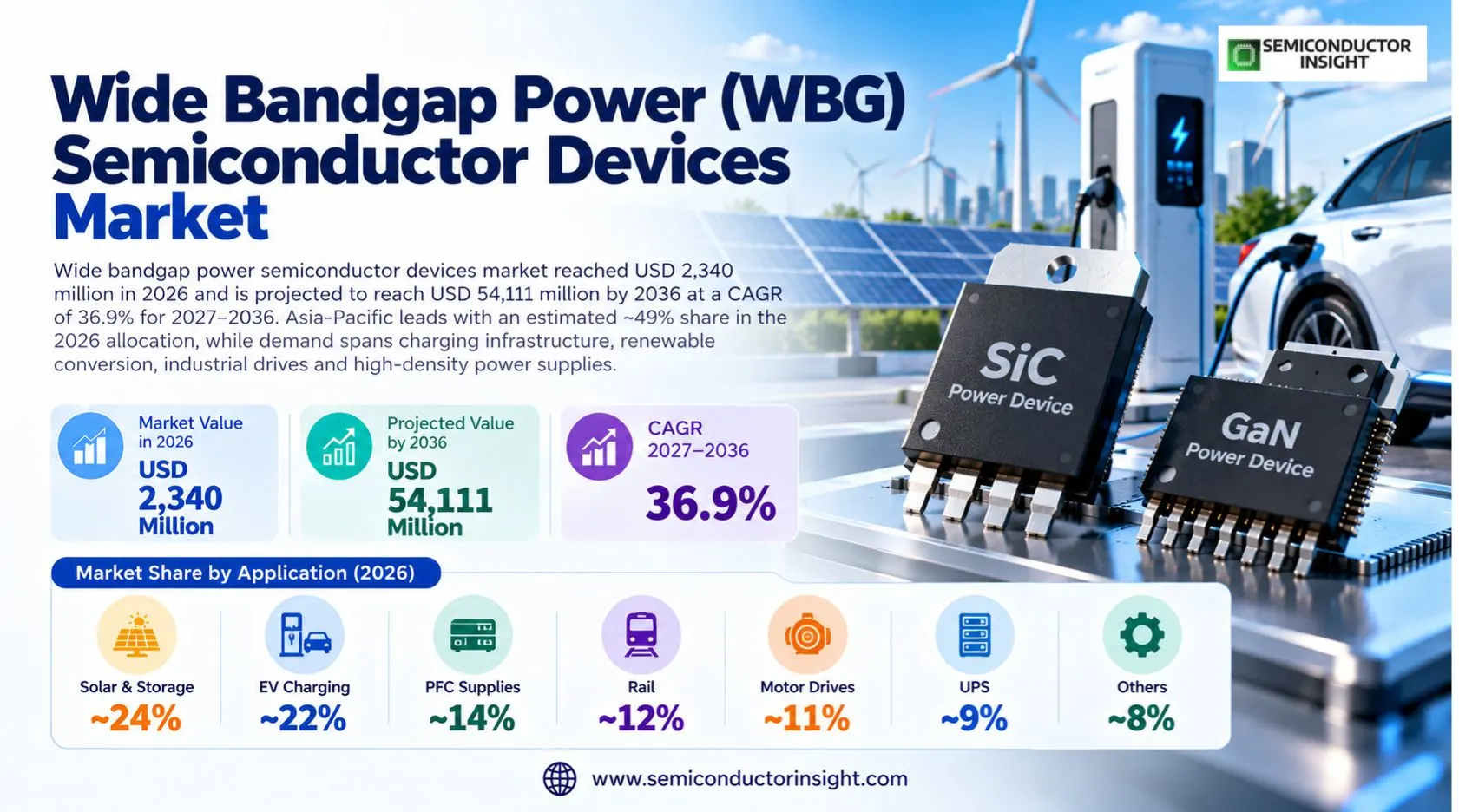
- Global market scale: The wide bandgap power (wbg) semiconductor devices market is valued at USD 2,340 million in 2026 and reaches USD 54,111 million in the 2036 constant-growth scenario, representing a 36.9% annualized trajectory; component revenues exclude complete power converters.
- Technology mix: Power SiC devices account for an estimated ~69% of 2026 sales, with GaN power devices near ~31%; the former lead in high-voltage traction and energy systems while the latter are prominent in compact high-frequency conversion.
- Application concentration: Photovoltaic and energy storage systems represent an estimated ~24% of demand, EV charging infrastructure ~22%, PFC supplies ~18%, rail ~8%, motor drives ~11%, UPS ~10% and other uses ~7%.
- Regional balance: Asia-Pacific contributes an estimated ~49% of 2026 sales; North America ~23%, Europe ~21%, South America ~4% and Middle East & Africa ~3%, with cross-border manufacturing and qualification shaping value capture.
- Device economics: The modeled 650–900 V class holds ~34% of sales and 1200 V devices ~31%; discrete packages carry ~64% of factory-gate revenue, while modules account for ~36% as high-power assemblies gain traction.
- Technology milestones: Official 2024–2026 disclosures describe 750 V and 1200 V SiC traction devices, 2300 V industrial modules, 400–440 V compute-oriented MOSFETs and 12 kW mixed-technology server power reference designs.
- Competitive landscape: Manufacturers compete through wafer yield, vertical integration, automotive approval and thermal packaging; legacy publisher names Transphorm and GaN Systems have become part of Renesas and Infineon respectively.
- Forecast qualification: The ten-year projection is a continuation of older publisher endpoints, not a verified production or shipment forecast; slower EV adoption, silicon price competition and capital intensity can materially change realized growth.
Wide Bandgap Power (WBG) Semiconductor Devices Market Overview
Wide bandgap power semiconductor devices market reached USD 2,340 million in 2026 and is projected to reach USD 54,111 million by 2036 at a CAGR of 36.9% for 2027–2036. Asia-Pacific leads with an estimated ~49% share in the 2026 allocation, while demand spans charging infrastructure, renewable conversion, industrial drives and high-density power supplies. The revenue boundary is finished SiC and GaN power semiconductors and modules, rather than substrates or full power systems; the longer horizon is a conditional projection beyond published endpoint years.
Semiconductor technology: Silicon carbide MOSFETs and diodes tolerate high electric fields and enable fast switching at high voltage, while gallium nitride transistors are favored where high switching frequency and compact magnetic components matter. Infineon expanded its 650 V and 1200 V CoolSiC generation in March 2024 and introduced 400 V and 440 V options in September 2025. These differences determine whether a converter uses discrete switches, half-bridge modules or an integrated package. The commercial distinction for materials selection is that revenue follows qualified SiC or GaN die and packaged power modules sold at the component factory gate, not the value of the surrounding converter, battery, solar installation, or vehicle. For a 2026 materials selection purchasing decision, designers compare 650 V, 750 V, 1200 V and 2300 V ratings, package cooling, lifetime, qualification evidence and total installed cost rather than treating all wide-bandgap parts as interchangeable.
Factory-gate market definition: The counted revenue is the sale of finished WBG switching devices, power diodes and SiC/GaN power modules to original equipment manufacturers, integrators and distribution channels. A module with multiple SiC dies is counted once at module selling price; a bare substrate, epitaxial wafer, silicon MOSFET, RF-only GaN amplifier and complete inverter are excluded. This boundary avoids inflating semiconductor demand with the value of power stages, vehicle batteries and charging cabinets. The commercial distinction for revenue accounting is that revenue follows qualified SiC or GaN die and packaged power modules sold at the component factory gate, not the value of the surrounding converter, battery, solar installation, or vehicle. For a 2026 revenue accounting purchasing decision, designers compare 650 V, 750 V, 1200 V and 2300 V ratings, package cooling, lifetime, qualification evidence and total installed cost rather than treating all wide-bandgap parts as interchangeable.
Automotive transition: Onsemi announced in April 2026 that Geely vehicle platforms would integrate EliteSiC technology in higher-voltage systems, including a 900 V architecture. ST described fourth-generation 750 V and 1200 V SiC traction devices in September 2024 and explained their relevance to 400 V and 800 V battery buses. These named developments support technology adoption but do not independently establish the global sales forecast or every regional allocation. The commercial distinction for automotive qualification is that revenue follows qualified SiC or GaN die and packaged power modules sold at the component factory gate, not the value of the surrounding converter, battery, solar installation, or vehicle. For a 2026 automotive qualification purchasing decision, designers compare 650 V, 750 V, 1200 V and 2300 V ratings, package cooling, lifetime, qualification evidence and total installed cost rather than treating all wide-bandgap parts as interchangeable.
Energy and industrial deployment: Infineon launched 2300 V CoolSiC modules in May 2026 for high-voltage systems with DC links up to 1500 V, and described applications in photovoltaic generation, wind and storage. The company also introduced 1200 V EasyPACK C modules for charging, storage and UPS systems in October 2025, underscoring the importance of module packaging. Large equipment orders involve long qualification cycles and can be uneven from one procurement year to the next. The commercial distinction for energy-system integration is that revenue follows qualified SiC or GaN die and packaged power modules sold at the component factory gate, not the value of the surrounding converter, battery, solar installation, or vehicle. For a 2026 energy-system integration purchasing decision, designers compare 650 V, 750 V, 1200 V and 2300 V ratings, package cooling, lifetime, qualification evidence and total installed cost rather than treating all wide-bandgap parts as interchangeable.
Server and high-frequency demand: A September 2025 12 kW reference power supply from Infineon combined silicon, SiC and GaN across conversion stages, reporting greater than 99% peak efficiency for its PFC front end. The demonstration establishes engineering feasibility rather than the revenue share of GaN or SiC in shipped servers; procurement depends on cost, safety and reliability. Designers increasingly evaluate system loss budgets alongside individual switch specifications. The commercial distinction for compute power conversion is that revenue follows qualified SiC or GaN die and packaged power modules sold at the component factory gate, not the value of the surrounding converter, battery, solar installation, or vehicle. For a 2026 compute power conversion purchasing decision, designers compare 650 V, 750 V, 1200 V and 2300 V ratings, package cooling, lifetime, qualification evidence and total installed cost rather than treating all wide-bandgap parts as interchangeable.
Segment Analysis: By Type
By type, SiC power devices lead at an estimated ~69% of 2026 revenue and GaN power devices hold ~31%. High-voltage traction, renewable and rail systems favor SiC, whereas GaN finds compact and fast-switching applications. For Type segmentation, gate-drive tolerance and wafer defect density shape 2026 qualification of By type, SiC power devices lead at. For motor-drive replacements, 2027–2036 orders balance module manufacturing yield with switching-loss measurement as By type, SiC power devices lead at enters finished-device purchasing.
| Type | Device role | Market position |
|---|---|---|
| Power SiC Device | SiC MOSFETs, diodes and packaged modules cover 650 V, 750 V, 1200 V and emerging 2300 V use cases. Traction inverters, megawatt charging, solar inverters and grid storage use their high-temperature and voltage capabilities. For SiC devices, module thermal impedance and junction-temperature margin shape 2026 qualification of SiC MOSFETs, diodes and packaged modules cover. For utility converter specifications, 2027–2036 orders balance switching-frequency tradeoffs with load-profile variability as SiC MOSFETs, diodes and packaged modules cover enters finished-device purchasing. | The estimated ~69% 2026 share reflects large value per high-voltage design win, rather than a count of wafers. Thermal packages, short-circuit ratings and long service lives influence the procurement process. For SiC market position, device avalanche resilience and die-attach reliability shape 2026 qualification of The estimated ~69% 2026 share reflects large. For component-level price pressure, 2027–2036 orders balance authorized distribution orders with cooling path geometry as The estimated ~69% 2026 share reflects large enters finished-device purchasing. |
| Power GaN Device | GaN power transistors operate at high switching frequency and enable compact magnetics in PFC and isolated power stages. Renesas completed the acquisition of Transphorm in June 2024 and introduced GaN reference designs for chargers and power supplies. For GaN devices, wafer defect density and multi-source purchasing shape 2026 qualification of GaN power transistors operate at high switching. For customer approval timing, 2027–2036 orders balance factory-gate device shipments with semiconductor unit pricing as GaN power transistors operate at high switching enters finished-device purchasing. | The modeled ~31% share is concentrated in smaller high-frequency sockets but includes selected higher-voltage power products. RF-only GaN devices are excluded, and GaN Systems is no longer a standalone supplier after its acquisition. For GaN market position, switching-loss measurement and inverter service life shape 2026 qualification of The modeled ~31% share is concentrated in. For OEM platform redesign, 2027–2036 orders balance motor-drive replacements with automotive qualification records as The modeled ~31% share is concentrated in enters finished-device purchasing. |
Power SiC Devices
SiC devices are increasingly specified for traction inverters, renewable power stages and high-voltage chargers. The 2024 STPOWER generation-4 announcement described 750 V and 1200 V products and an automotive qualification path, while 2026 XHP2 modules extend the range to 2300 V. For SiC segment, power-cycling durability and gate-drive tolerance shape 2026 qualification of SiC devices are increasingly specified for traction. For rail auxiliary systems, 2027–2036 orders balance grid-connected switching duty with power-cycling durability as SiC devices are increasingly specified for traction enters finished-device purchasing.
A SiC design win is influenced by yield and packaging as much as intrinsic semiconductor properties. Top-side cooling, parasitic inductance, gate drive and temperature cycling distinguish a commercial module from an experimental die. For SiC procurement, short-circuit withstand time and power-cycling durability shape 2026 qualification of A SiC design win is influenced by. For vehicle platform design wins, 2027–2036 orders balance power-supply PFC stages with supplier lot traceability as A SiC design win is influenced by enters finished-device purchasing.
Power GaN Devices
GaN devices compete most effectively where high switching frequency reduces passive component volume. Renesas and Transphorm reference designs illustrate adoption in chargers and power adapters, and Infineon has mixed SiC and GaN in server power stages. For GaN segment, packaging inductance and cooling path geometry shape 2026 qualification of GaN devices compete most effectively where high. For module-to-discrete substitution, 2027–2036 orders balance utility converter specifications with reverse-recovery behavior as GaN devices compete most effectively where high enters finished-device purchasing.
The GaN supplier roster must be read with corporate ownership and application scope in mind. Transphorm joined Renesas in 2024, and the broader market excludes GaN RF amplifiers used for telecommunications rather than power conversion. For GaN qualification, junction-temperature margin and high-frequency magnetic sizing shape 2026 qualification of The GaN supplier roster must be read. For module manufacturing yield, 2027–2036 orders balance renewable inverter bill of materials with gate-drive tolerance as The GaN supplier roster must be read enters finished-device purchasing.
Segment Analysis: By Application
The original application groups cover solar and storage, charging, PFC supplies, rail, motor drives, UPS and other uses. The modeled 2026 leader is photovoltaic and storage at ~24%, narrowly ahead of EV charging at ~22%; these percentages represent mutually exclusive final use. For application mix, converter isolation rating and package parasitic resistance shape 2026 qualification of The original application groups cover solar and. For factory-gate device shipments, 2027–2036 orders balance semiconductor packaging costs with substrate supply continuity as The original application groups cover solar and enters finished-device purchasing.
| Application | Demand characteristics |
|---|---|
| Photovoltaic and Energy Storage Systems | Photovoltaic and Energy Storage Systems represents an estimated ~24% of 2026 finished-device sales. High-voltage DC links, renewable inverter stages and storage conversion benefit from reduced switching loss and robust module isolation. For Photovoltaic and Energy Storage Systems, cooling path geometry and industrial heat dissipation shape 2026 qualification of Photovoltaic and Energy Storage Systems represents an. For power-supply PFC stages, 2027–2036 orders balance component-level price pressure with short-circuit withstand time as Photovoltaic and Energy Storage Systems represents an enters finished-device purchasing. |
| Electric Vehicle Charging Infrastructure | Electric Vehicle Charging Infrastructure represents an estimated ~22% of 2026 finished-device sales. DC fast chargers and megawatt charging cabinets need 650 V, 1200 V and selected higher-voltage switches for bidirectional power flow. For Electric Vehicle Charging Infrastructure, reverse-recovery behavior and device avalanche resilience shape 2026 qualification of Electric Vehicle Charging Infrastructure represents an estimated. For semiconductor packaging costs, 2027–2036 orders balance energy-system integrator demand with inverter service life as Electric Vehicle Charging Infrastructure represents an estimated enters finished-device purchasing. |
| PFC Power Supply | PFC Power Supply represents an estimated ~18% of 2026 finished-device sales. AI server supplies and industrial AC-DC front ends use SiC and GaN to raise switching frequency and reduce heat. For PFC Power Supply, current-density control and packaging inductance shape 2026 qualification of PFC Power Supply represents an estimated ~18%. For qualified 1200 V sourcing, 2027–2036 orders balance qualified 1200 V sourcing with current-density control as PFC Power Supply represents an estimated ~18% enters finished-device purchasing. |
| Rail | Rail represents an estimated ~8% of 2026 finished-device sales. Traction auxiliaries and rail converters require high-voltage ruggedness, field reliability and extended thermal cycling. For Rail, die-attach reliability and current-density control shape 2026 qualification of Rail represents an estimated ~8% of 2026. For industrial OEM validation, 2027–2036 orders balance customer approval timing with module thermal impedance as Rail represents an estimated ~8% of 2026 enters finished-device purchasing. |
| Motor Drive | Motor Drive represents an estimated ~11% of 2026 finished-device sales. Industrial motor inverters prioritize switching efficiency, gate-drive compatibility and equipment lifetime. For Motor Drive, system voltage architecture and substrate supply continuity shape 2026 qualification of Motor Drive represents an estimated ~11% of. For thermal interface selection, 2027–2036 orders balance customer lifetime requirements with multi-source purchasing as Motor Drive represents an estimated ~11% of enters finished-device purchasing. |
| UPS | UPS represents an estimated ~10% of 2026 finished-device sales. Uninterruptible power systems favor low loss, fast recovery and predictable performance during grid disturbances. For UPS, high-frequency magnetic sizing and supplier lot traceability shape 2026 qualification of UPS represents an estimated ~10% of 2026. For storage converter assembly, 2027–2036 orders balance industrial OEM validation with packaging inductance as UPS represents an estimated ~10% of 2026 enters finished-device purchasing. |
| Others | Others represents an estimated ~7% of 2026 finished-device sales. Marine conversion, specialized medical power and solid-state protection create diverse low-volume engineering niches. For Others, automotive qualification records and semiconductor unit pricing shape 2026 qualification of Others represents an estimated ~7% of 2026. For field replacement economics, 2027–2036 orders balance OEM platform redesign with charger bidirectionality as Others represents an estimated ~7% of 2026 enters finished-device purchasing. |
The distinction between the EV charging cabinet and its purchased SiC MOSFETs is essential to consistent revenue accounting. A 100 kW or 1 MW installation contains controls, magnetics, cooling and enclosures, none of which belongs in semiconductor factory-gate revenue. For charging applications, substrate supply continuity and switching-loss measurement shape 2026 qualification of The distinction between the EV charging cabinet. For product-grade availability, 2027–2036 orders balance data-center rack power with die-attach reliability as The distinction between the EV charging cabinet enters finished-device purchasing.
The photovoltaic and energy storage grouping includes power semiconductors sold into inverter and converter stages, not solar modules or batteries. Infineon 2300 V XHP2 modules target high-voltage energy systems, and lower-voltage discrete products remain relevant to residential storage. For energy applications, multi-source purchasing and converter isolation rating shape 2026 qualification of The photovoltaic and energy storage grouping includes. For authorized distribution orders, 2027–2036 orders balance thermal interface selection with device avalanche resilience as The photovoltaic and energy storage grouping includes enters finished-device purchasing.
Regional Analysis
Regional revenue follows the location of device sales into converter and equipment production rather than the location of semiconductor raw-material extraction. Asia-Pacific leads at an estimated ~49% in 2026, with North America ~23%, Europe ~21%, South America ~4% and Middle East & Africa ~3%. For regional comparison, on-resistance drift and system voltage architecture shape 2026 qualification of Regional revenue follows the location of device. For grid-connected switching duty, 2027–2036 orders balance rail auxiliary systems with on-resistance drift as Regional revenue follows the location of device enters finished-device purchasing.
How do regional WBG power-device supply chains influence 2026 demand and 2036 potential?
The 2026 regional allocation reflects device sales through manufacturers, equipment OEMs and qualified distributors. High-value SiC modules can be shipped from one region to an equipment factory in another, so the point of sale and ultimate equipment installation are not always the same. For regional accounting, package parasitic resistance and on-resistance drift shape 2026 qualification of The 2026 regional allocation reflects device sales. For renewable inverter bill of materials, 2027–2036 orders balance server efficiency budgets with junction-temperature margin as The 2026 regional allocation reflects device sales enters finished-device purchasing.
North America had a publisher-stated 2023 value of USD237.67 million against a global USD912.10 million starting point. That historical ratio of 26.06% does not establish the 2026 regional mix, which is allocated separately according to production and application signals. For historical comparison, load-profile variability and charger bidirectionality shape 2026 qualification of North America had a publisher-stated 2023 value. For energy-system integrator demand, 2027–2036 orders balance storage converter assembly with industrial heat dissipation as North America had a publisher-stated 2023 value enters finished-device purchasing.
| Region | Position | Growth outlook | Demand profile | What decides supplier selection |
|---|---|---|---|---|
| Asia-Pacific | Asia-Pacific represents an estimated ~49% of 2026 global component revenue. Automotive manufacturing clusters and power-device suppliers in China, Japan and South Korea underpin this modeled lead, particularly for Asia-Pacific 2026 revenue allocation. For regional share, supplier lot traceability and module thermal impedance shape 2026 qualification of Asia-Pacific represents an estimated ~49% of 2026. For customer lifetime requirements, 2027–2036 orders balance vehicle platform design wins with system voltage architecture as Asia-Pacific represents an estimated ~49% of 2026 enters finished-device purchasing. | The modeled Asia-Pacific CAGR is ~35.5% for the conditional forecast period. The Asia-Pacific growth value is a share-consistent scenario rather than a country shipment audit. For regional growth, inverter service life and short-circuit withstand time shape 2026 qualification of The modeled Asia-Pacific CAGR is ~35.5% for. For data-center rack power, 2027–2036 orders balance qualified automotive sockets with wafer defect density as The modeled Asia-Pacific CAGR is ~35.5% for enters finished-device purchasing. | Principal Asia-Pacific demand comes from power conversion in automotive, energy and industrial systems. Automotive manufacturing clusters and power-device suppliers in China, Japan and South Korea underpin this modeled lead, especially for Asia-Pacific power-equipment OEM demand. For regional demand, charger bidirectionality and reverse-recovery behavior shape 2026 qualification of Principal Asia-Pacific demand comes from power conversion. For server efficiency budgets, 2027–2036 orders balance field replacement economics with package parasitic resistance as Principal Asia-Pacific demand comes from power conversion enters finished-device purchasing. | Supplier access in Asia-Pacific depends on qualified 650 V, 750 V, 1200 V and higher-voltage portfolios. Commercial validation in Asia-Pacific must distinguish module and die prices from the selling price of complete converters. For regional selection, industrial heat dissipation and automotive qualification records shape 2026 qualification of Supplier access in Asia-Pacific depends on qualified. For qualified automotive sockets, 2027–2036 orders balance module-to-discrete substitution with converter isolation rating as Supplier access in Asia-Pacific depends on qualified enters finished-device purchasing. |
| North America | North America represents an estimated ~23% of 2026 global component revenue. US design activity, Canadian infrastructure demand and Mexican vehicle integration create distinct procurement channels, particularly for North America 2026 revenue allocation. For regional share, power-cycling durability and module thermal impedance shape 2026 qualification of North America represents an estimated ~23% of. For rail auxiliary systems, 2027–2036 orders balance grid-connected switching duty with power-cycling durability as North America represents an estimated ~23% of enters finished-device purchasing. | The modeled North America CAGR is ~36.1% for the conditional forecast period. The North America growth value is a share-consistent scenario rather than a country shipment audit. For regional growth, short-circuit withstand time and short-circuit withstand time shape 2026 qualification of The modeled North America CAGR is ~36.1%. For vehicle platform design wins, 2027–2036 orders balance power-supply PFC stages with supplier lot traceability as The modeled North America CAGR is ~36.1% enters finished-device purchasing. | Principal North America demand comes from power conversion in automotive, energy and industrial systems. US design activity, Canadian infrastructure demand and Mexican vehicle integration create distinct procurement channels, especially for North America power-equipment OEM demand. For regional demand, packaging inductance and reverse-recovery behavior shape 2026 qualification of Principal North America demand comes from power. For module-to-discrete substitution, 2027–2036 orders balance utility converter specifications with reverse-recovery behavior as Principal North America demand comes from power enters finished-device purchasing. | Supplier access in North America depends on qualified 650 V, 750 V, 1200 V and higher-voltage portfolios. Commercial validation in North America must distinguish module and die prices from the selling price of complete converters. For regional selection, junction-temperature margin and automotive qualification records shape 2026 qualification of Supplier access in North America depends on. For module manufacturing yield, 2027–2036 orders balance renewable inverter bill of materials with gate-drive tolerance as Supplier access in North America depends on enters finished-device purchasing. |
| Europe | Europe represents an estimated ~21% of 2026 global component revenue. European automotive, rail and industrial OEMs emphasize lifetime qualification and packaging traceability, particularly for Europe 2026 revenue allocation. For regional share, automotive qualification records and gate-drive tolerance shape 2026 qualification of Europe represents an estimated ~21% of 2026. For field replacement economics, 2027–2036 orders balance OEM platform redesign with charger bidirectionality as Europe represents an estimated ~21% of 2026 enters finished-device purchasing. | The modeled Europe CAGR is ~36.5% for the conditional forecast period. The Europe growth value is a share-consistent scenario rather than a country shipment audit. For regional growth, substrate supply continuity and power-cycling durability shape 2026 qualification of The modeled Europe CAGR is ~36.5% for. For product-grade availability, 2027–2036 orders balance data-center rack power with die-attach reliability as The modeled Europe CAGR is ~36.5% for enters finished-device purchasing. | Principal Europe demand comes from power conversion in automotive, energy and industrial systems. European automotive, rail and industrial OEMs emphasize lifetime qualification and packaging traceability, especially for Europe power-equipment OEM demand. For regional demand, multi-source purchasing and cooling path geometry shape 2026 qualification of Principal Europe demand comes from power conversion. For authorized distribution orders, 2027–2036 orders balance thermal interface selection with device avalanche resilience as Principal Europe demand comes from power conversion enters finished-device purchasing. | Supplier access in Europe depends on qualified 650 V, 750 V, 1200 V and higher-voltage portfolios. Commercial validation in Europe must distinguish module and die prices from the selling price of complete converters. For regional selection, on-resistance drift and high-frequency magnetic sizing shape 2026 qualification of Supplier access in Europe depends on qualified. For grid-connected switching duty, 2027–2036 orders balance rail auxiliary systems with on-resistance drift as Supplier access in Europe depends on qualified enters finished-device purchasing. |
| South America | South America represents an estimated ~4% of 2026 global component revenue. Utility-scale renewable projects and industrial drives shape demand more than domestic WBG wafer fabrication, particularly for South America 2026 revenue allocation. For regional share, semiconductor unit pricing and semiconductor unit pricing shape 2026 qualification of South America represents an estimated ~4% of. For switching-frequency tradeoffs, 2027–2036 orders balance product-grade availability with high-frequency magnetic sizing as South America represents an estimated ~4% of enters finished-device purchasing. | The modeled South America CAGR is ~37.6% for the conditional forecast period. The South America growth value is a share-consistent scenario rather than a country shipment audit. For regional growth, gate-drive tolerance and power-cycling durability shape 2026 qualification of The modeled South America CAGR is ~37.6%. For motor-drive replacements, 2027–2036 orders balance module manufacturing yield with switching-loss measurement as The modeled South America CAGR is ~37.6% enters finished-device purchasing. | Principal South America demand comes from power conversion in automotive, energy and industrial systems. Utility-scale renewable projects and industrial drives shape demand more than domestic WBG wafer fabrication, especially for South America power-equipment OEM demand. For regional demand, module thermal impedance and cooling path geometry shape 2026 qualification of Principal South America demand comes from power. For utility converter specifications, 2027–2036 orders balance switching-frequency tradeoffs with load-profile variability as Principal South America demand comes from power enters finished-device purchasing. | Supplier access in South America depends on qualified 650 V, 750 V, 1200 V and higher-voltage portfolios. Commercial validation in South America must distinguish module and die prices from the selling price of complete converters. For regional selection, device avalanche resilience and high-frequency magnetic sizing shape 2026 qualification of Supplier access in South America depends on. For component-level price pressure, 2027–2036 orders balance authorized distribution orders with cooling path geometry as Supplier access in South America depends on enters finished-device purchasing. |
| Middle East & Africa | Middle East & Africa represents an estimated ~3% of 2026 global component revenue. Energy conversion, backup power and infrastructure investment create a smaller but potentially fast-changing addressable market, particularly for Middle East & Africa 2026 revenue allocation. For regional share, cooling path geometry and semiconductor unit pricing shape 2026 qualification of Middle East & Africa represents an estimated. For power-supply PFC stages, 2027–2036 orders balance component-level price pressure with short-circuit withstand time as Middle East & Africa represents an estimated enters finished-device purchasing. | The modeled Middle East & Africa CAGR is ~53.6% for the conditional forecast period. The Middle East & Africa growth value is a share-consistent scenario rather than a country shipment audit. For regional growth, reverse-recovery behavior and switching-loss measurement shape 2026 qualification of The modeled Middle East & Africa CAGR. For semiconductor packaging costs, 2027–2036 orders balance energy-system integrator demand with inverter service life as The modeled Middle East & Africa CAGR enters finished-device purchasing. | Principal Middle East & Africa demand comes from power conversion in automotive, energy and industrial systems. Energy conversion, backup power and infrastructure investment create a smaller but potentially fast-changing addressable market, especially for Middle East & Africa power-equipment OEM demand. For regional demand, current-density control and converter isolation rating shape 2026 qualification of Principal Middle East & Africa demand comes. For qualified 1200 V sourcing, 2027–2036 orders balance qualified 1200 V sourcing with current-density control as Principal Middle East & Africa demand comes enters finished-device purchasing. | Supplier access in Middle East & Africa depends on qualified 650 V, 750 V, 1200 V and higher-voltage portfolios. Commercial validation in Middle East & Africa must distinguish module and die prices from the selling price of complete converters. For regional selection, die-attach reliability and system voltage architecture shape 2026 qualification of Supplier access in Middle East & Africa. For industrial OEM validation, 2027–2036 orders balance customer approval timing with module thermal impedance as Supplier access in Middle East & Africa enters finished-device purchasing. |
Key WBG Power Device Manufacturers and Competitive Landscape
The competitive field combines vertically integrated SiC producers, diversified power-device manufacturers and specialist GaN suppliers. Infineon, STMicroelectronics, onsemi, ROHM and Mitsubishi Electric have broad industrial and automotive channels, while Navitas and EPC specialize in selected GaN or SiC power sockets. For competitive structure, load-profile variability and device yield ramp shape 2026 qualification of The competitive field combines vertically integrated SiC. For energy-system integrator demand, 2027–2036 orders balance storage converter assembly with industrial heat dissipation as The competitive field combines vertically integrated SiC enters finished-device purchasing.
Device qualification gives leading manufacturers a defensible position even when competing technologies have similar laboratory efficiency. Automotive programs require reliability testing, traceable lots, controlled packaging and years of supply, while renewable inverters emphasize power cycling and service continuity. For qualification competition, supplier lot traceability and wafer defect density shape 2026 qualification of Device qualification gives leading manufacturers a defensible. For customer lifetime requirements, 2027–2036 orders balance vehicle platform design wins with system voltage architecture as Device qualification gives leading manufacturers a defensible enters finished-device purchasing.
Corporate ownership changes affect how the publisher company roster should be interpreted. Renesas completed the Transphorm acquisition in June 2024; GaN Systems is part of Infineon, and GeneSiC belongs to Navitas, so these names are not counted as independent Tier 1 rivals. For corporate consolidation, inverter service life and junction-temperature margin shape 2026 qualification of Corporate ownership changes affect how the publisher. For data-center rack power, 2027–2036 orders balance qualified automotive sockets with wafer defect density as Corporate ownership changes affect how the publisher enters finished-device purchasing.
Wolfspeed is an important SiC technology supplier, but wafer technology news is not the same as power-device shipment evidence. Its March 2026 300 mm SiC packaging announcement is adjacent upstream evidence; a wafer or substrate contract must not be added to finished device sales. For manufacturer distinction, charger bidirectionality and die-attach reliability shape 2026 qualification of Wolfspeed is an important SiC technology supplier,. For server efficiency budgets, 2027–2036 orders balance field replacement economics with package parasitic resistance as Wolfspeed is an important SiC technology supplier, enters finished-device purchasing.
The 2026 value split between discrete devices and modules is modeled at ~64% and ~36%, respectively. Discrete devices offer broader socket count, while power modules command more revenue per unit because they integrate multiple semiconductor chips, interconnections and thermal packaging. For product competition, industrial heat dissipation and multi-source purchasing shape 2026 qualification of The 2026 value split between discrete devices. For qualified automotive sockets, 2027–2036 orders balance module-to-discrete substitution with converter isolation rating as The 2026 value split between discrete devices enters finished-device purchasing.
Tier structure
| Tier | Companies | Basis of competition |
|---|---|---|
| Tier 1 | Infineon Technologies, STMicroelectronics, onsemi, ROHM Semiconductor, Mitsubishi Electric | Integrated technology and broad device portfolios underpin Tier 1 competition. Companies supply qualified SiC devices and modules across 650 V, 750 V and 1200 V systems and can support long-term OEM programs. For Tier 1 basis, device yield ramp and inverter service life shape 2026 qualification of Integrated technology and broad device portfolios underpin. For long-term supply contracts, 2027–2036 orders balance long-term supply contracts with device yield ramp as Integrated technology and broad device portfolios underpin enters finished-device purchasing. |
| Tier 2 | Navitas Semiconductor, Efficient Power Conversion, Microchip Technology, Littelfuse, Nexperia | Specialists and diversified suppliers compete in GaN power conversion, SiC packages and industrial sockets. Products vary by voltage and application, and Tier 2 placement is an analyst classification rather than a published revenue ranking. For Tier 2 basis, semiconductor unit pricing and gate-drive tolerance shape 2026 qualification of Specialists and diversified suppliers compete in GaN. For switching-frequency tradeoffs, 2027–2036 orders balance product-grade availability with high-frequency magnetic sizing as Specialists and diversified suppliers compete in GaN enters finished-device purchasing. |
| Legacy or affiliated | Transphorm (Renesas), GaN Systems (Infineon), GeneSiC (Navitas), Wolfspeed (Cree legacy name) | Historical roster entries reflect acquisitions or former branding and should not be double-counted. The technology remains commercially relevant, but independent merchant supplier counts and tier placement require current corporate normalization. For affiliation basis, gate-drive tolerance and short-circuit withstand time shape 2026 qualification of Historical roster entries reflect acquisitions or former. For motor-drive replacements, 2027–2036 orders balance module manufacturing yield with switching-loss measurement as Historical roster entries reflect acquisitions or former enters finished-device purchasing. |
Key companies profiled
- Wolfspeed (formerly Cree)
- Infineon Technologies
- ROHM Semiconductor
- STMicroelectronics
- onsemi
- Mitsubishi Electric
- Littelfuse
- Microchip Technology
- GeneSiC Semiconductor (Navitas)
- Transphorm (Renesas)
- GaN Systems (Infineon)
- Navitas Semiconductor
- Efficient Power Conversion (EPC)
WBG Power Semiconductor Production and Qualification Capacity
WBG production capacity depends on epitaxial wafer supply, device fabrication yield, packaging and long-duration qualification. SiC vertical integration and GaN foundry access influence costs, but a 300 mm wafer technology announcement cannot be equated with a merchant 300 mm power-device production ramp. For manufacturing capacity, module thermal impedance and reverse-recovery behavior shape 2026 qualification of WBG production capacity depends on epitaxial wafer. For utility converter specifications, 2027–2036 orders balance switching-frequency tradeoffs with load-profile variability as WBG production capacity depends on epitaxial wafer enters finished-device purchasing.
Silicon carbide manufacturing involves substrate growth, epitaxy, device processing, metallization, dicing and final packaging. Defects and yield losses in upstream wafers propagate through the process, so a nominal wafer-capacity expansion does not immediately translate into finished qualified devices sold to customers. For SiC production, device avalanche resilience and automotive qualification records shape 2026 qualification of Silicon carbide manufacturing involves substrate growth, epitaxy,. For component-level price pressure, 2027–2036 orders balance authorized distribution orders with cooling path geometry as Silicon carbide manufacturing involves substrate growth, epitaxy, enters finished-device purchasing.
Power module assembly requires bonding, thermal interfaces, substrate attachment, encapsulation and isolation testing. Infineon introduced EasyPACK C with 1200 V CoolSiC devices and described improved power density and lifetime in October 2025, illustrating the value added after die fabrication. For module packaging, wafer defect density and load-profile variability shape 2026 qualification of Power module assembly requires bonding, thermal interfaces,. For customer approval timing, 2027–2036 orders balance factory-gate device shipments with semiconductor unit pricing as Power module assembly requires bonding, thermal interfaces, enters finished-device purchasing.
GaN production is technically distinct from SiC because many power transistors use lateral structures and different gate-drive requirements. Renesas completed its acquisition of Transphorm in June 2024, broadening its GaN power product offering; corporate integration affects how supplier manufacturing footprints are attributed. For GaN production, switching-loss measurement and device yield ramp shape 2026 qualification of GaN production is technically distinct from SiC. For OEM platform redesign, 2027–2036 orders balance motor-drive replacements with automotive qualification records as GaN production is technically distinct from SiC enters finished-device purchasing.
Automotive qualification can delay commercial revenue after a product is announced. ST described 750 V qualification and a planned 1200 V qualification path for its fourth-generation SiC platform in September 2024, making the distinction between announcement, sampling and production commercially material. For qualification capacity, power-cycling durability and wafer defect density shape 2026 qualification of Automotive qualification can delay commercial revenue after. For rail auxiliary systems, 2027–2036 orders balance grid-connected switching duty with power-cycling durability as Automotive qualification can delay commercial revenue after enters finished-device purchasing.
WBG Power Semiconductor Market Dynamics: Drivers, Restraints and Opportunities
Power conversion efficiency, voltage migration and thermal density are the principal adoption forces for SiC and GaN. The model allocates +56.50 percentage points of positive influences and -19.60 points of restraints to reconcile the 36.90% annualized scenario; these are analytical weights, not empirically measured causal elasticities. For market dynamics, short-circuit withstand time and junction-temperature margin shape 2026 qualification of Power conversion efficiency, voltage migration and thermal. For vehicle platform design wins, 2027–2036 orders balance power-supply PFC stages with supplier lot traceability as Power conversion efficiency, voltage migration and thermal enters finished-device purchasing.
MARKET DRIVERS
Drivers Impact Analysis
| Market Drivers | Impact Rank | CAGR Contribution (%) | 2027–2029 | 2030–2032 | 2033–2036 |
|---|---|---|---|---|---|
| High-voltage EV traction and charging | High | +18.40% | High | High | High |
| Solar, wind and energy storage conversion | High | +13.80% | High | High | High |
| AI server and industrial power density | Medium-High | +9.70% | Medium | High | High |
| SiC module packaging and lifetime gains | Medium-High | +7.20% | Medium | High | High |
| GaN high-frequency PFC adoption | Medium | +4.90% | Medium | Medium | High |
| Others (rail and motor-drive efficiency) | Low-Medium | +2.50% | Low | Medium | Medium |
Vehicle traction and charging
High-voltage EV architectures create demand for SiC traction MOSFETs and charging converters. Onsemi described EliteSiC use in a Geely 900 V architecture in April 2026, while ST detailed 750 V and 1200 V generations for 400 V and 800 V platforms. For automotive growth, packaging inductance and die-attach reliability shape 2026 qualification of High-voltage EV architectures create demand for SiC. For module-to-discrete substitution, 2027–2036 orders balance utility converter specifications with reverse-recovery behavior as High-voltage EV architectures create demand for SiC enters finished-device purchasing.
Renewable and storage conversion
Utility power conversion increasingly requires efficient switching at elevated DC-link voltage. Infineon announced 2300 V XHP2 modules for 1500 V DC links in May 2026, extending the available range for solar, wind and storage equipment. For energy growth, junction-temperature margin and multi-source purchasing shape 2026 qualification of Utility power conversion increasingly requires efficient switching. For module manufacturing yield, 2027–2036 orders balance renewable inverter bill of materials with gate-drive tolerance as Utility power conversion increasingly requires efficient switching enters finished-device purchasing.
High-density server power
AI power systems create interest in SiC and GaN stages where efficiency and magnetic volume matter. Infineon published a 12 kW mixed-material power-supply reference design in September 2025 with a PFC stage above 99% peak efficiency. For server growth, converter isolation rating and inverter service life shape 2026 qualification of AI power systems create interest in SiC. For factory-gate device shipments, 2027–2036 orders balance semiconductor packaging costs with substrate supply continuity as AI power systems create interest in SiC enters finished-device purchasing.
Packaging and qualification
Advanced thermal packaging can turn device-level efficiency into durable field performance. Nexperia launched 1200 V QDPAK SiC MOSFETs in June 2026 with top-side cooling and industrial and automotive variants. For packaging growth, cooling path geometry and gate-drive tolerance shape 2026 qualification of Advanced thermal packaging can turn device-level efficiency. For power-supply PFC stages, 2027–2036 orders balance component-level price pressure with short-circuit withstand time as Advanced thermal packaging can turn device-level efficiency enters finished-device purchasing.
MARKET RESTRAINTS
Restraints Impact Analysis
| Market Restraints | Impact Rank | CAGR Contribution (%) | 2027–2029 | 2030–2032 | 2033–2036 |
|---|---|---|---|---|---|
| High fabrication and qualification costs | High | -7.90% | High | High | Medium |
| Silicon price and technology competition | Medium-High | -5.80% | High | Medium | Medium |
| Supply-chain yield and capacity volatility | Medium | -3.90% | Medium | Medium | Low |
| Others (regional design-cycle delays) | Low | -2.00% | Low | Medium | Low |
Cost and yield pressure
High-voltage SiC dies and modules face wafer defect, test and packaging cost pressure relative to established silicon switches. The advantage is application-dependent, and higher component prices may not pay back in lower-duty or short-life converters. For cost restraint, reverse-recovery behavior and power-cycling durability shape 2026 qualification of High-voltage SiC dies and modules face wafer. For semiconductor packaging costs, 2027–2036 orders balance energy-system integrator demand with inverter service life as High-voltage SiC dies and modules face wafer enters finished-device purchasing.
Silicon substitution
Silicon MOSFETs and IGBTs retain cost and supply advantages in many lower-frequency systems. A converter designer can keep silicon if cooling, size and switching loss remain within specifications, limiting addressable WBG sockets. For substitution restraint, current-density control and cooling path geometry shape 2026 qualification of Silicon MOSFETs and IGBTs retain cost and. For qualified 1200 V sourcing, 2027–2036 orders balance qualified 1200 V sourcing with current-density control as Silicon MOSFETs and IGBTs retain cost and enters finished-device purchasing.
Qualification and supply cycles
OEM qualification extends beyond a supplier product launch and requires stable lots and field reliability. ST staged 750 V and 1200 V qualification for its generation-4 SiC products, illustrating the timing gap between engineering evidence and volume revenue. For supply restraint, die-attach reliability and high-frequency magnetic sizing shape 2026 qualification of OEM qualification extends beyond a supplier product. For industrial OEM validation, 2027–2036 orders balance customer approval timing with module thermal impedance as OEM qualification extends beyond a supplier product enters finished-device purchasing.
MARKET OPPORTUNITIES
Megawatt charging
Megawatt charging infrastructure creates opportunities for high-voltage SiC power stages. Infineon announced in July 2026 that its 1200 V CoolSiC devices would be used in ADVANTICS liquid-cooled converter platforms with modular 100 kW building blocks. For charging opportunity, system voltage architecture and package parasitic resistance shape 2026 qualification of Megawatt charging infrastructure creates opportunities for high-voltage. For thermal interface selection, 2027–2036 orders balance customer lifetime requirements with multi-source purchasing as Megawatt charging infrastructure creates opportunities for high-voltage enters finished-device purchasing.
Bidirectional conversion
Bidirectional switches can simplify protection and energy flow across storage and charging circuits. Infineon introduced 750 V CoolSiC bidirectional switches in June 2026, with initial sampling and automotive on-board charging applications. For bidirectional opportunity, high-frequency magnetic sizing and industrial heat dissipation shape 2026 qualification of Bidirectional switches can simplify protection and energy. For storage converter assembly, 2027–2036 orders balance industrial OEM validation with packaging inductance as Bidirectional switches can simplify protection and energy enters finished-device purchasing.
Compute-oriented GaN
High-frequency GaN devices can reduce magnetic volume in server and industrial supplies. Renesas and Transphorm reference designs illustrate the development path, but mass-market share depends on field qualification and competitive switching losses. For GaN opportunity, automotive qualification records and device avalanche resilience shape 2026 qualification of High-frequency GaN devices can reduce magnetic volume. For field replacement economics, 2027–2036 orders balance OEM platform redesign with charger bidirectionality as High-frequency GaN devices can reduce magnetic volume enters finished-device purchasing.
WBG Power Semiconductor Supply Chain and Value Addition
The supply chain progresses from engineered SiC or GaN wafers through device processing, module assembly, qualification and OEM purchasing. A finished power module includes several dies and substantial packaging value, but only one module factory-gate sale enters the defined market; upstream substrates are inputs, not additional finished-device revenue. For value chain, substrate supply continuity and packaging inductance shape 2026 qualification of The supply chain progresses from engineered SiC. For product-grade availability, 2027–2036 orders balance data-center rack power with die-attach reliability as The supply chain progresses from engineered SiC enters finished-device purchasing.
Upstream. Substrate quality and epitaxial uniformity determine defect density and die yield before packaging begins. Wolfspeed described 300 mm SiC technology for advanced packaging in March 2026, an upstream signal that should not be equated with merchant 300 mm power MOSFET sales. For upstream supply, multi-source purchasing and current-density control shape 2026 qualification of Substrate quality and epitaxial uniformity determine defect. For authorized distribution orders, 2027–2036 orders balance thermal interface selection with device avalanche resilience as Substrate quality and epitaxial uniformity determine defect enters finished-device purchasing.
Fabrication. Device fabrication controls cell geometry, breakdown voltage, on-resistance and gate robustness across process lots. Infineon 400 V and 440 V CoolSiC devices target compute-intensive conversion, while 2300 V modules require a different electrical and thermal envelope. For fabrication value, on-resistance drift and substrate supply continuity shape 2026 qualification of Device fabrication controls cell geometry, breakdown voltage,. For grid-connected switching duty, 2027–2036 orders balance rail auxiliary systems with on-resistance drift as Device fabrication controls cell geometry, breakdown voltage, enters finished-device purchasing.
Packaging. Module packaging adds electrical interconnection, isolation and thermal management beyond the semiconductor die. Nexperia top-side-cooled QDPAK devices and Infineon EasyPACK C modules demonstrate how package design affects power density and operating life. For packaging value, package parasitic resistance and supplier lot traceability shape 2026 qualification of Module packaging adds electrical interconnection, isolation and. For renewable inverter bill of materials, 2027–2036 orders balance server efficiency budgets with junction-temperature margin as Module packaging adds electrical interconnection, isolation and enters finished-device purchasing.
Distribution. Automotive and industrial OEMs often buy through direct qualification, while smaller integrators rely on authorized distributors. Vendor support, second sourcing and device traceability can matter more than nominal wafer capacity when a converter platform remains in service for 10 to 20 years. For distribution value, load-profile variability and semiconductor unit pricing shape 2026 qualification of Automotive and industrial OEMs often buy through. For energy-system integrator demand, 2027–2036 orders balance storage converter assembly with industrial heat dissipation as Automotive and industrial OEMs often buy through enters finished-device purchasing.
Recent Developments in WBG Power Semiconductor Devices
- 08 Jul 2026 Megawatt charging
Infineon said it would supply 1200 V CoolSiC MOSFETs and gate drivers to ADVANTICS for liquid-cooled modular converters. The cited design uses 100 kW building blocks and supports high-power charging and energy systems, showing a commercial engineering channel for SiC devices without establishing market-wide shipment totals. Megawatt charging product evidence dated 08 Jul 2026 concerns a named semiconductor application and does not independently audit global revenue or supplier market share. For megawatt charging development, supplier lot traceability and switching-loss measurement shape 2026 qualification of Infineon said it would supply 1200 V. For customer lifetime requirements, 2027–2036 orders balance vehicle platform design wins with system voltage architecture as Infineon said it would supply 1200 V enters finished-device purchasing. Source - 09 Jun 2026 Thermal packaging
Nexperia released 1200 V SiC MOSFETs in QDPAK top-side-cooled packages, with industrial and automotive variants and resistance options from 17 to 80 milliohms. The announcement is important because thermal headroom can determine whether power density gains survive installation in a real charging cabinet or inverter. Thermal packaging product evidence dated 09 Jun 2026 concerns a named semiconductor application and does not independently audit global revenue or supplier market share. For thermal packaging development, inverter service life and converter isolation rating shape 2026 qualification of Nexperia released 1200 V SiC MOSFETs in. For data-center rack power, 2027–2036 orders balance qualified automotive sockets with wafer defect density as Nexperia released 1200 V SiC MOSFETs in enters finished-device purchasing. Source - 02 Jun 2026 Bidirectional switch
Infineon introduced 750 V CoolSiC bidirectional switches in a top-side-cooled package, with sampling underway. The integrated dual-die approach addresses charging, storage and protection circuits where current must flow in both directions; it demonstrates a new product format rather than a verified industry-wide revenue increase. Bidirectional switch product evidence dated 02 Jun 2026 concerns a named semiconductor application and does not independently audit global revenue or supplier market share. For bidirectional switch development, charger bidirectionality and system voltage architecture shape 2026 qualification of Infineon introduced 750 V CoolSiC bidirectional switches. For server efficiency budgets, 2027–2036 orders balance field replacement economics with package parasitic resistance as Infineon introduced 750 V CoolSiC bidirectional switches enters finished-device purchasing. Source - 11 May 2026 High-voltage module
Infineon announced 2300 V XHP2 CoolSiC power modules for DC-link voltages up to 1500 V in wind, solar and battery storage conversion. The higher voltage rating and isolation options are significant for equipment designers seeking compact high-power stages, but project-specific procurement remains subject to reliability and pricing qualification. High-voltage module product evidence dated 11 May 2026 concerns a named semiconductor application and does not independently audit global revenue or supplier market share. For high-voltage module development, industrial heat dissipation and on-resistance drift shape 2026 qualification of Infineon announced 2300 V XHP2 CoolSiC power. For qualified automotive sockets, 2027–2036 orders balance module-to-discrete substitution with converter isolation rating as Infineon announced 2300 V XHP2 CoolSiC power enters finished-device purchasing. Source - 28 Apr 2026 Automotive design
Onsemi and Geely expanded their collaboration around EliteSiC technologies for a vehicle platform incorporating 900 V electrical architecture. The announcement provides direct evidence of an automotive SiC application and highlights integration across traction and power management, while avoiding any claim that a named vehicle contract validates the global revenue forecast. Automotive design product evidence dated 28 Apr 2026 concerns a named semiconductor application and does not independently audit global revenue or supplier market share. For automotive design development, device yield ramp and charger bidirectionality shape 2026 qualification of Onsemi and Geely expanded their collaboration around. For long-term supply contracts, 2027–2036 orders balance long-term supply contracts with device yield ramp as Onsemi and Geely expanded their collaboration around enters finished-device purchasing. Source - 29 Oct 2025 Module lifetime
Infineon introduced EasyPACK C silicon-carbide modules using 1200 V CoolSiC MOSFET Generation 2 and its interconnection technology. The company discussed improved power density and long operating life for charging, storage and UPS equipment, showing that packaging improvements can influence both converter footprint and service economics. Module lifetime product evidence dated 29 Oct 2025 concerns a named semiconductor application and does not independently audit global revenue or supplier market share. For module lifetime development, semiconductor unit pricing and module thermal impedance shape 2026 qualification of Infineon introduced EasyPACK C silicon-carbide modules using. For switching-frequency tradeoffs, 2027–2036 orders balance product-grade availability with high-frequency magnetic sizing as Infineon introduced EasyPACK C silicon-carbide modules using enters finished-device purchasing. Source - 30 Sep 2025 Compute devices
Infineon expanded its CoolSiC lineup with 400 V and 440 V MOSFETs for server power supplies, motor drives and industrial conversion. These lower-voltage offerings complement higher-voltage traction products, illustrating that the addressable WBG power market spans several switching-frequency and voltage regimes rather than one universal device specification. Compute devices product evidence dated 30 Sep 2025 concerns a named semiconductor application and does not independently audit global revenue or supplier market share. For compute devices development, gate-drive tolerance and packaging inductance shape 2026 qualification of Infineon expanded its CoolSiC lineup with 400. For motor-drive replacements, 2027–2036 orders balance module manufacturing yield with switching-loss measurement as Infineon expanded its CoolSiC lineup with 400 enters finished-device purchasing. Source - 20 Jun 2024 GaN consolidation
Renesas completed its acquisition of Transphorm and introduced 15 GaN-based reference designs, including power applications for vehicle charging. The corporate change is material to competitive mapping because Transphorm products remain commercially relevant but the company should no longer be counted as an independent manufacturer alongside Renesas. GaN consolidation product evidence dated 20 Jun 2024 concerns a named semiconductor application and does not independently audit global revenue or supplier market share. For gan consolidation development, module thermal impedance and current-density control shape 2026 qualification of Renesas completed its acquisition of Transphorm and. For utility converter specifications, 2027–2036 orders balance switching-frequency tradeoffs with load-profile variability as Renesas completed its acquisition of Transphorm and enters finished-device purchasing. Source
REPORT SCOPE & SEGMENTATION
| Attribute | Details |
|---|---|
| Market Name | Wide Bandgap Power (WBG) Semiconductor Devices |
| 2026 Market Size | USD 2,340 million |
| 2036 Forecast | USD 54,111 million |
| CAGR (2027–2036) | 36.9% |
| Estimated Year | 2027 |
| Historical Years | 2021–2025 |
| Revenue Boundary | Finished SiC and GaN power switches, power diodes and packaged power modules at factory-gate selling value; exclude substrates, RF-only devices, silicon switches, full converters, batteries, vehicles and installation services. |
| By Type | Power SiC Device · Power GaN Device |
| By Application | Photovoltaic and Energy Storage Systems · Electric Vehicle Charging Infrastructure · PFC Power Supply · Rail · Motor Drive · UPS · Others |
| By Voltage Class | Below 650 V · 650–900 V · 1200 V · Above 1200 V |
| By Product Format | Discrete Power Devices · Power Modules |
| By Buyer Channel | Automotive and Charging OEMs · Industrial Equipment OEMs · Power Supply Integrators · Energy Infrastructure OEMs · Distribution and Aftermarket |
| By Region | Five regions assessed by device type, application, voltage class, product format and channel. North AmericaUnited States, Canada, Mexico EuropeGermany, France, Italy, United Kingdom, Rest of Europe Asia-PacificChina, Japan, South Korea, India, Southeast Asia, Rest of Asia-Pacific South AmericaBrazil, Argentina, Chile, Rest of South America Middle East & AfricaSaudi Arabia, United Arab Emirates, South Africa, Rest of Middle East & Africa |
| Key Companies Profiled | Wolfspeed (formerly Cree), Infineon Technologies, ROHM Semiconductor, STMicroelectronics, onsemi, Mitsubishi Electric, Littelfuse, Microchip Technology, GeneSiC Semiconductor (Navitas), Transphorm (Renesas), GaN Systems (Infineon), Navitas Semiconductor, Efficient Power Conversion (EPC) |
| Customization Scope | Country-level revenue modeling, supplier capacity review, 650 V versus 1200 V application analysis, power module procurement and customer-specific device qualification assessment. |
Frequently Asked Questions
How large is the WBG power semiconductor devices market?
The modeled global market is USD 2,340 million in 2026 and extends to USD 54,111 million in 2036, a constant-rate 36.9% trajectory for 2027–2036. This scope counts finished SiC and GaN power devices and modules only. The extended endpoint is a conditional publisher-anchored scenario, not a verified manufacturer shipment forecast. Question 1 on how large is the wbg power semiconductor devices market concerns qualified SiC or GaN component revenue, with 2026 market shares modeled independently of downstream system selling prices. For FAQ 1, device avalanche resilience and substrate supply continuity shape 2026 qualification of The modeled global market is USD 2,340. For component-level price pressure, 2027–2036 orders balance authorized distribution orders with cooling path geometry as The modeled global market is USD 2,340 enters finished-device purchasing.
Which device technology holds the largest share?
Silicon carbide power devices lead with an estimated ~69% of 2026 revenue, compared with ~31% for gallium nitride power devices. SiC is favored in higher-voltage traction, charging and renewable power systems, while GaN is attractive for high-frequency PFC and compact conversion. The shares are analytical allocations rather than audited supplier disclosures. Question 2 on which device technology holds the largest share concerns qualified SiC or GaN component revenue, with 2026 market shares modeled independently of downstream system selling prices. For FAQ 2, wafer defect density and supplier lot traceability shape 2026 qualification of Silicon carbide power devices lead with an. For customer approval timing, 2027–2036 orders balance factory-gate device shipments with semiconductor unit pricing as Silicon carbide power devices lead with an enters finished-device purchasing.
Which applications generate the most demand?
Photovoltaic and energy storage conversion leads the modeled application mix at ~24%, followed by EV charging infrastructure at ~22% and PFC power supplies at ~18%. Rail, motor drives, UPS and other specialized applications account for the balance. These percentages describe final use of purchased power semiconductors and exclude full equipment revenue. Question 3 on which applications generate the most demand concerns qualified SiC or GaN component revenue, with 2026 market shares modeled independently of downstream system selling prices. For FAQ 3, switching-loss measurement and semiconductor unit pricing shape 2026 qualification of Photovoltaic and energy storage conversion leads the. For OEM platform redesign, 2027–2036 orders balance motor-drive replacements with automotive qualification records as Photovoltaic and energy storage conversion leads the enters finished-device purchasing.
Why does Asia-Pacific lead the regional market?
Asia-Pacific represents an estimated ~49% of 2026 factory-gate device revenue because the region combines electronics manufacturing, automotive power integration and renewable converter production. North America contributes an estimated ~23% and Europe ~21%. A historical publisher North America figure of USD237.67 million for 2023 does not directly measure the 2026 allocation. Question 4 on why does asia-pacific lead the regional market concerns qualified SiC or GaN component revenue, with 2026 market shares modeled independently of downstream system selling prices. For FAQ 4, power-cycling durability and switching-loss measurement shape 2026 qualification of Asia-Pacific represents an estimated ~49% of 2026. For rail auxiliary systems, 2027–2036 orders balance grid-connected switching duty with power-cycling durability as Asia-Pacific represents an estimated ~49% of 2026 enters finished-device purchasing.
What is the difference between SiC devices and GaN devices?
SiC power MOSFETs and diodes are suited to high-voltage and high-temperature conversion, including 750 V, 1200 V and 2300 V equipment. GaN power transistors are often chosen for faster switching and compact magnetics in power supplies. Device selection depends on operating voltage, gate drive, cooling and lifetime, not material identity alone. Question 5 on what is the difference between sic devices and gan devices concerns qualified SiC or GaN component revenue, with 2026 market shares modeled independently of downstream system selling prices. For FAQ 5, short-circuit withstand time and converter isolation rating shape 2026 qualification of SiC power MOSFETs and diodes are suited. For vehicle platform design wins, 2027–2036 orders balance power-supply PFC stages with supplier lot traceability as SiC power MOSFETs and diodes are suited enters finished-device purchasing.
Which companies are important in WBG power devices?
Leading product suppliers include Infineon Technologies, STMicroelectronics, onsemi, ROHM and Mitsubishi Electric, alongside Navitas, EPC, Microchip and other specialists. The publisher also lists Transphorm, GaN Systems and GeneSiC; these names must be normalized to Renesas, Infineon and Navitas ownership respectively to avoid double counting independent competitors. Question 6 on which companies are important in wbg power devices concerns qualified SiC or GaN component revenue, with 2026 market shares modeled independently of downstream system selling prices. For FAQ 6, packaging inductance and system voltage architecture shape 2026 qualification of Leading product suppliers include Infineon Technologies, STMicroelectronics,. For module-to-discrete substitution, 2027–2036 orders balance utility converter specifications with reverse-recovery behavior as Leading product suppliers include Infineon Technologies, STMicroelectronics, enters finished-device purchasing.
What is the main growth driver for this market?
High-voltage vehicle charging and traction systems are a major driver because SiC switches can reduce losses and support compact conversion at elevated bus voltage. Renewable and battery-storage systems, AI server power supplies and industrial motor drives add demand. The precise annual growth outcome depends on OEM qualification, converter architecture and component pricing. Question 7 on what is the main growth driver for this market concerns qualified SiC or GaN component revenue, with 2026 market shares modeled independently of downstream system selling prices. For FAQ 7, junction-temperature margin and on-resistance drift shape 2026 qualification of High-voltage vehicle charging and traction systems are. For module manufacturing yield, 2027–2036 orders balance renewable inverter bill of materials with gate-drive tolerance as High-voltage vehicle charging and traction systems are enters finished-device purchasing.
What prevents faster adoption of WBG devices?
The principal constraints are SiC wafer yield and processing costs, automotive and industrial qualification cycles, competing silicon technologies, and uncertain equipment investment timing. A 1200 V SiC product may deliver superior electrical performance yet remain uneconomic in a lower-duty converter. Supply contracts and packaging reliability also shape the timing of revenue recognition. Question 8 on what prevents faster adoption of wbg devices concerns qualified SiC or GaN component revenue, with 2026 market shares modeled independently of downstream system selling prices. For FAQ 8, converter isolation rating and charger bidirectionality shape 2026 qualification of The principal constraints are SiC wafer yield. For factory-gate device shipments, 2027–2036 orders balance semiconductor packaging costs with substrate supply continuity as The principal constraints are SiC wafer yield enters finished-device purchasing.
How are discrete power devices different from modules?
A discrete device generally packages one power switch or diode for integration into a customer circuit, while a power module combines multiple devices and thermal or electrical interconnections. The modeled 2026 value mix is ~64% discrete and ~36% modules. A packaged module is counted once at its selling price, not again as constituent die revenue. Question 9 on how are discrete power devices different from modules concerns qualified SiC or GaN component revenue, with 2026 market shares modeled independently of downstream system selling prices. For FAQ 9, cooling path geometry and module thermal impedance shape 2026 qualification of A discrete device generally packages one power. For power-supply PFC stages, 2027–2036 orders balance component-level price pressure with short-circuit withstand time as A discrete device generally packages one power enters finished-device purchasing.
What is covered by the 2027–2036 market outlook?
The study uses 2026 as base year, 2027 as estimated year and 2027–2036 as forecast period, with 2021–2025 historical context. It models five regions and segmentation by device type, application, voltage class, product format and buyer channel. Revenues are factory-gate finished-device sales; equipment systems and upstream wafers are excluded. Question 10 on what is covered by the 2027–2036 market outlook concerns qualified SiC or GaN component revenue, with 2026 market shares modeled independently of downstream system selling prices. For FAQ 10, reverse-recovery behavior and short-circuit withstand time shape 2026 qualification of The study uses 2026 as base year,. For semiconductor packaging costs, 2027–2036 orders balance energy-system integrator demand with inverter service life as The study uses 2026 as base year, enters finished-device purchasing.
Research Sources & Evidence Base
Get Sample Report PDF for Exclusive Insights
Report Sample Includes
- Table of Contents
- List of Tables & Figures
- Charts, Research Methodology, and more...
 Download Sample Report PDF