Key Statistics
Key Takeaways
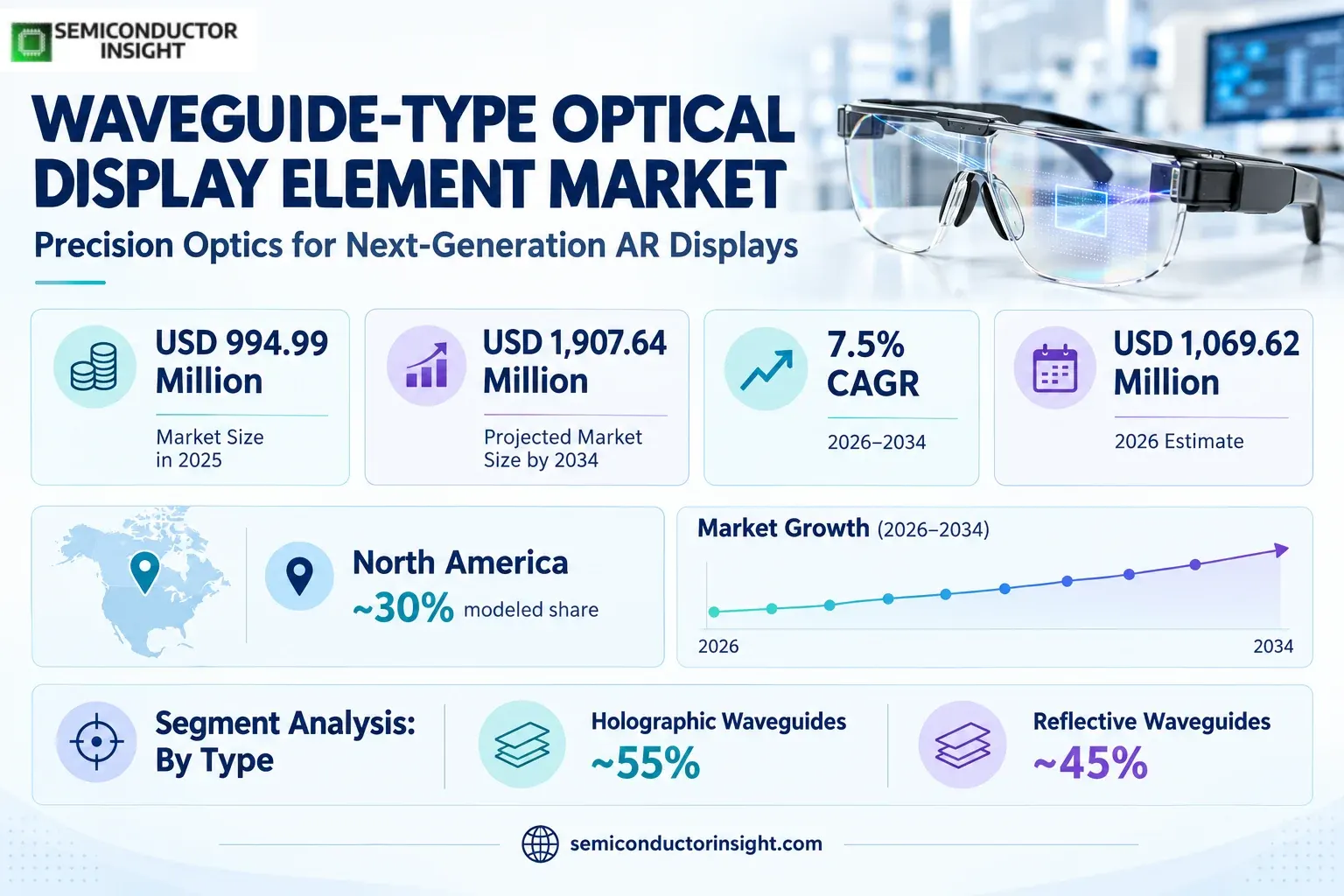
- Market value: waveguide-type optical display elements are modeled at USD 994.99 million in 2025 and projected to reach USD 1,907.64 million in 2034, with component demand supported by near-eye displays, enterprise visualization and improving optical manufacturing yields.
- Holographic Waveguides are the larger publisher-defined type at an estimated ~55% of base-year revenue, while Reflective Waveguide elements hold ~45%; the split distinguishes diffractive or holographic coupling structures from geometric mirror-based light routing.
- Wearable Display Device accounts for the largest application allocation at ~78% in 2025, ahead of Laptop at ~12% and Tablet at ~10%; eyewear integration imposes demanding requirements for optical efficiency, field of view and weight.
- North America has the largest modeled regional share at ~30%, followed by Asia-Pacific at ~29% and Europe at ~27%; the remaining ~14% is divided between South America and Middle East and Africa.
- Commercialization constraints include high-index substrate quality, nanometre-scale grating fabrication, reflective-layer alignment, brightness efficiency, color uniformity and the yield of complete optical assemblies. Supplier partnerships increasingly link specialist designs with industrial-scale manufacturing.
Waveguide-Type Optical Display Element Market Overview
waveguide-type optical display element market was valued at USD 994.99 million in 2025 and is projected to reach USD 1,907.64 million by 2034, registering a 7.5% CAGR over 2026–2034. North America is the largest modeled region, representing ~30% of 2025 revenue. The 2026 estimate is USD 1,069.62 million as the commercial base expands.
A waveguide display element directs a miniature projector’s light through a transparent optical plate toward the viewer while allowing the real world to remain visible. An input coupler injects the image, total internal reflection carries it through the substrate, and an output coupler releases light into the eye box. Optical pupil expansion helps a small projector serve a practical range of eye positions. The resulting assembly can be integrated into smart glasses, industrial head-mounted displays or other compact visualization systems.
The revenue boundary covers finished holographic or diffractive waveguide elements, geometric reflective waveguides and qualifying optical display subassemblies sold to equipment integrators for the publisher’s wearable, laptop and tablet application categories. It excludes complete glasses and headsets, finished laptop or tablet computers, standalone microdisplay engines, raw glass wafers sold without waveguide processing and ordinary backlight light guides. This distinction matters because the price of a finished wearable device includes electronics, cameras, batteries and software beyond its optical element.
Holographic and diffractive approaches use structured optical gratings to couple and expand light, while geometric reflective architectures route the image through arrays of partially reflective surfaces. Both can create transparent near-eye displays, but they differ in color management, fabrication methods, angular bandwidth and manufacturing yield. The appropriate choice depends on field of view, eyebox size, projector brightness, substrate refractive index and allowable thickness rather than on one universally superior optical architecture.
Optical efficiency is commercially important because wearable displays operate from small batteries and must remain legible in bright surroundings. High-index substrates can widen the angular range carried by total internal reflection, but their density, transmission, flatness and durability affect weight and yield. SCHOTT introduced an advanced lightweight glass composition in September 2026, illustrating the material engineering behind slimmer full-color designs. Finished waveguide production still requires accurate patterning, coating and final inspection.
The market is shifting from laboratory demonstrations toward application-specific manufacturing programs. Vuzix reported production activity in defense wearables and presented component reference designs with Himax and Avegant, while SCHOTT announced serial production capability for geometric reflective waveguides. Dispelix has pursued polymer optical substrates and a manufacturing-oriented partnership with AAC Technologies. These developments support an expanding ecosystem, although a design win or reference demonstration is not equivalent to verified global shipment revenue.
Segment Analysis: By Type
By type, the market contains Holographic Waveguides and Reflective Waveguide elements. Holographic structures are modeled at ~55% of 2025 revenue because diffractive coupling has been widely developed for transparent AR eyewear. Reflective waveguides represent ~45%, supported by improvements in precision glass bonding and the emergence of serial manufacturing programs for geometric reflector assemblies.
| Type | Optical operating principle | Market implications |
|---|---|---|
| Holographic Waveguides | Holographic or diffractive waveguides use patterned gratings, volume holograms or related microstructures to inject, redirect and extract image light from a transparent substrate. Pupil expansion spreads a small projector’s output across a usable eyebox, enabling relatively slim near-eye optics. Performance depends on grating uniformity, wavelength response, angular acceptance and substrate quality. Different implementations can require multiple optical layers or sophisticated color-combining strategies. | Largest modeled type at ~55% of 2025 value. This category benefits from substantial engineering activity in smart glasses and from manufacturing approaches such as nanoimprint lithography. Its modeled ~8.0% growth reflects broader OEM evaluation and progress toward full-color thin optics. Technical constraints include color nonuniformity, stray light, limited optical efficiency and the need for repeatable nanostructures across many substrates. |
| Reflective Waveguide | Geometric reflective waveguides guide light using embedded partially reflective surfaces or mirror arrays rather than relying primarily on diffractive gratings. Carefully designed reflector geometry can provide wide field-of-view performance and efficient light delivery, but the fabrication process demands precise alignment, coating, polishing and bonding. Polymer reflective variants are also being developed as alternatives to complex glass assemblies, with different durability and scale-up considerations. | Modeled ~45% of 2025 revenue. SCHOTT and Lumus have described a manufacturing pathway for geometric reflective optics, while Optinvent promotes molded polymer reflective approaches. These competing process strategies could reduce unit costs as yields improve, although supplier technical claims require independent product qualification. The modeled ~6.9% growth reflects a substantial installed development base and increasing production readiness rather than universal adoption. |
Material and manufacturing distinctions
High-index glass supports compact optical geometry, while polymer substrates may reduce mass and open alternative forming processes. The choice influences refractive performance, impact resistance, coating adhesion, environmental durability and achievable production yield. These are cross-cutting material decisions rather than additional market types, and each finished element is assigned to the optical architecture responsible for its primary light-guiding function.
Finished elements also differ by monochrome versus full-color operation, single-layer versus stacked construction and prescription integration. A consumer eyewear design may prioritize low mass and appearance, while a defense display may emphasize ruggedness and visibility under demanding lighting conditions. These engineering variations affect selling price and qualification without changing the publisher’s two top-level type categories.
Segment Analysis: By Application
The publisher identifies Wearable Display Device, Laptop and Tablet as applications. Wearable Display Device is the dominant modeled destination at ~78% of 2025 revenue because waveguides are especially useful when the image must be projected into the user’s view through a transparent eyepiece. Laptop and tablet applications remain smaller, specialized optical integration opportunities rather than substitutes for conventional flat-panel screens.
| Application | Demand characteristics |
|---|---|
| Wearable Display Device | Largest application at ~78% of base-year revenue. Smart glasses, industrial head-mounted systems and defense visualization equipment use optical waveguides to place data within the wearer’s view while preserving situational awareness. Device designers need adequate eyebox size, legible brightness and acceptable weight for prolonged use. Production orders and reference designs in 2025–2026 demonstrate movement beyond pure prototypes, though different programs remain at different commercialization stages. |
| Laptop | Modeled ~12% of 2025 revenue. Laptop-related optical display elements represent compact projection, near-eye companion or specialized integrated visualization designs rather than the standard LCD or OLED notebook screen. The market is limited by integration complexity and competition from mature display panels, but specialized enterprise workflows can justify optical overlays. Its modeled ~5.0% annual growth is lower than wearables because mainstream notebook replacement does not require a transparent waveguide. |
| Tablet | Modeled ~10% of base-year value. Tablet applications encompass niche transparent display elements and companion optical viewing systems associated with portable computing, not the value of entire tablets. Form-factor restrictions, battery consumption and viewing-angle requirements limit broad substitution for conventional displays. The modeled ~6.2% expansion reflects selective professional and educational use cases where a see-through image or head-up interaction provides a functional advantage. |
The application segmentation measures the primary destination of each optical element rather than the full value of a finished computing product. A waveguide supplied for smart glasses is counted once under Wearable Display Device even if the user connects those glasses to a laptop or tablet. This prevents overlap between host-device ownership and optical-component demand. Commercial opportunities are strongest when the waveguide solves a visibility or ergonomic problem that a conventional display cannot address efficiently.
Regional Analysis
Regional demand for waveguide optical display elements reflects the location of system integrators, optical engineering teams, precision glass processing and end-use deployments. North America leads the modeled 2025 allocation at ~30%, with Asia-Pacific at ~29% and Europe at ~27%. South America accounts for ~8% and Middle East and Africa for ~6%. These are analytical shares of the defined finished-element category, not audited national revenue statistics.
Which regions are most important for waveguide optical display elements?
Waveguide commercialization crosses borders: an optical design may originate in the United States or Israel, use specialty glass produced in Germany, undergo wafer processing in Asia and enter a wearable system assembled elsewhere. Revenue location is assigned by customer market rather than by every intermediate production step. The regional picture is therefore influenced by enterprise adoption and OEM procurement as well as manufacturing capacity. Differences in defense programs, smart-glasses trials and industrial use shape the growth outlook.
| Region | Position | Growth outlook | Demand profile | What decides supplier selection |
|---|---|---|---|---|
| North America | Largest (~30%) | Steady (~7.2% CAGR) | Defense and enterprise-led | OEM development contracts, display integration and local optics capability |
| Asia-Pacific | Second (~29%) | Fastest (~8.5% CAGR) | Manufacturing scale-led | Precision wafer processing, eyewear assembly and materials partnerships |
| Europe | Third (~27%) | Established (~7.0% CAGR) | Materials and design-led | High-index glass, polymer optics and industrial applications |
| South America | Fourth (~8%) | Emerging (~8.0% CAGR) | Pilot deployment-led | Importer support, industrial productivity and specialist system integrators |
| Middle East & Africa | Fifth (~6%) | Selective (~5.3% CAGR) | Project procurement-led | Defense evaluation, service coverage and harsh-environment reliability |
Key Waveguide Optical Display Manufacturers and Competitive Landscape
The waveguide display element supply base combines specialized optical design companies, precision glass manufacturers, high-volume electronics partners and system integrators. Vuzix, DigiLens, Dispelix, Lumus, SCHOTT and Optinvent illustrate different positions in the value chain, while larger technology companies influence device specifications and future demand. The publisher also names several finished-product brands and acquired businesses, which should not be treated as independent merchant waveguide manufacturers without product-level verification.
Competition begins with optical architecture. Diffractive specialists optimize grating geometry, color uniformity and pupil expansion, while geometric reflective suppliers emphasize efficient light routing and wide field of view. Both approaches require high-quality substrates and tightly controlled fabrication. Intellectual property can determine which contract manufacturers are licensed to produce a design, so a customer’s supplier choice involves long-term access to patents and process expertise as well as the price of each finished element.
Production capability is becoming more decisive as programs move beyond samples. SCHOTT described serial manufacturing of geometric reflective waveguides in September 2025, drawing on a partnership with Lumus and an international processing network. Dispelix announced a definitive acquisition agreement with AAC Technologies in November 2025, seeking closer integration of design knowledge with precision manufacturing. These developments indicate the importance of industrial yield and capacity, but the announcements do not disclose a complete global market-share ranking.
Vuzix has documented customized optical component programs for defense and enterprise customers, including production shipments and collaborative reference designs. DigiLens focuses on waveguide-enabled smart glasses and enterprise software compatibility. Their positions differ from finished-device platform companies such as Microsoft and Apple, which can influence procurement but should not automatically be counted as independent sellers of standalone optical elements. Acquired identities also need careful treatment: WaveOptics belongs to Snap, and Akonia Holographics became part of Apple.
Component economics depend on manufacturing process maturity and the optical specification ordered. A single-layer polymer element may pursue low mass, whereas a high-index glass reflective design can require precise coating and bonding. Customers compare optical efficiency, field of view, color performance, prescription integration, defect rate and price at qualified volume. Suppliers that offer application engineering and repeatable production can retain programs through several device generations, even if they do not lead the consumer market in brand recognition.
Tier structure
| Tier | Companies | Basis of competition |
|---|---|---|
| Tier 1 | Vuzix, DigiLens, Dispelix, Lumus, SCHOTT | These organizations have identifiable optical design, manufacturing or waveguide component activity, with public technical descriptions and commercial partnerships. Their positions are differentiated: some own optical architecture and customer programs, while others specialize in glass processing and manufacturing scale. This tier indicates direct relevance to the finished-element value chain rather than audited market share or equal business scale. |
| Tier 2 | Optinvent, TruLifeOptics, Kura AR, selected OEM optical specialists | Focused developers address particular waveguide architectures, application requirements or wearable display systems. They may offer polymer optical solutions, compact projection designs or integration expertise, but production volumes and product scope vary. A developer’s participation in a demonstration or patent program should not be mistaken for evidence of a large merchant revenue base. Their opportunities depend on OEM qualification and manufacturable yield. |
| Tier 3 | Microsoft HoloLens, Magic Leap, Apple / Akonia, Snap / WaveOptics, Kopin | These names are important as device platforms, acquired optical technology assets or adjacent microdisplay suppliers. HoloLens and Microsoft are one platform identity, and Vuzix Corporation is not a separate competitor from Vuzix. Kopin supplies microdisplay and optical-system technology that can be integrated with waveguides but is not necessarily the merchant producer of every finished waveguide. The tier avoids attributing unsupported standalone element sales. |
Key companies profiled
- Microsoft HoloLens
- Magic Leap One
- WaveOptics
- DigiLens
- Vuzix
- Apple (Akonia Holographics)
- TruLifeOptics
- Lumus
- Kura AR
- Kopin Corporation
- Dispelix Oy
- Optinvent
- SCHOTT
Waveguide Optical Display Element Production Capacity Analysis
Waveguide production requires a chain of optical glass or polymer preparation, microstructure formation, coating, bonding, inspection and final element qualification. Capacity cannot be inferred from raw wafer diameter alone because usable optical elements per wafer depend on geometry, field-of-view requirements and defect yield. Manufacturers are investing in processes that reproduce nanoscale or precisely aligned reflective structures at scale, with Asia-Pacific processing facilities complementing European and North American optical design.
Diffractive waveguides may use nanoimprint lithography or other grating fabrication techniques to form coupling and pupil-expansion structures on high-quality substrates. Uniform feature depth and placement are essential for consistent brightness and color across the eyebox. A small process defect can make an otherwise functional optical plate unsuitable for a premium wearable device, so inspection and scrap rates influence effective capacity. Increasing wafer size can improve throughput only when tooling and defect control remain adequate.
Geometric reflective waveguides use arrays of partially reflecting surfaces that must be positioned and bonded accurately. SCHOTT’s September 2025 announcement described serial production after investment in processing and coating capability, with operations spanning optical glass manufacture and Asian component finishing. The commercial importance is a route to repeatable output for device makers evaluating higher volumes. Production readiness does not remove the need to qualify each customer-specific optical geometry and environmental requirement.
New material approaches could alter capacity economics. Dispelix and Mitsui Chemicals demonstrated polymer waveguide optics using specialized Diffrar substrates, while Optinvent promotes molded polymer reflective elements. Lower mass and alternative forming processes may be attractive for eyewear, but manufacturing scale must be supported by data on optical uniformity, durability and final yield. Material substitution can also require different coatings and assembly methods, so existing glass production lines are not necessarily interchangeable with polymer processes.
Vuzix’s Shrike platform illustrates the breadth of optical acceptance criteria. Its September 2026 announcement identifies a 40-degree field of view, 1280 by 720 image format, 16:9 aspect ratio and 3000-nit brightness. The system also specifies 25 millimeters of eye relief and a 14.3 by 14 millimeter eye box. These are system-level design targets, not a forecast of finished waveguide output, but they show how many measurements an OEM must qualify before production.
SCHOTT described its newest optical substrate in 2026 with refractive index 2.0, density below 4 grams per cubic centimeter and supply in 150, 200 and 300 millimeter wafer diameters. It also identified rectangular formats as large as 310 by 310 millimeters and blue-light transmission above 96% at 460 nanometers across a 10 millimeter optical path. These specifications show that waveguide production must optimize mass, transmission and processable dimensions together rather than maximizing index alone.
The January 2026 Vuzix-Himax reference architecture provides another engineering benchmark: a 720 by 720 color-sequential LCoS image source, projector volume of 0.34 cubic centimeters and mass of 0.79 grams, paired with a waveguide plate that can be 0.35 millimeters thin. The collaborators described configurations around a 30-degree field of view and brightness exceeding 1000 nits. This combination matters because reducing projector bulk has limited value unless the optical exit pupil and eye relief remain useful.
Optinvent’s 2026 supplier analysis describes its ORA-Lens reflective polymer approach with a 50-degree field of view, optical efficiency claims reaching 5000 nits per lumen, mass near 4 grams and a nominal image focus around 1.5 meters. The company says the assembly uses 2 molded polymer parts and draws on 40 international patents. These are developer-reported design figures rather than independently audited production yields, but they frame a potentially different cost structure from precision-bonded glass optics.
For comparison across architectures, engineering teams often assess a 2025 prototype against a 2026 revision using the same 3 key performance dimensions: field of view, eye box and optical efficiency. A 1-layer color architecture can reduce stacking, but it may impose harder spectral constraints than a 2-layer approach; similarly, 150 millimeter and 300 millimeter substrates offer different theoretical die counts. The final decision depends on inspection yield and usable optical area, not nominal wafer diameter.
Waveguide Optical Display Element Market Dynamics: Drivers, Restraints and Opportunities
Growth is driven by more capable smart glasses, enterprise and defense wearable programs, improved optical efficiency, manufacturing partnerships and new substrate materials. The market also faces difficult cost and quality constraints: optical defects reduce yield, high-index materials can add expense, and device makers must balance field of view against brightness and weight. The net 7.5% annual growth path reflects gradual commercial qualification rather than immediate mass adoption across every consumer device category.
MARKET DRIVERS
Drivers Impact Analysis*
| Market Drivers | Impact Rank | CAGR Contribution (%) | 2026–2028 | 2029–2031 | 2032–2034 |
|---|---|---|---|---|---|
| Enterprise and defense wearable deployment | High | +3.20% | High | High | Medium |
| Improved optical efficiency and field-of-view capability | High | +2.60% | High | High | High |
| Precision manufacturing and yield scale-up | Medium-High | +2.00% | Medium | High | High |
| Consumer smart-glasses design activity | Medium | +1.50% | Medium | High | High |
| High-index and polymer material innovation | Low-Medium | +1.00% | Medium | Medium | High |
| Others (prescription integration, software ecosystems, OEM partnerships) | Low | +0.70% | Low | Medium | Medium |
Industrial programs convert trials into component orders
A waveguide-based wearable can place instructions, sensor readings or remote expert guidance in a worker’s view while leaving both hands available. The business case is strongest in tasks where looking away from machinery or a patient is costly. Vuzix has reported specific customer-funded and production-stage programs, providing evidence that some applications have advanced beyond demonstration units. These orders support a repeatable component channel even when consumer smart-glasses volumes remain uncertain.
Optical design improves brightness and usable eye position
Waveguide efficiency determines how much projector light reaches the eye and therefore affects battery size, thermal design and outdoor legibility. Developers are optimizing coupling structures, reflector geometry and pupil expansion to improve the viewing experience without making eyewear bulky. A larger usable eyebox reduces the precision required when the glasses move on the wearer’s face. Better optical performance can support higher selling prices and broader adoption in demanding professional settings.
Manufacturing partnerships address the yield bottleneck
The transition from a working optical prototype to qualified volume output requires process control across substrates, coatings, alignment and inspection. SCHOTT’s reflective-waveguide serial production announcement and Dispelix’s proposed integration with AAC Technologies both reflect the need for manufacturing capability alongside optical intellectual property. As effective yields improve, suppliers can quote more predictable costs and delivery schedules, making it easier for OEMs to commit to multiyear wearable product programs.
Consumer designs require thinner and lighter components
A transparent display must fit within eyewear that people are willing to wear for extended periods. Thinner optical plates, prescription compatibility and compact projector modules can reduce bulk while preserving useful image brightness. The Vuzix-Himax reference design and polymer waveguide demonstrations illustrate different engineering responses to this constraint. Commercial success will depend on integrating the optics with batteries, cameras and processing hardware without making the final device uncomfortable or prohibitively expensive.
MARKET RESTRAINTS
Restraints Impact Analysis*
| Market Restraints | Impact Rank | CAGR Contribution (%) | 2026–2028 | 2029–2031 | 2032–2034 |
|---|---|---|---|---|---|
| Complex fabrication and optical yield losses | High | -1.40% | High | High | Medium |
| Brightness, color and field-of-view trade-offs | Medium-High | -1.00% | High | Medium | Medium |
| High component and qualification cost | Medium | -0.70% | High | Medium | Low |
| Others (wearability, environmental durability, competing display architectures) | Low | -0.40% | Medium | Medium | Low |
Manufacturing precision limits effective capacity
Diffractive gratings and partially reflective mirror structures must be fabricated with high uniformity over the usable optical area. Small defects can produce stray light, uneven color or unacceptable image artifacts, making finished-element yield lower than the raw number of substrates processed. Specialized inspection and rework add cost, and a customer-specific optical design may require a new process window. These factors slow the movement from sample demonstrations to economically viable large-scale production.
Optical performance requirements conflict with form factor
A wider field of view and larger eyebox can demand more sophisticated waveguide geometry or higher-index substrates, while greater brightness can increase projector power consumption. The device must still remain transparent, comfortable and safe for prolonged wear. No architecture eliminates every trade-off, and different applications tolerate different compromises. An industrial monocular display may prioritize rugged visibility, whereas consumer eyewear may place greater weight on appearance and low mass.
OEM qualification cycles are long and expensive
An optical element cannot be evaluated independently of the microdisplay, prescription lens, frame and mechanical alignment. Device makers test environmental durability, color consistency, stray light and user comfort before committing to volume orders. Changes in one component can trigger further validation of the entire display engine. This slows revenue recognition for suppliers and can make the timing of production ramps unpredictable even after a promising design win has been announced.
Alternative displays can satisfy simpler use cases
Conventional LCD, OLED and microLED screens remain efficient solutions when transparency or a head-up viewing position is unnecessary. A tablet, handheld terminal or direct-view monitor can often deliver more pixels at lower cost than a waveguide-based wearable. The optical element must therefore enable a clear workflow or ergonomic benefit to justify its premium. This limits adoption in mainstream laptop and tablet applications and reinforces the dominance of specialized wearable display demand.
MARKET OPPORTUNITIES
Prescription-ready smart glasses for broader use
Integrating corrective lenses with a thin waveguide can make an AR device practical for users who otherwise need separate glasses or uncomfortable inserts. Vuzix and Himax described a prescription-ready reference architecture in January 2026, demonstrating that optical integration is becoming part of system design rather than a late accessory decision. Suppliers able to maintain image quality across prescription options may win consumer and enterprise programs that value all-day wearability.
Geometric reflective manufacturing at industrial scale
Serial production capability creates opportunities for optical designers whose prototypes previously faced uncertain costs or lead times. SCHOTT and Lumus have advanced a reflective waveguide platform that uses precision glass processing and partially reflective surfaces. Device makers can evaluate this architecture for applications requiring efficient light delivery and broad viewing angles, although each design still needs qualification. Manufacturing scale is especially valuable when an OEM plans multiple product generations.
Polymer waveguides for lower-mass eyewear
Polymer substrates and molded optical structures could reduce the mass of near-eye displays and potentially simplify some manufacturing steps. Dispelix and Mitsui Chemicals have demonstrated a lightweight polymer waveguide, while Optinvent describes a reflective molded approach. The opportunity is conditional on meeting optical transmission, durability and environmental standards. Successful processes could support new eyewear form factors or enable lower price points for applications that cannot justify complex glass assemblies.
Defense and industrial systems with defined requirements
Specialized wearable displays can be purchased for clear operational functions such as maintenance guidance, tactical overlays and thermal information rather than for general entertainment. Customers may fund engineering development and low-rate production before a wider rollout, giving component suppliers a pathway to commercial revenue. These programs also create demanding reference cases for optical performance, ruggedness and integration that can inform later products in adjacent enterprise markets.
Waveguide Optical Display Element Supply Chain Analysis
The value chain begins with high-index glass, engineered polymers, coatings and microdisplay components before progressing through optical patterning, precision assembly, inspection and integration into wearable or specialized computing systems. Design intellectual property and process yield determine where value accumulates. Some suppliers focus on finished waveguide elements, while others provide the substrate or light engine needed to make the element useful inside a complete near-eye display.
Upstream. Substrate refractive index, transmission, density and flatness influence the range of optical designs a supplier can manufacture. SCHOTT’s RealView glass portfolio and polymer material collaborations show why raw materials are strategic inputs rather than interchangeable commodities. Microdisplay light engines are another dependency because projector size, wavelength and brightness affect waveguide coupling efficiency. Supplier qualification therefore considers the optical system as a whole even when the commercial revenue unit is the finished waveguide element.
Manufacturing. Diffractive processes form fine grating structures, while geometric reflective routes use coated and bonded mirror surfaces with demanding alignment tolerances. Both require clean handling and inspection because small defects can produce visible artifacts in the projected image. Production yield is measured on finished optical quality, not merely on wafers processed. Manufacturers investing in automated coating, precision tooling and repeatable inspection can reduce cost variation and offer customers more reliable delivery schedules.
Distribution. Waveguide elements usually reach end users through device manufacturers and system integrators rather than through ordinary consumer component retail. OEM customers provide optical specifications, approve samples and may fund custom development before placing production orders. The channel therefore depends on engineering collaboration, confidentiality and long-term supply commitments. A supplier with proven manufacturing capability can become embedded in a device platform, but a delayed system launch may still postpone component shipments.
Downstream. Wearable devices for enterprise, defense and consumer use place different demands on the optical assembly. A field-service system may value bright overlays and repairability, while consumer eyewear requires low mass and an unobtrusive appearance. Defense customers can add ruggedness and secure integration requirements. The optical element’s value is realized only when it works with the microdisplay, sensors, software and frame, so downstream system design remains a major influence on demand timing.
Recent Developments in the Waveguide Optical Display Element Market
- 29 September 2026 Introduced
Vuzix introduced the Shrike configurable waveguide display platform and began shipping evaluation units for defense and security customers. The platform was described with a 40-degree field of view, 1280 by 720 imagery and options for system integration. Its commercial significance is a ready-to-evaluate optical display assembly that can shorten early program development, while customer-specific qualification and eventual production volumes remain separate decisions. Source - 3 September 2026 Launched
SCHOTT announced RealView 2.0 lightweight glass wafers for advanced AR waveguides, describing refractive index 2.0, density below 4 grams per cubic centimeter and supply formats including 150, 200 and 300 millimeter wafers. The material development addresses the tension between optical field of view and wearable mass. The announcement concerns a substrate platform that supports waveguide production rather than direct sales of finished smart glasses. Source - 7 January 2026 Demonstrated
Vuzix and Himax presented a prescription-ready optical reference design pairing a compact 720 by 720 LCoS engine with a thin waveguide architecture. The projector was described as occupying 0.34 cubic centimeters, while the optical plate could support a 0.35 millimeter construction. The development illustrates integration progress for lighter eyewear and creates a potential OEM design pathway without establishing broad commercial shipment volumes. Source - 6 January 2026 Collaborated
Avegant and Vuzix announced a binocular smart-glasses reference design combining an AG-30L3 LCoS light engine, Vuzix waveguide optics and Quanta manufacturing involvement. The companies positioned the architecture for more practical cost, performance and wearability. Its significance lies in combining complementary optical and electronics capabilities in one evaluated system, an approach that can reduce integration risk for device makers considering a new product generation. Source - 18 November 2025 Agreed
Dispelix announced that AAC Technologies had signed a definitive agreement to acquire its equity securities, with closing expected during the first half of 2026. The strategic rationale was to combine diffractive waveguide design with precision manufacturing and device integration capabilities. The announcement signals consolidation around scalable optics supply; it should be described as an agreement rather than a completed transaction unless a separate closing disclosure is established. Source - 29 September 2025 Scaled
SCHOTT announced serial production of geometric reflective waveguides following development with Lumus and investment in precision processing. The supplier described an integrated chain from optical glass manufacture to finished component assembly, including expanded capacity in Malaysia. The event matters because high-volume process readiness has been a major constraint on transparent AR optics, although device-specific field of view and quality targets still determine usable output. Source - 22 April 2025 Partnered
Dispelix and Mitsui Chemicals announced a polymer waveguide collaboration using Diffrar substrates, including a demonstrated eyepiece weighing 1.85 grams without cover glass. The project explores lower-mass full-color optics as an alternative to some conventional glass structures. Its potential commercial impact depends on optical uniformity, durability and manufacturing economics after scale-up, so the demonstration should not be equated with mass-market consumer device adoption. Source
REPORT SCOPE & SEGMENTATION
| Attribute | Details |
|---|---|
| Study Period | 2020–2034 |
| Base Year | 2025 |
| Estimated Year | 2026 |
| Forecast Period | 2026–2034 |
| Historical Period | 2020–2024 |
| Market Size 2025 | USD 994.99 million |
| Market Size 2026 | USD 1,069.62 million |
| Market Size 2034 | USD 1,907.64 million |
| Growth Rate | CAGR of 7.5% from 2026–2034 |
| Unit | Value (USD Million); element shipments and optical specifications where supported |
| Segmentation | By Type, By Application and By Region |
| By Type | Holographic Waveguides · Reflective Waveguide |
| By Application | Wearable Display Device · Laptop · Tablet |
| By Region | Each region is assessed for optical design, materials, manufacturing, OEM qualification and end-use programs. North AmericaUnited States, Canada, Mexico EuropeGermany, Finland, France, United Kingdom, Rest of Europe Asia-PacificChina, Japan, Taiwan, South Korea, Malaysia, Rest of Asia-Pacific South AmericaBrazil, Argentina, Chile, Colombia, Rest of South America Middle East & AfricaSaudi Arabia, United Arab Emirates, South Africa, North Africa, Rest of Middle East & Africa |
| Key Companies Profiled | Microsoft HoloLens, Magic Leap One, WaveOptics, DigiLens, Vuzix, Apple (Akonia Holographics), TruLifeOptics, Lumus, Kura AR, Kopin Corporation, Dispelix Oy, Optinvent, SCHOTT |
| Customization Scope | Additional country-level optical component analysis, holographic versus reflective process comparisons, qualified production capacity and device-integration mapping can be commissioned. |
Frequently Asked Questions
What is the size of the waveguide optical display element market?
The global finished-element market is modeled at USD 994.99 million in 2025 and USD 1,907.64 million in 2034, representing a 7.5% CAGR across the 2026–2034 framework. The series is derived from the publisher’s 2023 and 2030 headline monetary endpoints. It covers qualifying transparent optical display elements and subassemblies rather than the entire price of smart glasses, laptops or other finished devices.
How does a waveguide display produce a virtual image?
A miniature projector injects image light into a transparent optical substrate through an input coupling structure. Total internal reflection carries the light across the element, and output structures redirect it toward the viewer’s eye. Pupil expansion can enlarge the usable eye box, helping the image remain visible as the glasses shift on the face. The optical plate must also transmit the surrounding scene with acceptable clarity and minimal color distortion.
Which waveguide type has the largest modeled share?
Holographic Waveguides lead the type allocation at ~55% of 2025 revenue, while Reflective Waveguide elements account for ~45%. The former uses grating or holographic structures to couple and extract light, whereas the latter relies on geometric reflection from partially reflective surfaces. These are separate optical architectures with different manufacturing processes and trade-offs. The modeled percentages are market allocations rather than audited sales figures for individual manufacturers.
What application drives the greatest component demand?
Wearable Display Device is the largest application with an estimated ~78% of base-year revenue. Transparent waveguides are particularly useful in smart glasses, industrial head-mounted displays and defense wearables because the wearer can see digital information without losing the external scene. Laptop and Tablet applications remain smaller specialist categories at ~12% and ~10%, respectively. The allocation measures the optical element’s primary destination, not all devices that may connect to a headset.
Which region is the largest market for optical display waveguides?
North America is assigned the largest modeled 2025 share at ~30%, followed by Asia-Pacific at ~29% and Europe at ~27%. North America has visible defense and enterprise optical programs, Asia-Pacific provides important manufacturing capability, and Europe contributes specialty materials and design expertise. South America and Middle East and Africa together represent the remaining ~14%. Regional shares are scenario allocations informed by the ecosystem, not a country-level audited revenue census.
What limits the manufacturing scale of these optical elements?
Waveguide production requires extremely consistent gratings or mirror structures, optical coating, substrate flatness and precise alignment. Small defects can cause brightness variation, ghost images or unacceptable color artifacts, reducing finished yield even when raw wafer throughput is high. Customer-specific optical geometry also requires qualification and can limit reuse of a manufacturing recipe. Suppliers invest in inspection, process control and materials engineering to reduce scrap and achieve predictable unit costs.
How do reflective and holographic waveguides differ?
Reflective waveguides redirect light using embedded partially reflective surfaces or mirror arrays, while holographic or diffractive designs employ structured gratings or volume holograms. Both guide images through transparent materials and seek a usable field of view with acceptable optical efficiency. They differ in fabrication methods, wavelength behavior and alignment demands. The better option depends on the projector, eyewear form factor, brightness target, prescription integration and production process rather than a single headline specification.
Which companies are active in the waveguide ecosystem?
Relevant direct participants include Vuzix, DigiLens, Dispelix, Lumus, SCHOTT and Optinvent, alongside specialist optical developers and manufacturing partners. Microsoft HoloLens, Magic Leap and Apple are better understood primarily as finished-device or platform identities, while Kopin has a strong microdisplay and optical-system role. WaveOptics and Akonia Holographics are acquired technology assets. These distinctions help avoid double-counting companies or attributing unsupported merchant waveguide sales.
Why are high-index glass and polymer substrates important?
A higher refractive index can support a wider range of light propagation angles in a compact optical element, while lower material density helps keep wearable devices comfortable. SCHOTT’s advanced glass wafers and polymer research involving Dispelix and Mitsui Chemicals illustrate different strategies. Material selection also affects transmission, durability, coating adhesion and processing yield. A lightweight substrate is useful only when the finished element still meets the required optical and environmental specifications.
What is the commercial outlook for waveguide-enabled wearables?
The most tangible opportunities are application-specific systems that provide a clear operational benefit, including industrial assistance, defense visualization and specialized professional training. Consumer eyewear may offer larger eventual volumes, but success requires acceptable weight, brightness, prescription compatibility and cost. Reference designs and serial production announcements show progress in integration and manufacturing. They do not guarantee that every announced device program will move directly to large-scale shipments or generate the same revenue per optical element.
Research Sources & Evidence Base

Get Sample Report PDF for Exclusive Insights
Report Sample Includes
- Table of Contents
- List of Tables & Figures
- Charts, Research Methodology, and more...
 Download Sample Report PDF