Key Statistics
Key Takeaways
- Wafer carrier tray market was valued at USD 603.9 million in 2025 and is projected to reach USD 1.06 billion by 2034, representing a 6.4% CAGR over 2026–2034.
- The market is valued at USD 603.9 million in 2025 and is projected to reach USD 1.06 billion by 2034, representing a 6.4% CAGR over 2026–2034.
- 300mm carriers account for the largest value because leading logic and memory fabs rely on automated wafer handling and strict microenvironment control throughout hundreds of process steps.
- Semiconductor applications dominate, while advanced packaging is increasing demand for carriers designed around thin, thick, bonded and warped wafers rather than standard flat substrates.
- Asia Pacific leads because Taiwan, South Korea, China and Japan host the world’s largest wafer-fabrication and wafer-material ecosystems.
Wafer Carrier Tray Market Overview
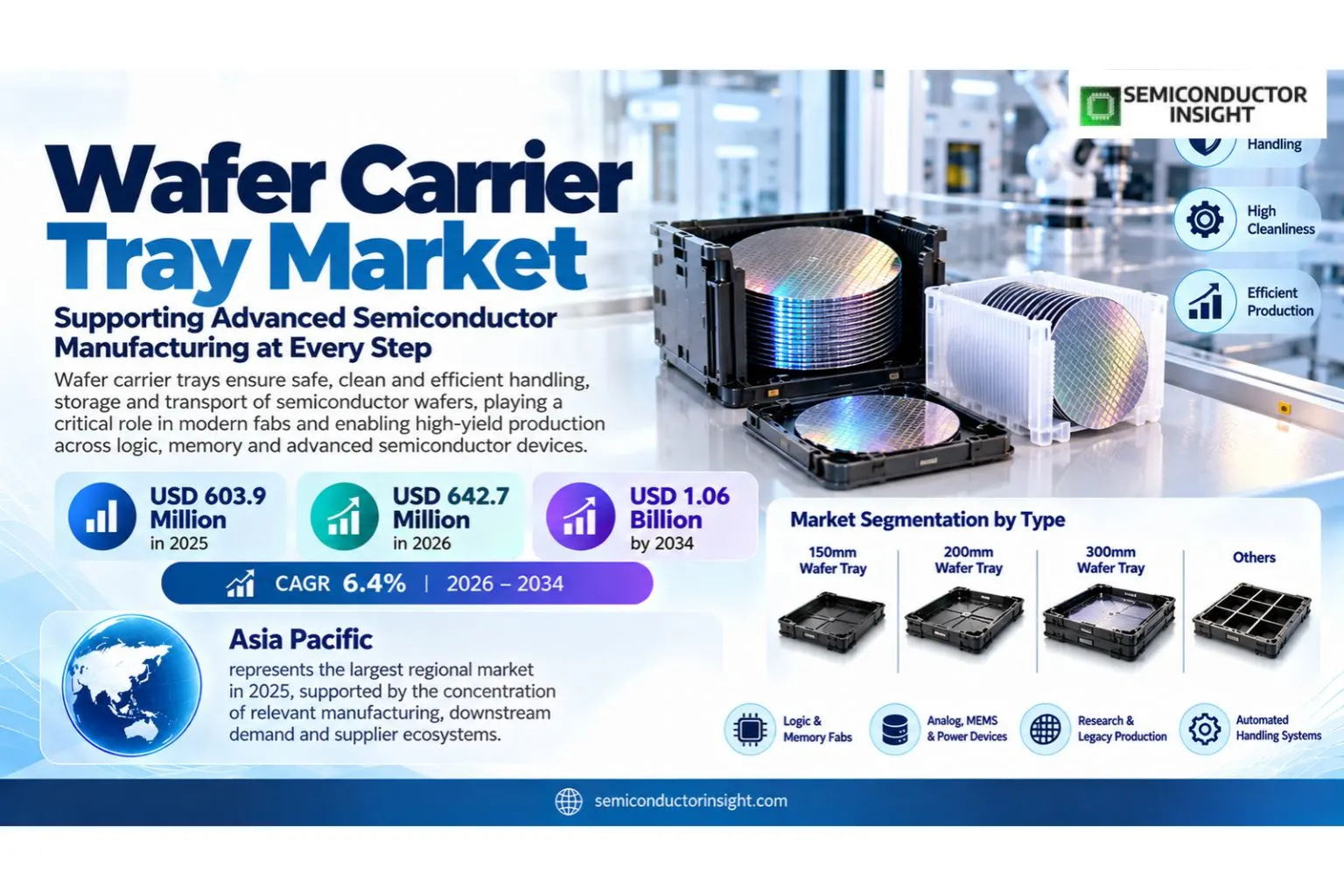
Wafer carrier tray market was valued at USD 603.9 million in 2025, is estimated at USD 642.7 million in 2026, and is projected to reach USD 1.06 billion by 2034, advancing at a 6.4% CAGR during 2026–2034. Asia Pacific represents the largest regional market in 2025, supported by the concentration of relevant manufacturing, downstream demand and supplier ecosystems.
Wafer carrier trays, cassettes, FOUPs and shipping boxes protect semiconductor wafers during transport, storage and automated fab movement. The products must control particles, electrostatic charge, moisture and mechanical contact while maintaining exact wafer spacing for robotic handling.
Carrier requirements are becoming more specialized as 300mm fabs automate more material movement and advanced packaging introduces thin, bonded, warped or heavy wafers. High-purity polymers, conductive materials, purge capability and RFID identification increasingly determine carrier value, especially where a contaminated or damaged wafer can compromise many high-value dies.
The commercial structure of the wafer carrier tray market is shaped by design qualification, production economics and the interaction between component performance and downstream system requirements. Suppliers that can combine consistent manufacturing, application engineering and supply assurance are better positioned to convert technical eligibility into repeat business. Customer decisions increasingly account for lifecycle continuity, geographic resilience and integration cost, which makes proven process control and ecosystem compatibility as important as nominal product capability.
Segment Analysis: By Type
By type, the Wafer Carrier Tray market is segmented into 150mm Wafer Tray, 200mm Wafer Tray, 300mm Wafer Tray, Others. 300mm products dominate value because FOUPs and automated carriers are standard in leading logic and memory fabs. 200mm remains important in analog, MEMS and power semiconductors, while smaller carriers support research and legacy production. Purchasing decisions vary by performance requirement, qualification burden, integration complexity and lifecycle economics, so suppliers compete on application fit rather than on a single technical specification.
| Type | Role in the market | Demand characteristics |
|---|---|---|
| 150mm Wafer Tray | 150mm Wafer Tray addresses a distinct part of the product and process mix. Its commercial position depends on technical fit, manufacturing maturity, integration requirements and customer qualification rather than on headline specifications alone. | Demand is strongest where the segment aligns with established customer designs, predictable supply, and measurable system-level performance. Suppliers that can document repeatability, compatibility and lifecycle support are better placed to defend design wins. |
| 200mm Wafer Tray | 200mm Wafer Tray addresses a distinct part of the product and process mix. Its commercial position depends on technical fit, manufacturing maturity, integration requirements and customer qualification rather than on headline specifications alone. | Demand is strongest where the segment aligns with established customer designs, predictable supply, and measurable system-level performance. Suppliers that can document repeatability, compatibility and lifecycle support are better placed to defend design wins. |
| 300mm Wafer Tray | 300mm Wafer Tray addresses a distinct part of the product and process mix. Its commercial position depends on technical fit, manufacturing maturity, integration requirements and customer qualification rather than on headline specifications alone. | Demand is strongest where the segment aligns with established customer designs, predictable supply, and measurable system-level performance. Suppliers that can document repeatability, compatibility and lifecycle support are better placed to defend design wins. |
| Others | Others addresses a distinct part of the product and process mix. Its commercial position depends on technical fit, manufacturing maturity, integration requirements and customer qualification rather than on headline specifications alone. | Demand is strongest where the segment aligns with established customer designs, predictable supply, and measurable system-level performance. Suppliers that can document repeatability, compatibility and lifecycle support are better placed to defend design wins. |
Segment Analysis: By Material
By material, the Wafer Carrier Tray market is segmented into High-Purity Plastics, PFA / PBT / PC, Advanced Composites, Others. High-purity PC, PBT and PFA are widely used because they combine chemical resistance, dimensional control and low contamination. Conductive fillers and barrier materials are added where electrostatic discharge or moisture control is important. Purchasing decisions vary by performance requirement, qualification burden, integration complexity and lifecycle economics, so suppliers compete on application fit rather than on a single technical specification.
| Material | Role in the market | Demand characteristics |
|---|---|---|
| High-Purity Plastics | High-Purity Plastics represents a relevant purchasing and deployment pathway within this market. Commercial attractiveness depends on how well it aligns with customer architecture, supply-chain constraints and required performance. | Growth is linked to design-in activity, installed-base transitions and the ability of suppliers to meet qualification, cost and availability requirements over the full product lifecycle. |
| PFA / PBT / PC | PFA / PBT / PC represents a relevant purchasing and deployment pathway within this market. Commercial attractiveness depends on how well it aligns with customer architecture, supply-chain constraints and required performance. | Growth is linked to design-in activity, installed-base transitions and the ability of suppliers to meet qualification, cost and availability requirements over the full product lifecycle. |
| Advanced Composites | Advanced Composites represents a relevant purchasing and deployment pathway within this market. Commercial attractiveness depends on how well it aligns with customer architecture, supply-chain constraints and required performance. | Growth is linked to design-in activity, installed-base transitions and the ability of suppliers to meet qualification, cost and availability requirements over the full product lifecycle. |
| Others | Others represents a relevant purchasing and deployment pathway within this market. Commercial attractiveness depends on how well it aligns with customer architecture, supply-chain constraints and required performance. | Growth is linked to design-in activity, installed-base transitions and the ability of suppliers to meet qualification, cost and availability requirements over the full product lifecycle. |
Segment Analysis: By Application
By application, the Wafer Carrier Tray market is segmented into Semiconductor, Solar Energy. Semiconductor manufacturing accounts for the majority of demand because carriers are used repeatedly across wafer fabrication and shipping. Solar-energy use is more cost focused and typically emphasizes durability and automated line handling over ultra-low contamination. Purchasing decisions vary by performance requirement, qualification burden, integration complexity and lifecycle economics, so suppliers compete on application fit rather than on a single technical specification.
| Application | Role in the market | Demand characteristics |
|---|---|---|
| Semiconductor | Semiconductor creates demand when the underlying system requires the market’s core function at production scale. Procurement is normally tied to platform launches, equipment upgrades, capacity expansion or replacement cycles. | Buyers evaluate reliability, qualification time, integration cost and vendor support alongside unit economics. Adoption accelerates when the solution removes a system bottleneck or supports a new performance tier without creating disproportionate redesign risk. |
| Solar Energy | Solar Energy creates demand when the underlying system requires the market’s core function at production scale. Procurement is normally tied to platform launches, equipment upgrades, capacity expansion or replacement cycles. | Buyers evaluate reliability, qualification time, integration cost and vendor support alongside unit economics. Adoption accelerates when the solution removes a system bottleneck or supports a new performance tier without creating disproportionate redesign risk. |
Segment Analysis: By End User
By end user, the Wafer Carrier Tray market is segmented into Foundries, Integrated Device Manufacturers, Wafer Manufacturers, OSATs & Advanced Packaging, Research Institutions. Foundries and IDMs use high-value process carriers, wafer manufacturers rely on shipping boxes, and advanced-packaging facilities increasingly need carriers for warped or nonstandard substrates. Purchasing decisions vary by performance requirement, qualification burden, integration complexity and lifecycle economics, so suppliers compete on application fit rather than on a single technical specification.
| End User | Role in the market | Demand characteristics |
|---|---|---|
| Foundries | Foundries represents a relevant purchasing and deployment pathway within this market. Commercial attractiveness depends on how well it aligns with customer architecture, supply-chain constraints and required performance. | Growth is linked to design-in activity, installed-base transitions and the ability of suppliers to meet qualification, cost and availability requirements over the full product lifecycle. |
| Integrated Device Manufacturers | Integrated Device Manufacturers represents a relevant purchasing and deployment pathway within this market. Commercial attractiveness depends on how well it aligns with customer architecture, supply-chain constraints and required performance. | Growth is linked to design-in activity, installed-base transitions and the ability of suppliers to meet qualification, cost and availability requirements over the full product lifecycle. |
| Wafer Manufacturers | Wafer Manufacturers represents a relevant purchasing and deployment pathway within this market. Commercial attractiveness depends on how well it aligns with customer architecture, supply-chain constraints and required performance. | Growth is linked to design-in activity, installed-base transitions and the ability of suppliers to meet qualification, cost and availability requirements over the full product lifecycle. |
| OSATs & Advanced Packaging | OSATs & Advanced Packaging represents a relevant purchasing and deployment pathway within this market. Commercial attractiveness depends on how well it aligns with customer architecture, supply-chain constraints and required performance. | Growth is linked to design-in activity, installed-base transitions and the ability of suppliers to meet qualification, cost and availability requirements over the full product lifecycle. |
| Research Institutions | Research Institutions represents a relevant purchasing and deployment pathway within this market. Commercial attractiveness depends on how well it aligns with customer architecture, supply-chain constraints and required performance. | Growth is linked to design-in activity, installed-base transitions and the ability of suppliers to meet qualification, cost and availability requirements over the full product lifecycle. |
Regional Analysis
Asia Pacific leads the wafer carrier tray market in 2025, while regional growth patterns differ according to manufacturing concentration, customer investment cycles, regulation, product mix and supply-chain access. The most important regional distinction is not simply market size; it is the mechanism that converts local investment and end-market demand into qualified purchases.
How does regional demand differ across the wafer carrier tray market?
Regional demand for wafer carrier tray is structurally uneven because manufacturing assets, design centers, downstream customers and qualification ecosystems are not distributed evenly. Asia Pacific typically has the deepest electronics manufacturing base, North America combines technology development with capital investment, Europe emphasizes reliability and industrial requirements, and emerging regions are more dependent on imported systems. These differences influence vendor selection, inventory policy, service expectations and the pace at which new technologies are adopted.
| Region | Market position | Growth outlook | Demand profile | Supplier-selection gate |
|---|---|---|---|---|
| Asia Pacific | Largest | Strong | Wafer fabrication and materials led | Cleanliness, automation compatibility and cost |
| North America | High-value market | Moderate-strong | Leading-edge fabs and materials led | Microenvironment control and lifecycle cost |
| Europe | Specialty manufacturing market | Moderate | Power, MEMS and research led | Mixed wafer sizes and long lifecycle |
| South America | Emerging | Selective | Research and solar led | Fab installed base |
| Middle East & Africa | Developing | Selective | Research and emerging semiconductor led | Manufacturing ecosystem scale |
Detailed Regional Blocks
Competitive Landscape
Competition in the wafer carrier tray market is determined by technical qualification, manufacturing consistency, customer relationships and the ability to support product lifecycles. Price matters, but it rarely overrides reliability, integration effort or switching cost once a supplier has been designed into a production platform.
The competitive field includes Entegris, Miraial, Shin-Etsu Polymer, 3S Korea, Gudeng Precision, Pozzetta, alongside other specialized suppliers. Market share can shift when a vendor gains access to a new platform, expands qualified capacity or introduces a technology that materially improves system performance. Because customer validation can be lengthy, incumbent suppliers often benefit from continuity, while challengers need a clear technical or supply-chain advantage to displace an approved source.
Competitive strategy is increasingly multi-dimensional. Leading suppliers invest in process or product development, application engineering and regional support at the same time, while customers seek second-source options where technically feasible. This creates a market in which differentiation is sustained through documented performance, manufacturing yield, quality systems, responsiveness and the ability to support future roadmap transitions without forcing unnecessary redesigns.
| Company | Competitive position | Primary basis of competition |
|---|---|---|
| Entegris | Established global / strategic supplier | Competes through product capability, qualification, account access and supply execution. |
| Miraial | Established global / strategic supplier | Competes through product capability, qualification, account access and supply execution. |
| Shin-Etsu Polymer | Established global / strategic supplier | Competes through product capability, qualification, account access and supply execution. |
| 3S Korea | Specialist / regional competitor | Competes through product capability, qualification, account access and supply execution. |
| Gudeng Precision | Specialist / regional competitor | Competes through product capability, qualification, account access and supply execution. |
| Pozzetta | Specialist / regional competitor | Competes through product capability, qualification, account access and supply execution. |
| SPS-Europe | Focused challenger / niche participant | Competes through product capability, qualification, account access and supply execution. |
| Ferrotec | Focused challenger / niche participant | Competes through product capability, qualification, account access and supply execution. |
Production Capacity Analysis
Carrier capacity depends on high-purity resin supply, precision injection molding, tooling, clean assembly and contamination testing. Dimensional consistency is critical because automated load ports and robots depend on standardized geometry.
Japan and broader Asia host major specialized suppliers, while Entegris provides a strong North American platform. New fabs can create step changes in demand because thousands of carriers are needed before production begins.
Capacity should therefore be evaluated on a qualified-output basis rather than as nominal installed capability. A supplier may possess equipment or production lines that appear suitable but still require customer-specific validation, process tuning, test correlation or upstream material qualification. This distinction becomes especially important during demand spikes, when headline capacity can overstate the volume that is immediately available for a particular application, technology generation or reliability class.
Market Dynamics
The wafer carrier tray market is being shaped by rising performance requirements and technology transitions on the demand side, while qualification complexity, supply concentration and cost discipline constrain the pace of adoption. The balance of these forces favors suppliers that can solve a measurable system problem without increasing integration risk.
Demand expansion is not uniform across all product variants or customer groups. New technology creates attractive design opportunities, but buyers typically require a clear economic or performance case before changing a qualified architecture. At the same time, supply-chain localization, capacity investment and tighter quality requirements are changing procurement behavior. As a result, growth is likely to concentrate around applications where performance upgrades, manufacturing scale and lifecycle value reinforce one another.
Market Drivers
Four forces provide the strongest support for demand in the wafer carrier tray market: performance-driven technology upgrades, expansion of relevant downstream applications, investment in manufacturing or infrastructure, and the need for more resilient supply. Their importance varies by segment, but each creates a direct reason for customers to qualify or purchase additional solutions.
| Driver | Impact | Commercial mechanism |
|---|---|---|
| Fab expansion increases carrier fleets | High | Every new wafer line requires process, storage and shipping carriers. |
| 300mm automation requires standardized carriers | High | FOUPs interface directly with automated material-handling and tool load ports. |
| Advanced packaging creates new substrate shapes | Medium-High | Thin, warped and bonded wafers need specialized supports and spacing. |
| Contamination control becomes more demanding | Medium-High | Particles, VOCs, moisture and electrostatic charge can reduce yield at advanced nodes. |
Fab expansion increases carrier fleets
Every new wafer line requires process, storage and shipping carriers. The commercial effect is strongest where customers can link the technology change to higher throughput, lower power, improved reliability, reduced lifecycle cost or access to a new end-market requirement.
300mm automation requires standardized carriers
FOUPs interface directly with automated material-handling and tool load ports. The commercial effect is strongest where customers can link the technology change to higher throughput, lower power, improved reliability, reduced lifecycle cost or access to a new end-market requirement.
Advanced packaging creates new substrate shapes
Thin, warped and bonded wafers need specialized supports and spacing. The commercial effect is strongest where customers can link the technology change to higher throughput, lower power, improved reliability, reduced lifecycle cost or access to a new end-market requirement.
Contamination control becomes more demanding
Particles, VOCs, moisture and electrostatic charge can reduce yield at advanced nodes. The commercial effect is strongest where customers can link the technology change to higher throughput, lower power, improved reliability, reduced lifecycle cost or access to a new end-market requirement.
Market Restraints
Growth is moderated by qualification burden, cyclical purchasing, technology substitution and supply-chain risk. These restraints do not eliminate demand, but they can extend sales cycles, limit supplier switching and reduce the speed at which technically superior solutions convert into production revenue.
| Restraint | Impact | Commercial consequence |
|---|---|---|
| Carriers have long service lives | High | Durable reusable products can slow replacement demand. |
| Qualification takes time | High | Material outgassing, particles and dimensional behavior must be validated before fab use. |
| High-purity polymers cost more | Medium | Specialty PC, PFA and conductive materials raise product cost. |
| Designs vary by wafer and process | Medium | 200mm, 300mm, thin, warped and specialty substrates require different carrier geometries. |
Carriers have long service lives
Durable reusable products can slow replacement demand. Suppliers can mitigate part of this pressure through stronger qualification support, transparent lifecycle planning, dual-source strategies and better alignment between product roadmaps and customer production schedules.
Qualification takes time
Material outgassing, particles and dimensional behavior must be validated before fab use. Suppliers can mitigate part of this pressure through stronger qualification support, transparent lifecycle planning, dual-source strategies and better alignment between product roadmaps and customer production schedules.
High-purity polymers cost more
Specialty PC, PFA and conductive materials raise product cost. Suppliers can mitigate part of this pressure through stronger qualification support, transparent lifecycle planning, dual-source strategies and better alignment between product roadmaps and customer production schedules.
Designs vary by wafer and process
200mm, 300mm, thin, warped and specialty substrates require different carrier geometries. Suppliers can mitigate part of this pressure through stronger qualification support, transparent lifecycle planning, dual-source strategies and better alignment between product roadmaps and customer production schedules.
Market Opportunities
The most attractive opportunities in the wafer carrier tray market occur where a technology transition creates measurable value and where suppliers can enter before the customer architecture is locked. Early engagement, application-specific engineering and credible supply planning can convert these windows into durable design positions.
Advanced packaging FOUPs
Thin, thick and warped wafers create higher-value specialized products. The opportunity is strongest for suppliers that can demonstrate performance with production-relevant data, provide engineering support during qualification and maintain a roadmap that gives customers confidence in long-term availability.
RFID and smart tracking
Integrated identification improves carrier genealogy and fab logistics. The opportunity is strongest for suppliers that can demonstrate performance with production-relevant data, provide engineering support during qualification and maintain a roadmap that gives customers confidence in long-term availability.
Lower moisture and AMC designs
Barrier materials and purge systems can reduce microenvironment contamination. The opportunity is strongest for suppliers that can demonstrate performance with production-relevant data, provide engineering support during qualification and maintain a roadmap that gives customers confidence in long-term availability.
Recyclable and replaceable carrier parts
Modular designs can lower lifecycle cost and improve sustainability. The opportunity is strongest for suppliers that can demonstrate performance with production-relevant data, provide engineering support during qualification and maintain a roadmap that gives customers confidence in long-term availability.
Supply Chain Analysis
High-purity polymers and conductive materials
PC, PBT, PFA and specialty barrier resins provide structural and contamination performance. Value capture at this stage depends on quality consistency, technical differentiation and the difficulty of substitution. Bottlenecks can propagate downstream when qualification or material compatibility prevents customers from shifting quickly to an alternative supplier.
Precision molding and assembly
Components are molded, cleaned and assembled to tight dimensional tolerances. Value capture at this stage depends on quality consistency, technical differentiation and the difficulty of substitution. Bottlenecks can propagate downstream when qualification or material compatibility prevents customers from shifting quickly to an alternative supplier.
Qualification and cleaning
Carriers are tested for particles, outgassing, ESD, durability and automation compatibility. Value capture at this stage depends on quality consistency, technical differentiation and the difficulty of substitution. Bottlenecks can propagate downstream when qualification or material compatibility prevents customers from shifting quickly to an alternative supplier.
Fab and shipping use
FOUPs, FOSBs and trays move wafers through fabs, between facilities and into packaging lines. Value capture at this stage depends on quality consistency, technical differentiation and the difficulty of substitution. Bottlenecks can propagate downstream when qualification or material compatibility prevents customers from shifting quickly to an alternative supplier.
Recent Developments
Recent developments show how technology roadmaps, manufacturing investment and standards are changing the competitive requirements of the wafer carrier tray market. The entries below are selected for their direct relevance to product capability, capacity, qualification or downstream adoption rather than for general corporate activity.
Entegris continues to offer 300mm FOUP platforms that control particles, VOCs, oxygen and humidity while supporting automated transport through hundreds of semiconductor process steps. Source
Miraial’s 300mm FOSB uses high-purity PC and PBT, supports robotic opening and complies with multiple SEMI standards for wafer shipment and receiving. Source
Entegris offers specialized 300mm FOUPs for thin, thick, bonded, 3D-IC and warped wafers, demonstrating how advanced packaging is changing carrier requirements. Source
Report Scope & Segmentation
| Report attribute | Coverage |
|---|---|
| Market | Wafer Carrier Tray |
| Base Year | 2025 |
| Estimated Year | 2026 |
| Forecast Period | 2026–2034 |
| 2025 Market Size | USD 603.9 million |
| 2026 Estimated Size | USD 642.7 million |
| 2034 Forecast Size | USD 1.06 billion |
| CAGR (2026–2034) | 6.4% |
| Largest Market in 2025 | Asia Pacific |
| By Type | 150mm Wafer Tray, 200mm Wafer Tray, 300mm Wafer Tray, Others |
| By Application | Semiconductor, Solar Energy |
| By Material | High-Purity Plastics, PFA / PBT / PC, Advanced Composites, Others |
| By End User | Foundries, Integrated Device Manufacturers, Wafer Manufacturers, OSATs & Advanced Packaging, Research Institutions |
| Companies Profiled | Entegris, Miraial, Shin-Etsu Polymer, 3S Korea, Gudeng Precision, Pozzetta, SPS-Europe, Ferrotec |
Frequently Asked Questions
What was the wafer carrier tray market size in 2025?
The global wafer carrier tray market was valued at USD 603.9 million in 2025. The 2025 value is the base-year reference used throughout this overview and provides the starting point for comparing the 2026 estimate and the 2034 forecast.
What is the projected wafer carrier tray market size in 2034?
The global market is projected to reach USD 1.06 billion by 2034. The forecast reflects the interaction of downstream adoption, technology transitions, production investment and the qualification requirements that shape commercial conversion across the market.
What is the CAGR of the wafer carrier tray market from 2026 to 2034?
The wafer carrier tray market is expected to expand at a 6.4% CAGR during 2026–2034. Growth will not be uniform across every product or region because customer qualification, capital cycles, supply constraints and application-specific performance requirements differ materially.
Which region is the largest wafer carrier tray market?
Asia Pacific is the largest regional market in 2025. Its position is supported by the concentration of relevant manufacturing, customers, technology ecosystems and downstream demand, although the precise commercial mechanism differs by country and application.
How is the wafer carrier tray market segmented by type?
By type, the market is segmented into 150mm Wafer Tray, 200mm Wafer Tray, 300mm Wafer Tray, Others. These categories address different performance, cost and integration requirements, so supplier selection depends on application fit, qualification history and lifecycle economics rather than a single specification.
What are the main applications for wafer carrier tray?
By application, the market covers Semiconductor, Solar Energy. Demand in each application is linked to platform launches, capacity expansion, equipment replacement and the degree to which the technology improves system performance or manufacturing economics.
What are the principal growth drivers for the wafer carrier tray market?
Key drivers include fab expansion increases carrier fleets and 300mm automation requires standardized carriers. These forces increase demand when customers can translate technical improvements into higher performance, lower cost, greater reliability or access to new applications.
What are the main restraints in the wafer carrier tray market?
Important restraints include carriers have long service lives and qualification takes time. The resulting qualification burden, purchasing cyclicality and technology risk can extend sales cycles and limit rapid supplier substitution even when new solutions offer clear technical advantages.
Which companies participate in the wafer carrier tray market?
Companies profiled in this market include Entegris, Miraial, Shin-Etsu Polymer, 3S Korea, Gudeng Precision, Pozzetta, SPS-Europe, Ferrotec. Competition centers on qualification, product or process performance, manufacturing consistency, customer support and the ability to maintain supply across the required product lifecycle.
What should buyers evaluate when selecting a wafer carrier tray supplier?
Buyers should evaluate demonstrated performance, qualification history, manufacturing consistency, lifecycle support, supply resilience and integration cost. A technically strong product can still face adoption barriers if it increases redesign risk, lacks regional support or cannot meet the customer’s production and quality requirements.
Research Sources & Evidence Base
View research sources used for this overview.
- Entegris. 300mm FOUPs — Microenvironment control and automated wafer transport in fabs.
- Entegris. A300 Thick and Warped Wafer FOUP — Advanced packaging carrier requirements for bonded and warped wafers.
- Miraial. 300mm FOSB — 300mm shipping-box materials, automation and SEMI-standard compliance.
- Miraial. 300mm FOUP — Long-life 300mm process carrier design and contamination-control features.

Get Sample Report PDF for Exclusive Insights
Report Sample Includes
- Table of Contents
- List of Tables & Figures
- Charts, Research Methodology, and more...
 Download Sample Report PDF