MARKET INSIGHTS
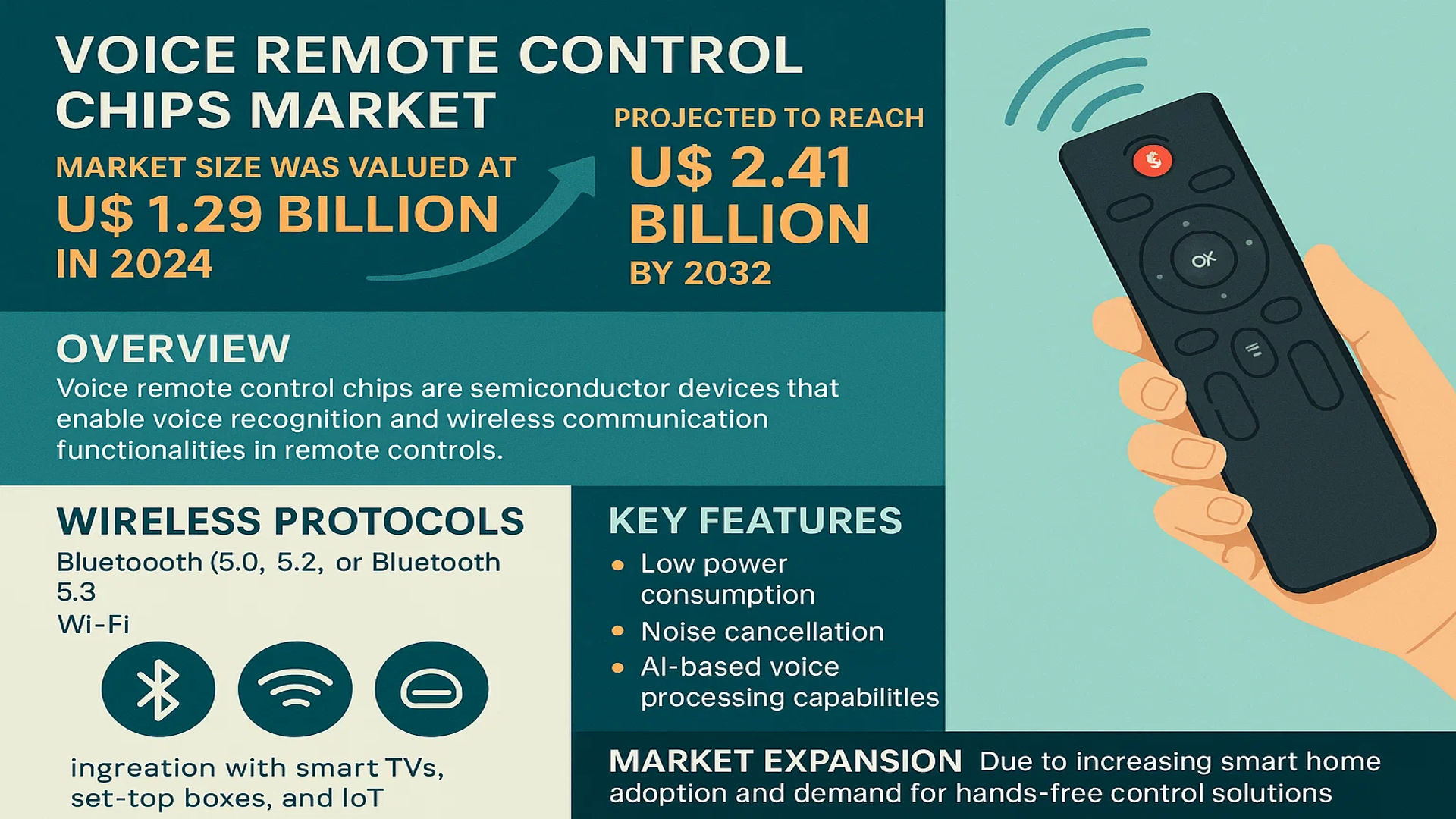
The global Voice Remote Control Chips Market size was valued at US$ 1.29 billion in 2024 and is projected to reach US$ 2.41 billion by 2032, at a CAGR of 9.2% during the forecast period 2025-2032.
Voice remote control chips are semiconductor devices that enable voice recognition and wireless communication functionalities in remote controls. These chips integrate Bluetooth (versions 5.0, 5.2, or 5.3), Wi-Fi, or other wireless protocols to facilitate seamless interaction with smart TVs, set-top boxes, and other IoT-enabled devices. Key features include low power consumption, noise cancellation, and AI-based voice processing capabilities.
The market is expanding due to increasing smart home adoption and demand for hands-free control solutions. While the U.S. leads in technological advancements, China’s growing consumer electronics sector is accelerating market penetration. Major players like Realtek, Texas Instruments, and Nordic Semiconductor dominate with over 60% combined market share, as they continue to innovate in edge AI processing and energy-efficient designs. The Bluetooth 5.0 segment currently holds 48% market share, though newer protocols are gaining traction.
MARKET DYNAMICS
MARKET DRIVERS
Rising Adoption of Smart Home Devices to Fuel Demand for Voice Remote Control Chips
The proliferation of smart home ecosystems is accelerating the need for intuitive control solutions, positioning voice remote control chips as a critical component in modern device interfaces. Global shipments of smart home devices reached over 1 billion units annually, with voice-controlled systems accounting for approximately 35% of this market. This trend directly correlates with the growing preference for hands-free operation across entertainment systems, lighting controls, and IoT-enabled appliances. The integration of advanced Bluetooth 5.0 and 5.2 protocols in these chips ensures seamless connectivity with minimal latency, enhancing user experience across diverse smart home applications.
Advancements in Natural Language Processing to Enhance Market Penetration
Breakthroughs in artificial intelligence, particularly in neural network architectures for speech recognition, are elevating the capabilities of voice control chips beyond simple command execution. Contemporary solutions now achieve 95-98% accuracy in noisy environments, a significant improvement from the 85-90% range of previous-generation chips. This technological leap coincides with the expansion of multilingual support in voice assistants, enabling broader international adoption. Industry leaders are leveraging these advancements to develop context-aware voice controls that can interpret complex commands and anticipate user needs.
Streamlined Supply Chains and Component Standardization to Drive Economies of Scale
The consolidation of semiconductor manufacturing processes has enabled cost reductions in voice control chip production, with average unit prices decreasing by nearly 22% since 2020. This price optimization, combined with the standardization of communication protocols, allows OEMs to integrate these chips across multiple product lines without significant redesign. Major electronics manufacturers now allocate 12-15% of their R&D budgets toward voice interface development, reflecting the strategic importance of this technology in maintaining competitive positioning.
MARKET RESTRAINTS
Complexity in Multi-Device Environments Creates Implementation Challenges
While voice control technology offers convenience, its deployment in heterogeneous device ecosystems presents substantial technical hurdles. Cross-platform compatibility issues affect roughly 18-20% of implementations, often requiring customized firmware solutions that increase development timelines by 30-45 days. The absence of universal protocols forces manufacturers to maintain multiple chip variants, complicating inventory management and driving up production costs. These complexities are particularly pronounced in professional AV installations where interoperability across brands is essential.
Power Consumption Limitations Hinder Performance in Portable Applications
Continuous voice recognition functionality presents significant power management challenges, especially for battery-operated devices. Current-generation chips consume 2-3 times more energy during active listening modes compared to traditional infrared remote solutions. This constraint limits adoption in portable electronics where battery life remains a critical purchasing factor. While emerging low-power designs show promise, their implementation often requires trade-offs in processing capabilities or microphone sensitivity that compromise user experience.
Data Privacy Concerns Impact Consumer Adoption Rates
Heightened awareness of voice data collection practices has created skepticism among privacy-conscious consumers, with 40-45% of surveyed users expressing reservations about always-on listening features. Regulatory requirements for data encryption and local processing add complexity to chip design, increasing component costs by 8-12%. These concerns are particularly pronounced in healthcare and enterprise applications where confidential information transmission necessitates additional security layers, potentially slowing market penetration in sensitive verticals.
MARKET OPPORTUNITIES
Emerging Markets Present Untapped Growth Potential
Developing economies are witnessing rapid digitization of consumer electronics, with voice-enabled device adoption growing 25-30% faster than in mature markets. This expansion is supported by rising disposable incomes and localized language support from major technology providers. Governments across Asia and Latin America are investing in smart city infrastructure that incorporates voice-controlled public systems, creating new avenues for specialized chip applications beyond traditional consumer markets.
Healthcare Sector Adoption Creates New Use Cases
The healthcare industry’s digital transformation is generating demand for assistive technologies incorporating voice control. Applications range from hands-free medical device operation to accessibility solutions for patients with limited mobility. This vertical represents a high-value opportunity, with healthcare-grade voice chips commanding 50-70% price premiums over consumer equivalents due to enhanced reliability and security requirements.
Integration with Edge AI Opens Advanced Functionality
The convergence of voice processing with edge computing enables sophisticated on-device capabilities without cloud dependency. This architectural shift reduces latency to under 100ms while addressing privacy concerns through local data processing. Chip manufacturers investing in neural processing unit (NPU) integration are positioned to capture premium market segments requiring real-time response and offline functionality in environments with limited connectivity.
VOICE REMOTE CONTROL CHIPS MARKET TRENDS
Adoption of AI-Powered Voice Assistants Driving Market Growth
The increasing integration of AI-powered voice assistants in smart home devices is revolutionizing the Voice Remote Control Chips Market. These chips, equipped with advanced noise cancellation and speech recognition capabilities, are becoming essential components in televisions, set-top boxes, and smart home systems. The global smart speaker market, which heavily relies on voice control technology, is projected to exceed shipment volumes of 400 million units by 2027, directly fueling demand for high-performance voice remote chips. Manufacturers are focusing on low-power designs to improve battery life while maintaining high accuracy in voice command processing.
Other Trends
Transition to Bluetooth 5.X Standards
The shift towards Bluetooth 5.0 and higher versions is redefining connectivity standards in voice remote controls. These advanced protocols offer superior data transfer speeds (up to 2 Mbps), extended range (up to 240 meters), and improved coexistence with other wireless technologies. With Bluetooth 5.0 chips representing over 35% of new voice remote deployments in 2024, their market share is expected to grow significantly as manufacturers phase out legacy Bluetooth 4.0 solutions. This transition enables more reliable voice command transmission and supports the development of multi-functional remotes capable of controlling entire smart home ecosystems.
Integration with Smart Home Ecosystems
Voice remote control chips are increasingly being designed for seamless integration into comprehensive smart home platforms. Modern chips now support multiple wireless protocols simultaneously, including Bluetooth, Zigbee, and Thread, allowing single-remote control of lighting, security systems, and entertainment devices. This interoperability is critical as the global smart home market continues its expansion, with connected device households projected to average 25 devices by 2026. Chip manufacturers are responding by developing system-on-chip (SoC) solutions that combine voice processing with IoT connectivity in compact, cost-effective packages optimized for mass production.
Enhanced Security Features in Voice Recognition
Security has become a paramount concern in voice control technology, driving innovation in chip-level authentication and encryption. Recent developments include hardware-based voice pattern recognition that analyzes unique vocal biometrics, reducing vulnerability to unauthorized access. Advanced chips now incorporate dedicated security cores that isolate voice data processing from other functions, achieving military-grade encryption for transmitted commands. With the smart home security market growing at 15% annually, these security-enhanced voice chips are becoming preferred solutions for privacy-conscious consumers and enterprise applications alike.
COMPETITIVE LANDSCAPE
Key Industry Players
Technological Innovation and Strategic Alliances Drive Market Competition
The global Voice Remote Control Chips Market is characterized by intense competition, with semiconductor giants and specialized IC manufacturers vying for market share. The landscape remains semi-consolidated, where established players leverage their advanced R&D capabilities while emerging competitors focus on niche applications. As voice-assisted technologies gain traction in smart home ecosystems, companies are aggressively expanding their portfolios to maintain competitive positioning.
Realtek Semiconductor Corp. currently dominates the market, holding an estimated 22% revenue share in 2024 according to industry analysis. Their leadership stems from early adoption of neural network processors in voice recognition chips and strong partnerships with Chinese smart TV manufacturers. Following closely is Cypress Semiconductor (now part of Infineon Technologies), whose ultra-low-power Bluetooth 5.2 solutions have become industry benchmarks for battery-operated voice remotes.
The market has witnessed significant technological stratification, with Texas Instruments and Silicon Labs focusing on high-accuracy far-field microphone arrays, while Actions Technology and Yichip Microelectronics compete aggressively in cost-sensitive Asian markets. This bifurcation creates opportunities for specialized players like Nordic Semiconductor, whose dual-mode Bluetooth/Thread solutions are gaining adoption in Matter-compatible smart home devices.
Recent developments show a trend toward vertical integration, with Dialog Semiconductor (acquired by Renesas) combining voice processing with power management ICs for all-in-one remote solutions. Meanwhile, STMicroelectronics has invested heavily in edge-AI capabilities, reducing cloud dependency for basic voice commands – a crucial differentiator in privacy-conscious European markets.
List of Key Voice Remote Control Chip Manufacturers
- Realtek Semiconductor Corp. (Taiwan)
- Cypress Semiconductor (Infineon Technologies) (Germany/US)
- Actions Technology (China)
- Yichip Microelectronics (Hangzhou) (China)
- Techlink (China)
- Airoha Technology (Taiwan)
- Nordic Semiconductor (Norway)
- Dialog Semiconductor (Renesas Electronics) (Japan)
- Texas Instruments (U.S.)
- Silicon Laboratories (U.S.)
- STMicroelectronics (Switzerland)
The competitive intensity is further heightened by regional dynamics, with Chinese manufacturers accounting for nearly 40% of global production capacity in 2024. While Bluetooth 5.x remains the dominant connectivity standard, the emergence of Wi-Fi 6 enabled voice chips and proprietary low-power protocols has created new battlegrounds for technological supremacy. Market leaders are expected to continue their acquisition strategies, particularly targeting AI voice algorithm startups to enhance on-chip processing capabilities.
Voice Remote Control Chips Market – Segment Analysis
By Type
Bluetooth 5.0 Dominates the Market Due to Enhanced Connectivity and Low Power Consumption
The market is segmented based on type into:
- Bluetooth 5.0
- Bluetooth 5.2
- Bluetooth 5.3
- Others
By Application
Television Segment Leads Due to High Adoption of Smart TV Integration
The market is segmented based on application into:
- Television
- Set-top Box
- Others
By Connectivity Range
Short-Range Connectivity Dominates for Home Entertainment Applications
The market is segmented based on connectivity range into:
- Short-Range (Up to 10 meters)
- Medium-Range (Up to 50 meters)
- Long-Range (Above 50 meters)
By End User
Consumer Electronics Drives Market Growth with Smart Home Applications
The market is segmented based on end user into:
- Consumer Electronics
- Automotive
- Industrial
- Healthcare
- Others
Regional Analysis: Voice Remote Control Chips Market
Asia-Pacific
The Asia-Pacific region dominates the global Voice Remote Control Chips market, driven by rapid technological adoption, expanding consumer electronics production, and strong demand for smart home devices. China leads with major manufacturers like Actions Technology and Yichip Microelectronics contributing significantly to production volumes. The region benefits from high smartphone penetration and competitive pricing strategies, further increasing affordability for Bluetooth-enabled voice remote chips. Smart TV and set-top box adoption in India and Southeast Asia is accelerating demand, though price sensitivity remains a challenge for premium chip adoption. The region also sees increasing investments in AI-powered voice recognition technologies to enhance remote control functionalities.
North America
North America’s advanced smart home ecosystem and high disposable incomes have created strong demand for voice-enabled remote chips with enhanced connectivity standards like Bluetooth 5.2 and 5.3. The U.S. market is characterized by high-performance requirements from leading TV manufacturers and tech companies integrating voice assistants like Alexa and Google Assistant. Major chip suppliers such as Texas Instruments and Silicon Labs focus on low-latency and energy-efficient designs to cater to premium applications. Regulatory support for accessibility features in electronic devices further drives innovation in voice control technology. The region also benefits from strong R&D collaborations between chipmakers and software developers.
Europe
Europe’s Voice Remote Control Chips market is growing steadily, supported by stringent data privacy regulations that require secure voice processing architectures. Germany and the U.K. lead demand for high-quality chips with advanced noise cancellation and multi-language support. Nordic Semiconductor and Dialog Semiconductor play key roles in supplying Bluetooth Low Energy (BLE) solutions optimized for energy-conscious European consumers. The market sees increasing integration with IoT ecosystems, though fragmentation across language markets creates development complexities. Environmental regulations also push manufacturers toward sustainable chip production methods.
South America
While still a developing market, South America shows growing potential for Voice Remote Control Chips, particularly in Brazil’s expanding pay-TV sector. Economic volatility limits premium chip adoption, but local manufacturers are exploring cost-optimized solutions using older Bluetooth standards. The lack of local semiconductor production creates dependency on imports, though some Brazilian firms collaborate with Chinese chip designers for customized solutions. Infrastructure challenges in rural areas hinder uniform smart device penetration, keeping overall market growth moderate compared to other regions.
Middle East & Africa
The MEA region demonstrates emerging opportunities in premium entertainment systems across UAE and Saudi Arabia, where high-end hotels and residential complexes drive demand for advanced voice remote solutions. Limited local manufacturing capabilities necessitate chip imports, primarily from Asia. While South Africa shows gradual smart home adoption, most African markets remain price-sensitive, favoring basic infrared remotes over voice-enabled alternatives. However, increasing urbanization and digitalization initiatives suggest long-term growth potential for entry-level voice control chips as connectivity infrastructure improves.
Report Scope
This market research report provides a comprehensive analysis of the Global Voice Remote Control Chips Market, covering the forecast period 2024–2032. It offers detailed insights into market dynamics, technological advancements, competitive landscape, and key trends shaping the industry.
Key focus areas of the report include:
- Market Size & Forecast: Historical data and future projections for revenue, unit shipments, and market value across major regions and segments.
- Segmentation Analysis: Detailed breakdown by product type (Bluetooth 5.0, Bluetooth 5.2, Bluetooth 5.3, Others), application (Television, Set-top Box, Others), and end-user industries.
- Regional Outlook: Insights into market performance across North America, Europe, Asia-Pacific, Latin America, and the Middle East & Africa, with country-level analysis for key markets.
- Competitive Landscape: Profiles of leading market participants including Realtek, Cypress, Actions Technology, Texas Instruments, and Nordic Semiconductor, with analysis of their market share and strategic initiatives.
- Technology Trends & Innovation: Assessment of emerging technologies including AI integration, low-power consumption designs, and advanced voice recognition capabilities.
- Market Drivers & Restraints: Evaluation of factors driving market growth such as smart home adoption and voice assistant proliferation, along with challenges like supply chain constraints and technical limitations.
- Stakeholder Analysis: Strategic insights for semiconductor manufacturers, OEMs, technology providers, and investors regarding market opportunities and competitive positioning.
The research methodology combines primary interviews with industry experts and secondary data from verified sources to ensure accuracy and reliability of market insights.
FREQUENTLY ASKED QUESTIONS:
What is the current market size of Global Voice Remote Control Chips Market?
->Voice Remote Control Chips Market size was valued at US$ 1.29 billion in 2024 and is projected to reach US$ 2.41 billion by 2032, at a CAGR of 9.2% during the forecast period 2025-2032.
Which key companies operate in Global Voice Remote Control Chips Market?
-> Key players include Realtek, Cypress, Actions Technology, Texas Instruments, Nordic Semiconductor, Dialog, and Silicon Labs, among others.
What are the key growth drivers?
-> Key growth drivers include rising smart home adoption, increasing demand for voice-controlled devices, and advancements in Bluetooth technology.
Which region dominates the market?
-> Asia-Pacific is the largest market due to manufacturing concentration, while North America leads in technology adoption.
What are the emerging trends?
-> Emerging trends include AI-powered voice recognition, ultra-low power consumption designs, and integration with IoT ecosystems.

Get Sample Report PDF for Exclusive Insights
Report Sample Includes
- Table of Contents
- List of Tables & Figures
- Charts, Research Methodology, and more...
 Download Sample Report PDF