Key Statistics
Key Takeaways
- Market value: USD 634.76 million in 2026 increases to USD 3,317.76 million by 2036 at a reconciled 18.0% CAGR, reflecting the power-conversion component scenario rather than total converter, radio amplifier or wafer sales.
- Power-conversion scope: Finished GaN switches, integrated power stages and dedicated modules define the revenue boundary; RF-only amplifiers are excluded despite appearing in the source taxonomy, and the original mixed classification cannot establish an audited power-only allocation.
- Pacific demand: An estimated ~28% of U.S. 2026 value is associated with Pacific-state customers, where data-center engineering, semiconductor design and power-supply procurement coexist; this is a modeled buyer-location allocation rather than a survey of regional invoices.
- Application structure: Industrial power conversion and the catch-all category of charging, data centers and energy each account for an estimated ~24%; telecommunications remains material at ~23% but includes power supplies, not radio-frequency amplifier output.
- Voltage transition: Devices rated 650V and above are modeled at ~52% of revenue, while the below-100V class addresses high-current intermediate-bus conversion and motor control; both are distinct purchasing sockets within power electronics.
- Competitive dynamics: Navitas, EPC, Renesas, Infineon and onsemi provide documented GaN power technology; legacy names such as Transphorm and GaN Systems must be consolidated under their acquirers rather than treated as separate current competitors.
- Demand catalyst: Power delivery for 800V data-center distribution, electric mobility charging and compact industrial drives is expanding the device-design opportunity, although a reference design or sample release does not itself prove a recurring U.S. shipment.
- Scenario caution: The 2036 endpoint is six years beyond the original 2030 horizon and overlaps the U.S. GaN-device category in row 168, so the two monetary forecasts represent competing scenarios and cannot be added.
United States Gallium Nitride Power Device Market Overview
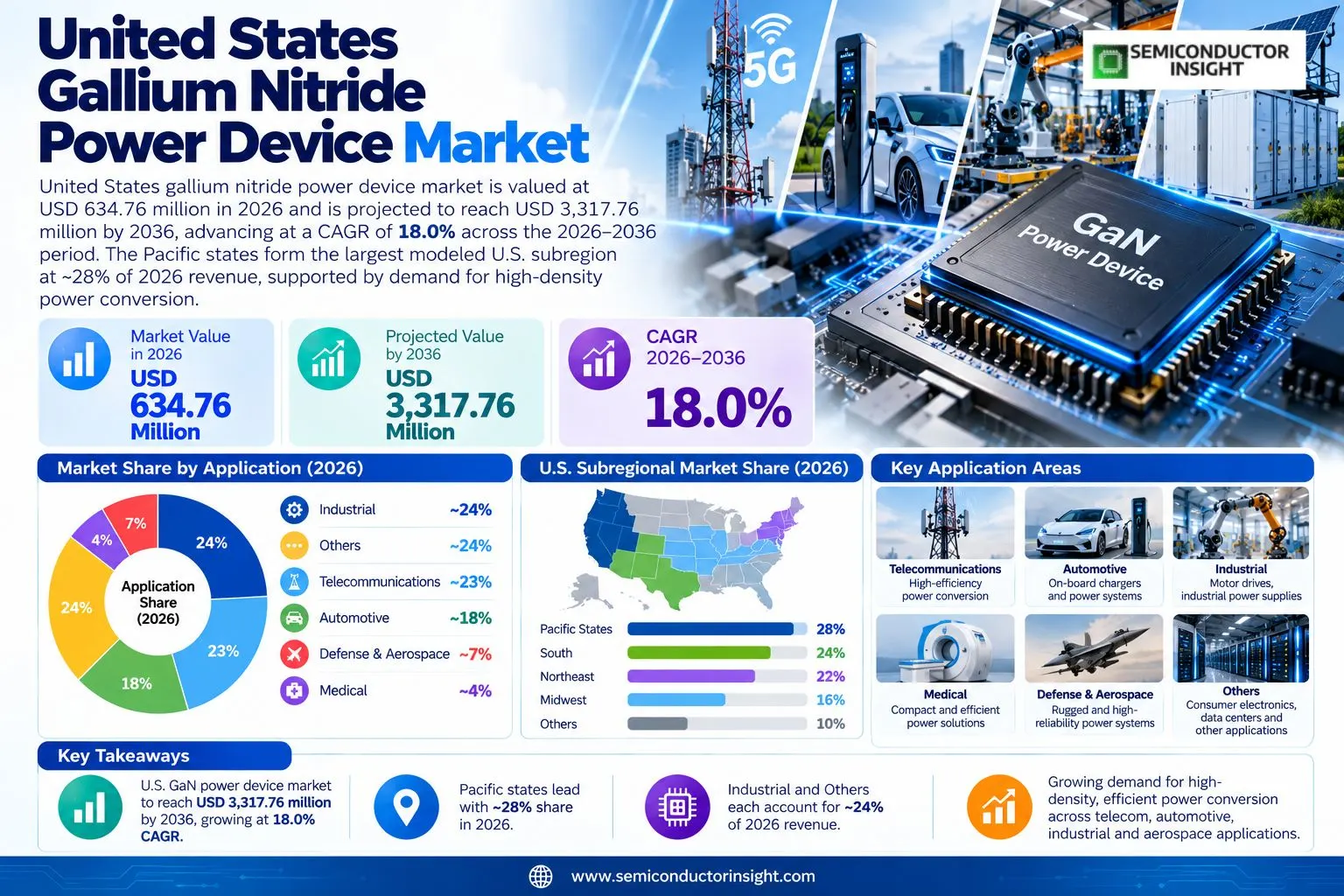
United States gallium nitride power device market is valued at USD 634.76 million in 2026 and is projected to reach USD 3,317.76 million by 2036, advancing at a CAGR of 18.0% across the 2026–2036 period. The Pacific states form the largest modeled U.S. subregion at ~28% of 2026 revenue, supported by demand for high-density power conversion.
Gallium nitride power devices are electronic switches whose wide-bandgap channel permits rapid transitions between conducting and blocking states. A device manufacturer may sell a discrete field-effect transistor, a protected power-stage integrated circuit or a qualified multi-device package. The commercial unit measured here is the semiconductor component delivered to a U.S. customer, not the finished charger, vehicle powertrain, rack power shelf or inverter that contains it. This distinction separates silicon value from equipment-level turnover.
The boundary also separates switching transistors from gallium nitride radio-frequency amplifiers. A 5G base-station amplifier handles a modulated radio signal, whereas a power-conversion FET handles energy flow through a DC-DC or AC-DC topology. Both may use GaN, but they have different design rules, reliability tests, packaging, customers and price structures. Only power-conversion devices are counted in the market scenario; an RF-only amplifier is outside the measured product category even when listed by a broad supplier directory.
The publisher anchors of USD 456 million in 2024 and USD 1.23 billion in 2030 imply 17.984% annual growth over six years. Extending that same trajectory produces a 2026 base and a 2036 scenario, rather than an independently confirmed U.S. shipment forecast. The closely related U.S. GaN-device report in the cumulative tracker has higher anchors of USD 567 million and USD 1.56 billion for the same two years. The difference is commercially material and cannot be resolved by adding, averaging or treating either figure as a subsidiary market.
The technology choice depends on voltage, current, thermal path and circuit topology. EPC reported 100V integrated stages for motion control in April 2026 and subsequent mass production in August, demonstrating a lower-voltage route into robots and compact motor drives. Renesas introduced 650V devices with dual-side cooling in September 2026, addressing a different problem: carrying high power through a small package in dense 800V power architectures. These developments represent different design sockets rather than interchangeable devices.
Industry consolidation changes how competitors should be counted. Infineon completed the purchase of GaN Systems in October 2023, while Renesas completed its Transphorm acquisition in June 2024. Both former brands may still appear in catalogs or installed designs, but their revenue is not an additional independent supplier total. Onsemi launched the GaNEXUS family for sampling in June 2026, so its announced voltage coverage is a technology milestone rather than proof that every sampled part had reached high-volume commercial sales.
Customer adoption is uneven across the United States. Server-power architects on the Pacific coast may qualify a high-voltage switch years before large shipments, automotive buyers in the Midwest may require extensive reliability data, and industrial distributors across the South can prioritize component availability over absolute switching frequency. These differences create regional variation in design-in timing and average selling prices. The five U.S. regional shares are explicitly modeled and do not imply access to invoice-level geographic sales records.
Segment Analysis: By Type
The publisher separates Power Device and RF Power Device, but the present finished power-conversion boundary contains only the first. The model assigns an estimated ~100% of in-scope value to Power Device and zero to RF-only devices. That is a classification decision, not evidence that the publisher originally excluded RF sales from its total.
| Original type | Technical function | Revenue treatment |
|---|---|---|
| Power Device | Discrete enhancement-mode GaN FETs, cascode switches, integrated power stages and eligible multi-device packages perform energy conversion in charging, server power, industrial motion and vehicle auxiliaries. Their prices reflect electrical rating, protection, package and reliability qualification. | In-scope allocation: ~100%. This category includes 100V integrated stages from EPC, 650V conversion switches from Renesas and Infineon, and automotive-qualified GaN power ICs from Navitas. A completed inverter or charger is excluded even when sold by the same supplier. |
| RF Power Device | Radio-frequency GaN transistors and power amplifiers boost signals in telecommunications, radar and microwave links; the electrical function differs from switching a DC power rail. Companies including MACOM, Qorvo and Microchip maintain relevant RF catalogs. | Excluded from factory-gate power-conversion revenue: 0%. This source-listed type is retained to disclose the classification conflict rather than to imply a merchant switching-device sale. Radio transmitter revenue, military radar amplifier revenue and related RF power modules do not enter the modeled power market. |
Additional segmentation: voltage, product format and buyer channel
Three additional nonoverlapping revenue axes describe where power devices are sold. By voltage, the 650V-and-above class is largest at an estimated ~52% of 2026 value; below 100V, 100–199V and 200–649V cover different DC buses and switching topologies. By product format, discrete FETs represent an estimated ~52%, integrated power stages ~33% and modules ~15%. By buyer channel, power-supply OEMs lead at ~44%, ahead of industrial integrators, automotive Tier-1 suppliers and distribution-led engineering orders. These are modeled allocations of the same total, not additive markets.
U.S. modeled segment revenue scenarios, 2026–2036
The following cross-axis matrix shows internally reconciled scenario revenue in USD million for 2026 through 2036. Each axis separately allocates the same finished GaN device total, so adding rows across Region, Application, Voltage, Product Format and Buyer Channel would double count. Segment trajectories are model constructs derived from the headline growth path and explicit share allocations; they are not supplier-reported annual U.S. sales or guaranteed capacity commitments.
| Modeled axis and segment | 2026 | 2027 | 2028 | 2029 | 2030 | 2031 | 2032 | 2033 | 2034 | 2035 | 2036 |
|---|---|---|---|---|---|---|---|---|---|---|---|
| Region — Pacific (2026 ~28%) | 177.7 | 197.8 | 220.2 | 245.1 | 272.8 | 303.7 | 338.0 | 376.2 | 418.8 | 466.1 | 518.9 |
| Region — South (2026 ~26%) | 165.0 | 201.7 | 246.4 | 301.2 | 368.0 | 449.7 | 549.6 | 671.6 | 820.6 | 1,002.8 | 1,225.5 |
| Region — Northeast (2026 ~23%) | 146.0 | 170.2 | 198.5 | 231.4 | 269.9 | 314.7 | 366.9 | 427.8 | 498.8 | 581.6 | 678.1 |
| Region — Midwest (2026 ~15%) | 95.2 | 113.3 | 134.8 | 160.5 | 190.9 | 227.2 | 270.4 | 321.8 | 382.9 | 455.6 | 542.2 |
| Region — Mountain (2026 ~8%) | 50.8 | 61.6 | 74.8 | 90.9 | 110.3 | 133.9 | 162.6 | 197.3 | 239.6 | 290.9 | 353.1 |
| Type — Power Device (2026 ~100%) | 634.8 | 748.9 | 883.6 | 1,042.5 | 1,230.0 | 1,451.2 | 1,712.2 | 2,020.1 | 2,383.4 | 2,812.0 | 3,317.8 |
| Application — Telecommunications (2026 ~23%) | 146.0 | 164.0 | 184.2 | 206.9 | 232.4 | 261.0 | 293.2 | 329.3 | 369.9 | 415.5 | 466.7 |
| Application — Automotive (2026 ~18%) | 114.3 | 135.1 | 159.6 | 188.7 | 223.0 | 263.6 | 311.6 | 368.3 | 435.3 | 514.6 | 608.2 |
| Application — Industrial (2026 ~24%) | 152.3 | 183.7 | 221.6 | 267.2 | 322.3 | 388.7 | 468.7 | 565.3 | 681.7 | 822.1 | 991.5 |
| Application — Medical (2026 ~4%) | 25.4 | 29.2 | 33.6 | 38.6 | 44.4 | 51.1 | 58.7 | 67.5 | 77.7 | 89.3 | 102.7 |
| Application — Military, Defense & Aerospace (2026 ~7%) | 44.4 | 52.2 | 61.2 | 71.9 | 84.4 | 99.1 | 116.3 | 136.6 | 160.3 | 188.2 | 221.0 |
| Application — Others (charging, data center, energy) (2026 ~24%) | 152.3 | 182.5 | 218.6 | 261.9 | 313.8 | 375.9 | 450.4 | 539.5 | 646.4 | 774.3 | 927.7 |
| Voltage — Below 100V (2026 ~20%) | 127.0 | 146.1 | 168.2 | 193.6 | 222.8 | 256.5 | 295.2 | 339.8 | 391.1 | 450.1 | 518.1 |
| Voltage — 100–199V (2026 ~16%) | 101.6 | 116.8 | 134.3 | 154.5 | 177.6 | 204.3 | 234.9 | 270.2 | 310.7 | 357.3 | 410.9 |
| Voltage — 200–649V (2026 ~12%) | 76.2 | 89.4 | 105.0 | 123.3 | 144.7 | 169.9 | 199.4 | 234.1 | 274.9 | 322.7 | 378.9 |
| Voltage — 650V and above (2026 ~52%) | 330.1 | 395.4 | 473.7 | 567.5 | 679.9 | 814.5 | 975.8 | 1,169.0 | 1,400.5 | 1,677.7 | 2,009.9 |
| Product Format — Discrete FETs (2026 ~52%) | 330.1 | 385.8 | 450.8 | 526.9 | 615.8 | 719.7 | 841.1 | 983.0 | 1,148.9 | 1,342.7 | 1,569.2 |
| Product Format — Integrated GaN Power Stages (2026 ~33%) | 209.5 | 252.6 | 304.7 | 367.4 | 443.1 | 534.4 | 644.5 | 777.2 | 937.4 | 1,130.4 | 1,363.3 |
| Product Format — GaN Power Modules (2026 ~15%) | 95.2 | 109.5 | 125.9 | 144.8 | 166.5 | 191.5 | 220.2 | 253.3 | 291.3 | 335.0 | 385.2 |
| Buyer Channel — Power-supply OEMs (2026 ~44%) | 279.3 | 320.0 | 366.5 | 419.9 | 481.0 | 551.0 | 631.3 | 723.2 | 828.4 | 949.0 | 1,087.2 |
| Buyer Channel — Automotive Tier-1s (2026 ~17%) | 107.9 | 129.3 | 154.9 | 185.5 | 222.3 | 266.3 | 319.0 | 382.2 | 457.8 | 548.5 | 657.1 |
| Buyer Channel — Industrial integrators (2026 ~24%) | 152.3 | 186.2 | 227.5 | 278.0 | 339.7 | 415.1 | 507.3 | 619.9 | 757.5 | 925.7 | 1,131.2 |
| Buyer Channel — Distribution and engineering (2026 ~15%) | 95.2 | 111.0 | 129.4 | 150.9 | 176.0 | 205.2 | 239.3 | 279.0 | 325.3 | 379.3 | 442.3 |
Segment Analysis: By Application
Applications are Telecommunications, Automotive, Industrial, Medical, Military, Defense & Aerospace and Others. Industrial conversion and Others each account for an estimated ~24% of 2026 revenue; telecom conversion is ~23%, automotive ~18%, defense and aerospace ~7%, and medical ~4%. These percentages allocate finished switching devices only. Every allocation excludes RF amplifier chips and equipment-level sales, preserving one consistent conversion-device revenue boundary.
| Application | Demand characteristics |
|---|---|
| Telecommunications | Estimated ~23% share. Telecom power conversion includes DC rectification, isolated supplies, backup power and intermediate-bus stages for network equipment. It excludes the GaN RF amplifier that directly handles the antenna signal, preventing a radio-front-end sales stream from entering the conversion device total. In Telecommunications purchasing, a 2026 design win may become a 2027 or 2028 production order only after application-specific power-system validation; device manufacturers distinguish qualification pipelines from booked wafer or packaged-part shipments. |
| Automotive | Estimated ~18% share. Automotive orders arise in onboard chargers, low-voltage auxiliary converters and selected electrification systems. Qualification against applicable automotive stress standards and power-cycle reliability can lengthen the interval between engineering samples and high-volume component orders. In Automotive purchasing, a 2026 design win may become a 2027 or 2028 production order only after application-specific power-system validation; device manufacturers distinguish qualification pipelines from booked wafer or packaged-part shipments. |
| Industrial | Estimated ~24% share. Industrial demand includes motor drives, automation, power tools, robotics and factory power supplies. EPC’s 100V integrated GaN stages illustrate the value of protection features and compact packages where multiple axes must switch efficiently in restricted enclosures. In Industrial purchasing, a 2026 design win may become a 2027 or 2028 production order only after application-specific power-system validation; device manufacturers distinguish qualification pipelines from booked wafer or packaged-part shipments. |
| Medical | Estimated ~4% share. Medical power conversion uses compact isolated supplies and selected imaging or laboratory electronics. Procurement emphasizes leakage current, safety certification and sustained availability, and these qualification burdens make the addressable component revenue smaller than in mass-market charging. In Medical purchasing, a 2026 design win may become a 2027 or 2028 production order only after application-specific power-system validation; device manufacturers distinguish qualification pipelines from booked wafer or packaged-part shipments. |
|
Military, Defense & Aerospace |
Estimated ~7% share. Defense and aerospace power supplies require documented reliability and mission-specific screening, often for smaller annual production volumes. RF GaN radar components are excluded from this conversion-only axis even when their buyers are also defense contractors. In Military, Defense & Aerospace purchasing, a 2026 design win may become a 2027 or 2028 production order only after application-specific power-system validation; device manufacturers distinguish qualification pipelines from booked wafer or packaged-part shipments. |
| Others (charging, data center, energy) | Estimated ~24% share. Consumer fast chargers, data-center power conversion, storage interfaces and solar microinverters form the residual application class. It is substantial because several fast-growing use cases were not separately named in the original publisher application taxonomy. In Others (charging, data center, energy) purchasing, a 2026 design win may become a 2027 or 2028 production order only after application-specific power-system validation; device manufacturers distinguish qualification pipelines from booked wafer or packaged-part shipments. |
The same GaN die technology can appear in several applications without creating a separate upstream market. A 650V switch sold into a rack power shelf and a comparable part sold into a charger are both semiconductor sales, but the downstream equipment values differ by orders of magnitude. Assigning each invoice to its final power-conversion application prevents counting the same die again when it is mounted on a board, packaged in a module or incorporated into a complete appliance.
Regional Analysis
The U.S. market is divided into five disjoint domestic subregions: Pacific, South, Northeast, Midwest and Mountain. Pacific is modeled largest at ~28% of 2026 sales, followed by South ~26%, Northeast ~23%, Midwest ~15% and Mountain ~8%. Every state and the District of Columbia belongs to exactly one region; territories are outside this market.
Where is GaN power-conversion demand concentrated within the United States?
Buyer geography differs from semiconductor manufacturing geography. A GaN switch fabricated on a 200mm wafer outside the United States can be counted when sold into a U.S. power-electronics program, while a wafer made in the United States and shipped abroad is not automatically a U.S. end-market sale. The regional scenario therefore reflects engineering and purchasing exposure rather than a map of fabs or headquarters.
Large cloud-power and automotive programs may take 18 to 36 months to progress from reference design to repeat shipments. Regional allocation is sensitive to whether a distributor records a sale at its warehouse, the system integrator’s address or the final equipment plant. The five modeled shares sum to 100% for 2026 and should be read as comparable demand categories rather than audited regional sales figures.
| Region | Position | Growth outlook | Demand profile | What decides supplier selection |
|---|---|---|---|---|
| Pacific | Estimated ~28% share | ~11.3% CAGR scenario | Design centers, cloud-power platforms and fast-charging electronics | Qualification of 100V and 650V switches, thermal packages and delivery continuity for the Pacific buyer base. |
| South | Estimated ~26% share | ~22.2% CAGR scenario | Energy conversion, industrial distribution and data-center expansion | Qualification of 100V and 650V switches, thermal packages and delivery continuity for the South buyer base. |
| Northeast | Estimated ~23% share | ~16.6% CAGR scenario | Enterprise electronics, industrial design and regulated power systems | Qualification of 100V and 650V switches, thermal packages and delivery continuity for the Northeast buyer base. |
| Midwest | Estimated ~15% share | ~19.0% CAGR scenario | Automotive supply chains, industrial motors and factory equipment | Qualification of 100V and 650V switches, thermal packages and delivery continuity for the Midwest buyer base. |
| Mountain | Estimated ~8% share | ~21.4% CAGR scenario | Renewable-energy electronics, specialized equipment and distribution | Qualification of 100V and 650V switches, thermal packages and delivery continuity for the Mountain buyer base. |
United States Gallium Nitride Power Device Competitive Landscape
The competitive field spans established GaN power-device manufacturers, newly sampling entrants and legacy brands absorbed through acquisition. Direct-fit suppliers include Navitas, EPC, Renesas, Infineon, Texas Instruments and onsemi, while RF-focused companies from the broad publisher roster are adjacent rather than interchangeable merchant power-switch competitors. Ownership, device qualification and documented commercial power-conversion functions determine supplier placement within this landscape.
EPC offers enhancement-mode devices and integrated stages for lower-voltage applications, while Navitas markets protected GaNFast and GaNSafe power integrated circuits across charging and higher-power designs. Renesas gained the Transphorm SuperGaN portfolio in June 2024 and expanded both low-voltage and 650V families in 2026. Infineon completed the acquisition of GaN Systems in October 2023, adding a portfolio of conversion devices to its broader power business. These ownership changes alter the supplier count without creating new incremental end-market sales.
Onsemi’s GaNEXUS devices were sampling in June 2026 across 40V to 650V, and its development collaboration with GlobalFoundries targets 200mm GaN-on-silicon manufacturing. Sampling and process agreements are credible indicators of product roadmaps, but they are not equivalent to audited merchant shipments. Similarly, Texas Instruments offers GaN-enabled power management and reference architectures, yet companywide semiconductor revenue cannot be allocated wholesale to U.S. finished GaN switches.
MACOM, Qorvo and parts of Microchip’s GaN portfolio focus on RF power amplification. Their presence in a source company list does not make radar or telecom RF amplifier sales part of a conversion-switch market. Cree is a legacy corporate name associated with Wolfspeed, whose business includes silicon-carbide materials and devices; it should not be assumed to have independent current merchant GaN conversion-switch sales without product-level evidence. Competitive tiers therefore reflect direct product fit, not inferred company revenue shares.
Tier structure
| Tier | Companies | Basis of competition |
|---|---|---|
| Tier 1 — direct fit | Navitas Semiconductor; Efficient Power Conversion; Renesas Electronics; Infineon Technologies | Published merchant GaN power switches or integrated stages with specific voltage ratings and commercial application documentation. |
| Tier 2 — emerging / diversified | onsemi; Texas Instruments | Sampling or mixed power-management portfolios with documented GaN conversion activity; shipment scale varies by product and date. |
| Adjacent / excluded | Microchip RF; Qorvo RF; MACOM RF; legacy Cree/Wolfspeed | RF amplifier catalogs, silicon-carbide portfolios or legacy brand references cannot establish independent finished GaN conversion revenue. |
Key companies profiled
- Navitas Semiconductor
- Efficient Power Conversion (EPC)
- Renesas Electronics (Transphorm)
- Infineon Technologies (GaN Systems)
- Texas Instruments
- onsemi
- Power Integrations
- Innoscience
- GlobalFoundries (foundry partner)
- Microchip Technology (RF boundary)
- MACOM Technology Solutions (RF boundary)
- Qorvo (RF boundary)
United States Gallium Nitride Power Device Production and Capacity
GaN power-device capacity depends on foundry wafer processes, packaging, electrical test and qualified design channels. The U.S. sales market should not be confused with domestic wafer output: suppliers may fabricate 200mm GaN-on-silicon wafers abroad, package devices in multiple locations and sell them into American conversion systems. Testing throughput, gate-drive compatibility and packaging yield can matter more than nominal wafer diameter when buyers select parts.
Onsemi and GlobalFoundries announced a collaboration in December 2025 for 200mm enhancement-mode GaN-on-silicon technology, initially targeting 650V lateral devices. The agreement is evidence of a manufacturing roadmap rather than confirmation of a completed U.S. shipment ramp. Device yields, defect control, wafer-level reliability and high-voltage packaging all determine whether a process can supply merchant components at competitive cost. The conversion market counts the finished device, not a separately sold substrate or unprocessed epitaxial wafer.
EPC reported mass production of its 100V integrated power-stage family in August 2026 after introducing the devices in April. This sequence matters because a production declaration is stronger evidence of availability than a product demonstration. By contrast, onsemi’s June 2026 GaNEXUS announcement described sampling across 40V to 650V, which supports design-in activity but not a quantified annual revenue run rate. Manufacturers often have several qualification phases between initial sample and stable high-volume delivery.
Navitas disclosed a strategic shift toward AI data centers, grid infrastructure and industrial electrification in its 2025 and 2026 financial releases. The company also sells SiC products, so its consolidated financial results cannot be treated as pure GaN power-device revenue. The value chain spans epi supply, front-end wafer processing, dicing, assembly, test and distribution, with different firms owning different steps. A factory-gate revenue model assigns the sale once when the eligible finished semiconductor enters the customer channel.
United States Gallium Nitride Power Device Market Dynamics
Demand is led by denser AI-server power delivery, higher-frequency conversion in industrial drives and vehicle auxiliary systems, and maturing GaN qualification. Offsetting forces include silicon and SiC competition, qualification expense, supply-chain transition risk and uncertain conversion of announced reference designs into repeat component orders. Purchasing decisions depend on power-stage performance and reliability, not simply on announcements of new process technology or design partnerships.
MARKET DRIVERS
Drivers Impact Analysis
| Market Drivers | Impact Rank | CAGR Contribution (%) | 2027–2029 | 2030–2032 | 2033–2036 |
|---|---|---|---|---|---|
| 800V AI data-center conversion adoption | High | +6.10% | High | High | High |
| Compact industrial motors and robotics | High | +4.80% | High | High | Medium |
| Automotive and mobility power-stage qualification | Medium-High | +4.10% | Medium | High | High |
| High-frequency charging and energy conversion | Medium | +3.70% | High | Medium | Medium |
| GaN packaging and 200mm process scaling | Low-Medium | +2.80% | Medium | High | High |
| Others (industrial distributors and specialist medical supplies) | Low | +1.50% | Low | Medium | Medium |
800V architectures expand GaN design opportunities
Renesas introduced a dual-side-cooled 650V device in September 2026 and Infineon described CoolGaN-based 800V intermediate-bus conversion in March. Both developments address power density and thermal constraints that become more important as AI racks move beyond conventional 48V distribution. They support demand for high-voltage conversion switches, but the market measures semiconductor orders, not the gross value of server racks or power shelves.
Robotics and factory motion require efficient switching
EPC’s April 2026 announcement described protected 100V integrated stages for compact motor drives, followed by a mass-production notice in August. These parts reduce the number of external gate-control and protection components required in multi-axis designs. Industrial purchasing remains fragmented across original equipment makers, specialist integrators and distributors, creating many small opportunities rather than one national order stream.
Automotive qualification creates long-duration sockets
Navitas announced GaNSafe qualification to automotive component standards in April 2025, supporting onboard charger and auxiliary conversion applications. Qualification does not guarantee that every platform will adopt GaN, but it can reduce a vehicle maker’s perceived reliability risk. Once a power semiconductor is selected for a production program, redesign costs and validation cycles can make the commercial socket durable.
Packaging and foundry choices improve power density
Onsemi’s December 2025 process collaboration and Renesas’ September 2026 thermal package announcement highlight different bottlenecks: economical wafer fabrication and heat removal from a finished switch. Successful scaling can broaden the viable operating envelope of GaN devices, yet yield, assembly cost and power-cycle robustness must be established before lower device prices translate into larger annual sales.
MARKET RESTRAINTS
Restraints Impact Analysis
| Market Restraints | Impact Rank | CAGR Contribution (%) | 2027–2029 | 2030–2032 | 2033–2036 |
|---|---|---|---|---|---|
| Silicon and SiC substitution at competing voltages | High | -2.20% | High | High | Medium |
| Qualification and thermal design expense | Medium-High | -1.40% | High | Medium | Medium |
| Production ramp and sourcing uncertainty | Medium | -0.90% | Medium | Medium | Low |
| Others (price pressure, long customer design cycles) | Low | -0.50% | Medium | Medium | Low |
Incumbent devices retain many established sockets
Silicon MOSFETs remain economical in numerous low-voltage designs, while SiC often suits higher-voltage or high-temperature applications. GaN offers switching advantages but cannot displace those devices without a favorable system-level cost comparison. Engineers must evaluate drivers, magnetics, electromagnetic interference and thermal interfaces; the smallest semiconductor package is not automatically the cheapest complete power stage.
Design validation delays commercial conversion
A GaN device can switch faster than its silicon alternative, yet that speed raises gate-layout sensitivity and electromagnetic compatibility challenges. Automotive and aerospace customers also require documentation, stress testing and predictable supply over many years. These burdens can postpone purchases even after a promising 2026 reference design, separating a technically credible product launch from a booked U.S. market transaction.
Announced manufacturing plans are not shipped capacity
A 200mm wafer collaboration, a product-sampling announcement and a qualified power-stage family represent different milestones. Production yields, assembly throughput and customer approval must align before the merchant supply chain delivers stable annual volumes. Buyers seeking dual-source security may slow adoption until competing parts are electrically and mechanically interchangeable, especially where qualification costs are high.
MARKET OPPORTUNITIES
Intermediate-bus conversion for AI infrastructure
High-voltage distribution creates new combinations of 650V front-end switches and 100V intermediate-bus stages. Suppliers that publish validated 800V-to-48V and 48V-to-low-voltage reference architectures can shorten customer design cycles, provided that the eligible GaN device is sold separately or carries a clearly attributable component value. System-level power boards and cloud computing services remain outside the revenue total.
Bidirectional conversion for chargers and energy storage
Navitas publicized production-released 650V bidirectional GaN integrated circuits in 2025 for charger and energy applications. Bidirectional topologies can reduce component count and enable energy to flow in both directions, but field adoption depends on protection, cost and regulatory qualification. This opportunity concerns semiconductor switches inside conversion equipment, not the sale price of a vehicle charger or solar installation.
Industrial motor stages with built-in protection
Integrated GaN stages can package high-speed switching and fault detection for robots, drones and automated equipment. EPC’s 100V products provide a direct illustration of this approach. Industrial customers may pay more for a protected integrated part if it reduces assembly time or system failures, making functionality and qualification more important than raw die area alone.
Broader supplier choice through diversified manufacturing
The combination of onsemi’s GaNEXUS sampling, its GlobalFoundries agreement, and existing merchant products from Renesas, Infineon and EPC increases the number of design options available to U.S. power engineers. Competitive supply can lower adoption risk, but no single supplier’s announced capacity should be extrapolated into a verified market-wide shipment share.
United States Gallium Nitride Power Device Supply Chain
The supply chain begins with GaN epitaxy and wafer fabrication, passes through device processing and packaging, and ends with qualified semiconductor sales to U.S. power-electronics buyers. Revenue is measured once at the finished device stage, even if a downstream integrator incorporates the same switch into a larger assembly. The model avoids counting separate wafer transactions and final equipment sales as additional device turnover.
Upstream materials. Gallium nitride epitaxial structures are produced on engineered wafers, frequently using silicon as the underlying substrate for lateral power devices. The cost and yield of the epi process influence device pricing, but the sale of a merchant wafer is a separate upstream transaction. Onsemi’s announced 200mm GaN-on-silicon development work illustrates the importance of process compatibility and wafer scale without proving finished-device shipment volume.
Device manufacturing. Fabrication turns the epitaxial structure into transistors with defined breakdown voltage, gate characteristics and switching losses. The same foundry technology may support several power ratings, but each qualified device has its own reliability and package requirements. Manufacturers must balance on-resistance, gate charge and thermal resistance; optimizing one electrical parameter can raise manufacturing cost or complicate the system designer’s layout.
Distribution. Power-device distributors hold inventory, provide technical support and help buyers qualify alternatives across package footprints. Large server and automotive programs often negotiate directly with manufacturers, while smaller industrial orders flow through authorized channels. Counting a manufacturer shipment and the distributor resale as two market transactions would inflate factory-gate revenue, so the scenario assigns each eligible device only once.
Downstream use. A GaN switch may be installed in a 65W charger, a 3kW server supply, a 100V motor stage or an automotive DC-DC converter. The finished systems contain control silicon, magnetics, cooling and mechanical parts in addition to GaN. Their full selling prices cannot be used as a proxy for merchant GaN device revenue, and RF-only amplifier equipment is excluded altogether.
Recent Developments in the United States Gallium Nitride Power Device Market
- 6 October 2026 Launched
Renesas expanded its GaN offering with 100V enhancement-mode FETs for AI data centers, robotics and industrial motor drives. The announcement demonstrates movement from its high-voltage Transphorm heritage into lower-voltage conversion stages. The new devices address different electrical sockets from 650V switches, and the launch supports product availability rather than a measured U.S. market share. Source - 30 September 2026 Announced
Renesas presented a 650V, 20mΩ dual-side-cooled GaN FET in an 8-by-8-millimeter package for dense AI power conversion. Its thermal design responds to high-current power architectures where board space and cooling constrain adoption. The device specification is verifiable; annual U.S. sales or customer qualification volume is not supplied by the announcement. Source - 26 August 2026 Mass production
EPC reported volume production of its 100V integrated GaN stages for motor drives, including robotics and compact battery-powered platforms. This is a stronger commercialization signal than sampling alone because the company identifies a production status. It does not specify a nationwide sales total, so regional and application shares remain explicitly modeled. Source - 9 June 2026 Sampling
Onsemi introduced its GaNEXUS family covering 40V to 650V and said initial power devices were sampling. The launch broadens design choices for AI infrastructure, industrial automation and energy systems. Sampling should not be treated as a confirmed high-volume shipment ramp, particularly for every voltage and integrated-protection configuration announced. Source - 2 April 2026 Launched
EPC introduced 100V protected integrated power stages targeting multi-axis motion, drones and robotic equipment. The family incorporates control and fault-handling functions that can simplify a power-stage bill of materials. The technical development is relevant to industrial GaN adoption, while complete motors and robots remain excluded from semiconductor factory-gate revenue. Source - 17 March 2026 Demonstrated
Infineon described 800V intermediate-bus converter reference designs built around its 650V CoolGaN switches, including routes to 50V and 12V rails. The demonstrations connect high-voltage rack distribution with power-device selection. A reference design is an engineering platform rather than proof that the complete system has entered mass commercial deployment. Source - 18 December 2025 Agreed
Onsemi and GlobalFoundries announced a 200mm GaN-on-silicon development collaboration initially targeting 650V devices for AI, automotive and industrial applications. The manufacturing partnership could improve future sourcing flexibility and wafer economics. It remains a development milestone, and wafer output must not be counted as finished packaged-device sales. Source - 15 April 2025 Qualified
Navitas announced automotive qualification of high-power GaNSafe ICs against applicable component stress standards and described its field-reliability experience. Automotive qualification can support onboard-charger and auxiliary converter design-ins, but it is not a universal vehicle-platform approval. Device sales occur only when customers purchase qualified components for production or engineering programs. Source
REPORT SCOPE & SEGMENTATION
| Attribute | Details |
|---|---|
| Study Period | 2021–2036 |
| Base Year | 2026 |
| Estimated Year | 2027 |
| Forecast Period | 2026–2036 |
| Historical Period | 2021–2025 |
| Market Size 2026 | USD 634.76 million |
| Market Size 2027 | USD 748.92 million |
| Market Size 2036 | USD 3,317.76 million |
| Growth Rate | CAGR of 18.0% over 2026–2036 |
| Currency | USD million, finished semiconductor factory-gate value |
| Geographic boundary | U.S. buyer market only; 50 states and District of Columbia; territories excluded |
| By Type | Power Device; RF Power Device (publisher-listed but excluded from conversion boundary) |
| By Application | Telecommunications; Automotive; Industrial; Medical; Military, Defense & Aerospace; Others |
| By Voltage | Below 100V; 100–199V; 200–649V; 650V and above |
| By Product Format | Discrete FETs; Integrated GaN Power Stages; GaN Power Modules |
| By Buyer Channel | Power-supply OEMs; Automotive Tier-1s; Industrial integrators; Distribution and engineering |
| By Region | U.S. subregions only. Every state and DC assigned exactly once; these allocations are modeled demand shares, not audited sales. PacificCalifornia, Oregon, Washington, Alaska and Hawaii SouthU.S. Census South states and District of Columbia NortheastNew England and Middle Atlantic states MidwestEast North Central and West North Central states MountainArizona, Colorado, Idaho, Montana, Nevada, New Mexico, Utah and Wyoming |
| Key Companies Profiled | Navitas Semiconductor; Efficient Power Conversion; Renesas Electronics; Infineon Technologies; Texas Instruments; onsemi; Power Integrations; Innoscience; GlobalFoundries; Microchip Technology; MACOM; Qorvo |
| Customization Scope | Available extensions include application-specific voltage splits, distributor qualification evidence, U.S. subregional purchasing scenarios and reconciliation of overlapping GaN market titles. RF-only GaN, upstream materials, complete converters and silicon/SiC devices remain outside the finished power-device boundary. |
Frequently Asked Questions
What is the size of the United States gallium nitride power device market in 2026?
The modeled U.S. market is USD 634.76 million in 2026 for finished GaN switching devices and integrated power stages sold for conversion applications. The revenue boundary excludes RF-only amplifiers, GaN substrates and complete chargers or power shelves. The figure follows a rebasing of the 2024 and 2030 publisher endpoints rather than a fresh manufacturer-audited shipment census.
How large could the U.S. GaN power-device market become by 2036?
The endpoint scenario is USD 3,317.76 million by 2036, corresponding to a 18.0% annualized rate from 2026. This is a six-year extension beyond the source forecast horizon, not an independently verified capacity plan. The number should be used as a scenario for semiconductor components rather than combined with the overlapping U.S. GaN report or global wide-bandgap device totals.
What is the largest modeled U.S. subregion?
Pacific states lead with an estimated ~28% of 2026 finished-device revenue, reflecting engineering and purchasing exposure in cloud-power, electronics and industrial systems. The South follows at ~26%, the Northeast at ~23%, the Midwest at ~15% and Mountain states at ~8%. These are nonoverlapping modeled shares of U.S. buyer demand rather than audited factory locations or state invoice records.
Does the market include GaN RF power amplifiers?
No. The conversion-device boundary covers semiconductor switches that control energy flow in power supplies and converters. RF amplifiers handle telecommunications or radar signals and belong to a different market even though both may use GaN technology. The original source lists RF Power Device as a type, so the report explicitly records that taxonomy conflict rather than silently mixing radio and conversion sales.
Which application groups drive GaN device demand?
Industrial power and the residual category of charging, data centers and energy each represent an estimated ~24% of 2026 device value. Telecom conversion is modeled at ~23%, automotive at ~18%, defense and aerospace at ~7%, and medical at ~4%. Application allocations describe the final conversion socket of a finished semiconductor, not the sales value of downstream equipment.
Which voltage ratings are commercially important?
Devices rated 650V and above lead the modeled voltage axis at ~52% of 2026 revenue because AC-DC conversion and high-voltage intermediate buses create valuable power-switch sockets. Lower-voltage GaN is also important for 48V distribution, motor drives and compact point-of-load conversion. The appropriate rating depends on transient margin, topology, packaging and system qualification rather than voltage alone.
Who are the principal GaN power-device manufacturers?
Navitas, Efficient Power Conversion, Renesas and Infineon have direct published product evidence for power-conversion devices. Texas Instruments supplies GaN-enabled power-management solutions, while onsemi announced sampling of its GaNEXUS family in 2026. GaN Systems is part of Infineon and Transphorm part of Renesas; they should not be counted as independent additional competitors after their acquisitions.
What is the role of 200mm GaN-on-silicon manufacturing?
A 200mm process can offer scaling and cost opportunities if device yield, epitaxy quality and qualification support repeatable production. Onsemi and GlobalFoundries announced development work on this route in December 2025. A wafer-process collaboration is not itself a finished-device shipment, and an upstream wafer sale must not be added to the value of the packaged semiconductor derived from it.
How do AI data centers affect the market?
Higher rack power encourages conversion architectures using 800V distribution, 650V high-voltage switches and 100V intermediate stages. Renesas and Infineon announced relevant devices or reference designs in 2026, while EPC addressed lower-voltage power stages. The opportunity is the semiconductor content of those systems, not the full value of a server, rack power shelf or cloud service.
Why should the two U.S. GaN forecasts not be added?
Two report titles describe essentially the same finished GaN power-conversion device market but publish different 2024 and 2030 revenue anchors. One scenario begins at USD 456 million in 2024, while the overlapping title begins at USD 567 million. They are alternative estimates of overlapping revenue, not separate product categories. Adding them would double count semiconductor sales and misstate U.S. market scale.
Research Sources & Evidence Base

Get Sample Report PDF for Exclusive Insights
Report Sample Includes
- Table of Contents
- List of Tables & Figures
- Charts, Research Methodology, and more...
 Download Sample Report PDF