Key Statistics
Key Takeaways
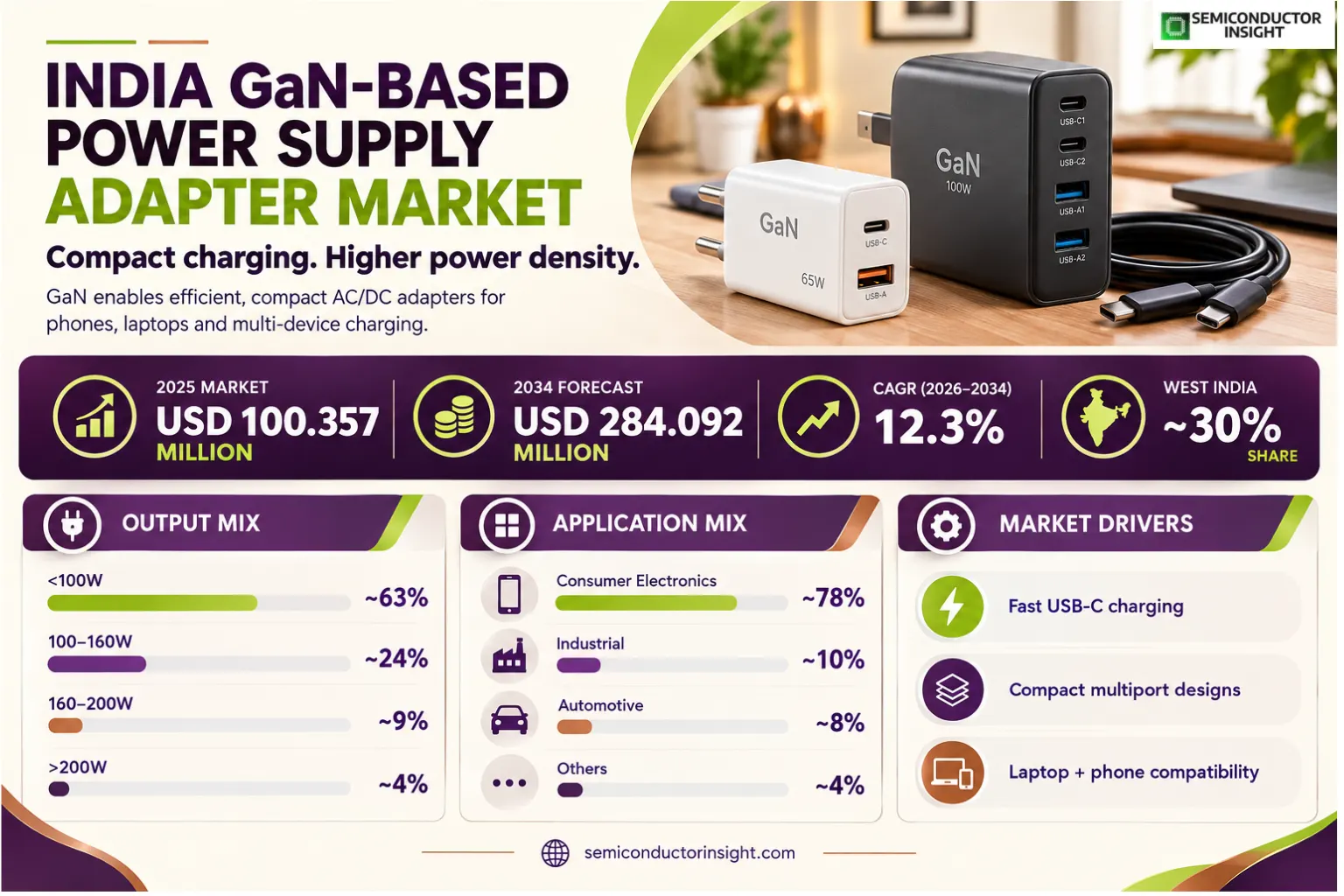
- Market trajectory: India GaN-based power supply adapter demand was valued at USD 100.357 million in 2025 and is projected to reach USD 284.092 million in 2034, representing 12.3% over 2026–2034. Compact 65W USB-C supplies and higher-output multiport designs are broadening the finished-product category.
- Less Than 100W: the largest wattage segment captures an estimated ~63% of 2025 market revenue. The category is supported by mobile phones, ultrabooks, tablets and accessory brands that offer 35W and 65W products with USB Power Delivery and programmable power supply control.
- Consumer Electronics: the leading application represents an estimated ~78% of 2025 value, while Industrial Products at ~10% and Automotive at ~8% describe smaller auxiliary-power uses, not traction inverters or complete charging stations.
- West India: the largest domestic zone holds an estimated ~30% of 2025 sales, reflecting Mumbai–Pune distribution, premium-device ownership and online fulfilment; South India follows at ~28%, with strong Bengaluru and Hyderabad demand.
- Competitive structure: Spigen, Belkin, iGear and JINX provide finished India-market charger examples, while upstream GaN semiconductor designers influence efficiency, switching topology and thermal design without automatically selling the finished adapters themselves.
India GaN-based Power Supply Adapter Market Overview
India GaN-based power supply adapter market reached USD 100.357 million in 2025 and is projected to total USD 284.092 million by 2034, advancing at a CAGR of 12.3% during 2026–2034. West India accounted for an estimated ~30% of domestic revenue in 2025, supported by high-density consumer electronics channels in Mumbai and Pune; chargers below 100W remained the volume foundation at an estimated ~63% share.
Gallium nitride changes the economics of a small external power supply by allowing the high-voltage switch to operate at higher frequency and with lower switching losses than many conventional silicon designs. A finished adapter still needs a transformer, isolation barrier, controller, USB-C interface, enclosure, electromagnetic-interference filtering and safety qualification. For buyers, the relevant benefit is a compact 35W, 65W or 100W charger that can travel with a phone and laptop, not the semiconductor die by itself. That distinction explains why brand distribution and device compatibility matter alongside electrical efficiency.
This market measures finished AC/DC GaN-based power supply adapters and external chargers supplied to Indian customers, including single-port USB-C, multiport desktop and travel products, and eligible industrial or automotive auxiliary adapters. It excludes merchant GaN transistors, integrated gate drivers, semiconductor wafers, silicon-only chargers, battery packs, complete public EV charging stations, onboard traction converters and finished smartphones. A semiconductor reference board establishes technical feasibility but is not a sale of a retail charger. A 200W product falls in the 160–200W class; only a rating strictly above 200W enters the uppermost band.
The physical product mix is visible in Indian retail catalogues: Spigen offers a 35W GaN charger and a 65W three-port USB-C/USB-A wall unit; Belkin offers a 65W dual-USB-C PPS wall charger and a 100W three-port GaN product. These examples illustrate the coexistence of affordable single-device charging and premium shared-output use, rather than disclosing national shipments. Port allocation matters because a nominal 100W adapter may deliver less power to each connected device when two or three ports operate together, making transparent power budgeting a commercial differentiator.
Power electronics evidence explains why the category can grow without assuming every fast charger uses GaN. Texas Instruments documents a 65W USB PD3.0 reference design using an integrated LMG3624 GaN stage, reporting 94.32% efficiency at 230Vac and 25.29 W per cubic inch of power density. The measured figures apply to that engineering design, not to all adapters sold in India. Designers still face creepage distance, temperature rise, conducted emissions, input surge and insulation constraints. A compact unit that fails reliability testing cannot convert semiconductor performance into sustained market acceptance.
Indian demand follows several purchasing cycles: replacing a lost phone charger, equipping a laptop that ships without a high-output brick, buying a multiport travel unit and standardising office-device accessories. West and South India concentrate early premium adoption through large electronics retail networks, while North India provides a substantial Delhi-region distribution market. East and Central/Northeast India expand as fulfilment networks and device affordability improve. This geography describes modeled domestic sales concentration rather than the manufacturing location of every charger, many of which are imported or assembled from internationally sourced components.
Segment Analysis: By Type
The Indian GaN-based adapter market is classified by total rated output into Less Than 100W, 100-160W, 160-200W and More Than 200W. Less Than 100W leads at an estimated ~63% share because 35W and 65W units fit the largest installed population of phones and lightweight computers. The ~24% 100-160W segment addresses dual-device charging, while higher-output categories expand from a smaller base and require more demanding thermal design.
| Type | Function | Market position |
|---|---|---|
| Less Than 100W | The Less Than 100W class encompasses 35W and 65W compact USB-C wall chargers, with output class defined by the total rated adapter power rather than by the sum of marketing claims for individual USB ports. Its engineering constraints include transformer temperature, input surge tolerance, galvanic isolation and the USB-C PD negotiation state across 1, 2 or 3 connected loads. Commercial purchases arise from single-device mobile charging, lightweight laptops and tablets; the Spigen 35W/65W and Belkin 65W demonstrate the accessible retail format. Distribution partners must distinguish verified electrical ratings from device-specific peak charging speeds to avoid costly returns and customer confusion. | Estimated ~63% of 2025 value, with ~11.3% modeled CAGR. The Less Than 100W revenue position reflects distribution breadth, charger price and practical use cases rather than the number of GaN chips enclosed in a product. For Less Than 100W, buyers compare connector count, cable inclusion, thermal behavior at 230V input, support for PPS and after-sales replacement. A brand able to document safe sustained output and stable port allocation can retain pricing better than a look-alike product sold only on advertised wattage. |
| 100-160W | The 100-160W class encompasses 100W and 160W multiport travel or desk adapters, with output class defined by the total rated adapter power rather than by the sum of marketing claims for individual USB ports. Its engineering constraints include transformer temperature, input surge tolerance, galvanic isolation and the USB-C PD negotiation state across 1, 2 or 3 connected loads; this qualification has particular relevance to a 35W handset adapter supplied through West India retail in the 2025 planning window. Commercial purchases arise from laptop plus handset charging, shared ports and PPS negotiation; the Belkin 100W product and 160W power-control demonstrations frame premium use. Distribution partners must distinguish verified electrical ratings from device-specific peak charging speeds to avoid costly returns and customer confusion; this qualification has particular relevance to a 65W laptop-compatible unit offered in South India in the 2025 planning window. | Estimated ~24% of 2025 value, with ~13.1% modeled CAGR. The 100-160W revenue position reflects distribution breadth, charger price and practical use cases rather than the number of GaN chips enclosed in a product. For 100-160W, buyers compare connector count, cable inclusion, thermal behavior at 230V input, support for PPS and after-sales replacement. A brand able to document safe sustained output and stable port allocation can retain pricing better than a look-alike product sold only on advertised wattage; this qualification has particular relevance to a 100W three-port charger bought in North India in the 2025 planning window. |
| 160-200W | The 160-200W class encompasses high-output 180W to 200W multiport chargers, with output class defined by the total rated adapter power rather than by the sum of marketing claims for individual USB ports. Its engineering constraints include transformer temperature, input surge tolerance, galvanic isolation and the USB-C PD negotiation state across 1, 2 or 3 connected loads; this qualification has particular relevance to a 160W multi-device travel supply distributed in East India in the 2025 planning window. Commercial purchases arise from simultaneous notebooks, peripherals and creator equipment; the JINX 200W six-port charger provides a finished India-market illustration. Distribution partners must distinguish verified electrical ratings from device-specific peak charging speeds to avoid costly returns and customer confusion; this qualification has particular relevance to a 200W specialist adapter shipped to Central and Northeast India in the 2025 planning window. | Estimated ~9% of 2025 value, with ~14.5% modeled CAGR. The 160-200W revenue position reflects distribution breadth, charger price and practical use cases rather than the number of GaN chips enclosed in a product. For 160-200W, buyers compare connector count, cable inclusion, thermal behavior at 230V input, support for PPS and after-sales replacement. A brand able to document safe sustained output and stable port allocation can retain pricing better than a look-alike product sold only on advertised wattage; this qualification has particular relevance to USB-C PPS negotiation in Bengaluru office procurement in the 2025 planning window. |
| More Than 200W | The More Than 200W class encompasses specialist supplies strictly rated above 200W, with output class defined by the total rated adapter power rather than by the sum of marketing claims for individual USB ports. Its engineering constraints include transformer temperature, input surge tolerance, galvanic isolation and the USB-C PD negotiation state across 1, 2 or 3 connected loads; this qualification has particular relevance to thermal qualification of a Mumbai premium-accessory SKU in the 2025 planning window. Commercial purchases arise from niche professional benches and multi-device high-power setups; the upstream 250W PoE design illustrates topology, not confirmed India adapter sales. Distribution partners must distinguish verified electrical ratings from device-specific peak charging speeds to avoid costly returns and customer confusion; this qualification has particular relevance to cable and port-power allocation for Hyderabad laptop users in the 2025 planning window. | Estimated ~4% of 2025 value, with ~16.0% modeled CAGR. The More Than 200W revenue position reflects distribution breadth, charger price and practical use cases rather than the number of GaN chips enclosed in a product. For More Than 200W, buyers compare connector count, cable inclusion, thermal behavior at 230V input, support for PPS and after-sales replacement. A brand able to document safe sustained output and stable port allocation can retain pricing better than a look-alike product sold only on advertised wattage; this qualification has particular relevance to regional warranty handling for Delhi NCR marketplaces in the 2025 planning window. |
Output architecture and charging protocol
Power rating does not by itself determine real-world charging speed. A 65W adapter can negotiate 20V at 3.25A for a compatible laptop, but a handset may require a proprietary protocol or PPS profile to reach its maximum advertised rate. When two ports are occupied, firmware may rebalance the 65W or 100W total budget; this behavior influences consumer satisfaction more than a nominally higher switching frequency. USB-C cable current rating, plug temperature and standby consumption therefore deserve separate consideration in product selection.
Manufacturers also face a transition from one-output flyback designs toward multiport architectures with active power distribution. Reference designs from Texas Instruments and STMicroelectronics show how integrated GaN power stages reduce the count of switching and sensing components, while protection and electromagnetic compatibility remain enclosure-level obligations. The commercial consequence is a wider range of 35W, 65W, 100W, 160W and 200W offerings without assuming that every listed semiconductor board is sold as a complete charger in India.
Segment Analysis: By Application
By application, Consumer Electronics, Automotive, Industrial Products and Others form the four publisher-defined demand channels. Consumer Electronics accounts for an estimated ~78% of 2025 revenue as phones and portable computers generate repeated charger purchases. Industrial Products at ~10% and Automotive at ~8% have different safety and qualification cycles; their inclusion does not extend the market into finished traction equipment or large EV charging installations.
| Application | Demand characteristics |
|---|---|
| Consumer Electronics | Estimated ~78% of 2025 value; modeled growth ~11.8% CAGR. Demand comes from phones, tablets, ultrabooks and premium multiport travel chargers, and buyers typically procure retail accessories, marketplace fulfilment and office replacement cycles. The commercial purchase decision balances usable wattage, stable 230V input performance, cable compatibility, protection behavior and warranty terms. Finished GaN adapter sales are counted at the charger-unit level, not as separate revenues for the power transistor, controller and enclosure. In this channel, an attractive compact design can justify a premium only when safe thermal operation and predictable device negotiation are demonstrated under realistic multi-hour use. |
| Automotive | Estimated ~8% of 2025 value; modeled growth ~14.2% CAGR. Demand comes from vehicle-cabin and accessory-compatible auxiliary power conversion, and buyers typically procure limited external or accessory supply niches rather than propulsion electronics. The commercial purchase decision balances usable wattage, stable 230V input performance, cable compatibility, protection behavior and warranty terms; this qualification has particular relevance to verified 230V input performance for Pune buyers in the 2025 planning window. Finished GaN adapter sales are counted at the charger-unit level, not as separate revenues for the power transistor, controller and enclosure; this qualification has particular relevance to genuine-product checks in Kolkata retail channels in the 2025 planning window. In this channel, an attractive compact design can justify a premium only when safe thermal operation and predictable device negotiation are demonstrated under realistic multi-hour use; this qualification has particular relevance to service accessibility for Guwahati accessory customers in the 2025 planning window. |
| Industrial Products | Estimated ~10% of 2025 value; modeled growth ~13.5% CAGR. Demand comes from portable industrial instruments, field laptops and specialised AC/DC auxiliary supplies, and buyers typically procure qualification for temperature, surge and service life. The commercial purchase decision balances usable wattage, stable 230V input performance, cable compatibility, protection behavior and warranty terms; this qualification has particular relevance to high-frequency switching design in a compact 65W enclosure in the 2025 planning window. Finished GaN adapter sales are counted at the charger-unit level, not as separate revenues for the power transistor, controller and enclosure; this qualification has particular relevance to industrial auxiliary supplies serving portable instrumentation in the 2025 planning window. In this channel, an attractive compact design can justify a premium only when safe thermal operation and predictable device negotiation are demonstrated under realistic multi-hour use; this qualification has particular relevance to device-replacement purchases among Jaipur phone users in the 2025 planning window. |
| Others | Estimated ~4% of 2025 value; modeled growth ~14.0% CAGR. Demand comes from educational, laboratory and mixed-use low-volume charging configurations, and buyers typically procure project orders and small specialised distributors. The commercial purchase decision balances usable wattage, stable 230V input performance, cable compatibility, protection behavior and warranty terms; this qualification has particular relevance to a three-port 100W design with simultaneous device loading in the 2025 planning window. Finished GaN adapter sales are counted at the charger-unit level, not as separate revenues for the power transistor, controller and enclosure; this qualification has particular relevance to a 35W handset adapter supplied through West India retail in the 2026 planning window. In this channel, an attractive compact design can justify a premium only when safe thermal operation and predictable device negotiation are demonstrated under realistic multi-hour use; this qualification has particular relevance to a 65W laptop-compatible unit offered in South India in the 2026 planning window. |
The channel split also changes distribution economics. Consumer Electronics products are sold as individual boxed accessories and compete with low-cost silicon chargers, whereas industrial customers may specify a connector, mounting method or wider operating-temperature requirement before accepting a design. Automotive auxiliary use is a distinct lower-volume opportunity with additional electrical-noise and reliability concerns. The 2025 modeled shares describe finished adapter value by end use, so they should not be interpreted as semiconductor bill-of-material shares or as a forecast of electric-vehicle charger infrastructure.
Regional Analysis
West India accounts for an estimated ~30% of 2025 finished GaN adapter revenue, followed by South India at ~28%, North India at ~24%, East India at ~12% and Central & Northeast India at ~6%. The distribution reflects urban device mix, channel availability and replacement spending rather than an assumption that adapters are manufactured in their region of purchase. South India is modeled to grow fastest at ~13.0% CAGR because professional laptop use creates opportunities for 65W to 160W multiport products.
Where are GaN power supply adapters bought and specified across India?
Indian demand divides into five commercial zones with different buyer expectations. West India concentrates premium accessories and broad distribution; South India emphasizes workplace portability and simultaneous device charging; North India combines a large wholesale network with value-conscious retail purchasing. East India benefits from widening availability through marketplaces, while Central & Northeast India is constrained more by replenishment and after-sales access. The estimated shares are revenue allocations by location of demand, not the manufacturing origins of components or retail inventory.
Growth rates differ because wattage mix and purchase frequency are not uniform. A 35W travel charger in a secondary city is usually bought as a practical replacement, while a 100W or 160W multiport adapter in a technology hub can be an upgrade purchase. This distinction creates a regional price ladder even when the same semiconductor topology is used across several finished products. Distributors therefore need local stock planning, genuine-product identification and USB-C compatibility information rather than one national sales strategy.
| Region | Position | Growth outlook | Demand profile | What decides supplier selection |
|---|---|---|---|---|
| West India | Largest (~30%) | ~12.8% CAGR | Premium handset and laptop replacement cycles support estimated ~30% of India demand in 2025, with the category spread across 35W, 65W and 100W formats. | Buyer qualification is shaped by warranty handling and genuine-brand authentication; suppliers win through national accessory distributors, large-format retail and rapid online fulfilment, with distinct price sensitivity for 160W and 200W products. |
| South India | Second (~28%) | ~13.0% CAGR | Dense technology workforce and portable-device fleets support estimated ~28% of India demand in 2025, with the category spread across 35W, 65W and 100W formats. | Buyer qualification is shaped by USB-C PD interoperability across laptop brands; suppliers win through electronics marketplaces, enterprise resellers and laptop specialists, with distinct price sensitivity for 160W and 200W products. |
| North India | Third (~24%) | ~11.7% CAGR | Large retail population and cross-brand accessory demand support estimated ~24% of India demand in 2025, with the category spread across 35W, 65W and 100W formats. | Buyer qualification is shaped by counterfeit resistance and verified electrical ratings; suppliers win through NCR wholesale distribution, organised electronics chains and direct-to-consumer brands, with distinct price sensitivity for 160W and 200W products. |
| East India | Fourth (~12%) | ~11.4% CAGR | Wider premium-device availability and e-commerce delivery support estimated ~12% of India demand in 2025, with the category spread across 35W, 65W and 100W formats. | Buyer qualification is shaped by landed price, inventory continuity and returns logistics; suppliers win through regional resellers and marketplace-led replenishment, with distinct price sensitivity for 160W and 200W products. |
| Central & Northeast India | Fifth (~6%) | ~9.5% CAGR | Online reach into secondary cities and replacement purchasing support estimated ~6% of India demand in 2025, with the category spread across 35W, 65W and 100W formats. | Buyer qualification is shaped by delivery cost, warranty access and reliable service points; suppliers win through marketplace logistics and specialist city retailers, with distinct price sensitivity for 160W and 200W products. |
India GaN Power Supply Adapter Manufacturers and Competitive Landscape
Competition in finished Indian GaN adapters is structured around branded accessory makers and local distribution rather than around the identity of the power switch alone. Spigen, Belkin, iGear and JINX document finished India-facing chargers spanning 35W to 200W. Semiconductor firms such as Infineon, Texas Instruments, STMicroelectronics, Navitas and Power Integrations provide technology that may be designed into finished supplies; their participation does not establish that they sell boxed chargers directly to Indian consumers.
The lower-wattage category is the most visible battleground. Spigen lists 35W and 65W GaN products in India, while Belkin lists 65W dual-USB-C and 100W three-port variants. The presence of multiple models at 65W indicates that connector mix, packaging, warranty and protocol support can differentiate two adapters even when their headline output is identical. The estimated ~63% share of Less Than 100W therefore reflects an installed-device opportunity and distribution reach, not exclusive technical control by one brand.
Premium positioning depends on verified performance under simultaneous loads. Belkin 100W adapters and the JINX 200W six-port product address different use cases; the 200W product belongs in the 160–200W class by rating. Port-priority firmware, thermal management and cable selection can make a higher-priced model worthwhile for a travelling professional. By contrast, entry buyers often choose a compact 35W charger because it is easier to carry and meets a phone’s actual negotiated input.
Upstream innovation influences the cost of a finished charger but should be separated from channel sales. Texas Instruments documents integrated GaN switching and current sensing in a 65W reference design, and STMicroelectronics publishes 65W USB-PD evaluation hardware. Infineon has publicised 650V CoolGaN devices and a 160W Anker collaboration. These documents support technology capability, while the retail product pages identify finished adapters; neither category alone provides audited India shipment shares.
The publisher also names industrial and defence-linked organisations, including Bharat Electronics Limited and Hindustan Aeronautics Limited, but their presence does not demonstrate a verified consumer GaN adapter line. They are therefore not treated as finished-charger competitors without a specific qualifying product. The same caution applies to other upstream technology providers: semiconductor intellectual property and distribution partnerships can influence supply without making a firm a direct seller of wall chargers.
Tier structure
| Tier | Companies | Basis of competition |
|---|---|---|
| Finished charger brands | Spigen India; Belkin India; iGear; JINX | These brands document India-market finished GaN adapter SKUs with identifiable wattage, ports and customer-facing specifications. They compete on USB-C PD/PPS interoperability, retailer coverage, warranty service and transparent simultaneous-output allocation, rather than simply on possession of a GaN device technology. Their catalogues establish product presence, not quantified national market leadership. |
| Upstream power technology | Infineon Technologies; Texas Instruments; STMicroelectronics; Navitas Semiconductor; Power Integrations | These firms provide switching devices, integrated controllers, drivers, evaluation boards and reference designs used by power-supply designers. They influence size, efficiency, protection and qualification cost but cannot be assigned finished-adapter retail revenue from their semiconductor product announcements. Their relevance is the bill of materials and system architecture behind qualified charger hardware. |
| Other named ecosystem participants | Vishay Intertechnology; Bharat Electronics Limited; Hindustan Aeronautics Limited; Quantum Materials Corp. | Some names participate in passive components, industrial electronics or other technology domains without direct official evidence of a finished India-market GaN adapter SKU. They remain identifiable in the publisher company universe but should not be presented as Tier 1 or Tier 2 charger vendors. Finished-product classification requires an actual adapter specification or verified sales channel. |
Key companies profiled
- Spigen India
- Belkin India
- iGear
- JINX
- Infineon Technologies
- Texas Instruments
- STMicroelectronics
- Navitas Semiconductor
- Power Integrations
- Vishay Intertechnology
- Bharat Electronics Limited
- Hindustan Aeronautics Limited
- Quantum Materials Corp.
India GaN Adapter Supply Chain and Production Capacity Analysis
India-market charger availability is determined by a distributed electronics supply chain that combines internationally sourced GaN power devices, controller ICs, magnetics, safety-certified plastics and finished branded products. The same retail brand may source different wattage classes from different contract manufacturers. Product catalogues confirm availability, but they do not establish a domestic GaN wafer fab, a named local adapter assembly line or an India-specific production capacity figure. Supply-chain resilience therefore rests on component alternatives and qualified finished-product channels.
An external 65W charger requires far more than a GaN transistor. A typical architecture combines high-voltage switching, an isolated transformer, optocoupler or digital feedback, USB-C PD control, output filtering and protection against abnormal temperature or voltage. Texas Instruments reports 94.32% efficiency at 230Vac in a documented 65W reference design, but those figures describe an engineering board. Production yields, enclosure ventilation and certification determine whether a finished SKU can deliver comparable performance after shipping and repeated consumer use.
Component sourcing has become strategically important as adapters move from 35W to 100W and 160W multiport formats. Infineon, STMicroelectronics and Power Integrations offer different integrated or discrete GaN power approaches, while brand owners evaluate magnetics, thermal interfaces and controller firmware for each form factor. A substitution in the power stage can require new conducted-emissions testing or revised thermal design, making supplier qualification a real barrier to rapid cost-down even where the semiconductor die is commercially available.
Distribution capacity is equally consequential in India. Mumbai, Pune, Bengaluru, Hyderabad and Delhi NCR host dense electronics channels, whereas eastern and northeastern customers may rely more heavily on marketplace replenishment. The modeled ~30% West India share and ~28% South India share indicate where premium stock turns may be fastest, not where every device is assembled. Returns management, counterfeit screening and a reliable warranty network can preserve a brand’s gross margin when unbranded chargers compete aggressively on nominal wattage.
India GaN Adapter Market Dynamics: Drivers, Restraints and Opportunities
Demand is supported by USB-C adoption, replacement purchases, multi-device work patterns, improved power density and expanding distribution outside metropolitan cities. Growth is moderated by price premiums over conventional silicon chargers, thermal and electromagnetic-compatibility qualification, inconsistent proprietary fast-charging behavior and counterfeit products. These forces have different effects across the 35W, 65W, 100W and 160W bands: smaller chargers rely on mass affordability, while high-output products depend on trust in sustained performance and safe power sharing.
MARKET DRIVERS
Drivers Impact Analysis*
| Market Drivers | Impact Rank | CAGR Contribution (%) | 2026–2028 | 2029–2031 | 2032–2034 |
|---|---|---|---|---|---|
| USB-C phone and laptop replacement purchasing | High | +4.60% | High | High | Medium |
| Compact GaN designs replacing bulky silicon bricks | High | +3.50% | High | High | High |
| Multiport 100W and 160W premium adoption | Medium-High | +2.80% | Medium | High | High |
| Organised online and offline retail distribution | Medium | +2.10% | High | Medium | Medium |
| Industrial auxiliary power and portable workstations | Low-Medium | +1.50% | Low | Medium | High |
| Others (travel charging, office accessory refresh, specialist high-output use) | Low | +1.00% | Medium | Medium | Low |
USB-C replacement demand broadens the buyer base
A user replacing a missing phone or laptop adapter increasingly evaluates USB-C Power Delivery rather than an exact original-equipment brick. That makes a branded 35W or 65W GaN charger relevant across multiple device generations and creates recurring purchases after hardware replacement. Spigen and Belkin product listings show how one compact SKU can serve tablets, phones and compatible computers. This driver is strongest when buyers understand negotiated voltage profiles and receive a reliable cable, since a connector shape alone does not guarantee the desired charging speed.
Higher switching frequency enables smaller travel supplies
Gallium nitride can reduce switching loss and support high-frequency conversion, which lets engineers shrink some magnetic and filtering components. Texas Instruments demonstrates a 65W design with 25.29 W/in³ power density and 94.32% efficiency at 230Vac, showing a concrete engineering pathway. These measured figures are not the performance of every Indian charger. Nonetheless, size and weight are easy for consumers to compare at the point of sale, so proven compactness can command a premium when reliability and safety remain intact.
Multiport work patterns lift average adapter value
A professional carrying a laptop, phone and earbuds can replace two or three wall bricks with a shared 100W or 160W supply. Belkin documents a 100W three-port model, and the 160W Anker collaboration illustrates how digital control can allocate power among multiple USB-C outputs. Such products are more complex than a single 35W adapter, but they also offer a higher ticket value and a defensible convenience benefit. Adoption therefore depends on predictable port behavior rather than merely the total printed wattage.
Distribution reach opens secondary-city replacement demand
Marketplace logistics allow GaN accessories to reach customers beyond Mumbai, Bengaluru and Delhi, while regional resellers can explain the difference between a 65W PD charger and a proprietary fast-charging standard. East India and Central & Northeast India together account for an estimated ~18% of 2025 revenue, leaving scope for assortment expansion. The opportunity is not simply to advertise 200W units everywhere; it is to match local device ownership, warranty access and price tolerance with a credible set of 35W, 65W and 100W products.
MARKET RESTRAINTS
Restraints Impact Analysis*
| Market Restraints | Impact Rank | CAGR Contribution (%) | 2026–2028 | 2029–2031 | 2032–2034 |
|---|---|---|---|---|---|
| Price premium and low-cost silicon alternatives | High | -1.50% | High | High | Medium |
| Safety, thermal and electromagnetic compatibility qualification | Medium-High | -0.80% | High | Medium | Medium |
| Proprietary charging protocols and port-allocation confusion | Medium | -0.50% | Medium | Medium | High |
| Others (counterfeits, returns, component sourcing and warranty costs) | Low | -0.40% | Medium | Medium | Low |
Price comparisons compress margins below 100W
The largest type segment, Less Than 100W at an estimated ~63% of 2025 revenue, also faces the widest range of silicon-based alternatives. Consumers comparing 35W or 65W products may not pay extra for GaN unless the finished unit is visibly smaller, cooler or more convenient. Online promotions can amplify this pressure, and low-cost sellers sometimes advertise headline wattage without clear sustained-output evidence. Branded suppliers must defend price through certified performance, genuine inventory, clear warranty terms and fewer costly returns.
Thermal and compliance testing slow rapid product turnover
A charger that performs well on a reference board can behave differently in a sealed travel enclosure after hours at 230V input. Isolation distances, transformer hot spots, input surge, conducted emissions and plug temperature all need attention before commercial release. Moving from 65W to 100W or 160W also changes cable and port-management requirements. These engineering steps lengthen qualification and can reduce the speed at which a small brand copies a high-density topology into a finished product.
Protocol fragmentation creates misleading customer expectations
USB-C connectors conceal several charging negotiations, including fixed Power Delivery profiles, PPS ranges and device-specific fast-charge behavior. A 100W multiport unit may not supply 100W to each device when all outputs are occupied, and some phones cannot use their fastest proprietary mode on a generic PD supply. The resulting customer complaints can increase retailer returns even when the GaN stage operates correctly. Product makers therefore need readable power-allocation tables and honest compatibility statements across the 35W to 200W portfolio.
MARKET OPPORTUNITIES
Clear multi-device charging profiles can become a premium feature
A 100W or 160W adapter that visibly explains its power split has a stronger proposition for laptop users than a charger whose ports silently renegotiate output. Digital power management, efficient GaN switching and carefully selected cables can make three-port travel designs reliable across common devices. Brands can translate this into reduced support burden and higher accessory attachment rates through honest compatibility tables, field-tested 230V operation and longer warranties rather than through unsubstantiated efficiency superlatives.
Secondary cities offer a disciplined route to market expansion
Eastern and central Indian cities have growing access to premium electronics through national marketplaces, but their preferred wattage mix may be different from the largest metros. Retailers can begin with 35W and 65W units, then introduce 100W and 160W models where laptop ownership supports higher price points. This staged approach avoids tying up inventory in niche above-200W products while creating a service and warranty network that supports future adoption.
Industrial auxiliary adapters can reward reliability over novelty
Industrial customers sometimes need compact isolated power for field laptops, instrumentation or portable maintenance systems, with better surge tolerance and longer product life than ordinary travel chargers. GaN can help meet enclosure and efficiency constraints, but only a finished adapter that passes the relevant electrical qualification should count as commercial supply. This is a smaller opportunity than Consumer Electronics at an estimated ~78% share, yet its engineering requirements may protect margins and encourage longer supplier relationships.
India GaN Charger Value Chain and Commercial Sourcing
The finished charger value chain links high-voltage GaN device design to converter topology, transformer and enclosure engineering, protocol firmware, testing, branded distribution and post-sale service. A 65W reference design can shorten engineering effort but does not remove the need to qualify the full product. India-market brands compete most directly in retail packaging and channel availability, while semiconductor suppliers capture a separate upstream bill-of-material opportunity that is excluded from the finished-adapter market total.
Design-to-product conversion. The reference-design ecosystem from Texas Instruments, STMicroelectronics and Power Integrations helps engineers evaluate flyback and integrated GaN approaches, but a complete retail unit also needs mechanical and safety decisions. Power density may be measured on a development board at 65W, while a shipped charger must survive repeated plug cycles, multiple load profiles and thermal stress. This difference makes contract-manufacturer capability and validation documentation material to supplier selection.
Commercial channels. Spigen, Belkin, iGear and JINX provide visible finished-adapter examples in India at 35W, 65W, 100W and 200W ratings. Their product pages demonstrate a range of port configurations, not market shares or unit shipments. Retail partners assess price, return rates, authenticity and replacement speed; high-output products add the complexity of multiport allocation and the cost of maintaining compatible cables. These commercial attributes can matter as much as semiconductor efficiency.
Demand mapping. West India at an estimated ~30% share and South India at ~28% are modeled as the two largest 2025 demand zones, but a distributor may import a finished charger through one city and sell it in another. Regional revenue should follow customer demand rather than customs entry or chip origin. Keeping that boundary consistent prevents the same adapter from being counted again as a transistor sale, a retail charger sale and a separate accessory component.
Recent Developments in GaN Charger and Power-Conversion Technology
- 28 November 2025 Adjacent product collaboration
Infineon documented the Anker 160W Prime Charger with its XDP digital controller and CoolGaN transistors, explaining how one compact adapter allocates up to 160W across three devices. The announcement demonstrates system-level power density and port management; it does not disclose Indian sales of that model. Its relevance is the technology pathway for premium 100–160W products and the need to distinguish finished chargers from their power IC suppliers. Source - 23 September 2025 Adjacent power design
Infineon discussed CoolGaN devices in a 250W power-over-Ethernet supply, an engineering application above the mainstream 35W–160W travel-adapter range. The event is relevant to high-power converter architectures, but a PoE adapter should not be counted as a confirmed India consumer USB-C charger. Its market significance is evidence of wider GaN design capability and the increasing importance of thermal qualification at higher output. Source - 2 May 2025 Adjacent module introduction
Infineon introduced an EasyPACK CoolGaN 650V power module for industrial and energy conversion, broadening the technology ecosystem beyond compact phone chargers. This announcement is not a finished India-market adapter launch, and the module’s target systems operate at a different power scale. It nevertheless signals component investment and design-tool maturity that can indirectly affect cost and engineering expertise in GaN conversion. Source - 22 April 2025 Adjacent semiconductor update
Navitas showcased developments in GaNFast and SiC power technologies for high-efficiency conversion, adding evidence of upstream product innovation. Semiconductor demonstrations cannot be converted into Indian wall-charger unit volumes, because final sales depend on design wins, qualified production and distribution. Their importance for this market lies in the range of device options that charger designers can evaluate as wattage and thermal requirements increase. Source - 9 April 2025 Adjacent design partnership
Navitas and GigaDevice announced a joint power-and-control development effort involving GaNFast ICs and microcontrollers for high-frequency power platforms. The collaboration targeted multiple sectors rather than a named India consumer charger, so it is classified as upstream evidence. It matters because integrated control and switching can simplify future power-stage designs while finished adapter suppliers remain responsible for USB-C compatibility, safety and warranty performance. Source - 10 March 2025 Adjacent reference demonstration
Texas Instruments published a 65W USB-C GaN charger demonstration showing a practical reference-design pathway for high-density conversion. The demonstration supports engineering feasibility but does not prove the launch or shipment of a finished charger brand in India. Its commercial relevance is the reproducible technical starting point available to designers of 35W–100W products, subject to additional enclosure and certification work. Source - 4 November 2024 Adjacent GaN component launch
Infineon announced a new generation of 650V CoolGaN G5 power discretes with adapter and power-conversion relevance. The release concerns semiconductor components rather than a specific finished Indian charger SKU. It illustrates a possible efficiency and size improvement for future designs, while national sales still depend on retail pricing, compatibility, qualification and the presence of a complete boxed adapter in distribution. Source
REPORT SCOPE & SEGMENTATION
| Attribute | Details |
|---|---|
| Study Period | 2020–2034 |
| Base Year | 2025 |
| Estimated Year | 2026 |
| Forecast Period | 2026–2034 |
| Historical Period | 2020–2024 |
| Market Size 2025 | USD 100.357 million |
| Market Size 2026 | USD 112.658 million |
| Market Size 2034 | USD 284.092 million |
| Growth Rate | CAGR of 12.3% during 2026–2034 |
| Unit | Value in USD million; finished India-market external GaN adapters |
| Segmentation | By Type, By Application, and By Domestic Zone |
| By Type | Less Than 100W · 100-160W · 160-200W · More Than 200W |
| By Application | Consumer Electronics · Automotive · Industrial Products · Others |
| By Region | Domestic zones of Indian customer demand, not manufacturing origin; estimated 2025 shares West IndiaMumbai Metropolitan Region, Pune and Pimpri-Chinchwad, Gujarat urban corridor South IndiaBengaluru urban market, Hyderabad technology corridor, Chennai and Coimbatore North IndiaDelhi National Capital Region, Noida and Gurugram, Jaipur and Chandigarh East IndiaKolkata and Howrah, Bhubaneswar and Cuttack, Patna and Ranchi Central & Northeast IndiaIndore and Bhopal, Raipur and Nagpur-linked routes, Guwahati and Northeast distribution |
| Key Companies Profiled | Spigen India, Belkin India, iGear, JINX, Infineon Technologies, Texas Instruments, STMicroelectronics, Navitas Semiconductor, Power Integrations, Vishay Intertechnology, Bharat Electronics Limited, Hindustan Aeronautics Limited, Quantum Materials Corp. |
| Customization Scope | Customization can examine wattage-class revenue, USB-C port configurations, retail-channel availability and domestic-zone demand. It can also distinguish finished adapter brands from semiconductor device providers without treating a reference design as commercial India shipment evidence. |
Frequently Asked Questions
How large is the India GaN-based power supply adapter market?
The market reached USD 100.357 million in 2025 and is forecast to reach USD 284.092 million in 2034, with a 12.3% CAGR over 2026–2034. This valuation concerns complete GaN-based external power adapters and chargers supplied to Indian customers. It is not a measure of merchant GaN transistor revenue, and it does not include conventional silicon-only charging bricks or finished public EV charging stations.
Which output class is the largest in India?
Less Than 100W leads with an estimated ~63% of 2025 value because 35W and 65W chargers cover common phone, tablet and lightweight laptop needs. The 100–160W class follows at ~24% and is more focused on multiport travel and workstation charging. Higher ratings carry greater thermal and port-management complexity, so their average price can be higher even when shipment volumes are smaller.
Which application buys the most GaN adapters?
Consumer Electronics accounts for an estimated ~78% of 2025 market value, reflecting frequent purchases of mobile and laptop charging accessories. Industrial Products at ~10% and Automotive at ~8% are narrower categories for qualified auxiliary power supplies. The automotive segment should not be confused with traction inverters or complete EV charging infrastructure, because the revenue boundary remains a finished external adapter.
Where is Indian GaN adapter demand concentrated?
West India leads with an estimated ~30% of 2025 sales, supported by Mumbai and Pune accessory distribution. South India contributes ~28% through Bengaluru, Hyderabad and Chennai, while North India holds ~24% through NCR and adjacent markets. East India accounts for ~12% and Central & Northeast India for ~6%. These allocations describe modeled customer demand, not the location of GaN wafer fabrication or charger assembly.
Are all fast USB-C chargers based on gallium nitride?
No. A charger may support USB Power Delivery or a proprietary fast-charge mode while using silicon switching devices, and a GaN stage does not by itself guarantee support for a particular phone protocol. Buyers should check the declared semiconductor technology, rated output, USB-C PD/PPS profiles and independent safety documentation. Finished GaN charger classification requires a complete qualifying product rather than an unsupported marketing inference.
Which companies sell finished GaN chargers in India?
Official India-facing catalogues document finished GaN adapter products from Spigen, Belkin, iGear and JINX. Semiconductor suppliers including Infineon, Texas Instruments, STMicroelectronics, Navitas and Power Integrations provide related power devices or reference designs but are not automatically finished charger vendors. A company should be classified as a direct competitor only when an identifiable charger SKU or verified finished-product supply channel supports that description.
What does a 200W charger mean for segmentation?
A unit rated exactly 200W belongs in the 160–200W category, because the More Than 200W class begins above that threshold. A JINX six-port 200W product is an example of a finished higher-output adapter, although the nominal total may be shared across active ports. The number of USB connectors does not multiply the device’s rated output, and power allocation should be checked before comparing models.
What technical advantages does GaN offer adapter designers?
GaN switching can reduce switching losses and support higher-frequency power conversion, potentially shrinking magnetic components and the finished enclosure. A Texas Instruments 65W reference design reports 94.32% efficiency at 230Vac and 25.29 W/in³ power density under specified test conditions. These are design-specific engineering results, not a market-wide average. Thermal, insulation and electromagnetic-compatibility requirements still determine whether a commercial charger can deliver reliable sustained performance.
Why do regional growth rates differ inside India?
South India is modeled at ~13.0% CAGR because a concentration of technology workers and portable-computer fleets supports premium multiport charging. West India is modeled at ~12.8%, supported by broad distribution and professional device ownership. East India at ~11.4% and Central & Northeast India at ~9.5% face different inventory, warranty and affordability conditions. These figures are analytical allocations, not official state-level shipment statistics.
What is included in the study period and market scope?
The study uses 2025 as its base year, 2026 as its estimate year and 2026–2034 as the forecast interval, with historical context from 2020–2024. It covers Less Than 100W, 100–160W, 160–200W and More Than 200W types across Consumer Electronics, Automotive, Industrial Products and Others. Five domestic zones are analyzed, with finished chargers separated from upstream GaN semiconductors, complete vehicles and charging infrastructure.
Research Sources & Evidence Base
Get Sample Report PDF for Exclusive Insights
Report Sample Includes
- Table of Contents
- List of Tables & Figures
- Charts, Research Methodology, and more...
 Download Sample Report PDF