Key Statistics
Key Takeaways
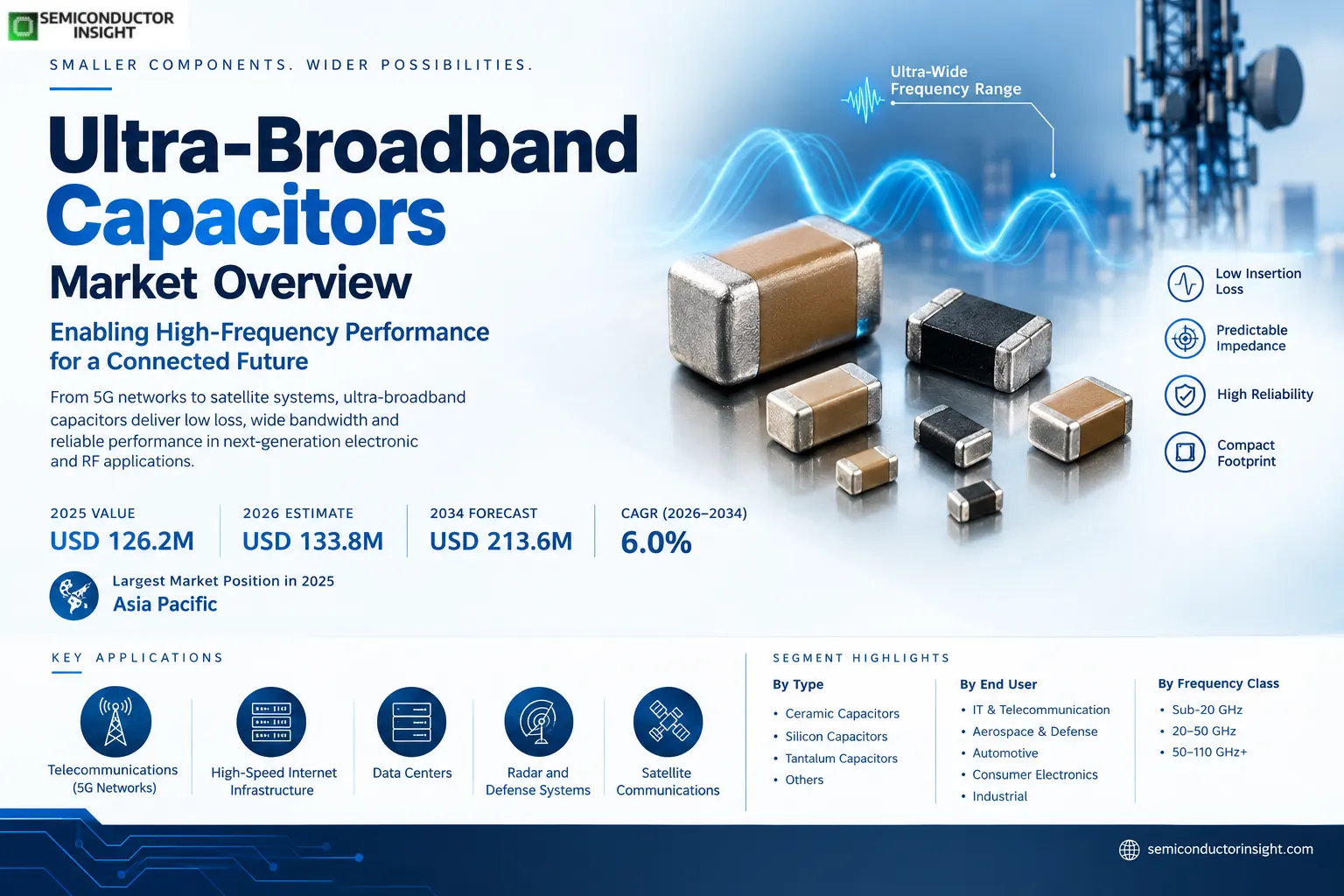
- Market size: the Ultra-Broadband Capacitors market was valued at USD 126.2 million in 2025 and is projected to reach USD 213.6 million by 2034, representing a 6.0% CAGR over 2026–2034.
- Ceramic Capacitors has the strongest current type position because ceramic construction combines ruggedness, very small footprints and proven broadband RF performance across optical and microwave systems.
- Telecommunications (5G Networks) is the most commercially important application because telecommunications and high-speed optical infrastructure create the broadest recurring need for DC blocking and coupling across wide frequency ranges.
- Asia Pacific is the largest regional market in 2025; regional expansion depends on the local mix of installed infrastructure, regulation, manufacturing capability and customer investment.
- Competitive differentiation increasingly depends on application engineering, qualification support and lifecycle reliability rather than price alone.
Ultra-Broadband Capacitors Market Overview
Ultra-Broadband Capacitors market was valued at USD 126.2 million in 2025 and is estimated at USD 133.8 million in 2026. It is projected to reach USD 213.6 million by 2034, registering a 6.0% CAGR over 2026–2034. Asia Pacific held the largest market position in 2025.
Ultra-broadband capacitors are specialized RF and microwave capacitors designed to provide low insertion loss and predictable impedance across a very wide frequency range. They are commonly used for DC blocking, coupling, bypassing and feedback in high-speed data, optical modules, microwave instruments and millimeter-wave systems. Unlike general-purpose MLCCs, these components are engineered to suppress resonant behavior and parasitic inductance across bandwidths that can extend well into tens of gigahertz.
Supplier technical data illustrates how far the category has advanced. KYOCERA AVX specifies its 550/560 UBC families for operation from 7 kHz to above 110 GHz in 01005, 0201 and 0402 sizes, targeting optical communications, transimpedance amplifiers and broadband microwave applications. Knowles Precision Devices markets ultra-broadband DC-blocking solutions with resonance-free performance beyond 40 GHz. These capabilities align with faster optical links, test equipment and higher-frequency RF front ends.
The market remains relatively small in value because these are compact passive components, yet qualification is demanding and unit prices are higher than commodity capacitors. Engineers select parts based on insertion loss, return loss, voltage rating, footprint and temperature stability. Once a component is embedded in a carefully tuned RF path, replacement can require layout and signal-integrity revalidation, giving qualified suppliers meaningful design-in persistence.
Segment Analysis: By Type
By type, the market is segmented into Ceramic Capacitors, Silicon Capacitors, Tantalum Capacitors, Others. Ceramic Capacitors has the strongest current position, while the remaining categories compete on performance, integration effort, lifecycle economics and customer qualification requirements.
| Type | Function / role | Market position |
|---|---|---|
| Ceramic Capacitors | Engineered ceramic dielectric and electrode structures minimize parasitics. | Largest segment; strong combination of size, repeatability and very wide bandwidth. |
| Silicon Capacitors | Silicon-based capacitor structures offer tight integration and low parasitics. | Attractive where semiconductor-style integration and compact footprints are important. |
| Tantalum Capacitors | Tantalum-based specialty products serve selected power and RF roles. | Niche in true ultra-broadband signal paths because parasitic behavior limits some high-frequency uses. |
| Others | Other specialty constructions target specific power, package or frequency needs. | Small application-specific segment. |
Commercial implications by type
Ceramic UBCs dominate because vendors can deliver compact standard footprints with characterized S-parameter performance across broad frequencies. Silicon alternatives can gain where integration density or wafer-level assembly is important. Purchasing decisions are engineering-led; customers pay for stable RF behavior, measurement data and qualification confidence rather than capacitance value alone.
Segment Analysis: By Application
By application, the market is segmented into Telecommunications (5G Networks), High-Speed Internet Infrastructure, Data Centers, Radar and Defense Systems, Satellite Communications. Purchasing behavior differs materially by use case because performance thresholds, duty cycles, safety requirements and integration costs vary across end systems.
| Application | Demand characteristics |
|---|---|
| Telecommunications (5G Networks) | 5G, optical transport and radio infrastructure use broadband DC blocking and coupling where low loss across wide frequency bands is critical. |
| High-Speed Internet Infrastructure | High-speed optical modules and broadband access equipment require signal integrity from low frequencies through microwave bands. |
| Data Centers | Data-center optics and test systems increasingly use high-speed links where compact broadband passives reduce board parasitics. |
| Radar and Defense Systems | Radar and electronic-warfare systems value wide bandwidth, ruggedness and repeatable microwave behavior. |
| Satellite Communications | Satellite payloads and ground systems need compact RF components that maintain predictable performance across wide temperature and frequency ranges. |
By End User
The by end user view is segmented into IT & Telecommunication, Aerospace & Defense, Automotive, Consumer Electronics, Industrial. IT and telecom leads because optical networking, broadband access and RF infrastructure combine high unit volumes with demanding signal-integrity requirements.
By Frequency Class
The by frequency class view is segmented into Sub-20 GHz, 20–50 GHz, 50–110 GHz+. Demand is shifting upward in frequency as 5G, mmWave test, optical modules and broadband instrumentation push designers toward components characterized well beyond 40 GHz.
Regional Analysis
Asia Pacific leads the Ultra-Broadband Capacitors market in 2025. The regional structure is not uniform: adoption reflects differences in end-market scale, qualification requirements, manufacturing ecosystems, regulation and customer access rather than one global purchasing pattern.
How does regional demand differ across the Ultra-Broadband Capacitors market?
Regional demand should be read through the local deployment mechanism. Mature markets usually place more weight on qualification, regulation and replacement cycles, while faster-growing markets are shaped by new capacity, infrastructure build-out and rising local production. Supplier strategy therefore differs by region: channel depth and compliance may matter more than low price in mature markets, while local engineering and availability can decide share in expansion markets.
| Region | Position | Growth outlook | Demand profile | Supplier-selection factor |
|---|---|---|---|---|
| Asia Pacific | Largest | Strong | Electronics and telecom manufacturing | Scale, local design-in |
| North America | Large | Strong | RF, data center, defense | Performance, qualification |
| Europe | Large | Moderate | Telecom, aerospace, industrial | Reliability, compliance |
| South America | Emerging | Moderate | Telecom infrastructure | Availability, import cost |
| Middle East & Africa | Emerging | Moderate | 5G and defense projects | Distribution, project qualification |
Competitive Landscape
Competition is concentrated among RF-capacitor specialists and large passive-component groups able to characterize insertion loss and return loss across very wide frequency ranges. Product credibility depends on measured data, repeatability and package control, so application engineering is more important than catalog breadth alone.
KYOCERA AVX has a prominent position with its 550/560 UBC series spanning 7 kHz to above 110 GHz and very small case sizes. Its February 2026 portfolio expansion targeted optical communications, directly aligning product development with higher-speed network demand.
Knowles Precision Devices competes with Opti-Cap and Milli-Cap broadband blocking solutions designed for low loss and very low series inductance across microwave and millimeter-wave applications.
Murata, TDK, Vishay, Exxelia and Asian passive suppliers compete through broader capacitor portfolios, local customer access and specialized RF products. Design wins can be persistent because changing a capacitor in a broadband path can alter S-parameters and require board-level requalification.
| Company | Positioning | Competitive relevance |
|---|---|---|
| KYOCERA AVX Components Corporation | Established / platform leader | Dedicated ultra-broadband series, tiny footprints and published 110 GHz+ capability provide strong technical differentiation. |
| Knowles Precision Devices | Established / specialist | Specialized broadband DC-blocking products and RF expertise support photonics, test and microwave applications. |
| Murata Manufacturing | Established / specialist | Large passive-component scale and RF materials capability support adjacent broadband capacitor opportunities. |
Companies Profiled
KYOCERA AVX Components Corporation, Knowles Precision Devices, Murata Manufacturing, Exxelia, AMOTECH, Vishay Intertechnology, TDK Corporation, Walsin Technology Corporation, Samwha Electric.
Production Capacity Analysis
Ultra-broadband capacitor manufacturing depends on precision ceramic or silicon processing, electrode geometry, termination control and test capability. Absolute volume capacity is less constrained than for leading-edge semiconductors, but only a limited set of suppliers can consistently produce and characterize components across tens of gigahertz.
High-frequency testing is a meaningful capacity requirement because customers need S-parameter data, insertion-loss curves and repeatability across production lots. As operating frequencies rise, fixture design and calibration become more difficult, raising the value of suppliers with established RF metrology and automated test systems.
Market Dynamics
Growth is driven by faster optical links, 5G and millimeter-wave systems, while the market is restrained by its niche scale, demanding RF qualification and competition from alternative DC-blocking architectures. Supplier value rises with characterized bandwidth and repeatable low-loss performance.
Market Drivers
Drivers Impact Analysis
| Driver | Impact | Commercial implication |
|---|---|---|
| High-speed optical communications | High | Faster data-center and telecom optical modules need compact DC-blocking and coupling components with low insertion loss across very broad frequency ranges. |
| 5G and millimeter-wave RF | High | Higher operating frequencies increase sensitivity to parasitic inductance and resonances, favoring purpose-built broadband capacitor structures. |
| Data-center bandwidth growth | Medium-High | High-speed interconnects and test equipment create recurring demand for small RF passives that preserve signal integrity. |
| Defense and satellite systems | Medium-High | Radar, electronic warfare and satellite communications use broad frequency coverage and value rugged, repeatable RF components. |
High-speed optical communications
Faster data-center and telecom optical modules need compact DC-blocking and coupling components with low insertion loss across very broad frequency ranges.
5G and millimeter-wave RF
Higher operating frequencies increase sensitivity to parasitic inductance and resonances, favoring purpose-built broadband capacitor structures.
Data-center bandwidth growth
High-speed interconnects and test equipment create recurring demand for small RF passives that preserve signal integrity.
Defense and satellite systems
Radar, electronic warfare and satellite communications use broad frequency coverage and value rugged, repeatable RF components.
Market Restraints
Restraints Impact Analysis
| Restraint | Impact | Commercial implication |
|---|---|---|
| Niche application base | Medium | True ultra-broadband capacitors are used in a smaller set of RF paths than commodity MLCCs, limiting total unit volumes. |
| High-frequency qualification cost | Medium-High | Customers need measured RF performance and often board-level validation, lengthening design-in cycles and raising engineering cost. |
| Alternative circuit approaches | Medium | Distributed structures, integrated capacitors or different biasing topologies can sometimes replace discrete broadband DC blocks. |
| Price premium | Medium | Specialized characterization and low-volume manufacturing make UBCs more expensive than general-purpose capacitors, limiting use where bandwidth is not critical. |
Niche application base
True ultra-broadband capacitors are used in a smaller set of RF paths than commodity MLCCs, limiting total unit volumes.
High-frequency qualification cost
Customers need measured RF performance and often board-level validation, lengthening design-in cycles and raising engineering cost.
Alternative circuit approaches
Distributed structures, integrated capacitors or different biasing topologies can sometimes replace discrete broadband DC blocks.
Price premium
Specialized characterization and low-volume manufacturing make UBCs more expensive than general-purpose capacitors, limiting use where bandwidth is not critical.
Market Opportunities
110 GHz+ optical and test systems
The move toward faster optical modules and sub-THz test environments creates demand for components characterized far beyond conventional microwave bands.
Co-packaged and high-density optics
Smaller 01005 and 0201 footprints can support denser photonic and transimpedance-amplifier layouts where parasitic control is critical.
Satellite and defense modernization
Broadband electronic warfare, radar and phased-array systems benefit from low-loss passives with repeatable performance across wide bands.
Application-specific characterization
Suppliers can differentiate by providing de-embedded measurement data, modeling libraries and layout guidance that reduce customer design risk.
Supply Chain Analysis
Dielectric / substrate
Precision fabrication
RF characterization
OEM / distribution
RF characterization is the defining value-added stage because a nominal capacitance number is insufficient for broadband design. Customers need confidence in the part’s impedance over frequency and in lot-to-lot repeatability.
Distribution supports low-volume engineering builds, but strategic programs often require direct supplier engagement for modeling, samples and qualification. Long lifecycle and stable package geometry are especially important for aerospace and optical-module platforms.
Recent Developments
Report Scope & Segmentation
| Attribute | Coverage |
|---|---|
| Market | Ultra-Broadband Capacitors |
| Base year | 2025 |
| Estimated year | 2026 |
| Forecast period | 2026–2034 |
| Market size | USD 126.2 million (2025) to USD 213.6 million (2034) |
| CAGR | 6.0% (2026–2034) |
| Largest market | Asia Pacific |
| By Type | Ceramic Capacitors, Silicon Capacitors, Tantalum Capacitors, Others |
| By Application | Telecommunications (5G Networks), High-Speed Internet Infrastructure, Data Centers, Radar and Defense Systems, Satellite Communications |
| By End User | IT & Telecommunication, Aerospace & Defense, Automotive, Consumer Electronics, Industrial |
| By Frequency Class | Sub-20 GHz, 20–50 GHz, 50–110 GHz+ |
| Companies profiled | KYOCERA AVX Components Corporation, Knowles Precision Devices, Murata Manufacturing, Exxelia, AMOTECH, Vishay Intertechnology, TDK Corporation, Walsin Technology Corporation, Samwha Electric |
Frequently Asked Questions
What is the Ultra-Broadband Capacitors market size in 2025?
The market was valued at USD 126.2 million in 2025.
What is the projected Ultra-Broadband Capacitors market size by 2034?
The market is projected to reach USD 213.6 million by 2034.
What is the CAGR of the Ultra-Broadband Capacitors market from 2026 to 2034?
The market is expected to expand at a 6.0% CAGR over 2026–2034.
Which region leads the Ultra-Broadband Capacitors market?
Asia Pacific holds the largest market position in 2025 based on the demand, supplier and adoption structure described in this analysis.
What are the main product or service types?
The main types are Ceramic Capacitors, Silicon Capacitors, Tantalum Capacitors, Others.
What are the key applications?
Key applications include Telecommunications (5G Networks), High-Speed Internet Infrastructure, Data Centers, Radar and Defense Systems, Satellite Communications.
What is a major growth driver?
Faster data-center and telecom optical modules need compact DC-blocking and coupling components with low insertion loss across very broad frequency ranges.
What is a major restraint?
True ultra-broadband capacitors are used in a smaller set of RF paths than commodity MLCCs, limiting total unit volumes.
Where are the strongest opportunities?
The move toward faster optical modules and sub-THz test environments creates demand for components characterized far beyond conventional microwave bands.
Which companies are active in the market?
Companies profiled include KYOCERA AVX Components Corporation, Knowles Precision Devices, Murata Manufacturing, Exxelia, AMOTECH, Vishay Intertechnology, TDK Corporation, Walsin Technology Corporation.
Research Sources & Evidence Base
View supporting primary and technical sources
- KYOCERA AVX: Ultra-Broadband Capacitors 550/560 Series — frequency range, package sizes and target applications.
- KYOCERA AVX: 2026 UBC Series extension — recent product expansion for optical communications.
- Knowles Precision Devices: Opti-Cap Ultra Broadband Capacitor — broadband DC-blocking performance and applications.

Get Sample Report PDF for Exclusive Insights
Report Sample Includes
- Table of Contents
- List of Tables & Figures
- Charts, Research Methodology, and more...
 Download Sample Report PDF