Key Statistics
Key Takeaways
- Momentary and classic amplitude-modulation designs remain the volume foundation because they reproduce familiar amplifier-style tremolo with simple rate, depth and waveform controls, while digital designs expand the addressable market with tap tempo, subdivisions, presets, stereo routing and MIDI synchronization.
- Recording studios and live performance are the core professional demand pools, but schools, home studios and creator-led music production broaden unit demand by favoring compact, affordable pedals that can be integrated with guitar, bass, keyboards and desktop recording rigs without specialized outboard equipment.
- North America is the largest regional market due to its dense installed base of guitar players, touring acts, independent studios, pedal builders and specialty retailers. The region also anchors several premium brands that compete through analog circuit character, stereo processing, artist communities and direct-to-consumer launches.
- Asia Pacific is the fastest-growing regional opportunity as guitar participation, online retail, local pedal manufacturing and compact digital effects adoption expand across China, Japan, South Korea, Southeast Asia and India. The region also supplies a large share of contract-manufactured electronics and metal enclosures used by global pedal brands.
- Feature convergence is the principal competitive shift. Premium standalone tremolo pedals increasingly add stereo I/O, presets, expression control, tap tempo and MIDI, while multi-effects products add credible tremolo algorithms. This pushes standalone products toward stronger tone identity and workflow advantages rather than simple effect availability.
- The main restraint is substitution by multi-effects and software. A guitarist can obtain tremolo inside an amplifier, modeler, digital workstation or modulation multi-effect, so a dedicated pedal must justify pedalboard space through tactile control, distinctive analog response, performance reliability, routing flexibility or a recognizable vintage circuit character.
Tremolo Effect Pedal Market Overview
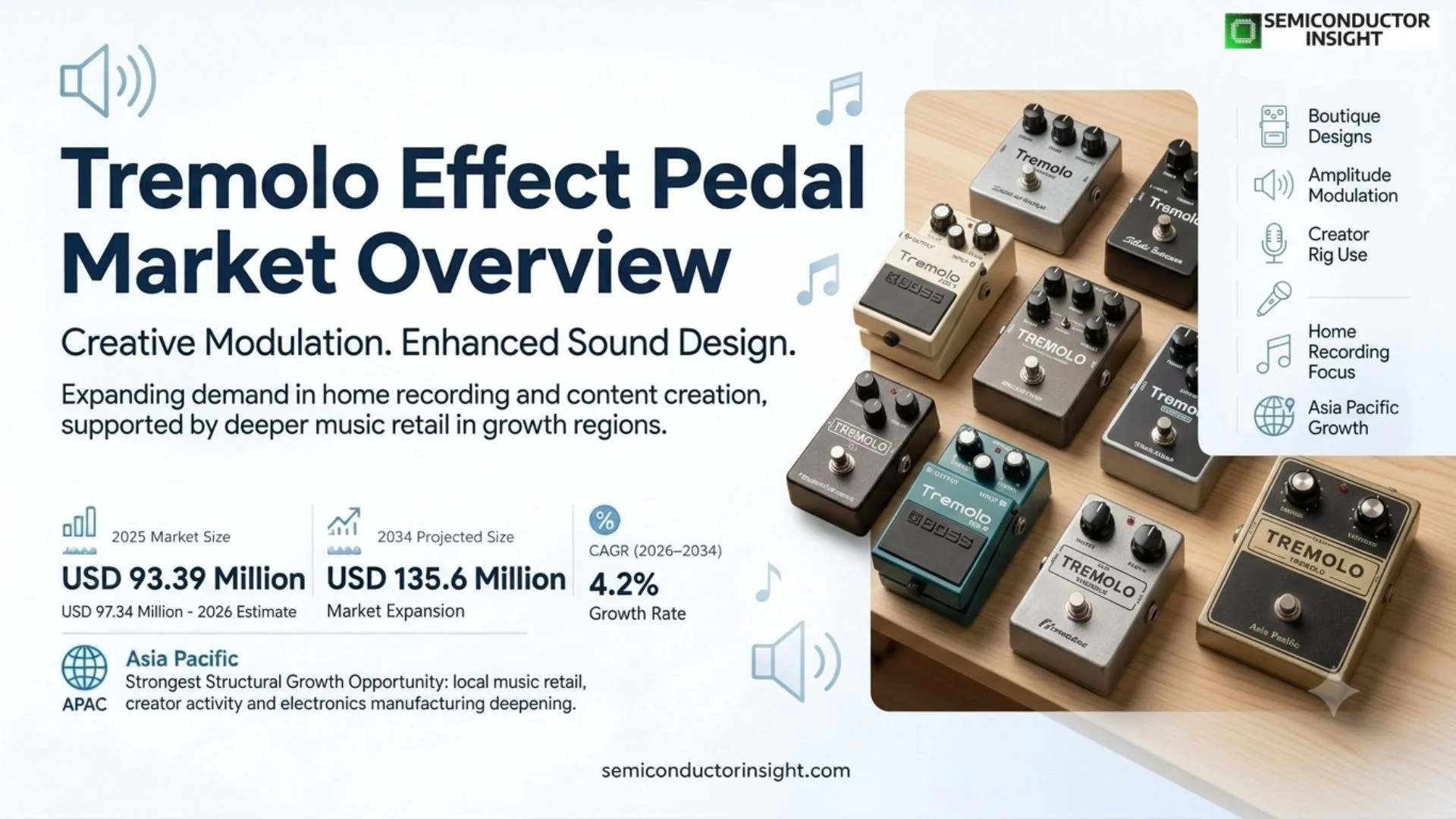
Tremolo Effect Pedal Market is valued at USD 93.39 million in 2025 and is projected to reach USD 135.6 million by 2034, representing a 4.2% CAGR during 2026–2034. The 2026 market is estimated at USD 97.34 million. North America is the largest regional market, while Asia Pacific offers the strongest structural growth opportunity as local music retail, creator activity and electronics manufacturing deepen.
A tremolo effect pedal cyclically varies signal amplitude, and in some harmonic implementations alternates the relative level of frequency bands, to create rhythmic pulsing that can range from subtle movement to hard chopped patterns. The category spans simple analog stompboxes, optical and bias-inspired circuits, digitally controlled pedals with tap tempo and subdivisions, and premium stereo products that combine tremolo with reverb, panning, presets or external control.
The commercial boundary is the dedicated pedal or pedal-led hardware purchase rather than every device capable of generating tremolo. Amplifiers, plug-ins and multi-effects units are important substitutes and demand influences, but are not counted as dedicated tremolo effect pedals unless tremolo is sold as a distinct pedal product. This scope keeps the market tied to retail hardware revenue and avoids inflating demand with software or amplifier value.
Product evolution is moving in two directions at once. Entry and traditionalist buyers continue to value simple three-knob designs because they are fast to operate and familiar on stage, while premium users increasingly expect stereo signal paths, tap tempo, preset recall and synchronisation. BOSS keeps the TR-2 centered on rate, depth and wave controls, whereas Strymon Flint and Walrus Monumental add multiple tremolo voices, stereo routing and preset-oriented control. This widening feature ladder supports price segmentation without displacing the compact analog format.
Segment Analysis: By Type
By type, the market is segmented into Momentary, Delay, Optical, Harmonic and Others. Momentary and conventional volume-modulation designs form the broadest installed base because they match familiar amplifier tremolo behavior and low-cost pedal architecture. Optical and harmonic designs support premium pricing through distinctive response, while digitally timed and other advanced designs compete on tap tempo, rhythmic subdivisions, stereo movement and preset functionality.
| Type | Technology and use case | Market position |
|---|---|---|
| Momentary | Momentary products emphasize direct rhythmic volume modulation with straightforward rate and depth control, making them accessible to players who want a recognizable tremolo sound without menu navigation. They fit compact pedalboards, rehearsal rigs and general live use, and their lower control count supports lower manufacturing cost. The segment therefore carries broad unit demand even as premium features migrate upward. | Largest volume-oriented segment. Competition is intense because circuit architecture is widely understood and many brands can offer credible basic tremolo. Brand reputation, switch feel, noise performance, enclosure durability and retail distribution therefore matter as much as circuit novelty. Established compact formats retain replacement demand because musicians value predictable operation on stage. |
| Delay | Delay-oriented or timing-enhanced tremolo designs use digital control to synchronize the modulation cycle, introduce subdivisions or coordinate tremolo with other time-based effects. The purchasing trigger is rhythmic precision: players want pulsing aligned with a song tempo, sequenced arrangement or MIDI clock rather than a free-running rate knob. Digital control expands functionality but increases firmware, user-interface and power-management requirements. | Growing feature-led niche. Tap tempo and rhythmic divisions are moving from premium features toward mid-range expectations, particularly in digital pedals. Suppliers benefit when timing features are intuitive enough for live use; overly complex interfaces can push users toward broader multi-effects systems that provide the same synchronization alongside other modulation effects. |
| Optical | Optical tremolo uses a light source and light-dependent resistance or related optical control to vary signal level, reproducing the sharper pulse associated with classic amplifier circuits. Strymon describes its 1965 photocell mode through a virtual light-dependent-resistor concept, while Walrus positions Monumental as an analog optical tremolo. Buyers choose this type for response character rather than for raw feature count. | Premium heritage segment. Optical products support differentiation because players associate the topology with vintage amplifier behavior and because component selection affects attack, depth and perceived smoothness. Suppliers can combine optical signal paths with modern stereo, preset and expression functions, creating a bridge between traditional tone expectations and contemporary pedalboard control. |
| Harmonic | Harmonic tremolo divides the signal into frequency bands and modulates them out of phase, producing movement that can resemble a blend of tremolo and phase modulation. Strymon’s Flint offers a dedicated harmonic mode, and Walrus Monumental can blend standard and harmonic behavior. This gives the type a distinctive sonic identity that is difficult to duplicate with basic amplitude modulation alone. | Fast-growing premium type. Harmonic tremolo is frequently positioned in higher-value pedals because the circuit or processing is more specialized and the audience actively seeks vintage-inspired character. Stereo spread, presets and expression control further raise selling prices, making this segment commercially attractive despite lower unit volumes than conventional tremolo. |
| Others | Other types include digitally modeled bias tremolo, sawtooth and random waveforms, stereo auto-panning hybrids, combined tremolo-reverb products and multi-algorithm modulation pedals sold with a strong tremolo proposition. MOOER Triangolo, for example, provides triangle, square and sawtooth waveforms with tap tempo, while broader digital platforms can store several modulation algorithms and user presets. | Innovation segment with the highest substitution overlap. These products expand creative possibilities but compete directly with multi-effects processors. Suppliers succeed when the tremolo implementation has a clear performance advantage, such as tactile access, low latency, stereo architecture or fast preset recall, rather than simply offering more algorithms than a traditional pedal. |
Pricing by product architecture
Price tiers are shaped more by architecture and control depth than by the tremolo effect itself. Budget pedals typically use compact enclosures, mono signal paths and a small set of knobs, while mid-range products add tap tempo, waveform choices, better switching and stronger mechanical components. Premium products can add stereo I/O, presets, MIDI, expression control, high-headroom analog front ends and multiple historically modeled tremolo modes. The user is therefore paying for workflow, routing and build quality as much as for the modulation algorithm.
Segment Analysis: By Application
By application, demand is segmented into Recording Studio, Concert, School and Others. Recording studios and concert use account for the most commercially intensive purchasing because reliability, low noise and repeatable control justify higher-value hardware. School and other applications broaden entry-level demand through music education, home recording, worship, rehearsal spaces and creator-oriented content production.
| Application | Demand characteristics |
|---|---|
| Recording Studio | Studios value low-noise signal paths, repeatable settings, stereo routing and the ability to move between guitar-level and line-oriented workflows. Premium tremolo-reverb combinations are attractive because they can recreate vintage amplifier movement without committing to a specific amplifier during tracking. Preset recall and MIDI are increasingly useful in project studios where sessions move rapidly between songs and instruments. |
| Concert | Live performers need durable footswitches, clear visual feedback, predictable bypass behavior and controls that can be adjusted quickly under stage conditions. Tap tempo and preset recall have direct value because modulation must align with arrangements without stopping the performance. Stereo-capable pedals also benefit artists running dual amplifiers or wet-dry rigs, but compact mono pedals retain strong demand for simple boards. |
| School | Music schools, teaching studios and institutional programs generally favor robust, understandable products that demonstrate modulation concepts without complicated setup. Lower and mid-range pedals are well suited because they let students hear changes in rate, depth and waveform immediately. Purchasing is less frequent than professional use, but education builds long-term familiarity with pedal formats and can support future consumer demand. |
| Others | Other applications include home studios, worship teams, rehearsal rooms, streaming creators, synthesizer users and hobbyist guitarists. This is a diverse demand pool in which online demonstrations and direct-to-consumer retail can influence product discovery more strongly than traditional artist endorsement alone. Compact digital pedals and combined effects are especially relevant because users often need broad functionality within limited space and budgets. |
Regional Analysis
North America is the largest tremolo effect pedal market, supported by a deep guitar culture, large live-music economy, independent pedal builders, recording infrastructure and specialty retail. Asia Pacific is the fastest-growing structural opportunity as Japan’s established effects industry combines with expanding Chinese manufacturing, regional online retail and a larger base of players across emerging Asian markets. Europe remains a premium, design-conscious market with strong boutique demand.
How does regional demand differ across the tremolo effect pedal market?
The category behaves differently by region because the buying trigger is cultural and channel-driven rather than tied to industrial capacity alone. North America combines premium brands with a large installed player base and direct-to-consumer launches. Europe places heavy value on boutique craftsmanship and heritage tones. Asia Pacific combines local manufacturing scale with expanding consumer demand, while South America and the Middle East & Africa rely more heavily on imported inventory, distributor economics and price-sensitive product selection.
| Region | Position | Growth outlook | Demand profile | Supplier-selection factor |
|---|---|---|---|---|
| North America | Largest | Steady premium growth | Professional, boutique and hobbyist | Brand community, retail reach, feature differentiation |
| Europe | Major premium market | Steady | Boutique, studio and touring | Tone identity, build quality, dealer availability |
| Asia Pacific | Fastest-growing | Highest structural growth | Manufacturing + expanding player base | Price-performance, online retail, compact formats |
| South America | Smaller | Moderate | Import-led enthusiast market | Landed price, distributor inventory, currency stability |
| Middle East & Africa | Emerging | Selective | Urban premium and education demand | Availability, warranty support, import cost |
Competitive Landscape
Competition is fragmented across global compact-pedal brands, premium digital specialists, boutique analog builders and value-focused Asian manufacturers. The largest competitive divide is not simply analog versus digital; it is between products sold on familiar immediacy and products sold on programmable workflow. A supplier can win with three knobs and a durable enclosure, or with stereo presets and MIDI, but products without a clear reason for dedicated pedalboard space face the strongest substitution pressure.
BOSS competes through compact-pedal familiarity, global distribution and the long-lived TR-2 platform. Fender uses amplifier heritage to connect tremolo with recognizable spring-reverb and vintage modulation references. Strymon occupies a premium digital tier with studio-grade processing, stereo operation and deep external control, while Walrus Audio and other boutique brands combine analog character with modern features such as presets, expression and stereo panning. These positions create distinct buyer groups rather than one uniform price market.
Value-focused competition is strongest where digital control can add visible functionality at low cost. MOOER’s micro-format pedals and broader multi-effects platforms show how waveform selection, tap tempo and several modulation types can be delivered in compact hardware. This puts pressure on basic standalone pedals to compete on reliability, switching feel, noise performance and brand trust rather than simply feature count. It also encourages premium brands to make their controls more performance-oriented.
The profiled company set includes TC Electronic, Fender Musical Instruments Corporation, Strymon Engineering, Electro-Harmonix, Keeley Electronics, Ernie Ball Incorporation, Ibanez, Walrus Audio, Fulltone, EarthQuaker Devices, Shenzhen MOOER Audio, BOSS Corporation and JHS Pedals. Not every company competes with the same tremolo architecture at the same time, so market share shifts are driven by product cycles, channel strength and artist visibility more than by large manufacturing-capacity differences.
| Competitive tier | Representative suppliers | How they compete |
|---|---|---|
| Global compact-pedal leaders | BOSS Corporation, TC Electronic, Electro-Harmonix, Ibanez | These companies benefit from broad dealer coverage, recognized pedal formats and price points accessible to a large player base. Their advantage is dependable availability and familiar controls, which lowers purchase risk for customers who want a standalone tremolo without researching boutique circuit variations. |
| Premium digital / hybrid specialists | Strymon Engineering, Fender, Walrus Audio | These suppliers justify higher prices through stereo signal paths, multiple vintage-inspired modes, tap tempo, presets, MIDI or combined effects. Their customer is willing to dedicate more pedalboard space and budget when the pedal becomes part of a repeatable performance or studio workflow. |
| Boutique analog builders | Keeley Electronics, EarthQuaker Devices, JHS Pedals, Fulltone | Boutique brands compete through circuit character, limited product runs, artist credibility and direct community engagement. They can move quickly into harmonic, bias-inspired or unusual waveform designs, but their unit economics depend more heavily on component sourcing, skilled assembly and direct or specialty-dealer margins. |
| Value and compact digital suppliers | Shenzhen MOOER Audio and other Asian compact-pedal manufacturers | This tier competes on small footprint, feature density and aggressive price-performance. Digital algorithms make it possible to offer tap tempo, waveform selection and multiple modulation choices with fewer specialized analog components. The trade-off is intense price competition and greater overlap with multi-effects products. |
Profiled companies
TC Electronic; Fender Musical Instruments Corporation; Strymon Engineering; Electro-Harmonix; Keeley Electronics; Ernie Ball Incorporation; Ibanez; Walrus Audio; Fulltone; EarthQuaker Devices; Shenzhen MOOER Audio; BOSS Corporation; and JHS Pedals. The market remains structurally fragmented because brand identity, control philosophy and sonic character can support viable niches even when total unit volumes are modest. This makes product cadence and channel engagement particularly important competitive variables.
Production Capacity Analysis
Tremolo pedal capacity is distributed rather than concentrated in a small number of dedicated mega-factories. Production combines printed circuit board assembly, analog and digital components, footswitches, potentiometers, jacks, die-cast or machined enclosures, finishing, final assembly and audio testing. Large brands can use contract electronics manufacturing and standardized enclosure supply, while boutique suppliers often retain final assembly, testing or calibration in-house to protect tone consistency and brand positioning.
The main upstream constraint is component continuity rather than raw assembly floor space. Audio-grade operational amplifiers, microcontrollers, digital signal processors, light-dependent components, potentiometers and mechanical switches can become unavailable or change revision over a product’s commercial life. A pedal circuit may be inexpensive in absolute component value, yet redesigning around a discontinued part can require engineering validation, firmware changes and renewed noise or reliability testing. Suppliers therefore place a premium on parts with long availability windows.
Enclosure and mechanical capacity also matters because the user interacts physically with the pedal throughout its life. Die-cast aluminum boxes, powder coating, screen printing, knobs, jacks and footswitches must withstand repeated stage use. Premium brands can accept higher assembly cost to preserve switch feel, tolerances and visual finish, while value suppliers gain scale by standardizing enclosure sizes across many pedal models. This standardization reduces tooling cost and supports rapid product extensions.
Digital products shift more value toward firmware, converters and control electronics. Once a processing platform is established, suppliers can reuse hardware across several effects and differentiate through algorithms, which improves development leverage but raises substitution risk for standalone tremolo. Analog and optical pedals have lower software burden and can maintain long production lives, but component variation can affect noise and response, making end-of-line audio testing and calibration an important part of quality control.
Market Dynamics
Market growth is supported by the continued popularity of guitar-based music, creator-led home recording, pedalboard culture and the migration of premium control features into smaller hardware. The counterforce is effect consolidation: amplifiers, software and multi-effects processors can all provide tremolo. Dedicated pedals therefore grow when they offer a tangible reason to remain separate, such as tactile immediacy, distinctive analog response, stereo movement, preset recall or reliable stage operation.
MARKET DRIVERS
| Factor | Impact | Commercial implication |
|---|---|---|
| Home recording and creator growth | High | More musicians build compact recording rigs that use pedals as both performance tools and front-end sound-design hardware, widening demand beyond touring guitarists. |
| Premium control features | Medium-High | Tap tempo, stereo I/O, presets, MIDI and expression control make tremolo more useful in modern synchronized and stereo rigs, lifting average selling prices. |
| Vintage amplifier tone revival | Medium | Optical, bias and harmonic designs monetize recognizable amplifier-era sounds without requiring the original amplifier, supporting premium analog and modeled products. |
| Online demonstrations and direct sales | Medium | Video demos and direct-to-consumer launches reduce the discovery barrier for specialized modulation pedals and allow boutique brands to reach international buyers. |
Home studios turn modulation pedals into production tools
A growing share of pedal use happens before a recording interface rather than only in front of a stage amplifier. This changes the purchasing logic because a pedal can be justified as an always-available sound-design tool for guitars, synthesizers and other instruments. Stereo outputs, line-level headroom and quiet bypass behavior become more valuable in this environment. Suppliers that design for both pedalboards and desktop studios can address more use cases without changing the core tremolo function.
Tap tempo, presets and stereo routing lift value per unit
Modern performance rigs increasingly synchronize modulation to song tempo and route signals across two amplifiers or stereo processing chains. Strymon Flint, Fender Tre-Verb and Walrus Monumental demonstrate different ways to monetize this need through tap tempo, stereo I/O, preset memory or MIDI. These features raise bill of materials and software complexity, but they also move the product out of commodity comparison with simple three-knob pedals and support higher selling prices.
Vintage tone remains commercially durable
Tremolo is strongly associated with classic amplifier circuits, so product development can repeatedly reinterpret familiar optical, bias and harmonic behaviors without relying on entirely new musical concepts. Fender’s pedal strategy draws directly on amplifier heritage, while Strymon and Walrus describe distinct historical tremolo characters inside modern products. This gives suppliers a durable marketing vocabulary and allows buyers to seek a specific feel or era rather than a generic modulation category.
Digital distribution improves niche product economics
Specialized tremolo products can reach a global audience through manufacturer web stores, dealer e-commerce and creator demonstrations, reducing dependence on shelf space in large physical music stores. This is particularly valuable to boutique brands because a product can remain economically viable at lower volumes if gross margin and direct customer engagement are strong. The same channel, however, exposes buyers to many substitutes, so product demonstrations and clear differentiation become essential conversion tools.
MARKET RESTRAINTS
| Factor | Impact | Commercial implication |
|---|---|---|
| Multi-effects substitution | High | Modelers and multi-effects hardware include tremolo alongside many other effects, reducing the need for a dedicated pedal when pedalboard space or budget is constrained. |
| Software and amplifier integration | Medium-High | DAWs, plug-ins and modern amplifiers can generate synchronized tremolo without extra hardware, especially in studio-first workflows. |
| Fragmented discretionary demand | Medium | Purchases depend on musician income, touring activity and hobby spending, making the market more exposed to discretionary slowdowns than essential professional audio equipment. |
| Feature complexity and power demand | Low-Medium | Premium digital pedals need more current, setup knowledge and firmware support, which can make simple analog alternatives more attractive to players seeking reliability. |
Multi-effects processors absorb basic tremolo demand
The strongest structural restraint is that tremolo is rarely unavailable to a modern musician. MOOER META FX and many other multi-effects products include tremolo inside broader modulation libraries, while digital amplifiers and modelers often include several tremolo types as standard. A dedicated pedal therefore competes against an effect the buyer may already own. Standalone products must win on immediacy, tone, routing or stage workflow rather than on basic functionality.
Software reduces hardware necessity in recording
In recording workflows, plug-ins can add tempo-synchronized tremolo after the performance with full recall and automation. This is difficult for hardware to match on convenience alone. Hardware remains relevant when the effect influences how the musician performs, when players want zero-menu tactile control, or when analog front-end behavior is part of the tone. The restraint is therefore strongest for studio users who treat tremolo as a post-production decision rather than a performance interaction.
Discretionary spending creates cyclical retail risk
Effect pedals are relatively affordable compared with guitars and amplifiers, but they remain discretionary purchases. When musicians reduce gear spending, specialized modulation can be deferred more easily than replacement strings, repairs or core amplification. Retailers respond by narrowing inventory toward proven sellers, which can make it harder for new tremolo models to secure shelf space. Direct sales partly offset this but transfer inventory and marketing risk back to the manufacturer.
Complexity can erode the value of premium features
Presets, MIDI and stereo routing create value only when users can configure them quickly. Excessive secondary functions or hidden controls can make a premium pedal less attractive than a simpler analog unit, especially for live players who prioritize immediate adjustments. Suppliers must balance capability against interface clarity and documentation. More digital functions also increase firmware-support obligations and current draw, which can complicate integration with older pedalboard power supplies.
MARKET OPPORTUNITIES
Stereo and spatial tremolo
Who benefits: Premium and professional users. What changes: Stereo rigs turn tremolo into movement across the sound field rather than only a change in volume. Walrus Monumental uses a dedicated pan control and Strymon Flint supports stereo operation, showing a path for suppliers to combine modulation with broader spatial sound design. Commercial implication: Premium brands can defend higher prices and reduce direct comparison with basic mono pedals by treating stereo movement as a performance feature rather than a simple output specification.
MIDI and preset integration
Who benefits: Touring acts and synchronized rigs. What changes: MIDI clock, preset recall and external expression allow tremolo to follow set lists and automated arrangements. Strymon Flint provides extensive MIDI control and hundreds of MIDI preset locations, demonstrating how a traditional effect can become part of a programmable live system. Commercial implication: Suppliers that expose common control standards can sell tremolo into advanced pedalboards and hybrid guitar-electronic performances where repeatability matters more than manual knob settings.
Compact value pedals in emerging Asian markets
Who benefits: First-time and space-constrained buyers. What changes: Micro-format digital pedals such as MOOER Triangolo combine tap tempo and multiple waveforms in a small enclosure, improving feature access for buyers who cannot justify premium pricing or larger pedalboard footprints. Commercial implication: Manufacturers can expand unit demand by pairing low-cost electronics manufacturing with online distribution, but long-term value depends on reliability and brand trust rather than an endless race to add features.
Cross-instrument and studio use
Who benefits: Synthesizer, keyboard and recording users. What changes: Line-capable or high-headroom tremolo can be used on keyboards, bass, re-amped tracks and effects loops, broadening the market beyond guitar. Strymon explicitly supports line-level operation on Flint, while stereo pedals naturally fit modern audio-interface workflows. Commercial implication: Products designed with wider input headroom and stereo routing can capture studio budgets and reduce dependence on guitar-only purchasing cycles, especially when the control layout remains fast enough for live use.
Supply Chain Analysis
Electronic components and controls
The upstream bill of materials includes op-amps, transistors, microcontrollers or DSPs, converters, potentiometers, switches, jacks, LEDs, optical components, passives and power regulation. Most are standard electronics, but the pedal’s sonic character can depend on specific component behavior and noise performance. Suppliers protect continuity by qualifying alternate parts where possible, while boutique analog designs may accept narrower sourcing flexibility in exchange for a preferred circuit response.
PCB assembly and firmware
Printed circuit board assembly can be performed in-house or by contract manufacturers depending on scale. Digital products add firmware development, preset management and control logic, which shifts more value toward engineering and testing. Reusing a common digital platform across several effects improves economics, but it also means a software or processor issue can affect multiple models. Analog pedals have simpler software requirements but still need tight test procedures for noise, gain and modulation depth.
Enclosures, finishing and final assembly
Mechanical production includes die-cast aluminum enclosures, drilling or machining, powder coating, printing, knobs and final hardware assembly. Enclosure durability is commercially visible because pedals are stepped on and transported repeatedly. Large suppliers standardize box dimensions and switch locations to reduce tooling cost, while boutique products may use distinctive graphics and control layouts as part of brand value. Final audio testing verifies bypass, modulation range and channel consistency before shipment.
Distribution and end users
Pedals reach customers through specialty music stores, online retailers, manufacturer direct stores and distributors. Premium products benefit from demonstrations because differences in harmonic response, stereo spread and control workflow are difficult to communicate through specifications alone. Value products rely more on search visibility, price and broad marketplace availability. Used-equipment markets are also influential because durable pedals can circulate for years, supporting brand awareness but creating an alternative to new-unit purchases.
Recent Developments
- 2026 MULTI-EFFECTS SUBSTITUTION
MOOER introduced the META FX platform with swappable modulation firmware, a full stereo path, user presets and a modulation library that includes tremolo among 19 modulation types. The launch increases competitive pressure on dedicated tremolo pedals because a single compact device can cover many modulation functions, while also showing that tap tempo, presets and stereo processing are becoming expected capabilities in digital pedal workflows. MOOER META FX product page - June 12, 2025 PORTFOLIO EXPANSION
Fender announced a broad second-half 2025 product rollout that included new Hammertone pedals alongside guitars, acoustics and Mustang products. The development matters to tremolo suppliers because large instrument brands continue to invest in pedal ecosystems, using existing amplifier and guitar audiences to support accessory sales and strengthen cross-category retail visibility. Fender Newsroom announcement - 2024 PREMIUM STEREO TREMOLO
Walrus Audio’s Monumental Harmonic Stereo Tremolo reached the market with analog optical tremolo, true stereo I/O, three onboard presets, expression control, stereo panning and a blend between standard and harmonic tremolo. The product illustrates the premium segment’s direction toward spatial control and recall while retaining analog circuit identity. Walrus Audio Monumental product page - Current generation PROGRAMMABLE VINTAGE MODELING
Strymon’s second-generation Flint combines three tremolo types with three reverbs, stereo operation, MIDI clock synchronization and 300 MIDI preset locations. The design shows how premium digital pedals translate amplifier-era tremolo behaviors into programmable studio and stage workflows, expanding the value proposition beyond a fixed analog modulation circuit. Strymon Flint V2 product page
REPORT SCOPE & SEGMENTATION
| Attribute | Scope |
|---|---|
| Market | Tremolo Effect Pedal Market |
| Base year | 2025 |
| Estimated year | 2026 |
| Forecast period | 2026–2034 |
| 2025 market size | USD 93.39 million |
| 2034 projected size | USD 135.6 million |
| CAGR (2026–2034) | 4.2% |
| Largest market in 2025 | North America |
| By Type | Momentary; Delay; Optical; Harmonic; Others |
| By Application | Recording Studio; Concert; School; Others |
| By Price Range | Budget (<$100); Mid-Range ($100–$300); Premium (>$300) |
| By Distribution Channel | Online Retail; Specialty Stores; Direct Sales; Others |
| Regions | North America; Europe; Asia Pacific; South America; Middle East & Africa |
| Companies | TC Electronic; Fender Musical Instruments Corporation; Strymon Engineering; Electro-Harmonix; Keeley Electronics; Ernie Ball Incorporation; Ibanez; Walrus Audio; Fulltone; EarthQuaker Devices; Shenzhen MOOER Audio; BOSS Corporation; JHS Pedals |
Frequently Asked Questions
Frequently Asked Questions
Research Sources & Evidence Base
View research sources used for this overview.
- BOSS. TR-2 Tremolo product page, compact analog-style tremolo controls, waveform adjustment, electrical specifications and current product positioning.
- Fender Musical Instruments Corporation. Tre-Verb Digital Reverb/Tremolo, three tremolo modes, tap tempo, stereo I/O and amplifier-heritage positioning.
- Strymon Engineering. Flint V2 Tremolo & Reverb, harmonic, power-tube and photocell tremolo modes, stereo signal path, MIDI synchronization and preset capability.
- Walrus Audio. Monumental Harmonic Stereo Tremolo, analog optical architecture, stereo panning, onboard presets, expression control and standard-to-harmonic blend.
- MOOER Audio. Triangolo Digital Tremolo Pedal, digital tremolo with triangle, square and sawtooth waveforms, tap tempo and rhythmic subdivisions.
- MOOER Audio. META FX, 2026 multi-effects platform with stereo processing, presets and modulation firmware that includes tremolo.
- Fender Musical Instruments Corporation. Fender brings the heat this summer with a new range of innovative products for the second half of 2025, June 12, 2025 portfolio announcement including new Hammertone pedals.

Get Sample Report PDF for Exclusive Insights
Report Sample Includes
- Table of Contents
- List of Tables & Figures
- Charts, Research Methodology, and more...