Market Insights
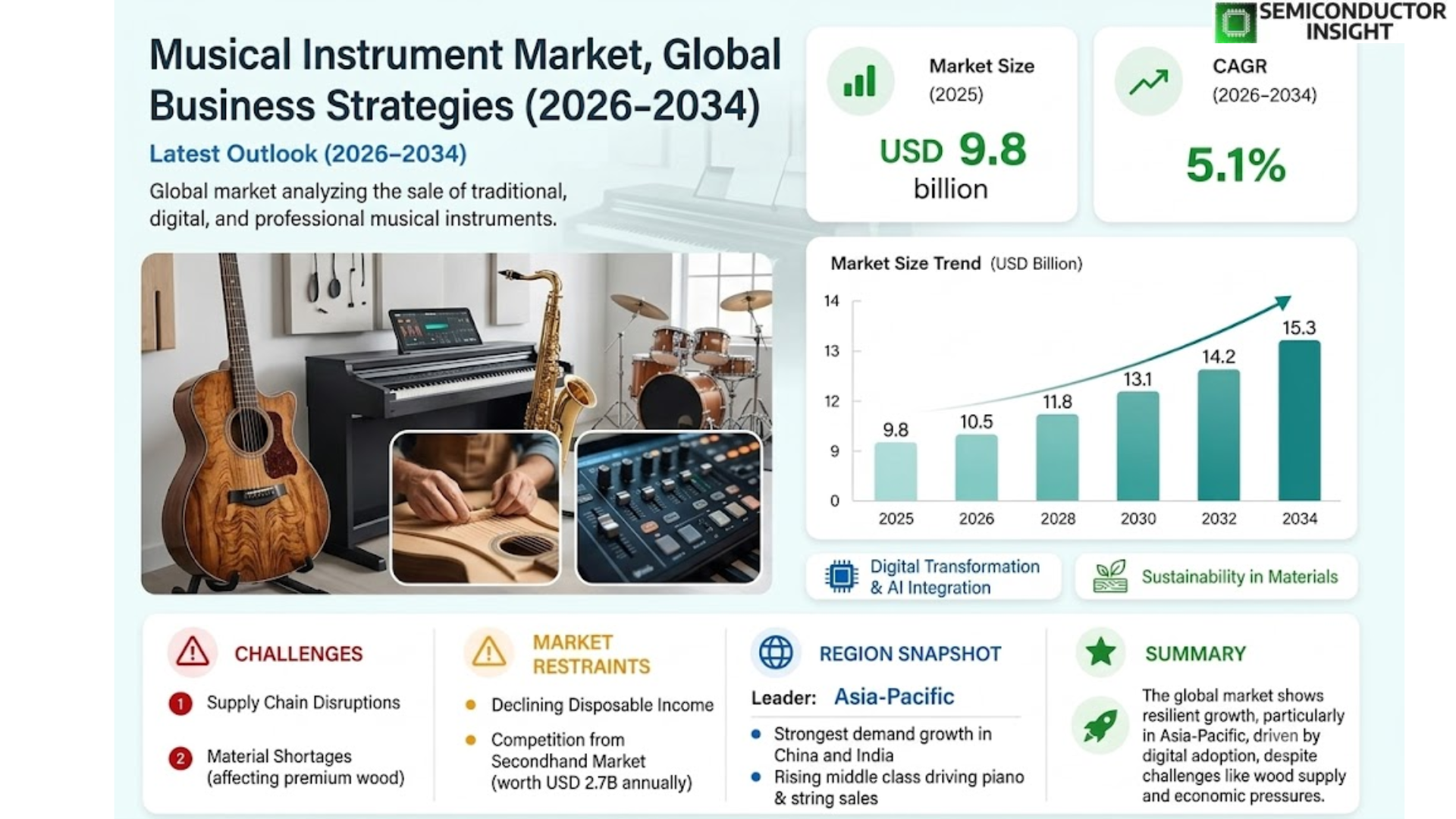
Global Musical Instrument Market size was valued at USD 9.8 billion in 2025 and is projected to grow from USD 10.5 billion in 2026 to USD 15.3 billion by 2033, exhibiting a CAGR of 5.1% during the forecast period.
Musical Instrument are devices designed to produce sound through vibration, encompassing a wide range of categories such as string, wind, percussion, and electronic instruments. These include guitars, pianos, drums, synthesizers, and amplifiers, each serving distinct musical applications across genres and performance settings.
The market growth is driven by increasing disposable income in emerging economies, rising interest in music education programs, and technological advancements in digital instruments. The Asia-Pacific region dominates the market with a 45% share, led by Japan (25%) and China (20%), while guitar amplifiers hold the largest product segment at 55% market share. Key players like Yamaha, Roland, and Fender continue to innovate with hybrid acoustic-electric models and AI-powered learning features to cater to evolving consumer demands.
MARKET DRIVERS
Growing Popularity of Music Education
Global Musical Instrument Market is witnessing steady growth due to increasing investments in music education programs worldwide. Schools and private institutions are incorporating music lessons into their curricula, driving demand for entry-level instruments like keyboards, guitars, and violins. Studies show that regions with strong music education programs experience 22% higher instrument sales.
Technological Advancements in Digital Instruments
Digital innovation is reshaping the Musical Instrument Market with smart pianos, MIDI controllers, and app-connected devices gaining traction. These products offer enhanced learning features and space-saving designs, appealing to urban consumers. The digital segment now accounts for approximately 28% of total instrument sales.
Social media platforms are creating new demand as amateur musicians showcase their skills, with platform engagement correlating directly with instrument purchase trends.
MARKET CHALLENGES
Supply Chain Disruptions Impacting Production
Musical Instrument Market continues to face material shortages and shipping delays, particularly affecting premium acoustic instruments that require specific wood types. Manufacturers report production lead times have increased by 35% compared to pre-pandemic levels.
Other Challenges
Price Sensitivity in Emerging Markets
While demand grows in developing regions, consumers show strong price sensitivity, limiting adoption of higher-end instruments and impacting profit margins.
Competition from Secondhand Market
The thriving used instrument market, estimated at USD 2.7 billion annually, creates pricing pressure for new instrument manufacturers.
MARKET RESTRAINTS
Declining Disposable Income in Key Markets
Economic uncertainties in major markets have caused consumers to postpone discretionary purchases, with musical instruments often being affected. Market data shows a 12% reduction in mid-tier instrument purchases during economic downturns. The student and hobbyist segments remain most vulnerable to these economic pressures.
MARKET OPPORTUNITIES
Expansion in Emerging Economies
Asia-Pacific represents the fastest-growing region for the Musical Instrument Market, with China and India showing particularly strong demand growth. The rising middle class in these markets is driving 18% annual growth in piano and string instrument sales. Manufacturers are adapting product lines to local preferences and price points to capitalize on this expansion.
Global Musical Instrument Market Trends
Asia-Pacific Dominates Musical Instrument Market Growth
The Asia-Pacific region accounts for approximately 45% of the global Musical Instrument Market, with Japan leading at 25% market share. Key players like Yamaha and Roland maintain strong positions, collectively holding 70% regional market share. China and South Korea continue to show accelerated growth, driven by rising disposable incomes and music education initiatives.
Other Trends
Guitar Amplifiers Lead Product Segment
Guitar amplifiers dominate the Musical Instrument Market with 55% share, supported by growing electric guitar adoption. The segment benefits from increasing home recording and live performance demand across both amateur and professional musicians worldwide.
Digital Transformation Reshapes Market Dynamics
Smart connected instruments and AI-powered learning tools are emerging as key growth drivers. The market is witnessing increased R&D investment from manufacturers like Roland and Korg to develop hybrid analog-digital solutions. However, premium acoustic instruments maintain steady demand among traditional musicians.
Electric Guitar Applications Drive Amplifier Sales
Electric guitar applications account for the largest segment of amplifier usage, followed by electric bass and keyboards. Professional musicians increasingly demand multi-functional amplifiers capable of modeling various classic tones, creating opportunities for integrated digital solutions.
Established Brands Maintain Market Leadership
Legacy brands including Fender, Marshall, and MESA/Boogie continue leading the high-end segment through signature product lines and artist endorsements. The market shows consistent premiumization trends despite economic fluctuations, with collectors and professionals driving demand for boutique amplifiers.
COMPETITIVE LANDSCAPE
Key Industry Players
Asian Dominance and Strategic Diversification Define Musical Instrument Market
Global Musical Instrument Market is characterized by strong dominance by Asian manufacturers, with Yamaha Corporation leading as the undisputed market leader holding approximately 25% revenue share. Japan serves as both the production hub and largest consumption market, contributing to Yamaha’s competitive advantage. The market exhibits an oligopolistic structure where the top 5 players collectively control around 70% of amplifier sales, with Roland Corporation, Marshall Amplification, Ampeg, and Blackstar maintaining strong positions through technological innovation and brand legacy.
Niche specialists like Fishman Transducers and MESA/Boogie have carved out significant market positions through focused product strategies – Fishman dominates in acoustic instrument amplification while MESA/Boogie excels in high-end tube amplifiers. European players including Behringer and Orange Amplifiers compete through cost leadership and distinctive tone technologies. The electric guitar amplifier segment remains the largest revenue generator, driving most R&D investments from key players.
List of Key Musical Instrument Companies Profiled
- Yamaha Corporation
- Roland Corporation
- Marshall Amplification
- Ampeg
- Blackstar Amplification
- Behringer
- Fender Musical Instruments
- Korg Inc.
- Hughes and Kettner
- Orange Amplifiers
- Laney Amplification
- Fishman Transducers
- Rivera Amplification
- MESA/Boogie
- Randall Amplifiers
Segment Analysis:
| Segment Category | Sub-Segments | Key Insights |
| By Type |
|
Guitar Amplifiers dominate the market due to:
|
| By Application |
|
Electric Guitar applications lead due to:
|
| By End User |
|
Professional Musicians represent the most demanding segment because:
|
| By Distribution Channel |
|
Online Retailers are gaining significant traction due to:
|
| By Price Range |
|
Mid-range products show strongest performance as they:
|
Regional Analysis: Global Musical Instrument Market
North America
North American consumers demonstrate strong preference for high-end acoustic instruments, particularly grand pianos, professional-grade guitars, and brass/wind instruments. This aligns with the region’s professional musician density and collector culture.
As the birthplace of numerous music tech startups, the region leads in digital pianos, MIDI controllers, and audio interfaces. Silicon Valley collaborations bring advanced features to electronic instruments appealing to younger demographics.
Robust school music programs create stable demand for student-level instruments. Manufacturer-sponsored initiatives and rental programs ensure consistent market penetration across socioeconomic groups.
Vibrant used instrument markets and boutique luthiers complement new sales. Vintage instrument trading flourishes through specialized dealers and online platforms catering to collectors.
Europe
Europe maintains strong positions in classical and traditional instrument manufacturing, with Germany, France, and Italy housing globally-respected manufacturers. The region exhibits balanced growth between acoustic heritage products and contemporary electronic instruments. Specialized music shops offering expert consultation coexist with larger retailers, preserving artisanal appreciation while serving casual buyers. Government support for music education and cultural preservation helps sustain demand across generations. Environmental regulations increasingly influence material selection for bow instruments and woodwind production.
Asia-Pacific
Asia-Pacific shows the fastest Musical Instrument Market growth, led by Japan’s electronic innovation and China’s expanding middle class. Digital pianos and portable keyboards achieve particularly strong penetration. Traditional instruments maintain cultural importance while Western imports gain popularity among students. Manufacturing hubs in Indonesia and China supply global entry-level segments. South Korea’s competitive music education environment drives specialized purchases, while India’s growing interest in Western music creates new opportunities.
South America
South America demonstrates growing musical instrument adoption fueled by cultural emphasis on music and dance. Brazil leads regional consumption, with strong demand for percussion and string instruments. Local manufacturers compete with imports through price competitiveness and adaptation to tropical climates. Economic fluctuations impact premium segment growth, but educational initiatives continue expanding the player base. Digital adoption trails other regions but shows accelerating interest.
Middle East & Africa
The Middle East shows concentrated demand in Gulf countries with high disposable income, favoring luxury instruments. Africa exhibits growing interest through music education NGOs and cultural revival movements. Import challenges affect price sensitivity in developing markets. Local craftsmanship maintains relevance for traditional instruments while urbanization drives electronic adoption. Regional conflicts and economic conditions create uneven market development patterns.
Report Scope
This market research report provides a comprehensive analysis of the Musical Instrument Market , covering the forecast period 2025–2033. It offers detailed insights into market dynamics, technological advancements, competitive landscape, and key trends shaping the industry.
Key focus areas of the report include:
- Market Overview: The report begins with an overview outlining its current market scenario, key growth indicators, and industry transformation drivers. It discusses macroeconomic factors, demand–supply balance, regulatory landscape, and the strategic role of musical instruments in powering advancements across industries such as music production, live performances, and education.
- Market Size & Forecast: Historical data and future projections for revenue, unit shipments, and market value across major regions and segments.
- Segmentation Analysis: Detailed breakdown by product type, technology, application, and end-user industry to identify high-growth segments and investment opportunities.
- Regional Insights: Insights into market performance across North America, Europe, Asia-Pacific, Latin America, and the Middle East & Africa, including country-level analysis where relevant.
- Competitive Landscape: Profiles of leading market participants, including their product offerings, R&D focus, manufacturing capacity, pricing strategies, and recent developments such as mergers, acquisitions, and partnerships.
- Technology Trends & Innovation: Assessment of emerging technologies, integration of digital audio processing, amplifier design trends, and evolving industry standards.
- Market Drivers & Restraints: Evaluation of factors driving market growth along with challenges, supply chain constraints, regulatory issues, and market-entry barriers.
- Stakeholder Insights: Insights for component suppliers, OEMs, system integrators, investors, and policymakers regarding the evolving ecosystem and strategic opportunities.
Primary and secondary research methods are employed, including interviews with industry experts, data from verified sources, and real-time market intelligence to ensure the accuracy and reliability of the insights presented.
FREQUENTLY ASKED QUESTIONS:
What is the current market size of Musical Instrument Market?
-> Musical Instrument Market size was valued at USD 9.8 billion in 2025 and is projected to grow from USD 10.5 billion in 2026 to USD 15.3 billion by 2033, exhibiting a CAGR of 5.1% during the forecast period.
Which key companies operate in Musical Instrument Market?
-> Key players include Yamaha, Roland, Marshall, Ampeg, Blackstar, Behringer, Fender, Korg, Hughes and Kettner, and Johnson, among others. The top five players hold about 70% market share.
What are the key growth drivers?
-> Key growth drivers include increasing music production activities, rising demand for live performances, and technological advancements in amplifier designs.
Which region dominates the market?
-> Asia-Pacific is the largest market, with Japan holding about 25% share, followed by China and South Korea with a combined 45% share.
What are the emerging trends?
-> Emerging trends include digital amplifier technologies, integration with smart devices, and sustainable musical instrument manufacturing.

Get Sample Report PDF for Exclusive Insights
Report Sample Includes
- Table of Contents
- List of Tables & Figures
- Charts, Research Methodology, and more...
 Download Sample Report PDF