Market Insights
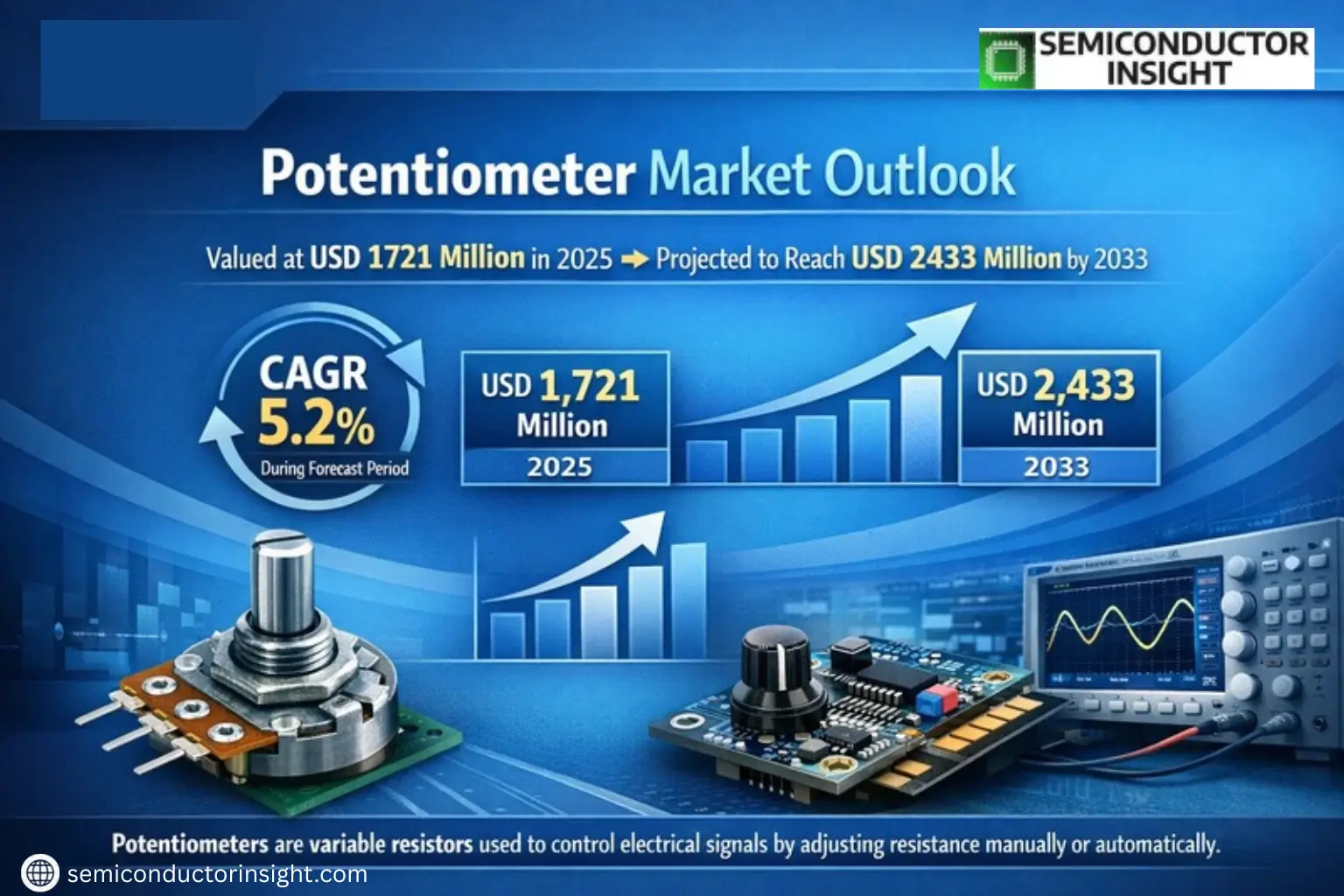
Global Potentiometer Market was valued at USD 1721 million in 2025 and is projected to reach USD 2433 million by 2033, exhibiting a CAGR of 5.2% during the forecast period.
Potentiometers are variable resistors used to control electrical signals by adjusting resistance manually or automatically. They consist of a resistive element and a sliding contact (wiper) that moves along the element to vary output voltage or current. Common types include wire-wound, carbon film, and plastic film potentiometers, each offering distinct advantages in resolution, durability, and noise reduction. Wire-wound variants provide high precision but limited resolution due to coil winding constraints, while carbon film and plastic film types offer finer adjustments with lower noise levels.
The market growth is driven by increasing demand in home appliances, industrial automation, and automotive applications, where potentiometers are integral for volume controls, sensor calibration, and motor speed regulation. Key players like ALPS, Nidec Copal Electronics, and Tokyo Cosmos Electric Co., Ltd. dominate the fragmented market, with China, Southeast Asia, and Europe collectively accounting for over 50% of global sales. Rotary potentiometers hold a dominant share (60%), favored for their versatility in consumer electronics and machinery.
MARKET DRIVERS
Rising Demand in Industrial Automation
Potentiometer Market is experiencing significant growth due to increasing adoption in industrial automation systems. These components are essential for precision control in manufacturing equipment, robotics, and process automation. Global industrial automation sector is projected to grow at over 8% annually, directly driving potentiometer demand.
Growth in Consumer Electronics
Consumer electronics manufacturing continues to fuel Potentiometer Market expansion, particularly in volume control applications for audio equipment and display brightness adjustment. With annual smartphone production exceeding 1.4 billion units, the need for compact, high-precision potentiometers remains strong.
Technological advancements in multi-turn and digital potentiometers are creating new application areas across industries while improving durability and accuracy.
MARKET CHALLENGES
Miniaturization Pressures
Potentiometer Market faces challenges from the ongoing trend toward product miniaturization, requiring manufacturers to develop smaller components without compromising performance. Many traditional designs struggle with reliability when scaled down to meet modern size requirements.
Other Challenges
Competition from Alternative Technologies
Digital encoders and solid-state sensors are gaining market share in applications where potentiometers traditionally dominated, particularly in harsh environments where contact-based designs show limitations.
Material Cost Volatility
Fluctuating prices for conductive plastics and specialty alloys used in premium potentiometer models create margin pressure for manufacturers.
MARKET RESTRAINTS
Maturation of Traditional Applications
Certain traditional potentiometer applications, particularly in basic consumer electronics, are being replaced by digital alternatives. This market restraint is partially offset by growth in industrial and automotive sectors, but limits overall market expansion potential.
MARKET OPPORTUNITIES
Emerging Industrial IoT Applications
The Industrial Internet of Things (IIoT) presents significant opportunities for the Potentiometer Market, particularly for smart sensors with integrated position feedback capabilities. Networked industrial systems require robust analog interfaces that potentiometers can provide.
Medical Device Innovation
High-precision potentiometers are finding new applications in medical equipment, particularly in surgical robotics and diagnostic devices where analog control remains preferred for certain functions. This specialized segment commands premium pricing and is growing at 9% annually.
Potentiometer Market Trends
Growing Demand for High-Precision Applications
Global Potentiometer Market is projected to grow from USD 1,721 million in 2025 to USD 2,433 million by 2033, exhibiting a CAGR of 5.2%. This growth is driven by increasing demand for high-resolution potentiometers in industrial automation, automotive systems, and consumer electronics. Plastic film potentiometers are gaining traction due to their superior resolution (up to 10-4) and low noise characteristics compared to traditional wire-wound variants.
Other Trends
Type Segmentation Dominance
Rotary potentiometers currently hold over 60% market share, favored for their reliability in volume control and position sensing applications. The linear potentiometer segment is expanding in industrial measurement systems, though at a slower growth rate of 3.8% annually.
Regional Market Developments
Asia-Pacific commands 50% of global potentiometer production, with China, Japan, and Southeast Asia as key manufacturing hubs. European demand is growing steadily at 4.5% CAGR, particularly for industrial automation applications. North America shows strong adoption in aerospace and automotive sectors, accounting for 22% of global consumption.
Material Technology Advancements
Carbon film potentiometers remain cost-effective for consumer electronics, while plastic film variants are replacing wire-wound types in precision applications. Manufacturers are developing hybrid materials to improve durability while maintaining resolution below 0.01% for medical equipment applications.
Competitive Landscape Shifts
The market remains fragmented with ALPS, Bourns, and Vishay collectively holding 28% share. Medium-sized Asian manufacturers like Taiwan Alpha Electronic are gaining ground through competitive pricing. Recent acquisitions have focused on expanding product portfolios in IoT-compatible digital potentiometers, which grew 18% in 2023.
Application Sector Growth
Home appliances and industrial applications dominate with 60% market share. Automotive sector demand is accelerating with electric vehicles requiring 35% more potentiometers per vehicle compared to traditional models. Smart home devices are emerging as a fast-growing niche, projected to grow 22% annually through 2030.
COMPETITIVE LANDSCAPE
Key Industry Players
Global Potentiometer Market Leaders and Emerging Competitors
Global Potentiometer Market features a fragmented competitive landscape with ALPS and Nidec Copal Electronics emerging as dominant players, collectively holding significant market share. Japanese manufacturers maintain strong technological dominance in high-precision potentiometers, particularly in wire-wound and plastic film variants. The market concentration remains low with regional leaders like TOCOS in Asia, Bourns in North America, and Teikoku in Europe developing specialized product portfolios for industrial applications.
Niche specialists are gaining traction through customized solutions – Vishay leads in military-grade components, while Taiwan Alpha Electronic dominates cost-sensitive consumer electronics segments. Emerging Chinese manufacturers like Chengdu Hongming Electronics are disrupting traditional supply chains with competitive pricing, though quality control remains a challenge. European players such as Hohner Automaticos maintain strong positions in automotive applications with robust rotary potentiometer offerings.
List of Key Potentiometer Companies Profiled
- ALPS ALPINE CO., LTD.
- Nidec Copal Electronics
- Tokyo Cosmos Electric Co., Ltd. (TOCOS)
- Teikoku Tsushin Kogyo Co., Ltd (NOBLE)
- Panasonic Corporation
- Sakae Tsushin Kogyo Co., Ltd
- Bourns, Inc
- Vishay Intertechnology, Inc
- TT Electronics plc
- Honeywell International Inc.
- CTS Corporation
- ABB Ltd.
- Siemens AG
- TE Connectivity Ltd.
- Taiwan Alpha Electronic Co., Ltd
Segment Analysis:
| Segment Category | Sub-Segments | Key Insights |
| By Type |
|
Plastic Film Potentiometers are gaining traction due to their superior characteristics:
|
| By Application |
|
Industrial Applications dominate potentiometer usage due to:
|
| By End User |
|
Electronics Manufacturers lead in potentiometer consumption because:
|
| By Motion Type |
|
Rotary Potentiometers maintain industry preference due to:
|
| By Resistance Characteristics |
|
Linear Taper potentiometers are most prevalent because:
|
Regional Analysis: Global Potentiometer Market
Asia-Pacific’s integrated electronics manufacturing clusters provide component manufacturers with streamlined access to end-users. This ecosystem reduces lead times and supports just-in-time production models for potentiometer applications.
Rapid adoption of Industry 4.0 technologies in the region drives demand for high-precision potentiometers in robotics and automated systems. Local manufacturers continuously upgrade product specifications to meet evolving application requirements.
Established raw material networks and component suppliers enable efficient potentiometer production. Regional trade agreements facilitate smooth movement of both finished products and manufacturing inputs across borders.
Growing middle-class populations and urbanization fuel demand for consumer electronics incorporating potentiometers. Manufacturers are expanding distribution channels to reach emerging markets with rising disposable incomes.
North America
The North American Potentiometer Market thrives on advanced industrial and aerospace applications. U.S. manufacturers focus on high-reliability components for defense systems and medical equipment, commanding premium pricing. The region sees strong demand for miniature and ruggedized potentiometers in specialized applications. Technological partnerships between component suppliers and end-users drive product innovation. Mexico’s growing automotive electronics sector presents new opportunities for market expansion. Supply chain reshoring initiatives are gradually increasing regional potentiometer production capabilities.
Europe
Europe maintains strong potentiometer demand across automotive, industrial, and renewable energy applications. German engineering standards influence product specifications across the region. Eastern European nations are emerging as competitive manufacturing bases for cost-sensitive applications. Strict environmental regulations drive development of RoHS-compliant potentiometer solutions. The market benefits from close collaboration between component manufacturers and industrial automation firms. Renewable energy projects create sustained demand for potentiometers in monitoring and control systems.
South America
South America’s Potentiometer Market grows steadily with industrial modernization efforts. Brazil leads in automotive component demand while Chile focuses on mining equipment applications. Market growth faces challenges from economic volatility and import dependencies. Local assembly operations are increasing to serve regional manufacturers more efficiently. Aftermarket sales represent a significant portion of potentiometer business due to equipment maintenance requirements.
Middle East & Africa
The MEA Potentiometer Market shows potential in oil & gas and infrastructure applications. Gulf nations invest in industrial diversification, creating new demand for control components. South Africa serves as a regional hub for electronics manufacturing. Market development is constrained by limited local production capabilities. Smart city initiatives in the UAE and Saudi Arabia present long-term growth opportunities for precision components including potentiometers.
Report Scope
This market research report provides a comprehensive analysis of the Potentiometer Market , covering the forecast period 2025–2033. It offers detailed insights into market dynamics, technological advancements, competitive landscape, and key trends shaping the industry.
Key focus areas of the report include:
- Market Overview: The report begins with an overview outlining its current market scenario, key growth indicators, and industry transformation drivers. It discusses macroeconomic factors, demand–supply balance, regulatory landscape, and the strategic role of semiconductors in powering advancements across industries such as automotive, telecommunications, consumer electronics, and industrial automation.
- Market Size & Forecast: Historical data and future projections for revenue, unit shipments, and market value across major regions and segments.
- Segmentation Analysis: Detailed breakdown by product type, technology, application, and end-user industry to identify high-growth segments and investment opportunities.
- Regional Insights: Insights into market performance across North America, Europe, Asia-Pacific, Latin America, and the Middle East & Africa, including country-level analysis where relevant.
- Competitive Landscape: Profiles of leading market participants, including their product offerings, R&D focus, manufacturing capacity, pricing strategies, and recent developments such as mergers, acquisitions, and partnerships.
- Technology Trends & Innovation: Assessment of emerging technologies, integration of AI/IoT, semiconductor design trends, fabrication techniques, and evolving industry standards.
- Market Drivers & Restraints: Evaluation of factors driving market growth along with challenges, supply chain constraints, regulatory issues, and market-entry barriers.
- Stakeholder Insights: Insights for component suppliers, OEMs, system integrators, investors, and policymakers regarding the evolving ecosystem and strategic opportunities.
Primary and secondary research methods are employed, including interviews with industry experts, data from verified sources, and real-time market intelligence to ensure the accuracy and reliability of the insights presented.
FREQUENTLY ASKED QUESTIONS:
What is the current market size of Potentiometer Market?
-> Potentiometer Market was valued at USD 1721 million in 2025 and is projected to reach USD 2433 million by 2033, exhibiting a CAGR of 5.2% during the forecast period.
Which key companies operate in Potentiometer Market?
-> Key players include ALPS, Nidec Copal Electronics, Tokyo Cosmos Electric Co., Ltd. (TOCOS), Teikoku Tsushin Kogyo Co., Ltd (NOBLE), Panasonic, and Bourns, Inc, among others.
What are the key growth drivers?
-> Key growth drivers include increasing demand from home appliances and industrial sectors, technological advancements in potentiometer designs, and expanding applications in automotive electronics.
Which region dominates the market?
-> Asia is the largest market, with China and Southeast Asia occupying about 50% of the global market share.
What are the emerging trends?
-> Emerging trends include increasing adoption of plastic film potentiometers for their superior resolution, development of miniaturized potentiometers, and integration of smart sensing capabilities.

Get Sample Report PDF for Exclusive Insights
Report Sample Includes
- Table of Contents
- List of Tables & Figures
- Charts, Research Methodology, and more...
 Download Sample Report PDF