Transistor Type Solid State Relays Market Insights
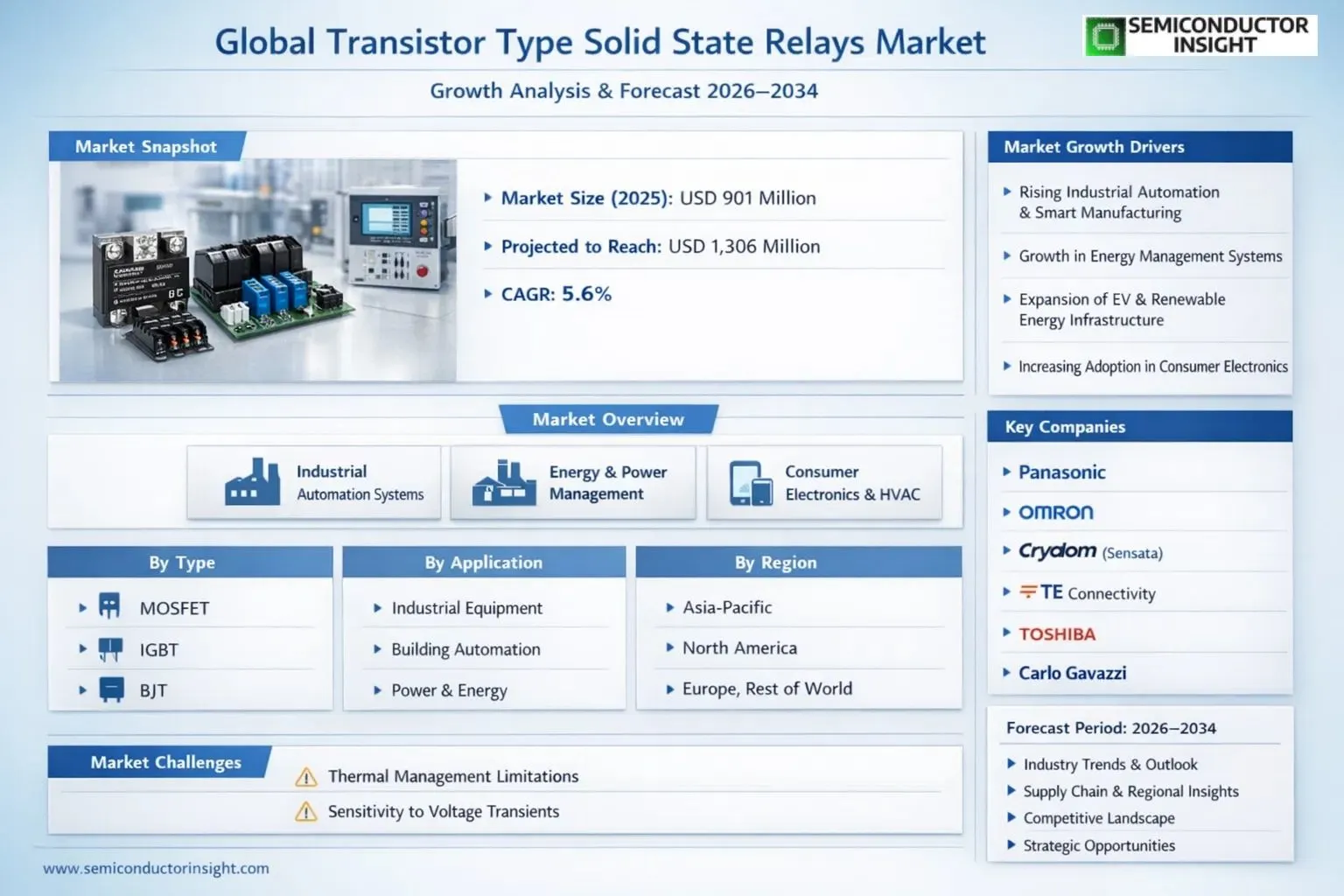
Global Transistor Type Solid State Relays market size was valued at USD 901 million in 2025. The market is projected to grow from USD 952.45 million in 2026 to USD 1,306 million by 2034, exhibiting a CAGR of 5.6% during the forecast period.
A Transistor-type Solid State Relay (SSR) is a type of solid-state relay that uses transistors , typically bipolar junction transistors (BJTs), MOSFETs, or insulated-gate bipolar transistors (IGBTs) , to switch electrical loads. Unlike conventional electromechanical relays, these SSRs operate entirely without mechanical parts, delivering reliable, fast, and silent switching performance across a wide range of industrial and commercial applications.
The market is witnessing steady growth driven by rising demand for energy-efficient switching solutions, rapid expansion of industrial automation, and the increasing adoption of solid-state technologies in sectors such as industrial equipment, building automation, and power & energy. The growing preference for transistor-type SSRs over traditional relays , owing to their longer operational lifespan, reduced electromagnetic interference, and superior thermal performance , continues to reinforce market momentum. Leading global manufacturers such as Panasonic, OMRON, Crydom, TE Connectivity, and Toshiba remain at the forefront of product innovation and competitive positioning within this market.
MARKET DRIVERS
Rising Industrial Automation and Smart Manufacturing Initiatives
Global shift toward industrial automation and smart manufacturing ecosystems has emerged as one of the most significant drivers propelling growth in Transistor Type Solid State Relays Market. Unlike electromechanical relays, transistor type solid state relays (SSRs) offer superior switching speeds, longer operational lifespans, and the absence of moving mechanical parts, making them ideally suited for high-frequency switching applications in programmable logic controllers (PLCs), conveyor systems, and robotic assemblies. As manufacturing facilities increasingly adopt Industry 4.0 frameworks, demand for reliable, low-noise, and high-durability switching components has correspondingly intensified across sectors including automotive, food and beverage processing, and semiconductor fabrication.
Growing Adoption in Consumer Electronics and Energy Management Systems
The proliferation of energy-efficient consumer electronics and advanced building energy management systems (BEMS) has created substantial downstream demand for transistor type solid state relays. These relays are increasingly deployed in HVAC control panels, smart lighting systems, and photovoltaic inverters due to their ability to switch DC loads with high precision and minimal power dissipation. Global emphasis on reducing energy consumption and carbon footprints has further reinforced the uptake of transistor-output SSRs, as they facilitate tighter load control with reduced thermal losses compared to conventional switching technologies. Government-backed green energy programs across North America, Europe, and Asia-Pacific continue to create favorable regulatory conditions supporting this trend.
➤ The integration of transistor type solid state relays into renewable energy infrastructure, particularly solar and wind power generation systems, is anticipated to remain a key growth catalyst as utilities and independent power producers prioritize switching precision and long-term component reliability over short-term capital expenditure savings.
Furthermore, the accelerating deployment of electric vehicle (EV) charging infrastructure globally has opened new application avenues for transistor type SSRs in power distribution and battery management systems. The inherent advantages of transistor type solid state relays,including silent operation, resistance to shock and vibration, and consistent switching performance across wide temperature ranges,position them as a preferred solution in mission-critical EV and industrial power applications, reinforcing the long-term demand trajectory for this market segment.
MARKET CHALLENGES
Thermal Management Limitations Constraining High-Power Application Suitability
One of the persistent technical challenges confronting Transistor Type Solid State Relays Market is the inherent thermal dissipation constraint associated with transistor-based switching elements. Unlike their electromechanical counterparts, transistor type SSRs generate notable amounts of heat during continuous operation at elevated load currents, necessitating the use of external heat sinks and thermal interface materials. This requirement adds to system volume, cost, and design complexity, particularly in space-constrained industrial enclosures. Engineers specifying transistor type solid state relays for high-current applications must carefully balance switching frequency, ambient temperature conditions, and thermal derating curves to avoid premature device failure, which adds engineering overhead and can slow product adoption among less technically sophisticated end users.
Other Challenges
Susceptibility to Voltage Transients and Electromagnetic Interference
Transistor type solid state relays, while offering numerous performance advantages, remain susceptible to damage from voltage transients, surges, and electromagnetic interference (EMI) in harsh industrial environments. Without adequate surge protection circuitry or proper circuit layout practices, transient overvoltage events can degrade or permanently damage the transistor output stage, leading to unplanned downtime and increased maintenance costs. This vulnerability necessitates additional protective components in system designs, which can partially offset the cost competitiveness of transistor type SSRs relative to electromechanical alternatives in certain applications.
Intense Price Competition from Low-Cost Electromechanical Relays
Price sensitivity among small and medium-sized enterprises (SMEs), particularly in emerging markets across Southeast Asia and Latin America, poses a continued challenge for broader penetration of Transistor Type Solid State Relays Market. Electromechanical relays continue to dominate cost-sensitive applications where switching speed and operational lifespan are secondary considerations, placing downward pressure on transistor type SSR pricing and margins for manufacturers. Overcoming this challenge requires sustained investment in product education, total cost of ownership (TCO) analysis tools, and application-specific solution development targeted at design engineers and procurement decision-makers.
MARKET RESTRAINTS
High Initial Component Costs Relative to Conventional Switching Alternatives
The comparatively elevated per-unit acquisition cost of transistor type solid state relays versus traditional electromechanical relays continues to act as a meaningful restraint on market expansion, particularly within price-sensitive end-use segments. Although the total cost of ownership of transistor type SSRs is frequently more favorable when accounting for reduced maintenance, longer service life, and lower failure rates, the upfront capital expenditure requirement remains a barrier for budget-constrained procurement cycles. This cost differential is especially pronounced in developing economies where industrial automation adoption is still maturing and purchasing decisions are predominantly governed by initial bill-of-materials costs rather than lifecycle value assessments.
Supply Chain Disruptions and Semiconductor Component Availability Constraints
Transistor Type Solid State Relays Market is inherently dependent on the availability of key semiconductor inputs, including power transistors, optocouplers, and integrated driver circuits. Periodic disruptions to global semiconductor supply chains,whether driven by geopolitical trade tensions, raw material shortages, or capacity constraints at foundry level,can adversely affect production schedules, lead times, and pricing stability for SSR manufacturers. The industry experienced acute supply chain stress in recent years, underscoring the vulnerability of transistor type solid state relay production to upstream semiconductor market dynamics. Manufacturers that lack diversified sourcing strategies or sufficient component inventory buffers face heightened exposure to demand-supply mismatches that can erode customer confidence and competitive positioning.
MARKET OPPORTUNITIES
Expanding Applications in Next-Generation Industrial IoT and Edge Computing Platforms
The rapid proliferation of Industrial Internet of Things (IIoT) architectures and edge computing infrastructure presents a compelling growth opportunity for Transistor Type Solid State Relays Market. As industrial facilities deploy increasingly dense networks of sensors, actuators, and intelligent edge nodes, the need for compact, fast-switching, and digitally compatible relay solutions has grown correspondingly. Transistor type SSRs, with their compatibility with low-voltage logic control signals and rapid response characteristics, are well-positioned to serve as critical interface components between digital control systems and field-level electrical loads. Leading manufacturers are actively developing miniaturized and surface-mount compatible transistor type SSR variants to address the stringent space and power constraints of next-generation IIoT hardware platforms.
Strategic Growth Potential in Asia-Pacific Driven by Infrastructure Expansion and Industrialization
The Asia-Pacific region represents one of the most dynamic growth frontiers for Transistor Type Solid State Relays Market, underpinned by accelerating industrialization, large-scale infrastructure investment, and the rapid expansion of electronics manufacturing capacity across China, India, South Korea, and Vietnam. Government-led initiatives promoting domestic semiconductor and electronics manufacturing, combined with rising labor cost pressures accelerating factory automation adoption, are collectively driving heightened demand for advanced switching components including transistor type solid state relays. Regional manufacturers and global tier-one suppliers alike are expanding their Asia-Pacific sales and distribution footprints to capture this structural demand growth, with tailored product portfolios addressing both high-volume consumer electronics assembly applications and heavy-duty industrial process control requirements.
Innovation in SiC and GaN-Based Transistor Technologies Enhancing Product Performance
The ongoing advancement of wide-bandgap semiconductor technologies, particularly silicon carbide (SiC) and gallium nitride (GaN) power transistors, is creating meaningful product innovation opportunities within Transistor Type Solid State Relays Market. These next-generation transistor materials enable significantly higher switching frequencies, elevated operating temperature thresholds, and reduced on-state resistance compared to conventional silicon-based transistor outputs, directly addressing two of the most persistent limitations of traditional transistor type SSR designs,thermal management complexity and efficiency losses at high load currents. As SiC and GaN device costs continue to decline with increasing volume production, their incorporation into advanced transistor type solid state relay designs is expected to unlock new high-performance application segments in power electronics, renewable energy conversion, and precision industrial drives, further broadening the addressable market for this technology category.
Trends
Rising Industrial Automation Driving Demand for Transistor Type Solid State Relays
Transistor Type Solid State Relays Market is experiencing significant momentum as industries worldwide accelerate their shift toward advanced automation and smart control systems. Unlike traditional electromechanical relays, transistor-based solid state relays , utilizing MOSFET, IGBT, or BJT switching technologies , offer silent operation, faster switching speeds, and enhanced durability without mechanical wear. This fundamental advantage is reshaping procurement decisions across industrial equipment manufacturers, energy sector operators, and building automation integrators globally. The absence of moving parts in transistor type solid state relays translates directly into lower maintenance costs and higher operational reliability, factors that are increasingly critical in continuous production environments. As manufacturing facilities expand their use of programmable logic controllers and distributed control systems, the integration of transistor type SSRs has become a standard engineering practice rather than an optional upgrade.
Other Trends
MOSFET-Based SSRs Gaining Traction in Low-to-Medium Voltage Applications
Within Transistor Type Solid State Relays Market, MOSFET-based variants are emerging as the preferred choice for low-to-medium voltage switching applications. Their superior gate control characteristics, low on-resistance, and compatibility with microcontroller-driven systems make them especially well-suited for home appliances, HVAC systems, and light industrial controls. The growing penetration of energy-efficient consumer electronics and smart home ecosystems is a key factor amplifying demand for MOSFET-type SSRs. Manufacturers such as Panasonic, OMRON, Sharp, and Toshiba have focused product development efforts on compact, thermally efficient MOSFET SSR modules that address space constraints in modern equipment designs.
IGBT Segment Addressing High-Power Industrial and Energy Applications
IGBT-based transistor type solid state relays are gaining adoption in power-intensive environments, including industrial motor drives, renewable energy inverters, and grid-tied power conditioning systems. The ability of IGBTs to handle higher voltage and current levels while maintaining controllable switching behavior positions them as a preferred technology in the Power & Energy application segment. Companies including Crydom, TE Connectivity, IXYS, and Schneider have expanded their IGBT SSR portfolios to serve utilities and industrial power management projects, where reliability under load and thermal stability are non-negotiable requirements.
Geographic Expansion and Competitive Landscape Shaping Market Dynamics
Asia-Pacific remains the dominant regional market for transistor type solid state relays, driven by the concentration of electronics manufacturing, industrial automation investment, and construction activity across China, Japan, South Korea, and Southeast Asia. China in particular represents a substantial production and consumption hub, with domestic manufacturers such as Hongfa Technology, Xiamen Jinxinrong Electronics, and Zhejiang Chint Electrics competing alongside global leaders. North America and Europe continue to present steady demand driven by industrial modernization, building automation initiatives, and the ongoing transition toward smart grid infrastructure. The competitive landscape is characterized by a mix of global conglomerates and specialized manufacturers, with leading players including Panasonic, OMRON, Carlo Gavazzi, Rockwell Automation, Siemens, Fujitsu Limited, and Vishay maintaining strong positioning through product innovation, regional distribution networks, and application-specific engineering support.
COMPETITIVE LANDSCAPE
Key Industry Players
Transistor Type Solid State Relays Market – Competitive Dynamics, Strategic Positioning, and Leading Manufacturer Profiles
Global Transistor Type Solid State Relays (SSR) market is characterized by a moderately consolidated competitive environment, with a mix of established multinational electronics conglomerates and specialized relay manufacturers vying for market share. As of 2025, the market is valued at approximately USD 901 million and is projected to reach USD 1,306 million by 2034, growing at a CAGR of 5.6%. Leading the competitive field are companies such as Panasonic, OMRON, and Crydom, which command significant revenue shares owing to their extensive product portfolios spanning MOSFET, IGBT, and BJT-based solid state relay variants, strong distribution networks, and deep-rooted presence across key end-use sectors including industrial equipment, building automation, and power & energy. These dominant players continuously invest in R&D to enhance switching speed, thermal management, and miniaturization, reinforcing their technological edge in high-demand applications such as industrial automation and smart grid infrastructure.
Beyond the top-tier players, the Transistor Type SSR market hosts a robust ecosystem of niche and regional manufacturers that are gaining traction by offering cost-competitive and application-specific solutions. Companies like Carlo Gavazzi, TE Connectivity, Groupe Celduc, IXYS (now part of IXYS/Littelfuse), Toshiba, Fujitsu Limited, Schneider Electric, Siemens, Rockwell Automation, and OPTO22 have established strong footholds in specialized verticals such as process automation, HVAC control, and renewable energy systems. Meanwhile, Chinese manufacturers including Hongfa Technology, Xiamen Jinxinrong Electronics, JiangSu GlOD Electrical Control Technology, Wuxi Tianhao Electronics, Shaanxi Qunli, Zhejiang Chint Electrics, Wuxi Solid, and Suzhou Integrated Technology are increasingly challenging incumbents through aggressive pricing strategies, expanding production capacities, and improving product reliability standards to meet international certifications. Additionally, semiconductor-focused players such as Vishay and Broadcom bring advanced device-level integration capabilities to the market, further intensifying competition across the MOSFET and IGBT product segments.
List of Key Transistor Type Solid State Relays Companies Profiled
- Panasonic
- Crydom (Sensata Technologies)
- OMRON
- Carlo Gavazzi
- Sharp
- TE Connectivity
- Groupe Celduc
- IXYS (Littelfuse)
- Toshiba
- Fujitsu Limited
- Schneider Electric
- Siemens
- Hongfa Technology
- Rockwell Automation
- OPTO22
- Xiamen Jinxinrong Electronics
- JiangSu GlOD Electrical Control Technology
- Vishay
- Broadcom
- Zhejiang Chint Electrics
- Wuxi Tianhao Electronics
- Shaanxi Qunli
- Wuxi Solid
- COSMO
- Suzhou Integrated Technology
- Clion Electric
- Bright Toward
Segment Analysis:
| Segment Category | Sub-Segments | Key Insights |
| By Type |
|
MOSFET is the leading segment within Transistor Type Solid State Relays Market, driven by its superior switching characteristics and broad compatibility across voltage ranges.
|
| By Application |
|
Industrial Equipment dominates the application landscape of Transistor Type Solid State Relays Market, underpinned by the widespread adoption of automated manufacturing systems and smart factory initiatives globally.
|
| By End User |
|
Industrial Manufacturing stands as the dominant end-user segment, reflecting the deep integration of solid-state switching technology in production automation, robotics, and process control systems across diverse manufacturing verticals.
|
| By Mounting Type |
|
PCB Mount emerges as the leading segment in this category, reflecting the growing miniaturization trend across electronics and the widespread adoption of transistor-type SSRs in compact, board-level control systems.
|
| By Load Type |
|
DC Load switching represents the dominant segment, closely aligned with the widespread use of MOSFET and IGBT transistor technologies that are inherently optimized for direct current switching applications across industrial and automotive environments.
|
Regional Analysis: Transistor Type Solid State Relays Market
Asia-Pacific
Asia-Pacific hosts the world’s most extensive electronics and industrial manufacturing ecosystems. The region’s transistor type solid state relays market benefits directly from vertically integrated production networks, where relay components are sourced, assembled, and deployed within proximity. This structural advantage enables tighter quality control, reduced lead times, and highly competitive pricing across both OEM and aftermarket channels.
Industrial automation adoption across Asia-Pacific is accelerating at a remarkable pace, directly fueling demand for transistor type solid state relays. Governments and private enterprises are investing heavily in smart factory transitions, robotic process integration, and IoT-enabled production environments. These deployments require reliable, high-performance solid state switching solutions, positioning transistor type relays as essential components within next-generation industrial architectures.
The region’s robust semiconductor ecosystem provides a critical foundation for transistor type solid state relay development and production. Access to advanced fabrication technologies, a highly skilled engineering workforce, and deeply established R&D institutions enables regional manufacturers to continuously innovate in relay switching speed, power efficiency, and miniaturization , maintaining competitive differentiation in both domestic and export markets globally.
Stringent energy efficiency regulations and green manufacturing mandates across Asia-Pacific markets are compelling industries to transition from conventional electromechanical relays to transistor type solid state alternatives. These solid state solutions offer superior energy performance, longer operational lifespans, and reduced maintenance demands. Regulatory tailwinds are therefore acting as a structural demand accelerator, shaping procurement preferences across the region’s diverse industrial landscape.
North America
North America represents a mature yet strategically significant market for transistor type solid state relays, characterized by high technology adoption rates, stringent industrial safety standards, and sustained investment in advanced manufacturing modernization. The United States leads regional demand, with its extensive aerospace, defense, medical devices, and industrial automation sectors generating consistent procurement activity for high-reliability solid state switching components. Canada contributes through its growing energy infrastructure and industrial digitization programs, while Mexico’s expanding manufacturing corridors create incremental demand. Transistor Type Solid State Relays Market in North America benefits from strong relationships between component manufacturers and end-user industries, enabling co-development of application-specific relay solutions. Additionally, increasing reshoring of critical manufacturing activities and the proliferation of electric vehicle production facilities are expected to introduce new, high-volume demand pockets for transistor type solid state relays across the region through the forecast period ending 2034.
Europe
Europe occupies a prominent position in Global transistor type solid state relays market, underpinned by the region’s world-class industrial engineering tradition, rigorous product quality standards, and ambitious energy transition agenda. Germany, France, Italy, and the Nordic countries represent core demand centers, driven by sophisticated automation, renewable energy integration, and precision manufacturing sectors. European manufacturers and end-users place a premium on product reliability, thermal management performance, and compliance with European Union electromagnetic compatibility directives , factors that consistently favor transistor type solid state relays over conventional alternatives. The region’s aggressive pursuit of carbon neutrality and industrial decarbonization is further accelerating the adoption of energy-efficient solid state relay technologies. Innovation partnerships between European relay manufacturers and academic research institutions are also contributing to next-generation product development within Transistor Type Solid State Relays Market landscape.
South America
South America presents an evolving growth frontier for Transistor Type Solid State Relays Market, with Brazil serving as the region’s principal demand engine. The country’s substantial industrial manufacturing base, spanning automotive, food processing, petrochemical, and agricultural machinery sectors, generates consistent requirements for reliable solid state switching solutions. Argentina, Chile, and Colombia are also demonstrating gradual market expansion as industrial modernization programs gain momentum. While infrastructure limitations and economic volatility have historically tempered market growth rates, increasing foreign direct investment in regional manufacturing and growing awareness of the operational advantages of transistor type solid state relays are progressively reshaping procurement patterns. Regional distributors are playing an increasingly critical role in expanding market accessibility and technical education across South America’s diverse industrial user base.
Middle East & Africa
The Middle East and Africa region represents an emerging opportunity landscape for Transistor Type Solid State Relays Market, shaped by large-scale infrastructure development, oil and gas sector modernization, and growing industrialization initiatives. Gulf Cooperation Council countries, particularly Saudi Arabia and the UAE, are investing substantially in smart city projects, industrial diversification programs, and renewable energy installations , all of which create demand for advanced solid state relay technologies. South Africa serves as the primary gateway market within the African continent, with its mining, utilities, and manufacturing industries driving baseline relay procurement. Although the region currently accounts for a comparatively smaller share of Global transistor type solid state relays market, long-term structural investments in industrial infrastructure and energy sector transformation are expected to progressively elevate regional demand through the 2026–2034 forecast horizon.
Report Scope
This market research report provides a comprehensive analysis of Transistor Type Solid State Relays Market, covering the forecast period 2026–2034. It offers detailed insights into market dynamics, technological advancements, competitive landscape, and key trends shaping the industry.
Key focus areas of the report include:
- Market Overview: The report begins with an overview outlining its current market scenario, key growth indicators, and industry transformation drivers. It discusses macroeconomic factors, demand–supply balance, regulatory landscape, and the strategic role of semiconductors in powering advancements across industries such as automotive, telecommunications, consumer electronics, and industrial automation.
- Market Size & Forecast: Historical data and future projections for revenue, unit shipments, and market value across major regions and segments.
- Segmentation Analysis: Detailed breakdown by product type, technology, application, and end-user industry to identify high-growth segments and investment opportunities.
- Regional Insights: Insights into market performance across North America, Europe, Asia-Pacific, Latin America, and the Middle East & Africa, including country-level analysis where relevant.
- Competitive Landscape: Profiles of leading market participants, including their product offerings, R&D focus, manufacturing capacity, pricing strategies, and recent developments such as mergers, acquisitions, and partnerships.
- Technology Trends & Innovation: Assessment of emerging technologies, integration of AI/IoT, semiconductor design trends, fabrication techniques, and evolving industry standards.
- Market Drivers & Restraints: Evaluation of factors driving market growth along with challenges, supply chain constraints, regulatory issues, and market-entry barriers.
- Stakeholder Insights: Insights for component suppliers, OEMs, system integrators, investors, and policymakers regarding the evolving ecosystem and strategic opportunities.
Primary and secondary research methods are employed, including interviews with industry experts, data from verified sources, and real-time market intelligence to ensure the accuracy and reliability of the insights presented.
FREQUENTLY ASKED QUESTIONS:
What is the current market size of Transistor Type Solid State Relays Market?
-> Global Transistor Type Solid State Relays Market was valued at USD 901 Million in 2025 and is expected to reach USD 1306 Million by 2034, growing at a CAGR of 5.6% during the forecast period 2026–2034.
Which key companies operate in Transistor Type Solid State Relays Market?
-> Key players include Panasonic, Crydom, OMRON, Carlo Gavazzi, Sharp, TE Connectivity, Groupe Celduc, IXYS, Toshiba, Fujitsu Limited, Schneider, Siemens, Hongfa Technology, Rockwell Automation, and OPTO22, among others.
What are the key growth drivers?
-> Key growth drivers include rising demand for industrial automation and control systems, growth in building automation and smart energy management, increasing adoption of solid state relays in home appliances and power & energy applications, and the superior performance of transistor-type SSRs such as reliable, fast, and silent switching compared to traditional electromechanical relays.
Which region dominates the market?
-> Asia is a key growth region in Global Transistor Type Solid State Relays Market, driven by strong demand from China, Japan, South Korea, and Southeast Asia, while North America and Europe remain significant markets with established industrial and automation sectors.
What are the emerging trends?
-> Emerging trends include increasing use of MOSFET and IGBT-based solid state relays, growing integration of SSRs in building automation and smart grid systems, rising adoption in industrial equipment and power & energy sectors, and the shift toward energy-efficient and digitally controlled switching solutions across diverse end-use industries.

Get Sample Report PDF for Exclusive Insights
Report Sample Includes
- Table of Contents
- List of Tables & Figures
- Charts, Research Methodology, and more...