Touch Screen Controller IC Market Insights
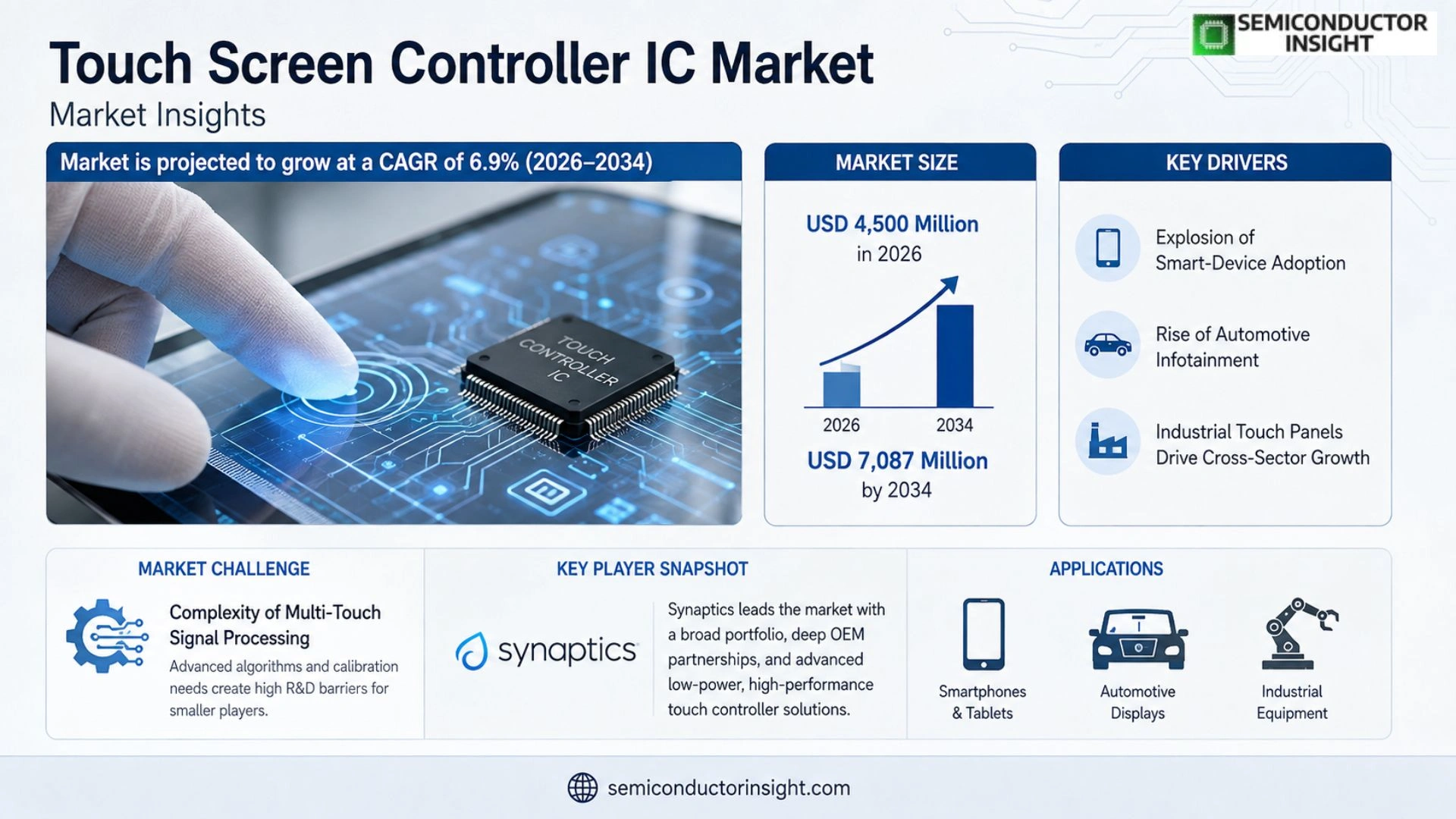
Touch Screen Controller IC market is expected to increase from USD 4500 million in 2026 to USD 7087 million by 2034, reflecting a CAGR of 6.9 % over the forecast period.
Touch screen controller ICs are semiconductor devices that detect and process touch inputs on capacitive or resistive panels, converting physical contact into digital coordinates and gestures for host processors. These integrated circuits typically combine sensing, signal acquisition, filtering, noise suppression, gesture recognition and communication interfaces such as I²C, SPI or USB.
The market is expanding because higher‑integration designs and advanced signal‑processing capabilities are becoming standard across consumer, automotive and industrial segments. Large‑size and high‑performance touch applications demand stronger anti‑interference immunity, glove‑and‐wet‐touch support and greater reliability,driving more sophisticated controller architectures. In‐cell and on‐cell solutions reduce module thickness while raising the importance of firmware optimisation; meanwhile power efficiency gains prominence as thinner battery‐powered devices seek lower consumption without sacrificing responsiveness.
Key players such as Synaptics, Goodix, FocalTech and ELAN Microelectronics are actively launching next‐generation controllers that address these trends. Their roadmaps stress enhanced multi‐touch precision, curved‐display compatibility and tighter integration with display drivers,positioning them well for growth in automotive digital cockcits, industrial control panels and smart‐home interfaces.
MARKET DRIVERS
Explosion of Smart‑Device Adoption
The proliferation of smartphones, tablets, and wearables has pushed OEMs to seek more responsive touch interfaces. Manufacturers are opting for controller ICs that can handle higher touch frequencies and support larger panel sizes, thereby elevating user experience and extending product lifecycles.
Rise of Automotive Infotainment
Automakers are integrating larger, multi‑touch displays in dashboards, demanding controller ICs capable of operating across wide temperature ranges while maintaining low power draw. The shift toward digital cockpits fuels a steady increase in component orders from tier‑one suppliers.
➤ “Higher integration density and lower latency are becoming decisive factors for designers seeking to differentiate premium devices.”
Beyond consumer electronics, industrial machinery is embracing touch panels for ergonomic control, prompting vendors to develop robust ICs that survive harsh environments. This cross‑sector diffusion thins the traditional market segmentation and creates a broader revenue base for Touch Screen Controller IC market.
MARKET CHALLENGES
Complexity of Multi‑Touch Signal Processing
Designing ICs that reliably discern simultaneous touch points on large glass surfaces requires sophisticated algorithms and precise calibration. Smaller firms often lack the R&D depth to compete, leading to consolidation pressure as larger players acquire specialized talent.
Other Challenges
Supply Chain Volatility
Component shortages in semiconductors cascade down to controller IC production, forcing OEMs to hold higher inventory buffers and potentially delay product launches.
Regulatory scrutiny over electromagnetic emissions adds another layer of testing, inflating development cycles and raising cost structures for niche markets such as medical imaging devices.
MARKET RESTRAINTS
Escalating Material Costs
The price surge of high‑purity silicon and advanced glass substrates compresses margins for controller IC manufacturers, especially those targeting price‑sensitive segments.
Fragmented standards across geographic regions compel vendors to customize firmware and packaging, a process that erodes economies of scale.
Emerging alternatives such as optical or ultrasonic touch sensing present a technology‑risk that could divert investment away from traditional capacitive controller ICs.
MARKET OPPORTUNITIES
Integration of AI‑Assisted Gesture Recognition
Embedding lightweight neural‑network engines within controller ICs enables on‑chip interpretation of complex gestures, reducing processor load and opening premium pricing tiers for OEMs.
The expanding Internet‑of‑Things (IoT) ecosystem, particularly in smart home appliances, calls for low‑power touch controllers that can operate on harvested energy, presenting a niche yet growing revenue stream.
Collaborations between semiconductor foundries and display manufacturers accelerate the rollout of 1.5 µm process nodes, allowing higher integration of sensor front‑ends and communication interfaces on a single die.
Geographic expansion into emerging markets, where mobile penetration is still accelerating, offers the chance to capture first‑mover advantage by delivering cost‑effective, high‑performance controller solutions tailored to local device ecosystems.
Touch Screen Controller IC Market Trends
Higher Integration and Advanced Signal Processing
Touch Screen Controller IC market is moving away from simple touch detection toward chips that combine sensing, filtering, gesture decoding and communication on a single die. This consolidation reduces bill‑of‑materials cost and shortens the time designers spend on firmware tuning. Engineers value the tighter noise‑rejection loops and the ability to support dozens of simultaneous touch points, which becomes critical as display sizes expand and curvature increases in premium smartphones and foldable devices. By embedding sophisticated algorithms directly in silicon, manufacturers create a defensible performance edge that ties customers to their ecosystem.
Other Trends
In‑Cell and On‑Cell Touch Integration
Manufacturers are increasingly delivering controllers that sit beneath the display matrix, eliminating the need for separate touch layers. This approach trims module thickness, improves optical clarity and enables higher aperture ratios, translating into brighter screens with lower power draw. The integration also forces controller designers to optimise signal timing and power sequencing, because any latency directly impacts display refresh rates. Companies that master this co‑design gain leverage in thin‑form‑factor markets such as wearables and ultra‑slim laptops.
Power Efficiency and System‑Level Optimization
Battery life constraints are prompting a push for touch controllers that operate in the sub‑milliwatt range while still delivering rapid response times. Adaptive sampling techniques, sleep‑mode handshaking with host processors and dynamic voltage scaling are becoming standard features. The result is a noticeable extension of operational time for portable devices and a reduction in thermal load for automotive consoles, where prolonged use in confined spaces can be problematic.
Automotive and Industrial Touch Demand
Large‑format and rugged applications are reshaping Touch Screen Controller IC market. Vehicles now rely on digital instrument clusters and infotainment panels that must function reliably under temperature extremes, electromagnetic interference and the occasional gloved or wet touch. Industrial control panels face similar challenges, with operators demanding consistent performance in harsh factory settings. To meet these requirements, controller vendors are layering hardened front‑end amplifiers and robust error‑correction schemes into their designs, thereby creating a product class that commands higher margins and deeper design‑in relationships with OEMs.
COMPETITIVE LANDSCAPE
Key Industry Players
Touch Screen Controller IC Market – Competitive Overview
Synaptics retains the dominant position in the touch controller arena, leveraging its deep integration with major smartphone OEMs and an extensive portfolio that spans capacitive, in‑cell, and automotive‑grade solutions. The company’s ability to bundle advanced noise‑suppression algorithms with low‑power front‑end designs sustains strong design‑in momentum, translating into a sizable share of the $4.5 billion market recorded in 2025. Market structure is clearly tiered: a handful of multibillion‑dollar firms hold the bulk of volume, while a second tier of specialist suppliers captures high‑margin niches such as large‑format automotive displays and rugged industrial panels. This bifurcation encourages aggressive R&D investment among the leaders and creates opportunities for smaller innovators to differentiate through custom firmware or unique interface options.
Goodix, FocalTech, ELAN Microelectronics and Chipone Technology illustrate the vibrant mid‑tier ecosystem. Goodix has entrenched itself in the Chinese smartphone supply chain, offering cost‑effective controllers that support high‑frequency scanning for fast gesture response. FocalTech focuses on automotive and industrial segments, where its robust anti‑interference architecture meets the stringent reliability standards of digital cockpits. ELAN capitalizes on the wearables market by shrinking die size and optimizing power draw, while Chipone distinguishes itself with proprietary I2C‑SPI hybrid interfaces that simplify board layout for OEMs. Additional players such as Microchip Technology, STMicroelectronics, Texas Instruments, Renesas Electronics, Analog Devices, NXP Semiconductors, Silicon Labs, Zinitix, Hynitron, GalaxyCore, and Novatek round out the competitive set, each contributing niche capabilities,ranging from ultra‑low‑voltage operation to integrated optical/infrared sensing,that collectively enrich the market’s technical depth.
List of Key Touch Screen Controller IC Companies Profiled
- Synaptics
- Goodix
- FocalTech
- ELAN Microelectronics
- Microchip Technology
- STMicroelectronics
- Texas Instruments
- Renesas Electronics
- Analog Devices
- NXP Semiconductors
- Silicon Labs
- Zinitix
- Hynitron
- Chipone Technology
- GalaxyCore
- Novatek
Segment Analysis:
| Segment Category | Sub-Segments | Key Insights |
| By Type |
|
Capacitive Touch Controller
|
| By Application |
|
Consumer Electronics
|
| By End User |
|
Smartphones & Tablets
|
| By Integration Level |
|
Integrated Multi‑Function Controllers
|
| By Emerging Trend |
|
In‑Cell / On‑Cell Touch Integration
|
Regional Analysis: Touch Screen Controller IC Market
Asia‑Pacific
Concentrated fab capacity in Taiwan and South Korea delivers sub‑10‑micron node capability at competitive pricing. This depth allows volume producers to source high‑performance controller chips without incurring premium margins, reinforcing the region’s attractiveness for cost‑sensitive consumer electronics programs.
Local design firms merge AI‑based touch analytics with power‑efficient ASIC architectures, delivering controllers that support multi‑touch, stylus, and haptic feedback in a single die. Their rapid prototyping culture accelerates feature rollout, pressuring rivals to upgrade roadmaps more frequently.
Recent geopolitical tensions prompted firms to diversify logistics networks across ASEAN ports and inland rail corridors. Such redundancy safeguards component flow, ensuring that demand spikes for tablets or in‑vehicle infotainment systems are met without jeopardizing delivery schedules.
Government incentives for semiconductor R&D, combined with streamlined export licensing, lower entry barriers for start‑ups. The supportive regulatory climate nurtures a pipeline of niche players that specialize in low‑power, high‑precision touch controllers for emerging wearables and medical devices.
North America
North America remains a focal point for high‑value applications such as augmented‑reality headsets and premium laptops. Local system integrators prioritize security‑enhanced touch controllers that incorporate encryption and tamper detection, driving demand for differentiated IP. While manufacturing largely occurs offshore, the region’s strength lies in software‑centric development, where universities and research labs feed proprietary gesture‑recognition frameworks into commercial chips. For multinational suppliers, aligning with U.S. OEMs’ stringent validation processes can unlock long‑term contracts in enterprise and defense sectors.
Europe
European OEMs emphasize sustainability and ergonomic design, prompting a shift toward ultra‑low‑power touch controllers that extend battery life in portable devices. The region’s stringent REACH and RoHS regulations also push manufacturers to adopt lead‑free packaging and greener production methods. This regulatory pressure nurtures a niche of eco‑focused suppliers who can certify compliance across the EU, offering a competitive edge for brands targeting environmentally conscious consumers.
South America
In South America, market traction is tightly linked to the rollout of affordable smartphones and point‑of‑sale terminals. Local distributors value cost‑effective controller solutions that can be integrated into legacy display technologies without extensive redesign. Partnerships with regional fabs enable modest volume production runs, satisfying the price‑sensitive retail sector while still delivering acceptable performance for touch‑heavy applications.
Middle East & Africa
The Middle East & Africa region is witnessing gradual adoption of touch‑enabled kiosks and smart‑city interfaces. Infrastructure projects often require ruggedized controllers capable of withstanding temperature extremes and dust exposure. Suppliers that can certify extended operating ranges and provide localized support services gain a strategic foothold, especially as governments invest in digital signage and interactive public information displays.
Report Scope
This market research report provides a comprehensive analysis of the Touch Screen Controller IC Market , covering the forecast period 2026–2034. It offers detailed insights into market dynamics, technological advancements, competitive landscape, and key trends shaping the industry.
Key focus areas of the report include:
- Market Overview: The report begins with an overview outlining its current market scenario, key growth indicators, and industry transformation drivers. It discusses macroeconomic factors, demand–supply balance, regulatory landscape, and the strategic role of semiconductors in powering advancements across industries such as automotive, telecommunications, consumer electronics, and industrial automation.
- Market Size & Forecast: Historical data and future projections for revenue, unit shipments, and market value across major regions and segments.
- Segmentation Analysis: Detailed breakdown by product type, technology, application, and end-user industry to identify high-growth segments and investment opportunities.
- Regional Insights: Insights into market performance across North America, Europe, Asia-Pacific, Latin America, and the Middle East & Africa, including country-level analysis where relevant.
- Competitive Landscape: Profiles of leading market participants, including their product offerings, R&D focus, manufacturing capacity, pricing strategies, and recent developments such as mergers, acquisitions, and partnerships.
- Technology Trends & Innovation: Assessment of emerging technologies, integration of AI/IoT, semiconductor design trends, fabrication techniques, and evolving industry standards.
- Market Drivers & Restraints: Evaluation of factors driving market growth along with challenges, supply chain constraints, regulatory issues, and market-entry barriers.
- Stakeholder Insights: Insights for component suppliers, OEMs, system integrators, investors, and policymakers regarding the evolving ecosystem and strategic opportunities.
Primary and secondary research methods are employed, including interviews with industry experts, data from verified sources, and real-time market intelligence to ensure the accuracy and reliability of the insights presented.
FREQUENTLY ASKED QUESTIONS:
What is the current market size of Touch Screen Controller IC Market?
-> Touch Screen Controller IC market is expected to increase from USD 4500 million in 2026 to USD 7087 million by 2034, reflecting a CAGR of 6.9 %
Which key companies operate in Touch Screen Controller IC Market?
-> Key players include Synaptics, Goodix, FocalTech, ELAN Microelectronics, Microchip Technology, STMicroelectronics, Texas Instruments, Renesas Electronics, Analog Devices, NXP Semiconductors, Silicon Labs, Zinitix, Hynitron, Chipone Technology, GalaxyCore, Novatek.
What are the key growth drivers?
-> Key growth drivers include expansion of automotive digital cockpits, increasing industrial touch interfaces, rising smart‑home device adoption, continued replacement demand in consumer electronics, and the need for higher power efficiency and larger‑size high‑performance touch solutions.
Which region dominates the market?
-> Asia‑Pacific dominates Touch Screen Controller IC market, driven by strong demand from smartphone manufacturers, automotive OEMs, and industrial equipment producers in the region.
What are the emerging trends?
-> Emerging trends include in‑cell and on‑cell touch integration, ultra‑low‑power controller designs, AI/IoT‑enabled gesture recognition, support for larger and curved displays, and enhanced noise‑immunity for automotive and industrial environments.
Get Sample Report PDF for Exclusive Insights
Report Sample Includes
- Table of Contents
- List of Tables & Figures
- Charts, Research Methodology, and more...
 Download Sample Report PDF