ToF Driver IC Market Insights
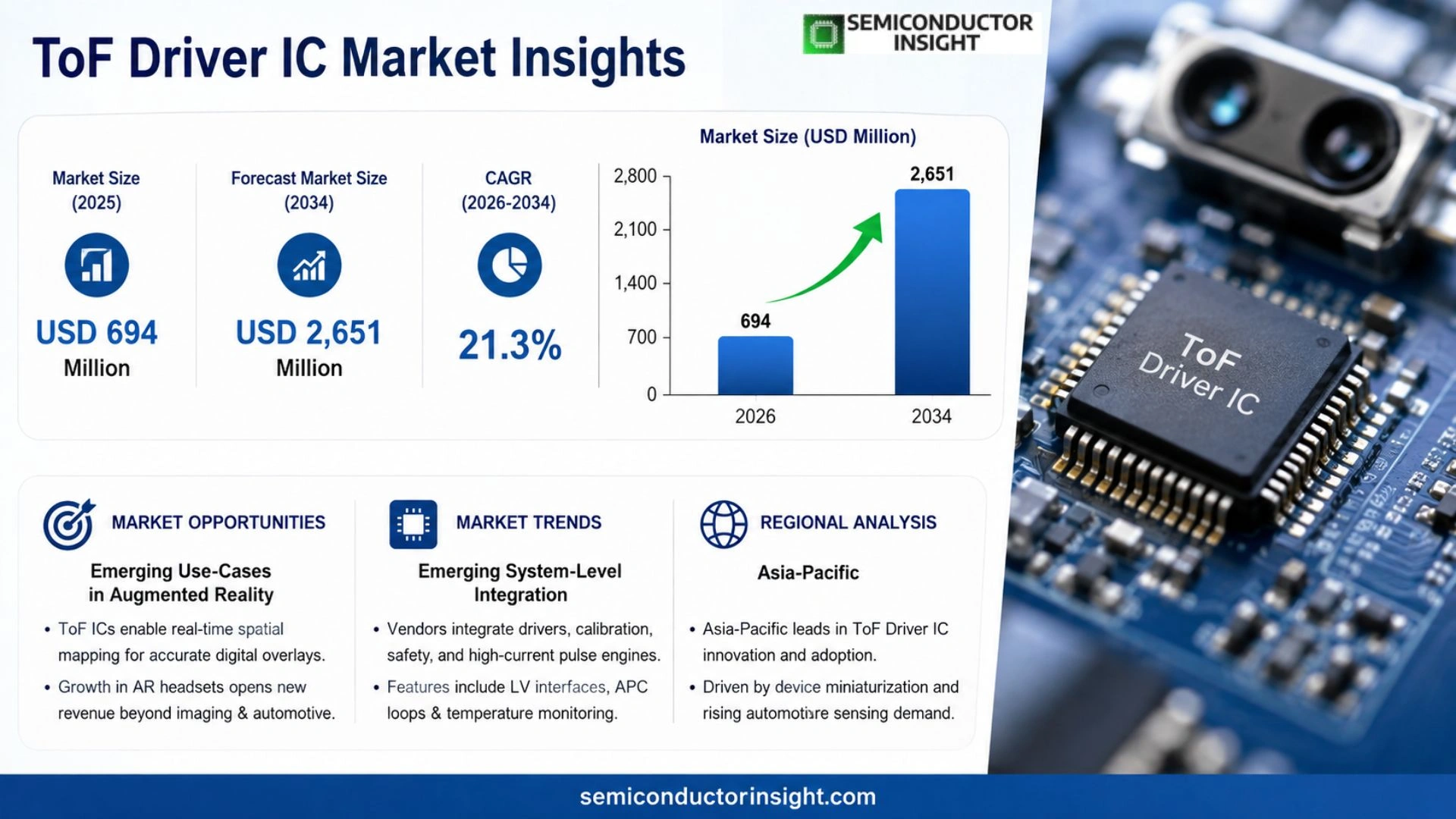
ToF Driver IC market size was valued at USD 694 million in 2025. The market is projected to grow from USD 694 million in 2026 to USD 2,651 million by 2034, exhibiting a CAGR of 21.3% during the forecast period.
A ToF Driver IC is a critical analog and mixed-signal chip used in time-of-flight ranging and depth-sensing systems. Its core role is to provide high-speed switching, high-current pulsing, stable modulation, and power control for emitters such as VCSELs, laser diodes, or LEDs under tight constraints on power consumption, thermal design, size, and safety, thereby converting electrical signals into optical signals suitable for distance measurement and 3D sensing. These products are typically designed around indirect ToF, enhanced ToF, or broader ToF ranging chains, and commonly integrate capabilities such as LVDS or SPI control interfaces, APC, temperature monitoring, fail-safe protection, ambient light rejection, and system-level optimization with external emitters, detectors, and host controllers.
The market is experiencing rapid growth due to several factors,including rising demand for smartphone depth sensing, expanding automotive in-cabin monitoring solutions,and increasing adoption of robotics and smart-space applications. Moreover,recent product introductions that combine driver functionality with signal processing are shortening design-in cycles for OEMs. For example,in early 2024 Infineon announced an AEC-Q100 Grade 2 qualified driver IC for automotive driver-monitoring; ETEK released a miniaturized WLCSP driver with adaptive pulse control for AR/VR devices;and Awinic introduced a high-peak-current (15 A) driver targeting short-range LiDAR. Key players such as Infineon Technologies AG,Efficient Power Conversion Corp.,Wuxi ETEK Micro-Electronics Co.,Shanghai Awinic Technology Co.,Dongwoon Anatech Co.,and Renesas Electronics Corp. continue to broaden portfolios to meet diverse application needs.
MARKET DRIVERS
Increasing Adoption in Consumer Electronics
ToF Driver IC market benefits from smartphones, wearables, and gaming consoles that demand precise depth perception for features such as facial authentication and gesture control. Manufacturers are selecting Time‑of‑Flight (ToF) solutions because they deliver centimeter‑level accuracy while consuming modest power, a combination that aligns with the design constraints of ultra‑slim devices. This alignment translates into higher bill‑of‑materials acceptance and accelerates product cycles.
Advancements in 3‑D Sensing Technology
Recent silicon‑photonic breakthroughs have lowered the noise floor of ToF sensors, enabling reliable operation under ambient lighting conditions that previously limited deployment. As a result, automotive cockpit systems and industrial robotics are integrating ToF driver ICs to replace legacy lidar architectures, achieving tighter form factors and faster data refresh rates. The technical maturity of these chips reduces engineering risk, encouraging OEMs to embed them early in platform designs.
➤ “The convergence of lower power draw and higher depth resolution creates a compelling value proposition for device makers across multiple verticals.”
Collectively, these forces generate a feedback loop: broader device inclusion fuels higher volume production, which in turn drives economies of scale that further lower unit costs. Stakeholders that capitalize on this loop can secure differentiated market positioning before the competitive landscape saturates.
MARKET CHALLENGES
Cost Sensitivity in Tier‑2 Devices
While flagship smartphones readily absorb premium ToF driver IC pricing, mid‑range and entry‑level products operate on razor‑thin margins. Engineers must balance bill‑of‑materials constraints against performance targets, often opting for legacy proximity sensors when cost overruns threaten pricing strategies. This price pressure can delay the penetration of ToF technology into high‑volume, cost‑driven market segments.
Other Challenges
Supply‑Chain Volatility
Global semiconductor shortages have intermittently restricted the availability of key photodiode components, prompting manufacturers to maintain higher safety stocks. The resulting lead‑time extensions compel OEMs to plan longer product cycles, which can impede the rapid introduction of next‑generation ToF driver ICs.
MARKET RESTRAINTS
Regulatory Hurdles for Automotive Integration
Automotive applications of ToF driver ICs must satisfy stringent functional‑safety standards such as ISO 26262. Certification processes are lengthy and costly, deterring smaller suppliers from entering the automotive niche. Until a clearer pathway for compliance emerges, many vehicle manufacturers continue to rely on proven radar and ultrasonic solutions, limiting the immediate upside for the ToF driver IC segment.
MARKET OPPORTUNITIES
Emerging Use‑Cases in Augmented Reality
Augmented reality (AR) headsets require real‑time spatial mapping to overlay digital content accurately. ToF driver ICs that combine high frame rates with low latency are uniquely positioned to satisfy this demand. As enterprise and consumer AR deployments scale, ToF Driver IC market stands to capture a new revenue stream that extends beyond traditional imaging and automotive domains, especially when integrated with edge‑AI processors that perform on‑device depth analysis.
ToF Driver IC Market Trends
Emerging System‑Level Integration
ToF Driver IC market is moving from a component‑focused supply model toward a platform that bundles driver performance, calibration logic, and safety functions. Vendors now embed LV‑type interfaces, APC loops, and temperature‑monitoring blocks alongside the high‑current pulse engine. This convergence reduces board‑level BOM counts and shortens the time required for module makers to achieve repeatable depth‑sensing results across diverse emitter families. For smartphone OEMs, the added configurability translates into tighter integration with camera‑ISP pipelines, while automotive suppliers benefit from a single chip that satisfies both power‑efficiency constraints and the reliability standards demanded by in‑cabin monitoring systems. The strategic shift is reshaping supplier bargaining power: success hinges less on raw current capability and more on the ability to deliver a calibrated, protected, and certifiable solution that can be dropped into reference designs with minimal engineering effort.
Other Trends
Automotive Qualification Shift
Automotive customers are no longer treating ToF Driver ICs as optional accessories; they are insisting on AEC‑Q100 Grade‑2 qualification, extended temperature ranges, and documented failure‑mode handling. This requirement pushes manufacturers such as Infineon to redesign driver architectures for enhanced thermal stability and to certify production lines for automotive‑grade throughput. The immediate business impact is a premium price tier for qualified parts, but it also opens a longer product lifecycle, encouraging downstream OEMs to lock in supply contracts that span multiple vehicle generations. Consequently, the market is developing a bifurcated pricing structure: high‑volume consumer chips remain cost‑driven, whereas automotive‑qualified devices command a margin premium tied to compliance and longevity.
Application Diversification Beyond Mobile
While smartphones sustain the bulk of current shipments, ToF Driver IC market is gaining traction in robotics, smart‑space infrastructure, and short‑range LiDAR for parking assistance. In industrial automation, reliable ambient‑light rejection and fail‑safe shutdown are becoming decisive attributes, prompting system integrators to select drivers that combine high‑peak current with built‑in diagnostics. Similarly, access‑control portals are leveraging the same driver families to achieve precise presence detection without adding separate sensor modules. These emerging use cases broaden the addressable address base, creating a second growth curve that is less sensitive to the cyclical nature of consumer device launches. Companies that can tailor driver parameters,such as pulse width and repetition rate,to the unique demands of each vertical are positioned to capture incremental revenue without cannibalizing their core mobile business.
COMPETITIVE LANDSCAPE
Key Industry Players
ToF Driver IC Market: Competitive Positioning and Strategic Trends
Infineon Technologies AG commands the top tier of the ToF Driver IC arena, leveraging its automotive‑grade AEC‑Q100 qualification and a portfolio that spans 10 A peak current modules operating at 130 MHz. This capability lets OEMs integrate high‑speed modulation with robust temperature monitoring, a combination that reduces system‑level design risk and shortens time‑to‑market for in‑cabin sensing solutions. Infineon’s market share reflects a deliberate shift from pure driver chips toward hybrid devices that embed LVDS reception and fail‑safe logic, positioning the firm as a preferred supplier for Tier‑1 automotive integrators. The company’s extensive evaluation‑board ecosystem further entrenches its foothold, as design houses increasingly demand turnkey reference platforms to accelerate development cycles.
Beyond the front‑runner, a cohort of niche innovators fuels differentiation across verticals. Efficient Power Conversion Corp. supplies high‑current VCSEL drivers prized by robotics firms for nanosecond‑class pulse precision, while Wuxi ETEK and Shanghai Awinic specialize in compact WLCSP packages that enable ultra‑thin smartphone modules. Renesas Electronics augments its industrial automation credentials with temperature‑compensated drivers, and STMicroelectronics offers a mixed‑signal family that blends emitter control with lightweight signal‑processing. Emerging challengers such as NXP Semiconductors, ROHM Semiconductor, and AMS AG are extending their sensor portfolios to include automotive‑qualified drivers, emphasizing environmental robustness and long‑life part qualification. This mosaic of specialized offerings creates a competitive environment where value is extracted from system‑level integration, reliability guarantees, and the ability to expedite design‑in rather than from sheer current capability alone.
List of Key ToF Driver IC Companies Profiled
- Infineon Technologies AG
- Efficient Power Conversion Corp.
- Wuxi ETEK Micro‑Electronics Co., Ltd.
- Shanghai Awinic Technology Co., Ltd.
- Dongwoon Anatech Co., Ltd.
- Renesas Electronics Corporation
- STMicroelectronics
- Texas Instruments
- ON Semiconductor
- NXP Semiconductors
- ROHM Semiconductor
- AMS AG
- Analog Devices
- Melexis
- Broadcom Inc.
Segment Analysis:
| Segment Category | Sub-Segments | Key Insights |
| By Type |
|
iToF Driver IC
|
| By Application |
|
Automotive In‑Cabin Sensing
|
| By End User |
|
Module Makers
|
| By Current Class |
|
4 A – 10 A Class
|
| By Reliability Grade |
|
Automotive‑qualified
|
Regional Analysis: ToF Driver IC Market
Asia-Pacific
The region’s ToF Driver IC portfolio dwarfs other locales, reflecting a blend of high‑volume consumer launches and early‑stage autonomous vehicle pilots. Growth is underpinned by manufacturers’ shift toward multi‑camera arrays, demanding driver ICs that can manage tighter tolerances and lower power envelopes. This trajectory reinforces the region’s status as a net exporter of both design expertise and fabricated silicon.
Depth sensing in flagship smartphones, gesture‑controlled smart home hubs, and short‑range LiDAR modules for driver assistance dominate usage patterns. Notably, industrial robotics in Japan and China are leveraging ToF driver ICs to achieve millimetric positioning, expanding the addressable market beyond consumer horizons.
A handful of integrated device manufacturers dominate design‑wins, yet a wave of niche players from Taiwan’s fabless sector is challenging incumbents with differentiated low‑power architectures. Mergers among packaging specialists and silicon designers hint at consolidation aimed at offering turnkey solutions for OEMs seeking speed to market.
While automotive safety standards in Japan and South Korea increasingly reference depth‑sensor reliability, there is no unified global framework yet. This regulatory patchwork drives companies to adopt region‑specific validation protocols, influencing product roadmaps and testing investments.
North America
In the United States and Canada, the ToF Driver IC narrative is shaped by the convergence of autonomous driving pilots and the expansion of augmented‑reality devices. Major automotive OEMs are integrating depth‑sensing modules into prototype platforms, demanding driver ICs that can survive harsh temperature cycles while maintaining latency under microseconds. Meanwhile, corporate R&D centers on the West Coast are exploring monolithic integration of driver functions with image processors, a move that could shrink board footprints and reduce bill of materials. For vendors, securing early design wins with tier‑one automotive suppliers and leading AR headset makers represents a critical lever for market penetration.
Europe
European activity revolves around stringent functional safety requirements and a strong emphasis on sustainability. The EU’s push for low‑emission vehicles has accelerated adoption of driver‑IC‑enabled short‑range LiDAR in electric cars, while industrial automation firms in Germany seek ultra‑reliable depth sensors for collaborative robots. Intellectual property regimes in the region favor incremental patenting, encouraging firms to bundle driver IC innovations with broader sensor solutions. Companies that can navigate the complex compliance landscape and deliver energy‑efficient designs are likely to command premium pricing.
South America
Growth in Brazil and Mexico reflects a nascent but increasingly diversified application base. Smartphone manufacturers are introducing premium models with built‑in depth cameras, prompting local assemblers to source driver ICs that balance cost with performance. Additionally, agritech initiatives are trialing ToF‑based proximity sensors for autonomous farming equipment, a sector that could unlock new revenue streams if supply‑chain constraints ease. Stakeholders that invest in localized testing facilities will mitigate lead‑time challenges associated with importing calibrated components.
Middle East & Africa
The region is witnessing a gradual uptake of depth‑sensing technologies in security surveillance and smart‑city deployments. Nations such as the United Arab Emirates are piloting driver‑IC‑driven LiDAR networks for traffic monitoring, creating a demand for rugged, low‑power solutions capable of operating in high‑temperature environments. While overall market volume remains modest, early government contracts and partnerships with global OEMs are establishing a foothold that could expand as infrastructure projects progress.
Report Scope
This market research report provides a comprehensive analysis of the ToF Driver IC Market , covering the forecast period 2026–2034. It offers detailed insights into market dynamics, technological advancements, competitive landscape, and key trends shaping the industry.
Key focus areas of the report include:
- Market Overview: The report begins with an overview outlining its current market scenario, key growth indicators, and industry transformation drivers. It discusses macroeconomic factors, demand–supply balance, regulatory landscape, and the strategic role of semiconductors in powering advancements across industries such as automotive, telecommunications, consumer electronics, and industrial automation.
- Market Size & Forecast: Historical data and future projections for revenue, unit shipments, and market value across major regions and segments.
- Segmentation Analysis: Detailed breakdown by product type, technology, application, and end-user industry to identify high-growth segments and investment opportunities.
- Regional Insights: Insights into market performance across North America, Europe, Asia-Pacific, Latin America, and the Middle East & Africa, including country-level analysis where relevant.
- Competitive Landscape: Profiles of leading market participants, including their product offerings, R&D focus, manufacturing capacity, pricing strategies, and recent developments such as mergers, acquisitions, and partnerships.
- Technology Trends & Innovation: Assessment of emerging technologies, integration of AI/IoT, semiconductor design trends, fabrication techniques, and evolving industry standards.
- Market Drivers & Restraints: Evaluation of factors driving market growth along with challenges, supply chain constraints, regulatory issues, and market-entry barriers.
- Stakeholder Insights: Insights for component suppliers, OEMs, system integrators, investors, and policymakers regarding the evolving ecosystem and strategic opportunities.
Primary and secondary research methods are employed, including interviews with industry experts, data from verified sources, and real-time market intelligence to ensure the accuracy and reliability of the insights presented.
FREQUENTLY ASKED QUESTIONS:
What is the current market size of ToF Driver IC Market?
-> ToF Driver IC market is projected to grow from USD 694 million in 2026 to USD 2,651 million by 2034, exhibiting a CAGR of 21.3%
Which key companies operate in ToF Driver IC Market?
-> Key players include Infineon Technologies AG, Efficient Power Conversion Corporation, Wuxi ETEK Micro-Electronics Co., Ltd., Shanghai Awinic Technology Co., Ltd., Dongwoon Anatech Co., Ltd., and Renesas Electronics Corporation, among others.
What are the key growth drivers?
-> Key growth drivers include rising demand for depth‑sensing in smartphones and AR/VR devices, expanding automotive in‑cabin sensing and driver‑monitoring systems, increased adoption in industrial automation and robotics, and the push for higher‑performance, automotive‑qualified ToF Driver ICs with integrated safety and calibration features.
Which region dominates the market?
-> Asia‑Pacific is the leading region, driven by strong semiconductor manufacturing ecosystems in China, Japan, and South Korea, while Europe and North America remain important markets for automotive‑grade and industrial applications.
What are the emerging trends?
-> Emerging trends include integration of signal‑processing functions with emitter drivers, implementation of advanced safety features such as fail‑safe protection and ambient‑light rejection, miniaturization through WLCSP packages, and the qualification of devices to automotive standards like AEC‑Q100 Grade 2.
Get Sample Report PDF for Exclusive Insights
Report Sample Includes
- Table of Contents
- List of Tables & Figures
- Charts, Research Methodology, and more...
 Download Sample Report PDF