Key Statistics
Key Takeaways
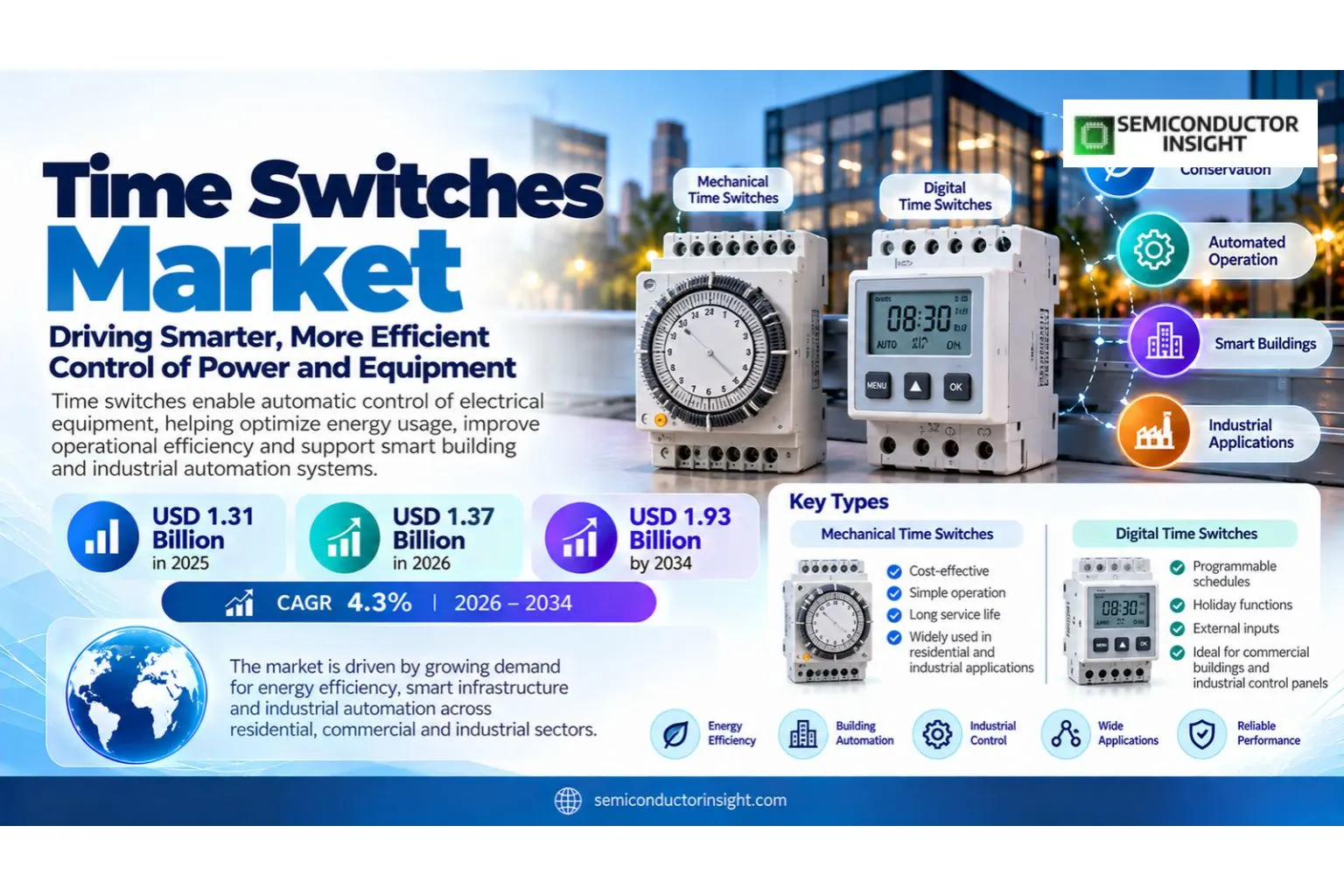
- The market is valued at USD 1.31 billion in 2025 and is projected to reach USD 1.93 billion by 2034, representing a 4.3% CAGR over 2026–2034.
- Digital Time Switches is a major product segment, while adjacent variants are expanding as performance, integration and cost requirements evolve.
- Lighting Control is a leading application area, supported by demand across Industrial Automation, HVAC Systems.
- North America is the largest market in 2025 based on the current concentration of demand, manufacturing capacity and ecosystem maturity.
Time Switches Market Overview
Time Switches are electrical control devices that automatically open or close circuits according to programmed schedules. They are widely used for lighting, ventilation, pumps, irrigation, signage and industrial loads where operating times are predictable and manual switching would create unnecessary energy use or labor. Commercial adoption of Time Switches products therefore depends on system-level productivity, integration requirements, reliability expectations and the economics of replacing established alternatives in real operating environments.
The category is steadily shifting from electromechanical timers toward digital products with weekly calendars, holiday functions, external inputs and easier programming. Smart-building integration is extending the role of the timer from a simple clock-controlled relay into a low-cost scheduling endpoint that can coordinate with broader energy-management systems. Suppliers that translate technical improvements into measurable gains in efficiency, uptime, cost, ergonomics or workflow simplicity are better positioned to win long-duration programs and repeat purchases.
Segment Analysis: By Type
Digital time switches lead because programmable weekly schedules, holiday functions and external inputs suit commercial buildings and industrial control panels. Mechanical variants remain cost-effective where users value simplicity, visual setting and long service life. Within this segment, customers increasingly compare lifecycle support, qualification requirements, integration effort and total ownership cost rather than relying on a single specification or upfront price.
| Type | Market relevance |
|---|---|
| Digital Time Switches | Programmable, precise and integration friendly. |
| Mechanical Time Switches | Simple, durable and economical. |
Segment Analysis: By Application
Lighting control is the largest application because operating hours can be scheduled directly around occupancy and daylight patterns. HVAC, irrigation and industrial equipment add recurring demand where predictable start-stop cycles reduce manual intervention and energy consumption. Within this segment, customers increasingly compare lifecycle support, qualification requirements, integration effort and total ownership cost rather than relying on a single specification or upfront price.
| Application | Market relevance |
|---|---|
| Lighting Control | Largest installed use in buildings and outdoor systems. |
| Industrial Automation | Production scheduling and machine control. |
| HVAC Systems | Heating, ventilation and cooling schedules. |
| Agricultural Irrigation | Pump and irrigation cycle control. |
| Security Systems | Timed lighting and access/security loads. |
Segment Analysis: By Mounting
DIN-rail units dominate commercial and industrial panels because they integrate cleanly with breakers and contactors. Wall-mounted and plug-in formats serve retrofit, residential and appliance-level use cases where a full control panel is unnecessary. Within this segment, customers increasingly compare lifecycle support, qualification requirements, integration effort and total ownership cost rather than relying on a single specification or upfront price.
| Mounting | Market relevance |
|---|---|
| DIN-Rail | Preferred for electrical panels. |
| Panel / Wall Mount | Retrofit and equipment-specific use. |
| Plug-In / Socket | Simple local plug-load scheduling. |
Segment Analysis: By Connectivity
Standalone devices remain the installed-base leader, while networked and IoT-enabled timers are gaining value where facility managers want remote schedule changes, status visibility and coordination with broader building-management systems. Within this segment, customers increasingly compare lifecycle support, qualification requirements, integration effort and total ownership cost rather than relying on a single specification or upfront price.
| Connectivity | Market relevance |
|---|---|
| Standalone | Lowest complexity and cost. |
| Networked / IoT-Enabled | Remote management and smart-building integration. |
Regional Analysis
North America leads because commercial building automation and infrastructure upgrades create strong demand for programmable scheduling, while Europe remains highly developed and Asia Pacific is the fastest expanding through construction, manufacturing and urban infrastructure. Regional share also reflects supplier depth, engineering support, manufacturing concentration and the speed at which new Time Switches designs can move from evaluation into repeat deployment.
| Region | 2025 Position | Growth Outlook | Demand Profile |
|---|---|---|---|
| North America | Largest | Steady | Commercial buildings and infrastructure led |
| Europe | Large mature market | Moderate | Building efficiency and industrial automation led |
| Asia Pacific | Fastest growing | Strong | Manufacturing, construction and smart-city led |
| South America | Emerging | Moderate | Commercial and irrigation led |
| Middle East & Africa | Developing | Moderate-strong | Lighting, irrigation and infrastructure led |
Detailed Regional Blocks
Why is North America important to this market?
North America has the largest current market because commercial buildings, outdoor lighting, irrigation and industrial facilities use large installed bases of digital and electromechanical timers. Retrofit demand remains durable because scheduling is a simple and reliable energy-management measure. In North America, procurement decisions also depend on service coverage, qualification resources, logistics and long-term availability, so ecosystem maturity can materially influence adoption even when core technology performance is similar.
| Country / Subregion | Role | Market Context |
|---|---|---|
| United States | Largest national market | Commercial buildings and infrastructure support high installed volume. |
| Canada | Building automation and municipal demand | Energy-efficiency projects support digital timers. |
| Mexico | Industrial and commercial growth | Manufacturing and facilities expand demand. |
- The report page assigns North America a 39.71% revenue share in 2023.
- Intermatic continues to market electronic and mechanical time controls across commercial and industrial applications.
- Simple scheduled control remains attractive where networked building automation would be unnecessarily complex.
Why is Europe important to this market?
Europe is a mature market with broad use in lighting, heating and industrial control. DIN-rail programmable products align well with European electrical-panel design and energy-efficiency requirements. In Europe, procurement decisions also depend on service coverage, qualification resources, logistics and long-term availability, so ecosystem maturity can materially influence adoption even when core technology performance is similar.
| Country / Subregion | Role | Market Context |
|---|---|---|
| Germany | Industrial and building-controls hub | Automation and energy management support demand. |
| France | Commercial-building market | Digital scheduling is widely used in electrical panels. |
| Nordic countries | Energy-efficiency focused | Precise control supports lighting and heating optimization. |
- Schneider Electric’s IHP family is designed to control heating, lighting and ventilation through memorized on/off schedules.
- The IHP range includes external inputs and memory-based program duplication for easier commissioning.
- Digital timers fit naturally into modular distribution-board architectures common across Europe.
Why is Asia Pacific important to this market?
Asia Pacific is expanding through industrialization, commercial construction and urban infrastructure. China, India and Southeast Asia add demand for panel timers, lighting controls and irrigation scheduling across both modern and cost-sensitive installations. In Asia Pacific, procurement decisions also depend on service coverage, qualification resources, logistics and long-term availability, so ecosystem maturity can materially influence adoption even when core technology performance is similar.
| Country / Subregion | Role | Market Context |
|---|---|---|
| China | Largest regional volume base | Buildings and manufacturing create broad demand. |
| India | Infrastructure growth | Commercial, irrigation and public-lighting applications support adoption. |
| Japan | Precision industrial market | Factories favor dependable programmable controls. |
- Digital time switches are increasingly specified in new control panels because they reduce manual operation.
- Agricultural pumping and irrigation remain important use cases in water-constrained markets.
- Regional demand spans basic mechanical timers and higher-value programmable products.
Why is South America important to this market?
South America is an emerging market where Brazil dominates commercial-building, agricultural and industrial demand. Mechanical and economical digital products coexist because project budgets vary widely. In South America, procurement decisions also depend on service coverage, qualification resources, logistics and long-term availability, so ecosystem maturity can materially influence adoption even when core technology performance is similar.
| Country / Subregion | Role | Market Context |
|---|---|---|
| Brazil | Largest regional market | Buildings, agriculture and industry support demand. |
| Chile | Commercial and irrigation niche | Energy management supports programmable control. |
| Argentina | Industrial and building use | Replacement demand sustains the market. |
- Irrigation scheduling is useful where pumps operate on predictable cycles.
- Commercial lighting is a stable retrofit application.
- Price sensitivity preserves demand for mechanical time switches.
Why is Middle East & Africa important to this market?
Middle East and Africa demand is developing through commercial buildings, outdoor lighting and irrigation. Gulf markets favor digital controls, while lower-cost mechanical products remain common in price-sensitive areas. In Middle East & Africa, procurement decisions also depend on service coverage, qualification resources, logistics and long-term availability, so ecosystem maturity can materially influence adoption even when core technology performance is similar.
| Country / Subregion | Role | Market Context |
|---|---|---|
| United Arab Emirates | Commercial automation | Hotels and offices support programmable timers. |
| Saudi Arabia | Infrastructure and irrigation | Large projects broaden use. |
| South Africa | Commercial and industrial market | Panel timers serve facilities and automation. |
- High cooling loads create value for scheduled HVAC operation.
- Irrigation timing remains important in arid environments.
- Standalone timers are useful where network connectivity is unnecessary.
Competitive Landscape
Schneider Electric, Honeywell, Siemens, Legrand, Hager, Panasonic, Omron, Eaton, ABB and Intermatic compete across mechanical and digital formats. Product differentiation centers on scheduling flexibility, ease of programming, channel count, electrical ratings, enclosure compatibility and integration with smart-building systems.
| Company | Position | Relevant capability |
|---|---|---|
| Schneider Electric | Key participant | IHP programmable time switches with weekly schedules, external inputs and panel integration. |
| Honeywell | Key participant | Competes through product breadth, integration capability, qualification and customer support. |
| Siemens | Key participant | Industrial and building automation ecosystem with programmable control products. |
| Legrand | Key participant | Competes through product breadth, integration capability, qualification and customer support. |
| Hager Group | Key participant | Competes through product breadth, integration capability, qualification and customer support. |
| Panasonic | Key participant | Competes through product breadth, integration capability, qualification and customer support. |
| Omron | Key participant | Competes through product breadth, integration capability, qualification and customer support. |
| Eaton | Key participant | Competes through product breadth, integration capability, qualification and customer support. |
| ABB | Key participant | Competes through product breadth, integration capability, qualification and customer support. |
| Intermatic | Key participant | Long-established mechanical and electronic time-control portfolio. |
Production Capacity Analysis
Time-switch manufacturing uses mature electromechanical parts, relays, microcontrollers, displays, plastic housings and standard power-electronic components. Production is scalable and geographically diversified, so shortages are more likely to arise from component disruptions than specialized manufacturing constraints. Scaling output without degrading consistency requires stable upstream materials, disciplined process control and final testing that catches drift before products reach high-value customer systems.
Digital variants rely more heavily on microcontrollers, displays and memory, while mechanical products depend on precision gears and motors. Suppliers can serve multiple regions with common platforms, but electrical standards, certification and panel formats require localized product variants. Second-source planning and regional technical support therefore become increasingly important as deployments expand and buyers seek supply continuity without repeating lengthy qualification work.
Market Dynamics
The market is mature but resilient because scheduling remains one of the simplest ways to reduce unnecessary operating hours. Digital products are replacing mechanical designs where users value calendar functions and easier changes, while mechanical products remain competitive in basic high-reliability applications. This is changing competitive behavior because vendors increasingly sell system-level value, workflow integration and lifecycle economics rather than an isolated component specification.
Smart-building competition is changing the value proposition. Presence sensors and app-based automation can replace fixed schedules in some sites, but time switches remain attractive where predictable operation, simplicity and low commissioning cost matter more than continuous sensing or analytics. Buyers consequently evaluate total ownership cost, qualification effort and roadmap stability across the life of a program instead of focusing only on initial purchase price.
Market Drivers
| Factor | Analyst Interpretation |
|---|---|
| Building energy efficiency | Scheduled lighting and HVAC reduce unnecessary operating hours. |
| Industrial automation | Factories use timers for recurring equipment cycles and auxiliary loads. |
| Infrastructure growth | New commercial and municipal projects add programmable control points. |
| Irrigation automation | Timed pumping supports water and labor efficiency. |
Market Restraints
| Factor | Analyst Interpretation |
|---|---|
| Competition from smart controls | Occupancy sensors and app-based automation can replace fixed schedules. |
| Mature replacement cycles | Reliable timers often remain installed for many years. |
| Price pressure | Basic mechanical and low-end digital products are highly competitive. |
| Integration complexity | Networked variants require more commissioning than standalone devices. |
Market Opportunities
| Factor | Analyst Interpretation |
|---|---|
| IoT-enabled timers | Remote scheduling and status monitoring can connect low-cost loads to building platforms. |
| Multi-channel devices | One timer can coordinate several circuits from a single panel position. |
| Energy-monitoring integration | Combining switching with usage data can increase value. |
| Agricultural automation | Scheduling remains a simple entry point for precision irrigation. |
Supply Chain Analysis
The supply chain combines relays, clocks or microcontrollers, displays, electrical contacts, enclosures and final certification. Digital products add software and programming interfaces, while mechanical timers rely on robust low-cost electromechanical mechanisms. Traceability and coordination between component suppliers, integrators and end users are important because failures found late in the chain can be far more expensive than the underlying part itself.
| Supply Chain Stage | Role in the Market |
|---|---|
| Electronic and mechanical components | Relays, microcontrollers, motors and gears provide timing and switching. |
| Product assembly | Components are integrated into DIN-rail, wall or plug-in housings. |
| Certification and distribution | Products are qualified for electrical standards and regional channels. |
| Installation and integration | Electricians connect timers to lighting, HVAC, pumps and control panels. |
Recent Developments
| Date | Development | Source |
|---|---|---|
| 2026 | Schneider Electric continues its IHP programmable time-switch range for automatic control of heating, lighting and ventilation with programmable on/off schedules. | Schneider Electric |
| 2026 | Schneider Electric's CCT15441 Acti 9 IHP provides weekly scheduling with 56 switching operations for panel-based automation. | Schneider Electric |
| 2026 | The IHP DCF SMART platform remains available for weekly programmed control with additional memory and external-control functions. | Schneider Electric |
Report Scope & Segmentation
| Scope Item | Coverage |
|---|---|
| Base Year | 2025 |
| Estimated Year | 2026 |
| Forecast Period | 2026–2034 |
| 2025 Market Size | USD 1.31 billion |
| 2026 Estimated Size | USD 1.37 billion |
| 2034 Forecast Size | USD 1.93 billion |
| CAGR (2026–2034) | 4.3% |
| Largest Market in 2025 | North America |
| Category | Control Systems / Timing Devices / Electrical Automation |
| By Type | Digital Time Switches, Mechanical Time Switches |
| By Application | Lighting Control, Industrial Automation, HVAC Systems, Agricultural Irrigation, Security Systems |
| By Mounting | DIN-Rail, Panel / Wall Mount, Plug-In / Socket |
| By Connectivity | Standalone, Networked / IoT-Enabled |
Frequently Asked Questions
What is the 2025 market size of the Time Switches market?
The market is valued at USD 1.31 billion in 2025.
What is the projected 2034 market size of the Time Switches market?
The market is projected to reach USD 1.93 billion by 2034.
What is the CAGR of the Time Switches market from 2026 to 2034?
The market is expected to expand at a CAGR of 4.3% during 2026–2034.
Which region leads the Time Switches market?
North America is the largest market in 2025 based on the current demand, manufacturing and deployment structure.
Which type segment is important in the Time Switches market?
Digital Time Switches is a major segment, while adjacent product variants are gaining share as performance and integration requirements evolve.
What is the main application for Time Switches products?
Lighting Control is a leading application, with additional growth coming from Industrial Automation, HVAC Systems.
What drives growth in the Time Switches market?
Scheduled lighting and HVAC reduce unnecessary operating hours.
What is a key restraint for the Time Switches market?
Occupancy sensors and app-based automation can replace fixed schedules.
Which companies participate in the Time Switches market?
Key participants include Schneider Electric, Honeywell, Siemens, Legrand, Hager Group, alongside other specialized suppliers and system companies.
What technology trend is shaping the Time Switches market?
Remote scheduling and status monitoring can connect low-cost loads to building platforms.
Research Sources & Evidence Base
View research sources used for this overview.
- Schneider Electric — IHP Programmable Time Switches: Current use cases and programmable scheduling functions. Source
- Schneider Electric — Acti 9 IHP CCT15441: Current one-channel weekly digital time-switch product. Source
- Schneider Electric — IHP DCF SMART: Current smart programmable weekly time-switch platform. Source
Get Sample Report PDF for Exclusive Insights
Report Sample Includes
- Table of Contents
- List of Tables & Figures
- Charts, Research Methodology, and more...
 Download Sample Report PDF