Sustainable Semiconductor Manufacturing Market Insights
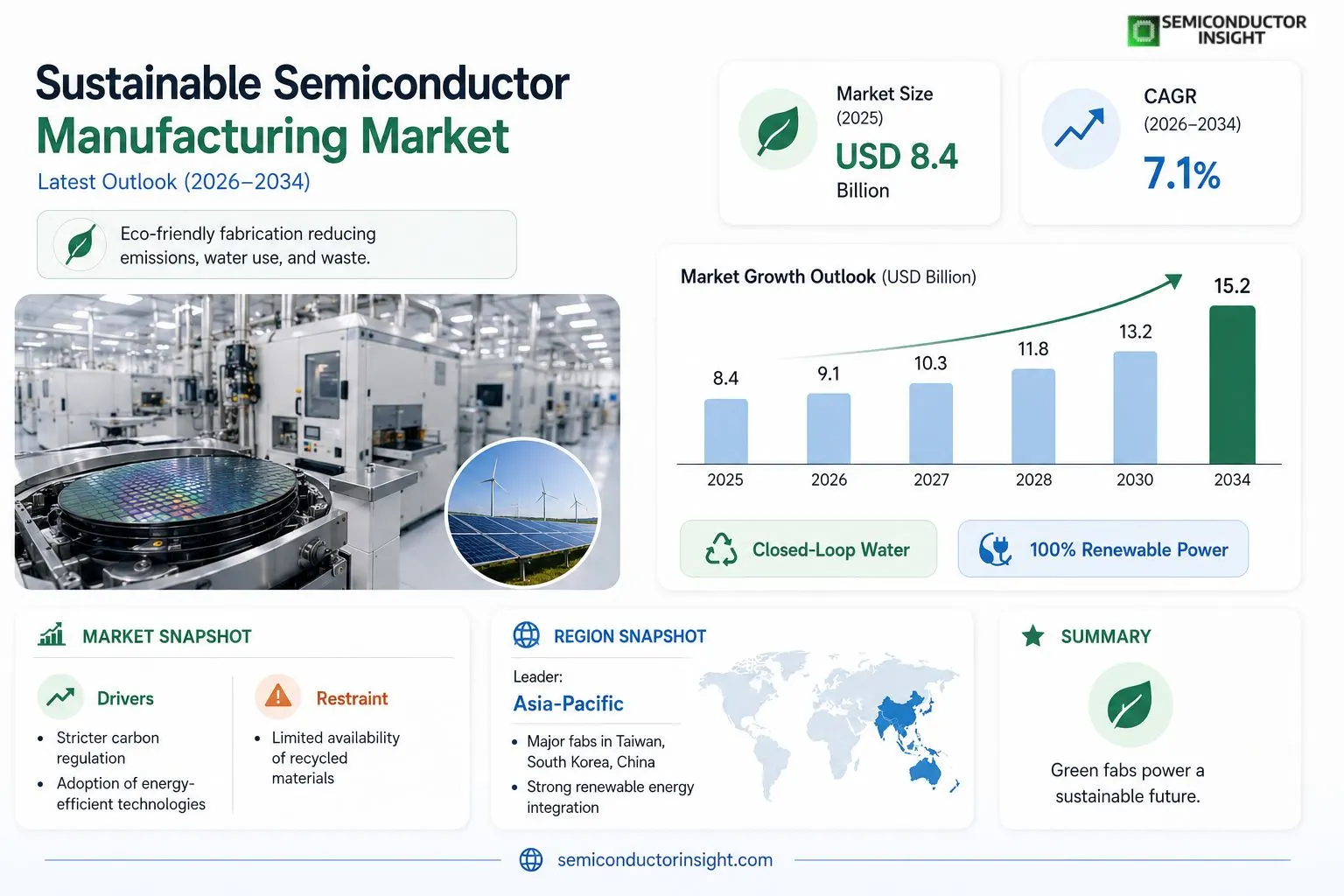
Global sustainable semiconductor manufacturing market size was valued at USD 8.4 billion in 2025. The market is projected to grow from USD 9.1 billion in 2026 to USD 15.2 billion by 2034, exhibiting a CAGR of 7.1% during the forecast period.
Sustainable semiconductor manufacturing refers to eco‑friendly fabrication processes that aim to lower carbon emissions, conserve water resources, and integrate circular‑economy practices such as material recycling and waste‑to‑energy conversion. Key techniques include low‑temperature plasma etching, reduced‑chemical lithography, renewable‑energy powered fabs, and closed‑loop water treatment systems.The market is experiencing rapid growth because regulators worldwide are tightening carbon‑footprint standards while investors pour capital into green fabs.Furthermore, leading companies,Intel Corporation, TSMC, Samsung Electronics and GlobalFoundries,are accelerating renewable‑energy projects and partnering with equipment suppliers like Applied Materials on energy‑efficient tools.
For instance, in March 2024 Intel announced a strategic partnership with Enel Green Power to source 100 % renewable electricity for its newFab 28 facility in Arizona.These initiatives are expected to propel further expansion of Sustainable Semiconductor Manufacturing Market.
MARKET DRIVERS
Increasing Regulatory Pressure for Low‑Carbon Production
Sustainable Semiconductor Manufacturing Market is being propelled by stricter environmental regulations worldwide. Governments in North America, Europe and Asia are mandating carbon‑intensity caps for fabs, driving manufacturers to adopt renewable energy sources and to report greenhouse‑gas emissions transparently.
Adoption of Energy‑Efficient Process Technologies
Advanced lithography, low‑temperature plasma etching and single‑wafer processing reduce power consumption by up to 30 % compared with legacy equipment. Companies that integrate these technologies gain a competitive edge while lowering operating costs.
➤ “Investments in water‑recycling systems can cut freshwater usage by 40 % without compromising yield,” says an industry analyst.
Enterprise‑wide sustainability programs are also encouraging cross‑functional collaboration, leading to faster adoption of circular‑economy practices such as silicon‑scrap reuse, which further fuels market growth.
MARKET CHALLENGES
High Capital Expenditure for Green Facilities
Building a Sustainable Semiconductor Manufacturing Market‑compliant fab requires substantial upfront investment in clean energy infrastructure, advanced waste‑treatment units and carbon‑capture technologies. The payback period frequently exceeds five years, which deters smaller players.
Other Challenges
Supply Chain Constraints
The availability of high‑purity recycled silicon and low‑loss photomasks is limited, creating bottlenecks that can delay production schedules and increase component costs.
MARKET RESTRAINTS
Limited Availability of Recycled Materials
While Sustainable Semiconductor Manufacturing Market aims to close material loops, the current recycling ecosystem cannot meet the volume demanded by leading fabs, restricting the scale of circular initiatives.In addition, the quality variance of reclaimed substrates often necessitates additional purification steps, raising operational complexity and cost.Furthermore, regional differences in recycling regulations create uneven market conditions, making it challenging for multinational manufacturers to implement uniform sustainability standards.
MARKET OPPORTUNITIES
Emerging Circular Economy Business Models
New leasing arrangements for equipment and “as‑a‑service” wafer production enable manufacturers to upgrade to greener technologies without capital strain, unlocking growth for Sustainable Semiconductor Manufacturing Market.Partnerships between semiconductor firms and renewable‑energy providers are also creating off‑grid power solutions that guarantee clean electricity supply, reducing carbon footprints and operational risk.Finally, advanced analytics for energy‑usage optimization present a lucrative avenue, allowing fabs to achieve real‑time sustainability monitoring and to certify compliance with emerging ESG standards.
Sustainable Semiconductor Manufacturing Market Trends
Regulatory Momentum Fuels Green Fab Expansion
Governments across North America, Europe and parts of Asia have introduced stricter carbon‑footprint standards for semiconductor fabs. These policies, combined with rising ESG expectations from investors, are compelling leading manufacturers to redesign production lines for lower emissions and water use. As a result, Sustainable Semiconductor Manufacturing Market is experiencing a rapid shift toward facilities that source 100 % renewable electricity and employ closed‑loop water recycling. The regulatory environment therefore serves as a primary catalyst for accelerated adoption of sustainable practices.
Other Trends
Energy‑Efficient Process Innovations
Equipment suppliers are delivering tools that reduce thermal budgets and chemical consumption. Low‑temperature plasma etching and reduced‑chemical lithography enable patterning with substantially less energy input while maintaining yield. Renewable‑energy powered fabs, such as Intel’s Fab 28 in Arizona, now operate exclusively on green power supplied through a partnership with Enel Green Power. Parallel efforts by TSMC and Samsung focus on integrating on‑site solar arrays and wind turbines to offset the high electricity demand of advanced nodes.
Circular‑Economy Integration Accelerates
Material recycling and waste‑to‑energy conversion are becoming standard components of fab design. Closed‑loop water treatment systems capture and purify process water for reuse, cutting freshwater withdrawals by up to 60 %. Simultaneously, companies are collaborating with specialty recyclers to recover rare metals from end‑of‑life silicon wafers, turning waste streams into valuable inputs for new production cycles. These circular‑economy measures not only lower operational costs but also reinforce stakeholder confidence in the sustainability credentials of the sector.The convergence of regulatory pressure, investor focus, and technological advancement positions Sustainable Semiconductor Manufacturing Market for sustained growth. Partnerships between chipmakers and energy providers, coupled with continuous innovation in low‑impact fabrication, suggest that eco‑friendly semiconductor production will become the industry norm rather than an exception. Analysts anticipate that as more fabs achieve net‑zero targets, the competitive landscape will increasingly reward firms that embed sustainability into every stage of the manufacturing value chain.
COMPETITIVE LANDSCAPEKey Industry Players
Sustainable Semiconductor Manufacturing Market – Competitive Overview
The market is dominated by a handful of global fabs that have integrated renewable‑energy sourcing, water‑recycling loops, and low‑temperature etching into their production lines. Intel Corporation leads the transition with its Arizona Fab 28 powered entirely by green electricity, while TSMC has committed to 100 % renewable power across all 2025‑2027 capacity expansions. Samsung Electronics and GlobalFoundries follow suit, embedding circular‑economy practices such as waste‑to‑energy conversion and closed‑loop water treatment. These carriers shape the market structure by setting sustainability benchmarks that drive supplier demand for eco‑efficient equipment and material‑recovery services.Beyond the tier‑one fabs, a cohort of equipment and materials specialists is accelerating the green fab agenda. Applied Materials supplies energy‑efficient deposition tools, ASML provides lithography platforms designed for reduced chemical usage, and Lam Research offers plasma‑etch solutions that cut water consumption. Tokyo Electron, NXP Semiconductors, Texas Instruments, Infineon Technologies, STMicroelectronics, Renesas Electronics, Micron Technology, and SMIC are also investing in sustainable processes, creating a layered competitive ecosystem where technology suppliers and niche chipmakers collaborate to meet tightening carbon‑footprint regulations worldwide.
List of Key Semiconductor Manufacturing Companies Profiled
- Intel Corporation
- Taiwan Semiconductor Manufacturing Company (TSMC)
- Samsung Electronics
- GlobalFoundries
- Applied Materials
- ASML Holding
- Lam Research
- Tokyo Electron
- NXP Semiconductors
- Texas Instruments
- Infineon Technologies
- STMicroelectronics
- Renesas Electronics
- Micron Technology
- SMIC
Segment Analysis:
| Segment Category | Sub-Segments | Key Insights |
| By Type |
|
Energy‑Efficient Equipment is emerging as the pivotal sub‑segment. It drives adoption of tools that consume less power while maintaining throughput, encouraging fabs to retrofit legacy lines.
|
| By Application |
|
Logic Chip Fabrication commands significant attention due to its high energy intensity. Sustainable practices are reshaping design and process flows.
|
| By End User |
|
Mobile Device Manufacturers are accelerating sustainable fab choices to meet consumer expectations for greener products.
|
| By Technology |
|
Renewable Energy‑Powered Fabs represent the cornerstone of a truly sustainable semiconductor ecosystem.
|
| By Sustainability Initiative |
|
Carbon Neutrality Programs drive holistic change across the value chain.
|
Regional Analysis: North America
United States
The US is attracting substantial investments in sustainable semiconductor manufacturing, fueled by tax incentives and government funding for green technology development. Companies are increasingly prioritizing investments in water recycling and renewable energy infrastructure within their facilities.
Innovation in chip design and manufacturing processes is key to sustainability. The US is at the forefront of developing energy-efficient chip architectures and exploring novel materials to reduce the environmental impact of semiconductor production.
Government policies and regulations play a crucial role in driving sustainable practices. Initiatives promoting carbon neutrality and responsible resource management are influencing the adoption of eco-friendly manufacturing methods.
Increasingly, companies are focusing on building more sustainable and resilient supply chains for semiconductor manufacturing, prioritizing ethical sourcing of materials and reducing transportation emissions.
Europe
Europe is making significant strides in the Sustainable Semiconductor Manufacturing Market, driven by stringent environmental regulations and a strong emphasis on circular economy principles. Several European countries are actively promoting investments in green manufacturing technologies and fostering collaborations between industry and academia to advance sustainable practices. The region’s focus on reducing water and energy consumption aligns with its broader sustainability goals. Moreover, the European Union’s initiatives, such as the European Green Deal, are creating a supportive framework for the adoption of sustainable semiconductor manufacturing. The development of innovative recycling technologies for semiconductor waste is also gaining momentum.
Asia-Pacific
Asia-Pacific represents a dynamic and rapidly expanding market for Sustainable Semiconductor Manufacturing. Countries like Japan, South Korea, and Taiwan are leading the way in adopting advanced eco-friendly manufacturing techniques. Driven by rising environmental awareness and government support, there is a growing emphasis on reducing the carbon footprint of semiconductor production in the region. The focus on water conservation and the development of energy-efficient fabrication processes are key priorities. Furthermore, the region’s strong semiconductor industry is actively investing in research and development of sustainable manufacturing solutions.
South America
The Sustainable Semiconductor Manufacturing Market in South America is in its nascent stages but holds significant potential for growth. While the region currently has a relatively small semiconductor manufacturing base, there is increasing interest in establishing more sustainable practices. Governments are beginning to recognize the importance of environmentally responsible manufacturing and are exploring policies to encourage green investments in the sector. The adoption of circular economy principles and the focus on reducing waste will be crucial for the future development of the market.
Middle East & Africa
The Sustainable Semiconductor Manufacturing Market in the Middle East & Africa is an emerging area with considerable long-term prospects. Driven by strategic investments in technology and infrastructure, the region is beginning to explore opportunities in semiconductor manufacturing with a focus on sustainability. While currently smaller than other regions, there is growing recognition of the need for environmentally responsible practices in the sector. Initiatives promoting renewable energy and water conservation are likely to play a significant role in shaping the future of sustainable semiconductor manufacturing in the region.
Report Scope
This market research report provides a comprehensive analysis of the Sustainable Semiconductor Manufacturing Market , covering the forecast period 2026–2034. It offers detailed insights into market dynamics, technological advancements, competitive landscape, and key trends shaping the industry.
Key focus areas of the report include:
- Market Overview: ✅ The report begins with an overview outlining its current market scenario, key growth indicators, and industry transformation drivers. It discusses macroeconomic factors, demand–supply balance, regulatory landscape, and the strategic role of semiconductors in powering advancements across industries such as automotive, telecommunications, consumer electronics, and industrial automation.
- ✅ Market Size & Forecast: Historical data and future projections for revenue, unit shipments, and market value across major regions and segments.
- ✅ Segmentation Analysis: Detailed breakdown by product type, technology, application, and end-user industry to identify high-growth segments and investment opportunities.
- ✅ Regional Insights: Insights into market performance across North America, Europe, Asia-Pacific, Latin America, and the Middle East & Africa, including country-level analysis where relevant.
- ✅ Competitive Landscape: Profiles of leading market participants, including their product offerings, R&D focus, manufacturing capacity, pricing strategies, and recent developments such as mergers, acquisitions, and partnerships.
- ✅ Technology Trends & Innovation: Assessment of emerging technologies, integration of AI/IoT, semiconductor design trends, fabrication techniques, and evolving industry standards.
- ✅ Market Drivers & Restraints: Evaluation of factors driving market growth along with challenges, supply chain constraints, regulatory issues, and market-entry barriers.
- ✅ Stakeholder Insights: Insights for component suppliers, OEMs, system integrators, investors, and policymakers regarding the evolving ecosystem and strategic opportunities.
Primary and secondary research methods are employed, including interviews with industry experts, data from verified sources, and real-time market intelligence to ensure the accuracy and reliability of the insights presented.
FREQUENTLY ASKED QUESTIONS:
What is the current market size of Sustainable Semiconductor Manufacturing Market?
-> Sustainable Semiconductor Manufacturing Market was valued at USD 8.4 billion in 2025 and is expected to reach USD 15.2 billion by 2034.
Which key companies operate in Sustainable Semiconductor Manufacturing Market?
-> Key players include Intel Corporation, TSMC, Samsung Electronics, and GlobalFoundries, among others.
What are the key growth drivers?
-> Key growth drivers include tightening carbon‑footprint regulations, increasing investor capital for green fabs, and widespread adoption of renewable‑energy‑powered semiconductor facilities.
Which region dominates the market?
-> Asia‑Pacific is a leading region, driven by major fabs in Taiwan, South Korea, and China, while maintaining a strong global presence.
What are the emerging trends?
-> Emerging trends include low‑temperature plasma etching, reduced‑chemical lithography, renewable‑energy‑powered fabs, and closed‑loop water treatment systems.

Get Sample Report PDF for Exclusive Insights
Report Sample Includes
- Table of Contents
- List of Tables & Figures
- Charts, Research Methodology, and more...
 Download Sample Report PDF