SEMICONDUCTOR INSIGHT
MARKET RESEARCH REPORT

SMT Squeegee and Blades Market

2026 to 2034
MARKET INTELLIGENCE
ACROSS KEY REGIONS
2026 EDITION
ELECTRONIC COMPONENTS Semiconductor Market Research

SMT Squeegee and Blades Market

Trends, Business Strategies 2026-2034

◷
UPDATED 17 September 2026
▤
REPORT LENGTH Detailed Report
▣
REPORT CODE abe2690d7553
▯
FORMATS PDF

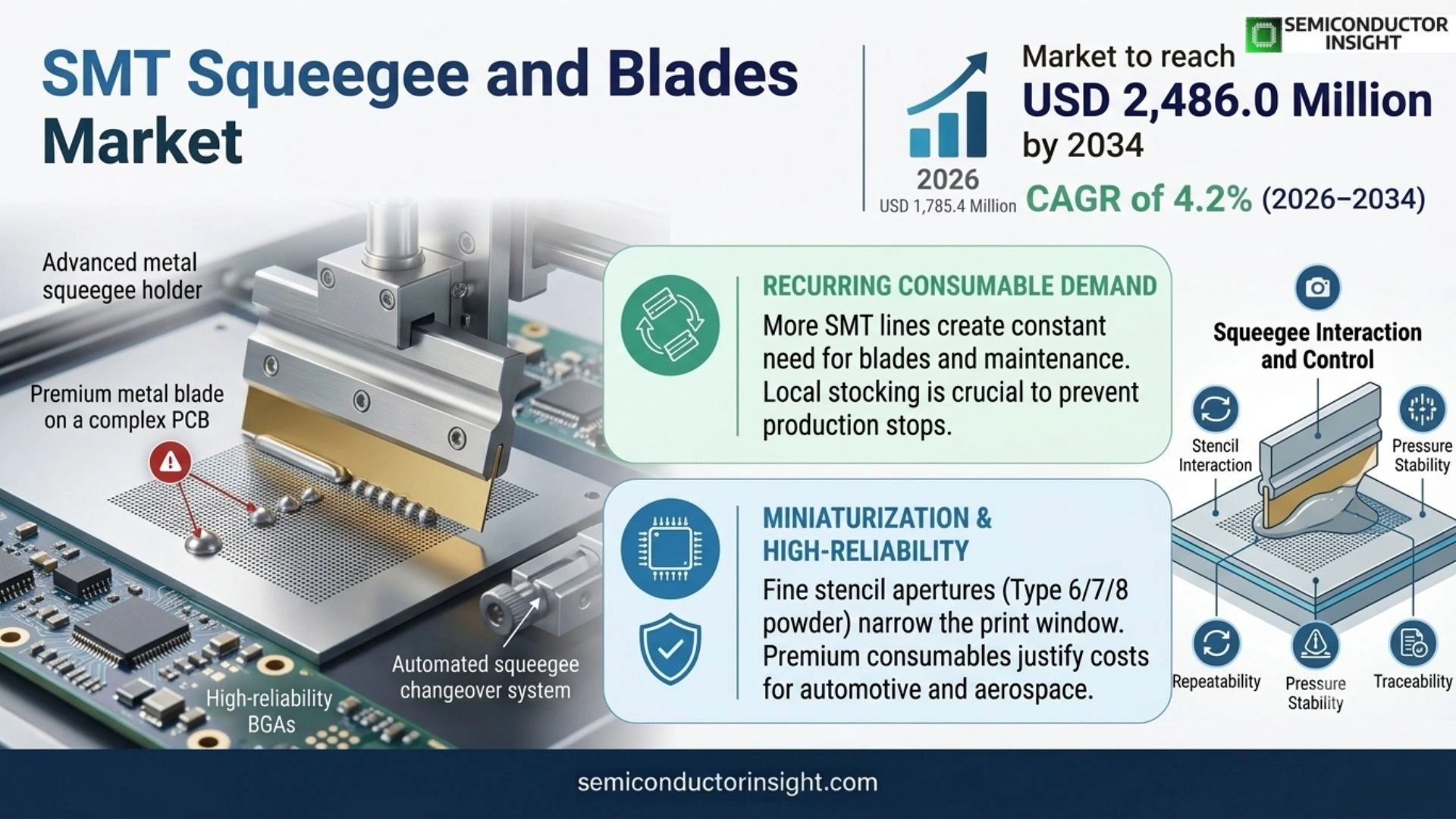
SMT Squeegee and Blades Market is estimated at USD 1,785.4 million in 2026, and is projected to reach USD 2,486.0 million by 2034, representing a CAGR of 4.2% during 2026–2034.

Get the sample PDF with study scope, segmentation and methodology details.

Key Statistics

2025 Market Size
USD 1,713.0 million
2026 Estimated Size
USD 1,785.4 million
2034 Projected Size
USD 2,486.0 million
CAGR (2026–2034)
4.2%
Largest Market in 2025
Asia Pacific

Key Takeaways

  • Metal squeegees remain the leading type because stainless-steel blades provide a wide process window, dimensional stability and consistent paste-roll control across high-volume SMT lines using fine-pitch and heterogeneous component mixes.
  • Automatic SMT printers are the largest application because high-throughput electronics factories depend on repeatable pressure, speed and changeover control that manual or semi-automatic equipment cannot match at comparable volume.
  • Asia Pacific is the largest regional market, supported by the concentration of electronics assembly, PCB production, smartphones, computing hardware, automotive electronics and semiconductor manufacturing across China, Japan, South Korea, Taiwan, Southeast Asia and India.
  • Blade replacement drives recurring demand because frames and holders can remain in service while blade edges wear, making replacement blades the economically preferred maintenance item in many high-volume printing operations.
  • Automation is changing the value proposition. Quick-change and fully automated stencil/squeegee changeovers reduce operator time, standardize setup and lower the probability of print defects caused by inconsistent mounting or pressure.
  • Fine-feature solder paste raises performance requirements. Type 6, Type 7 and Type 8 powders and smaller stencil apertures demand tighter control of blade edge condition, pressure, angle and paste roll to preserve transfer efficiency.

SMT Squeegee and Blades Market Overview

SMT Squeegee and Blades Market was valued at USD 1,713.0 million in 2025, is estimated at USD 1,785.4 million in 2026, and is projected to reach USD 2,486.0 million by 2034, representing a CAGR of 4.2% during 2026–2034. Asia Pacific is the largest regional market in 2025, while the commercial growth mechanism is increasingly shaped by finer-pitch PCB assembly, automated stencil printing, higher electronics manufacturing volumes, rapid product changeovers, and more demanding solder-paste transfer requirements in automotive, AI hardware and advanced packaging.

Base year: 2025 · Estimated year: 2026 · Forecast period: 2026–2034 · Values in USD million unless otherwise stated

SMT squeegees and blades are the mechanical interface that forces solder paste across a stencil and into apertures before electronic components are placed on a printed circuit board. The system typically combines a frame or holder with metal or polyurethane blades. Print quality depends on blade straightness, angle, pressure, edge condition and compatibility with the stencil and paste. Because solder-paste printing is an early process step, variation can propagate into bridging, insufficient deposits, opens, voids and rework later in the assembly line.

The market is increasingly influenced by miniaturization. Smartphones, wearables, advanced packaging and high-density computing boards use smaller passive components, finer pitches and tighter aperture ratios. Solder-paste suppliers are introducing Type 6, Type 7 and Type 8 powders for very small features, which makes consistent paste release more sensitive to stencil quality and squeegee mechanics. Automotive and industrial electronics add a different requirement: the print process must remain stable over long production runs and high-reliability assemblies where defect escape is costly.

Automation is also changing purchasing behavior. Modern printers can control squeegee pressure in closed loop, identify stencils by barcode and automate changeovers. ASMPT has introduced quick-change squeegees and an automated setup concept that cuts operator intervention dramatically. As factories move toward higher mix with shorter production runs, the commercial value of a squeegee system increasingly includes changeover speed, error prevention, paste utilization and compatibility with printer automation rather than only blade material cost.

Segment Analysis: By Type

By type, the market is segmented into Metal and Polyurethane squeegees and blades. Metal blades hold the leading position because stainless steel provides stiffness, a stable edge and reliable paste transfer across fine-pitch and mixed-technology assemblies. Polyurethane remains important where flexibility, multi-level stencils, adhesive printing or specific substrate conditions favor a compliant blade.

Type Technical role Market position
Metal Stainless-steel blades apply a stable, controlled force to the solder-paste roll and maintain a sharp working edge over repeated cycles. Their stiffness makes them well suited to fine-pitch apertures, lead-free solder paste and high-speed automatic printers. Blade geometry and surface finish influence paste rolling, stencil contact and cleaning behavior. The leading type for mainstream SMT printing. Metal blades provide durable, repeatable performance across heterogeneous boards and high-volume production. Premium laser-cut or precision-ground versions can reduce smearing and cleaning frequency, while replacement blades provide recurring aftermarket revenue after the frame remains in service.
Polyurethane Polyurethane blades are more compliant and can conform to uneven surfaces or specialized stencil conditions. Hardness can be selected for different applications, and the blade can be reground during its life. Polyurethane is also used in adhesive printing, mesh or emulsion screen printing and multi-level stencil applications where metal stiffness may be less suitable. A smaller but durable segment with application-specific advantages. Demand is strongest in processes that value flexibility, regrindability or compatibility with unusual stencil and substrate geometries. Performance depends on durometer, chemical resistance and edge wear, while very fine-pitch high-speed SMT often continues to favor metal.

What determines blade life and printing consistency?

Blade life is determined by more than material hardness. Solder-paste abrasiveness, stencil surface, print pressure, blade angle, edge preparation and cleaning practice all influence wear. Excess pressure can accelerate blade and stencil damage, while insufficient pressure leaves paste on the stencil and creates incomplete aperture fill. Modern printers increasingly use software-controlled pressure and repeatable mounting to keep the process within a stable window. Replacement economics are also important: changing the blade rather than the complete squeegee assembly lowers maintenance cost and allows users to retain familiar holders and machine settings.

Segment Analysis: By Application

By application, the market is segmented into Automatic SMT Printer, Semi-automatic SMT Printer, and Others. Automatic SMT printers dominate because consumer electronics, automotive, telecom and computing factories require repeatable deposition at high throughput. Semi-automatic equipment remains relevant for prototyping, low-volume production, repair and smaller manufacturers where flexibility matters more than cycle time.

Application Demand characteristics
Automatic SMT Printer Automatic printers control board handling, stencil alignment, squeegee speed and pressure through software and closed-loop mechanisms. High-volume factories use them because repeatability and throughput directly affect line economics. The squeegee must remain dimensionally stable across long runs and integrate with automated changeover, paste transfer and error-prevention features as factories reduce manual intervention.
Semi-automatic SMT Printer Semi-automatic machines combine powered printing with greater operator involvement in board loading, alignment or setup. They are common in prototypes, low-volume electronics, education, repair and smaller manufacturing operations. Users prioritize versatility, easy blade replacement and lower capital cost, while process consistency depends more heavily on operator training and setup discipline.
Others Specialized printing systems serve semiconductor packaging, wafer coating, adhesive deposition, oversized boards and other non-standard applications. These processes may use unusual stencil thicknesses, fine powders, long blade lengths or custom profiles. Squeegee suppliers can capture higher value through application engineering because standard catalog blades may not produce acceptable transfer efficiency or mechanical stability.

Why is automatic changeover becoming commercially important?

High-mix electronics factories may change products many times per day, and every change requires a new stencil, squeegee setup, support configuration and verification. Manual procedures keep an operator at the printer and introduce variability in blade mounting or setup. ASMPT’s 2026 automated setup changeover reduces operator intervention from roughly four minutes to about 30 seconds by preparing the stencil and squeegees as a combined setup. For contract manufacturers, the value is not merely labor saving; faster, poka-yoke changeovers improve equipment utilization and reduce the chance that a setup error produces an entire batch of defective boards.

SMT Squeegee and Blades Market Analysis

Regional Analysis

Asia Pacific leads the SMT Squeegee and Blades market because the region contains the world’s largest concentration of electronics manufacturing and PCB assembly. China, Japan, South Korea and Taiwan remain major production centers, while Southeast Asia and India are receiving additional electronics investment. North America and Europe are smaller in volume but support premium demand from aerospace, medical, automotive and high-mix industrial manufacturing.

How do regional SMT printing requirements differ?

Asia Pacific emphasizes scale, throughput, local availability and rapid replacement because factories operate large numbers of SMT lines. North America has more high-mix, defense, medical and specialized manufacturing where process documentation and reliability can outweigh blade price. Europe is strongly influenced by automotive and industrial electronics, favoring stable processes and automation. South America is more dependent on imported printing equipment and consumables, while Middle East and Africa demand is emerging through electronics localization, telecom and industrial diversification.

Region Position Growth outlook Demand profile What decides supplier selection
Asia Pacific Largest Above market average High-volume electronics assembly Throughput, replacement availability, precision and printer compatibility
North America Premium specialized market Moderate Aerospace, medical, telecom and high-mix EMS Process reliability, technical support and repeatability
Europe Automotive and industrial specialist Moderate Automotive, industrial and high-reliability electronics Automation, quality, sustainability and lifecycle support
South America Smaller import-dependent market Selective Consumer, automotive and telecom assembly Landed cost, distributor inventory and service
Middle East & Africa Emerging market Selective Electronics localization and infrastructure Training, supply availability and rugged operation
Asia Pacific LARGEST MARKET

Why does Asia Pacific lead demand for SMT squeegees and blades?

Asia Pacific hosts the largest concentration of smartphones, computers, telecom hardware, automotive electronics and PCB assembly, so it operates the greatest number of solder-paste printing lines. China remains the largest manufacturing base, while Japan, South Korea and Taiwan contribute high-reliability and advanced electronics. Southeast Asia and India are receiving additional EMS, PCB and semiconductor investment, creating new demand for printer consumables, local technical support and rapid replacement inventory.

Market positionLargest region
Growth outlookAbove market average
Demand profileHigh-volume manufacturing
Market access gateAvailability, throughput and precision
Country / market Position in region Evidence-led demand logic
China Largest production base Mass electronics, telecom equipment, appliances, computing and automotive electronics create large recurring demand for metal replacement blades and complete squeegee assemblies. Local suppliers compete strongly on price and lead time, while global printer OEMs retain positions in advanced high-speed and fine-pitch lines.
Japan Precision and automotive market Automotive, industrial and high-reliability electronics require stable printing over long qualification cycles. Japanese factories value process capability, repeatability and supplier support, creating demand for precision-ground metal blades and printer-specific squeegee systems.
South Korea Consumer and semiconductor electronics hub Displays, memory systems, mobile devices and automotive electronics create high-density PCB assembly requirements. Fine-pitch printing and rapid line changeovers support demand for consistent blade edge quality and automated printer integration.
India & Southeast Asia Fast-growing assembly cluster EMS, smartphone, automotive and PCB investment is increasing line counts across India, Vietnam, Thailand, Malaysia and the Philippines. New factories create demand not only for printers but also for localized consumables, operator training and standardized maintenance practices.
17 Aug 2026 – ASMPT highlights India manufacturing expansion

ASMPT presented advanced SMT production technology at Productronica India as electronics manufacturing capacity expands in the country.

Market relevance: More automated SMT lines create recurring demand for printer consumables, squeegee replacements and technical support close to production sites.

24 Feb 2025 – IPC increases Southeast Asia and India resources

IPC expanded its regional organization across India, Malaysia, Vietnam, Thailand and the Philippines as member companies increase electronics and semiconductor manufacturing activity.

Market relevance: A larger regional manufacturing base raises demand for standardized assembly processes, training and consumables used in solder-paste printing.

2025–2026 – fine-feature semiconductor assembly expands

Asian packaging and electronics factories increased use of finer solder powders and smaller stencil apertures for miniaturized assemblies.

Electronics, defense, smart-city and industrial projects create a small but growing assembly base. High-mix production favors flexible printer setups and reliable local access to consumables.Saudi ArabiaLocalization opportunityIndustrial diversification and defense-electronics investment can create new SMT capacity. Greenfield lines offer opportunities for complete printer and consumable packages with long-term service agreements.South AfricaEstablished industrial electronics baseAutomotive, telecom, mining and industrial electronics support recurring PCB assembly demand. Imported equipment makes distributor support and replacement lead time commercially important.

2025–2026 – electronics localization initiatives broaden

Gulf industrial programs continued adding local technology and electronics manufacturing objectives.

Market relevance: New SMT lines create recurring demand for squeegees, stencils, solder materials and operator training even if the regional base remains small.

2026 – telecom and defense programs expand electronics content

Regional infrastructure and defense projects increased the use of locally integrated electronic systems.

Market relevance: Higher PCB assembly complexity raises demand for repeatable printing and better process control rather than purely manual assembly.

2025 – training and standards activity grows

Electronics manufacturing organizations increased regional engagement around assembly standards and workforce capability.

Market relevance: Process standardization supports adoption of consistent printer settings and replacement consumables, which is important when factories scale from pilot to repeatable production.

Full-report coverage: Country-level revenue, sales, supplier positioning and forecast detail are retained in the full study; this overview highlights the countries with the clearest, independently supportable demand mechanisms.

Competitive Landscape

Competition includes global SMT equipment leaders, specialized squeegee and stencil companies, solder-material suppliers and regional replacement-blade manufacturers. ASMPT integrates squeegees tightly with DEK printer automation, while Transition Automation and BlueRing Stencils focus on specialized printing consumables and process solutions. Chinese suppliers compete strongly on cost and lead time, especially for standard replacement blades.

ASMPT benefits from control of the printer platform itself, allowing it to design squeegee holders, quick-change mechanisms, automatic paste transfer and software as one system. This creates an installed-base advantage because customers value compatibility and validated process settings. Hitachi and other large industrial suppliers participate through established electronics-manufacturing relationships, while specialist companies can respond faster to custom blade lengths, profiles and materials.

Transition Automation, BlueRing Stencils, PCB Unlimited, Circuit Medic and High-Tech Conversions serve customers that need replacement blades, stencil-related products and specialized application support. Indium Corporation influences the printing process from the solder-material side; its fine-powder pastes place tighter demands on transfer efficiency and stencil interaction. These companies compete less on absolute scale than on the ability to solve a specific print-quality problem quickly.

Regional Chinese suppliers such as Shenzhen Fitech, Dongguan Jingtai Electronic Technology and CNSMT expand price competition in standard metal and polyurethane blades. Global vendors defend higher pricing through precision edge preparation, consistent material quality, printer-specific mounting and technical support. As automated changeovers spread, mechanical compatibility with the printer’s handling system may become a stronger barrier than raw blade material alone.

Competitive tier Representative companies Commercial basis
Integrated SMT equipment leaders Hitachi, ASMPT SMT Solutions Printer-platform integration, automation, global service, validated squeegee systems and relationships with large electronics manufacturers.
Specialist process & consumable suppliers Indium Corporation, Transition Automation, PCB Unlimited, BlueRing Stencils, Circuit Medic, High-Tech Conversions Printing materials, replacement blades, custom profiles, stencil expertise and application engineering for fine-pitch or high-mix production.
Regional value suppliers Shenzhen Fitech, Dongguan Jingtai Electronic Technology, CNSMT, Adafruit Learning System Cost-competitive standard products, local availability and flexible supply for smaller assemblers and regional manufacturing customers.

Key Market Participants

Hitachi, ASMPT SMT Solutions, Indium Corporation, Transition Automation, PCB Unlimited, Adafruit Learning System, BlueRing Stencils, Circuit Medic, High-Tech Conversions, Shenzhen Fitech, Dongguan Jingtai Electronic Technology, CNSMT.

Production Capacity Analysis

Squeegee and blade capacity is less capital intensive than semiconductor fabrication, but quality depends on materials, straightness, edge preparation, bonding to holders and compatibility with printer mechanics. Metal blades require controlled stainless-steel strip, laser cutting or precision grinding and surface finishing. Polyurethane blades depend on consistent elastomer hardness and chemical resistance. Regional manufacturing can scale relatively quickly, which keeps commodity pricing competitive while premium vendors differentiate through tighter tolerances and printer integration.

Metal blade production begins with stainless steel or other engineered strip material whose thickness and flatness affect pressure distribution across the stencil. Laser cutting, precision grinding and deburring establish the working edge. Small changes in edge geometry can alter paste smearing and stencil contact, so premium suppliers emphasize repeatable finishing rather than simply cutting a strip to length. Mounting holes or proprietary attachment features must also align precisely with the printer holder.

Polyurethane production depends on elastomer formulation, durometer and curing control. A blade that is too soft may deform and scoop paste from large apertures, while one that is too hard can behave more like metal and lose the compliance advantage. Chemical exposure to fluxes and cleaning solvents also affects life. Because polyurethane can be reground, service capability can extend blade use but introduces another variable in maintaining a consistent edge.

Final value increasingly comes from system compatibility. Automated changeover requires squeegees that the machine can identify, grip and position repeatably. Barcode or poka-yoke features reduce setup errors, while closed-loop pressure control assumes a predictable mechanical response from the blade and holder. This creates an opportunity for printer OEMs and qualified consumable suppliers to capture recurring revenue beyond the initial equipment sale.

Capacity layer Where it concentrates Commercial constraint
Metal strip & polymer materials Global steel and polymer supply with large Asian manufacturing presence Flatness, hardness, chemical resistance and consistent thickness determine the starting quality of the blade.
Cutting, grinding & edge preparation China, Europe, North America and specialist global suppliers Laser quality, burr removal, edge angle and straightness affect paste transfer and stencil wear.
Frame assembly & printer-specific mounting Near major SMT equipment and consumable suppliers Mechanical compatibility, repeatable clamping and automated handling increasingly differentiate premium products.
Distribution & replacement inventory Electronics manufacturing hubs worldwide Fast delivery matters because worn or damaged blades can stop a printer even when all other line equipment is available.

Market Dynamics

The market grows with electronics assembly volume and process difficulty rather than with PCB shipments alone. Finer apertures, high-reliability solder pastes, larger boards and frequent product changeovers increase the importance of blade quality and automation. At the same time, low entry barriers in standard replacement blades create price competition, so suppliers need printer integration, custom engineering or superior process consistency to protect margins.

Market Drivers

Factor Directional impact Why it matters
Electronics manufacturing expansion in Asia High New EMS, automotive, telecom and computing factories increase installed printer counts and recurring blade replacement demand.
Fine-pitch and advanced packaging High Smaller apertures and finer solder powders require tighter control of squeegee pressure, edge quality and paste transfer.
Automation and rapid changeover Medium-High Factories value squeegee systems that reduce operator intervention, setup time and process variation.
Automotive and high-reliability electronics Medium-High Higher defect costs and long qualification cycles support premium process control and durable blades.

More SMT lines create recurring consumable demand

Every new automated printer creates a recurring requirement for blades, frames and maintenance consumables throughout its operating life. Expansion of electronics assembly in India and Southeast Asia therefore matters even if the squeegee itself is inexpensive relative to the printer. Local stocking becomes important because a damaged blade can stop production immediately, encouraging manufacturers to standardize on qualified replacement parts and maintain safety inventory.

Miniaturization narrows the acceptable print window

Type 6, Type 7 and Type 8 solder powders enable much smaller deposits, but fine apertures are less forgiving of pressure variation, edge damage and paste rheology. A small change that would be invisible on a large passive component can create an open or bridge on an advanced package. This raises the value of consistent metal edges, controlled angles and optimized stencil-squeegee interaction.

Automated changeover converts labor savings into equipment uptime

High-mix factories lose productive minutes whenever an operator changes a stencil and squeegee. Quick-change and automated systems reduce the time the printer waits for manual work and can prevent incorrect assembly. The return is measured in line utilization and avoided setup defects, making the squeegee holder and changeover mechanism part of the automation investment rather than a simple accessory.

High-reliability markets justify premium consumables

Automotive, aerospace and medical boards may use expensive components and face costly rework or field failures. Manufacturers are therefore willing to pay more for printing processes with documented repeatability, stable pressure and predictable blade wear. Premium suppliers can support this need with tighter material specifications, traceability and technical process support rather than competing only on replacement price.

Market Restraints

Factor Directional impact Why it matters
Commodity price competition High Standard metal and polyurethane blades can be produced by many regional suppliers, limiting pricing power.
Blade wear and maintenance variability Medium-High Abrasive paste, excessive pressure or poor cleaning can shorten life and create inconsistent customer experience.
Printer-specific compatibility Medium Different holders, lengths and automated mechanisms complicate inventory and limit universal replacement products.
Electronics production cycles Medium Consumer and computing slowdowns can reduce printer utilization and delay replacement purchases or equipment upgrades.

Standard replacement blades are difficult to differentiate

A basic stainless-steel blade can be produced with relatively modest capital equipment, and local suppliers can offer short lead times near electronics factories. This creates persistent price competition. Premium vendors must demonstrate lower defect rates, longer life, better paste control or compatibility with automated printer systems. Without a measurable process advantage, customers are likely to treat the blade as a commodity maintenance item.

Wear depends heavily on how the customer runs the process

A blade can fail early because pressure is too high, the stencil is damaged, paste is abrasive or cleaning is poor. That makes product quality difficult to separate from process discipline. Suppliers respond with application guidance, recommended pressure windows and more durable edge treatments, but inconsistent factory practices can still create variable replacement intervals and complicate forecasting.

Installed printer diversity fragments the aftermarket

Factories may operate several generations of DEK, Yamaha, Panasonic, Fuji, Juki or other printing systems with different blade lengths and holders. A distributor must stock many configurations, while a manufacturer must manage low-volume variants. Automated changeover can increase this fragmentation because the machine may require a proprietary cartridge or mechanical interface instead of a generic blade.

Cyclical electronics utilization affects replacement timing

Blade wear is tied to print cycles. When factories reduce shifts during a smartphone, PC or consumer-electronics downturn, replacement demand falls even if the installed machine base is unchanged. This makes aftermarket revenue more resilient than equipment sales but not completely independent of production volumes. Suppliers with automotive, industrial and semiconductor-packaging customers can reduce exposure to a single cycle.

Market Opportunities

Automated squeegee and stencil changeover

Printer OEMs can convert squeegees from passive consumables into automation components by adding quick locking, machine handling, identification and prepared setup cartridges. Customers gain lower operator time and more repeatable changeovers, while the supplier strengthens aftermarket attachment to the installed printer base.

Fine-feature semiconductor and SiP printing

Advanced packaging uses finer solder powders and smaller stencil apertures than conventional PCB assembly. The process demands exceptional transfer efficiency and stable blade mechanics. Suppliers that validate blade geometry with Type 6–8 pastes and fine-aperture stencils can move into a higher-value niche where process knowledge is more important than commodity metal cost.

Localized supply in India and Southeast Asia

Electronics manufacturing investment is expanding faster than local consumable ecosystems in several countries. Establishing regional blade finishing, stocking and technical support can shorten lead times for EMS customers and reduce dependence on imported spare parts. Distributor partnerships can provide a lower-capital route to market before local manufacturing volume justifies a dedicated plant.

Oversized AI and power-electronics boards

High-performance computing, industrial power systems and electric-vehicle electronics use larger and more complex PCBs. Long print strokes make blade straightness and uniform pressure more difficult to maintain, while the value of the assembled board raises the cost of defects. Custom long blades, stronger holders and closed-loop pressure control can support premium pricing in this emerging application.

Supply Chain Analysis

Material SupplyStainless steel, polyurethane and holder materials provide the mechanical properties needed for printing.
Blade FabricationLaser cutting, grinding, edge finishing and molding create metal or polyurethane blades to printer-specific dimensions.
Frame & Printer IntegrationBlades are mounted in reusable or proprietary holders and validated for pressure, angle and automated changeover.
Distribution & SMT UseDistributors and OEM channels stock replacement blades for EMS, OEM and in-house assembly lines.

Material Supply. Stainless-steel strip must provide stable thickness and flatness, while polyurethane formulations require controlled hardness and chemical resistance. These materials are widely available, so raw supply rarely creates the same barriers seen in semiconductor markets. The commercial challenge is maintaining consistent properties from lot to lot because blade behavior changes when stiffness or edge quality varies.

Blade Fabrication. Metal blades are laser cut or ground to the required length and profile, then deburred and finished to control the working edge. Polyurethane blades are molded or cut and may be reground later. Precision matters because the squeegee interacts directly with a thin stencil surface; a small burr or uneven edge can damage the stencil or leave inconsistent paste deposits across the board.

Frame & Printer Integration. The holder establishes blade angle and transfers machine force to the stencil. Reusable frames reduce maintenance cost, which is why many customers replace only theblade. Modern quick-change and automated systems add coding, automatic clamping and prepared cartridges, increasing the importance of mechanical compatibility and creating stronger ties between the printer OEM and the consumable.

Distribution & SMT Use. Replacement demand is time sensitive, so distributors and local service organizations play a major role. Large EMS factories may keep standardized spare sets beside each line, while smaller assemblers buy on demand. Technical support helps users select blade length, angle and material for the stencil and paste, reducing the risk that a low-cost replacement causes expensive process instability.

Recent Developments in the SMT Squeegee and Blades Market

Developments tracked to September 2026. Entries are dated to the official publication date where available.

  • 3 September 2026 Automation
    ASMPT introduced automated setup changeover for the DEK TQ printer platform. The system combines stencil and squeegee preparation and reduces operator intervention during a changeover from roughly four minutes to around 30 seconds. Automated handling makes squeegee compatibility, identification and mounting part of the printer productivity architecture rather than a purely manual maintenance task. Source
  • 17 August 2026 Regional expansion
    ASMPT highlighted advanced SMT production systems at Productronica India 2026 as electronics manufacturing investment expands in India. Growth of automated lines increases the installed base that consumes squeegees, stencils and replacement blades, while local service and spare-parts availability become more important to factory uptime. Source
  • 1 April 2026 Process
    ASMPT emphasized print quality, connectivity, automation and scalability as central purchasing criteria for modern SMT printing. The approach reflects a broader shift toward treating the printing stage as a connected process whose precision and stability determine downstream yield, increasing the value of repeatable squeegee pressure and controlled changeovers. Source
  • 23 October 2025 Equipment
    ASMPT announced a new DEK solder-paste printer for oversized circuit boards used in high-performance computing and AI applications. Larger, more complex boards increase the difficulty of maintaining uniform squeegee pressure across the full print width and create opportunities for precision long-blade systems and robust holders. Source
  • 2025 Materials
    Indium Corporation expanded fine-feature solder-paste offerings for advanced assembly, including formulations supporting very small apertures and fine powder types. Finer printing increases sensitivity to blade edge condition, stencil interaction and pressure control, strengthening demand for precision squeegees in semiconductor and high-density PCB applications. Source

Report Scope & Segmentation

Attribute Coverage
Report title SMT Squeegee and Blades Market, Trends, Business Strategies 2026-2034
Base / estimate / forecast 2025 base year; 2026 estimated year; 2034 forecast end year; CAGR measured for 2026–2034.
By Type Metal; Polyurethane
By Application Automatic SMT Printer; Semi-automatic SMT Printer; Others
By End User EMS Providers; OEMs; In-house Assembly
By Component Blades; Squeegee Frames; Complete Assemblies
By Distribution Channel Direct from Manufacturers; Through Distributors; Online Platforms
Regions North America, Europe, Asia-Pacific, South America, and Middle East & Africa, with country-level analysis across the principal national markets.
Companies Hitachi, ASMPT SMT Solutions, Indium Corporation, Transition Automation, PCB Unlimited, Adafruit Learning System, BlueRing Stencils, Circuit Medic, High-Tech Conversions, Shenzhen Fitech, Dongguan Jingtai Electronic Technology, CNSMT
Customization Scope Free report customization (equivalent to up to 4 analyst working days) with purchase. Addition or alteration to country, regional and segment scope.

Frequently Asked Questions

What is the size of the SMT Squeegee and Blades market?

The global SMT Squeegee and Blades market is valued at approximately USD 1,713.0 million in 2025, is estimated at USD 1,785.4 million in 2026, and is projected to reach USD 2,486.0 million by 2034. This represents a 4.2% CAGR during 2026–2034, supported by electronics manufacturing expansion, fine-pitch printing and increasing automation of SMT setup and changeover.

What are SMT squeegees and blades used for?

SMT squeegees push solder paste across a stencil so that paste fills apertures corresponding to pads on a printed circuit board. The blade is mounted in a holder or frame and operates at a controlled angle, pressure and speed. Print consistency is critical because too much, too little or uneven solder paste can create bridging, opens, voids and other defects after component placement and reflow.

Which region leads the SMT Squeegee and Blades market?

Asia Pacific leads because China, Japan, South Korea, Taiwan, Southeast Asia and India contain the largest concentration of electronics manufacturing and PCB assembly. The region operates a very large installed base of automatic SMT printers across smartphones, computing, automotive, telecom and industrial electronics, creating recurring demand for replacement blades, frames and printing-process support.

Which material leads the SMT squeegee market?

Metal squeegees, particularly stainless-steel blades, lead because their stiffness and stable edge produce repeatable solder-paste transfer across fine-pitch and heterogeneous PCB assemblies. Metal blades are widely used in automatic printers and lead-free processes. Polyurethane remains important for multi-level stencils, adhesive printing and applications where a more compliant blade provides better conformity.

Which application is largest for SMT squeegees?

Automatic SMT printers are the largest application because high-volume electronics factories require repeatable alignment, pressure and print speed. Automatic equipment supports rapid production and increasingly integrates barcode verification, closed-loop pressure, paste transfer and automated squeegee changeover. Semi-automatic machines remain important for prototypes, low-volume assembly and smaller manufacturers.

Why are replacement blades commercially important?

The frame or holder often remains usable much longer than the working blade edge. Manufacturers therefore replace only the blade when wear begins to affect paste transfer, lowering maintenance cost and reducing waste. This creates recurring aftermarket demand tied to the number of print cycles. Suppliers that maintain local inventory and printer-specific dimensions can reduce downtime for electronics factories.

How does fine-pitch printing affect squeegee requirements?

Fine-pitch and advanced-package printing uses smaller stencil apertures and finer solder powders such as Type 6, Type 7 and Type 8. Paste release becomes more sensitive to edge condition, blade angle, pressure and stencil cleanliness. A small mechanical variation can create a large percentage change in deposit volume, so precision-ground blades and controlled printer settings become more valuable as component dimensions shrink.

What is changing in automated squeegee handling?

Printer manufacturers are reducing manual setup through quick-change holders and automated stencil/squeegee changeovers. ASMPT’s DEK TQ automation can reduce operator intervention during a changeover from roughly four minutes to about 30 seconds. These systems improve machine utilization and reduce mounting errors, while increasing the importance of proprietary or validated squeegee interfaces that the printer can handle automatically.

Who are the major SMT Squeegee and Blades companies?

Companies profiled include Hitachi, ASMPT SMT Solutions, Indium Corporation, Transition Automation, PCB Unlimited, Adafruit Learning System, BlueRing Stencils, Circuit Medic, High-Tech Conversions, Shenzhen Fitech, Dongguan Jingtai Electronic Technology and CNSMT. Competition ranges from integrated printer OEM consumables to specialist replacement-blade suppliers and regional low-cost manufacturers.

Where are the strongest future opportunities in SMT squeegees?

The strongest opportunities are in automated changeover systems, fine-feature semiconductor and SiP printing, localized supply in India and Southeast Asia, high-reliability automotive electronics, and oversized boards used in AI and high-performance computing. These applications increase the value of repeatable blade mechanics, rapid replacement and printer integration beyond the cost of a standard consumable.

Research Sources & Evidence Base

View research sources used for this overview
  1. ASMPT SMT Solutions. Squeegees, Metal, polyurethane, laser-cut replacement blades and application characteristics..
  2. ASMPT SMT Solutions. Automated Product Changeovers on DEK TQ, 2026 automated stencil and squeegee changeover with reduced operator time..
  3. ASMPT SMT Solutions. More Efficiency in the Solder Paste Printing Process, Quick-change squeegee, automated paste transfer and changeover productivity..
  4. ASMPT SMT Solutions. DEK Productivity Solutions, Quick Changeover Squeegee, automatic clamping and process-variability reduction..
  5. ASMPT SMT Solutions. Print Quality as a Strategic Factor for Success, Automation, quality management, connectivity and scalability in modern printing..
  6. ASMPT SMT Solutions. Productronica 2025 – New DEK Printer, Oversized-board printing and advanced SMT equipment for AI/HPC electronics..
  7. Indium Corporation. Semiconductor Fine Powder Solder Pastes, Type 5–8 fine-powder printing, small apertures and transfer-efficiency requirements..
  8. Indium Corporation. SiPaste C201HF Product Data Sheet, Recommended print speed, squeegee pressure, metal blade angle and stencil design..
  9. IPC. IPC Strengthens Focus in Southeast Asia and India, Electronics and semiconductor manufacturing expansion across Southeast Asia and India..
  10. IPC. Status of Standardization, 2025 electronics assembly, PCB and soldering standards activity supporting process control..
SMT Squeegee and Blades Market, Trends, Business Strategies 2026-2034

Get Sample Report PDF for Exclusive Insights

Report Sample Includes

  • Table of Contents
  • List of Tables & Figures
  • Charts, Research Methodology, and more...
PDF Icon Download Sample Report PDF
SKU: abe2690d7553
Category:
License Type

Corporate License, Excel License, PDF and Excel Databook License

Download Sample Report

Table of Content

1 Introduction to Research & Analysis Reports
1.1 SMT Squeegee and Blades Market Definition
1.2 Market Segments
1.2.1 Segment by Type
1.2.2 Segment by Application
1.3 Global SMT Squeegee and Blades Market Overview
1.4 Features & Benefits of This Report
1.5 Methodology & Sources of Information
1.5.1 Research Methodology
1.5.2 Research Process
1.5.3 Base Year
1.5.4 Report Assumptions & Caveats
2 Global SMT Squeegee and Blades Overall Market Size
2.1 Global SMT Squeegee and Blades Market Size: 2025 VS 2034
2.2 Global SMT Squeegee and Blades Market Size, Prospects & Forecasts: 2021-2034
2.3 Global SMT Squeegee and Blades Sales: 2021-2034
3 Company Landscape
3.1 Top SMT Squeegee and Blades Players in Global Market
3.2 Top Global SMT Squeegee and Blades Companies Ranked by Revenue
3.3 Global SMT Squeegee and Blades Revenue by Companies
3.4 Global SMT Squeegee and Blades Sales by Companies
3.5 Global SMT Squeegee and Blades Price by Manufacturer (2021-2026)
3.6 Top 3 and Top 5 SMT Squeegee and Blades Companies in Global Market, by Revenue in 2025
3.7 Global Manufacturers SMT Squeegee and Blades Product Type
3.8 Tier 1, Tier 2, and Tier 3 SMT Squeegee and Blades Players in Global Market
3.8.1 List of Global Tier 1 SMT Squeegee and Blades Companies
3.8.2 List of Global Tier 2 and Tier 3 SMT Squeegee and Blades Companies
4 Sights by Type
4.1 Overview
4.1.1 Segment by Type – Global SMT Squeegee and Blades Market Size Markets, 2025 & 2034
4.1.2 Metal
4.1.3 Polyurethane
4.2 Segment by Type – Global SMT Squeegee and Blades Revenue & Forecasts
4.2.1 Segment by Type – Global SMT Squeegee and Blades Revenue, 2021-2026
4.2.2 Segment by Type – Global SMT Squeegee and Blades Revenue, 2027-2034
4.2.3 Segment by Type – Global SMT Squeegee and Blades Revenue Market Share, 2021-2034
4.3 Segment by Type – Global SMT Squeegee and Blades Sales & Forecasts
4.3.1 Segment by Type – Global SMT Squeegee and Blades Sales, 2021-2026
4.3.2 Segment by Type – Global SMT Squeegee and Blades Sales, 2027-2034
4.3.3 Segment by Type – Global SMT Squeegee and Blades Sales Market Share, 2021-2034
4.4 Segment by Type – Global SMT Squeegee and Blades Price (Manufacturers Selling Prices), 2021-2034
5 Sights by Application
5.1 Overview
5.1.1 Segment by Application – Global SMT Squeegee and Blades Market Size, 2025 & 2034
5.1.2 Automatic SMT Printer
5.1.3 Semi-automatic SMT Printer
5.2 Segment by Application – Global SMT Squeegee and Blades Revenue & Forecasts
5.2.1 Segment by Application – Global SMT Squeegee and Blades Revenue, 2021-2026
5.2.2 Segment by Application – Global SMT Squeegee and Blades Revenue, 2027-2034
5.2.3 Segment by Application – Global SMT Squeegee and Blades Revenue Market Share, 2021-2034
5.3 Segment by Application – Global SMT Squeegee and Blades Sales & Forecasts
5.3.1 Segment by Application – Global SMT Squeegee and Blades Sales, 2021-2026
5.3.2 Segment by Application – Global SMT Squeegee and Blades Sales, 2027-2034
5.3.3 Segment by Application – Global SMT Squeegee and Blades Sales Market Share, 2021-2034
5.4 Segment by Application – Global SMT Squeegee and Blades Price (Manufacturers Selling Prices), 2021-2034
6 Sights Region
6.1 By Region – Global SMT Squeegee and Blades Market Size, 2025 & 2034
6.2 By Region – Global SMT Squeegee and Blades Revenue & Forecasts
6.2.1 By Region – Global SMT Squeegee and Blades Revenue, 2021-2026
6.2.2 By Region – Global SMT Squeegee and Blades Revenue, 2027-2034
6.2.3 By Region – Global SMT Squeegee and Blades Revenue Market Share, 2021-2034
6.3 By Region – Global SMT Squeegee and Blades Sales & Forecasts
6.3.1 By Region – Global SMT Squeegee and Blades Sales, 2021-2026
6.3.2 By Region – Global SMT Squeegee and Blades Sales, 2027-2034
6.3.3 By Region – Global SMT Squeegee and Blades Sales Market Share, 2021-2034
6.4 North America
6.4.1 By Country – North America SMT Squeegee and Blades Revenue, 2021-2034
6.4.2 By Country – North America SMT Squeegee and Blades Sales, 2021-2034
6.4.3 United States SMT Squeegee and Blades Market Size, 2021-2034
6.4.4 Canada SMT Squeegee and Blades Market Size, 2021-2034
6.4.5 Mexico SMT Squeegee and Blades Market Size, 2021-2034
6.5 Europe
6.5.1 By Country – Europe SMT Squeegee and Blades Revenue, 2021-2034
6.5.2 By Country – Europe SMT Squeegee and Blades Sales, 2021-2034
6.5.3 Germany SMT Squeegee and Blades Market Size, 2021-2034
6.5.4 France SMT Squeegee and Blades Market Size, 2021-2034
6.5.5 U.K. SMT Squeegee and Blades Market Size, 2021-2034
6.5.6 Italy SMT Squeegee and Blades Market Size, 2021-2034
6.5.7 Russia SMT Squeegee and Blades Market Size, 2021-2034
6.5.8 Nordic Countries SMT Squeegee and Blades Market Size, 2021-2034
6.5.9 Benelux SMT Squeegee and Blades Market Size, 2021-2034
6.6 Asia
6.6.1 By Region – Asia SMT Squeegee and Blades Revenue, 2021-2034
6.6.2 By Region – Asia SMT Squeegee and Blades Sales, 2021-2034
6.6.3 China SMT Squeegee and Blades Market Size, 2021-2034
6.6.4 Japan SMT Squeegee and Blades Market Size, 2021-2034
6.6.5 South Korea SMT Squeegee and Blades Market Size, 2021-2034
6.6.6 Southeast Asia SMT Squeegee and Blades Market Size, 2021-2034
6.6.7 India SMT Squeegee and Blades Market Size, 2021-2034
6.7 South America
6.7.1 By Country – South America SMT Squeegee and Blades Revenue, 2021-2034
6.7.2 By Country – South America SMT Squeegee and Blades Sales, 2021-2034
6.7.3 Brazil SMT Squeegee and Blades Market Size, 2021-2034
6.7.4 Argentina SMT Squeegee and Blades Market Size, 2021-2034
6.8 Middle East & Africa
6.8.1 By Country – Middle East & Africa SMT Squeegee and Blades Revenue, 2021-2034
6.8.2 By Country – Middle East & Africa SMT Squeegee and Blades Sales, 2021-2034
6.8.3 Turkey SMT Squeegee and Blades Market Size, 2021-2034
6.8.4 Israel SMT Squeegee and Blades Market Size, 2021-2034
6.8.5 Saudi Arabia SMT Squeegee and Blades Market Size, 2021-2034
6.8.6 UAE SMT Squeegee and Blades Market Size, 2021-2034
7 Manufacturers & Brands Profiles
7.1 Hitachi
7.1.1 Hitachi Company Summary
7.1.2 Hitachi Business Overview
7.1.3 Hitachi SMT Squeegee and Blades Major Product Offerings
7.1.4 Hitachi SMT Squeegee and Blades Sales and Revenue in Global (2021-2026)
7.1.5 Hitachi Key News & Latest Developments
7.2 BlueRing Stencils
7.2.1 BlueRing Stencils Company Summary
7.2.2 BlueRing Stencils Business Overview
7.2.3 BlueRing Stencils SMT Squeegee and Blades Major Product Offerings
7.2.4 BlueRing Stencils SMT Squeegee and Blades Sales and Revenue in Global (2021-2026)
7.2.5 BlueRing Stencils Key News & Latest Developments
7.3 Indium Corporation
7.3.1 Indium Corporation Company Summary
7.3.2 Indium Corporation Business Overview
7.3.3 Indium Corporation SMT Squeegee and Blades Major Product Offerings
7.3.4 Indium Corporation SMT Squeegee and Blades Sales and Revenue in Global (2021-2026)
7.3.5 Indium Corporation Key News & Latest Developments
7.4 Transition Automation
7.4.1 Transition Automation Company Summary
7.4.2 Transition Automation Business Overview
7.4.3 Transition Automation SMT Squeegee and Blades Major Product Offerings
7.4.4 Transition Automation SMT Squeegee and Blades Sales and Revenue in Global (2021-2026)
7.4.5 Transition Automation Key News & Latest Developments
7.5 PCB Unlimited
7.5.1 PCB Unlimited Company Summary
7.5.2 PCB Unlimited Business Overview
7.5.3 PCB Unlimited SMT Squeegee and Blades Major Product Offerings
7.5.4 PCB Unlimited SMT Squeegee and Blades Sales and Revenue in Global (2021-2026)
7.5.5 PCB Unlimited Key News & Latest Developments
7.6 Adafruit Learning System
7.6.1 Adafruit Learning System Company Summary
7.6.2 Adafruit Learning System Business Overview
7.6.3 Adafruit Learning System SMT Squeegee and Blades Major Product Offerings
7.6.4 Adafruit Learning System SMT Squeegee and Blades Sales and Revenue in Global (2021-2026)
7.6.5 Adafruit Learning System Key News & Latest Developments
7.7 ASMPT SMT Solutions
7.7.1 ASMPT SMT Solutions Company Summary
7.7.2 ASMPT SMT Solutions Business Overview
7.7.3 ASMPT SMT Solutions SMT Squeegee and Blades Major Product Offerings
7.7.4 ASMPT SMT Solutions SMT Squeegee and Blades Sales and Revenue in Global (2021-2026)
7.7.5 ASMPT SMT Solutions Key News & Latest Developments
7.8 Circuit Medic
7.8.1 Circuit Medic Company Summary
7.8.2 Circuit Medic Business Overview
7.8.3 Circuit Medic SMT Squeegee and Blades Major Product Offerings
7.8.4 Circuit Medic SMT Squeegee and Blades Sales and Revenue in Global (2021-2026)
7.8.5 Circuit Medic Key News & Latest Developments
7.9 High-Tech Conversions
7.9.1 High-Tech Conversions Company Summary
7.9.2 High-Tech Conversions Business Overview
7.9.3 High-Tech Conversions SMT Squeegee and Blades Major Product Offerings
7.9.4 High-Tech Conversions SMT Squeegee and Blades Sales and Revenue in Global (2021-2026)
7.9.5 High-Tech Conversions Key News & Latest Developments
7.10 Shenzhen Fitech
7.10.1 Shenzhen Fitech Company Summary
7.10.2 Shenzhen Fitech Business Overview
7.10.3 Shenzhen Fitech SMT Squeegee and Blades Major Product Offerings
7.10.4 Shenzhen Fitech SMT Squeegee and Blades Sales and Revenue in Global (2021-2026)
7.10.5 Shenzhen Fitech Key News & Latest Developments
7.11 Dongguan Jingtai Electronic Technology
7.11.1 Dongguan Jingtai Electronic Technology Company Summary
7.11.2 Dongguan Jingtai Electronic Technology Business Overview
7.11.3 Dongguan Jingtai Electronic Technology SMT Squeegee and Blades Major Product Offerings
7.11.4 Dongguan Jingtai Electronic Technology SMT Squeegee and Blades Sales and Revenue in Global (2021-2026)
7.11.5 Dongguan Jingtai Electronic Technology Key News & Latest Developments
7.12 CNSMT
7.12.1 CNSMT Company Summary
7.12.2 CNSMT Business Overview
7.12.3 CNSMT SMT Squeegee and Blades Major Product Offerings
7.12.4 CNSMT SMT Squeegee and Blades Sales and Revenue in Global (2021-2026)
7.12.5 CNSMT Key News & Latest Developments
8 Global SMT Squeegee and Blades Production Capacity, Analysis
8.1 Global SMT Squeegee and Blades Production Capacity, 2021-2034
8.2 SMT Squeegee and Blades Production Capacity of Key Manufacturers in Global Market
8.3 Global SMT Squeegee and Blades Production by Region
9 Key Market Trends, Opportunity, Drivers and Restraints
9.1 Market Opportunities & Trends
9.2 Market Drivers
9.3 Market Restraints
10 SMT Squeegee and Blades Supply Chain Analysis
10.1 SMT Squeegee and Blades Industry Value Chain
10.2 SMT Squeegee and Blades Upstream Market
10.3 SMT Squeegee and Blades Downstream and Clients
10.4 Marketing Channels Analysis
10.4.1 Marketing Channels
10.4.2 SMT Squeegee and Blades Distributors and Sales Agents in Global
11 Conclusion
12 Appendix
12.1 Note
12.2 Examples of Clients
12.3 DisclaimerList of Tables
Table 1. Key Players of SMT Squeegee and Blades in Global Market
Table 2. Top SMT Squeegee and Blades Players in Global Market, Ranking by Revenue (2025)
Table 3. Global SMT Squeegee and Blades Revenue by Companies, (US$, Mn), 2021-2026
Table 4. Global SMT Squeegee and Blades Revenue Share by Companies, 2021-2026
Table 5. Global SMT Squeegee and Blades Sales by Companies, (K Units), 2021-2026
Table 6. Global SMT Squeegee and Blades Sales Share by Companies, 2021-2026
Table 7. Key Manufacturers SMT Squeegee and Blades Price (2021-2026) & (US$/Unit)
Table 8. Global Manufacturers SMT Squeegee and Blades Product Type
Table 9. List of Global Tier 1 SMT Squeegee and Blades Companies, Revenue (US$, Mn) in 2025 and Market Share
Table 10. List of Global Tier 2 and Tier 3 SMT Squeegee and Blades Companies, Revenue (US$, Mn) in 2025 and Market Share
Table 11. Segment by Type – Global SMT Squeegee and Blades Revenue, (US$, Mn), 2025 & 2034
Table 12. Segment by Type – Global SMT Squeegee and Blades Revenue (US$, Mn), 2021-2026
Table 13. Segment by Type – Global SMT Squeegee and Blades Revenue (US$, Mn), 2027-2034
Table 14. Segment by Type – Global SMT Squeegee and Blades Sales (K Units), 2021-2026
Table 15. Segment by Type – Global SMT Squeegee and Blades Sales (K Units), 2027-2034
Table 16. Segment by Application – Global SMT Squeegee and Blades Revenue, (US$, Mn), 2025 & 2034
Table 17. Segment by Application – Global SMT Squeegee and Blades Revenue, (US$, Mn), 2021-2026
Table 18. Segment by Application – Global SMT Squeegee and Blades Revenue, (US$, Mn), 2027-2034
Table 19. Segment by Application – Global SMT Squeegee and Blades Sales, (K Units), 2021-2026
Table 20. Segment by Application – Global SMT Squeegee and Blades Sales, (K Units), 2027-2034
Table 21. By Region – Global SMT Squeegee and Blades Revenue, (US$, Mn), 2025 & 2034
Table 22. By Region – Global SMT Squeegee and Blades Revenue, (US$, Mn), 2021-2026
Table 23. By Region – Global SMT Squeegee and Blades Revenue, (US$, Mn), 2027-2034
Table 24. By Region – Global SMT Squeegee and Blades Sales, (K Units), 2021-2026
Table 25. By Region – Global SMT Squeegee and Blades Sales, (K Units), 2027-2034
Table 26. By Country – North America SMT Squeegee and Blades Revenue, (US$, Mn), 2021-2026
Table 27. By Country – North America SMT Squeegee and Blades Revenue, (US$, Mn), 2027-2034
Table 28. By Country – North America SMT Squeegee and Blades Sales, (K Units), 2021-2026
Table 29. By Country – North America SMT Squeegee and Blades Sales, (K Units), 2027-2034
Table 30. By Country – Europe SMT Squeegee and Blades Revenue, (US$, Mn), 2021-2026
Table 31. By Country – Europe SMT Squeegee and Blades Revenue, (US$, Mn), 2027-2034
Table 32. By Country – Europe SMT Squeegee and Blades Sales, (K Units), 2021-2026
Table 33. By Country – Europe SMT Squeegee and Blades Sales, (K Units), 2027-2034
Table 34. By Region – Asia SMT Squeegee and Blades Revenue, (US$, Mn), 2021-2026
Table 35. By Region – Asia SMT Squeegee and Blades Revenue, (US$, Mn), 2027-2034
Table 36. By Region – Asia SMT Squeegee and Blades Sales, (K Units), 2021-2026
Table 37. By Region – Asia SMT Squeegee and Blades Sales, (K Units), 2027-2034
Table 38. By Country – South America SMT Squeegee and Blades Revenue, (US$, Mn), 2021-2026
Table 39. By Country – South America SMT Squeegee and Blades Revenue, (US$, Mn), 2027-2034
Table 40. By Country – South America SMT Squeegee and Blades Sales, (K Units), 2021-2026
Table 41. By Country – South America SMT Squeegee and Blades Sales, (K Units), 2027-2034
Table 42. By Country – Middle East & Africa SMT Squeegee and Blades Revenue, (US$, Mn), 2021-2026
Table 43. By Country – Middle East & Africa SMT Squeegee and Blades Revenue, (US$, Mn), 2027-2034
Table 44. By Country – Middle East & Africa SMT Squeegee and Blades Sales, (K Units), 2021-2026
Table 45. By Country – Middle East & Africa SMT Squeegee and Blades Sales, (K Units), 2027-2034
Table 46. Hitachi Company Summary
Table 47. Hitachi SMT Squeegee and Blades Product Offerings
Table 48. Hitachi SMT Squeegee and Blades Sales (K Units), Revenue (US$, Mn) and Average Price (US$/Unit) & (2021-2026)
Table 49. Hitachi Key News & Latest Developments
Table 50. BlueRing Stencils Company Summary
Table 51. BlueRing Stencils SMT Squeegee and Blades Product Offerings
Table 52. BlueRing Stencils SMT Squeegee and Blades Sales (K Units), Revenue (US$, Mn) and Average Price (US$/Unit) & (2021-2026)
Table 53. BlueRing Stencils Key News & Latest Developments
Table 54. Indium Corporation Company Summary
Table 55. Indium Corporation SMT Squeegee and Blades Product Offerings
Table 56. Indium Corporation SMT Squeegee and Blades Sales (K Units), Revenue (US$, Mn) and Average Price (US$/Unit) & (2021-2026)
Table 57. Indium Corporation Key News & Latest Developments
Table 58. Transition Automation Company Summary
Table 59. Transition Automation SMT Squeegee and Blades Product Offerings
Table 60. Transition Automation SMT Squeegee and Blades Sales (K Units), Revenue (US$, Mn) and Average Price (US$/Unit) & (2021-2026)
Table 61. Transition Automation Key News & Latest Developments
Table 62. PCB Unlimited Company Summary
Table 63. PCB Unlimited SMT Squeegee and Blades Product Offerings
Table 64. PCB Unlimited SMT Squeegee and Blades Sales (K Units), Revenue (US$, Mn) and Average Price (US$/Unit) & (2021-2026)
Table 65. PCB Unlimited Key News & Latest Developments
Table 66. Adafruit Learning System Company Summary
Table 67. Adafruit Learning System SMT Squeegee and Blades Product Offerings
Table 68. Adafruit Learning System SMT Squeegee and Blades Sales (K Units), Revenue (US$, Mn) and Average Price (US$/Unit) & (2021-2026)
Table 69. Adafruit Learning System Key News & Latest Developments
Table 70. ASMPT SMT Solutions Company Summary
Table 71. ASMPT SMT Solutions SMT Squeegee and Blades Product Offerings
Table 72. ASMPT SMT Solutions SMT Squeegee and Blades Sales (K Units), Revenue (US$, Mn) and Average Price (US$/Unit) & (2021-2026)
Table 73. ASMPT SMT Solutions Key News & Latest Developments
Table 74. Circuit Medic Company Summary
Table 75. Circuit Medic SMT Squeegee and Blades Product Offerings
Table 76. Circuit Medic SMT Squeegee and Blades Sales (K Units), Revenue (US$, Mn) and Average Price (US$/Unit) & (2021-2026)
Table 77. Circuit Medic Key News & Latest Developments
Table 78. High-Tech Conversions Company Summary
Table 79. High-Tech Conversions SMT Squeegee and Blades Product Offerings
Table 80. High-Tech Conversions SMT Squeegee and Blades Sales (K Units), Revenue (US$, Mn) and Average Price (US$/Unit) & (2021-2026)
Table 81. High-Tech Conversions Key News & Latest Developments
Table 82. Shenzhen Fitech Company Summary
Table 83. Shenzhen Fitech SMT Squeegee and Blades Product Offerings
Table 84. Shenzhen Fitech SMT Squeegee and Blades Sales (K Units), Revenue (US$, Mn) and Average Price (US$/Unit) & (2021-2026)
Table 85. Shenzhen Fitech Key News & Latest Developments
Table 86. Dongguan Jingtai Electronic Technology Company Summary
Table 87. Dongguan Jingtai Electronic Technology SMT Squeegee and Blades Product Offerings
Table 88. Dongguan Jingtai Electronic Technology SMT Squeegee and Blades Sales (K Units), Revenue (US$, Mn) and Average Price (US$/Unit) & (2021-2026)
Table 89. Dongguan Jingtai Electronic Technology Key News & Latest Developments
Table 90. CNSMT Company Summary
Table 91. CNSMT SMT Squeegee and Blades Product Offerings
Table 92. CNSMT SMT Squeegee and Blades Sales (K Units), Revenue (US$, Mn) and Average Price (US$/Unit) & (2021-2026)
Table 93. CNSMT Key News & Latest Developments
Table 94. SMT Squeegee and Blades Capacity of Key Manufacturers in Global Market, 2024-2026 (K Units)
Table 95. Global SMT Squeegee and Blades Capacity Market Share of Key Manufacturers, 2024-2026
Table 96. Global SMT Squeegee and Blades Production by Region, 2021-2026 (K Units)
Table 97. Global SMT Squeegee and Blades Production by Region, 2027-2034 (K Units)
Table 98. SMT Squeegee and Blades Market Opportunities & Trends in Global Market
Table 99. SMT Squeegee and Blades Market Drivers in Global Market
Table 100. SMT Squeegee and Blades Market Restraints in Global Market
Table 101. SMT Squeegee and Blades Raw Materials
Table 102. SMT Squeegee and Blades Raw Materials Suppliers in Global Market
Table 103. Typical SMT Squeegee and Blades Downstream
Table 104. SMT Squeegee and Blades Downstream Clients in Global Market
Table 105. SMT Squeegee and Blades Distributors and Sales Agents in Global Market

List of Figures
Figure 1. SMT Squeegee and Blades Product Picture
Figure 2. SMT Squeegee and Blades Segment by Type in 2025
Figure 3. SMT Squeegee and Blades Segment by Application in 2025
Figure 4. Global SMT Squeegee and Blades Market Overview: 2025
Figure 5. Key Caveats
Figure 6. Global SMT Squeegee and Blades Market Size: 2025 VS 2034 (US$, Mn)
Figure 7. Global SMT Squeegee and Blades Revenue: 2021-2034 (US$, Mn)
Figure 8. SMT Squeegee and Blades Sales in Global Market: 2021-2034 (K Units)
Figure 9. The Top 3 and 5 Players Market Share by SMT Squeegee and Blades Revenue in 2025
Figure 10. Segment by Type – Global SMT Squeegee and Blades Revenue, (US$, Mn), 2025 & 2034
Figure 11. Segment by Type – Global SMT Squeegee and Blades Revenue Market Share, 2021-2034
Figure 12. Segment by Type – Global SMT Squeegee and Blades Sales Market Share, 2021-2034
Figure 13. Segment by Type – Global SMT Squeegee and Blades Price (US$/Unit), 2021-2034
Figure 14. Segment by Application – Global SMT Squeegee and Blades Revenue, (US$, Mn), 2025 & 2034
Figure 15. Segment by Application – Global SMT Squeegee and Blades Revenue Market Share, 2021-2034
Figure 16. Segment by Application – Global SMT Squeegee and Blades Sales Market Share, 2021-2034
Figure 17. Segment by Application -Global SMT Squeegee and Blades Price (US$/Unit), 2021-2034
Figure 18. By Region – Global SMT Squeegee and Blades Revenue, (US$, Mn), 2025 & 2034
Figure 19. By Region – Global SMT Squeegee and Blades Revenue Market Share, 2021 VS 2025 VS 2034
Figure 20. By Region – Global SMT Squeegee and Blades Revenue Market Share, 2021-2034
Figure 21. By Region – Global SMT Squeegee and Blades Sales Market Share, 2021-2034
Figure 22. By Country – North America SMT Squeegee and Blades Revenue Market Share, 2021-2034
Figure 23. By Country – North America SMT Squeegee and Blades Sales Market Share, 2021-2034
Figure 24. United States SMT Squeegee and Blades Revenue, (US$, Mn), 2021-2034
Figure 25. Canada SMT Squeegee and Blades Revenue, (US$, Mn), 2021-2034
Figure 26. Mexico SMT Squeegee and Blades Revenue, (US$, Mn), 2021-2034
Figure 27. By Country – Europe SMT Squeegee and Blades Revenue Market Share, 2021-2034
Figure 28. By Country – Europe SMT Squeegee and Blades Sales Market Share, 2021-2034
Figure 29. Germany SMT Squeegee and Blades Revenue, (US$, Mn), 2021-2034
Figure 30. France SMT Squeegee and Blades Revenue, (US$, Mn), 2021-2034
Figure 31. U.K. SMT Squeegee and Blades Revenue, (US$, Mn), 2021-2034
Figure 32. Italy SMT Squeegee and Blades Revenue, (US$, Mn), 2021-2034
Figure 33. Russia SMT Squeegee and Blades Revenue, (US$, Mn), 2021-2034
Figure 34. Nordic Countries SMT Squeegee and Blades Revenue, (US$, Mn), 2021-2034
Figure 35. Benelux SMT Squeegee and Blades Revenue, (US$, Mn), 2021-2034
Figure 36. By Region – Asia SMT Squeegee and Blades Revenue Market Share, 2021-2034
Figure 37. By Region – Asia SMT Squeegee and Blades Sales Market Share, 2021-2034
Figure 38. China SMT Squeegee and Blades Revenue, (US$, Mn), 2021-2034
Figure 39. Japan SMT Squeegee and Blades Revenue, (US$, Mn), 2021-2034
Figure 40. South Korea SMT Squeegee and Blades Revenue, (US$, Mn), 2021-2034
Figure 41. Southeast Asia SMT Squeegee and Blades Revenue, (US$, Mn), 2021-2034
Figure 42. India SMT Squeegee and Blades Revenue, (US$, Mn), 2021-2034
Figure 43. By Country – South America SMT Squeegee and Blades Revenue Market Share, 2021-2034
Figure 44. By Country – South America SMT Squeegee and Blades Sales, Market Share, 2021-2034
Figure 45. Brazil SMT Squeegee and Blades Revenue, (US$, Mn), 2021-2034
Figure 46. Argentina SMT Squeegee and Blades Revenue, (US$, Mn), 2021-2034
Figure 47. By Country – Middle East & Africa SMT Squeegee and Blades Revenue, Market Share, 2021-2034
Figure 48. By Country – Middle East & Africa SMT Squeegee and Blades Sales, Market Share, 2021-2034
Figure 49. Turkey SMT Squeegee and Blades Revenue, (US$, Mn), 2021-2034
Figure 50. Israel SMT Squeegee and Blades Revenue, (US$, Mn), 2021-2034
Figure 51. Saudi Arabia SMT Squeegee and Blades Revenue, (US$, Mn), 2021-2034
Figure 52. UAE SMT Squeegee and Blades Revenue, (US$, Mn), 2021-2034
Figure 53. Global SMT Squeegee and Blades Production Capacity (K Units), 2021-2034
Figure 54. The Percentage of Production SMT Squeegee and Blades by Region, 2025 VS 2034
Figure 55. SMT Squeegee and Blades Industry Value Chain
Figure 56. Marketing Channels