
Key Statistics
Key Takeaways
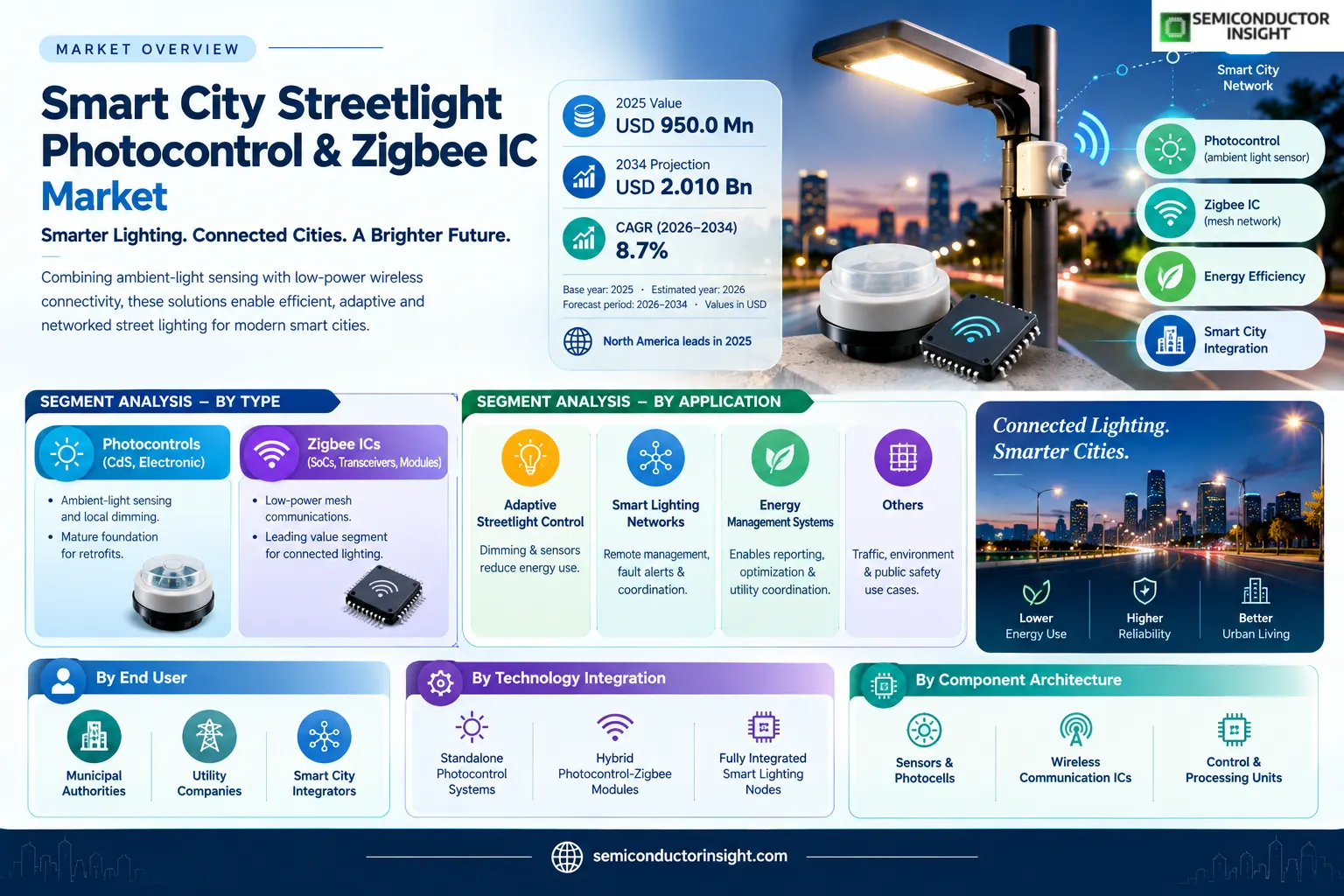
- Market size and growth: the market is valued at USD 950.0 million in 2025 and is projected to reach USD 2.010 billion by 2034, with a 8.7% CAGR over 2026–2034.
- Zigbee ICs leads by type because mesh connectivity enables remote control, fault detection and scalable citywide lighting management.
- Smart Lighting Networks is the principal application because cities increasingly manage public lighting as a connected infrastructure platform rather than isolated luminaires.
- North America is the largest regional market, while Asia Pacific has the strongest incremental growth profile.
- Primary driver: municipal LED modernization and IoT-enabled asset management are expanding demand for networked streetlight controls
- Principal restraint: interoperability, cybersecurity and upfront installation cost can slow citywide deployment
Market Overview
The smart city streetlight photocontrol and Zigbee IC market was valued at USD 950.0 million in 2025 and is projected to reach USD 2.010 billion by 2034, expanding at a 8.7% CAGR over 2026–2034. North America leads in 2025, while market structure is being reshaped by LED retrofits, RF mesh networking, remote asset management and integration with urban IoT platforms..
Smart streetlight photocontrol and Zigbee IC solutions combine ambient-light sensing with low-power wireless communications so public lighting can switch, dim, report faults and participate in citywide control systems. Photocontrols provide local dusk-to-dawn behavior, while Zigbee-class mesh SoCs and transceivers create resilient node-to-node communication. Commercial value is increasingly concentrated in integrated nodes that combine sensing, processing, secure wireless links and remote-management interfaces.
Connected lighting delivers operating benefits beyond electricity savings. Signify’s current city-lighting portfolio emphasizes remote monitoring, fault alerts, adaptive dimming and centralized asset management, while its EasyConnect architecture uses RF mesh nodes that automatically join the network. These capabilities reduce manual inspection and allow municipalities to treat every luminaire as a managed IoT asset with location, operating status and controllable light output.
Zigbee remains relevant because it is designed for low-power mesh networking and interoperable device communication. Nordic’s current Zigbee documentation supports new development on R23 stacks across modern multiprotocol devices. For streetlighting, supplier selection increasingly depends on outdoor RF performance, secure firmware updates, commissioning speed, interoperability and long-term software support rather than radio hardware cost alone.
Segment Analysis: By Type
By type, the market is segmented into Photocontrols (CdS, Electronic), Zigbee ICs (SoCs, Transceivers, Modules). Zigbee ICs holds the leading position.
| Type | Role | Commercial position |
|---|---|---|
| Photocontrols (CdS, Electronic) | Ambient-light sensing and local automatic switching or dimming. | Mature foundation for local control and simple retrofits. |
| Zigbee ICs (SoCs, Transceivers, Modules) | Low-power mesh communications, processing and security. | Leading value segment because connected lighting depends on remote networking. |
Commercial implications by type
The market is shifting from standalone photocells toward networked control nodes that preserve local sensing while adding bidirectional communications. Photocontrols remain important as a fail-safe layer, but Zigbee and related mesh ICs carry more software and integration value because they enable monitoring, scheduling, diagnostics and coordination with city-management platforms.
Segment Analysis: By Application
By application, the market includes Adaptive Streetlight Control, Smart Lighting Networks, Energy Management Systems, Others. Smart Lighting Networks is the largest demand pool.
| Application | Demand characteristics |
|---|---|
| Adaptive Streetlight Control | Dimming schedules and sensor inputs reduce energy consumption while maintaining required illumination. |
| Smart Lighting Networks | Largest application with remote management, outage detection and centralized coordination. |
| Energy Management Systems | Lighting data supports energy reporting, utility coordination and optimization. |
| Others | Traffic, environmental sensing and public-safety applications extend the streetlight node’s role. |
By End User
| End User | Commercial relevance |
|---|---|
| Municipal Authorities | Primary buyers of citywide lighting-control infrastructure. |
| Utility Companies | Value energy data, remote fault detection and asset management. |
| Smart City Integrators | Combine controls, sensors and urban software platforms. |
By Technology Integration
| Technology Integration | Commercial relevance |
|---|---|
| Standalone Photocontrol Systems | Local sensing with minimal networking. |
| Hybrid Photocontrol-Zigbee Modules | Local sensing plus mesh connectivity. |
| Fully Integrated Smart Lighting Nodes | Radio, sensing, control, security and platform integration in one unit. |
By Component Architecture
| Component Architecture | Commercial relevance |
|---|---|
| Sensors & Photocells | Ambient and environmental sensing. |
| Wireless Communication ICs | Mesh networking and secure connectivity. |
| Control & Processing Units | Local logic, dimming and diagnostics. |
Regional Analysis
North America leads the market because the source analysis describes North America as the leading region because of early smart-infrastructure adoption and extensive municipal lighting modernization. Asia Pacific has the strongest growth profile through large smart-city programs and urban infrastructure investment across China, India, Japan and Southeast Asia.
How does regional demand differ across this market?
North America leads on early deployment and connected-lighting software, while Asia Pacific offers the strongest expansion opportunity through rapid infrastructure investment. Europe emphasizes sustainability and interoperability. South America and the Middle East & Africa remain more project-driven, where financing, local integrators and long outdoor service life strongly affect procurement.
| Region | Position | Growth outlook | Demand profile | Supplier selection |
|---|---|---|---|---|
| North America | Largest | Strong | Connected streetlighting and smart-city infrastructure | Technology, support, lifecycle |
| Europe | Second | Moderate | Connected streetlighting and smart-city infrastructure | Compliance, efficiency, reliability |
| Asia Pacific | Third | Fastest | Connected streetlighting and smart-city infrastructure | Cost, scale, local supply |
| South America | Smaller | Moderate | Connected streetlighting and smart-city infrastructure | Cost and availability |
| Middle East & Africa | Emerging | Moderate | Connected streetlighting and smart-city infrastructure | Ruggedness, service, availability |
Competitive Landscape
Competition spans wireless semiconductor vendors, connected-lighting manufacturers and smart-city platform providers, with integration capability increasingly more important than component price alone.
Texas Instruments, Silicon Labs, NXP and Nordic supply low-power wireless and embedded-control silicon, while Signify and specialist lighting companies deliver complete nodes, luminaires and management systems.
Installation workflow is becoming a differentiator. Signify’s current EasyConnect architecture uses RF mesh and automatic asset discovery, reducing manual commissioning effort and making large retrofit projects easier to scale.
Municipal buyers also evaluate cybersecurity, open interfaces and multi-vendor compatibility. Suppliers that preserve reliable local control while integrating secure remote management are better positioned for decade-long infrastructure contracts.
| Competitive tier | Representative participants | Competitive focus |
|---|---|---|
| Wireless semiconductor vendors | Texas Instruments, Silicon Labs, NXP, Nordic | Zigbee/802.15.4 SoCs and embedded control |
| Connected-lighting leaders | Signify, Acuity Brands, Eaton, Current | Luminaires, nodes and city platforms |
| Smart-lighting specialists | Telensa, Ubicquia, FLASHNET, Tvilight | Municipal networking and analytics |
Companies Profiled
Texas Instruments, Silicon Labs, NXP Semiconductors, Nordic Semiconductor, Signify, Acuity Brands, Eaton, Current, Telensa, Ubicquia
Production Capacity Analysis
Supply depends on wireless SoCs, light sensors, power electronics, outdoor enclosures, certified firmware and the field capacity needed to commission large municipal networks.
Semiconductor capacity is shared with broader IoT product lines, so availability depends on mature-node radio and MCU production rather than a dedicated streetlighting process. Outdoor nodes add surge protection, power conversion and environmental sealing that can become bottlenecks during large rollouts.
Deployment capacity also depends on integrators. A citywide project requires network design, asset mapping, commissioning and software configuration. Automated commissioning and self-forming mesh networks can therefore expand practical deployment capacity even when the underlying hardware supply is unchanged.
Market Dynamics
The market is moving from isolated dusk-to-dawn control toward software-managed urban lighting networks that support additional sensors and data services.
The strongest business case combines energy savings with lower maintenance and better operational visibility. Cities increasingly expect systems to remain useful for a decade or more, which raises the value of open interfaces, firmware support and cybersecurity. Hardware suppliers are consequently moving toward recurring software, analytics and service revenue alongside node shipments.
Market Drivers
Drivers Impact Analysis
| Driver | Impact | Commercial mechanism |
|---|---|---|
| Smart-city investment | High | Cities are using connected lighting as a practical foundation for broader smart infrastructure. |
| LED retrofits | High | Control upgrades often occur when legacy luminaires are replaced. |
| Energy and maintenance savings | High | Adaptive dimming and remote fault detection reduce operating cost. |
| Low-power mesh networking | Medium | Mesh radios enable dense local networks without a cellular subscription per light. |
Smart-city investment
Cities are using connected lighting as a practical foundation for broader smart infrastructure.
LED retrofits
Control upgrades often occur when legacy luminaires are replaced.
Energy and maintenance savings
Adaptive dimming and remote fault detection reduce operating cost.
Low-power mesh networking
Mesh radios enable dense local networks without a cellular subscription per light.
Market Restraints
Restraints Impact Analysis
| Restraint | Impact | Commercial mechanism |
|---|---|---|
| Upfront project cost | High | Nodes, software and installation require significant initial budgets. |
| Protocol fragmentation | High | Mesh, cellular and LPWAN choices complicate long-term architecture decisions. |
| Cybersecurity | Medium | Connected public infrastructure requires strong authentication and update controls. |
| Maintenance skills | Medium | Large fleets require trained operations staff or service partners. |
Upfront project cost
Nodes, software and installation require significant initial budgets.
Protocol fragmentation
Mesh, cellular and LPWAN choices complicate long-term architecture decisions.
Cybersecurity
Connected public infrastructure requires strong authentication and update controls.
Maintenance skills
Large fleets require trained operations staff or service partners.
Market Opportunities
Adaptive lighting
Traffic, weather and occupancy data can dynamically change brightness.
Streetlight sensor platforms
Poles can host environmental, traffic and public-safety sensors.
Automated commissioning
Self-configuring nodes reduce installation labor.
Open data integration
APIs can link lighting with transport, utilities and emergency platforms.
Supply Chain Analysis
Zigbee SoCs, MCUs, photocells, power ICs
Control boards, surge protection, enclosures
Luminaires, gateways, RF mesh
Commissioning, dashboards, maintenance analytics
Semiconductors and sensors
Wireless ICs and photocontrols provide sensing and connectivity while power electronics interface with LED drivers.
Node hardware
Outdoor controllers must tolerate surge, temperature, moisture and long service intervals.
Lighting network
Mesh topology and gateways determine coverage and resilience.
Software and services
Asset management, fault alerts and analytics increasingly determine lifecycle value.
Recent Developments
2026 — Signify EasyConnect simplifies citywide commissioning
The current platform uses RF mesh and automatic asset discovery for connected streetlights. Source
2026 — Nordic maintains current Zigbee development support
Current Zigbee R23 tooling supports low-power mesh development on Nordic devices. Source
2026 — Signify continues Interact City platform development
Interact City combines remote management, adaptive control and city-service integration. Source
Report Scope & Segmentation
| Attribute | Coverage |
|---|---|
| Market | Smart City (Streetlight) Photocontrol & Zigbee IC |
| Base Year | 2025 |
| Estimated Year | 2026 |
| Forecast Period | 2026–2034 |
| 2025 Market Size | USD 950.0 million |
| 2026 Estimated Size | USD 1.030 billion |
| 2034 Forecast Size | USD 2.010 billion |
| CAGR | 8.7% (2026–2034) |
| By Type | Photocontrols (CdS, Electronic), Zigbee ICs (SoCs, Transceivers, Modules) |
| By Application | Adaptive Streetlight Control, Smart Lighting Networks, Energy Management Systems, Others |
| By End User | Municipal Authorities, Utility Companies, Smart City Integrators |
| By Technology Integration | Standalone Photocontrol Systems, Hybrid Photocontrol-Zigbee Modules, Fully Integrated Smart Lighting Nodes |
| By Component Architecture | Sensors & Photocells, Wireless Communication ICs, Control & Processing Units |
| Regions | North America, Europe, Asia Pacific, South America, Middle East & Africa |
| Companies Profiled | Texas Instruments, Silicon Labs, NXP Semiconductors, Nordic Semiconductor, Signify, Acuity Brands, Eaton, Current, Telensa, Ubicquia |
Frequently Asked Questions
What is the smart city streetlight photocontrol and Zigbee IC market size in 2025?
The market is valued at USD 950.0 million in 2025.
What is the projected market size by 2034?
The market is projected to reach USD 2.010 billion by 2034.
What is the CAGR from 2026 to 2034?
The market is expected to expand at a 8.7% CAGR.
Which region leads the market?
North America is the largest regional market in 2025.
Which type leads the market?
Zigbee ICs is the leading type.
Which application leads demand?
Smart Lighting Networks is the leading application.
What is the primary growth driver?
municipal LED modernization and IoT-enabled asset management are expanding demand for networked streetlight controls.
What is the principal restraint?
interoperability, cybersecurity and upfront installation cost can slow citywide deployment.
Where are the strongest opportunities?
automatic commissioning, adaptive lighting, smart-city APIs and sensor-rich streetlight nodes.
Which companies are active in the market?
Texas Instruments, Silicon Labs, NXP Semiconductors, Nordic Semiconductor, Signify, Acuity Brands, Eaton, Current.
Research Sources & Evidence Base
View primary and official evidence used in this overview
- Signify: City lighting / Interact City — Connected-lighting functions and remote management.
- Signify: EasyConnect — RF mesh and automatic commissioning.
- Nordic Semiconductor: Zigbee in nRF Connect SDK — Current Zigbee mesh development support.

Get Sample Report PDF for Exclusive Insights
Report Sample Includes
- Table of Contents
- List of Tables & Figures
- Charts, Research Methodology, and more...
 Download Sample Report PDF




