SiC Transistor Market Insights
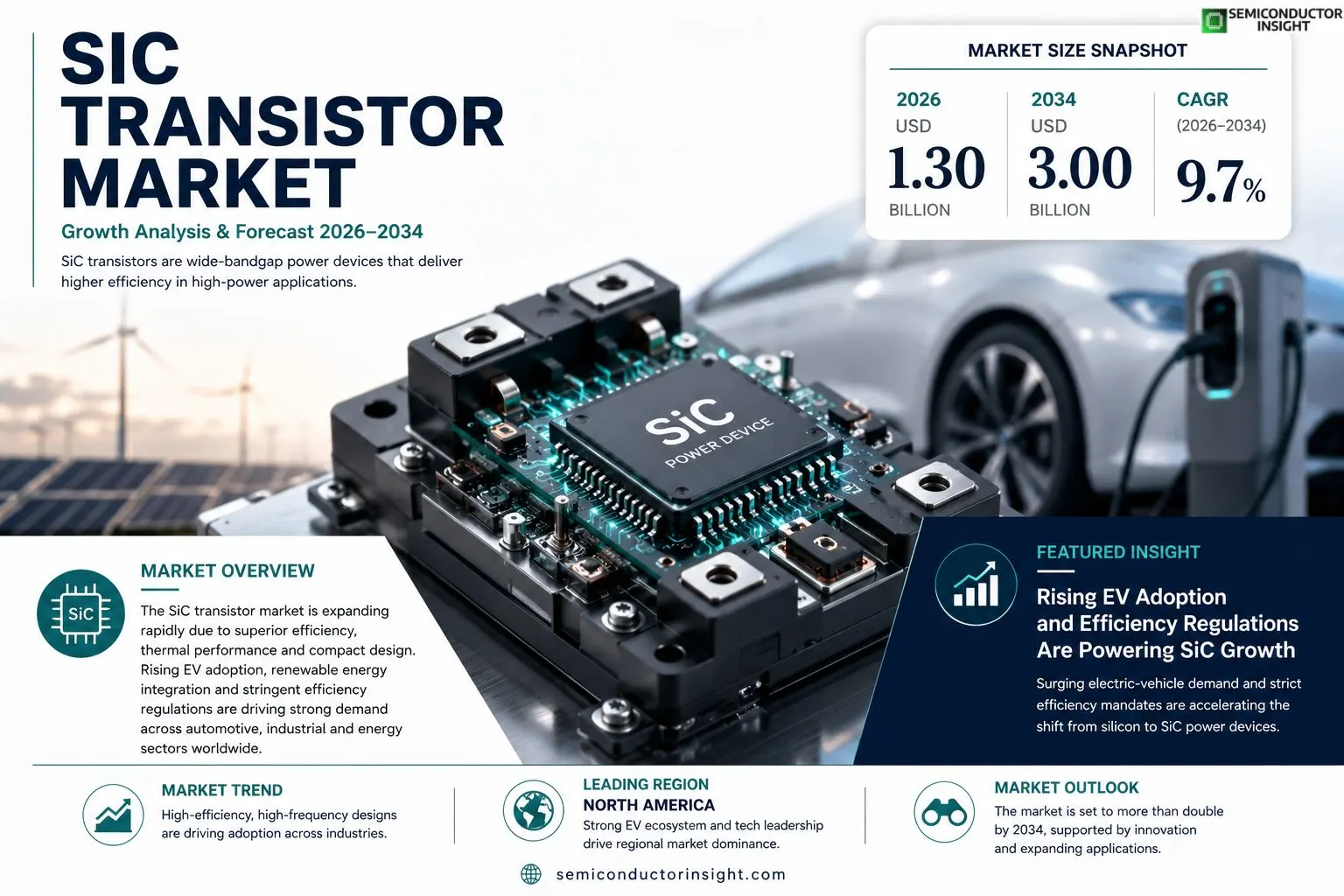
SiC transistor market size was valued at USD 1.30 billion in 2025.The market is projected to grow from USD 1.30 billion in 2025 to USD 3.00 billion by 2034, exhibiting a CAGR of 9.7% during the forecast period.
SiC transistors are wide‑bandgap power devices that leverage silicon carbide’s superior thermal conductivity and high breakdown voltage to achieve higher efficiency than conventional silicon counterparts.
They are employed in high‑power applications such as electric‑vehicle drivetrains, renewable‑energy converters, and industrial motor drives.The market is accelerating because electric‑vehicle adoption is surging worldwide and manufacturers demand lower‑loss power conversion.Furthermore, stringent energy‑efficiency regulations and declining production costs are driving broader uptake.
Key players,including Infineon Technologies, Wolfspeed (a Cree company), STMicroelectronics, and ROHM Semiconductor,are expanding capacity and launching next‑generation SiC MOSFETs and JFETs, further fueling growth.
MARKET DRIVERS
Efficiency Gains in Power Conversion
SiC Transistor Market is propelled by the superior efficiency of silicon carbide devices, which reduce conduction losses by up to 30 % compared with traditional silicon transistors. This efficiency translates into lower energy consumption for electric vehicles and data‑center power supplies, driving strong adoption across industrial and automotive sectors.
Thermal Performance and Compact Design
Silicon carbide transistors operate at higher temperatures, allowing designers to eliminate bulky heat‑sink solutions. The resulting smaller footprints enable lighter electric‑driven platforms and more flexible system layouts, which is a critical advantage for modern lightweight applications.
➤ Regulatory incentives for low‑carbon technologies are encouraging manufacturers to replace silicon power devices with SiC alternatives, accelerating market momentum.
In addition, the growing emphasis on renewable energy integration creates demand for reliable, high‑temperature power electronics, further solidifying SiC Transistor Market growth trajectory.
MARKET CHALLENGES
High Initial Cost and Capital Investment
Despite long‑term savings, the upfront price of SiC transistors remains a barrier for cost‑sensitive manufacturers. The need for specialized manufacturing equipment adds to capital expenditures, slowing penetration in price‑driven markets.
Other Challenges
Supply Chain Complexity
Limited wafer‑size options and a concentrated supplier base can lead to lead‑time variability, challenging large‑scale production planning.Furthermore, the expertise required for designing SiC‑based power circuits is still emerging, necessitating additional engineering investment and training.
MARKET RESTRAINTS
Material Availability and Manufacturing Yield
Silicon carbide wafer production is constrained by limited raw material sources, which can affect overall yield rates. Lower yields increase unit costs and may deter some OEMs from early adoption of SiC solutions.In parallel, the stringent quality standards required for high‑voltage applications add complexity to the manufacturing process, further restraining rapid market expansion.
MARKET OPPORTUNITIES
Emerging Applications in Renewable Energy Infrastructure
As the grid modernizes, SiC transistors are poised to play a pivotal role in inverters for solar and wind farms, where high efficiency and reliability are paramount. This creates a sizable opportunity for market participants to capture new revenue streams.Additionally, the acceleration of electric‑vehicle adoption in emerging economies offers a fertile landscape for SiC‑based power modules, especially in high‑performance drivetrain architectures that demand compact, thermally robust solutions.
SiC Transistor Market Trends
Rising Adoption in Electric‑Vehicle Powertrains
SiC Transistor Market is experiencing a clear upward trajectory as automotive manufacturers intensify investments in electric‑vehicle (EV) platforms. Silicon carbide devices enable higher efficiency in inverter stages, reducing thermal load and allowing greater driving range per charge. As EV sales volumes increase worldwide, system designers are replacing conventional silicon MOSFETs with SiC transistors to meet the dual goals of performance and compliance with tightening emissions standards. This shift is reinforced by the need for compact power modules that can operate at higher switching frequencies without sacrificing reliability. Consequently, the automotive segment now accounts for a substantial share of new SiC transistor deployments, shaping the market’s short‑term growth pattern.
Other Trends
Regulatory Push for Energy‑Efficiency Standards
Governments across Europe, North America, and Asia have introduced stricter energy‑efficiency regulations for industrial equipment and renewable‑energy installations. These policies directly influence SiC Transistor Market by creating demand for power converters that can achieve tighter loss margins and higher power density. Manufacturers of solar inverters and wind‑turbine drives are integrating SiC devices to meet mandated efficiency thresholds, often unlocking incentives for customers that adopt greener technologies. The regulatory environment therefore acts as a catalyst, prompting OEMs to redesign products around silicon carbide technology in order to avoid non‑compliance penalties and to benefit from potential tax credits.
Cost Reductions and Capacity Expansion
Recent advances in wafer‑scale manufacturing and supply‑chain optimization have led to noticeable cost reductions for SiC transistors, making them more competitive with traditional silicon counterparts. Leading players such as Infineon, Wolfspeed, STMicroelectronics, and ROHM Semiconductor have announced new production lines and expanded capacity to satisfy growing demand. These investments are accompanied by the launch of next‑generation MOSFET and JFET designs that offer lower on‑resistance and improved switching performance. The combined effect of lower prices and greater availability is encouraging adoption in sectors previously hesitant to switch, such as heavy‑duty industrial motors and aerospace power systems, thereby broadening the overall market base.
COMPETITIVE LANDSCAPEKey Industry Players
SiC Transistor Market Competitive Overview
SiC Transistor Market is dominated by a handful of ly integrated semiconductor firms that have leveraged extensive R&D budgets and advanced wafer‑scale manufacturing to secure leadership positions. Infineon Technologies leads the segment with a broad portfolio of SiC MOSFETs and JFETs, supported by high‑volume capacity expansions in Europe and Asia. Wolfspeed, operating under Cree, follows closely, capitalizing on its monocrystalline SiC substrate expertise to deliver ultra‑low‑loss devices for EV drivetrains and renewable‑energy converters. STMicroelectronics and ROHM Semiconductor round out the top tier, both launching third‑generation SiC power devices that combine high voltage ratings with compact footprint designs, reinforcing a market structure that favors a few large, technology‑driven incumbents.Beyond the primary tier, a diversified set of niche players contributes specialized solutions that address emerging applications and regional demand. ON Semiconductor provides cost‑effective SiC MOSFETs targeting industrial motor drives, while Mitsubishi Electric focuses on high‑power modules for railway and aerospace uses. Texas Instruments and Microchip have entered the space with SiC‑enabled driver ICs that complement discrete transistor offerings. Additional contributors include Nexperia, Sumitomo Electric, GeneSiC, United Silicon Carbide, STARK, and ABB, each leveraging unique process patents or supply‑chain partnerships to capture specific market slices such as grid‑level converters, high‑temperature automotive components, and compact power supplies.
List of Key SiC Transistor Companies Profiled
- Infineon Technologies
- Wolfspeed (Cree)
- STMicroelectronics
- ROHM Semiconductor
- ON Semiconductor
- Mitsubishi Electric
- Texas Instruments
- Microchip Technology
- Nexperia
- Sumitomo Electric
- GeneSiC
- United Silicon Carbide
- STARK
- ABB
- Rohm Semiconductor
Segment Analysis:
| Segment Category | Sub-Segments | Key Insights |
| By Type |
|
SiC MOSFETs
|
| By Application |
|
Electric‑Vehicle Powertrains
|
| By End User |
|
Automotive OEMs
|
| By Voltage Rating |
|
High Voltage
|
| By Device Architecture |
|
Planar Architecture
|
Regional Analysis: North America
United States
The automotive sector is the largest consumer of SiC transistors, driven by the need for higher efficiency and power density in electric vehicle powertrains. SiC’s ability to handle higher voltages and temperatures compared to silicon makes it ideal for inverters, on-board chargers, and motor drives. The increasing range expectations and performance demands of EVs are directly translating into greater SiC adoption.
The integration of renewable energy sources like solar and wind power necessitates robust power conversion systems. SiC transistors are playing a crucial role in enhancing the efficiency and reliability of solar inverters and wind turbine power electronics. Their ability to operate at higher frequencies leads to smaller and lighter systems, contributing to cost-effectiveness and improved performance.
Industrial applications, including motor drives, power supplies, and welding equipment, are increasingly adopting SiC transistors for their improved efficiency and reliability. The ability to operate in harsh environments and handle higher power levels makes them suitable for demanding industrial processes. The drive for energy savings and reduced carbon footprints in industrial settings is accelerating SiC adoption.
Data centers are significant consumers of power, and SiC transistors offer a compelling solution for improving power efficiency and reducing energy costs. Their high switching frequencies and low switching losses contribute to significant energy savings in power supplies and cooling systems within data centers. The increasing demand for computing power is driving the need for more efficient power infrastructure.
Europe
Europe represents a significant and growing market for SiC transistors. The region is characterized by strong government initiatives promoting renewable energy and electric mobility, coupled with a well-established automotive industry. The European Union’s ambitious climate goals are directly driving the demand for SiC in electric vehicles and power electronics. Key markets within Europe, such as Germany, France, and the UK, are witnessing substantial investments in SiC technology. The focus on energy efficiency standards and the expansion of charging infrastructure for EVs are further fueling market growth. While the automotive sector is a major driver, industrial applications and renewable energy integration are also contributing significantly to SiC adoption across the continent.
Asia-Pacific
Asia-Pacific is poised to become the largest and fastest-growing market for SiC transistors in the coming years. Driven by burgeoning EV markets in China and India, alongside rapid industrialization and increasing investments in renewable energy, the region presents a tremendous opportunity for SiC technology. China’s ambitious goals for electric vehicle adoption and its strong domestic semiconductor industry are particularly noteworthy. The region’s robust manufacturing capabilities and cost-competitive environment are also contributing to its attractiveness for SiC production. Growth in the power module segment, driven by demand from data centers and industrial applications, further underscores the potential of the Asia-Pacific market.
South America
South America is an emerging market for SiC transistors, with growth primarily driven by the expanding electric vehicle market in Brazil and the increasing adoption of renewable energy sources. The region’s growing focus on sustainable development and its commitment to reducing carbon emissions are creating favorable conditions for SiC adoption. While the market size is currently smaller compared to North America and Asia-Pacific, the long-term growth potential is significant. The increasing investment in electric bus fleets and the development of renewable energy projects are key drivers of SiC demand in the region.
Middle East & Africa
The Middle East and Africa represent a relatively nascent but promising market for SiC transistors. Driven by government initiatives to promote sustainable development and diversification of economies, the region is witnessing increasing investments in renewable energy and electric mobility. The growth of the EV market in countries like the UAE and Saudi Arabia is creating demand for SiC-based power electronics. Furthermore, the region’s abundant solar energy resources and ambitious renewable energy targets are poised to drive significant SiC adoption in solar inverters and power conversion systems. While the market is still developing, it offers substantial long-term growth potential.
Report Scope
This market research report provides a comprehensive analysis of the SiC Transistor Market , covering the forecast period 2026–2034. It offers detailed insights into market dynamics, technological advancements, competitive landscape, and key trends shaping the industry.
Key focus areas of the report include:
- Market Overview: The report begins with an overview outlining its current market scenario, key growth indicators, and industry transformation drivers. It discusses macroeconomic factors, demand–supply balance, regulatory landscape, and the strategic role of semiconductors in powering advancements across industries such as automotive, telecommunications, consumer electronics, and industrial automation.
- Market Size & Forecast: Historical data and future projections for revenue, unit shipments, and market value across major regions and segments.
- Segmentation Analysis: Detailed breakdown by product type, technology, application, and end-user industry to identify high-growth segments and investment opportunities.
- Regional Insights: Insights into market performance across North America, Europe, Asia-Pacific, Latin America, and the Middle East & Africa, including country-level analysis where relevant.
- Competitive Landscape: Profiles of leading market participants, including their product offerings, R&D focus, manufacturing capacity, pricing strategies, and recent developments such as mergers, acquisitions, and partnerships.
- Technology Trends & Innovation: Assessment of emerging technologies, integration of AI/IoT, semiconductor design trends, fabrication techniques, and evolving industry standards.
- Market Drivers & Restraints: Evaluation of factors driving market growth along with challenges, supply chain constraints, regulatory issues, and market-entry barriers.
- Stakeholder Insights: Insights for component suppliers, OEMs, system integrators, investors, and policymakers regarding the evolving ecosystem and strategic opportunities.
Primary and secondary research methods are employed, including interviews with industry experts, data from verified sources, and real-time market intelligence to ensure the accuracy and reliability of the insights presented.
FREQUENTLY ASKED QUESTIONS:
What is the current market size of SiC Transistor Market?
-> SiC Transistor Market was valued at USD 1.30 billion in 2025 and is expected to reach USD 3.00 billion by 2034.
Which key companies operate in SiC Transistor Market?
-> Key players include Infineon Technologies, Wolfspeed (a Cree company), STMicroelectronics, and ROHM Semiconductor, among others.
What are the key growth drivers?
-> Key growth drivers include surging electric‑vehicle adoption, demand for lower‑loss power conversion, stringent energy‑efficiency regulations, and declining production costs.
Which region dominates the market?
-> The provided reference does not specify a dominant region for SiC Transistor Market.
What are the emerging trends?
-> Emerging trends are not detailed in the supplied information.

Get Sample Report PDF for Exclusive Insights
Report Sample Includes
- Table of Contents
- List of Tables & Figures
- Charts, Research Methodology, and more...
 Download Sample Report PDF