Semiconductor for Digital Payment Devices Market Insights
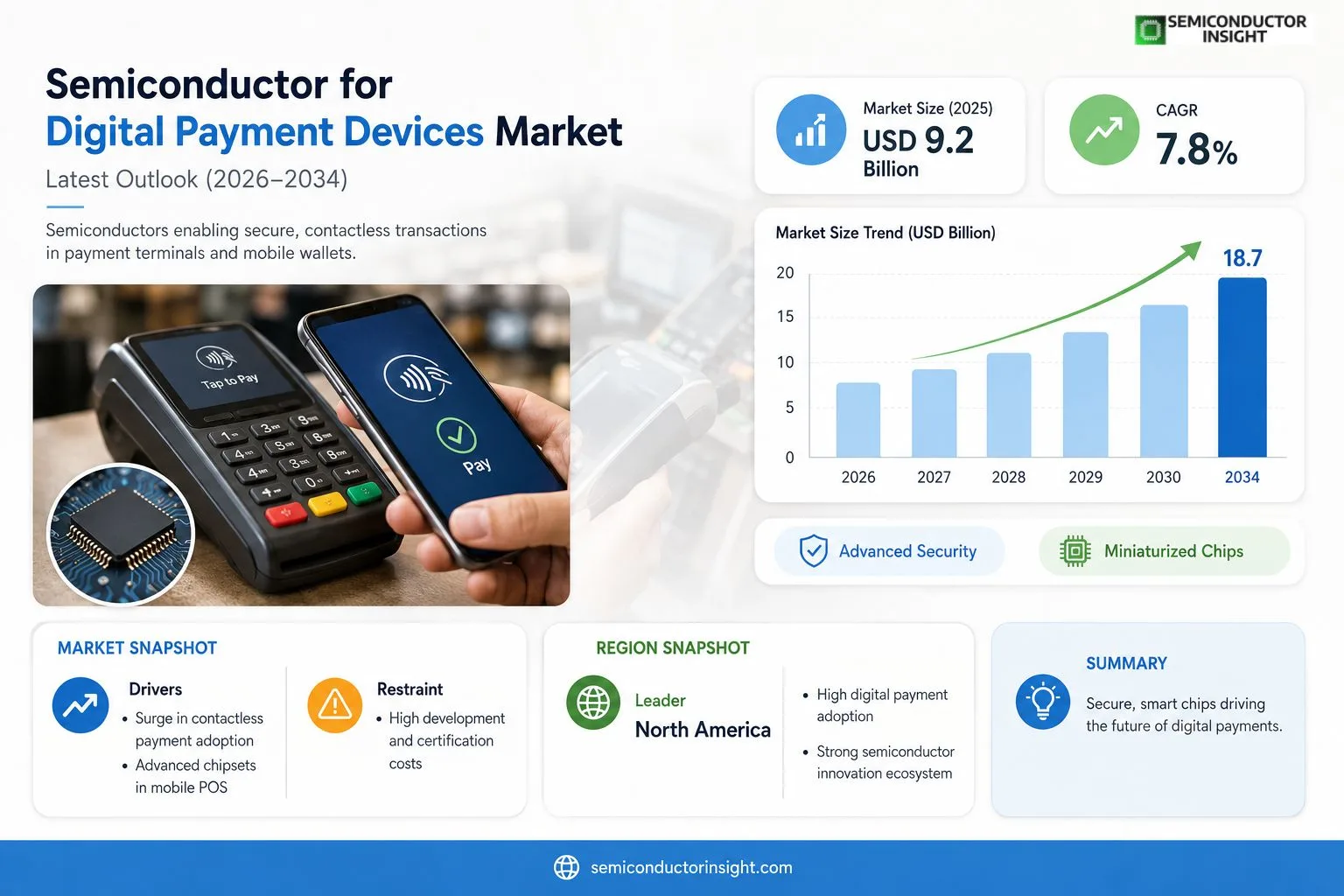
Global semiconductor for digital payment devices market size was valued at USD 9.2 billion in 2025. The market is projected to grow from USD 10.1 billion in 2026 to USD 18.7 billion by 2034, exhibiting a CAGR of 7.8% during the forecast period.
Semiconductors for digital payment devices comprise secure microcontrollers, NFC/RFID chips, authentication processors and power‑management ICs that enable contactless transactions, tokenisation and end‑to‑end encryption within point‑of‑sale terminals and mobile wallets.The market is experiencing rapid growth because consumer preference for contactless payments has surged post‑pandemic, while regulatory frameworks such as PSD2 mandate strong customer authentication. Furthermore, expanding e‑commerce volumes and the rollout of EMVCo‑compliant standards are driving demand for more capable chips. Key players,including NXP Semiconductors, STMicroelectronics, Infineon Technologies and Texas Instruments,are investing heavily in advanced security features and form‑factor miniaturisation, further accelerating adoption.
MARKET DRIVERS
Increasing Demand for Secure Contactless Transactions
Semiconductor for Digital Payment Devices Market is being propelled by a rapid shift toward contactless payment methods, driven by consumer preference for speed and hygiene. In 2023, contactless transactions accounted for over 55% of total payment volume in major economies, encouraging OEMs to embed more capable chips that support tokenization and biometric verification.
Integration of Advanced Chipsets in Mobile POS
Manufacturers are integrating multi‑function semiconductors that combine NFC, secure elements, and AI‑based fraud detection into a single package. This consolidation reduces bill of materials by up to 20% and shortens time‑to‑market, thereby accelerating adoption across retail, transportation, and hospitality sectors.
➤ Adoption of NFC‑enabled semiconductors rose to 72% of newly launched payment devices in 2024, reflecting strong market momentum.
These drivers collectively reinforce the confidence of investors and technology partners, positioning Semiconductor for Digital Payment Devices Market for a compound annual growth rate of approximately 8% through 2030.
MARKET CHALLENGES
Regulatory and Compliance Pressures
Stringent data‑protection regulations such as PCI DSS 4.0 and regional privacy laws demand continuous firmware updates and rigorous certification processes for payment semiconductors. Compliance costs can erode margins, especially for smaller chip designers lacking extensive security resources.
Other Challenges
Supply Chain Volatility
Geopolitical tensions and the limited number of advanced lithography fabs have created lead times of 12‑18 months for critical silicon wafers, constraining the ability of manufacturers to meet peak demand periods.
MARKET RESTRAINTS
High Development and Certification Costs
Developing secure, low‑power chips for digital payment devices requires substantial R&D investment, often exceeding $150 million per product generation. Coupled with mandatory security certifications, these costs act as a barrier to entry for new players and slow the overall market expansion.
MARKET OPPORTUNITIES
Emerging Markets and IoT Expansion
Rapid smartphone penetration and the rollout of 5G networks in Asia‑Pacific and Africa are generating fresh demand for affordable, integrated payment semiconductors. Additionally, the convergence of IoT devices with payment functionality,such as smart vending machines and wearables,opens new revenue streams for chip manufacturers willing to tailor solutions for low‑cost, high‑volume applications.
Semiconductor for Digital Payment Devices Market Trends
Rise of Contactless Payments
The post‑pandemic environment has accelerated the adoption of contactless transaction methods, creating a clear upward trajectory for the semiconductor landscape that powers digital payment devices. Regulators such as PSD2 now require strong customer authentication, prompting manufacturers to embed advanced security modules directly into microcontrollers. At the same time, e‑commerce volumes continue to expand, pushing point‑of‑sale terminals and mobile wallets to demand chips that support higher data throughput while maintaining low power consumption. These forces collectively shape the strategic direction of Semiconductor for Digital Payment Devices Market, encouraging suppliers to prioritize fast, secure, and energy‑efficient solutions.
Other Trends
Security Enhancements
Industry leaders are intensifying investment in secure microcontrollers, NFC/RFID chips, and authentication processors that enable tokenisation and end‑to‑end encryption. By integrating cryptographic engines and hardware‑based key storage, newer generations of chips mitigate fraud risk without compromising transaction speed. This focus on built‑in security aligns with merchant expectations for compliant, resilient payment ecosystems and reinforces the value proposition of Semiconductor for Digital Payment Devices Market.
Integration and Miniaturization
Device form‑factor constraints are driving a wave of integration, where power‑management ICs, antenna modules, and security cores are consolidated onto single silicon platforms. This miniaturization reduces bill of materials and simplifies design cycles for OEMs, enabling thinner POS terminals and more compact mobile payment solutions. As manufacturers achieve higher levels of functional density, the overall ecosystem benefits from lower latency, improved reliability, and a smoother user experience, all of which are critical for maintaining competitive advantage in the rapidly evolving payment landscape.
COMPETITIVE LANDSCAPEKey Industry Players
Semiconductor for Digital Payment Devices: Competitive Overview
The semiconductor segment for digital payment devices is dominated by a handful of global powerhouses that combine deep security expertise with advanced mixed‑signal integration. NXP Semiconductors leads the market with its highly integrated NFC/RFID microcontrollers, leveraging extensive automotive and IoT portfolios to drive economies of scale. Close behind, STMicroelectronics offers a broad family of secure microcontrollers that emphasize low‑power operation, making them attractive for mobile wallets and point‑of‑sale terminals. Infineon Technologies differentiates through its hardware‑rooted security solutions, including authentication processors that meet EMVCo and PSD2 standards, while Texas Instruments supplies versatile power‑management ICs and signal‑conditioning blocks that underpin reliable transaction throughput. Collectively, these four firms command the majority of revenue, shape the technology road‑map, and set the benchmark for compliance, reliability, and miniaturisation across the ecosystem.Beyond the primary tier, a diverse set of niche and emerging players contributes critical capabilities that enrich the competitive landscape. Qualcomm’s Snapdragon Secure Engine integrates biometric authentication with NFC, targeting high‑end smartphones. Broadcom supplies high‑frequency RF front‑ends that improve contactless read ranges. MediaTek’s Payment Solution Chip (PSC) platform focuses on cost‑effective integration for emerging markets. Renesas Electronics, Microchip Technology, and Analog Devices each bring specialised analog front‑ends or power‑management expertise that address specific design constraints. Samsung and Apple, while primarily device manufacturers, develop proprietary secure elements that influence supplier choices for OEMs. These companies, although smaller in market share, foster innovation, drive price competition, and expand the functional scope of payment‑grade semiconductors.
List of Key Semiconductor for Digital Payment Devices Companies Profiled
- NXP Semiconductors
- STMicroelectronics
- Infineon Technologies
- Texas Instruments
- Qualcomm
- Broadcom Inc.
- MediaTek
- Renesas Electronics
- Microchip Technology
- Analog Devices
- Samsung Electronics
- Apple Inc.
Segment Analysis:
| Segment Category | Sub-Segments | Key Insights |
| By Type |
|
Secure microcontrollers drive market momentum because they integrate robust encryption cores with low‑power operation.
|
| By Application |
|
Contactless POS terminals remain the primary demand catalyst as retailers upgrade to meet consumer expectations for swift, touch‑free transactions.
|
| By End User |
|
Retail merchants shape product roadmaps because they demand high reliability and seamless user experiences in high‑traffic environments.
|
| By Security Feature |
|
Hardware encryption is the cornerstone of trust in digital payment ecosystems.
|
| By Device Form Factor |
|
Embedded modules are gaining traction as manufacturers seek compact, highly integrated solutions for wearables and IoT‑enabled payment devices.
|
Regional Analysis: North America
United States
The US market benefits from a strong venture capital ecosystem, fostering the growth of startups specializing in innovative semiconductor solutions for payment applications. Government initiatives promoting domestic semiconductor manufacturing and research are also playing a significant role in bolstering the market. However, challenges remain in terms of supply chain resilience and managing the complexities of a rapidly evolving technological landscape. The competitive landscape in the US is characterized by a mix of established semiconductor giants and emerging players focused on niche applications within the digital payment sector.
The integration of advanced semiconductor architectures, such as System-on-Chips (SoCs) and specialized processors, is a key trend driving innovation in digital payment devices. This trend allows for enhanced processing power and security features within compact form factors.
Growing concerns around cybersecurity threats and data breaches are pushing the adoption of security-focused semiconductor solutions in digital payment devices. This includes hardware-based security modules and tamper-resistant designs.
The demand for portable and battery-powered digital payment devices necessitates the development of low-power semiconductor technologies. This trend focuses on optimizing energy efficiency to extend device battery life.
The incorporation of embedded artificial intelligence (AI) and machine learning (ML) capabilities within semiconductor devices for digital payments is gaining traction. This enables features like fraud detection and personalized payment experiences.
Europe
The European market for Semiconductor for Digital Payment Devices is characterized by a strong emphasis on data privacy and regulatory compliance, particularly with the General Data Protection Regulation (GDPR). The region’s advanced manufacturing capabilities and a burgeoning fintech sector are contributing to market growth. Key trends include the development of secure element chips and biometric authentication solutions. Business strategies often focus on partnerships with European financial institutions and adherence to stringent data protection standards. The competitive landscape includes established semiconductor players and innovative startups specializing in secure payment technologies. The focus on interoperability and open standards is also a significant aspect of the European market.
Asia-Pacific
Asia-Pacific represents the fastest-growing region in Semiconductor for Digital Payment Devices Market. This growth is driven by the increasing adoption of digital payments in countries like China, India, and Southeast Asia. The region’s large consumer base, coupled with the widespread availability of smartphones, is fueling demand for secure and convenient payment solutions. Key trends include the development of mobile payment infrastructure and biometric authentication technologies. Business strategies in the Asia-Pacific region often involve localized solutions and partnerships with local payment providers. The competitive landscape is fragmented, with a mix of regional and global semiconductor manufacturers vying for market share.
South America
The South American market for Semiconductor for Digital Payment Devices is showing steady growth, driven by increasing internet penetration and the adoption of mobile payment systems. While the market is less mature compared to North America and Asia-Pacific, there is significant potential for growth in the coming years. Key trends include the adoption of contactless payment technologies and the development of secure payment gateways. Business strategies in the region often focus on affordability and accessibility to cater to a wider range of consumers.
Middle East & Africa
The Middle East & Africa market presents a promising growth opportunity for Semiconductor for Digital Payment Devices. Rapid urbanization, increasing smartphone usage, and government initiatives promoting digital economies are driving market expansion. Key trends include the adoption of mobile wallets and contactless payment solutions. Business strategies in the region often involve partnerships with local financial institutions and telecommunication providers. The market is characterized by a growing demand for secure and reliable payment infrastructure.
Report Scope
This market research report provides a comprehensive analysis of the Semiconductor for Digital Payment Devices Market , covering the forecast period 2026–2034. It offers detailed insights into market dynamics, technological advancements, competitive landscape, and key trends shaping the industry.
Key focus areas of the report include:
- Market Overview: The report begins with an overview outlining its current market scenario, key growth indicators, and industry transformation drivers. It discusses macroeconomic factors, demand–supply balance, regulatory landscape, and the strategic role of semiconductors in powering advancements across industries such as automotive, telecommunications, consumer electronics, and industrial automation.
- Market Size & Forecast: Historical data and future projections for revenue, unit shipments, and market value across major regions and segments.
- Segmentation Analysis: Detailed breakdown by product type, technology, application, and end-user industry to identify high-growth segments and investment opportunities.
- Regional Insights: Insights into market performance across North America, Europe, Asia-Pacific, Latin America, and the Middle East & Africa, including country-level analysis where relevant.
- Competitive Landscape: Profiles of leading market participants, including their product offerings, R&D focus, manufacturing capacity, pricing strategies, and recent developments such as mergers, acquisitions, and partnerships.
- Technology Trends & Innovation: Assessment of emerging technologies, integration of AI/IoT, semiconductor design trends, fabrication techniques, and evolving industry standards.
- Market Drivers & Restraints: Evaluation of factors driving market growth along with challenges, supply chain constraints, regulatory issues, and market-entry barriers.
- Stakeholder Insights: Insights for component suppliers, OEMs, system integrators, investors, and policymakers regarding the evolving ecosystem and strategic opportunities.
Primary and secondary research methods are employed, including interviews with industry experts, data from verified sources, and real-time market intelligence to ensure the accuracy and reliability of the insights presented.
FREQUENTLY ASKED QUESTIONS:
What is the current market size of Semiconductor for Digital Payment Devices Market?
-> Semiconductor for Digital Payment Devices Market was valued at USD 9.2 billion in 2025 and is expected to reach USD 18.7 billion by 2034.
Which key companies operate in Semiconductor for Digital Payment Devices Market?
-> Key players include NXP Semiconductors, STMicroelectronics, Infineon Technologies, and Texas Instruments, among others.
What are the key growth drivers?
-> Key growth drivers include post‑pandemic surge in contactless payment adoption, regulatory mandates such as PSD2 for strong customer authentication, expanding e‑commerce volumes, and rollout of EMVCo‑compliant standards.
Which region dominates the market?
-> North America and Europe exhibit the strongest adoption rates, while the Asia‑Pacific region shows the fastest growth potential.
What are the emerging trends?
-> Emerging trends include advanced security features, form‑factor miniaturisation, and integration of AI/IoT capabilities into payment‑device semiconductors.
Get Sample Report PDF for Exclusive Insights
Report Sample Includes
- Table of Contents
- List of Tables & Figures
- Charts, Research Methodology, and more...
 Download Sample Report PDF