MARKET INSIGHTS
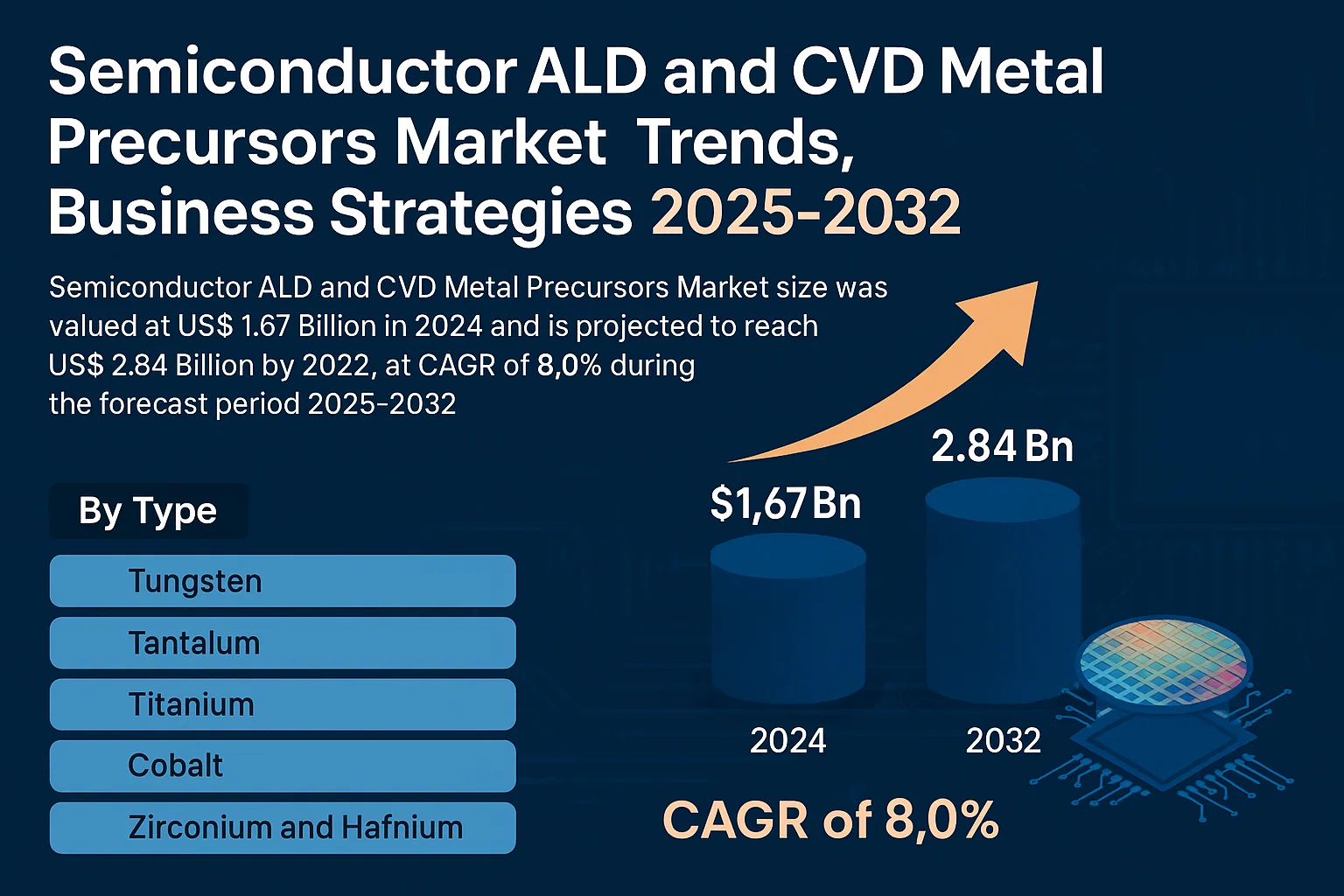
The global Semiconductor ALD and CVD Metal Precursors Market size was valued at US$ 1.67 billion in 2024 and is projected to reach US$ 2.84 billion by 2032, at a CAGR of 8.0% during the forecast period 2025-2032. This growth is closely tied to the broader semiconductor industry, which was valued at USD 579 billion in 2022 and is expected to reach USD 790 billion by 2029 at a 6% CAGR.
Semiconductor ALD (Atomic Layer Deposition) and CVD (Chemical Vapor Deposition) metal precursors are specialized chemical compounds used to deposit thin, uniform metal films in semiconductor fabrication. These precursors enable precise control over film thickness at the atomic level, with common materials including tungsten, tantalum, titanium, cobalt, and aluminum. The technology is critical for manufacturing advanced logic chips, memory devices, and emerging applications like 3D NAND and DRAM.
The market is being driven by multiple factors, including the increasing complexity of semiconductor nodes (particularly below 7nm), growing demand for advanced packaging technologies, and rising investments in foundry capacity expansion. While the memory segment showed a 12.8% decline in 2022, logic and analog segments grew by 14.46% and 20.76% respectively, creating diverse demand patterns. Major players like SK Materials, Merck Group, and Air Liquide are investing heavily in developing next-generation precursors to meet the industry’s evolving requirements for higher purity and thermal stability.
MARKET DYNAMICS
MARKET DRIVERS
Advancements in Semiconductor Fabrication Technologies Fueling Demand for ALD/CVD Precursors
The semiconductor industry’s relentless pursuit of smaller node sizes and 3D architectures is driving unprecedented demand for atomic layer deposition (ALD) and chemical vapor deposition (CVD) metal precursors. As transistor architectures shrink below 7nm, conventional deposition techniques reach their physical limits, making ALD indispensable for achieving angstrom-level thickness control. The global semiconductor fabrication market is projected to require over 40 million wafer starts per month by 2025, creating substantial demand for high-purity precursors. Leading foundries now incorporate ALD in over 25% of all deposition steps, compared to less than 10% five years ago, reflecting the technology’s growing importance in advanced chip manufacturing.
Expansion of Memory and Logic Chip Production Accelerating Market Growth
The rapid expansion of memory technologies, particularly 3D NAND and DRAM, represents another significant growth driver for ALD/CVD precursors. Modern 3D NAND stacks now exceed 200 layers, requiring precise deposition of tungsten, tantalum and titanium-based precursors for wordline and bitline formations. In logic chips, the transition to gate-all-around (GAA) transistors at 3nm nodes and below demands complex precursor chemistries for work function metals and barrier layers. Memory manufacturers collectively invested over $35 billion in fab expansions in 2023 alone, with particular emphasis on ALD-enabled processes that can maintain uniformity across increasingly tall stack architectures.
Growing Adoption of Advanced Packaging Solutions Creating New Demand
Advanced packaging technologies like 2.5D/3D IC integration and fan-out wafer-level packaging are emerging as crucial applications for CVD and ALD precursors. Through-silicon vias (TSVs), micro-bumps and redistribution layers all require specialized metal precursors for conformal coating. The advanced packaging market is growing at approximately 8% annually, driven by heterogeneous integration needs in AI processors and high-performance computing applications. New hybrid bonding techniques that eliminate solder bumps entirely are particularly precursor-intensive, often requiring multiple ALD steps for optimal interface formation and reliability.
MARKET RESTRAINTS
High Production Costs and Limited Precursor Supply Chain Capacity
While the market shows strong growth potential, it faces significant restraints from the high costs and supply chain complexities associated with metal precursors. Producing semiconductor-grade precursors requires specialized facilities and rigorous purification processes, with lead times for certain high-purity compounds exceeding six months. The global supply deficit for cobalt precursors has been particularly acute, with prices increasing by over 30% since 2022 due to both manufacturing challenges and raw material shortages. These cost pressures are especially problematic for smaller semiconductor manufacturers that lack the purchasing power of industry giants.
Technical Challenges in Precursor Development for Advanced Nodes
Developing precursors that meet the exacting requirements of sub-5nm nodes presents multiple technical hurdles. New materials must demonstrate exceptional thermal stability, low impurity levels, and precisely controlled deposition rates – often with vapor pressures in very specific ranges. The transition to ruthenium and molybdenum for interconnect applications has proven particularly challenging, with many precursors failing to meet yield and reliability targets. These development difficulties contribute to extended qualification cycles, with new precursor formulations typically requiring 18-24 months for full production approval from major foundries.
Regulatory and Environmental Constraints on Precursor Usage
Increasing environmental regulations are impacting the precursor market, particularly for compounds containing hazardous elements. Many jurisdictions are implementing stricter controls on per- and polyfluoroalkyl substances (PFAS) used in precursor formulations, while safety regulations governing pyrophoric materials continue to tighten. These regulatory pressures have already forced reformulation of several tungsten and titanium precursors, with compliance costs estimated to add 15-20% to development budgets. The industry also faces growing stakeholder scrutiny regarding responsible sourcing of rare metals, further complicating supply chain management.
MARKET CHALLENGES
Materials Innovation Race Creates Development Bottlenecks
The semiconductor industry’s accelerating materials roadmap creates significant challenges for precursor suppliers. As device architectures evolve, manufacturers demand precursors for entirely new material systems – often with unrealistic development timelines. The recent push for ferroelectric memories required development of specialized hafnium zirconium oxide precursors in less than two years. Such compressed development cycles strain R&D resources and frequently result in suboptimal precursor performance that impacts device yields. Approximately 40% of new precursor formulations fail to meet initial performance specifications, requiring multiple revision cycles before achieving production readiness.
Trade Restrictions and Geopolitical Factors Disrupt Supply Chains
Geopolitical tensions and trade restrictions are creating uncertainty in the global precursor supply chain. Export controls on certain specialty chemicals, particularly those with potential dual-use applications, have disrupted established procurement patterns. Several rare earth elements essential for advanced precursors now face allocation systems, with lead times for some materials exceeding one year. These disruptions are forcing manufacturers to evaluate costly dual-sourcing strategies and inventory buildups that negatively impact working capital requirements.
Precursor Compatibility Issues with Next-Generation Tools
The transition to next-generation deposition tools presents unforeseen precursor compatibility challenges. New high-productivity ALD systems often require reformulated precursors to maintain deposition uniformity across larger chamber volumes. Similarly, thermal budget constraints at advanced nodes demand precursors with lower decomposition temperatures, while maintaining sufficient reactivity. These tool-specific requirements force precursor suppliers to maintain multiple product variants, increasing complexity in both manufacturing and logistics operations.
MARKET OPPORTUNITIES
Emerging Applications in Power and Compound Semiconductors
The expanding markets for power devices and compound semiconductors represent significant opportunities for precursor suppliers. Wide bandgap materials like gallium nitride and silicon carbide require specialized metal-organic precursors for ohmic contacts and gate dielectrics. The power semiconductor market, projected to exceed $20 billion by 2027, is driving demand for novel aluminum and titanium-based formulations. Similarly, the photonics and RF semiconductor sectors are adopting ALD for precise interface engineering, creating new applications for zirconium and hafnium precursors.
Sustainable Precursor Development for Green Semiconductor Manufacturing
Environmental sustainability initiatives present opportunities for innovative precursor solutions. There is growing interest in halogen-free and PFAS-free precursors that can maintain performance while reducing environmental impact. Several leading manufacturers have committed to reducing perfluorocarbon emissions from deposition processes by 2030, creating demand for reformulated products. These sustainability-driven opportunities are particularly significant in Europe and North America, where environmental regulations are most stringent and customers demonstrate willingness to pay premium prices for green alternatives.
Digitalization and AI-Enabled Precursor Development
Advancements in computational chemistry and artificial intelligence are creating opportunities to transform precursor development. Machine learning models can now predict precursor decomposition pathways and deposition characteristics with increasing accuracy, potentially reducing development cycles by 30-40%. Digital twin simulations of deposition processes enable virtual precursor screening before costly physical experiments. Early adopters of these digital tools report significantly improved success rates in first-pass precursor formulations, with potential to accelerate time-to-market for new materials by 12-18 months.
SEMICONDUCTOR ALD AND CVD METAL PRECURSORS MARKET TRENDS
Advanced Node Semiconductor Fabrication Driving Demand for Precise Precursors
The continuous miniaturization of semiconductor nodes, particularly below 7nm, is significantly increasing the demand for ultra-high purity ALD (Atomic Layer Deposition) and CVD (Chemical Vapor Deposition) metal precursors. Leading foundries require precursors with sub-angstrom level precision to deposit uniform thin films in complex 3D structures like FinFETs and GAA (Gate-All-Around) transistors. Tungsten and cobalt precursors currently dominate this segment, accounting for over 45% of total metal precursor consumption in advanced logic fabrication. Recent advancements in precursor chemistry have enabled better step coverage and reduced impurity levels below 0.1 ppb, which is critical for maintaining yield rates above 95% in cutting-edge fabs.
Other Trends
Transition to 3D NAND and DRAM Scaling
The memory sector is witnessing accelerated adoption of ALD metal precursors as manufacturers transition to higher layer counts in 3D NAND (exceeding 200 layers) and pursue sub-10nm DRAM nodes. Tantalum and titanium precursors are seeing particularly strong demand for barrier/liner applications in vertical memory structures, with the segment projected to grow at 12% CAGR through 2030. Equipment manufacturers report precursor consumption per wafer has increased 3-4x compared to planar NAND architectures, creating new opportunities for material suppliers.
Packaging Innovations Fueling Alternative Precursor Development
Advanced packaging technologies like chiplet integration and 3D IC stacking are driving innovation in low-temperature deposition precursors. The need for thermally-sensitive interconnects in heterogeneous integration has spurred development of novel ruthenium and molybdenum precursors that can deposit high-quality films below 200°C. Major OSATs (Outsourced Semiconductor Assembly and Test providers) are collaborating with material companies to qualify these solutions, with prototype volumes expected to ramp in 2025. Simultaneously, the push for copper pillar and micro-bump applications in packaging is renewing interest in specialized copper precursors with enhanced nucleation characteristics.
COMPETITIVE LANDSCAPE
Key Industry Players
Global Suppliers Diversify Portfolios Amid Rising Semiconductor Demand
The Semiconductor ALD and CVD Metal Precursors market features a mix of multinational chemical suppliers and specialized semiconductor material manufacturers competing to meet the demands of advanced node fabrication. Merck Group is a dominant force in this space, leveraging its extensive materials science expertise and strategic acquisitions to supply high-purity precursors for both ALD and CVD processes.
SK Materials and UP Chemical (Yoke Technology) have emerged as key Asian players, capitalizing on their proximity to major semiconductor fabs in South Korea and Taiwan. The companies’ growth is fueled by their ability to develop proprietary precursor formulations that meet the exacting purity standards required for sub-10nm processes.
Industry leaders are aggressively expanding production capacity through joint ventures and new facilities. For example, Air Liquide recently opened a state-of-the-art precursor plant in South Korea to support the country’s ambitious semiconductor expansion plans. Similarly, Entegris has focused on vertical integration to improve supply chain resilience for critical materials.
Smaller specialized firms like DNF Solutions and Nanmat compete through technological differentiation, focusing on niche applications such as cobalt precursors for advanced interconnects. Meanwhile, Japanese firms including ADEKA and Tanaka Kikinzoku maintain strong positions in the high-margin precursor segment through their materials development expertise.
The competitive landscape is evolving rapidly, with innovation in atomic-level deposition processes driving demand for novel precursor chemistries. Established players are prioritizing R&D investments to develop next-generation materials while managing the complex regulatory environment surrounding these specialty chemicals.
List of Key Semiconductor ALD/CVD Precursor Companies Profiled
- SK Materials (South Korea)
- UP Chemical (Yoke Technology) (China)
- Merck Group (Germany)
- Air Liquide (France)
- Entegris (U.S.)
- SoulBrain Co Ltd (South Korea)
- ADEKA (Japan)
- DNF Solutions (South Korea)
- Mecaro (South Korea)
- Botai Electronic Material (China)
- Anhui Adchem (China)
- Natachem (Israel)
- Nanmat (China)
- Tanaka Kikinzoku (Japan)
- EpiValence (U.S.)
Segment Analysis:
By Type
Tungsten Precursors Lead the Market Due to High Demand in Advanced Semiconductor Nodes
The market is segmented based on type into:
- Tungsten
- Tantalum
- Titanium
- Cobalt
- Zirconium and Hafnium
- Aluminium
By Application
Semiconductor Atomic Layer Deposition Segment Dominates Owing to Precision Requirements in Nanoscale Fabrication
The market is segmented based on application into:
- Semiconductor Atomic Layer Deposition
- Semiconductor Chemical Vapor Deposition
By Process Node
Advanced Nodes Below 10nm Drive Maximum Demand for High-Purity Precursors
The market is segmented based on process node into:
- >45nm
- 28-45nm
- 10-28nm
- <10nm
By End User
Logic Chip Manufacturers Account for Largest Consumption Due to Complex Layering Requirements
The market is segmented based on end user into:
- Logic Chip Manufacturers
- Memory Chip Manufacturers
- Foundries
- IDMs (Integrated Device Manufacturers)
Regional Analysis: Semiconductor ALD and CVD Metal Precursors Market
North America
The North American market for semiconductor ALD and CVD metal precursors is driven by strong demand from leading semiconductor manufacturers and robust R&D investments. The U.S. leads in adoption due to cutting-edge fabrication facilities, with companies like Intel and GlobalFoundries expanding production capabilities. Government initiatives, including the CHIPS and Science Act, allocated $52 billion to bolster domestic semiconductor manufacturing, indirectly boosting precursor demand. However, stringent environmental regulations surrounding chemical usage in semiconductor fabrication require suppliers to develop compliant formulations. Titanium and cobalt precursors dominate due to their widespread use in advanced logic and memory devices, though supply chain challenges persist.
Europe
Europe maintains a strong position in the semiconductor precursor market, with Germany and France at the forefront due to their established automotive and industrial semiconductor sectors. The region’s focus on sustainability has pushed firms like Merck Group and Air Liquide to develop eco-friendly precursor formulations. EU regulations, such as REACH, impose strict guidelines on chemical safety, influencing material selection. While demand for tungsten and tantalum precursors remains steady for memory applications, the market faces pressure from rising energy costs and geopolitical uncertainties affecting raw material supplies. Collaborative R&D initiatives between academia and industry aim to enhance precursor performance for next-gen nodes.
Asia-Pacific
Asia-Pacific dominates global consumption, accounting for over 60% of the semiconductor ALD and CVD metal precursors market due to massive semiconductor production in China, Taiwan, South Korea, and Japan. TSMC, Samsung, and SMIC drive demand for high-purity precursors, particularly for sub-7nm nodes, where cobalt and zirconium-based precursors are critical. China’s push for semiconductor self-sufficiency has intensified domestic precursor production, though quality concerns linger. India is an emerging player, with government incentives attracting investments in semiconductor fabs. Cost sensitivity and supply chain disruptions from geopolitical tensions remain challenges, but long-term growth is assured by the region’s semiconductor expansion.
South America
South America’s market is nascent, with Brazil showing modest growth due to increasing electronics manufacturing. However, the lack of local semiconductor fabs limits precursor demand to niche research and small-scale applications. Economic instability and reliance on imported precursors hinder market development. Some opportunities exist in Argentina and Chile, where government-backed tech initiatives aim to attract semiconductor investments. The region’s growth potential is constrained by limited infrastructure and financing, though partnerships with foreign suppliers could gradually expand precursor adoption for industrial and automotive ICs.
Middle East & Africa
The Middle East & Africa region is in early-stage development, with Israel and UAE leading due to tech-driven economic diversification. Israel’s strong semiconductor design industry creates demand for specialized precursors, while UAE’s investments in smart cities and IoT drive incremental growth. Saudi Arabia’s Vision 2030 includes semiconductor sector development, though precursor adoption remains low-scale. Africa’s market is limited by insufficient fabrication infrastructure, though South Africa and Nigeria show potential through partnerships with global suppliers. While geopolitical risks and funding gaps slow progress, strategic collaborations could unlock long-term opportunities in high-growth applications.
Report Scope
This market research report provides a comprehensive analysis of the Global Semiconductor ALD and CVD Metal Precursors market, covering the forecast period 2025–2032. It offers detailed insights into market dynamics, technological advancements, competitive landscape, and key trends shaping the industry.
Key focus areas of the report include:
- Market Size & Forecast: Historical data and future projections for revenue, unit shipments, and market value across major regions and segments. The market was valued at US$ 1.67 billion in 2024 and is projected to reach US$ 2.84 billion by 2032, growing at a CAGR of 8.0%.
- Segmentation Analysis: Detailed breakdown by product type (Tungsten, Tantalum, Titanium, Cobalt, Zirconium & Hafnium, Aluminum) and application (Semiconductor ALD, Semiconductor CVD) to identify high-growth segments.
- Regional Outlook: Insights into market performance across North America, Europe, Asia-Pacific, Latin America, and Middle East & Africa, with country-level analysis for key markets.
- Competitive Landscape: Profiles of 15+ leading market participants including SK Materials, Merck Group, Air Liquide, Entegris, and ADEKA, covering their product portfolios and strategic developments.
- Technology Trends & Innovation: Assessment of emerging deposition technologies, material innovations, and process optimization in semiconductor fabrication.
- Market Drivers & Restraints: Evaluation of factors including semiconductor industry growth (projected USD 790 billion by 2029), miniaturization trends, and supply chain challenges.
- Stakeholder Analysis: Strategic insights for material suppliers, semiconductor manufacturers, equipment vendors, and investors.
The research methodology combines primary interviews with industry experts and analysis of verified market data to ensure accuracy and reliability.
FREQUENTLY ASKED QUESTIONS:
What is the current market size of Global Semiconductor ALD and CVD Metal Precursors Market?
-> Semiconductor ALD and CVD Metal Precursors Market size was valued at US$ 1.67 billion in 2024 and is projected to reach US$ 2.84 billion by 2032, at a CAGR of 8.0% during the forecast period 2025-2032.
Which key companies operate in this market?
-> Major players include SK Materials, Merck Group, Air Liquide, Entegris, ADEKA, UP Chemical, and SoulBrain.
What are the key growth drivers?
-> Growth is driven by semiconductor industry expansion (6% CAGR), advanced node development, and increasing demand for 3D NAND and logic devices.
Which region dominates the market?
-> Asia-Pacific leads the market due to semiconductor manufacturing concentration, with North America being strong in R&D.
What are the emerging trends?
-> Emerging trends include high-k metal precursors, cobalt replacement materials, and environmentally friendly formulations.

Get Sample Report PDF for Exclusive Insights
Report Sample Includes
- Table of Contents
- List of Tables & Figures
- Charts, Research Methodology, and more...
 Download Sample Report PDF