MARKET INSIGHTS
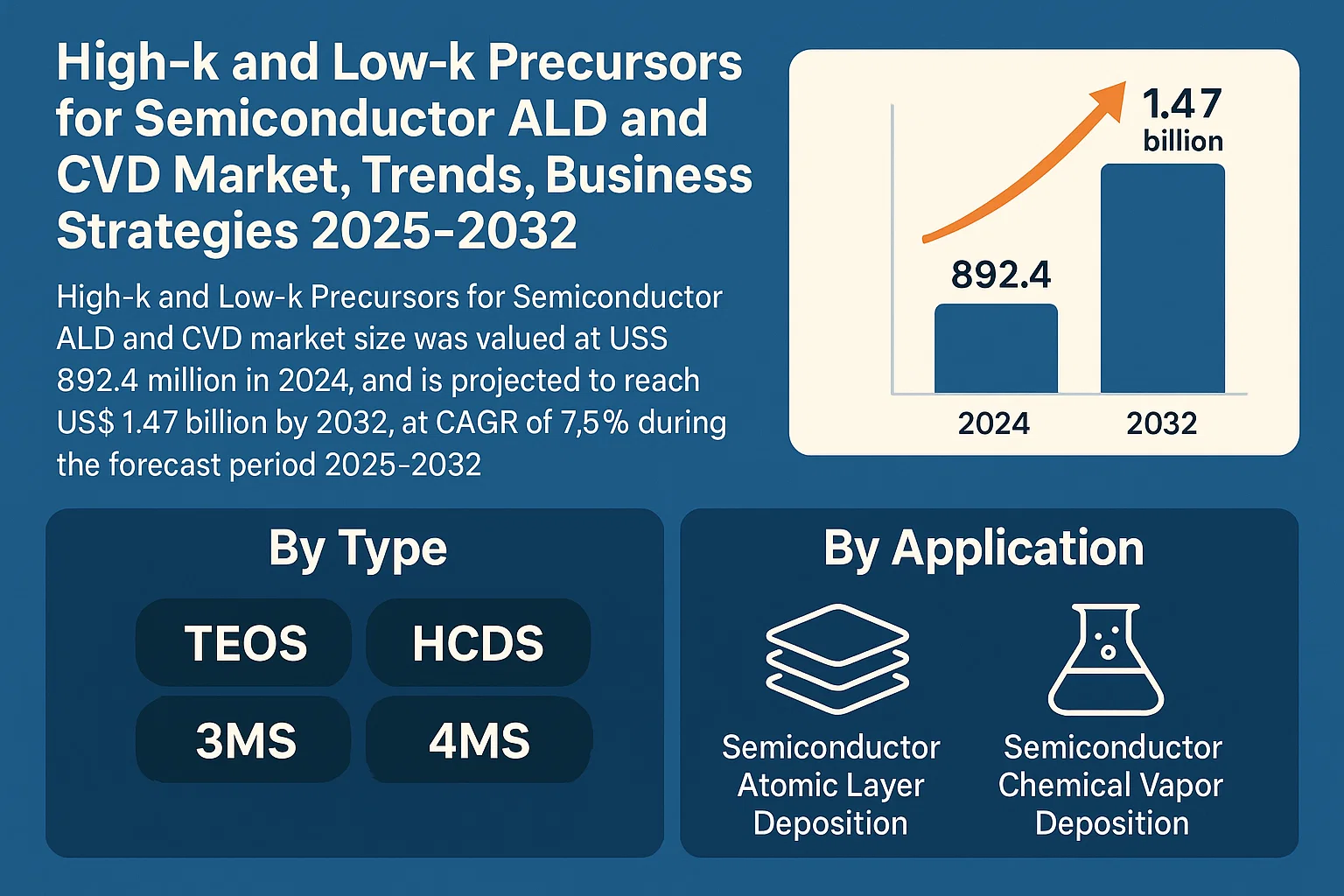
The global High-k and Low-k Precursors for Semiconductor ALD and CVD Market size was valued at US$ 892.4 million in 2024 and is projected to reach US$ 1.47 billion by 2032, at a CAGR of 7.5% during the forecast period 2025-2032. The growth is driven by increasing demand for advanced semiconductor nodes below 7nm where these materials are essential for dielectric applications.
High-k (high dielectric constant) and Low-k (low dielectric constant) precursors are specialized chemical compounds used in atomic layer deposition (ALD) and chemical vapor deposition (CVD) processes to create insulating layers in semiconductor devices. These materials enable continued transistor scaling by reducing leakage currents (High-k) and minimizing signal delay (Low-k) in interconnect structures. Key precursor types include metalorganic compounds like hafnium and zirconium-based materials for High-k applications, while Low-k precursors often involve organosilicon compounds.
The market expansion is fueled by rapid adoption of advanced logic and memory chips, particularly in 5G, AI, and IoT applications. While the semiconductor industry faces cyclical demand fluctuations, the precursor segment maintains steady growth due to its critical role in next-generation fabrication. Major players including Merck Group, Air Liquide, and Entegris are investing heavily in developing novel precursor chemistries to meet evolving industry requirements for improved performance and thermal stability at smaller technology nodes.
MARKET DYNAMICS
MARKET DRIVERS
Expansion of Advanced Semiconductor Nodes to Accelerate Demand for High-k and Low-k Precursors
The transition toward smaller semiconductor nodes below 7nm is driving significant demand for high-performance dielectric materials. High-k precursors enable reduced leakage currents and improved gate control in advanced transistors, while low-k materials minimize parasitic capacitance in interconnects. Foundries are allocating over 60% of their capex toward sub-7nm capacity expansion, creating sustained demand for specialized precursors. Leading logic manufacturers have already entered volume production at 3nm nodes, with prototype work underway at 2nm – these cutting-edge processes require increasingly sophisticated precursor chemistries to maintain performance gains.
Growth in 3D NAND Memory Architectures Creates New Material Requirements
3D NAND memory stacking is driving innovative precursor solutions as manufacturers push beyond 200 layers. Each additional vertical layer requires precise deposition of high-k charge trap layers and low-k interlayer dielectrics, with material properties becoming more critical at elevated aspect ratios. The 3D NAND market is projected to maintain over 15% annual growth through 2030, creating parallel demand for specialized ALD precursors that can deliver conformal coatings in high-aspect-ratio structures.
Rise of AI/ML Workloads Boosting Performance Material Needs
Artificial intelligence and machine learning applications are driving 35% of datacenter chip demand, requiring optimized dielectric materials for both logic and memory components. High-k gate oxides enable faster switching in AI accelerators, while ultra-low-k interconnects reduce signal delay. The AI chip market is forecast to exceed $200 billion by 2030, with leading foundries prioritizing material innovations that deliver the necessary performance characteristics through precise ALD and CVD processes.
MARKET RESTRAINTS
Stringent Purity Requirements Increase Production Complexity and Costs
Semiconductor-grade precursors demand exceptional purity levels, often exceeding 99.9999%, creating significant production challenges. The specialized purification processes and handling requirements can increase precursor costs by 200-300% compared to industrial-grade materials. With advanced nodes requiring ever-stricter contamination controls, manufacturers face growing profitability pressures in precursor development.
Geopolitical Tensions Disrupting Specialty Chemical Supply Chains
Trade restrictions and regionalization of semiconductor supply chains are creating bottlenecks in precursor availability. Certain key precursor components face export controls, forcing manufacturers to establish alternative sourcing strategies. These disruptions have led to lead time extensions for specialized precursors from 8-12 weeks to over 6 months in some cases, impacting fab expansion timelines.
Technical Hurdles in Novel Material Integration
As the industry explores new high-k and low-k material systems such as rare-earth oxides and porous organosilicates, integration challenges emerge. Novel precursors often require extensive process development to achieve stable interfaces and acceptable device reliability. These technical barriers extend material qualification cycles and increase adoption risks, particularly for emerging chemistries without extensive manufacturing histories.
MARKET OPPORTUNITIES
Emerging Applications in Power and RF Devices Open New Material Avenues
The growth of electric vehicles and 5G/6G infrastructure is driving demand for specialized power and RF semiconductors requiring high-k dielectrics with unique properties. Gallium nitride and silicon carbide devices benefit from atomic-level deposited high-k layers that enable higher breakdown voltages and improved thermal management. This represents a $5 billion+ opportunity for specialty precursors tailored to wide bandgap semiconductor applications.
Advanced Packaging Innovations Create Demand for Custom Dielectrics
Heterogeneous integration and 3D packaging techniques are driving innovations in package-level dielectric materials. Hybrid bonding and silicon interposer technologies require low-k materials with precisely controlled mechanical properties alongside electrical characteristics. The advanced packaging market is projected to grow at 8% CAGR, offering substantial opportunities for customized precursor solutions.
Sustainability Initiatives Driving Green Chemistry Development
Environmental regulations and ESG commitments are pushing manufacturers to develop more sustainable precursor chemistries with reduced global warming potential. This has spurred innovation in fluorine-free formulations and processes with higher material utilization efficiency. Over 75% of leading semiconductor companies have established net-zero roadmaps that include cleaner production materials.
MARKET CHALLENGES
Workforce Shortages Impacting Specialized Chemical Development
The semiconductor materials sector faces critical talent shortages in precursor chemistry and process engineering. With less than 20% of chemical engineering graduates specializing in materials science, companies struggle to staff advanced development programs. This skills gap is particularly acute for specialists capable of bridging fundamental chemistry with semiconductor manufacturing requirements.
Intellectual Property Protection in Material Formulations
Precursor chemistry represents substantial R&D investment, yet reverse engineering risks remain significant. Material suppliers face challenges protecting proprietary formulations while meeting customer characterization requirements. Patent protection often provides limited coverage as minor formulation changes can circumvent existing claims, creating ongoing IP management challenges.
Safety and Handling Complexities for Advanced Precursors
Next-generation precursors increasingly involve reactive and hazardous components requiring specialized handling infrastructure. Pyrophoric materials and high vapor pressure compounds demand significant capital investment in delivery systems and abatement equipment. These safety requirements add complexity to both manufacturing and fab integration processes.
HIGH-K AND LOW-K PRECURSORS FOR SEMICONDUCTOR ALD AND CVD MARKET TRENDS
Miniaturization of Semiconductor Devices Drives the Demand for Advanced Precursor Materials
The relentless push toward smaller, more efficient semiconductor devices continues to reshape the High-k (high dielectric constant) and Low-k (low dielectric constant) precursor markets. With the semiconductor industry transitioning to advanced nodes below 7nm, the need for precision deposition techniques like Atomic Layer Deposition (ALD) and Chemical Vapor Deposition (CVD) has intensified. High-k precursors, such as hafnium and zirconium-based compounds, are witnessing increased adoption for gate oxides in logic devices, while Low-k precursors are becoming critical for reducing interconnect delays in Back-End-of-Line (BEOL) processes. The market is projected to grow at a compound annual growth rate (CAGR) of approximately 7-9% from 2024 to 2032, fueled by the expansion of foundry capacities and advancements in 3D NAND and FinFET technologies.
Other Trends
Rise of Next-Generation Memory Solutions
The rapid growth of artificial intelligence (AI), high-performance computing (HPC), and data centers has accelerated innovation in memory technologies. High-k dielectric materials play a vital role in emerging memory solutions like DRAM and resistive RAM (RRAM), where material properties directly affect performance and scaling. Research indicates that the demand for High-k precursors used in memory applications is expected to grow by 8-10% annually, driven by the transition to DDR5/LPDDR5 standards and the increasing complexity of multi-layer 3D NAND architectures. Meanwhile, Low-k precursors are being optimized to minimize parasitic capacitance in advanced packaging solutions such as hybrid bonding and chiplets.
Expansion of Semiconductor Manufacturing in Asia-Pacific
The Asia-Pacific region, led by semiconductor powerhouses like Taiwan, South Korea, and China, continues to dominate global semiconductor production, accounting for over 60% of the market share in High-k and Low-k precursor consumption. Major foundries such as TSMC, Samsung, and SMIC are investing in cutting-edge fabrication facilities, with an emphasis on sub-3nm logic nodes and specialized memory production. This expansion is driving localized supply chain development for precursor materials, with regional suppliers increasingly gaining traction in the market. Furthermore, geopolitical dynamics and trade restrictions have prompted strategic stockpiling and diversification of precursor sources to mitigate supply chain risks.
COMPETITIVE LANDSCAPE
Key Industry Players
Strategic Investments and Innovation Shape Market Competition
The global High-k and Low-k Precursors for Semiconductor ALD and CVD market is characterized by a mix of established players and emerging contenders, creating a dynamic and competitive environment. UP Chemical (Yoke Technology) leads the market with its extensive product portfolio and strong foothold in Asia, particularly in semiconductor manufacturing hubs like Taiwan and South Korea. The company’s dominance is reinforced by its continuous R&D investments, which account for nearly 15% of its annual revenue.
Merck Group and Air Liquide also hold significant market shares, driven by their technological expertise and global distribution networks. These companies benefit from long-standing partnerships with leading semiconductor foundries such as TSMC and Samsung Foundry. Their ability to meet the stringent purity requirements of advanced nodes (below 7nm) gives them a competitive edge in the high-growth segments of the market.
Meanwhile, regional players like SoulBrain Co Ltd and ADEKA are gaining traction through targeted product development and cost-effective solutions for mature semiconductor processes. Their growth is particularly notable in the low-k precursor segment, where demand remains stable for legacy chip manufacturing.
The competitive intensity is further amplified by recent strategic moves. For instance, Entegris enhanced its market position through the acquisition of a specialty chemicals manufacturer in 2023, expanding its precursor portfolio for EUV-compatible deposition processes. Such consolidation activities are expected to continue as companies strive to offer comprehensive solutions for both ALD and CVD applications across multiple technology nodes.
List of Key High-k and Low-k Precursor Companies Profiled
- UP Chemical (Yoke Technology) (China)
- Merck Group (Germany)
- Air Liquide (France)
- Entegris (U.S.)
- SoulBrain Co Ltd (South Korea)
- ADEKA (Japan)
- DNF Solutions (South Korea)
- Mecaro (South Korea)
- Botai Electronic Material (China)
- Anhui Adchem (China)
Segment Analysis:
By Type
High-k Precursors Segment Holds Significant Market Share Due to Rising Demand for Advanced Semiconductor Nodes
The market is segmented based on type into:
- High-k Precursors
- Subtypes: Hafnium-based, Zirconium-based, and others
- Low-k Precursors
- Subtypes: Organosilicate-based, Carbon-doped, and others
By Application
Semiconductor Atomic Layer Deposition Drives Demand for Precursor Materials Due to Superior Film Uniformity
The market is segmented based on application into:
- Semiconductor Atomic Layer Deposition
- Semiconductor Chemical Vapor Deposition
By End-User
Foundries and IDMs Lead Consumption of High-k and Low-k Precursors for Advanced Semiconductor Manufacturing
The market is segmented based on end-user into:
- Foundries
- Integrated Device Manufacturers (IDMs)
- Research and Development Facilities
Regional Analysis: High-k and Low-k Precursors for Semiconductor ALD and CVD Market
North America
The North American market remains at the forefront of technological advancements in semiconductor manufacturing, driven by strong R&D investments from major players like Intel, Texas Instruments, and GlobalFoundries. The region accounted for approximately 28% of global high-k precursor demand in 2023, primarily due to the push for smaller node technologies (below 7nm) that require advanced dielectric materials. Stringent environmental regulations, particularly in California and Massachusetts, are accelerating the shift to greener precursor chemistries. However, the CHIPS Act’s $52 billion investment in domestic semiconductor production is expected to significantly boost precursor consumption, with several new fabrication plants scheduled for completion by 2026. Key challenges include supply chain dependencies on Asian raw material suppliers and rising production costs.
Europe
Europe maintains a strong position in specialty chemicals for semiconductor applications, with Germany and France leading in precursor development. The region’s market is characterized by high-value, low-volume transactions, focusing on ultra-high purity materials for automotive and industrial IoT applications. EU REACH regulations continue to shape product formulations, with companies like Merck and Air Liquide pioneering halogen-free precursors. Collaborative research initiatives such as the European Chips Act are fostering innovation in ALD processes. However, energy price volatility and the fragmented nature of Europe’s semiconductor ecosystem present challenges for consistent precursor supply chain management. The market is gradually shifting toward localized production to reduce geopolitical risks in material sourcing.
Asia-Pacific
Dominating global precursor consumption with over 62% market share, Asia-Pacific’s growth is propelled by China’s aggressive semiconductor self-sufficiency policies and Taiwan’s leading-edge foundry capabilities. South Korea and Japan collectively account for nearly 40% of high-k precursor patents, reflecting their technological leadership. While China is rapidly expanding domestic production through companies like UP Chemical, quality consistency remains a challenge compared to established Japanese and Korean suppliers. The region benefits from tight integration between precursor manufacturers and semiconductor fabs, creating efficient just-in-time delivery systems. Emerging applications in 3D NAND and advanced packaging are driving demand for novel low-k precursors, though intellectual property protection concerns occasionally hinder technology transfers.
South America
The South American market remains nascent but shows promising growth in specialty chemical applications, particularly for discrete power devices and analog chips. Brazil leads regional consumption, supported by its developing automotive electronics sector. Challenges include limited local R&D capabilities and dependence on imported precursors due to inadequate chemical infrastructure. Recent trade agreements with Asian suppliers are improving material accessibility, though at higher costs due to import duties. The lack of advanced semiconductor fabs in the region restricts demand to older technology nodes, resulting in slower adoption of cutting-edge precursors compared to other markets.
Middle East & Africa
This emerging market is witnessing increased activity through strategic partnerships, particularly in Israel and UAE, where governments are investing in semiconductor design capabilities. While precursor consumption remains limited, growing interest in MEMS and sensor manufacturing is creating niche opportunities. Saudi Arabia’s Vision 2030 initiative includes plans for basic semiconductor packaging facilities, which may drive future precursor demand. The region faces significant hurdles including limited technical expertise, lack of chemical manufacturing infrastructure, and geopolitical instability affecting supply chains. However, strategic geographic positioning between European and Asian markets offers potential for future logistics hubs catering to both regions.
Report Scope
This market research report provides a comprehensive analysis of the global and regional High-k and Low-k Precursors for Semiconductor ALD and CVD markets, covering the forecast period 2025–2032. It offers detailed insights into market dynamics, technological advancements, competitive landscape, and key trends shaping the industry.
Key focus areas of the report include:
- Market Size & Forecast: Historical data and future projections for revenue, unit shipments, and market value across major regions and segments. The Global High-k and Low-k Precursors market was valued at US$ 892.4 million in 2024 and is projected to reach US$ 1.47 billion by 2032, growing at a CAGR of 7.5% during the forecast period.
- Segmentation Analysis: Detailed breakdown by product type (High-k Precursors and Low-k Precursors), technology (ALD and CVD), application, and end-user industry to identify high-growth segments and investment opportunities.
- Regional Outlook: Insights into market performance across North America, Europe, Asia-Pacific, Latin America, and the Middle East & Africa, with particular focus on semiconductor manufacturing hubs like Taiwan, South Korea, and Japan.
- Competitive Landscape: Profiles of leading market participants including UP Chemical, Merck Group, Air Liquide, and Entegris, covering their product portfolios, R&D investments, and strategic initiatives.
- Technology Trends & Innovation: Assessment of emerging deposition technologies, material innovations, and integration challenges in advanced semiconductor nodes (below 7nm).
- Market Drivers & Restraints: Evaluation of factors such as semiconductor industry growth (projected to reach USD 790 billion by 2029), miniaturization trends, and supply chain constraints for specialty chemicals.
- Stakeholder Analysis: Strategic insights for material suppliers, semiconductor manufacturers, foundries, and equipment providers in the evolving precursor ecosystem.
The analysis combines primary research with industry experts and secondary data from verified sources, ensuring accuracy and actionable intelligence for decision-makers.
FREQUENTLY ASKED QUESTIONS:
What is the current market size of Global High-k and Low-k Precursors for Semiconductor ALD and CVD Market?
-> High-k and Low-k Precursors for Semiconductor ALD and CVD Market size was valued at US$ 892.4 million in 2024 and is projected to reach US$ 1.47 billion by 2032, at a CAGR of 7.5% during the forecast period 2025-2032.
Which key companies operate in this market?
-> Key players include UP Chemical (Yoke Technology), Merck Group, Air Liquide, Entegris, SoulBrain Co Ltd, and ADEKA, among others.
What are the key growth drivers?
-> Key drivers include advancements in semiconductor manufacturing (especially below 7nm nodes), increasing ALD/CVD adoption, and growing demand for advanced memory and logic devices.
Which region dominates the market?
-> Asia-Pacific dominates due to semiconductor manufacturing concentration, while North America leads in R&D and technology development.
What are the emerging trends?
-> Emerging trends include development of novel precursor chemistries, integration of AI in deposition processes, and focus on environmentally sustainable precursors.

Get Sample Report PDF for Exclusive Insights
Report Sample Includes
- Table of Contents
- List of Tables & Figures
- Charts, Research Methodology, and more...
 Download Sample Report PDF