Key Statistics
Key Takeaways
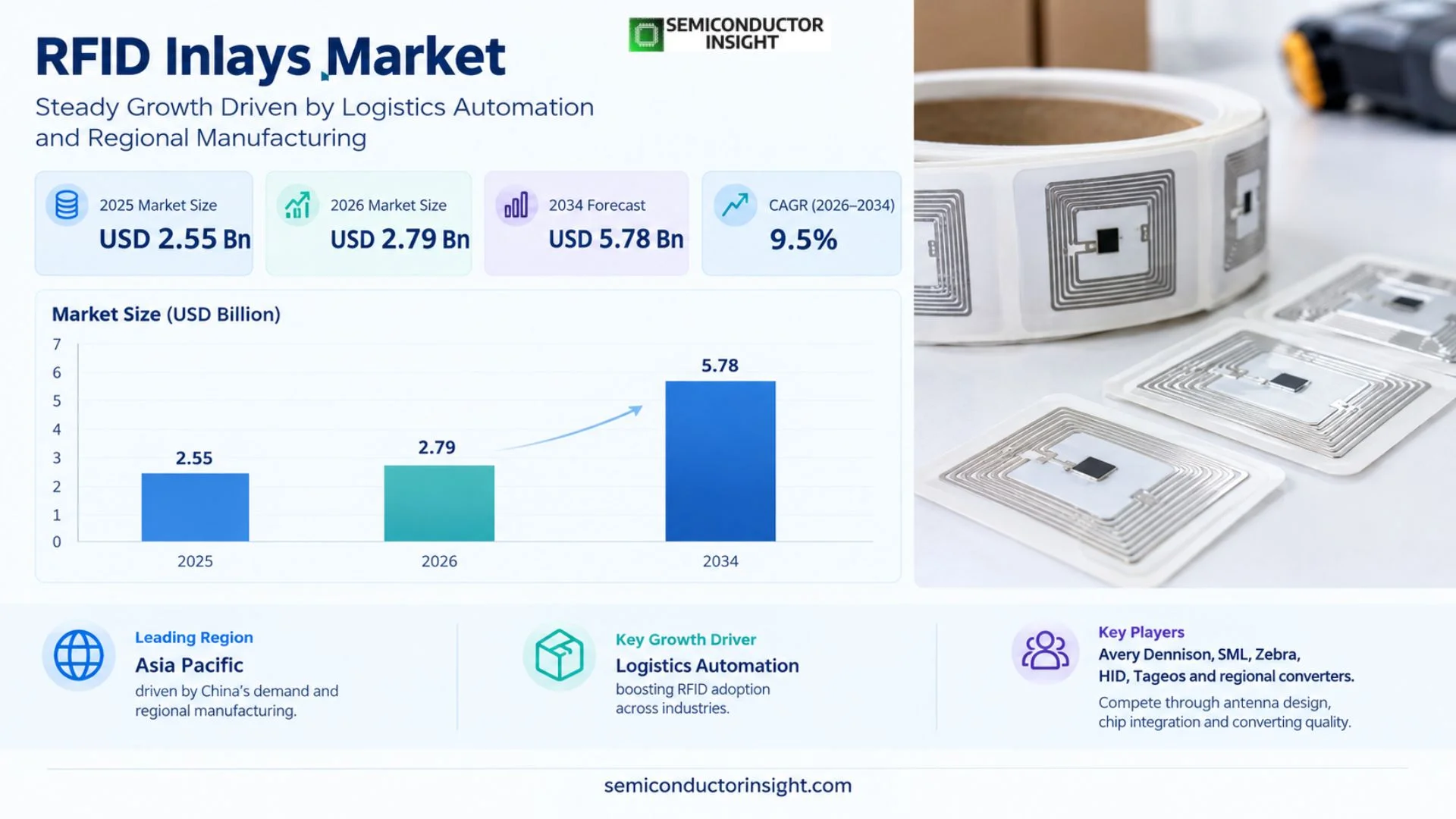
- Market size: The market is valued at USD 2.55 billion in 2025 and is projected to reach USD 5.78 billion by 2034, representing a 9.5% CAGR during 2026–2034.
- UHF RFID inlays are the largest product category, supported by item-level retail, logistics and supply-chain applications that benefit from long read range and fast bulk identification.
- Asia Pacific leads market scale, with China representing a particularly large manufacturing and end-use base for RFID inlays.
- Retail is the largest application, while fresh food, logistics and reusable packaging are expanding addressable volume.
- Sustainability is becoming a product differentiator, with PET-free aluminum antenna designs and lower-carbon inlay production gaining commercial attention.
RFID Inlays Market Overview
RFID Inlays Market is valued at USD 2.55 billion in 2025 and is projected to reach USD 5.78 billion by 2034, expanding at a 9.5% CAGR during 2026–2034. The 2026 market level is USD 2.79 billion. Asia Pacific leads market scale through China, regional manufacturing and expanding logistics automation. Retailers, brands and logistics providers are increasing item-level tagging, while new food, packaging and converter programs are broadening RFID beyond apparel.
RFID inlays combine an integrated circuit with a tuned antenna on a thin substrate. The inlay provides the core radio-frequency function that is later converted into a label, ticket, card or embedded tag. Performance depends on frequency band, antenna geometry, chip sensitivity, memory, attachment material and the electromagnetic properties of the tagged item. In commercial deployments, tag readability must remain consistent across millions of units and diverse packaging materials.
UHF dominates item-level retail and logistics because it supports longer range and fast bulk reads, while HF and LF remain important for cards, access, specialty industrial identification and applications requiring shorter-range coupling. New UHF chips such as Impinj M830 and NXP UCODE 9 improve sensitivity and readability, enabling smaller antennas and more difficult tagged materials while supporting privacy, serialization and high-speed inventory.
Manufacturing combines IC attachment, antenna conversion, lamination and high-speed testing. Inlay economics depend on very large volumes, placement yield and conversion efficiency. Avery Dennison’s 2025 RFID production facility in Pune and its 2026 converter program show that regional capacity and easier label integration are becoming strategic competitive tools as customers demand faster customization and lower total applied tag cost.
Segment Analysis: By Type
By type, the market is segmented into UHF, LF and HF RFID inlays. UHF is the largest category because item-level retail and logistics require longer read range and rapid multi-tag inventory. HF inlays serve cards, tickets and NFC-adjacent use cases, while LF remains relevant in access, animal identification and specialized industrial environments where short-range coupling is preferred.
| Type | Commercial role |
|---|---|
| UHF RFID Inlays | 860–960 MHz inlays for retail, logistics and high-volume item tracking. |
| LF RFID Inlays | Low-frequency products for access, animal identification and specialized industrial uses. |
| HF RFID Inlays | 13.56 MHz products used in cards, ticketing, libraries and short-range identification. |
Additional Segmentation: By Inlay Format
Inlay format determines how much downstream converting work is required. Dry inlays contain the chip and antenna, wet inlays add adhesive, and label or sticker products add face material and a finished converting structure. Customers select formats according to their own label-converting capability, automation equipment and the surface or package where the RFID identifier will be applied.
| Inlay Format | Demand characteristics |
|---|---|
| Dry Inlay | Core antenna and IC for further converting by label or tag manufacturers. |
| Wet Inlay | Adhesive-backed inlay ready for insertion or lamination. |
| Label / Sticker | Converted RFID label ready for item-level application. |
Segment Analysis: By Application
By application, retail is the largest segment because item-level RFID improves inventory accuracy and omnichannel fulfillment. Logistics and asset management use UHF for fast identification of cases, pallets, tools and reusable containers, while ticketing, cards and books use HF or LF products. Food and healthcare applications are expanding as new antenna designs improve performance on challenging packaging.
| Application | Demand characteristics |
|---|---|
| Retail | Item-level inventory, omnichannel fulfillment, loss prevention and self-checkout. |
| Asset Management/Inventory/Documents | Enterprise assets, tools, records and reusable containers. |
| Logistics | Pallets, parcels, returnable transport items and warehouse automation. |
| Ticketing/Cards/Books | Libraries, events, access and document identification. |
| Others | Healthcare, food, industrial and specialty tracking. |
Additional Segmentation: By Chip Platform
RFID IC choice affects read sensitivity, EPC memory, privacy features, encoding speed and tag manufacturability. NXP UCODE and Impinj M800-series chips are widely integrated into current UHF inlays, while other chip suppliers address specialized frequency, memory and security requirements. The inlay supplier must co-optimize antenna geometry with the selected chip to achieve reliable read range.
| Chip Platform | Commercial relevance |
|---|---|
| NXP UCODE | Widely deployed UHF EPC/RFID chip family for retail and logistics inlays. |
| Impinj M800 Series | High-sensitivity UHF endpoint ICs optimized for readability and dense tag populations. |
| Other RFID ICs | HF, LF and specialized UHF chips with application-specific memory or security. |
Regional Analysis
Asia Pacific leads market scale because China combines very large RFID demand with inlay and electronics manufacturing, while India and Southeast Asia are adding local converting capacity. North America and Europe remain mature adoption markets in retail, logistics and enterprise asset tracking. Regional differences are increasingly shaped by converter capability and local sustainability requirements.
Why does regional demand differ across the RFID Inlays market?
Regional market structure depends on both tag manufacturing and the maturity of RFID-enabled business processes. Asia benefits from production scale and fast logistics automation, North America from large retailer deployments, and Europe from sustainability and circularity initiatives. Suppliers that can offer the same validated chip and antenna platform across several local converting sites have an advantage in global programs.
| Region | Position | Demand profile | Supplier-selection factor |
|---|---|---|---|
| Asia Pacific | Largest / fastest | Retail, logistics, manufacturing | Volume scale and local conversion |
| North America | High-value | Retail, food, logistics | Retail adoption and standards |
| Europe | Mature | Retail, logistics, sustainability | Compliance and circularity |
| South America | Emerging | Retail and logistics | Converter ecosystem |
| Middle East & Africa | Emerging | Retail, logistics, government | Infrastructure and channel support |
Competitive Landscape
Avery Dennison, SML, Zebra, HID, Tageos and regional converters compete through antenna design, chip integration, converting quality and application-specific form factors. Supplier advantage depends on read performance, manufacturing yield, sustainability and the ability to support large global retailer specifications across multiple production sites. For commercial decisions in the RFID Inlays market, buyers also weigh qualification evidence, integration effort, operating reliability, lifecycle support, supply continuity and measurable system-level value rather than a single specification.
Competitive intensity is increasing as chip performance improves and converters can produce smaller or lower-cost tags. Avery Dennison’s Pure line and IdentiFresh series illustrate differentiation through sustainability and category-specific design, while Impinj M800 and NXP UCODE platforms provide the silicon foundation for many current UHF inlays. For commercial decisions in the RFID Inlays market, buyers also weigh qualification evidence, integration effort, operating reliability, lifecycle support, supply continuity and measurable system-level value rather than a single specification.
Regional manufacturing is becoming more important because transport cost, customization and retailer deployment schedules favor local converting capacity. Avery Dennison’s Pune facility and AD Fusion program show how suppliers can expand the ecosystem by lowering the capital barrier for label converters and accelerating adoption in new product categories. For commercial decisions in the RFID Inlays market, buyers also weigh qualification evidence, integration effort, operating reliability, lifecycle support, supply continuity and measurable system-level value rather than a single specification.
| Competitive tier | Representative companies | Primary differentiation |
|---|---|---|
| Global inlay leaders | Avery Dennison, SML, Tageos | High-volume UHF inlays, retailer qualification and global converting. |
| RFID silicon ecosystem | Impinj, NXP | Endpoint IC performance, memory and protocol capability. |
| Converters / solution providers | Zebra, HID and regional specialists | Finished labels, encoding and application integration. |
Key companies profiled
Avery Dennison, SML Group, Zebra Technologies, HID Global, Tageos, Impinj ecosystem partners, NXP ecosystem partners and regional RFID converters are included in the competitive scope. The market is fragmented beyond the largest global suppliers because antenna geometry and converting can be customized for individual retail, logistics or industrial applications. For commercial decisions in the RFID Inlays market, buyers also weigh qualification evidence, integration effort, operating reliability, lifecycle support, supply continuity and measurable system-level value rather than a single specification.
Production Capacity Analysis
RFID inlay capacity is measured in billions of units and depends on antenna converting, IC attachment, bonding yield, testing and downstream label conversion. High-speed reel-to-reel manufacturing is essential because unit prices are low and customers expect consistent read performance across very large production lots with tightly controlled chip placement. For commercial decisions in the RFID Inlays market, buyers also weigh qualification evidence, integration effort, operating reliability, lifecycle support, supply continuity and measurable system-level value rather than a single specification.
Regional manufacturing lowers lead time and logistics cost. Avery Dennison’s India facility and converter-focused programs illustrate how suppliers are localizing inlay or smart-label production while retaining common chip and antenna platforms. Sustainability upgrades must also preserve line speed and RF performance to be commercially viable. For commercial decisions in the RFID Inlays market, buyers also weigh qualification evidence, integration effort, operating reliability, lifecycle support, supply continuity and measurable system-level value rather than a single specification.
Market Dynamics
The market is driven by retail inventory accuracy, logistics automation, food waste reduction and broader IoT identification. Growth is restrained by tag cost, material compatibility and the need for readers and software across the deployment. The strongest opportunities are in non-apparel retail, fresh food, reusable assets and sustainable inlay constructions.
Market Drivers
| Driver | Impact | Commercial mechanism |
|---|---|---|
| Retail digitization | High | Item-level visibility improves inventory accuracy and omnichannel fulfillment. |
| Supply-chain automation | High | RFID reduces manual scanning in warehouses and logistics. |
| Fresh food | Medium-High | RFID can improve freshness management and reduce waste. |
| Sustainable inlays | Medium | Brands are evaluating carbon footprint and recyclability. |
Retail digitization
RFID lets retailers identify hundreds of items quickly without line-of-sight scanning. Better inventory accuracy improves replenishment, buy-online-pickup-in-store and shrink management. These benefits support large recurring inlay volumes once a retailer standardizes tagging across a category. For commercial decisions in the RFID Inlays market, buyers also weigh qualification evidence, integration effort, operating reliability, lifecycle support, supply continuity and measurable system-level value rather than a single specification.
Supply-chain automation
UHF inlays can identify pallets, cases and individual items automatically as they pass portals or conveyor systems. This improves traceability and reduces labor, particularly in high-throughput logistics operations where barcode scanning becomes a bottleneck. For commercial decisions in the RFID Inlays market, buyers also weigh qualification evidence, integration effort, operating reliability, lifecycle support, supply continuity and measurable system-level value rather than a single specification.
Fresh food
Avery Dennison’s 2026 IdentiFresh launch demonstrates expansion into bakery, meat, deli and produce. Short shelf life creates a strong use case for real-time inventory age and availability when tag economics fit the item value. For commercial decisions in the RFID Inlays market, buyers also weigh qualification evidence, integration effort, operating reliability, lifecycle support, supply continuity and measurable system-level value rather than a single specification.
Sustainable inlays
PET-free antenna structures and lower-material designs can reduce environmental impact without changing RFID workflows. Sustainability becomes a differentiator when brand packaging targets are as important as read performance. For commercial decisions in the RFID Inlays market, buyers also weigh qualification evidence, integration effort, operating reliability, lifecycle support, supply continuity and measurable system-level value rather than a single specification.
Market Restraints
| Restraint | Impact | Commercial consequence |
|---|---|---|
| Tag economics | High | Low-value products may not justify item-level RFID. |
| Material interference | Medium-High | Metal and liquids can reduce read range. |
| Infrastructure requirement | Medium | Readers, software and process changes are needed. |
| Privacy and data governance | Medium | Consumer-facing tags require clear policies. |
Tag economics
Even low-cost inlays add material, converting and encoding expense. Adoption is fastest where inventory, shrink or automation savings exceed the applied tag cost. Very low-value goods may remain barcode-only unless tag costs decline further. For commercial decisions in the RFID Inlays market, buyers also weigh qualification evidence, integration effort, operating reliability, lifecycle support, supply continuity and measurable system-level value rather than a single specification.
Material interference
RF performance depends on the tagged object’s dielectric properties. Specialized antenna designs or spacers may be required for liquids, metal or small form factors, increasing development effort and cost. For commercial decisions in the RFID Inlays market, buyers also weigh qualification evidence, integration effort, operating reliability, lifecycle support, supply continuity and measurable system-level value rather than a single specification.
Infrastructure requirement
An inlay alone does not create business value. Retailers and warehouses need readers, middleware, data integration and operating procedures, which can slow adoption outside organizations with clear deployment expertise. For commercial decisions in the RFID Inlays market, buyers also weigh qualification evidence, integration effort, operating reliability, lifecycle support, supply continuity and measurable system-level value rather than a single specification.
Privacy and data governance
Retailers must manage when tags remain active, what data is stored and how identifiers are used. Privacy-enhancing chip features and transparent customer policies reduce risk but add deployment considerations. For commercial decisions in the RFID Inlays market, buyers also weigh qualification evidence, integration effort, operating reliability, lifecycle support, supply continuity and measurable system-level value rather than a single specification.
Market Opportunities
Fresh-food RFID
Inlays designed for difficult food packaging can extend RFID into high-volume categories where waste reduction and expiration management have direct value. For commercial decisions in the RFID Inlays market, buyers also weigh qualification evidence, integration effort, operating reliability, lifecycle support, supply continuity and measurable system-level value rather than a single specification.
Converter enablement
Pre-inserted inlay materials can let more label converters offer RFID without dedicated insertion equipment, broadening industry capacity. For commercial decisions in the RFID Inlays market, buyers also weigh qualification evidence, integration effort, operating reliability, lifecycle support, supply continuity and measurable system-level value rather than a single specification. For commercial decisions in the RFID Inlays market, buyers also weigh qualification evidence, integration effort, operating reliability, lifecycle support, supply continuity and measurable system-level value rather than a single specification.
Reusable packaging
Returnable crates, totes and transport items justify more durable RFID because the tag cost is spread across many cycles. For commercial decisions in the RFID Inlays market, buyers also weigh qualification evidence, integration effort, operating reliability, lifecycle support, supply continuity and measurable system-level value rather than a single specification. For commercial decisions in the RFID Inlays market, buyers also weigh qualification evidence, integration effort, operating reliability, lifecycle support, supply continuity and measurable system-level value rather than a single specification.
Digital product identity
RFID can serve as a physical identifier feeding digital product records, authentication and circular-economy workflows. For commercial decisions in the RFID Inlays market, buyers also weigh qualification evidence, integration effort, operating reliability, lifecycle support, supply continuity and measurable system-level value rather than a single specification. For commercial decisions in the RFID Inlays market, buyers also weigh qualification evidence, integration effort, operating reliability, lifecycle support, supply continuity and measurable system-level value rather than a single specification.
Supply Chain Analysis
Silicon and materials. Endpoint ICs from NXP, Impinj and others are attached to aluminum, copper or printed antennas. Chip sensitivity and memory determine the minimum antenna size and read performance, while substrate choices influence flexibility and recycling. For commercial decisions in the RFID Inlays market, buyers also weigh qualification evidence, integration effort, operating reliability, lifecycle support, supply continuity and measurable system-level value rather than a single specification.
Inlay manufacturing. Reel-to-reel lines create antennas, place the IC, bond the connection and electrically test each inlay. High placement yield and fast test throughput are essential to economics because volumes can reach millions of units per customer program. For commercial decisions in the RFID Inlays market, buyers also weigh qualification evidence, integration effort, operating reliability, lifecycle support, supply continuity and measurable system-level value rather than a single specification.
Conversion. Dry or wet inlays are laminated into labels, hangtags, tickets or packaging. Converters print variable data and may encode EPC values before shipping finished tags to the brand or logistics operator. For commercial decisions in the RFID Inlays market, buyers also weigh qualification evidence, integration effort, operating reliability, lifecycle support, supply continuity and measurable system-level value rather than a single specification.
Deployment. Readers, portals and software connect the physical tag to inventory systems. The business case depends on process redesign, not just hardware, so mature deployments combine inlays with data standards and operational analytics. For commercial decisions in the RFID Inlays market, buyers also weigh qualification evidence, integration effort, operating reliability, lifecycle support, supply continuity and measurable system-level value rather than a single specification.
Recent Developments in the RFID Inlays Market
Developments tracked through September 2026 and limited to events that materially affect technology, capacity, adoption or competition.
- 18 August 2026
Avery Dennison launched AD Fusion, a converter program using SmartFace materials with pre-inserted RFID inlays to reduce the capital and process barriers for label and packaging converters entering smart-label production. Source - 25 February 2026
Avery Dennison launched the AD IdentiFresh inlay series for bakery, meat, deli and produce, using Impinj M800-series ICs to extend RFID inventory visibility into fresh-food categories. Source - 24 April 2025
Avery Dennison opened its first India-based RFID inlay and label production facility in Pune and introduced the AD Cobra inlay for local market requirements. Source
Report Scope & Segmentation
| Attribute | Scope |
|---|---|
| Base year | 2025 |
| Estimated year | 2026 |
| Forecast period | 2026–2034 |
| 2025 market size | USD 2.55 billion |
| 2026 estimated size | USD 2.79 billion |
| 2034 projected size | USD 5.78 billion |
| CAGR (2026–2034) | 9.5% |
| Largest market in 2025 | Asia Pacific |
| By Type | UHF RFID Inlays; LF RFID Inlays; HF RFID Inlays |
| By Application | Retail; Asset Management/Inventory/Documents; Logistics; Ticketing/Cards/Books; Others |
| By Inlay Format | Dry Inlay; Wet Inlay; Label/Sticker |
| By Chip Platform | NXP UCODE; Impinj M800 Series; Other RFID ICs |
| Companies profiled | Avery Dennison; SML Group; Zebra Technologies; HID; Tageos; Impinj ecosystem partners; NXP ecosystem partners; regional RFID converters |
Frequently Asked Questions
What is the RFID inlays market size in 2025?
The global RFID inlays market is valued at USD 2.55 billion in 2025 across UHF, HF and LF products.
What is the market forecast for 2034?
The market is projected to reach USD 5.78 billion by 2034, representing a 9.5% CAGR during 2026–2034. The corresponding 2026 market level is USD 2.79 billion.
Which region leads the market?
Asia Pacific leads market scale through China and the region’s large manufacturing, retail and logistics base.
Which RFID inlay type is largest?
UHF RFID inlays are the largest category because item-level retail and logistics benefit from long read range and rapid bulk identification.
What is the largest application?
Retail is the largest application, with logistics, asset management, ticketing and fresh-food tagging expanding total demand.
What is the difference between dry and wet inlays?
Dry inlays contain the chip and antenna, while wet inlays add adhesive and finished labels add face material and converting.
Which chip platforms are important?
NXP UCODE and Impinj M800-series chips are widely used in current UHF inlays, alongside other specialized RFID ICs.
Who are major suppliers?
Avery Dennison, SML, Tageos, Zebra/HID-related ecosystems and regional converters are important participants.
What limits adoption?
Tag cost, material interference, reader/software investment and privacy governance are the main barriers.
What will drive growth through 2034?
Retail digitization, logistics automation, fresh food, reusable packaging and sustainable inlay designs will support expansion.
Research Sources & Evidence Base
View research sources used in this market overview
- Avery Dennison – AD Pure RFID Inlays. PET-free UHF inlay construction and NXP UCODE 9 product evidence.
- Impinj – M800 Series Endpoint ICs. UHF tag chip performance and feature evidence.
Get Sample Report PDF for Exclusive Insights
Report Sample Includes
- Table of Contents
- List of Tables & Figures
- Charts, Research Methodology, and more...
 Download Sample Report PDF