Residential MCBs (Miniature Circuit Breakers) Market Insights
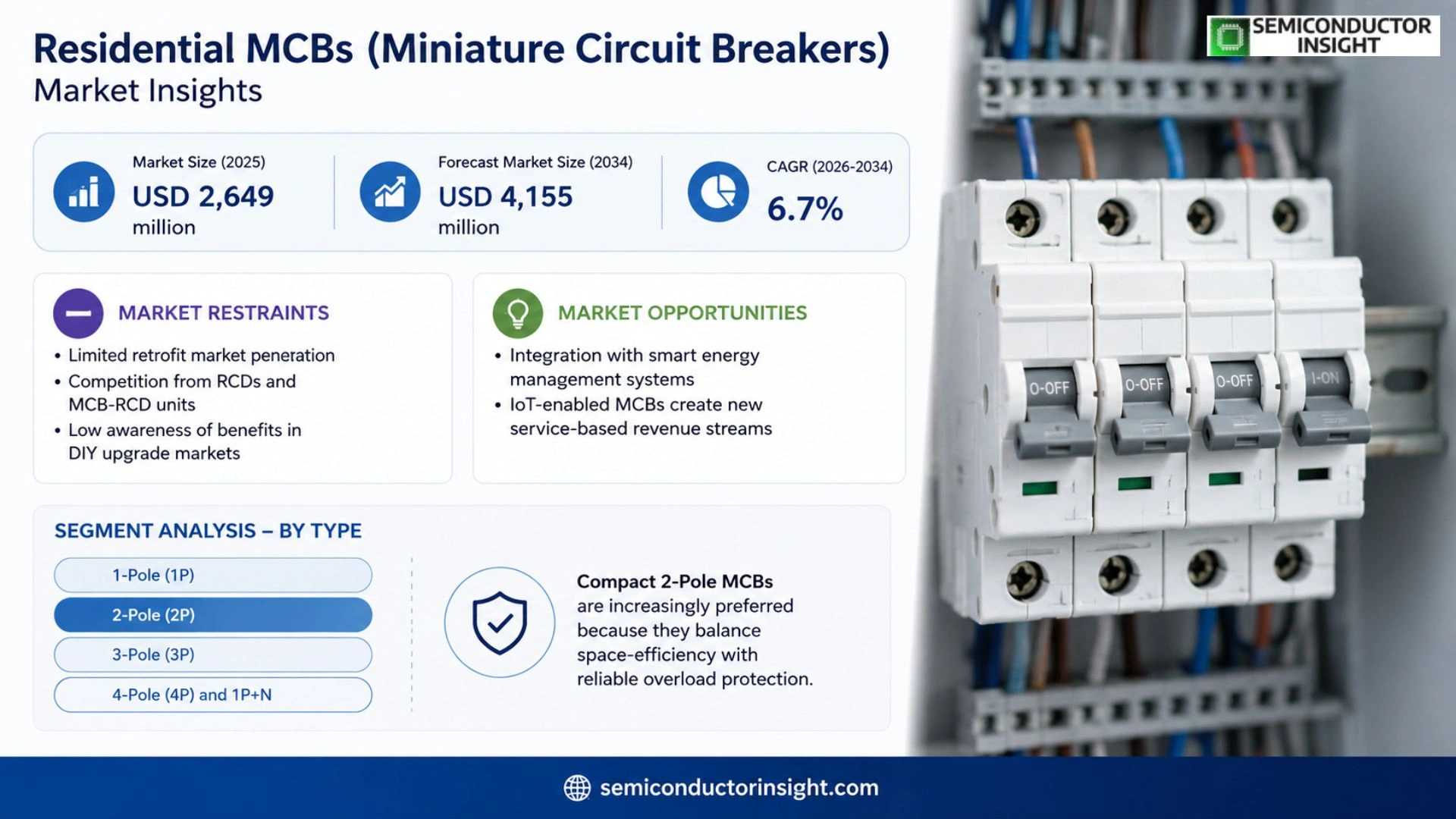
Residential MCBs (Miniature Circuit Breakers) market size was valued at USD 2649 million in 2025. The market is projected to reach USD 4155 million by 2034, exhibiting a CAGR of 6.7% during the forecast period.
Residential miniature circuit breakers are compact over‑current protection devices intended for final‑circuit distribution in homes and similar premises. They are installed in consumer units or distribution boards and disconnect fault current rapidly under overload or short‑circuit conditions while also providing routine switching, isolation and branch control. Core technology relies on thermal‑magnetic tripping, modular DIN‑rail mounting, pole configurations from 1P up to 4P + N and trip curves B, C or D; breaking capacities range from 3 kA to 15 kA or higher and compliance with IEC 60898‑1, IEC 60947‑2 and UL standards is mandatory.
The sector benefits from tighter safety regulations worldwide, rising new‑construction activity and an accelerating retrofit cycle for aging housing stock. Moreover, integration with smart home platforms and compatibility with RCCBs, RCBOs or AFDDs creates added value for installers seeking system‑level solutions. Leading manufacturers such as Schneider Electric, ABB, Legrand and Siemens have expanded their residential portfolios during 2023‑24 with slimmer modules and enhanced accessory ecosystems, reinforcing competitive pressure on cost‑efficient Chinese suppliers while encouraging innovation around modular width reduction and multi‑standard certification.
MARKET DRIVERS
Increasing Home Electrification
Residential power demand has risen sharply as consumers adopt higher‑wattage appliances, home‑theater systems, and electric‑vehicle chargers. This surge compels builders and remodelers to specify reliable protection devices, making Residential MCBs (Miniature Circuit Breakers) Market growth a natural outcome of modern living standards.
Regulatory Push for Safety Standards
Building codes across major economies now mandate circuit‑breaker protection for all new dwellings. The tightening of safety regulations forces manufacturers to innovate, offering higher‑rated fault interruption and compact designs that fit tighter conduit spaces.
➤ Designs that combine Arc‑Fault Detection with standard MCB functionality are gaining traction among specifiers seeking dual protection without added cost.
Together, expanding electrical loads and stricter compliance frameworks create a fertile environment where product differentiation and volume sales reinforce each other, prompting industry players to accelerate R&D pipelines.
MARKET CHALLENGES
Cost Sensitivity in New Builds
Developers operating on narrow margins often prioritize low‑cost components, which can limit the adoption of advanced MCB features. When a project’s budget is constrained, the incremental price of a smart‑enabled breaker may be viewed as non‑essential.
Other Challenges
Supply Chain Volatility
Fluctuations in copper and polymer prices directly affect bill‑of‑material costs. Recent geopolitical tensions have compressed lead times for molded‑case circuit breaker housings, forcing manufacturers to hold higher inventory levels or risk production delays.
MARKET RESTRAINTS
Limited Retro‑fit Market Penetration
Homeowners tend to retain existing distribution panels unless a safety incident forces replacement. This inertia curtails opportunities for Residential MCBs (Miniature Circuit Breakers) Market expansion beyond new‑construction projects.
Competing protective devices such as Residual Current Devices (RCDs) or combined MCB‑RCD units often crowd the retrofit space, offering multifunctionality that single‑pole MCBs cannot match without additional wiring.
Awareness gaps about the advantages of selective tripping and fault isolation further dampen demand, especially in regions where DIY upgrades are common but professional guidance is scarce.
MARKET OPPORTUNITIES
Integration with Smart Energy Management
IoT‑enabled MCBs that report load status, trip events, and health metrics to cloud platforms are opening a service‑oriented revenue stream. Utilities and energy‑management firms are beginning to bundle these data feeds into demand‑response programs, creating a new market for value‑added connectivity.
Emerging economies are witnessing a construction boom accompanied by government incentives for energy‑efficient housing. Early entrants that localize smart‑breaker solutions to meet regional voltage standards can capture a sizeable share of this fledgling demand.
Aftermarket services,including remote diagnostics, predictive maintenance, and upgrade kits,represent a high‑margin avenue for manufacturers seeking to extend the product lifecycle beyond the initial installation.
Residential MCBs (Miniature Circuit Breakers) Market Trends
Shift Toward Compact, Multi‑Standard Modules
The residential protection segment is witnessing a clear move toward smaller module widths that accommodate increasingly tight panel interiors. Manufacturers are engineering DIN‑rail units that occupy a single slot yet retain the ability to host 1P, 2P or 3P configurations with B, C and D tripping curves. This mechanical efficiency matters because new high‑rise constructions demand dense distribution boards without sacrificing safety margins. At the same time, certification programmes such as IEC 60898‑1, IEC 60947‑2 and UL are being bundled into a single product line, allowing installers to source a “one‑stop” device that complies with European, North‑American and Asian regulations. The business implication is straightforward: suppliers that can promise a reduced footprint while delivering cross‑regional certification are well positioned to capture contracts from panel assemblers who seek to minimise inventory complexity and reduce engineering change cycles.
Other Trends
Integration with Smart Distribution Platforms
Beyond pure over‑current protection, MCB manufacturers are embedding communication modules that speak to building‑automation backbones. These smart accessories enable remote reset, status monitoring and predictive maintenance alerts via protocols such as Modbus or newer IEC 61850 extensions. For utilities and property managers, the value lies in early fault detection that avoids costly downtime in multi‑unit dwellings. For vendors, the shift creates a premium revenue stream tied to software licences and service contracts, rather than a one‑off hardware sale. The trend also pressures legacy players to develop retrofit kits that can be slipped into existing consumer units without extensive rewiring, thereby expanding the addressable market among renovation projects.
Regional Supply‑Chain Realignments
Asian producers, particularly those based in mainland China, have leveraged scale to offer dense product portfolios at competitive price points, while European firms emphasize engineered modular families that align with high‑value project specifications. Korean manufacturers sit at the intersection, providing both cost‑effective units and advanced smart‑ready models. This geographic differentiation is influencing procurement strategies: large‑scale developers in Europe and North America are mixing sources to balance cost, compliance and innovation, whereas developers in emerging markets are increasingly leaning on locally sourced breakers to shorten lead times. The resulting competitive landscape rewards companies that can adapt their platform to multiple standards and support a flexible supply chain, turning what once was a commoditized component into a strategic element of the final‑circuit ecosystem.
COMPETITIVE LANDSCAPE
Key Industry Players
Residential MCBs Market: Competitive Positioning and Trends
Schneider Electric dominates the residential MCB segment by leveraging a deep portfolio of modular breakers that fit tightly into standard consumer units across Europe and North America. Its strategy blends incremental product refinement,such as slimmer widths for space‑constrained panels,with a global certification network that satisfies IEC, UL and regional standards alike. This breadth permits Schneider to command premium pricing while retaining top‑tier shelf space in both large‑scale distributor contracts and specialist installer channels. The company’s focus on integrated solutions, where MCBs are bundled with RCCBs and smart control modules, reinforces a platform advantage that makes it difficult for newcomers to compete on volume alone.
Beyond the dominant tier, a constellation of regional specialists and emerging Asian manufacturers intensifies rivalry. ABB and Siemens offer comparable modular lines but differentiate through advanced thermal‑magnetic calibrations aimed at high‑rise building applications. Asian players such as CHINT, PEOPLE, LS ELECTRIC and DELIXI provide cost‑effective alternatives backed by extensive channel penetration in China, India and Southeast Asia, often prioritising compliance with local standards over universal certifications. European brands like Legrand and Hager focus on design‑centric offerings that integrate seamlessly with home‑automation ecosystems. Japanese firms,including Hitachi, Mitsubishi Electric and Fuji Electric,concentrate on compact wiring breakers for dense urban housing, while smaller innovators such as SENTAI and TAESUNG pursue niche markets through rapid‑cycle product introductions and aggressive price positioning.
List of Key Residential MCBs Companies Profiled
- Schneider Electric
- ABB
- Siemens
- Legrand
- Eaton
- Hitachi
- Mitsubishi Electric
- CHINT
- People Electrical Appliance Group
- LS ELECTRIC
- Delixi Electric
- TAESUNG ELECTRIC
- SENTAI
- GEYA Electrical Equipment Supply
- Panasonic Switchgear Systems
Segment Analysis:
| Segment Category | Sub-Segments | Key Insights |
| By Type |
|
Compact 2‑Pole MCBs are increasingly preferred because they balance space‑efficiency with reliable overload protection. ‑ Installation ease drives adoption in high‑rise residential panels where panel depth is limited. ‑ Compatibility with multiple trip curves (B, C, D) enables flexible design for varied load profiles. ‑ Growing emphasis on modularity encourages manufacturers to offer interchangeable accessories that simplify future upgrades. |
| By Application |
|
High‑Rise Distribution segments the market with a focus on safety‑critical protection for densely packed circuits. ‑ Designers value MCBs that integrate with RCCB or RCBO solutions for coordinated fault isolation. ‑ The trend toward smart building infrastructure raises demand for MCBs that support remote monitoring accessories. ‑ Compatibility with both IEC and UL standards ensures global deployment across multinational projects. |
| By End User |
|
Contractor‑Driven Choice emphasizes product reliability and ease of replacement during new builds or upgrades. ‑ Standardized mounting dimensions reduce inventory complexity for distributors. ‑ Certification alignment with local codes (IEC, UL) simplifies approval processes for installers. ‑ Value‑added accessories such as test switches and lockable handles are becoming decisive factors in procurement decisions. |
| By Installation Width |
|
Compact MCBs are gaining traction as panel designers seek to maximize circuit density. ‑ Reduced width allows additional protective devices within the same panel, supporting more granular circuit segmentation. ‑ Manufacturers that provide interchangeable modules across width categories enable flexible upgrades without panel redesign. ‑ The trade‑off between compactness and ease of handling is addressed by ergonomic terminal designs. |
| By Certification Standard |
|
Multi‑Standard Compliance supports global supply chains and reduces duplication of product SKUs. ‑ Suppliers that certify across IEC and UL markets can serve both European and North American projects seamlessly. ‑ Emerging regional harmonization drives demand for devices that meet overlapping safety requirements while maintaining cost efficiency. ‑ Certification bodies increasingly evaluate integrated solutions (MCB + RCCB), encouraging manufacturers to develop bundled offerings. |
Regional Analysis: Residential MCBs (Miniature Circuit Breakers) Market
North America
Recent updates to the NEC and Canadian Electrical Code now require higher interrupt‑rating breakers for new residential units. Manufacturers respond by engineering breakers with enhanced thermal‑magnetic coordination, positioning compliance as a key purchasing criterion for contractors and electricians.
Homeowners are gravitating toward panels that simplify future upgrades. This trend fuels a premium segment for modular breakers that can be swapped without extensive rewiring, encouraging OEMs to offer interchangeable product families.
The region’s reliance on domestic copper processing mitigates exposure to overseas shortages. Companies are consolidating distribution centers near major metros, shortening lead times and enhancing service reliability for both new builds and retrofits.
Silicon Valley‑adjacent labs are pioneering breakers that embed IoT sensors for real‑time overload detection. Early adopters view these smart devices as extensions of broader home‑energy‑management ecosystems, driving a niche but fast‑growing segment.
Europe
European markets exhibit a nuanced demand pattern, shaped by stringent low‑voltage directives and a strong push toward renewable‑energy integration in residential settings. Countries such as Germany and the United Kingdom prioritize breakers that can tolerate bidirectional power flows from rooftop photovoltaics, prompting manufacturers to adapt designs for fault‑current limiting capabilities. Simultaneously, the EU’s emphasis on circular economy principles is encouraging suppliers to develop recyclable housing for breakers, offering a competitive edge in procurement specifications. The collaborative nature of standards bodies across the continent accelerates consensus on performance benchmarks, making compliance a decisive factor for distributors. As energy‑efficiency incentives mature, installers are increasingly specifying high‑performance breakers that align with whole‑home certification schemes, thereby enlarging the premium slice of the market.
Asia‑Pacific
In Asia‑Pacific, rapid urbanization and a surge in affordable housing projects create a divergent demand environment. While Japan and South Korea maintain high technical standards, the vast construction boom in India and Indonesia is driven by cost‑sensitive developers who favor basic, reliable breakers over advanced features. Nevertheless, middle‑class growth is expanding awareness of safety standards, nudging manufacturers to introduce tiered product lines that bridge low‑cost and high‑performance segments. Regional trade agreements are easing cross‑border component flows, yet local content requirements in several countries compel firms to establish joint ventures with domestic producers. The resulting hybrid supply model blends global engineering expertise with locally sourced materials, allowing firms to balance price competitiveness with quality assurances.
South America
South American economies are characterized by uneven regulatory enforcement, yet the overarching trend points toward modernization of aging electrical infrastructure. Brazil’s recent code revisions now demand breakers with greater short‑circuit endurance, while Argentina’s incentives for energy‑efficient renovations are spurring retrofitting activity. Market participants contend with fluctuating currency environments, prompting a strategic shift toward localized assembly to insulate margins. Distribution channels remain fragmented, with a mix of large distributors in Brazil and numerous smaller, region‑specific dealers elsewhere, influencing how manufacturers prioritize after‑sales support and training programs.
Middle East & Africa
The Middle East & Africa region is experiencing a gradual transition from legacy electromechanical breakers to compact, high‑rupture‑capacity devices suited for increasingly complex residential electrification. Gulf Cooperation Council nations, buoyed by substantial investment in smart‑city initiatives, are adopting breakers that integrate with building‑management systems, whereas sub‑Saharan markets remain focused on durability and low maintenance costs. Climate considerations, such as high ambient temperatures, drive demand for breakers with superior thermal stability. Companies that can tailor their product portfolios to accommodate both premium smart solutions and rugged basic models gain a strategic foothold across this heterogeneous market.
Report Scope
This market research report provides a comprehensive analysis of the Residential MCBs (Miniature Circuit Breakers) Market , covering the forecast period 2026–2034. It offers detailed insights into market dynamics, technological advancements, competitive landscape, and key trends shaping the industry.
Key focus areas of the report include:
- Market Overview: The report begins with an overview outlining its current market scenario, key growth indicators, and industry transformation drivers. It discusses macroeconomic factors, demand–supply balance, regulatory landscape, and the strategic role of semiconductors in powering advancements across industries such as automotive, telecommunications, consumer electronics, and industrial automation.
- Market Size & Forecast: Historical data and future projections for revenue, unit shipments, and market value across major regions and segments.
- Segmentation Analysis: Detailed breakdown by product type, technology, application, and end-user industry to identify high-growth segments and investment opportunities.
- Regional Insights: Insights into market performance across North America, Europe, Asia-Pacific, Latin America, and the Middle East & Africa, including country-level analysis where relevant.
- Competitive Landscape: Profiles of leading market participants, including their product offerings, R&D focus, manufacturing capacity, pricing strategies, and recent developments such as mergers, acquisitions, and partnerships.
- Technology Trends & Innovation: Assessment of emerging technologies, integration of AI/IoT, semiconductor design trends, fabrication techniques, and evolving industry standards.
- Market Drivers & Restraints: Evaluation of factors driving market growth along with challenges, supply chain constraints, regulatory issues, and market-entry barriers.
- Stakeholder Insights: Insights for component suppliers, OEMs, system integrators, investors, and policymakers regarding the evolving ecosystem and strategic opportunities.
Primary and secondary research methods are employed, including interviews with industry experts, data from verified sources, and real-time market intelligence to ensure the accuracy and reliability of the insights presented.
FREQUENTLY ASKED QUESTIONS:
What is the current market size of Residential MCBs (Miniature Circuit Breakers) Market?
-> Residential MCBs (Miniature Circuit Breakers) market is projected to reach USD 4155 million by 2034, exhibiting a CAGR of 6.7% during the forecast period.
Which key companies operate in Residential MCBs (Miniature Circuit Breakers) Market?
-> Key players include Schneider Electric, ABB, Legrand, Siemens, Eaton, Hitachi, Mitsubishi Electric, Fuji Electric, SENTAI, Lovato, WEG Electric, Hager Group, CHINT Electric Co., Ltd., Delixi Electric Ltd., PEOPLE Electrical Appliance Group Co., Ltd., CNC Electric Group Co., Ltd., Panasonic Switchgear Systems Co., Ltd., Tempearl Industry Co., Ltd., LS ELECTRIC Co., Ltd., TAESUNG ELECTRIC INDUSTRY CO., LTD., TECO Electric & Machinery Co., Ltd., MAXGE Electric, GEYA Electrical Equipment Supply, among others.
What are the key growth drivers?
-> Key growth drivers include increasing residential construction, retrofit projects, stricter safety standards, expansion of high‑rise building distribution systems, and the integration of DC/photovoltaic circuits.
Which region dominates the market?
-> Asia holds the largest market share, while Europe remains a significant and mature market.
What are the emerging trends?
-> Emerging trends include system‑level solutions that combine MCBs with RCCBs, RCBOs, AFDDs, smart accessories, and remote‑control capabilities, as well as modular designs for space‑efficient installation.

Get Sample Report PDF for Exclusive Insights
Report Sample Includes
- Table of Contents
- List of Tables & Figures
- Charts, Research Methodology, and more...
 Download Sample Report PDF