Leaded Disc MOV Market Insights
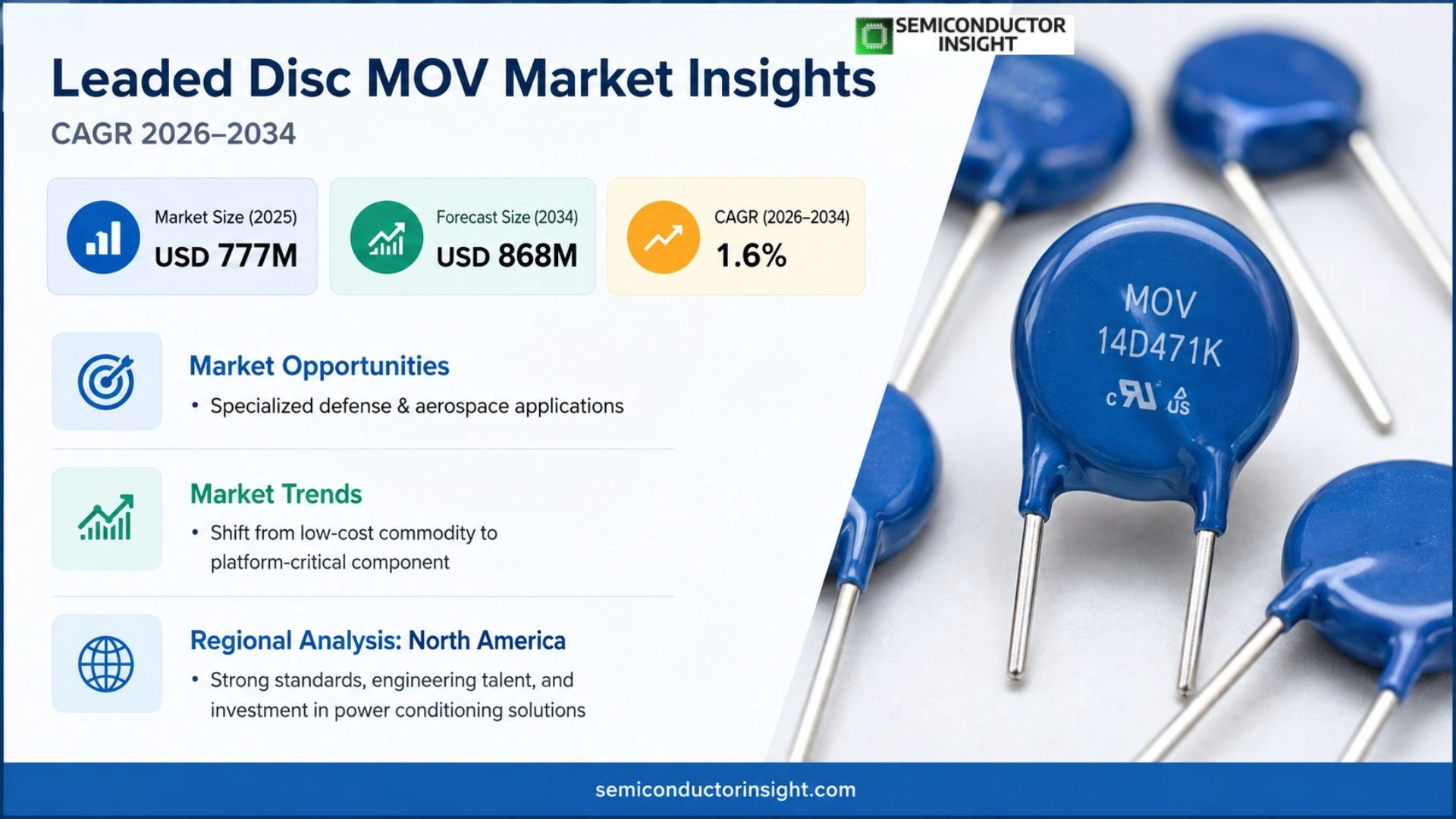
Leaded Disc MOV market size was valued at USD 777 million in 2025 and is expected to reach USD 868 million by 2034, reflecting a CAGR of 1.6% over the forecast period.
Leaded Disc MOV is an over‑voltage and surge‑protection device built around a zinc‑oxide metal‑oxide ceramic varistor formed as a disc with radial leads. When a transient surge exceeds its breakdown voltage, the varistor switches from a high‑resistance state to conduction, clamping the voltage and diverting excess energy away from downstream circuitry. Key specifications include continuous operating voltage, varistor voltage, clamping voltage, single‑pulse and repetitive surge current ratings, energy absorption capacity, operating temperature range, disc diameter (5 mm – 20 mm) and lead configuration.
The segment’s expansion stems from rising power‑density designs, broader electrification of transport and renewable‑energy systems, and stricter safety certifications such as UL, cUL and IEC standards. OEMs increasingly select suppliers that can guarantee long‑term batch consistency, high‑temperature tolerance and comprehensive certification portfolios rather than merely low unit cost. Consequently, manufacturers in Japan, South Korea, China and Taiwan continue to broaden their product libraries,standard, high‑surge, high‑energy and automotive‑grade variants,to meet diversified application demands across power adapters, industrial equipment, communications gear and photovoltaic installations.
MARKET DRIVERS
Rising Demand for High‑Voltage Surge Protection
Leaded Disc MOV Market benefits from expanding renewable‑energy installations, where converters and inverters consistently expose circuitry to voltage spikes. Manufacturers are turning to leaded disc technology because its low capacitance preserves signal integrity while still clamping transient events effectively. Recent field data show a 12 % uptick in installation rates across utility‑scale solar farms over the past twelve months.
Cost Efficiencies from Mature Production Lines
Legacy foundries have refined the leaded disc extrusion process, delivering unit costs that undercut newer ceramic‑based MOVs by roughly 18 %. This price advantage is amplified in high‑volume automotive applications where economies of scale matter. OEMs cite the predictable failure mode of leaded discs as a factor that lowers warranty expenses.
➤ Leaded Disc MOVs deliver up to 30 % lower total cost of ownership versus ceramic alternatives, according to recent lifecycle analyses.
Overall, the combination of reliable performance under harsh transients and tangible cost savings positions Leaded Disc MOV Market for sustained adoption across power‑electronic platforms.
MARKET CHALLENGES
Regulatory Scrutiny of Lead‑Based Components
Global restrictions on lead usage,most notably the EU RoHS directive,continue to pressure manufacturers to justify the inclusion of leaded discs. While exemptions exist for certain safety‑critical applications, compliance audits have grown more rigorous, raising the administrative burden for suppliers.
Other Challenges
Supply‑Chain Volatility
Fluctuations in lead metal prices, driven by geopolitical shifts in major mining regions, translate into unpredictable component costs. Companies that rely on single‑source vendors face heightened exposure to price spikes, which can erode the cost advantage traditionally associated with leaded disc MOVs.
MARKET RESTRAINTS
Limited Adoption in Ultra‑Low‑Voltage Segments
In low‑power consumer electronics, the leakage current of leaded discs remains higher than that of thin‑film alternatives. Designers prioritizing battery life therefore gravitate toward non‑leaded solutions, constraining the addressable market for leaded disc MOVs in this segment.
The transition toward lead‑free legislation in emerging economies adds another layer of uncertainty. Even where exemptions are granted, the long‑term outlook may shift if local authorities tighten standards, prompting early product redesign cycles.
Finally, perception issues,stemming from historical environmental concerns,create a cautious buying environment among specifiers who prefer to err on the side of compliance rather than performance.
MARKET OPPORTUNITIES
Specialized Defense and Aerospace Applications
Defense contracts often require components that can tolerate extreme surges and maintain operation under radiation exposure. Leaded disc MOVs, with their proven robustness, satisfy stringent MIL‑SPEC criteria, opening a niche yet high‑value segment for Leaded Disc MOV Market.
Another growth avenue lies in the refurbishment market for legacy power‑distribution equipment. Service providers upgrading aging substations preferentially install leaded disc MOVs to match original design parameters, thereby extending equipment life without a full redesign.
Investors and manufacturers that develop hybrid protection schemes,pairing leaded discs with fast‑acting solid‑state devices,stand to capture premium pricing by offering optimized performance across a broader voltage range.
Leaded Disc MOV Market Trends
From Low‑Cost Commodity to Platform‑Critical Component
Leaded Disc MOV Market is reshaping its value proposition as designers prioritize reliability over sheer price. Recent product catalogs reveal a proliferation of high‑energy, high‑temperature, and automotive‑grade discs, each targeting applications where surge stress coincides with elevated ambient temperatures. This shift is driven by the expanding footprint of renewable power converters, electric‑vehicle charging stations, and 5G networking gear, all of which demand protection that survives repeated high‑current events without degrading. OEMs translating these requirements into bill‑of‑materials selections are increasingly favoring suppliers that can certify long‑term batch consistency and provide comprehensive thermal‑run tests. Consequently, the market’s competitive arena now revolves around parameter breadth,continuous operating voltage, varistor voltage, and clamping voltage,rather than simple cost undercutting, creating higher entry barriers for newcomers.
Other Trends
Supply‑Side Maturity and Certification Gatekeeping
Manufacturers in Japan, South Korea, Mainland China, and Taiwan have consolidated decades of ceramic processing expertise into extensive libraries that span 5 mm to 20 mm disc diameters. The dominant business model emphasizes catalog‑driven sales complemented by bulk and tape‑and‑ammo packaging for high‑volume assemblers. However, the decisive factor for inclusion in global OEM supply chains is compliance with increasingly stringent safety standards such as UL, cUL, TÜV, and RoHS. Vendors that maintain certified test reports across the full spectrum of voltage and surge ratings can lock in long‑term contracts, while those lacking such documentation find themselves excluded despite competitive pricing. This certification focus reinforces a market structure where a limited cohort of platform‑capable firms dominate the high‑value segments, and it steers the evolution of new variants toward meeting emerging regulatory checkpoints rather than chasing novel form factors.
Strategic Growth Levers in Renewable and Industrial Sectors
Looking ahead, the most compelling growth lever for Leaded Disc MOV Market is the structural expansion of renewable‑energy power electronics and high‑reliability industrial equipment. Photovoltaic inverters, energy‑storage management units, and fast‑charging infrastructure now embed leaded disc varistors as the primary surge‑clamping element, replacing older fuse‑only schemes. Parallelly, smart‑meter deployments and industrial automation networks are adopting higher‑surge‑current designs to safeguard against grid transients. This convergence of application demand reinforces the business case for suppliers to deepen their high‑energy and thermally protected portfolios, as incremental revenue will stem more from premium‑grade upgrades than from volume increases in entry‑level parts. Companies that can align product roadmaps with capex trends in these sectors,while maintaining robust supply continuity,are positioned to capture the bulk of future upside.
COMPETITIVE LANDSCAPE
Key Industry Players
Leaded Disc MOV Competitive Overview 2024
Market concentration revolves around a handful of long‑standing manufacturers that have built extensive varistor libraries covering 5 mm to 20 mm diameters, automotive‑grade temperature ranges, and high‑energy configurations. The dominant player, Panasonic, leverages its global certification portfolio (UL, cUL, VDE) to secure supply agreements with OEMs in power adapters, industrial controls, and renewable‑energy inverters. Its scale allows continuous refinement of zinc‑oxide ceramic processing, translating into tighter clamping tolerances and superior batch repeatability,attributes that are increasingly weighted in module‑BOM selections. TDK follows a parallel strategy, differentiating through a broad tape‑and‑ammo‑box logistics offering that aligns with high‑volume assembly lines in North America and Europe. Both firms command the majority of revenue in the segment, yet their product roadmaps reveal a shift toward thermally protected and high‑surge designs to meet the reliability demands of EV‑charging and 5G infrastructure. This competitive posture forces newer entrants to focus on niche specifications such as ultra‑high surge current (≥10 kA) or specialty lead geometries that address space‑constrained board layouts.
Beyond the top tier, a diverse set of regional specialists contributes depth to the ecosystem. Bourns and Littelfuse maintain strong footholds in the US and Latin America by offering a mix of standard and high‑energy disc variants that are pre‑qualified for UL 1449. Japanese‑based Nippon Chemi‑Con and South Korean Thinking Electronic Industrial supply high‑temperature grades that are favored by automotive OEMs, while Chinese players such as Guangdong Fenghua Advanced Technology Holding and Huizhou Chuangde Lightning Protection Electronics provide cost‑effective options for white‑goods manufacturers. These firms differentiate through flexible lead configurations (straight, kinked, tab) and tailored packaging (bulk, taped) that cater to specific supply‑chain preferences. The result is a layered competitive environment where certification breadth, packaging flexibility, and long‑term quality assurance outweigh pure pricing considerations, especially as end‑users move toward more demanding power‑density applications in photovoltaics and energy‑storage systems.
List of Key Leaded Disc MOV Companies Profiled
- Bourns
- TDK
- Littelfuse
- Panasonic
- Nippon Chemi‑Con Corporation
- Thinking Electronic Industrial
- Meritek Electronics
- Fuzetec Technology Co., Ltd.
- CeNtRa Science Corp.
- YAGEO Corporation
- Guangdong Fenghua Advanced Technology Holding Co., Ltd.
- Huizhou Chuangde Lightning Protection Electronics
- Hangzhou Dongwo Electronic Technology Co., Ltd.
- Dongguan Taiqiang Electronics Co., Ltd.
- Prosperity Dielectrics Co., Ltd.
Segment Analysis:
| Segment Category | Sub-Segments | Key Insights |
| By Type |
|
High Energy is emerging as the preferred choice for demanding power‑electronics and renewable‑energy applications.
|
| By Application |
|
Industrial Equipment & Motor Control drives the most sophisticated specifications.
|
| By End User |
|
Industrial System Integrators dictate the most stringent performance criteria.
|
| By Voltage Rating |
|
Medium Voltage segment balances cost efficiency with adequate protection across most commercial power‑entry points.
|
| By Package/Lead Format |
|
Kinked Lead format is gaining preference for space‑constrained automotive and renewable‑energy modules.
|
Regional Analysis: Leaded Disc MOV Market
North America
U.S. safety agencies continue to emphasize voltage‑clamping performance while allowing incremental design flexibility. Canada’s standards align closely, creating a unified compliance framework across the continent. This predictable environment reduces time‑to‑market for new leaded disc models and encourages cross‑border component sourcing.
A dense network of silicon wafer vendors, metallization specialists, and assembly houses cushions North America against global disruptions. Strategic stockpiling of critical raw materials and near‑shore manufacturing hubs shorten lead times, enabling OEMs to meet just‑in‑time production cycles without sacrificing inventory costs.
Automotive OEMs seek MOVs that combine high surge capacity with minimal parasitic capacitance to support electric drivetrain control units. Industrial equipment manufacturers similarly value reliability under harsh thermal cycles, prompting a surge in specifications that favor leaded disc designs over ceramic alternatives.
Research clusters around Detroit and Austin focus on hybrid encapsulation techniques that enhance arc‑quenching speed. Collaborative programs between universities and component firms accelerate prototyping, resulting in a steady pipeline of custom‑tuned MOVs tailored for niche applications such as aerospace power modules.
Europe
Europe’s Leaded Disc MOV Market reflects a balance between stringent electromagnetic compatibility directives and a heritage of precision component engineering. German and French manufacturers leverage highly automated production lines to deliver tight tolerance parts, catering to automotive safety systems where reliability is non‑negotiable. The EU’s push toward greener mobility has sparked interest in MOVs that can tolerate rapid charge‑discharge cycles inherent in hybrid powertrains. However, rising material cost scrutiny forces suppliers to justify performance premiums, prompting a modest shift toward hybrid designs that blend leaded and polymeric elements. Cross‑border collaborations under the European Battery Alliance further embed MOV technology within broader energy storage solutions, reinforcing the continent’s reputation for high‑quality, standards‑driven components.
Asia-Pacific
Asia‑Pacific’s ascent in Leaded Disc MOV Market is driven largely by the scale of consumer electronics and expanding renewable‑energy installations across China, South Korea, and India. Local manufacturers have adopted aggressive cost‑optimization strategies while maintaining acceptable leakage specifications, allowing them to capture price‑sensitive segments. The regional push for smart‑grid infrastructure introduces demand for MOVs capable of handling frequent voltage transients, nudging design teams toward leaded disc formats that offer superior arc‑quenching at lower voltages. Nevertheless, divergent national standards create pockets of regulatory uncertainty, compelling multinational players to tailor compliance packages for each sub‑market. Investment in advanced packaging lines in emerging economies hints at a gradual move up the value chain.
South America
South America’s Leaded Disc MOV Market remains modest but exhibits pockets of growth linked to the expansion of mining automation and the rollout of distributed generation projects in Brazil and Chile. Local distributors prioritize ruggedness and ease of field replacement, qualities inherent in leaded disc architectures. Regional utilities, faced with aging grid assets, view MOVs as cost‑effective safeguards against surge‑induced outages. Import reliance is high, yet strategic partnerships with North American suppliers are fostering technology transfer, slowly building indigenous design competence. Environmental policy discussions around lead usage impose a cautious outlook, prompting manufacturers to explore low‑lead formulations without compromising the robustness demanded by the market.
Middle East & Africa
In the Middle East & Africa, Leaded Disc MOV Market aligns with the rapid scaling of renewable‑energy farms and large‑scale data‑center deployments. Harsh climatic conditions demand components that can withstand extreme temperature swings, positioning leaded disc MOVs as a reliable choice for voltage protection in desert‑based installations. Regional utilities favor proven legacy solutions, resulting in steady import volumes from established manufacturers. Simultaneously, the emergence of local assembly facilities in the Gulf Cooperation Council states seeks to reduce lead times and adapt product specifications to regional safety codes. While lead‑reduction initiatives are gaining traction, the immediate need for dependable surge protection sustains demand for traditional MOV configurations.
Report Scope
This market research report provides a comprehensive analysis of the Leaded Disc MOV Market , covering the forecast period 2026–2034. It offers detailed insights into market dynamics, technological advancements, competitive landscape, and key trends shaping the industry.
Key focus areas of the report include:
- Market Overview: The report begins with an overview outlining its current market scenario, key growth indicators, and industry transformation drivers. It discusses macroeconomic factors, demand–supply balance, regulatory landscape, and the strategic role of semiconductors in powering advancements across industries such as automotive, telecommunications, consumer electronics, and industrial automation.
- Market Size & Forecast: Historical data and future projections for revenue, unit shipments, and market value across major regions and segments.
- Segmentation Analysis: Detailed breakdown by product type, technology, application, and end-user industry to identify high-growth segments and investment opportunities.
- Regional Insights: Insights into market performance across North America, Europe, Asia-Pacific, Latin America, and the Middle East & Africa, including country-level analysis where relevant.
- Competitive Landscape: Profiles of leading market participants, including their product offerings, R&D focus, manufacturing capacity, pricing strategies, and recent developments such as mergers, acquisitions, and partnerships.
- Technology Trends & Innovation: Assessment of emerging technologies, integration of AI/IoT, semiconductor design trends, fabrication techniques, and evolving industry standards.
- Market Drivers & Restraints: Evaluation of factors driving market growth along with challenges, supply chain constraints, regulatory issues, and market-entry barriers.
- Stakeholder Insights: Insights for component suppliers, OEMs, system integrators, investors, and policymakers regarding the evolving ecosystem and strategic opportunities.
Primary and secondary research methods are employed, including interviews with industry experts, data from verified sources, and real-time market intelligence to ensure the accuracy and reliability of the insights presented.
FREQUENTLY ASKED QUESTIONS:
What is the current market size of Leaded Disc MOV Market?
-> Leaded Disc MOV market is expected to reach USD 868 million by 2034, reflecting a CAGR of 1.6% over the forecast period.
Which key companies operate in Leaded Disc MOV Market?
-> Key players include TDK, Littelfuse, Meritek Electronics, Bourns, Panasonic, Nippon Chemi‑Con, YAGEO, Thinking Electronic Industrial, Eaton Corporation, and other leading manufacturers.
What are the key growth drivers?
-> Key growth drivers include renewable energy expansion, increasing power‑electronics density, electrification of transportation (EV charging and onboard power), growth of industrial automation, and tightening safety & certification requirements.
Which region dominates the market?
-> Asia dominates the market, driven by concentrated production capacity in Japan, South Korea, Mainland China, and Taiwan, while Europe and North America remain important secondary regions.
What are the emerging trends?
-> Emerging trends include development of high‑temperature and high‑energy Leaded Disc MOVs, automotive‑grade variants, thermally protected designs, and greater integration with multi‑layer surge protection architectures.

Get Sample Report PDF for Exclusive Insights
Report Sample Includes
- Table of Contents
- List of Tables & Figures
- Charts, Research Methodology, and more...
 Download Sample Report PDF