DC Molded Case Circuit Breaker Market Insights
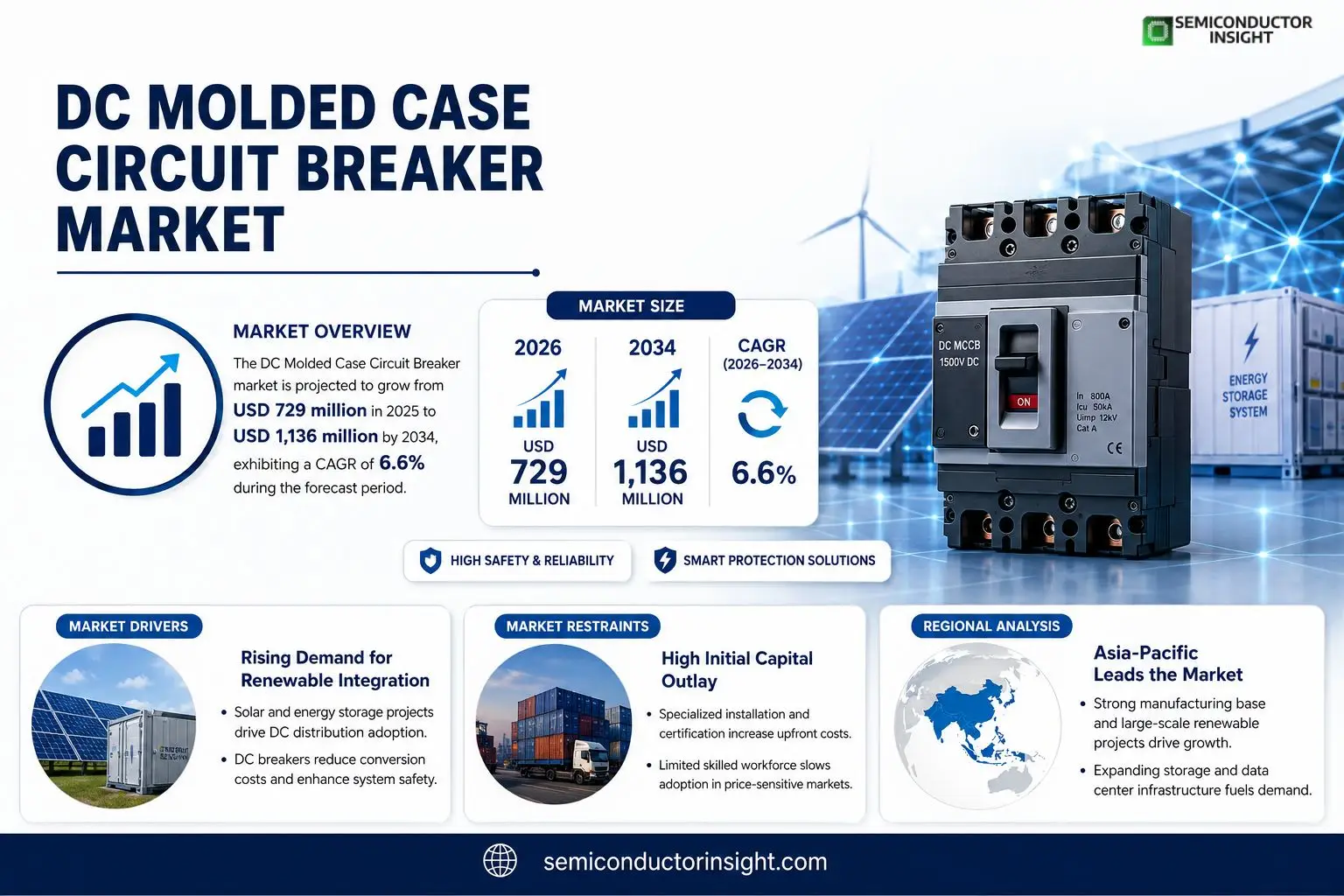
DC Molded Case Circuit Breaker market size was valued at USD 729 million in 2025. The market is projected to grow from USD 729 million in 2025 to USD 1,136 million by 2034, exhibiting a CAGR of 6.6% during the forecast period.
A DC molded case circuit breaker is a medium‑to‑high current protection and isolation device used in DC distribution circuits. It is deployed across photovoltaic DC sides, energy‑storage battery and battery‑connection cabinets, UPS and data‑center high‑voltage DC power supplies, industrial DC distribution, and rail‑transit scenarios. Its core task is to provide reliable overload protection, short‑circuit protection, and safe interruption under DC conditions where there is no natural current zero crossing.The market is experiencing rapid growth due to several factors, including increased investment in renewable‑energy projects, rising adoption of energy‑storage systems, and expanding data‑center power infrastructure. Additionally, advancements in thermal‑magnetic and hybrid‑trip technologies are contributing to market expansion. Initiatives by the key players in the market are also expected to fuel the market growth. For instance, ABB has introduced its SACE Tmax PV covering up to 1500 V DC; LS ELECTRIC and PROJOY have broadened their portfolios with higher voltage and current ratings; Schneider Electric, Siemens and Eaton remain among the leading suppliers offering extensive product ranges.
MARKET DRIVERS
Rising Demand for Renewable Energy Integration
The surge in solar‑plus‑storage projects has pushed designers to rely on DC distribution architectures. Because DC‑rated circuit breakers can protect photovoltaic strings without repeated AC conversion, system designers are favoring the DC Molded Case Circuit Breaker Market as a cost‑effective safety solution. This shift is not merely technical; it translates into higher bill‑of‑materials volumes for manufacturers that can meet the tighter coordination requirements of inverter‑to‑panel layouts.
Stringent Safety and Performance Regulations
Regulatory bodies in Europe and North America have updated IEC standards to mandate over‑current protection on DC branches of 48 V and above. Compliance pressures compel OEMs to replace legacy fuses with molded case breakers that offer repeatable trip curves. Companies that embed testing labs and certification expertise are gaining a competitive edge, as end‑users seek assurance that their installations will pass inspection on first try.
➤ “Designers now allocate up to 15 % of project budgets to advanced DC protection devices, a clear sign that safety compliance is a decisive cost driver.”
Beyond compliance, the improved fault isolation of molded case breakers reduces downtime during preventive maintenance. Operators report a 20 % drop in lost‑production incidents when a reliable DC breaker is in place, reinforcing the business case for higher‑specification protection hardware.
MARKET CHALLENGES
Supply Chain Bottlenecks
shortages of high‑grade semiconductor switches have constrained the ability of breaker manufacturers to scale production. While demand for DC‑rated devices climbs, the limited availability of silicon carbide (SiC) components forces some suppliers to extend lead times to 12 weeks, eroding the responsiveness that system integrators expect.
Other Challenges
Cost Competitiveness
The price premium of DC molded case breakersoften 30 % higher than comparable AC unitsdeters price‑sensitive segments such as residential solar. Without economies of scale or streamlined material sourcing, manufacturers risk losing market share to lower‑cost alternatives that may not meet the latest safety standards.Moreover, the rapid evolution of DC‑fast‑charging standards introduces a moving target for product development. Companies that cannot synchronize their engineering cycles with emerging protocol revisions may face obsolescence risk, further complicating investment decisions.
MARKET RESTRAINTS
High Initial Capital Outlay
Installation of molded case circuit breakers in DC networks requires specialized mounting hardware and qualified technicians. The upfront capital required for tooling, certification, and training can outweigh short‑term savings, especially for small‑scale developers who operate on thin margins.The limited pool of certified installers further restricts adoption. Project planners often prefer conventional fuse solutions because the workforce is already familiar with them, creating a self‑reinforcing barrier to market penetration.Finally, the perceived complexity of coordinating breaker settings with inverter protection schemes adds a layer of engineering risk. Without clear design guidelines, some system architects opt for simpler, albeit less efficient, protection strategies.
MARKET OPPORTUNITIES
Growth of Electric Vehicle Infrastructure
The rollout of high‑power DC fast‑charging stations across Europe and Asia demands reliable over‑current devices that can handle up to 500 A. Molded case circuit breakers tailored for these power levels are poised to become a standard component in charging hubs, opening a sizable revenue stream for vendors that can certify their products for automotive safety standards.
Smart Grid Deployment
Advanced distribution management systems increasingly incorporate remote monitoring of DC protection devices. Breakers equipped with digital communication modules enable utilities to perform predictive maintenance, a service that can be monetized through subscription‑based analytics platforms.
Modular Design Innovation
Emerging modular architectures allow a single molded case breaker to be stacked or linked, providing scalable protection for micro‑grids and off‑grid installations. Companies that invest in modular product lines are positioned to capture projects ranging from remote telecom sites to temporary disaster‑relief power supplies.
DC Molded Case Circuit Breaker Market Trends
Rising Renewable Power Drives Demand
The shift from traditional industrial distribution to large‑scale solar and battery installations has placed medium and high current DC protection at the forefront of system design. Photovoltaic projects now require combiner boxes and inverter fronts that operate above 1000 V DC, while utility‑scale storage adds a permanent need for reliable isolation under continuous DC load. Data centre operators, confronting a doubling of DC power consumption, are specifying breakers that can be integrated with auxiliary contacts and shunt releases to minimise downtime. This confluence of renewable generation, storage, and high‑density computing creates a market environment where the reliability of the DC Molded Case Circuit Breaker Market becomes a decisive factor in project economics and safety compliance.
Other Trends
Product Evolution Toward Higher Voltage and Current
Leading manufacturers have extended their portfolios to cover 1500 V DC platforms and frame sizes reaching 1600 A, reflecting customer demand for fewer devices in compact cabinets. Thermal‑magnetic trip remains dominant, yet hybrid solutions are emerging that combine low temperature rise with zero‑arc flash chambers. Accessory ecosystemsplug‑in, draw‑out, and fixed mounting optionsare now standard, allowing system integrators to select a single breaker family across photovoltaic, storage, and rail transit projects. The competitive focus is therefore moving from pure interrupting rating toward holistic platform value, where engineering flexibility and lifecycle cost become pricing levers.
Geographic Competition and Channel Expansion
International brands such as ABB, Siemens, and Schneider Electric retain leadership in high‑specification certifications and large‑project execution, while Chinese suppliers accelerate market penetration by offering cost‑effective units across the 1000 V to 1500 V range. Korean and Japanese players occupy niche segments that demand ultra‑reliable performance in HVDC and specialized transit applications. This tiered structure pushes pricing upward for premium configurations and creates opportunities for regional distributors to bundle accessories and services. Companies that can align product roadmaps with regional regulatory trends and develop localized support networks are likely to capture outsized share of the evolving DC Molded Case Circuit Breaker Market.
COMPETITIVE LANDSCAPEKey Industry Players
Competitive Overview of DC Molded Case Circuit Breaker Market
ABB continues to dominate the high‑voltage segment, leveraging its SACE Tmax PV line that spans up to 1500 V DC and exceeds 1200 A. The breadth of its portfolio, strong certification base, and deep experience in large‑scale photovoltaic and energy‑storage projects give it pricing leverage and a preferred status among system integrators. Siemens follows closely with its 3VD series, which concentrates on compact two‑pole designs to meet space‑constrained installations in data centers and UPS applications. Both firms benefit from distribution networks and a reputation for reliability, positioning them as the benchmark for premium‑grade DC MCCBs.Beyond the tier‑one giants, a cluster of Chinese and Asian manufacturers intensifies competition on cost, product breadth, and speed of innovation. CHINT and Hongfa have expanded their offerings to cover 1000–1500 V DC platforms with frame ratings up to 1600 A, directly challenging international brands on price‑sensitive projects in emerging markets. Korean player LS ELECTRIC and Japan’s Mitsubishi Electric provide hybrid‑trip solutions that cater to the stringent reliability demands of rail‑transit and industrial DC distribution. Smaller firms such as Projoy, ETEK, and ACE REARE focus on niche accessory ecosystemsauxiliary contacts, shunt releases, and draw‑out mechanismsadding differentiated value that can sway contract decisions where installation efficiency and lifecycle serviceability matter most.
List of Key DC Molded Case Circuit Breaker Companies Profiled
- ABB
- Siemens
- Schneider Electric
- Eaton
- LS ELECTRIC
- CHINT Group Co., Ltd.
- Hongfa (Xiamen Hongfa Electroacoustic Co., Ltd.)
- Projoy Electric Co., Ltd.
- ETEK Electrical Technology Co., Ltd.
- Mitsubishi Electric
- Fuji Electric
- ACE REARE
- Benyi New Energy Co., Ltd.
- Taixi Electric
- CNC Electric
Segment Analysis:
| Segment Category | Sub-Segments | Key Insights |
| By Type |
|
Distribution Protection
|
| By Application |
|
New Energy
|
| By End User |
|
Panel Builders & System Integrators
|
Regional Analysis: DC Molded Case Circuit Breaker Market
North America
Federal safety standards have been amended to recognise the specific fault‑level characteristics of DC circuits, granting manufacturers clearer pathways to certification. State‑level incentives for grid‑modernisation projects reinforce compliance momentum, prompting early‑stage adoption among utility engineers.
Leading OEMs are pursuing joint‑development agreements with semiconductor firms to embed arc‑fault detection directly into breaker housings. This collaboration shortens time‑to‑market for next‑generation devices and differentiates offerings in a crowded field.
The availability of high‑grade copper and silicon carbide has become a strategic lever; manufacturers are diversifying sources to shield production from geopolitical fluctuations, while also exploring recycled material streams to meet ESG targets.
Electric‑vehicle fast‑charging stations are beginning to specify molded‑case breakers as a preferred protection solution, citing their compact footprint and ability to handle rapid load transients inherent to high‑power chargers.
Europe
European utilities are leveraging the DC Molded Case Circuit Breaker Market to meet stringent energy‑efficiency directives set by the European Green Deal. The transition to DC microgrids in urban redevelopment schemes is creating a niche for breakers that combine high‑voltage tolerance with modular designs. Moreover, the region’s strong focus on digital twins encourages manufacturers to embed communication protocols that align with IEC 61850, allowing system operators to simulate fault scenarios remotely. Demand from offshore wind farms is also rising, where space‑constrained substations benefit from the reduced footprint of molded‑case solutions.
Asia‑Pacific
In Asia‑Pacific, rapid industrialisation and the rollout of large‑scale solar farms are accelerating interest in DC protection equipment. Countries such as China, India, and Vietnam are constructing utility‑scale DC distribution networks to minimise transmission losses over long distances. Local OEMs are scaling production capacity, yet they are challenged by the need to comply with varying national safety codes. Partnerships with Western firms are emerging as a strategy to acquire advanced designs while tailoring them to regional cost structures, thereby expanding the market’s reach across both mature and emerging economies.
South America
South American markets are at an inflection point as governments incentivise renewable‑energy integration to reduce reliance on hydro‑dependent grids. The deployment of DC‑based photovoltaic farms in Brazil and Chile is prompting utilities to seek breakers that can tolerate higher ambient temperatures and corrosive coastal conditions. While the overall market remains fragmented, recent public‑private collaborations are establishing standardized testing procedures, which should foster greater confidence among end‑users and stimulate incremental adoption.
Middle East & Africa
The Middle East & Africa region is witnessing a gradual shift from legacy AC protection schemes toward DC solutions, driven by ambitious solar‑power targets and the emergence of data‑center hubs in the Gulf. Harsh desert environments demand breakers with robust thermal management, prompting manufacturers to introduce reinforced enclosures and ceramic inserts. In Africa, pilot projects for off‑grid solar microgrids are evaluating molded‑case breakers as a low‑maintenance alternative, highlighting the technology’s potential to support electrification initiatives in remote communities.
Report Scope
This market research report provides a comprehensive analysis of the DC Molded Case Circuit Breaker Market , covering the forecast period 2026–2034. It offers detailed insights into market dynamics, technological advancements, competitive landscape, and key trends shaping the industry.
Key focus areas of the report include:
-
Market Overview: The report begins with an overview outlining its current market scenario, key growth indicators, and industry transformation drivers. It discusses macroeconomic factors, demand–supply balance, regulatory landscape, and the strategic role of semiconductors in powering advancements across industries such as automotive, telecommunications, consumer electronics, and industrial automation.
- Market Size & Forecast: Historical data and future projections for revenue, unit shipments, and market value across major regions and segments.
- Segmentation Analysis: Detailed breakdown by product type, technology, application, and end-user industry to identify high-growth segments and investment opportunities.
- Regional Insights: Insights into market performance across North America, Europe, Asia-Pacific, Latin America, and the Middle East & Africa, including country-level analysis where relevant.
- Competitive Landscape: Profiles of leading market participants, including their product offerings, R&D focus, manufacturing capacity, pricing strategies, and recent developments such as mergers, acquisitions, and partnerships.
- Technology Trends & Innovation: Assessment of emerging technologies, integration of AI/IoT, semiconductor design trends, fabrication techniques, and evolving industry standards.
- Market Drivers & Restraints: Evaluation of factors driving market growth along with challenges, supply chain constraints, regulatory issues, and market-entry barriers.
- Stakeholder Insights: Insights for component suppliers, OEMs, system integrators, investors, and policymakers regarding the evolving ecosystem and strategic opportunities.
Primary and secondary research methods are employed, including interviews with industry experts, data from verified sources, and real-time market intelligence to ensure the accuracy and reliability of the insights presented.
FREQUENTLY ASKED QUESTIONS:
What is the current market size of DC Molded Case Circuit Breaker Market?
-> DC Molded Case Circuit Breaker Market was valued at USD 729 million in 2025 and is expected to reach USD 1,136 million by 2034, growing at a CAGR of 6.6% during the forecast period.
Which key companies operate in DC Molded Case Circuit Breaker Market?
-> Key players include ABB, LS ELECTRIC, PROJOY, ETEK, CHINT, Siemens, Schneider Electric, Eaton, Mitsubishi Electric, Fuji Electric, and other regional manufacturers.
What are the key growth drivers?
-> Key growth drivers include rapid expansion of renewable power generation (especially solar PV), large‑scale energy storage deployment, increasing data‑center and EV charging infrastructure, rising electricity demand (≈3.6% CAGR), and the need for higher‑voltage DC distribution solutions.
Which region dominates the market?
-> Asia‑Pacific holds the largest market share, driven by strong manufacturing capabilities in China and extensive renewable‑energy and storage projects across the region.
What are the emerging trends?
-> Emerging trends include progression to higher DC rated voltages (up to 1,500 V), larger current frames (up to 1,600 A), enhanced breaking capacity, broader environmental tolerance, hybrid thermal‑magnetic trip technology, modular pole configurations, and integration of smart monitoring accessories.

Get Sample Report PDF for Exclusive Insights
Report Sample Includes
- Table of Contents
- List of Tables & Figures
- Charts, Research Methodology, and more...
 Download Sample Report PDF