Molded Case Circuit Breaker for Photovoltaic Market Insights
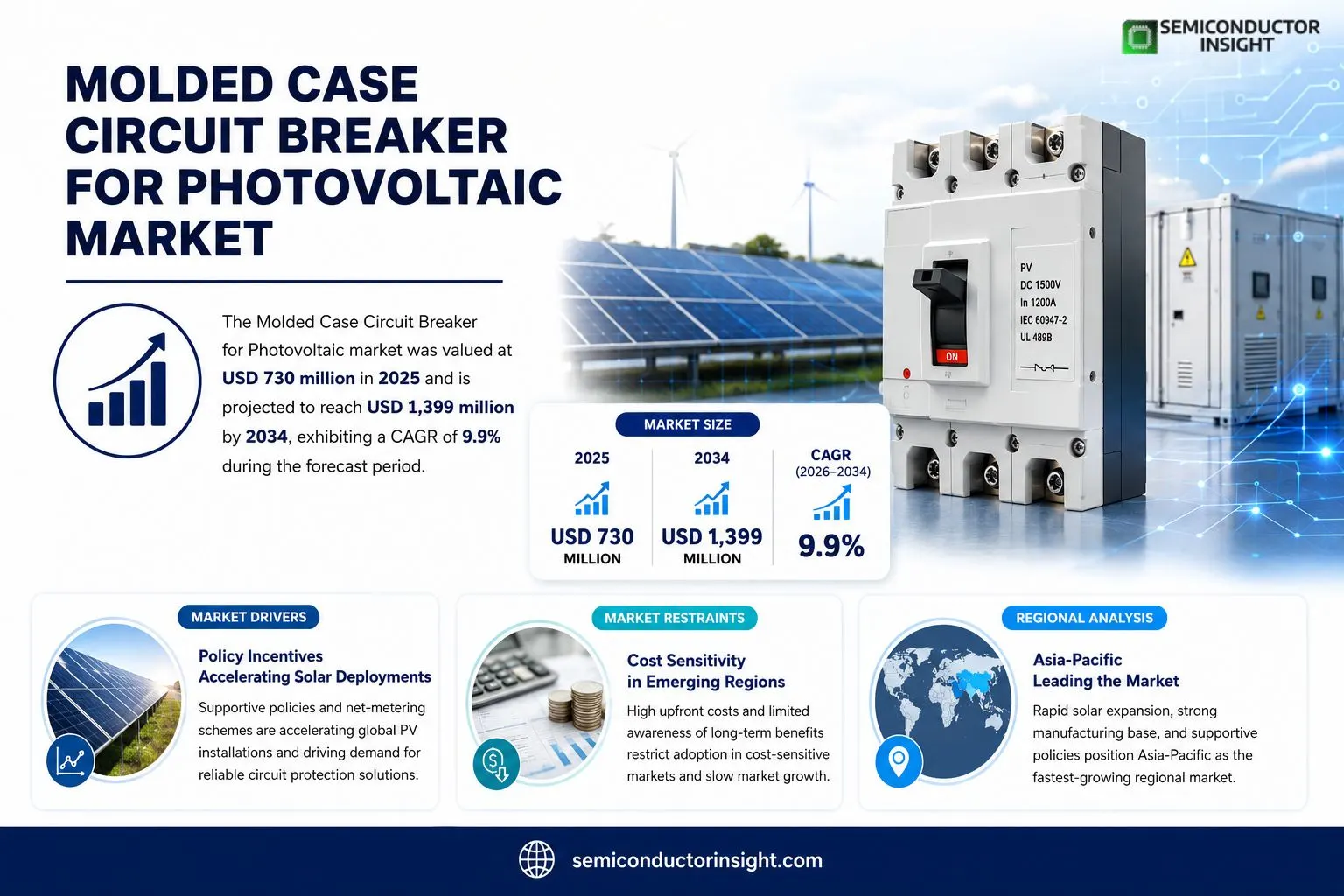
Molded Case Circuit Breaker for Photovoltaic market was valued at USD 730 million in 2025 and is projected to reach USD 1,399 million by 2034, exhibiting a CAGR of 9.9% during the forecast period.
A molded case circuit breaker for photovoltaic applications is a medium‑to‑high current protection and isolation device installed on the DC side or at the AC‑DC interface of solar power systems. Its core function includes overload protection, short‑circuit interruption, fault isolation and maintenance isolation within combiner boxes, junction boxes, inverters, DC cabinets and related switchgear. By preventing reverse connections, arcing and overcurrent in high‑voltage DC circuits, it safeguards system safety and generation continuity. Recent product releases emphasize higher DC voltage ratings (up to 1500 VDC), expanded current frames (600 A–1600 A), improved arc‑extinguishing capability and compliance with IEC 60947‑2, UL 489 and UL 489B standards.
MARKET DRIVERS
Policy Incentives Accelerating Solar Deployments
The rollout of net‑metering tariffs and renewable‑energy credits has nudged utilities and independent power producers toward larger photovoltaic (PV) installations. Those schemes reduce the levelized cost of electricity, prompting system designers to prioritize safety devices that can handle higher currents without compromising reliability. Molded Case Circuit Breaker for Photovoltaic Market beneficiaries are therefore witnessing a surge in specification requirements.
Technological Convergence of DC and AC Protection
Modern inverters increasingly operate with dual‑mode protection, demanding circuit breakers that can safely interrupt both direct and alternating currents. Manufacturers that integrate low‑temperature magnetic release mechanisms are gaining preference because they minimize arc energy and reduce downtime during fault events. This shift is reshaping procurement norms across residential, commercial, and utility‑scale projects.
➤ Industrial adopters report a 12% reduction in outage durations after retrofitting molded case breakers with smart‑trip analytics.
Beyond compliance, system integrators are valuing the compact footprint of molded case devices, which simplifies rack‑mount layouts and cuts balance‑of‑system weight. As photovoltaic farms expand into constrained rooftops and offshore platforms, the space‑saving attribute directly translates into higher module density and better return on investment.
MARKET CHALLENGES
Stringent Certification Processes
Achieving UL 489 and IEC 60947‑2 certification for DC applications requires extensive testing cycles. Small‑to‑mid‑size manufacturers often lack the capital to fund multiple prototype iterations, causing them to lag behind larger competitors in product launches.
Other Challenges
Supply‑Chain Volatility
The reliance on copper and specialty alloys ties breaker production to commodity price swings. Recent geopolitical tensions have strained raw‑material availability, inflating bill‑of‑materials costs and compressing profit margins for OEMs.
MARKET RESTRAINTS
Cost Sensitivity in Emerging Regions
Developing markets prioritize upfront capital efficiency, often opting for conventional thermal fuses over molded case breakers. The higher initial outlay, despite longer life‑cycle savings, hampers broader adoption in regions where financing structures remain conservative.Furthermore, limited awareness of the long‑term reliability advantages of molded case technology creates a perception gap. Without targeted education programs, project owners may undervalue the operational benefits, reinforcing the status quo of cheaper, less robust protection schemes.
MARKET OPPORTUNITIES
Smart‑Grid Integration and Remote Monitoring
Embedding IoT sensors within molded case breakers enables real‑time fault detection and predictive maintenance. Service providers that bundle analytics platforms with the hardware can command premium pricing, while utilities gain actionable insights to optimize grid stability.In parallel, the emergence of bifacial modules and high‑efficiency panels increases overall system voltage, demanding breakers with elevated breaking capacities. Companies that certify products for 1500 V DC and above are positioned to capture a sizable share of upcoming utility‑scale contracts.
Molded Case Circuit Breaker for Photovoltaic Market Trends
Shift Toward Higher DC Voltage Ratings
The latest specifications from leading manufacturers show a clear concentration around DC 1000 V and DC 1500 V platforms. This migration mirrors the industry’s push to lower line losses and accommodate larger inverter modules in utility‑scale projects. By extending the voltage envelope, system designers can reduce the number of series‑connected strings, simplifying combiner box layouts and cutting balance‑of‑system costs. At the same time, the current frame has expanded from the traditional 600 A range to 1200 A and even 1600 A, enabling a single breaker to serve high‑density string architectures. Molded Case Circuit Breaker for Photovoltaic Market therefore reflects a technical inflection point where voltage and current capabilities become primary selection criteria rather than mere compliance checks.
Other Trends
Cross‑Application Integration with Energy Storage and Data‑Center DC
Product catalogs now list dual‑certified units that satisfy both IEC 60947‑2 and UL 489B while offering accessory kits for battery‑management systems and high‑density data‑center switchgear. This convergence is driven by the growing practice of co‑locating solar farms with behind‑the‑meter storage, which creates a continuous DC distribution backbone. Suppliers that can guarantee consistent arc‑extinguishing performance across a 1500 VDC rating and a 1600 A frame are gaining preference in projects where an inverter, a storage rack, and a UPS share the same protective device. The practical outcome is a reduction in the parts count for EPC contractors and a smoother certification pathway for projects targeting multiple standards.
Regional Competitive Dynamics
In Europe and the United States, multinational firms such as ABB, Schneider Electric, and Eaton dominate high‑end tenders, leveraging extensive IEC/UL portfolios and service networks. Asian manufacturers, particularly from China, focus on volume production of 1500 VDC breakers, emphasizing rapid customization and cost efficiency to capture fast‑track EPC contracts in emerging markets like India, Brazil, and the Middle East. Japanese and Korean players retain a niche by promoting proven reliability in HVDC‑linked solar installations. The competitive landscape is thus bifurcated: premium projects prioritize certification breadth and long‑term service guarantees, while price‑sensitive deployments lean on local supply chains and accelerated delivery. This duality shapes sourcing strategies and informs where new entrants should allocate R&D resources.
COMPETITIVE LANDSCAPE
Key Industry Players
Molded Case Circuit Breaker Landscape for Photovoltaic Applications
The segment is dominated by multinational firms that have translated their low‑voltage protection expertise into purpose‑built PV solutions. ABB, Schneider Electric and Eaton command the premium tier by offering dual IEC/UL certification, extensive accessory portfolios and project services that match the stringent bankability requirements of utility‑scale developers. Their product families consistently span DC 1000–1500 V and 600‑1600 A, enabling system architects to consolidate protection in a single device and reduce bill of materials. This capability, combined with long‑term service networks, locks them into high‑value contracts across Europe, North America and selected Asian markets, where certification and lifecycle support are decisive tender criteria.Beyond the top tier, a cohort of Japanese, Korean and Chinese manufacturers is expanding the competitive set with highly engineered, cost‑effective alternatives. Mitsubishi Electric, Fuji Electric and LS ELECTRIC leverage their heritage in HVDC and data‑center switching to deliver breakers with superior arc‑extinguishing performance, appealing to projects that push DC voltages toward 1500 V. Chinese players such as Chint Group, Tianjin CNY, Dongfang Electric, Sungrow Power and TDK are rapidly scaling production of 1200‑1600 A units, capitalising on proximity to PV module assemblers and offering aggressive delivery lead times. Their emphasis on regional compliance, localized service hubs and flexible configuration support makes them the preferred choice for fast‑track installations in China, India and emerging markets where price sensitivity and rapid execution dominate procurement decisions.
List of Key Molded Case Circuit Breaker for Photovoltaic Companies Profiled
- ABB Ltd.
- Schneider Electric
- Eaton Corporation
- Mitsubishi Electric
- Fuji Electric
- LS ELECTRIC
- Chint Group
- Tianjin CNY
- Dongfang Electric
- Sungrow Power
- TDK Corporation
- Hitachi Energy
Segment Analysis:
| Segment Category | Sub-Segments | Key Insights |
| By Type |
|
High‑Voltage DC Segment is becoming the core differentiator for PV projects.
|
| By Application |
|
Expanded Application Base reflects the migration of MCCBs from purely protective roles to system‑level integration points.
|
| By End User |
|
End‑User Priorities shape product specifications and selection criteria.
|
| By Standard Compliance |
|
Certification as a Market Gatekeeper drives procurement in regulated regions.
|
| By Supply Base Geography |
|
Geographic Supply Dynamics influence pricing strategy, lead times, and risk mitigation.
|
Regional Analysis: Molded Case Circuit Breaker for Photovoltaic Market
Europe
The updated Low Voltage Directive and the EU’s Renewable Energy Action Plan have tightened certification criteria for protection equipment, forcing suppliers to demonstrate higher short‑circuit endurance and environmental compliance. This regulatory rigor has filtered out marginal players and elevated the market’s overall technical bar.
Recent disruptions highlighted the fragility of cross‑border component flows. European firms now favour a hybrid sourcing model that blends domestic coil production with selective overseas procurement, reducing exposure to geopolitical shocks while retaining cost advantages.
Smart‑enabled breakers that communicate via IEC 61850 are gaining traction in micro‑grid projects across the Nordics. Operators value the ability to remotely monitor fault conditions, which translates into lower maintenance cycles and higher plant availability.
Established OEMs leverage legacy relationships with EPC contractors, while emerging players differentiate through modular designs that fit a broader range of inverter sizes, creating a nuanced competitive ecosystem.
North America
North America’s trajectory for the Molded Call Circuit Breaker for Photovoltaic Market is defined by a patchwork of state incentives and a strong emphasis on grid reliability. In the United States, the push for residential solar installations has led distributors to favour compact breakers that can be retrofitted into existing panelboards. Canadian provinces, meanwhile, are prioritising equipment that can endure harsh climatic swings, prompting manufacturers to offer enhanced temperature‐rating options. The overall effect is a market that rewards flexibility and durability, with forward‑looking firms seeking partnerships with utility‑scale developers to embed advanced protection schemes early in project design.
Asia‑Pacific
The Asia‑Pacific region presents a fertile environment for Molded Case Circuit Breaker for Photovoltaic Market, driven by rapid utility‑scale roll‑outs in China, India and Southeast Asia. Policy frameworks that couple capacity‑building subsidies with stringent safety standards have accelerated the adoption of higher‑rated breakers. Local manufacturers benefit from economies of scale, yet they face pressure to meet evolving IEC compliance benchmarks, prompting a wave of joint‑venture initiatives with Western technology partners. This dynamic fosters a competitive landscape where cost efficiency coexists with an escalating demand for performance consistency.
South America
South America’s solar expansion, especially in Brazil and Chile, is reshaping demand patterns for molded case circuit breakers. Developers are increasingly specifying units that can tolerate elevated humidity and corrosive coastal conditions, reflecting the region’s diverse geography. Financial incentives tied to long‑term power purchase agreements have made reliability a decisive factor, encouraging system owners to select breakers with proven fault‑interrupt capability. Consequently, regional distributors are gravitating toward suppliers that can provide tailored warranty structures and localized technical support.
Middle East & Africa
In the Middle East & Africa, Molded Case Circuit Breaker for Photovoltaic Market is evolving alongside ambitious solar‑park projects in the United Arab Emirates, Saudi Arabia and South Africa. Harsh desert temperatures and sand ingress demand robust enclosure designs, prompting OEMs to introduce enhanced sealing technologies. Meanwhile, emerging financing models, such as public‑private partnerships, have heightened the importance of equipment that can demonstrate low lifecycle cost. Stakeholders who can align product durability with financing criteria are positioning themselves as preferred partners in this high‑visibility market segment.
Report Scope
This market research report provides a comprehensive analysis of the Molded Case Circuit Breaker for Photovoltaic Market , covering the forecast period 2026–2034. It offers detailed insights into market dynamics, technological advancements, competitive landscape, and key trends shaping the industry.
Key focus areas of the report include:
- Market Overview: The report begins with an overview outlining its current market scenario, key growth indicators, and industry transformation drivers. It discusses macroeconomic factors, demand–supply balance, regulatory landscape, and the strategic role of semiconductors in powering advancements across industries such as automotive, telecommunications, consumer electronics, and industrial automation.
- Market Size & Forecast: Historical data and future projections for revenue, unit shipments, and market value across major regions and segments.
- Segmentation Analysis: Detailed breakdown by product type, technology, application, and end-user industry to identify high-growth segments and investment opportunities.
- Regional Insights: Insights into market performance across North America, Europe, Asia-Pacific, Latin America, and the Middle East & Africa, including country-level analysis where relevant.
- Competitive Landscape: Profiles of leading market participants, including their product offerings, R&D focus, manufacturing capacity, pricing strategies, and recent developments such as mergers, acquisitions, and partnerships.
- Technology Trends & Innovation: Assessment of emerging technologies, integration of AI/IoT, semiconductor design trends, fabrication techniques, and evolving industry standards.
- Market Drivers & Restraints: Evaluation of factors driving market growth along with challenges, supply chain constraints, regulatory issues, and market-entry barriers.
- Stakeholder Insights: Insights for component suppliers, OEMs, system integrators, investors, and policymakers regarding the evolving ecosystem and strategic opportunities.
Primary and secondary research methods are employed, including interviews with industry experts, data from verified sources, and real-time market intelligence to ensure the accuracy and reliability of the insights presented.
FREQUENTLY ASKED QUESTIONS:
What is the current market size of Molded Case Circuit Breaker for Photovoltaic Market?
-> Molded Case Circuit Breaker for Photovoltaic Market was valued at USD 730 million in 2025 and is expected to reach USD 1399 million by 2034, at a CAGR of 9.9% during the forecast period.
Which key companies operate in Molded Case Circuit Breaker for Photovoltaic Market?
-> Key players include ABB, Schneider Electric, Eaton, Mitsubishi Electric, Fuji Electric, LS ELECTRIC, among others.
What are the key growth drivers?
-> Key growth drivers include rising solar PV installations, shift to higher DC voltage architectures, integration with energy storage and data‑center applications, and supportive renewable energy policies worldwide.
Which region dominates the market?
-> Asia-Pacific is the fastest‑growing region, while Europe remains a dominant market.
What are the emerging trends?
-> Emerging trends include DC voltage ratings of 1000‑1500 V, larger current frames up to 1600 A, dual IEC/UL certification, and expanded applications in UPS, data centres, and electric‑vehicle charging infrastructure.

Get Sample Report PDF for Exclusive Insights
Report Sample Includes
- Table of Contents
- List of Tables & Figures
- Charts, Research Methodology, and more...
 Download Sample Report PDF