Key Statistics
Key Takeaways
- 8 Inch MEMS Wafer is the leading source-defined type because 200 mm processing improves die output and supports transfer of selected MEMS flows into higher-volume manufacturing infrastructure.
- MEMS Microphones are the largest source-defined application, benefiting from smartphones, wearables, hearables, voice interfaces and other devices that require multiple compact acoustic sensors.
- Asia Pacific is the largest market because it combines high-volume electronics demand with foundry and semiconductor manufacturing infrastructure; North America remains a major innovation and capacity-expansion market.
- Capacity localization is accelerating. Silex agreed in July 2026 to acquire a 200 mm Pennsylvania fab for USD 40 million and convert it to MEMS production, while a U.S. CHIPS proposal supports a separate pure-play MEMS foundry in Florida.
- Process customization and yield learning are the central competitive barriers. MEMS flows are device-specific, so transferring a design between foundries requires more engineering than transferring a standardized digital IC process.
Pure-play MEMS Foundry Market Overview
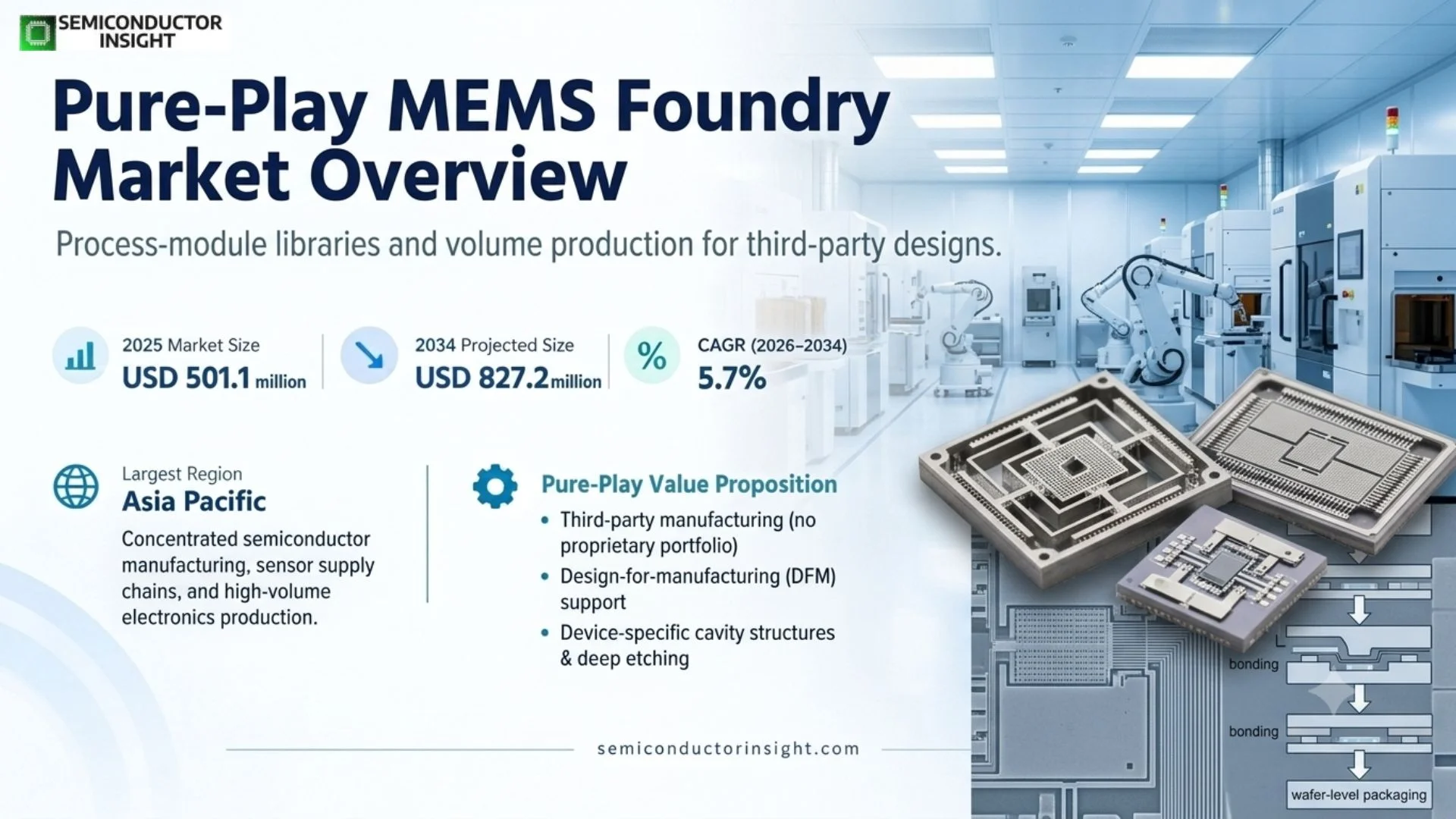
Pure-Play MEMS Foundry Market was valued at USD 501.1 million in 2025 and is projected to reach USD 827.2 million by 2034, expanding at a 5.7% over 2026–2034. The 2026 market value is USD 529.8 million. Asia Pacific represents the largest market in 2025, supported by the concentration of semiconductor manufacturing, sensor supply chains and high-volume electronics production across Taiwan, China, Japan and other Asian markets.
Pure-play MEMS foundries manufacture micro-electro-mechanical systems for third-party customers without relying on a proprietary end-product portfolio. Their value proposition is a combination of process-module libraries, design-for-manufacturing support, wafer fabrication, bonding, wafer-level packaging and volume production. Unlike standardized logic foundry processes, MEMS flows often depend on device-specific materials, cavity structures, deep etching, mechanical layers and packaging steps that must be tuned to the customer’s physical sensor or actuator.
Demand spans consumer electronics, automotive, industrial, medical and communications applications. The source-defined market includes accelerometers, gyroscopes, digital compasses, MEMS microphones, pressure sensors and temperature sensors. The commercial trend toward 200 mm MEMS processing reflects a search for better wafer economics and compatibility with larger-scale semiconductor infrastructure, but 150 mm and smaller lines remain economically relevant for high-mix, specialized devices and long-lived qualified processes.
Capacity expansion is becoming more geographically diversified. Silex disclosed in July 2026 that it had agreed to acquire a 200 mm fab in Pennsylvania for USD 40 million and convert it to MEMS, creating its first U.S. manufacturing base. Separately, the U.S. Department of Commerce proposed up to USD 6.7 million for Rogue Valley Microdevices’ Florida pure-play MEMS and sensor foundry, a project expected to nearly triple the company’s manufacturing capacity and support 300 mm MEMS capability.
Segment Analysis: By Type
By type, the source-defined market is segmented into 4 Inch MEMS Wafer, 6 Inch MEMS Wafer, 8 Inch MEMS Wafer and Others. The 8-inch segment leads because 200 mm lines offer more die per wafer, stronger automation potential and closer integration with modern semiconductor equipment, while smaller wafers remain important for specialty processes where installed tools and qualified recipes are already depreciated.
| Type | Technical / commercial role | Market position and purchasing logic |
|---|---|---|
| 4 Inch MEMS Wafer | 100 mm MEMS processing remains relevant for research, prototyping, legacy products and highly specialized devices where volume does not justify migration. Tooling can be flexible and lower cost, but die output per wafer and automation economics are weaker than on larger diameters. | A niche and legacy-oriented segment. Customers stay on 100 mm when a process is deeply qualified, product volume is limited, or specialized equipment would be costly to replicate on a larger platform. Lifecycle stability can matter more than unit-cost optimization. |
| 6 Inch MEMS Wafer | 150 mm production is widely used for mature MEMS products and offers a strong balance between specialized process flexibility and scalable manufacturing. Many foundry toolsets support deep reactive ion etch, deposition, bonding and wafer-level packaging on this diameter. | A durable high-mix production base. Teledyne DALSA operates MEMS on both 150 mm and 200 mm, illustrating how foundries maintain multiple wafer diameters to match customer volumes, legacy process ownership and package integration needs. |
| 8 Inch MEMS Wafer | 200 mm production provides more die per wafer and greater alignment with automated semiconductor infrastructure. It is increasingly used for higher-volume MEMS microphones, inertial sensors, pressure devices and MEMS-on-CMOS integration where the process flow can be standardized enough to justify transfer. | Largest type in 2025. The 200 mm segment has the strongest scaling economics, but migration requires process redevelopment and qualification. Foundries that already operate mature 200 mm MEMS lines can win higher-volume programs while preserving specialized process flexibility. |
| Others | The source-defined residual category captures wafer formats and process platforms outside 100, 150 and 200 mm, including emerging larger-diameter work or non-standard substrates. These projects can target specific materials, research programs or integration schemes rather than mainstream volume economics. | A technology-development segment rather than the current volume anchor. Potential upside comes from 300 mm MEMS integration and heterogeneous processing, but adoption depends on whether device designs and toolsets can justify the higher capital and process-transfer burden. |
Why wafer diameter is a commercial decision, not only a process choice
Moving a MEMS process from 150 mm to 200 mm can improve die output and automation, but the transfer is rarely a simple shrink. Etch profiles, film stress, wafer bow, bonding behavior, cavity formation, test and package interactions can all change with equipment and wafer diameter. The foundry must therefore compare lower potential unit cost against engineering effort, qualification time and the risk of disturbing a stable legacy process.
Segment Analysis: By Application
By application, the source segments the market into Accelerometer, Gyroscope, Digital Compass, MEMS Microphone, Pressure Sensor, Temperature Sensor and Others. MEMS microphones are the leading source-defined application, while automotive and industrial sensing broaden the opportunity for inertial and pressure devices that require stringent quality systems and longer product lifecycles.
| Application | Demand characteristics |
|---|---|
| Accelerometer | Accelerometers serve smartphones, wearables, automotive safety, industrial condition monitoring and navigation. Foundry requirements vary from very high-volume consumer devices to high-reliability automotive parts. Customers evaluate noise, bias stability, mechanical robustness, package interaction and the foundry’s ability to hold critical dimensions across long production runs. |
| Gyroscope | MEMS gyroscopes require tight control of mechanical structures and vacuum or controlled-atmosphere packaging. Applications include mobile devices, drones, automotive stability systems and industrial navigation. Process yield and package hermeticity are central purchasing factors because small mechanical variations can materially affect drift, sensitivity and calibration cost. |
| Digital Compass | Digital compass functions are often integrated with other motion sensors, reducing standalone volume but sustaining demand for magnetic and multi-sensor process capability. Foundry value comes from materials integration, contamination control and the ability to support compact packages that fit within mobile and wearable form factors. |
| MEMS Microphone | Largest application. Smartphones, earbuds, wearables, smart speakers and voice-enabled electronics can use multiple microphones per device. High unit volume favors 200 mm wafer economics and standardized process modules, while acoustic consistency, package design and contamination control remain essential to production yield. |
| Pressure Sensor | Pressure MEMS serve automotive, industrial, medical and environmental applications. The market includes high-volume tire and manifold sensing as well as specialized medical and harsh-environment devices. Foundries differentiate through diaphragm control, media compatibility, wafer bonding and package-ready process options. |
| Temperature Sensor | MEMS and microsystem temperature sensing can be integrated into industrial, medical and environmental platforms. Volumes are smaller than microphones or inertial devices, but customers may value custom materials, low-power design and co-integration with other sensing functions, supporting high-mix foundry economics. |
| Others | The residual segment includes optical MEMS, micro-mirrors, microfluidics, ultrasonic transducers, RF MEMS and emerging actuators. These applications are important to pure-play foundries because they often require specialized process development that IDMs do not want to build internally, creating higher engineering content and longer customer relationships. |
Regional Analysis
Asia Pacific is the largest pure-play MEMS foundry market because the region combines electronics manufacturing, semiconductor foundry infrastructure and major sensor end markets. North America is a major R&D and capacity-expansion center, demonstrated by Silex’s planned Pennsylvania MEMS conversion and Rogue Valley Microdevices’ Florida project, while Europe retains deep specialty MEMS expertise in Sweden and Germany.
How do regional foundry models differ between high-volume manufacturing and specialized MEMS engineering?
MEMS foundry capacity is less standardized than logic foundry capacity because each device can require a unique combination of materials, etch, deposition, bonding and packaging. Asia Pacific benefits from proximity to high-volume electronics supply chains, North America from design and defense/medical demand, and Europe from specialty process expertise. Capacity statistics should therefore be interpreted together with process capability: a 200 mm line qualified for one MEMS family cannot automatically serve every sensor design.
| Region | Position | Growth outlook | Demand profile | What decides supplier selection |
|---|---|---|---|---|
| Asia Pacific | Largest | High | High-volume electronics and sensor led | Cost, scale, process breadth, OEM proximity |
| North America | Innovation & expansion hub | High | R&D, defense, medical, automotive | IP protection, process customization, domestic supply |
| Europe | Specialty stronghold | Moderate–high | Industrial, automotive, medical | Reliability, engineering depth, quality systems |
| South America | Nascent | Gradual | Industrial and environmental sensing | Access, engineering support, cost |
| Middle East & Africa | Emerging | Project-led | Industrial, energy, defense, IoT | Technology transfer, qualified global supply |
Key Pure-play MEMS Foundry Manufacturers and Competitive Landscape
Competition in pure-play MEMS foundry services is determined less by nominal wafer capacity than by the ability to reproduce a customer’s mechanical structure, materials stack and electrical interface at stable yield. Dedicated specialists such as Silex Microsystems, Teledyne and other specialty foundries compete through process-development depth and confidentiality, while diversified semiconductor foundries can offer broader infrastructure and scale. Customer qualification makes switching difficult once a process is released to volume.
Process libraries and installed equipment create durable differentiation. Deep reactive-ion etching, wafer bonding, cavity formation, thin-film deposition, piezoelectric materials and wafer-level packaging each require equipment recipes and metrology methods that are not interchangeable across fabs. A foundry that already supports a similar device architecture can reduce development time and qualification risk, which often matters more to a customer than a small difference in wafer price.
Scale matters when a MEMS design moves into smartphones, wearables, automotive platforms or high-volume industrial systems. Larger wafer formats can lower die cost, but only if yield and tool utilization remain high. Specialty foundries therefore balance flexible development capacity with the discipline required for repeatable production, while diversified foundries can leverage larger manufacturing networks when the process fits existing toolsets.
The source company list spans dedicated foundries, diversified wafer manufacturers and integrated device companies. Their roles are not identical. Pure-play specialists sell manufacturing capability to external customers, whereas some profiled semiconductor companies use foundry capacity alongside their own product businesses. For buyers, the practical comparison is therefore process fit, IP protection, available wafer diameter, packaging support and long-term capacity commitment rather than corporate size alone.
Tier structure
| Competitive tier | Representative companies | How competition works |
|---|---|---|
| Dedicated / specialty MEMS foundries | Silex Microsystems; Teledyne Technologies; X-Fab; Asia Pacific Microsystems Inc.; Atomica Corp; Philips Engineering Solutions | Compete through customer-specific process development, specialized MEMS toolsets, confidential manufacturing and the ability to support products from engineering through qualified volume production. |
| Diversified semiconductor foundries | TSMC; VIS; Tower Semiconductor; UMC | Bring broader wafer-fab infrastructure, established quality systems and scale. They are strongest where a MEMS flow can be integrated into specialty semiconductor manufacturing without excessive customization. |
| Integrated / product manufacturers in the source profile | Sony Corporation; STMicroelectronics; ROHM CO.LTD. | Participate through internal semiconductor and sensor capabilities as well as ecosystem relationships. Their strategic position differs from a pure merchant foundry because manufacturing supports product portfolios and internal technology roadmaps. |
Key companies profiled
The source report profiles the following organizations: Silex Microsystems; Teledyne Technologies; TSMC; Sony Corporation; X-Fab; Asia Pacific Microsystems Inc.; Atomica Corp; Philips Engineering Solutions; VIS; Tower Semiconductor; UMC; STMicroelectronics; ROHM CO.LTD..
Pure-play MEMS Foundry Production Capacity Analysis
Pure-play MEMS capacity cannot be judged from cleanroom square footage alone because effective output depends on the exact process sequence, wafer diameter, device footprint, number of mask layers, bonding steps and yield. Teledyne DALSA reports annual manufacturing capacity above 100,000 wafers and MEMS processing on 150 mm and 200 mm platforms, while current U.S. projects show that additional specialty capacity is being added to support domestic and high-mix programs.
Silex’s July 2026 agreement to acquire a Pennsylvania semiconductor fab for USD 40 million adds a meaningful 200 mm platform to the company’s manufacturing footprint. The site includes about 3,000 square meters of cleanroom space and room for roughly 12,000 square meters of expansion. The commercial challenge is conversion and qualification: installed cleanroom area becomes sellable MEMS capacity only after customer-specific processes, tools, metrology and quality systems are transferred and stabilized.
Rogue Valley Microdevices’ planned Florida expansion provides a different capacity model focused on specialty access. The U.S. Department of Commerce announced preliminary terms for up to USD 6.7 million in CHIPS incentives, with the project intended to nearly triple manufacturing capacity and support a path toward 300 mm MEMS manufacturing. For customers, the significance is access to domestic capacity for technologies that may not justify a dedicated internal fab.
Yield learning is the real bottleneck in many MEMS ramps. Mechanical dimensions, film stress, cavity geometry, wafer bonding and package interaction can all influence final sensor behavior. A fab may have available tool hours yet still face constrained sellable output if a new process has not reached stable parametric and mechanical yield. Experienced foundries create value by shortening this learning cycle and controlling process changes after qualification.
Pure-play MEMS Foundry Market Dynamics: Drivers, Restraints and Opportunities
Market growth is driven by rising sensor content across electronics and industrial systems, greater willingness to outsource specialized wafer processing, and the cost advantages of moving qualified high-volume devices to larger wafer formats. The counterweight is technical complexity: MEMS processes are less standardized than digital CMOS, so yield learning, packaging interaction, specialized equipment and long customer qualifications can slow capacity conversion and limit supplier portability.
MARKET DRIVERS
Drivers Impact Analysis*
| Driver | Impact | Time horizon | Commercial effect |
|---|---|---|---|
| Higher sensor content per system | High | 2026–2034 | Expands demand for microphones, inertial sensors, pressure devices and specialized sensing structures across multiple end markets. |
| Outsourcing of MEMS process development | High | 2026–2034 | Lets fabless and product companies access specialized etch, bonding and materials capability without financing a dedicated MEMS fab. |
| Migration toward 200 mm manufacturing | Medium–High | 2026–2034 | Can improve die output and equipment economics for qualified high-volume products when process transfer and yield are controlled. |
| Automotive, industrial and medical qualification | Medium–High | 2026–2034 | Creates durable production programs where lifecycle support, traceability and process stability outweigh lowest short-term wafer cost. |
More systems require multiple MEMS functions
Smartphones, vehicles, industrial equipment, medical devices and connected infrastructure increasingly use combinations of microphones, accelerometers, gyroscopes and pressure sensors. The commercial effect is broader than unit shipment growth because a single end product can contain several sensing functions. Foundries benefit when customers require differentiated mechanical structures or materials that are impractical to integrate into a standard logic process.
Outsourcing avoids dedicated-fab capital and utilization risk
Building a MEMS line requires specialized etch, deposition, bonding, cleaning and metrology equipment that may be underutilized if a single product has uneven demand. Merchant foundries spread those assets across multiple customers and processes. This lowers the threshold for fabless sensor developers and diversified semiconductor companies to commercialize new devices without committing to a fully captive manufacturing base.
200 mm manufacturing improves scale for qualified products
The source report identifies 8 inch wafers as the leading type segment, reflecting a broader move toward 200 mm production for volume MEMS. A larger wafer can provide more die per run and access to a wider semiconductor equipment ecosystem. The benefit is strongest when product demand is high enough to support tooling, masks and qualification costs and when mechanical yield remains stable after transfer.
Long qualification cycles can create durable revenue
Automotive, industrial and medical customers validate sensor performance over temperature, vibration, lifetime and packaging conditions. Once a foundry process is qualified, moving it elsewhere can require a full re-characterization program. That switching cost rewards suppliers that maintain process discipline, stable materials and controlled change procedures, turning technical qualification into a commercial barrier to entry.
MARKET RESTRAINTS
Restraints Impact Analysis*
| Restraint | Impact | Time horizon | Commercial effect |
|---|---|---|---|
| Process customization and limited standardization | High | Ongoing | Reduces portability between fabs and raises engineering time for new customer programs. |
| Mechanical yield and package interaction | High | 2026–2034 | Can delay ramps because final device performance depends on dimensions, stress, bonding and assembly as well as electrical yield. |
| Specialized equipment and workforce | Medium–High | Ongoing | Constrains rapid capacity additions because deep etch, bonding and MEMS metrology require experienced process teams. |
| Fragmented product volumes | Medium | 2026–2034 | Makes the economics of large-wafer migration uneven across low-volume specialty sensors. |
MEMS processes are not as portable as standard CMOS
A digital design can often move between comparable logic platforms with a structured redesign effort, but MEMS performance is tightly linked to mechanical dimensions, film properties, etch profiles and wafer bonding. Process recipes therefore become part of the device design itself. This limits second-sourcing flexibility and can make customer acquisition expensive because each new program requires meaningful engineering work before volume revenue begins.
Mechanical yield can dominate the ramp
A die may pass basic electrical checks yet fail pressure sensitivity, resonance, offset, acoustic response or long-term drift because of small mechanical variations. Packaging stress can introduce another layer of variability. Foundries must therefore control both semiconductor and mechanical yield, which increases metrology needs and extends the time required to move a new product from pilot lots to stable volume.
Specialized tools and people limit instant capacity conversion
Deep reactive-ion etchers, bonders, specialty deposition equipment and wafer-level test systems require process knowledge that cannot be added simply by installing more floor space. Experienced engineers are needed to tune recipes and interpret mechanical failure modes. This makes capacity expansions slower to monetize than a headline cleanroom figure may suggest, particularly when the fab is being converted from another semiconductor use.
Not every product benefits from 200 mm or 300 mm scale
Low-volume medical, aerospace or industrial sensors may use unusual materials, thick structures or long lifecycle processes that are economically attractive on smaller wafers. Forcing such products onto a larger diameter can increase mask, tooling and qualification cost without enough volume to recover the investment. The market therefore remains structurally mixed rather than converging on a single wafer size.
MARKET OPPORTUNITIES
U.S. localization of specialty MEMS manufacturing
New capacity projects in Pennsylvania and Florida create an opportunity for customers that require domestic production, controlled supply chains or close engineering collaboration. Suppliers that combine local manufacturing with mature 200 mm process capability can address defense, medical, industrial and strategic semiconductor programs that assign value to geography and traceability in addition to unit cost.
Selective migration toward 300 mm
Rogue Valley Microdevices’ planned 300 mm capability highlights a longer-term opportunity to bring selected high-volume MEMS processes onto larger wafers. The economic case is strongest for standardized, high-throughput products with stable process modules and sufficient volume to absorb tooling and qualification costs. Successful 300 mm programs could improve die economics while integrating MEMS more closely with advanced semiconductor manufacturing infrastructure.
Piezoelectric, optical and ultrasonic MEMS
Growth is not limited to conventional inertial and pressure sensors. Piezoelectric transducers, optical structures, ultrasonic devices and other specialty MEMS require non-standard films, cavities, bonding and acoustic or photonic integration. Foundries that broaden materials capability can capture higher-value programs where customers prioritize process know-how and co-development rather than commodity manufacturing.
Wafer-level packaging and MEMS-on-CMOS integration
Packaging strongly influences MEMS size, cost and performance. Foundries that can combine sensing structures with wafer-level caps, through-wafer interconnects or closely integrated CMOS create more value per wafer and reduce interface risk for customers. The opportunity is especially important for microphones, inertial devices and compact consumer sensors where footprint and assembly cost are critical.
Pure-play MEMS Foundry Supply Chain Analysis
Materials determine mechanical behavior
MEMS starts with materials that define stiffness, stress, piezoelectric response, conductivity and bonding behavior. Small changes in film thickness or residual stress can alter device performance, so material control is more directly linked to functionality than in many conventional semiconductor products. Foundries therefore qualify upstream wafers and films as part of the process platform rather than treating them as interchangeable commodities.
Process development is the core foundry value
Wafer fabrication combines standard semiconductor steps with highly specialized mechanical processing such as deep silicon etching, cavity formation, sacrificial release and wafer bonding. The foundry’s commercial value lies in turning those modules into a repeatable sequence that meets a customer’s device targets at stable yield. Process ownership and engineering collaboration are therefore central to customer retention.
Packaging is part of the sensor function
A MEMS die does not operate independently of its package. Pressure ports, acoustic cavities, cap wafers, stress from mold compounds and interconnect geometry can all change measured performance. Wafer-level packaging and close coordination with assembly partners can reduce size and cost while preserving calibration, making packaging capability a strategic extension of front-end manufacturing.
OEM qualification converts capacity into revenue
Automotive, medical, industrial and consumer customers qualify complete devices against application-specific reliability and performance requirements. That process can extend over many months and often locks the foundry flow, materials and packaging configuration. Commercial success therefore depends on supporting documentation, change control and long lifecycle supply in addition to producing wafers on schedule.
Recent Developments in the Pure-play MEMS Foundry
July 2026 – Silex reports strong second-quarter growth
Silex Microsystems reported second-quarter 2026 sales of SEK 393 million, up 27.3% year on year, and described demand as stable to growing. The result is relevant to the pure-play foundry market because it shows sustained customer demand for dedicated MEMS manufacturing and process-development services across a specialized supplier rather than a captive IDM model. Source
July 2026 – Silex acquires Pennsylvania fab for U.S. MEMS manufacturing
Silex announced an agreement to acquire an Onsemi semiconductor fab in Pennsylvania for USD 40 million. The site provides about 3,000 square meters of existing cleanroom space and room for further expansion, creating a platform for U.S.-based 200 mm MEMS capacity and a geographically diversified manufacturing footprint. Source
July 2024 – U.S. CHIPS preliminary terms support Rogue Valley Microdevices expansion
The U.S. Department of Commerce announced preliminary terms for up to USD 6.7 million in direct funding for Rogue Valley Microdevices. The Florida project is intended to nearly triple manufacturing capacity, support more than 75 jobs and create a path toward 300 mm MEMS manufacturing, strengthening domestic access to specialty foundry services. Source
Current capability – Teledyne documents more than 100,000 wafers per year of capacity
Teledyne DALSA states that its semiconductor manufacturing operation includes 41,000 square feet of cleanroom space and annual production capacity above 100,000 wafers, with MEMS processing available on 150 mm and 200 mm wafers. The disclosed capacity provides a concrete benchmark for established North American specialty MEMS manufacturing scale. Source
REPORT SCOPE & SEGMENTATION
| Attribute | Scope |
|---|---|
| Report title | Pure-play MEMS Foundry Market Size, Share & Industry Analysis, By Type (4 Inch MEMS Wafer, 6 Inch MEMS Wafer, 8 Inch MEMS Wafer, Others), By Application (Accelerometer, Gyroscope, Digital Compass, MEMS Microphone, Pressure Sensor, Temperature Sensor, Others), and Regional Forecast, 2026-2034 |
| Market definition | Third-party and merchant MEMS wafer foundry services covering process development and wafer fabrication for source-defined wafer sizes and sensor applications. The scope centers on outsourced MEMS manufacturing value rather than the full revenue of finished sensors, ASICs, modules or end systems, and it preserves the source report’s segmentation by wafer diameter and application. |
| Base / estimate / forecast | 2025: USD 501.1 million; 2026: USD 529.8 million; 2034: USD 827.2 million; CAGR 2026–2034: 5.7%. |
| Geographic coverage | North America; Europe; Asia Pacific; South America; Middle East & Africa. |
| By Type | 4 Inch MEMS Wafer; 6 Inch MEMS Wafer; 8 Inch MEMS Wafer; Others |
| By Application | Accelerometer; Gyroscope; Digital Compass; MEMS Microphone; Pressure Sensor; Temperature Sensor; Others |
| Companies profiled | Silex Microsystems; Teledyne Technologies; TSMC; Sony Corporation; X-Fab; Asia Pacific Microsystems Inc.; Atomica Corp; Philips Engineering Solutions; VIS; Tower Semiconductor; UMC; STMicroelectronics; ROHM CO.LTD. |
Frequently Asked Questions
What is the 2025 size of the pure-play MEMS foundry market?
The global pure-play MEMS foundry market is valued at USD 501.1 million in 2025 on the anchor-consistent series used in this overview. The same series places the 2026 value at USD 529.8 million and the 2034 value at USD 827.2 million, corresponding to a 5.7% CAGR over the 2026–2034 forecast period.
What is the forecast CAGR for 2026–2034?
The market is projected to expand at a 5.7% CAGR over 2026–2034. Growth is supported by higher MEMS content across electronics and industrial systems, continued outsourcing of specialized process development, larger-wafer manufacturing for qualified volume products and long-lived automotive, medical and industrial programs that favor stable external foundry relationships.
Which wafer size is the leading type?
The source report identifies 8 Inch MEMS Wafer, or 200 mm, as the leading type. The format can improve die output and manufacturing economics for products with sufficient volume while also aligning with a broad installed base of semiconductor equipment. Smaller wafers remain commercially relevant for specialty processes and lower-volume devices where migration costs outweigh scale benefits.
Which application is the leading segment?
The source report identifies MEMS Microphone as the leading application. Demand is supported by smartphones, wearables, connected devices, automotive interfaces and voice-enabled systems. The foundry opportunity extends beyond wafer volume because acoustic performance depends on mechanical structures, cavity design and packaging, requiring stable process integration rather than a generic semiconductor manufacturing flow.
Which region is the largest market?
Asia Pacific is the largest market in 2025 because it combines high-volume electronics manufacturing, established semiconductor foundry infrastructure, packaging capacity and major sensor customers. Taiwan, China and Japan contribute different strengths across wafer fabrication, end-device manufacturing and automotive or industrial demand, creating a dense ecosystem for both dedicated and diversified foundry models.
Why is 200 mm manufacturing important for MEMS foundries?
A 200 mm wafer can provide more die per manufacturing run than smaller formats and can use a larger installed base of semiconductor tools. The commercial benefit depends on volume and yield: customer-specific MEMS processes must transfer without changing mechanical performance, and the additional masks, tooling and qualification expense must be recovered through sufficient production scale.
What does pure-play MEMS foundry mean?
A pure-play MEMS foundry primarily manufactures MEMS wafers for external customers rather than relying on a captive finished-sensor portfolio. Customers bring device concepts, process requirements or co-development programs, and the foundry provides specialized wafer processing, engineering and production. This model gives fabless and diversified product companies access to MEMS equipment and know-how without owning a dedicated fab.
What are the main restraints on market growth?
The main restraints are process customization, limited portability between fabs, mechanical-yield risk, packaging interaction, specialized equipment and engineering requirements, and fragmented volumes across specialty applications. These factors mean that available cleanroom space does not automatically translate into qualified production capacity and that moving a released MEMS product between suppliers can be costly and slow.
Which companies are profiled in the market?
The source report profiles Silex Microsystems, Teledyne Technologies, TSMC, Sony Corporation, X-Fab, Asia Pacific Microsystems, Atomica, Philips Engineering Solutions, VIS, Tower Semiconductor, UMC, STMicroelectronics and ROHM. The list includes dedicated foundries, diversified foundries and integrated manufacturers, so their commercial roles and degree of pure-play exposure are not identical.
What is the 2034 outlook for the pure-play MEMS foundry market?
The market is projected to reach USD 827.2 million by 2034. The most important structural developments are continued migration of suitable products toward 200 mm manufacturing, selective exploration of 300 mm capacity, more regionalized specialty supply in the United States, broader use of non-standard materials and continued demand for outsourced process engineering across sensor applications.
Research Sources & Evidence Base
View research sources used for this overview.
- Silex Microsystems. Interim Report for the Second Quarter 2026 – Strong Growth and Profitability, second-quarter 2026 sales of SEK 393 million, year-on-year growth and demand commentary.
- Silex Microsystems. Silex Establishes U.S. Manufacturing Capacity – Acquires Semiconductor Fab in Pennsylvania, USD 40 million acquisition, cleanroom scale and U.S. 200 mm MEMS manufacturing expansion, July 2026.
- U.S. Department of Commerce / NIST. Preliminary Terms with Rogue Valley Microdevices, proposed CHIPS funding of up to USD 6.7 million, capacity expansion, employment and 300 mm MEMS pathway, July 2024.
- Teledyne DALSA. MEMS Foundry Production, cleanroom area, annual wafer capacity and 150 mm / 200 mm MEMS manufacturing capability.
- Teledyne DALSA. About Teledyne MEMS Foundry, pure-play MEMS foundry positioning, process-development and manufacturing context.
- SEMI. Eighteen New Semiconductor Fabs to Start Construction in 2025, broader specialty and semiconductor capacity investment context for regional manufacturing analysis.

Get Sample Report PDF for Exclusive Insights
Report Sample Includes
- Table of Contents
- List of Tables & Figures
- Charts, Research Methodology, and more...
 Download Sample Report PDF