MARKET INSIGHTS
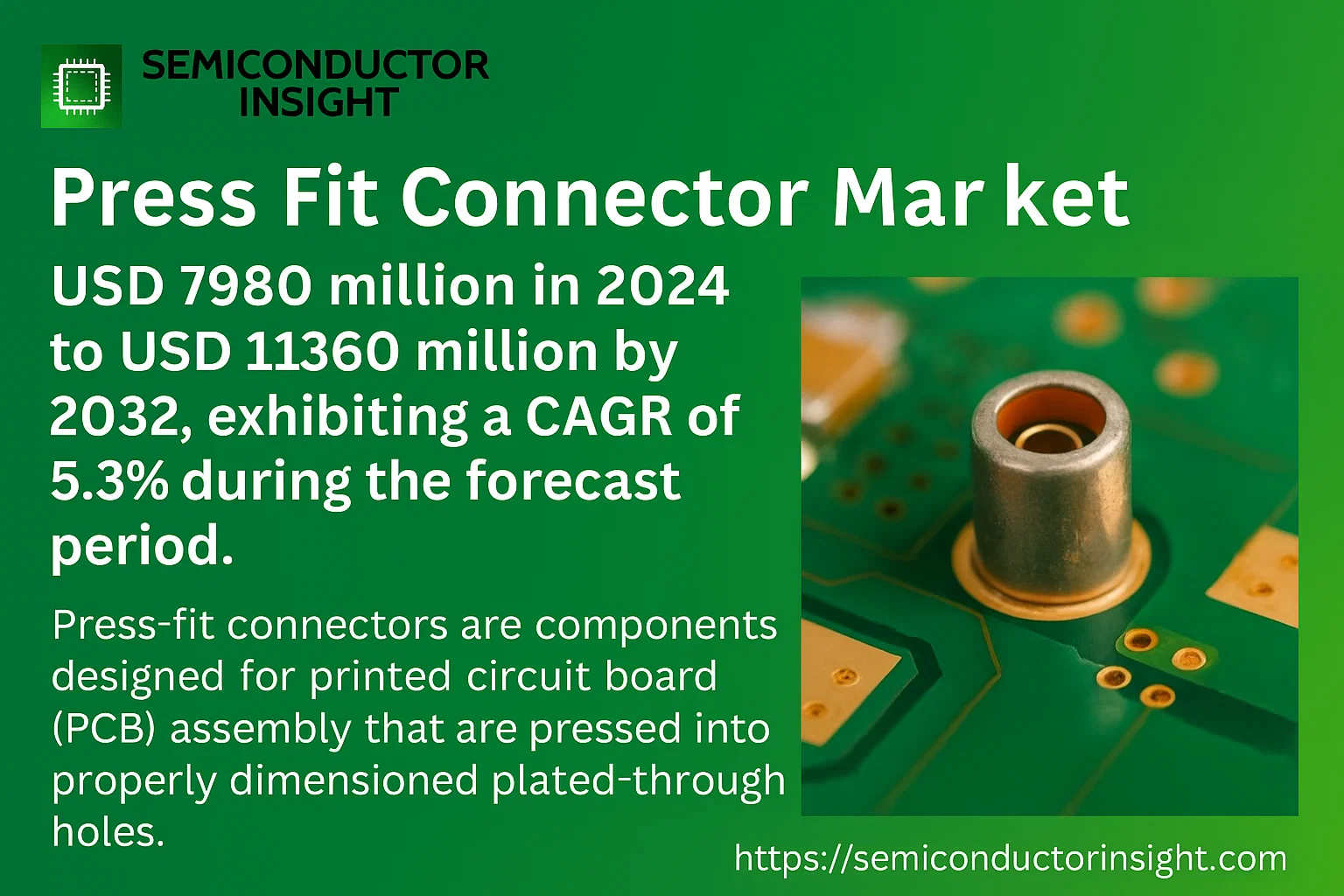
Global Press Fit Connector Market was valued at USD 7980 million in 2024 to USD 11360 million by 2032, exhibiting a CAGR of 5.3% during the forecast period.
Press-fit connectors are components designed for printed circuit board (PCB) assembly that are pressed into properly dimensioned plated-through holes. This technology serves as a robust alternative to traditional soldering, offering significant advantages by eliminating thermal stress on the PCB, preventing cold solder joints and solder bridging, and removing the need for lead-free solder processes. These connectors are also highly valued for being easily repairable, more environmentally friendly, and cost-effective over the product lifecycle.
The market is experiencing steady growth driven by rising demand across key sectors like automotive electronics and telecommunications. The expansion of electric vehicles (EVs) and advanced driver-assistance systems (ADAS), which require highly reliable connections, is a primary growth driver. Furthermore, Europe represents the largest regional market, accounting for approximately 35% of global share, followed closely by North America at around 30%. The competitive landscape is concentrated, with leading manufacturers such as TE Connectivity, Samtec, and Amphenol collectively holding a significant portion of the market.
MARKET DRIVERS
Rising Demand for Miniaturized and High-Density Electronics
The proliferation of compact electronic devices in sectors like consumer electronics, automotive, and telecommunications is a primary driver. Press-fit connectors, which provide reliable connections without soldering, are essential for high-density printed circuit boards (PCBs) where space is constrained. This technology supports the trend towards smaller, more powerful devices, with the global market for high-density interconnects projected to grow significantly.
Advancements in Automotive Electronics and Safety Systems
The automotive industry’s shift towards electric vehicles (EVs) and advanced driver-assistance systems (ADAS) requires robust and vibration-resistant connector solutions. Press-fit technology offers superior mechanical stability and reliability compared to soldered connections, making it ideal for demanding automotive applications. The increasing electronic content per vehicle, which is expected to exceed 50% of total vehicle cost by 2030, fuels this demand.
Furthermore, the expansion of 5G infrastructure and data centers creates substantial demand. These applications require high-speed, high-frequency connectors that can handle significant data throughput, and press-fit connectors provide the necessary signal integrity and durability for server backplanes and base station equipment.
MARKET CHALLENGES
High Initial Tooling and Implementation Costs
The implementation of press-fit technology requires specialized and often costly tooling for both the connectors and the PCBs. This includes precise press-in machines and the need for PCBs with controlled impedance and specific plating, which can increase the overall system cost. This high initial investment can be a barrier to adoption, especially for small and medium-sized manufacturers.
Other Challenges
Technical Expertise and Skill Gap
The proper installation of press-fit connectors requires precise force control and expertise to avoid damaging the PCB or the connector. A shortage of skilled technicians who are trained in this specific technology can lead to manufacturing defects and reliability issues in the field.
Competition from Alternative Technologies
Press-fit connectors face competition from soldering, surface-mount technology (SMT), and compression mount connectors. In some cost-sensitive or less demanding applications, these alternatives may be preferred, challenging the market share of press-fit solutions.
MARKET RESTRAINTS
Stringent Quality and Reliability Standards
Industries such as aerospace, defense, and medical devices impose extremely high reliability standards. While press-fit connectors are reliable, the certification processes and need to meet specific standards like ISO, IEC, and UL can be lengthy and expensive. This acts as a restraint by slowing down the time-to-market for new products incorporating this technology.
Supply Chain Vulnerabilities for Specialized Materials
The production of high-performance press-fit connectors relies on specialized materials, including specific copper alloys and plating materials like gold or tin. Disruptions in the supply chain for these raw materials can lead to increased costs and production delays, potentially restraining market growth.
MARKET OPPORTUNITIES
Growth in Renewable Energy and Industrial Automation
The renewable energy sector, particularly solar and wind power, utilizes sophisticated power conversion and control systems that require durable interconnects. Similarly, Industry 4.0 and industrial automation rely on robust control cabinets and PLCs. Press-fit connectors are well-suited for these harsh environments, presenting a significant growth opportunity as these industries expand globally.
Innovation in High-Speed Data Transmission
There is a continuous push for higher data rates in networking and telecommunications. This creates an opportunity for the development of advanced press-fit connectors designed for next-generation data rates beyond 56 Gbps per channel. Innovations in connector design to minimize signal loss and crosstalk can capture value in high-performance computing and networking markets.
Press Fit Connector Market Trends
Accelerated Market Growth and Expansion
Global l Press Fit Connector market is on a significant growth trajectory, valued at USD 7980 million in 2024 and projected to reach USD 11360 million by 2032, exhibiting a Compound Annual Growth Rate (CAGR) of 5.3% during the forecast period. This robust expansion is fueled by the technology’s inherent advantages over traditional soldering methods. The press-fit process eliminates thermal stress on PCBs, prevents cold solder joints and solder bridging, and removes the complications associated with lead-free soldering. These benefits drive adoption across multiple industries seeking reliable, cost-effective, and environmentally friendly manufacturing solutions.
Other Trends
Dominance of Established Market Leaders and Regional Concentration
The competitive landscape is characterized by the dominance of a few key players. Leading manufacturers such as TE Connectivity, Samtec, and Amphenol collectively account for approximately 50% of the global market share. This concentration highlights the importance of technological expertise, extensive product portfolios, and established supply chains. Geographically, the market exhibits distinct regional strengths. Europe is the largest market, representing about 35% of the global total, largely driven by a strong automotive and industrial manufacturing base. North America follows closely, accounting for roughly 30% of the market, supported by advanced electronics and aerospace sectors.
Diversification by Material and Application Sectors
Market segmentation reveals critical trends in material usage and application areas. The market is divided by connector material, primarily brass and stainless steel, each offering distinct performance characteristics for different operational environments. In terms of application, the demand is segmented across automotive electronics, consumer electronic products, aerospace, and other industrial sectors. The automotive electronics segment is a major growth driver, propelled by the increasing electronic content in modern vehicles and the transition to electric vehicles, which require highly reliable and durable interconnection solutions. The consistent demand from the aerospace sector, where reliability is paramount, also contributes significantly to the market’s steady growth, underpinning the long-term positive outlook for press-fit connector technology.
COMPETITIVE LANDSCAPE
Key Industry Players
An Industry Dominated by a Few Global Leaders with Strong Niche Specialists
The press-fit connector market is characterized by a high level of consolidation, where the top three manufacturers—TE Connectivity, Samtec, and Amphenol—collectively command approximately 50% of the global market share. TE Connectivity stands as the unequivocal market leader, leveraging its extensive global footprint, diverse and robust product portfolio, and long-standing relationships across key end-user industries such as automotive electronics, telecommunications, and industrial automation. This dominance is reinforced by significant investments in research and development, focusing on creating connectors that meet the escalating demands for higher data rates, miniaturization, and reliability in harsh environments. The market structure is oligopolistic, with competition based on technological innovation, product reliability, global supply chain efficiency, and the ability to provide customized solutions for complex applications.
Beyond the dominant players, a cohort of other significant companies competes effectively by carving out specialized niches or focusing on specific geographic regions or application segments. Companies like Molex and JST possess considerable market presence and offer a wide array of press-fit solutions, particularly strong in consumer electronics and automotive applications. Specialists such as Hirose Electric and Japan Aviation Electronics (JAE) are renowned for their high-precision connectors catering to the demanding requirements of the aerospace, defense, and high-performance computing sectors. European players like HARTING and ERNI hold strong positions within their regional market, benefiting from deep integration into the industrial and automotive manufacturing ecosystems. Yamaichi Electronics and Fujitsu Component (now part of Shin-Etsu Polymer in some connector lines) are also key contributors, often recognized for their innovation in test & measurement and high-density interconnect solutions.
List of Key Press Fit Connector Companies Profiled
- TE Connectivity
- Samtec, Inc.
- Amphenol Corporation
- Molex, LLC
- Hirose Electric Co., Ltd.
- Japan Aviation Electronics Industry, Ltd. (JAE)
- JST Manufacturing Inc.
- HARTING Technology Group
- Yamaichi Electronics Co., Ltd.
- ERNI Electronics GmbH (Part of TE Connectivity)
- Fujitsu Component Limited
- I-PEX (Dai-Ichi Seiko Co., Ltd.)
- Würth Elektronik Group
Segment Analysis:
| Segment Category | Sub-Segments | Key Insights |
| By Type |
|
Brass Connector emerges as the leading segment due to its exceptional conductivity, excellent machinability, and cost-effectiveness for a wide range of electronic applications. The material properties of brass provide a reliable and stable electrical connection, which is critical for the press-fit technology’s performance. While stainless steel connectors offer superior strength and corrosion resistance, brass remains the preferred choice for many standard applications because it strikes an optimal balance between performance, durability, and overall system cost, making it the dominant material in the market. |
| By Application |
|
Automotive Electronics is the leading application segment, driven by the rapid increase in electronic content per vehicle and the stringent reliability requirements for connectors in harsh operating environments. The inherent advantages of press-fit technology, such as eliminating thermal stress on PCBs and providing robust, solderless connections, are particularly valuable in automotive applications where vibration resistance and long-term reliability are paramount. The ongoing trends of electrification, advanced driver-assistance systems (ADAS), and in-vehicle infotainment systems continue to fuel significant demand for high-performance press-fit connectors in this sector. |
| By End User |
|
Original Equipment Manufacturers (OEMs) represent the dominant end-user segment. OEMs in the automotive, consumer electronics, and industrial equipment sectors heavily integrate Press Fit Connectors directly into their product designs due to the technology’s reliability and assembly efficiency. The ability to streamline the production process by avoiding soldering steps and ensuring consistent connection quality makes press-fit technology highly attractive for large-scale manufacturing. This segment’s leadership is reinforced by the strategic partnerships between major connector manufacturers and large OEMs to co-develop customized solutions for next-generation products. |
| By Technology Level |
|
High-Density/High-Speed Press-Fit is the leading technology segment, experiencing the strongest growth momentum. This is directly attributed to the ongoing miniaturization of electronic devices and the escalating data rate requirements in applications like telecommunications infrastructure, high-performance computing, and advanced automotive systems. These connectors are engineered to maintain signal integrity at higher frequencies while occupying less board space, making them critical for modern, compact electronic designs. The development in this segment reflects the industry’s push toward more sophisticated and capable interconnection solutions. |
| By Sales Channel |
|
Direct Sales is the predominant channel for the Press Fit Connector market. This dominance is driven by the highly technical nature of the products and the need for close collaboration between manufacturers and their large industrial customers, such as automotive and aerospace OEMs. Direct relationships allow for customized product development, stringent quality control, integrated supply chain management, and dedicated technical support, which are essential for meeting the specific and often demanding requirements of these key clients. While distributors serve smaller volume buyers effectively, the bulk of market volume flows through direct sales partnerships. |
Regional Analysis: Press Fit Connector Market
Asia-Pacific’s dominance is anchored in its vast electronics manufacturing base. The concentration of leading OEMs and ODMs creates a powerful demand-pull for high-volume, reliable connector solutions used in everything from smartphones to industrial control systems. The mature supply chain ensures cost-effectiveness and rapid time-to-market.
The rapid shift towards electric vehicles (EVs) and advanced driver-assistance systems (ADAS) in China, Japan, and South Korea is a major growth driver. Press fit connectors are essential for the high-density electronic control units (ECUs), battery management systems, and infotainment systems within modern vehicles.
Massive investments in 5G network rollouts across the region require robust and compact connector solutions for base stations and networking equipment. Press fit technology is favored for its reliability and high-speed performance, making it integral to building next-generation communication infrastructure.
Proactive government policies, such as “Made in China 2025” and similar initiatives in other APAC countries, promote advanced manufacturing and R&D in key electronics sectors. This fosters a highly innovative environment where the latest press fit connector technologies are developed and adopted quickly.
North America
North America remains a critical and technologically advanced market for press fit connectors, characterized by high-value, innovation-driven demand. The region is a leader in the aerospace, defense, and high-performance computing sectors, where reliability and performance under demanding conditions are paramount. The presence of major technology companies and a strong automotive industry, particularly in the United States, focusing on electric and autonomous vehicles, sustains demand for sophisticated connector solutions. Furthermore, significant investments in upgrading data center infrastructure and developing AI capabilities create a steady need for high-speed, high-density interconnects. The market is distinguished by stringent quality standards and a focus on cutting-edge applications.
Europe
The European press fit connector market is mature and characterized by strong demand from its robust automotive and industrial sectors. Germany, in particular, is a powerhouse in automotive manufacturing, with a strong push towards electrification that heavily utilizes press fit connectors in powertrain and safety systems. The region also has a significant presence in industrial automation and medical device manufacturing, where precision and reliability are non-negotiable. European regulations emphasizing energy efficiency and product sustainability drive innovation in connector design. While growth may be more moderate compared to Asia-Pacific, the demand is for high-quality, specialized connectors that meet rigorous European standards.
South America
The press fit connector market in South America is a developing but promising region, with growth largely tied to the industrial and telecommunications sectors in countries like Brazil and Argentina. The market benefits from the gradual modernization of manufacturing facilities and infrastructure projects. Demand is primarily driven by the need for industrial automation equipment and the expansion of mobile networks. However, the market’s growth trajectory can be influenced by regional economic volatility and political factors. The emphasis is often on cost-effective solutions that meet basic reliability requirements for industrial and consumer electronic applications.
Middle East & Africa
The Middle East & Africa region represents an emerging market with growth potential centered on specific strategic initiatives. In the Middle East, investments in smart city projects, telecommunications infrastructure (especially 5G), and economic diversification away from oil are creating new opportunities. The African market is more fragmented, with growth driven by the gradual expansion of telecommunications networks and the development of manufacturing hubs in certain nations. The demand in this region is often for connectors that offer a balance between cost, durability, and performance to suit the developing infrastructure and climatic conditions.
Report Scope
This market research report provides a comprehensive analysis of the Press Fit Connector Market , covering the forecast period 2025–2032. It offers detailed insights into market dynamics, technological advancements, competitive landscape, and key trends shaping the industry.
Key focus areas of the report include:
- Market Overview: The report begins with an overview outlining its current market scenario, key growth indicators, and industry transformation drivers. It discusses macroeconomic factors, demand–supply balance, regulatory landscape, and the strategic role of semiconductors in powering advancements across industries such as automotive, telecommunications, consumer electronics, and industrial automation.
- Market Size & Forecast: Historical data and future projections for revenue, unit shipments, and market value across major regions and segments.
- Segmentation Analysis: Detailed breakdown by product type, technology, application, and end-user industry to identify high-growth segments and investment opportunities.
- Regional Insights: Insights into market performance across North America, Europe, Asia-Pacific, Latin America, and the Middle East & Africa, including country-level analysis where relevant.
- Competitive Landscape: Profiles of leading market participants, including their product offerings, R&D focus, manufacturing capacity, pricing strategies, and recent developments such as mergers, acquisitions, and partnerships.
- Technology Trends & Innovation: Assessment of emerging technologies, integration of AI/IoT, semiconductor design trends, fabrication techniques, and evolving industry standards.
- Market Drivers & Restraints: Evaluation of factors driving market growth along with challenges, supply chain constraints, regulatory issues, and market-entry barriers.
- Stakeholder Insights: Insights for component suppliers, OEMs, system integrators, investors, and policymakers regarding the evolving ecosystem and strategic opportunities.
Primary and secondary research methods are employed, including interviews with industry experts, data from verified sources, and real-time market intelligence to ensure the accuracy and reliability of the insights presented.
FREQUENTLY ASKED QUESTIONS:
What is the current market size of Press Fit Connector Market?
-> Press Fit Connector Market was valued at USD 7980 million in 2024 to USD 11360 million by 2032, exhibiting a CAGR of 5.3% during the forecast period.
Which key companies operate in Press Fit Connector Market?
-> Key players include TE Connectivity, Samtec, Amphenol, Molex, and JST, with the top three manufacturers accounting for about 50% of the market.
What are the key growth drivers?
-> Key growth drivers include the technology’s advantages over soldering, such as elimination of thermal stress, cold solder joints, and solder bridging; easier repairs; environmental benefits; and cost effectiveness.
Which region dominates the market?
-> Europe is the main market, accounting for about 35%, followed by North America at about 30%.
What are the emerging trends?
-> Emerging trends center on the adoption of press-fit technology as a reliable, solder-free alternative for PCB assembly, driven by demand from sectors like automotive electronics, consumer electronics, and aerospace.

Get Sample Report PDF for Exclusive Insights
Report Sample Includes
- Table of Contents
- List of Tables & Figures
- Charts, Research Methodology, and more...
 Download Sample Report PDF