Predictive Control Market Insights
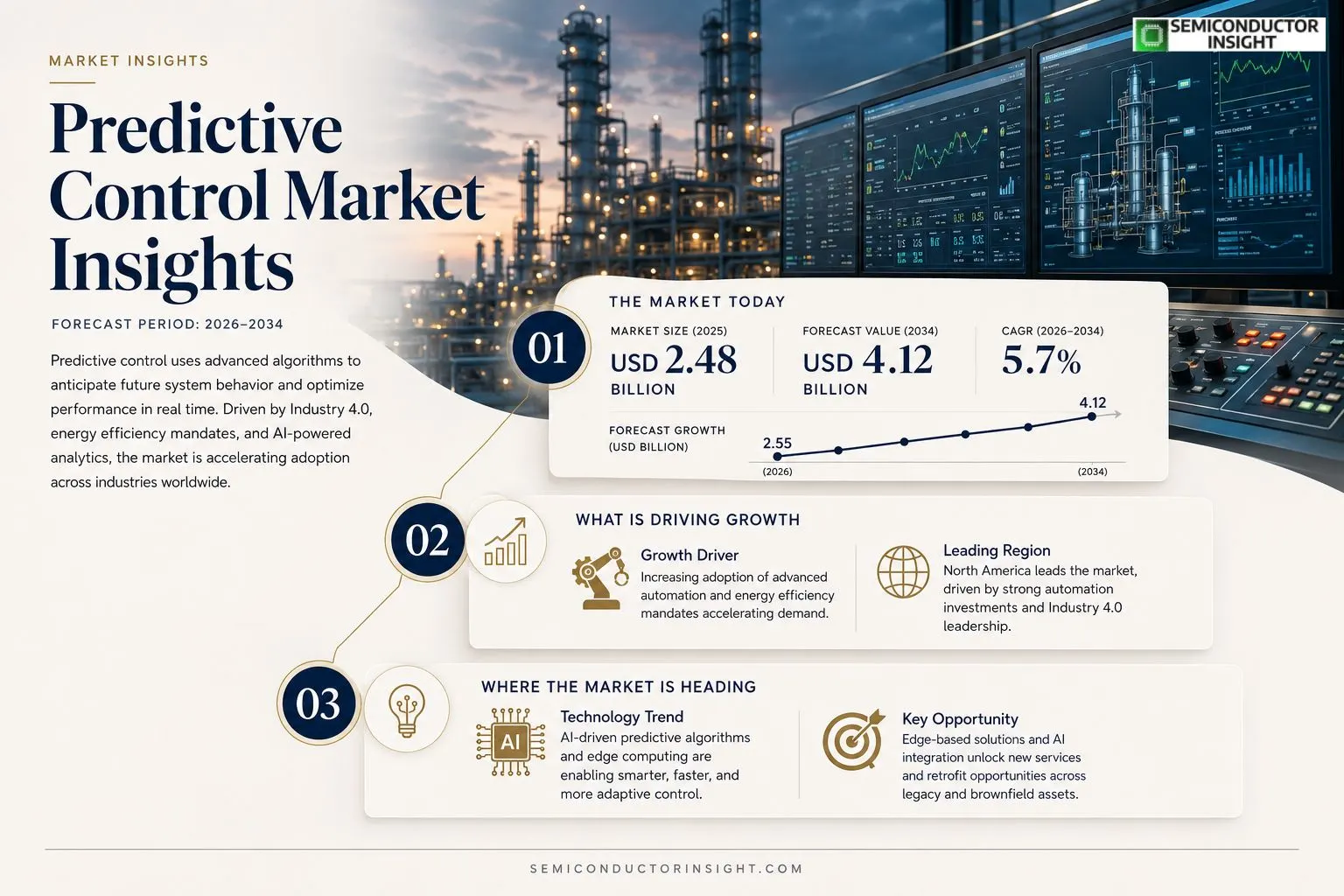
Predictive control market size was valued at USD 2.48 billion in 2025. The market is projected to grow from USD 2.55 billion in 2026 to USD 4.12 billion by 2034, exhibiting a CAGR of 5.7% during the forecast period.
Predictive control refers to advanced algorithms that anticipate future system behavior and adjust inputs in real time. It is widely applied in process industries, automotive systems, building automation, and robotics, integrating model‑based predictions with feedback loops to optimize performance, cut energy use, and enhance safety.The market is experiencing rapid growth because of increasing adoption of Industry 4.0 technologies, rising demand for energy‑efficient solutions, and expanding use of AI‑driven analytics in manufacturing. Furthermore, regulatory pressure for emissions reduction and the rollout of smart grids are accelerating deployments. Key players such as Siemens AG, ABB Ltd., Schneider Electric, Honeywell International and Rockwell Automation continue to invest in R&D and strategic partnerships, further fueling Predictive Control Market expansion.
MARKET DRIVERS
Increasing Adoption of Advanced Automation
Predictive Control Market is being propelled by manufacturers that seek higher productivity and lower downtime. Real‑time optimization enables plants to anticipate disturbances, resulting in smoother operations and measurable cost savings. Industrial firms are therefore investing in model‑based controllers to stay competitive.
Regulatory Push for Energy Efficiency
Governments across major economies are tightening energy‑use standards, compelling process industries to adopt technologies that can demonstrate compliance. Predictive control solutions deliver precise set‑point management, which directly supports carbon‑reduction targets. This regulatory environment creates a robust demand pipeline for Predictive Control Market.
➤ Predictive algorithms can cut energy consumption by up to 15 % compared with conventional PID loops, according to recent field studies.
Collectively, these drivers are accelerating market penetration, encouraging OEMs to embed Predictive capabilities into next‑generation equipment, and fostering a competitive ecosystem that benefits end users.
MARKET CHALLENGES
Integration Complexity
Integrating Predictive control modules with legacy SCADA and MES platforms often requires custom interfacing, extending project timelines. Companies must allocate skilled resources to harmonize data models, which can increase overall implementation risk.
Other Challenges
Talent Shortage
The specialized knowledge required to design, tune, and maintain Predictive algorithms is scarce, leading to higher labor costs and potential project delays.
MARKET RESTRAINTS
High Initial Investment
Capital expenditure for high‑performance controllers, sensors, and software licenses remains a significant barrier for small‑ and mid‑size enterprises. The upfront cost can deter early adoption despite long‑term operational benefits.Additionally, the ROI calculation often depends on accurate forecasting of production gains, which varies by industry and may introduce uncertainty in budgeting decisions.Consequently, many organizations postpone full‑scale deployment until clear cost‑recovery models are demonstrable.
MARKET OPPORTUNITIES
Emerging Edge Computing Solutions
Edge‑based architectures enable Predictive control algorithms to run closer to the process, reducing latency and bandwidth demands. This technological shift opens opportunities for retrofitting older plants without extensive overhauls.Furthermore, the convergence of AI‑driven analytics with Predictive control is creating new value‑added services, such as automated anomaly detection and self‑optimizing loops, that can differentiate vendors in the marketplace.Stakeholders that capitalize on these innovations are positioned to capture a larger share of the growing Predictive Control Market as industries accelerate digital transformation initiatives.
Predictive Control Market Trends
Industrial Adoption Accelerates
Predictive Control Market is witnessing a pronounced shift as manufacturers embed model‑based algorithms into production lines to anticipate process deviations before they occur. Across process industries, automotive systems, building automation and robotics, real‑time adjustments are now routine, providing tighter control loops that improve yield and reduce waste. This momentum is propelled by the broader Industry 4.0 agenda, where connectivity, sensor density and edge computing create the data foundation required for Predictive optimisation. Simultaneously, AI‑driven analytics are being fused with traditional control theory, enabling adaptive strategies that evolve with changing operating conditions.
Other Trends
Energy Efficiency and Sustainability
Energy consumption patterns are being reshaped as Predictive controllers fine‑tune heating, ventilation, air‑conditioning and motor‑driven equipment. By forecasting load profiles and adjusting set points pre‑emptively, facilities achieve measurable reductions in electricity use, directly supporting emissions‑reduction mandates. Smart‑grid integration further extends this benefit: controllers coordinate with demand‑response signals, shifting consumption to periods of lower carbon intensity. The cumulative effect is a measurable drop in operational costs while aligning plant performance with sustainability objectives.
Strategic Investments by Leading Vendors
Key industry players such as Siemens AG, ABB Ltd., Schneider Electric, Honeywell International and Rockwell Automation are intensifying R&D programmes focused on next‑generation prediction models and modular hardware platforms. Partnerships with software innovators accelerate the rollout of cloud‑native control suites, while joint ventures with semiconductor firms ensure that high‑performance processors are optimised for deterministic control workloads. These collaborative efforts not only expand the functional envelope of Predictive solutions but also lower entry barriers for mid‑size manufacturers seeking to modernise legacy assets.
Overall, the trajectory of Predictive Control Market reflects a convergence of digitalisation, regulatory impetus and supplier commitment. Companies that adopt these advanced control strategies are positioned to capture efficiency gains, improve product quality and meet tightening environmental standards, reinforcing the market’s steady upward trend.
COMPETITIVE LANDSCAPEKey Industry Players
Predictive Control Market – Competitive Overview
Predictive Control Market is led by a handful of technology powerhouses that combine deep control‑theory expertise with extensive AI and IoT portfolios. Siemens AG anchors the segment with its Digital Industries portfolio, leveraging model‑based Predictive algorithms across automation, energy and smart‑grid projects. ABB Ltd. follows closely, integrating Predictive control into its distributed control systems for process industries, while Schneider Electric expands its offering through EcoStruxure‑based Predictive solutions that target energy‑efficiency and safety. Honeywell International and Rockwell Automation round out the top tier, each investing heavily in R&D to embed real‑time optimization in industrial and building automation. Together, these leaders capture the majority of revenue, drive standard‑setting activities, and shape partnership ecosystems that accelerate adoption of Industry 4.0 technologies.Niche but highly specialized players are gaining traction in vertical markets where bespoke algorithms are essential. Mitsubishi Electric applies Predictive control to automotive manufacturing lines, and Bosch Rexroth focuses on motion‑control applications for robotics. Yokogawa Electric supplies advanced process control for petrochemical plants, while Emerson Electric targets refining and chemical sectors with its DeltaV suite. General Electric leverages its Predix platform for large‑scale energy assets, and Aspen Technology offers industry‑specific Predictive optimization for process engineering. National Instruments, Texas Instruments and IBM contribute critical hardware, firmware and AI services that enable end‑to‑end Predictive control implementations across sectors ranging from aerospace to pharmaceuticals.
List of Key Predictive Control Companies Profiled
- Siemens AG
- ABB Ltd.
- Schneider Electric
- Honeywell International
- Rockwell Automation
- Mitsubishi Electric
- Bosch Rexroth
- Yokogawa Electric
- Emerson Electric
- General Electric
- Aspen Technology
- National Instruments
- Texas Instruments
- IBM
Segment Analysis:
| Segment Category | Sub-Segments | Key Insights |
| By Type |
|
Model‑Predictive Control is the leading type because it offers deterministic optimization based on accurate process models, enabling fine‑tuned regulation of complex industrial loops. • Engineers value its capacity to anticipate disturbances and adjust inputs proactively. • Integration with advanced sensors and IoT platforms makes it a cornerstone for Industry 4.0 deployments. • Continuous algorithm refinement drives higher energy efficiency and safer operations. |
| By Application |
|
Process Industries dominate the application landscape as Predictive control aligns with stringent quality, safety, and environmental regulations. • Real‑time optimization reduces waste and energy consumption, meeting sustainability targets. • The ability to manage multi‑variable interactions supports batch‑to‑continuous transitions. • Vendors embed Predictive analytics to enable autonomous decision‑making, elevating overall plant resilience. |
| By End User |
|
OEMs & System Integrators lead the end‑user segment because they embed Predictive control algorithms directly into equipment, delivering turnkey solutions that accelerate adoption. • Their close collaboration with software providers ensures seamless integration with existing control architectures. • They capitalize on service contracts that include ongoing algorithm tuning and performance monitoring. • Strategic partnerships with AI specialists create differentiated value propositions for customers. |
Regional Analysis: North America
United States
The manufacturing sector in North America is witnessing a rapid transformation towards intelligent automation. Predictive control systems are being integrated into production lines to optimize processes, reduce waste, and improve product quality. This digital transformation is creating a strong demand for advanced control solutions.
The energy sector is increasingly leveraging Predictive control for optimized power generation and distribution. This includes applications in smart grids, renewable energy integration, and Predictive maintenance of critical infrastructure. Enhanced efficiency and reliability are key drivers for adoption in this sector.
The aerospace and defense industries are utilizing Predictive control for advanced flight control systems, autonomous navigation, and mission-critical operations. The need for precision and reliability in these applications is paramount, driving demand for robust control solutions.
Predictive Control is finding increasing applications in chemical processing, pharmaceuticals, and food & beverage industries to optimize complex processes. This includes improved throughput, reduced energy consumption, and enhanced product consistency.
Europe
Europe represents a significant and growing market for Predictive Control Market. Stringent environmental regulations and a strong focus on sustainability are key drivers for adoption. The region’s advanced industrial base, particularly in automotive and aerospace, necessitates sophisticated control systems to meet stringent quality and performance standards. Furthermore, investments in smart city initiatives and the expansion of the industrial internet of things (IIoT) are creating new opportunities for Predictive control solutions. The emphasis on energy efficiency and the transition towards a circular economy are also bolstering market growth.
Asia-Pacific
The Asia-Pacific region, particularly China and Japan, is poised for substantial growth in Predictive Control Market. Rapid industrialization, increasing automation, and government initiatives promoting technological advancement are driving demand. The electronics, automotive, and manufacturing sectors are key consumers of Predictive control technologies. Furthermore, the region’s growing focus on smart manufacturing and Industry 4.0 will further accelerate market expansion. The increasing availability of skilled labor and decreasing costs of technology also contribute to the region’s growth potential.
South America
South America presents a nascent but promising market for Predictive Control Market. The agriculture and mining sectors are key drivers, with increasing adoption of automation to improve efficiency and productivity. The rising demand for processed goods and the expansion of manufacturing industries are also creating opportunities. However, challenges such as infrastructure limitations and economic volatility may hinder rapid growth. Strategic investments in education and technology are crucial for unlocking the region’s potential.
Middle East & Africa
The Middle East & Africa region is an emerging market for Predictive Control Market. Significant investments in infrastructure development, particularly in the oil & gas and construction sectors, are fueling demand for automation and control solutions. The growing focus on energy efficiency and the development of smart cities are also driving market growth. The region’s vast natural resources and increasing industrial activity present long-term opportunities for Predictive control adoption.
Report Scope
This market research report provides a comprehensive analysis of the Predictive Control Market , covering the forecast period 2026–2034. It offers detailed insights into market dynamics, technological advancements, competitive landscape, and key trends shaping the industry.
Key focus areas of the report include:
- Market Overview: The report begins with an overview outlining its current market scenario, key growth indicators, and industry transformation drivers. It discusses macroeconomic factors, demand–supply balance, regulatory landscape, and the strategic role of semiconductors in powering advancements across industries such as automotive, telecommunications, consumer electronics, and industrial automation.
- Market Size & Forecast: Historical data and future projections for revenue, unit shipments, and market value across major regions and segments.
- Segmentation Analysis: Detailed breakdown by product type, technology, application, and end-user industry to identify high-growth segments and investment opportunities.
- Regional Insights: Insights into market performance across North America, Europe, Asia-Pacific, Latin America, and the Middle East & Africa, including country-level analysis where relevant.
- Competitive Landscape: Profiles of leading market participants, including their product offerings, R&D focus, manufacturing capacity, pricing strategies, and recent developments such as mergers, acquisitions, and partnerships.
- Technology Trends & Innovation: Assessment of emerging technologies, integration of AI/IoT, semiconductor design trends, fabrication techniques, and evolving industry standards.
- Market Drivers & Restraints: Evaluation of factors driving market growth along with challenges, supply chain constraints, regulatory issues, and market-entry barriers.
- Stakeholder Insights: Insights for component suppliers, OEMs, system integrators, investors, and policymakers regarding the evolving ecosystem and strategic opportunities.
Primary and secondary research methods are employed, including interviews with industry experts, data from verified sources, and real-time market intelligence to ensure the accuracy and reliability of the insights presented.
FREQUENTLY ASKED QUESTIONS:
What is the current market size of Predictive Control Market?
-> Predictive Control Market was valued at USD 2.48 billion in 2025 and is expected to reach USD 4.12 billion by 2034, exhibiting a CAGR of 5.7% during the forecast period.
Which key companies operate in Predictive Control Market?
-> Key players include Siemens AG, ABB Ltd., Schneider Electric, Honeywell International, and Rockwell Automation, among others.
What are the key growth drivers?
-> Key growth drivers include adoption of Industry 4.0 technologies, rising demand for energy‑efficient solutions, AI‑driven analytics in manufacturing, regulatory pressure for emissions reduction, and the rollout of smart grids.
Which region dominates the market?
-> Regional dominance is not specifically disclosed in the provided information.
What are the emerging trends?
-> Emerging trends include integration of AI/IoT, advanced model‑based Predictive algorithms, and increasing deployment of smart grid solutions.
Get Sample Report PDF for Exclusive Insights
Report Sample Includes
- Table of Contents
- List of Tables & Figures
- Charts, Research Methodology, and more...
 Download Sample Report PDF