MARKET INSIGHTS
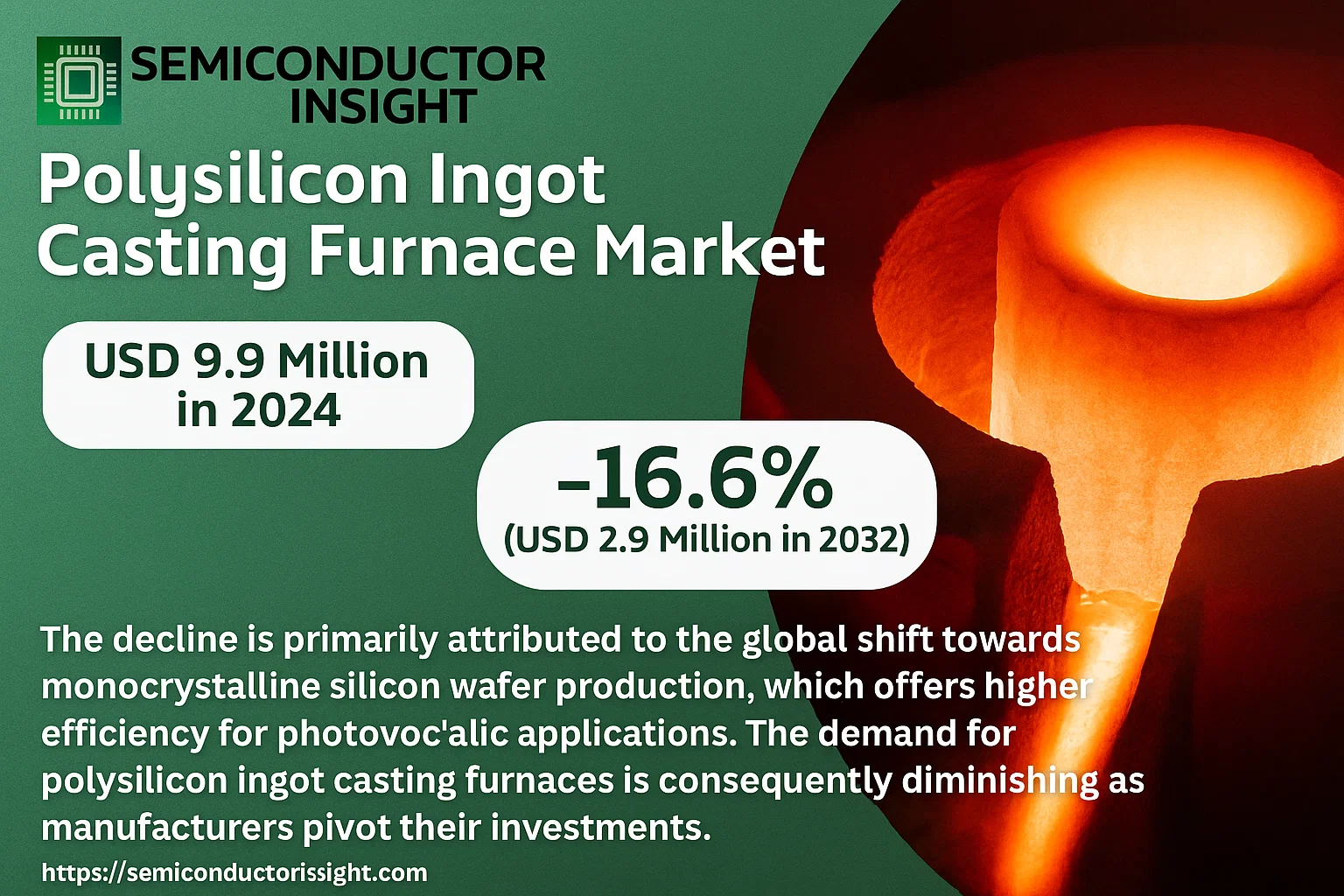
Global Polysilicon Ingot Casting Furnace Market was valued at USD 9.9 million in 2024 and is projected to reach USD 2.9 million by 2032, exhibiting a negative CAGR of -16.6% during the forecast period. This decline is primarily attributed to the global shift towards monocrystalline silicon wafer production, which offers higher efficiency for photovoltaic applications. The demand for polysilicon ingot casting furnaces is consequently diminishing as manufacturers pivot their investments.
A polysilicon ingot casting furnace is a key piece of equipment for manufacturing polycrystalline silicon, a material used in the production of solar panels. The furnace operates by melting high-purity silicon and then carefully cooling it to form a large, polycrystalline ingot. The quality of this ingot is critical, as it directly impacts the efficiency of the final solar cells. The stability and precision of the furnace’s process control are paramount to producing high-quality silicon for the photovoltaic industry.
The market’s contraction is driven by the declining demand for polycrystalline silicon wafers in favor of monocrystalline alternatives. Monocrystalline silicon offers higher efficiency rates, which is a critical factor for solar energy providers aiming to maximize power output per unit area. This shift in material preference has led to a reduced demand for the polycrystalline silicon casting equipment, including the furnaces themselves. Despite this, certain niche applications and regions with specific manufacturing capabilities continue to utilize this technology.
MARKET DRIVERS
Robust Global Solar PV Demand
The polysilicon ingot casting furnace market is primarily driven by the exponential growth in global demand for solar photovoltaic (PV) installations. Governments worldwide are implementing ambitious renewable energy targets and offering subsidies, directly fueling the need for polysilicon, the primary raw material for solar wafers. This sustained demand for solar panels, projected to grow at a compound annual growth rate (CAGR) of over 15% in the coming years, creates a continuous requirement for manufacturing equipment like casting furnaces.
Technological Advancements in Furnace Efficiency
Manufacturers are consistently investing in Research and Development to enhance the performance of polysilicon ingot casting furnaces. Key advancements focus on increasing thermal efficiency, reducing energy consumption per ingot, and improving the quality and size of the monocrystalline or multi-crystalline ingots produced. The transition towards G12 and other larger wafer sizes necessitates furnaces capable of casting larger, higher-purity ingots, prompting equipment upgrades and new purchases.
➤ The global push for energy independence and carbon neutrality is creating an unprecedented, long-term pipeline of demand for solar energy infrastructure, solidifying the foundation for the polysilicon equipment market.
Furthermore, the establishment of new polysilicon production facilities, particularly in regions like Asia and the United States, to secure supply chains and reduce geopolitical dependencies, is generating significant capital expenditure investments in new casting furnace lines. This capacity expansion is a critical driver for equipment suppliers.
MARKET CHALLENGES
High Capital and Operational Costs
Polysilicon ingot casting furnaces represent a significant capital investment for manufacturers. The high cost of the furnaces, coupled with the substantial energy required for the high-temperature casting process, presents a major barrier to entry and operational profitability. Fluctuations in electricity prices can severely impact production costs, making it challenging for manufacturers to maintain competitive pricing, especially during periods of oversupply and price pressure on solar modules.
Other Challenges
Technical Complexity and Skilled Labor Shortage
Operating and maintaining these advanced furnaces requires highly specialized technical expertise. There is a growing challenge in sourcing and retaining skilled engineers and technicians capable of optimizing furnace operations, troubleshooting complex issues, and ensuring consistent, high-yield production, which can delay production ramp-ups in new facilities.
Supply Chain Volatility for Critical Components
The production of these furnaces relies on a complex global supply chain for high-quality graphite components, advanced insulation materials, and precision control systems. Disruptions, geopolitical tensions, or trade barriers can lead to extended lead times and increased costs for critical parts, hampering the ability of furnace manufacturers to meet delivery schedules.
MARKET RESTRAINTS
Cyclical Nature of the Solar Industry
The polysilicon ingot casting furnace market is intrinsically tied to the cyclicality of the solar PV industry. Periods of overcapacity and subsequent price collapses for polysilicon and solar wafers lead to reduced profitability for manufacturers, causing them to delay or cancel investments in new production equipment. This boom-and-bust cycle creates significant uncertainty and can restrain steady growth for furnace suppliers, who must navigate periods of robust demand followed by sharp downturns.
Competition from Alternative Technologies
While ingot casting is the dominant method for producing multi-crystalline silicon, the market faces restraint from the growing adoption of alternative wafer technologies. The shift towards monocrystalline ingots grown using the Czochralski (CZ) process, which offers higher efficiency, is impacting demand for standard multi-crystalline casting furnaces. Continuous technological evolution requires furnace makers to constantly innovate to stay relevant.
MARKET OPPORTUNITIES
Expansion into Emerging Markets and Localized Production
Emerging economies in Asia, Latin America, and the Middle East are rapidly increasing their solar energy capacity. This presents a significant opportunity for furnace manufacturers to expand into these new markets. Additionally, government policies promoting localized manufacturing, such as India’s Production Linked Incentive (PLI) scheme, are creating opportunities for setting up domestic polysilicon and wafer production facilities, requiring new casting furnace installations.
Development of High-Efficiency and N-Type Specific Furnaces
The industry’s transition to high-efficiency N-type silicon wafers, which require higher purity and more controlled crystallization processes, opens up a premium segment of the market. There is a growing opportunity for furnace manufacturers to develop and sell advanced models specifically designed to produce high-quality N-type monocrystalline ingots, catering to the demand for top-tier solar modules.
After-Sales Services and Digitalization
There is an increasing opportunity in providing comprehensive after-sales services, including predictive maintenance, remote monitoring, and performance optimization software. Integrating IoT sensors and data analytics into furnaces allows for proactive maintenance, reduces downtime, and improves overall equipment effectiveness, creating a valuable recurring revenue stream beyond initial equipment sales.
Polysilicon Ingot Casting Furnace Market Trends
Market Consolidation and Technological Shift Drive Industry Evolution
The global Polysilicon Ingot Casting Furnace market is undergoing a significant transformation, characterized by a projected contraction from a valuation of US$9.9 million in 2024 to US$2.9 million by 2032, representing a compound annual growth rate (CAGR) of -16.6%. This negative growth trajectory is indicative of a maturing market and a fundamental shift in the photovoltaic industry away from multi-crystalline silicon technologies towards monocrystalline silicon, which uses different growth furnaces. Despite this overall market decline, the equipment remains critical for existing production lines, with technological advancements focused on improving the efficiency and cost-effectiveness of the remaining capacity.
Other Trends
Dominance of Larger Wafer Formats
Within the polysilicon casting furnace segment, the market is dominated by equipment capable of producing G7 (and larger) ingots, which holds a market share of over 61%. This trend is driven by the photovoltaic industry’s relentless pursuit of lower cost-per-watt, as larger ingots and wafers lead to higher production throughput and reduced material losses during wafering. This has consolidated demand around furnace models that can accommodate these larger charge sizes, making them the standard for new installations and upgrades.
Geographic Market Concentration
The Asia-Pacific region is the largest market for Polysilicon Ingot Casting Furnaces, accounting for approximately 54% of the global market. This dominance is a direct result of the region’s concentration of photovoltaic cell and module manufacturing. North America and Europe follow, but their market shares are significantly smaller. This geographic concentration means that market dynamics, including pricing and technological adoption, are heavily influenced by the strategies of leading manufacturers and policy developments within Asia-Pacific countries, particularly China.
Competitive Landscape and Application Focus
The competitive landscape is highly concentrated, with the top five players, including ALD Vacuum Technology GmbH, ECM, and JYT Corporation, collectively holding about 75% of the market share. This high level of consolidation intensifies competition among the remaining players, who are focused on providing advanced, reliable equipment and services to a shrinking customer base. In terms of application, the market is overwhelmingly driven by the production of Photovoltaic Polycrystalline Silicon Wafers, which constitutes over 75% of the demand. The Cast-Mono (or quasi-mono) Crystalline Silicon Wafer segment represents a smaller, niche application as the industry transitions.
COMPETITIVE LANDSCAPE
Key Industry Players
A Consolidating Market with High Technological Barriers
The global polysilicon ingot casting furnace market is characterized by a high degree of concentration among a few key equipment manufacturers, with the top five players collectively accounting for approximately 75% of the market share. This dominance is driven by significant technological barriers, including the need for expertise in vacuum furnace technology, precise thermal management, and advanced process control systems to produce high-quality, structurally sound silicon ingots. Leading the market is ALD Vacuum Technology GmbH, a German company renowned for its advanced vacuum metallurgy solutions. Other major players like ECM and JYT Corporation have also established strong positions through their specialized furnace designs and robust global supply chains, particularly serving the massive photovoltaic industry in the Asia-Pacific region, which constitutes the largest market.
Beyond the market leaders, several niche players compete by offering specialized solutions or targeting specific regional markets. Companies such as Jinggong Technology and JSG have significant presence, often focusing on cost-competitive offerings for the dominant G7 furnace segment. Other notable suppliers like Jiangsu Huasheng Tianlong Photoelectric and Rijing cater to domestic demand within China, the world’s largest producer of photovoltaic products. Furthermore, established industrial equipment providers like Ferrotec (Hanhong) and PVA TePla bring their expertise in thermal processing to this specialized field, offering integrated solutions. The competitive dynamics are heavily influenced by the ongoing transition in the solar industry towards higher efficiency monocrystalline and cast-mono wafers, which is pressuring furnace manufacturers to innovate and develop equipment capable of producing larger, higher-quality ingots.
List of Key Polysilicon Ingot Casting Furnace Companies Profiled
- ALD Vacuum Technology GmbH
- ECM
- JYT Corporation
- Jinggong Technology
- JSG
- Jiangsu Huasheng Tianlong Photoelectric
- Rijing
- Ferrotec (Hanhong)
- PVA TePla
- centrotherm international AG
- MTI Corporation
- SVCS Process Innovation
- Linton Technologies
Segment Analysis:
| Segment Category | Sub-Segments | Key Insights |
| By Type |
|
G7 furnaces represent the dominant technology due to their superior balance between ingot size and production efficiency. Their larger capacity significantly reduces the cost per wafer, making them the preferred choice for manufacturers aiming for economies ofscale. While G8 furnaces offer even greater capacity, they present more complex operational challenges and higher initial investment requirements. Meanwhile, the demand for older G6 and below technologies is steadily declining, primarily used in legacy production lines or for specialized niche applications. |
| By Application |
|
Photovoltaic Polycrystalline Silicon Wafer production remains the overwhelming application driving furnace demand, underpinned by the massive scale of the global solar energy industry. The established manufacturing processes and cost-effectiveness of polycrystalline silicon continue to secure its position. The Cast-Mono segment is an important, though smaller, niche valued for producing wafers with higher conversion efficiencies, appealing to certain premium solar panel manufacturers seeking enhanced performance characteristics. |
| By End User |
|
Large-Scale Wafer Manufacturers are the primary consumers, driving volume demand for high-throughput, reliable furnaces to feed global solar supply chains. Their purchasing decisions are heavily influenced by operational stability, production yield, and long-term total cost of ownership. Specialty producers focus on advanced materials like cast-mono silicon, demanding furnaces with precise control capabilities. R&D institutions require highly flexible and advanced furnace systems for developing next-generation ingot growth techniques and materials science research. |
| By Technology Level |
|
Fully Automated Systems are increasingly becoming the industry standard for new installations, as they offer superior process consistency, reduced labor costs, and minimized human error, which are critical for maintaining high yields in competitive wafer manufacturing. The transition towards automation is a key strategic focus for leading equipment suppliers and manufacturers aiming to optimize operational efficiency. Semi-automated systems serve as a transitional or cost-conscious option, while purely manual systems are largely obsolete in mainstream production, reserved for pilot lines or very specific experimental setups. |
| By Market Maturity |
|
High-Growth Emerging Markets, particularly across Asia-Pacific, demonstrate the most dynamic demand, driven by new capacity expansions and government support for solar energy infrastructure. In these regions, demand is primarily for new, state-of-the-art furnace installations. Conversely, established mature markets, such as parts of Europe and North America, exhibit more stable demand characterized by strategic upgrades to modernize existing fleets and improve efficiency rather than pure capacity additions. This focus on technology replacement creates a distinct market segment for advanced, high-yield furnaces designed to retrofit older production lines. |
Regional Analysis: Polysilicon Ingot Casting Furnace Market
The entire value chain, from raw polysilicon to finished solar modules, is concentrated in the Asia-Pacific. This co-location creates immense efficiency, allowing furnace suppliers to work directly with customers on customization and rapid technical support, minimizing downtime and optimizing furnace performance for specific production requirements.
Aggressive national renewable energy goals in China, India, and Southeast Asia are the primary drivers. These policies mandate continuous expansion of solar manufacturing capacity, which directly translates into sustained procurement of new, more efficient ingot casting furnaces to keep pace with both domestic and global demand for solar wafers.
Intense competition among local furnace manufacturers fosters a hotbed of innovation. The focus is on developing larger furnace capacities, automating loading and unloading processes, and enhancing thermal control systems to produce higher-purity ingots with fewer defects, which is critical for next-generation high-efficiency solar cells.
The region maintains a significant cost advantage due to economies of scale, local sourcing of components, and a highly skilled yet cost-effective engineering and technical workforce. This makes Asia-Pacific-produced furnaces highly attractive globally, further cementing the region’s export strength in this market segment.
North America
The North American market for polysilicon ingot casting furnaces is characterized by a focus on technological sophistication and niche, high-value production. While overall market volume is smaller than Asia-Pacific, there is significant activity driven by investments in domestic solar supply chain resilience. The United States, supported by policy incentives, is seeing a resurgence in PV manufacturing ambitions, which includes procuring advanced casting furnaces for new facilities. The regional demand is for state-of-the-art equipment that maximizes energy efficiency and yield, often tailored for producing high-purity mono-crystalline ingots for premium solar applications. R&D efforts are strong, with collaborations between national laboratories, universities, and equipment makers focusing on next-generation ingot growth techniques.
Europe
Europe’s market is defined by a strong emphasis on sustainability, quality, and technological innovation within its “Green Deal” industrial framework. The region hosts several specialized manufacturers of high-precision casting furnaces, catering to a demand for equipment that minimizes energy consumption and environmental impact. There is a growing push to re-shore portions of the solar manufacturing value chain, leading to investments in new production lines that require modern furnace technology. The market dynamics are influenced by stringent regulatory standards and a preference for furnaces that enable the production of high-efficiency, n-type silicon ingots. Collaboration between European equipment suppliers and research institutes is a key feature, driving advancements in furnace design.
South America
The South American market for polysilicon ingot casting furnaces is nascent but shows potential for growth aligned with the region’s expanding solar energy capacity. Currently, market activity is limited, with most solar wafer and cell production relying on imports. However, countries like Brazil are beginning to explore local manufacturing incentives, which could eventually stimulate demand for casting furnace equipment. The dynamics are shaped by the need for cost-effective and robust furnace solutions suitable for emerging industrial bases. The primary focus for any future market development will be on establishing a foundational manufacturing ecosystem, with furnace procurement being a later-stage requirement as the solar supply chain matures.
Middle East & Africa
The Middle East & Africa region presents a market with long-term potential rather than significant current activity. The dynamics are driven by vast solar irradiation resources and ambitious national visions for renewable energy, particularly in Gulf Cooperation Council countries. While these nations are heavily investing in solar power generation, the establishment of upstream manufacturing like ingot casting is still in early planning stages. The market for furnaces is presently negligible, but future dynamics could see demand emerge as part of integrated solar industrial cities and economic diversification plans, where local production of key components becomes a strategic priority.
Report Scope
This market research report provides a comprehensive analysis of the Polysilicon Ingot Casting Furnace Market , covering the forecast period 2025–2032. It offers detailed insights into market dynamics, technological advancements, competitive landscape, and key trends shaping the industry.
Key focus areas of the report include:
- Market Overview: The report begins with an overview outlining its current market scenario, key growth indicators, and industry transformation drivers. It discusses macroeconomic factors, demand–supply balance, regulatory landscape, and the strategic role of semiconductors in powering advancements across industries such as automotive, telecommunications, consumer electronics, and industrial automation.
- Market Size & Forecast: Historical data and future projections for revenue, unit shipments, and market value across major regions and segments.
- Segmentation Analysis: Detailed breakdown by product type, technology, application, and end-user industry to identify high-growth segments and investment opportunities.
- Regional Insights: Insights into market performance across North America, Europe, Asia-Pacific, Latin America, and the Middle East & Africa, including country-level analysis where relevant.
- Competitive Landscape: Profiles of leading market participants, including their product offerings, R&D focus, manufacturing capacity, pricing strategies, and recent developments such as mergers, acquisitions, and partnerships.
- Technology Trends & Innovation: Assessment of emerging technologies, integration of AI/IoT, semiconductor design trends, fabrication techniques, and evolving industry standards.
- Market Drivers & Restraints: Evaluation of factors driving market growth along with challenges, supply chain constraints, regulatory issues, and market-entry barriers.
- Stakeholder Insights: Insights for component suppliers, OEMs, system integrators, investors, and policymakers regarding the evolving ecosystem and strategic opportunities.
Primary and secondary research methods are employed, including interviews with industry experts, data from verified sources, and real-time market intelligence to ensure the accuracy and reliability of the insights presented.
FREQUENTLY ASKED QUESTIONS:
What is the current market size of Polysilicon Ingot Casting Furnace Market?
-> Polysilicon Ingot Casting Furnace Market was valued at USD 9.9 million in 2024 and is projected to reach USD 2.9 million by 2032, exhibiting a negative CAGR of -16.6% during the forecast period.
Which key companies operate in Polysilicon Ingot Casting Furnace Market?
-> Key players include ALD Vacuum Technology GmbH, ECM, JYT Corporation, Jinggong Technology, and JSG, among others. The top five players occupy a share of about 75%.
What are the key growth drivers?
-> Key growth drivers are related to the demand for photovoltaic polycrystalline silicon wafers and the critical role of the equipment in producing qualified silicon ingots.
Which region dominates the market?
-> Asia-Pacific is the largest market, with a share of about 54%, followed by North America and Europe.
What are the emerging trends?
-> Emerging trends include the dominance of the G7 product segment, which holds a share over 61%, and the application focus on Photovoltaic Polycrystalline Silicon Wafer, which accounts for over 75% of the market.

Get Sample Report PDF for Exclusive Insights
Report Sample Includes
- Table of Contents
- List of Tables & Figures
- Charts, Research Methodology, and more...
 Download Sample Report PDF