MARKET INSIGHTS
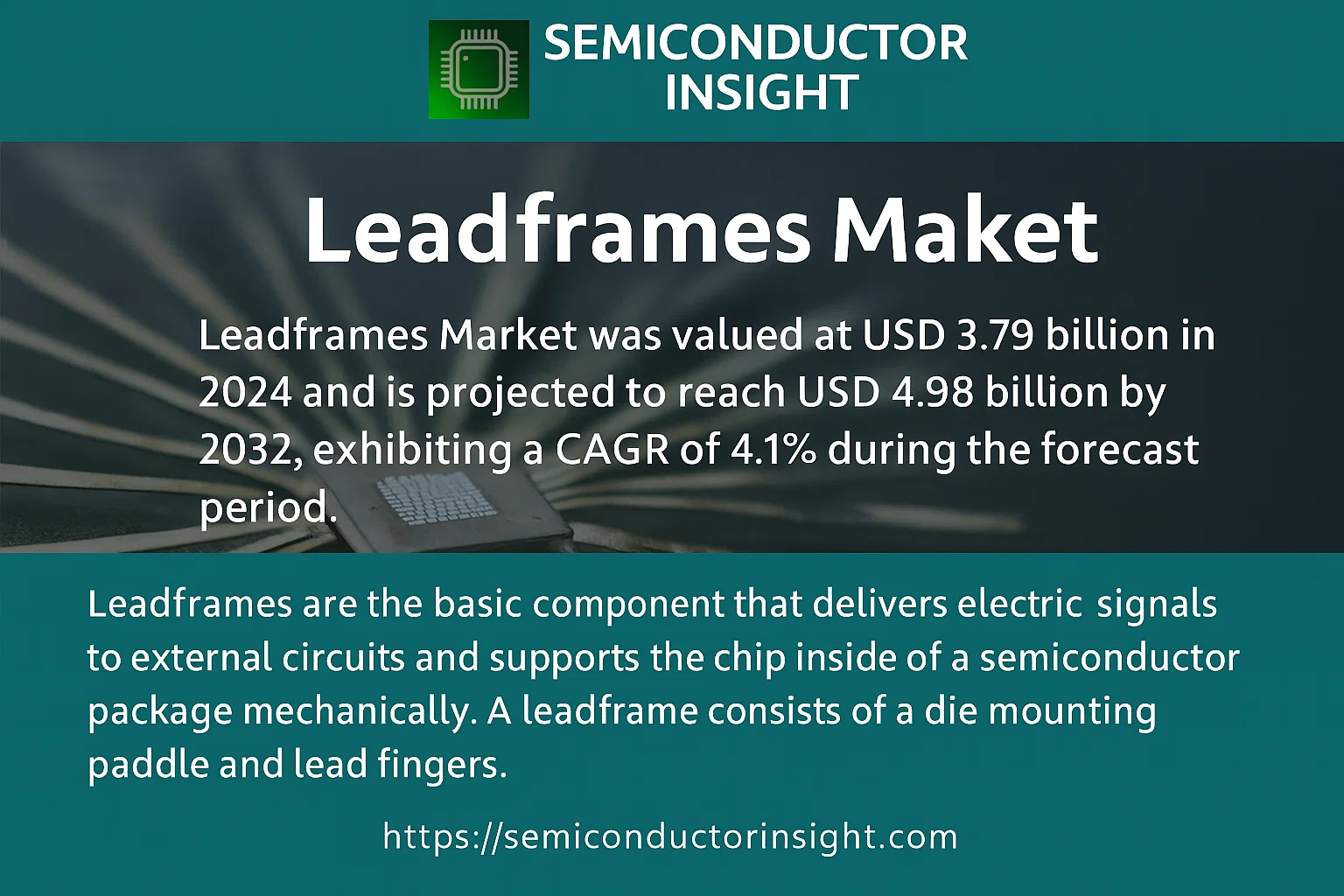
Global Leadframes Market was valued at USD 3.79 billion in 2024 and is projected to reach USD 4.98 billion by 2032, exhibiting a CAGR of 4.1% during the forecast period.
Leadframes are the basic component that delivers electric signals to external circuits and supports the chip inside of a semiconductor package mechanically. A leadframe consists of a die mounting paddle and lead fingers. The die paddle serves primarily to mechanically support the die during package manufacture. The lead fingers connect the die to the circuitry external to the package.
Global leadframes key manufacturers include Mitsui High-tec, Shinko, and Chang Wah Technology Co., among others. The top three manufacturers hold about 35% of the global share. The key production regions are mainly located in China, Japan, Korea, Taiwan (China), and Southeast Asia, with China being the largest production region with a 27% share. In terms of process type, stamping process leadframes are the largest segment with about 74% share, while in terms of downstream application, integrated circuits are the largest segment with a 60% share, followed by discrete devices.
We have surveyed the Leadframes manufacturers, suppliers, distributors, and industry experts on this industry, involving the sales, revenue, demand, price change, product type, recent development and plan, industry trends, drivers, challenges, obstacles, and potential risks.
MARKET DRIVERS
Rising Demand for Miniaturized and High-Performance Electronics
The relentless push for smaller, more powerful, and energy-efficient electronic devices is a primary driver for the leadframes market. As semiconductor packages shrink to fit smartphones, wearables, and IoT devices, the demand for advanced, high-density leadframes that offer superior electrical and thermal performance has intensified. This trend directly fuels innovation and adoption of technologies like QFN (Quad Flat No-lead) and DFN (Dual Flat No-lead) packages.
Growth in Automotive Electronics and Electrification
The automotive industry’s transformation, particularly the shift towards electric vehicles (EVs) and advanced driver-assistance systems (ADAS), requires a significant increase in semiconductor content per vehicle. Leadframes are critical components in the power management systems, sensors, and control units for these applications, creating sustained demand. The stringent reliability requirements of the automotive sector further drive the need for high-quality, durable leadframe solutions.
➤ The global automotive semiconductor market is projected to see substantial growth, directly correlating with increased leadframe consumption.
Furthermore, the expansion of 5G infrastructure and the continued data center build-out necessitate advanced semiconductor packages, many of which rely on sophisticated leadframe designs to manage signal integrity and heat dissipation, propelling market growth.
MARKET CHALLENGES
Price Pressure and Intense Competition
The leadframe market is highly competitive, with numerous global and regional players. This environment, coupled with the cost-sensitive nature of the semiconductor supply chain, creates significant price pressure. Manufacturers are constantly challenged to reduce production costs while maintaining high quality and meeting increasingly complex technical specifications.
Other Challenges
Transition to Advanced Packaging Technologies
The industry’s ongoing shift towards fan-out wafer-level packaging (FO-WLP) and system-in-package (SiP) solutions poses a challenge for traditional leadframe suppliers. These advanced packaging methods can reduce or eliminate the need for leadframes in certain high-performance applications, requiring suppliers to innovate and adapt their product portfolios to remain relevant.
Volatility in Raw Material Costs
The primary raw material for leadframes is copper alloy, and fluctuations in copper prices directly impact manufacturing costs and profit margins. This volatility makes financial planning difficult and can squeeze profitability, especially when long-term supply contracts limit the ability to pass cost increases to customers.
MARKET RESTRAINTS
High Capital Investment for Advanced Manufacturing
Producing advanced leadframes, particularly those with intricate etching and plating requirements for fine-pitch applications, demands significant capital investment in specialized equipment and cleanroom facilities. This high barrier to entry can restrain market growth by limiting the ability of smaller players to compete and innovate at the leading edge of technology.
Supply Chain Vulnerabilities
Global supply chain disruptions, as experienced in recent years, can severely impact the leadframe market. Dependencies on specific regions for raw materials or manufacturing, coupled with logistical bottlenecks, can lead to production delays and increased costs, acting as a restraint on stable market expansion.
MARKET OPPORTUNITIES
Expansion in Power Semiconductor Applications
The rapid growth in renewable energy, industrial automation, and electric vehicles is driving strong demand for power semiconductors, such as IGBTs and MOSFETs. These devices heavily rely on robust leadframes capable of handling high currents and temperatures, presenting a significant growth avenue for specialized leadframe manufacturers.
Development of Leadframe-Based Advanced Packages
There is a substantial opportunity in the development of cost-effective, leadframe-based packages that can compete with more expensive alternatives. Innovations like multi-row QFN packages and thermally enhanced leadframes offer high performance at a lower cost, making them attractive for a wide range of mid-to-high-tier applications and opening new market segments.
Adoption in Emerging Technologies
Emerging technologies such as artificial intelligence, machine learning, and the broader Internet of Things (IoT) ecosystem require vast quantities of sensors and connectivity chips. Many of these components utilize leadframe packages, creating a sustained and growing demand base for the foreseeable future.
Leadframes Market Trends
Sustained Growth Driven by Semiconductor Demand
The global Leadframes market is on a steady growth trajectory, with its value projected to increase from $3,793 million in 2024 to $4,983 million by 2032, representing a Compound Annual Growth Rate (CAGR) of 4.1%. This sustained expansion is primarily fueled by the relentless demand for semiconductors across a multitude of industries, including automotive, consumer electronics, and industrial automation. As the essential component that delivers electrical signals and provides mechanical support for semiconductor chips, the demand for leadframes is intrinsically linked to the health of the global electronics sector. The market’s resilience is further evidenced by consistent sales volumes measured in billions of units annually.
Other Trends
Geographical Production Concentration
A dominant trend is the concentration of production in the Asia-Pacific region, which accounted for the largest share of the global market. China stands as the largest production region, holding a 27% share, with other key manufacturing hubs located in Japan, South Korea, Taiwan (China), and Southeast Asia. This geographical clustering benefits from established supply chains, manufacturing expertise, and proximity to major semiconductor fabrication plants. The competitive landscape is also concentrated, with the top three manufacturers—Mitsui High-tec, Shinko, and Chang Wah Technology—collectively holding approximately 35% of the global market share.
Process and Application Segmentation
The market is clearly segmented by manufacturing process and application. Stamping process leadframes dominate the industry, commanding about 74% of the market share due to their cost-effectiveness for high-volume production. In contrast, etching process leadframes are utilized for more complex, high-precision applications. In terms of downstream usage, Integrated Circuits (ICs) are the largest application segment, accounting for 60% of demand, followed by discrete devices. This segmentation highlights the critical role of leadframes in both complex processing units and individual electronic components.
Market Evolution and Competitive Dynamics
The leadframes market is characterized by ongoing technological evolution to meet the demands for miniaturization and higher performance in semiconductor packaging. Key players are continuously engaged in research and development to enhance material properties and production efficiency. The competitive dynamics involve strategic initiatives such as capacity expansion, mergers, and acquisitions as companies seek to strengthen their market position and cater to the growing and diversifying requirements of the global electronics industry. The market’s future development is closely tied to innovations in semiconductor technology and global economic factors influencing electronics consumption.
COMPETITIVE LANDSCAPE
Key Industry Players
An In-Depth Look at the Structure and Dynamics of the Leadframes Market
The global leadframes market is characterized by a moderately consolidated landscape, with the top three manufacturers—Mitsui High-tec, Shinko, and Chang Wah Technology—collectively holding approximately 35% of the global market share. This concentration reflects the high capital investment, specialized technical expertise, and established supply chain relationships required for leadframe manufacturing. Competition is intense, driven by demands for miniaturization, cost efficiency, and high thermal and electrical performance from downstream semiconductor packaging customers. The market dynamics are influenced by regional production strengths, with Asia-Pacific, particularly China (which accounts for about 27% of production), Japan, South Korea, and Taiwan, being the dominant manufacturing hubs.
Beyond the top-tier players, a diverse group of companies competes by specializing in particular segments or processes. Some focus on serving the high-volume market for stamping process leadframes, which holds a dominant 74% share of the market. Others differentiate themselves through advanced capabilities in the etching process, which is essential for finer pitch and higher-density applications. These niche players often compete on technological innovation, responsiveness to custom requirements, and regional market penetration, providing alternatives to the offerings of the largest suppliers, particularly for discrete devices and specific integrated circuit packages.
List of Key Leadframes Companies Profiled
- Mitsui High-tec
- Shinko
- Chang Wah Technology
- Advanced Assembly Materials International
- HAESUNG DS
- SDI
- Fusheng Electronics
- Enomoto
- Kangqiang
- POSSEHL
- JIH LIN TECHNOLOGY
- Jentech
- Hualong
- Dynacraft Industries
- QPL Limited
- WUXI HUAJING LEADFRAME
- HUAYANG ELECTRONIC
- DNP
- Xiamen Jsun Precision Technology
Segment Analysis:
| Segment Category | Sub-Segments | Key Insights |
| By Type |
|
Stamping Process Leadframes dominate the market due to their cost-effectiveness and high-volume production capabilities, making them the preferred choice for a wide range of standard semiconductor packaging applications. The etching process, while offering higher precision for complex and miniaturized designs, caters to niche, high-performance segments but involves a more complex and expensive manufacturing workflow. |
| By Application |
|
Integrated Circuits represent the principal application segment, driven by the pervasive demand for computing, communication, and consumer electronics. The complexity and high pin-count requirements of modern ICs create sustained demand for advanced leadframe solutions. Discrete devices form a significant secondary market, while the “Others” category includes specialized applications that contribute to a diversified demand base. |
| By End User |
|
Consumer Electronics is the leading end-user segment, fueled by the massive and continuous global demand for smartphones, laptops, and home appliances. The automotive electronics sector is a rapidly growing segment, driven by increasing vehicle electrification and the integration of advanced driver-assistance systems, which require reliable and robust semiconductor packaging. |
| By Material |
|
Copper Alloy leadframes are the most widely used material due to their superior electrical and thermal conductivity, which is critical for high-performance semiconductor devices. Alloy 42 is favored in applications where a close thermal expansion match with silicon is necessary to prevent stress, while other advanced alloys are developed for specific requirements like higher strength or corrosion resistance. |
| By Package Type |
|
Quad Flat Package (QFP) and Quad Flat No-lead (QFN) packages represent the leading segment, as they are extensively used for complex integrated circuits requiring a high number of input/output connections in a compact form factor. The ongoing trend towards miniaturization and enhanced functionality in electronics continues to drive innovation and demand within this package type category. |
Regional Analysis: Leadframes Market
The region’s core strength lies in its dense network of integrated device manufacturers (IDMs) and outsourced semiconductor assembly and test (OSAT) companies. This creates a synergistic environment where leadframe producers are in close proximity to their largest customers, ensuring rapid response times, reduced logistics costs, and collaborative development for custom leadframe solutions tailored to next-generation chip designs. The entire value chain, from base material processing to precision etching and plating, is well-established.
Asia-Pacific is at the forefront of adopting and developing advanced leadframe-based packages like QFNs (Quad Flat No-leads) and power discrete packages. Local manufacturers are heavily investing in R&D to produce leadframes with finer pitches, improved thermal and electrical performance, and better integration capabilities. This focus on innovation is crucial for keeping pace with the demanding requirements of high-performance computing, 5G infrastructure, and automotive power electronics.
National policies, such as China’s “Made in China 2025” and support for the domestic semiconductor industry in other APAC countries, provide a significant tailwind. These initiatives offer subsidies, tax incentives, and strategic guidance that encourage local production of key components, reducing reliance on imports and fostering a resilient and self-sufficient semiconductor ecosystem, which directly benefits the leadframe market.
The sheer volume and diversity of electronics manufacturing in the region fuel consistent demand. From mass-produced smartphones and laptops to the rapidly growing automotive semiconductor sector and industrial automation equipment, the need for reliable, cost-effective leadframe packages is immense. This broad-based demand provides market stability and encourages continuous capacity expansion among leadframe suppliers.
North America
North America maintains a significant presence in the leadframes market, characterized by a strong focus on high-value, specialized applications rather than high-volume commodity production. The region is home to leading fabless semiconductor companies and integrated device manufacturers that design highly advanced chips for sectors like aerospace, defense, telecommunications, and high-performance computing. This drives demand for precision-engineered leadframes capable of handling high frequencies, extreme temperatures, and stringent reliability standards. The market is supported by a robust R&D ecosystem involving universities, national labs, and corporate research centers, pushing the boundaries of packaging technology. While manufacturing capacity is smaller compared to Asia-Pacific, the emphasis is on innovation, quality control, and serving niche markets with demanding technical requirements, ensuring its position as a key technological leader and high-value market segment.
Europe
The European leadframes market is anchored by its formidable automotive industry, which is a major consumer of semiconductors and, consequently, leadframes. With the rapid acceleration of vehicle electrification, advanced driver-assistance systems (ADAS), and in-vehicle networking, the demand for robust and reliable power discrete and microcontroller packages has surged. European leadframe suppliers and semiconductor manufacturers are deeply integrated into the automotive supply chain, adhering to strict quality standards. The region also has strengths in industrial automation, medical devices, and aerospace, which require highly reliable components. European players often focus on specialized, high-margin segments, leveraging their engineering expertise to develop leadframe solutions that meet specific regional regulatory and performance demands, creating a stable and technologically advanced market.
South America
The leadframes market in South America is emerging and relatively modest in scale compared to other regions. Its growth is primarily tied to the gradual expansion of the regional electronics manufacturing base, particularly in countries like Brazil. Demand is largely driven by the consumer electronics and automotive sectors, though the market is characterized by a higher reliance on imported semiconductor components. Local production of leadframes is limited, with the market mainly served by international suppliers. Growth is steady but is often influenced by broader economic conditions and regional industrial policies aimed at fostering local manufacturing. The potential for growth exists, particularly if regional economic integration and investment in technology infrastructure increase, but it remains a developing market within the global landscape.
Middle East & Africa
The Middle East & Africa region represents a smaller but growing segment of the global leadframes market. Development is uneven, with more significant activity concentrated in the Middle East, where nations are actively pursuing economic diversification initiatives that include building technology and manufacturing hubs. The demand for leadframes is linked to the growth of telecommunications infrastructure, consumer electronics imports, and some industrial applications. Africa’s market is nascent, with potential linked to long-term economic development and the gradual establishment of electronics assembly operations. The region is currently a net importer of semiconductor components, and the leadframe market’s evolution is closely tied to foreign direct investment and the success of broader industrialization efforts.
Report Scope
This market research report provides a comprehensive analysis of the Leadframes Market , covering the forecast period 2025–2032. It offers detailed insights into market dynamics, technological advancements, competitive landscape, and key trends shaping the industry.
Key focus areas of the report include:
- Market Overview: The report begins with an overview outlining its current market scenario, key growth indicators, and industry transformation drivers. It discusses macroeconomic factors, demand–supply balance, regulatory landscape, and the strategic role of semiconductors in powering advancements across industries such as automotive, telecommunications, consumer electronics, and industrial automation.
- Market Size & Forecast: Historical data and future projections for revenue, unit shipments, and market value across major regions and segments.
- Segmentation Analysis: Detailed breakdown by product type, technology, application, and end-user industry to identify high-growth segments and investment opportunities.
- Regional Insights: Insights into market performance across North America, Europe, Asia-Pacific, Latin America, and the Middle East & Africa, including country-level analysis where relevant.
- Competitive Landscape: Profiles of leading market participants, including their product offerings, R&D focus, manufacturing capacity, pricing strategies, and recent developments such as mergers, acquisitions, and partnerships.
- Technology Trends & Innovation: Assessment of emerging technologies, integration of AI/IoT, semiconductor design trends, fabrication techniques, and evolving industry standards.
- Market Drivers & Restraints: Evaluation of factors driving market growth along with challenges, supply chain constraints, regulatory issues, and market-entry barriers.
- Stakeholder Insights: Insights for component suppliers, OEMs, system integrators, investors, and policymakers regarding the evolving ecosystem and strategic opportunities.
Primary and secondary research methods are employed, including interviews with industry experts, data from verified sources, and real-time market intelligence to ensure the accuracy and reliability of the insights presented.
FREQUENTLY ASKED QUESTIONS:
What is the current market size of Leadframes Market?
-> Leadframes Market was valued at USD 3.79 billion in 2024 and is projected to reach USD 4.98 billion by 2032, exhibiting a CAGR of 4.1% during the forecast period.
Which key companies operate in Leadframes Market?
-> Key players include Mitsui High-tec, Shinko, Chang Wah Technology, Advanced Assembly Materials International, and HAESUNG DS, among others. The top three manufacturers hold about 35% of the global market share.
What are the key growth drivers?
-> Key growth drivers include rising demand for semiconductors across automotive, telecommunications, and consumer electronics, technological advancements in packaging, and global expansion of electronics manufacturing, particularly in Asia.
Which region dominates the market?
-> Asia is the dominant production region, with China being the largest production region with a 27% share, followed by Japan, Korea, Taiwan (China), and Southeast Asia.
What are the emerging trends?
-> Emerging trends include the dominance of stamping process leadframes (74% share), the growth of integrated circuits as the largest application segment (60% share), and continued innovation in semiconductor packaging technologies.

Get Sample Report PDF for Exclusive Insights
Report Sample Includes
- Table of Contents
- List of Tables & Figures
- Charts, Research Methodology, and more...
 Download Sample Report PDF