Key Statistics
Key Takeaways
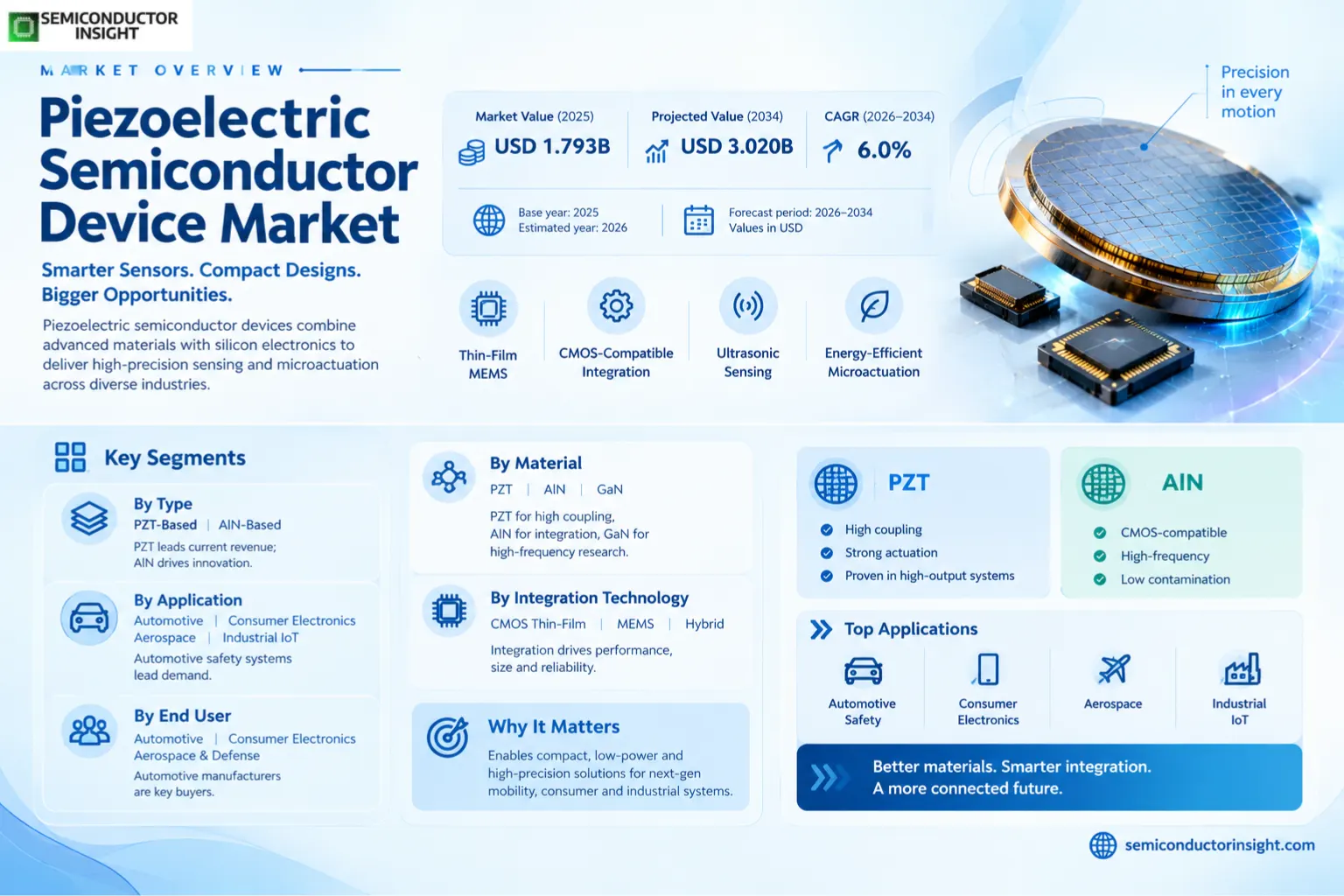
- Market size and growth: the market is valued at USD 1.793 billion in 2025 and is projected to reach USD 3.020 billion by 2034, representing a 6.0% CAGR across 2026–2034.
- PZT-Based Devices leads the type mix because PZT offers high electromechanical coupling and a mature manufacturing ecosystem for actuators, ultrasonic transducers and high-output devices.
- Automotive Safety Systems is the leading application, supported by ultrasonic ranging, vibration control and safety-related sensing require compact devices with strong electromechanical response.
- Asia Pacific is the largest geographic market, while Asia Pacific has the strongest incremental growth profile.
- Primary driver: miniaturization, ultrasonic sensing and thin-film MEMS integration are expanding piezoelectric functionality across automotive, consumer and industrial systems
- Principal restraint: material deposition, acoustic packaging and reliability qualification can be technically demanding and capital intensive
Market Overview
The piezoelectric semiconductor device market was valued at USD 1.793 billion in 2025 and is projected to reach USD 3.020 billion by 2034, expanding at a 6.0% CAGR over 2026–2034. Asia Pacific holds the leading market position in 2025, while the category is being reshaped by thin-film piezoelectric MEMS, CMOS-compatible integration, ultrasonic sensing and energy-efficient microactuation..
Piezoelectric semiconductor devices combine piezoelectric materials with semiconductor or MEMS structures to convert mechanical energy into electrical signals or electrical drive into controlled mechanical motion. The category includes sensors, ultrasonic transducers, resonators, microactuators and energy-harvesting structures using materials such as lead zirconate titanate, aluminum nitride and gallium nitride. Integration with silicon electronics allows compact modules with signal conditioning, control and communications.
PZT provides strong electromechanical coupling for actuators and higher-output transducers, while AlN is attractive for thin-film processes and compatibility with semiconductor fabrication. STMicroelectronics describes piezoelectric MEMS structures using PZT or AlN for sensing and actuation, while its thin-film piezoelectric technology targets microactuators in compact systems. Murata’s ultrasonic sensors demonstrate a mature high-volume use of piezoelectric ceramics in object detection and automotive parking assistance.
The market benefits from the same forces driving MEMS generally: smaller systems, lower power, higher integration and more embedded sensing. The highest value is created when material deposition, MEMS structures, ASICs and packaging are co-optimized, because piezoelectric performance is sensitive to film quality, geometry, stress and acoustic coupling. Suppliers therefore compete on process control and system-level integration, not material selection alone.
Segment Analysis: By Type
By type, the market is segmented into PZT-Based Devices, AlN-Based Devices. PZT-Based Devices leads the current revenue mix, while product innovation is concentrated in performance, integration, reliability and system-level economics.
| Type | Function / role | Market position |
|---|---|---|
| PZT-Based Devices | Uses lead zirconate titanate films or ceramics for high coupling and strong actuation. | Largest type in high-output actuators and ultrasonic applications due to mature material performance. |
| AlN-Based Devices | Uses aluminum nitride thin films that are compatible with semiconductor process flows and high-frequency acoustic structures. | Strong growth where CMOS-compatible deposition, low contamination and high-frequency performance matter. |
Commercial implications by type
PZT retains an advantage where electromechanical coupling and actuation force dominate, while AlN offers process-integration benefits and is well suited to thin-film acoustic devices. Commercial selection therefore depends on the required displacement, frequency, process compatibility, temperature range and packaging rather than a single universal material winner.
Segment Analysis: By Application
By application, the market includes Automotive Safety Systems, Consumer Electronics, Aerospace, Industrial IoT. Automotive Safety Systems is the leading demand pool because purchasing is tied directly to system performance, reliability, user experience or operating continuity.
| Application | Demand characteristics |
|---|---|
| Automotive Safety Systems | Ultrasonic parking, occupancy, vibration and active-control systems use compact piezoelectric sensing and actuation. |
| Consumer Electronics | MEMS speakers, haptics, autofocus and ultrasonic functions benefit from thin, low-power piezoelectric structures. |
| Aerospace | High-reliability vibration, actuation and sensing use cases value compact electromechanical conversion. |
| Industrial IoT | Vibration sensing, ultrasonic measurement and energy harvesting support connected industrial monitoring. |
By End User
| End User | Commercial relevance |
|---|---|
| Automotive Manufacturers | Require qualified devices with long supply life, high reliability and integration with vehicle electronics. |
| Consumer Electronics Brands | Prioritize small size, low power, acoustic performance and high-volume manufacturability. |
| Aerospace & Defense Contractors | Value environmental tolerance, reliability and custom qualification. |
By Material
| Material | Commercial relevance |
|---|---|
| Lead Zirconate Titanate (PZT) | High piezoelectric coefficients support actuators and high-output transducers. |
| Aluminum Nitride (AlN) | Thin-film compatibility and high-frequency performance support semiconductor-integrated acoustic devices. |
| Gallium Nitride (GaN) | Wide-bandgap semiconductor properties enable specialized piezoelectric and high-frequency device research. |
By Integration Technology
| Integration Technology | Commercial relevance |
|---|---|
| CMOS-Compatible Thin-Film Deposition | Enables piezoelectric layers to be integrated with silicon electronics and wafer-scale processing. |
| MEMS Integration | Combines mechanical structures, piezoelectric films and electronics in compact sensor or actuator systems. |
| Hybrid Module Assembly | Allows optimized piezoelectric elements and separate ASICs to be packaged together when monolithic integration is impractical. |
Regional Analysis
Asia Pacific leads the market because Japan, China, South Korea and Taiwan combine large semiconductor, MEMS, automotive and consumer-electronics manufacturing ecosystems. Asia Pacific has the strongest growth profile as investment and adoption shift toward high-volume consumer electronics, vehicle sensing, localized MEMS capacity and increasing use of thin-film acoustic devices.
How does regional demand differ across this market?
Asia Pacific leads through electronics manufacturing and material know-how, North America is strong in MEMS innovation, aerospace and industrial applications, and Europe has a large automotive and precision-sensing base. Smaller regions participate mainly through downstream system integration. Supplier selection depends on material performance, wafer process capability, acoustic packaging, reliability qualification and the ability to integrate the device with control electronics.
| Region | Position | Growth outlook | Demand profile | Supplier selection |
|---|---|---|---|---|
| Asia Pacific | Largest | Fastest | Consumer electronics and automotive manufacturing | Scale, process control and cost |
| North America | Second | Strong | Innovation and high-value systems | Performance and integration |
| Europe | Third | Moderate | Automotive and industrial | Qualification and lifecycle |
| South America | Smaller | Selective | Industrial applications | Cost and local support |
| Middle East & Africa | Emerging | Project-led | Industrial and infrastructure | Ruggedness and support |
Competitive Landscape
Competition spans MEMS manufacturers, diversified semiconductor companies and specialist acoustic-component suppliers, with process know-how and packaging performance acting as major barriers.
STMicroelectronics, Murata, TDK, Texas Instruments, Infineon, Bosch Sensortec and other suppliers participate at different points in the piezoelectric and MEMS value chain. Some companies manufacture integrated MEMS structures and ASICs, while others focus on piezoelectric ceramics, acoustic components or application modules. This makes direct competitive overlap application-specific rather than uniform across the market.
Manufacturing capability is a key differentiator because film thickness, residual stress, electrode design and wafer-level processing directly influence frequency response and electromechanical efficiency. Companies with internal MEMS process technology can optimize the mechanical structure and interface electronics together, which improves yield and shortens qualification cycles.
Packaging is equally strategic in ultrasonic and acoustic applications. The device must couple mechanical energy efficiently while surviving moisture, vibration and temperature variation. Suppliers that can control package geometry and calibration can capture more system value than those selling an undifferentiated die.
| Competitive tier | Representative participants | Competitive focus |
|---|---|---|
| Integrated semiconductor / MEMS leaders | STMicroelectronics, Infineon, Bosch Sensortec, NXP | MEMS structures, ASIC integration and high-volume qualification |
| Piezoelectric component leaders | Murata, TDK, Panasonic | Materials, ultrasonic and acoustic component expertise |
| Mixed-signal and RF specialists | Texas Instruments, Analog Devices, Qorvo, Silicon Labs | Interface electronics, resonators and application-specific integration |
Companies Profiled
STMicroelectronics, Texas Instruments, Murata Manufacturing, Infineon Technologies, Bosch Sensortec, NXP Semiconductors, Analog Devices, Qorvo, TDK, Silicon Labs, Renesas Electronics, Panasonic, onsemi
Production Capacity Analysis
Production capacity depends on high-quality piezoelectric films or ceramics, MEMS wafer processing, electrodes, ASIC integration, wafer bonding and application-specific packaging.
Thin-film piezoelectric devices require controlled deposition and etch processes because thickness, crystal orientation and residual stress directly affect resonance and actuation efficiency. Scaling capacity therefore depends on process stability and yield learning, not simply adding wafer starts. PZT also introduces materials-handling requirements that can complicate integration with standard semiconductor lines.
Back-end capacity can be equally important. Ultrasonic sensors, microphones and actuators require acoustic or mechanical packaging that preserves the intended energy path. Automated calibration, wafer-level packaging and precision assembly can become bottlenecks when unit volumes grow, especially in consumer electronics and automotive applications with tight cost targets.
Market Dynamics
The market is shifting from discrete piezoelectric elements toward integrated MEMS devices that combine mechanical structures, electronics and packaging.
Traditional ceramic components remain highly competitive in mature ultrasonic and actuator applications, but thin-film integration opens functions that require smaller size, lower power and wafer-scale manufacturing. The strongest growth occurs where integration creates a system benefit that outweighs process complexity, such as thinner speakers, compact autofocus actuators or high-density ultrasonic arrays.
Market Drivers
Drivers Impact Analysis
| Driver | Impact | Commercial mechanism |
|---|---|---|
| Miniaturization of electronic systems | High | Smaller devices create demand for thin, efficient sensing and actuation structures. |
| Automotive ultrasonic sensing | High | Parking, occupancy and safety functions use robust piezoelectric transducers. |
| MEMS integration | High | Wafer-scale processes improve repeatability and enable compact semiconductor-compatible devices. |
| Energy harvesting and autonomous sensing | Medium | Piezoelectric structures can convert vibration into power for low-energy sensor nodes. |
Miniaturization of electronic systems
Smaller devices create demand for thin, efficient sensing and actuation structures.
Automotive ultrasonic sensing
Parking, occupancy and safety functions use robust piezoelectric transducers.
MEMS integration
Wafer-scale processes improve repeatability and enable compact semiconductor-compatible devices.
Energy harvesting and autonomous sensing
Piezoelectric structures can convert vibration into power for low-energy sensor nodes.
Market Restraints
Restraints Impact Analysis
| Restraint | Impact | Commercial mechanism |
|---|---|---|
| Complex thin-film process control | High | Material orientation, stress and thickness variation can reduce performance and yield. |
| Packaging sensitivity | High | Acoustic and mechanical coupling depend strongly on package geometry and assembly quality. |
| Material trade-offs | Medium | PZT offers strong coupling but presents process and environmental considerations, while AlN has lower coupling. |
| Qualification cost | Medium | Automotive and aerospace applications require long reliability validation. |
Complex thin-film process control
Material orientation, stress and thickness variation can reduce performance and yield.
Packaging sensitivity
Acoustic and mechanical coupling depend strongly on package geometry and assembly quality.
Material trade-offs
PZT offers strong coupling but presents process and environmental considerations, while AlN has lower coupling.
Qualification cost
Automotive and aerospace applications require long reliability validation.
Market Opportunities
Piezoelectric MEMS speakers
Solid-state acoustic devices can reduce thickness and improve integration in earbuds, wearables and smart glasses.
Ultrasonic sensing
Automotive, robotics and industrial measurement create sustained demand for compact transmit-receive devices.
Energy harvesting
Industrial IoT nodes can use machine vibration to supplement or extend battery life.
CMOS-compatible microactuation
Thin-film actuation can support autofocus, micro-pumps, infrared scanning and precision positioning.
Supply Chain Analysis
PZT, AlN, GaN, electrodes
Deposition, patterning, MEMS structures
Signal conditioning, bonding, acoustic packaging
Automotive, consumer, industrial, aerospace
Piezo materials
Material purity, crystal orientation and film stress determine electromechanical performance and process repeatability.
Wafer processing
Deposition, lithography and etch define resonant structures and actuator geometry. Yield learning is essential because small process shifts can alter frequency or displacement.
ASIC and packaging
Control electronics, amplification and calibration turn the mechanical element into a usable semiconductor device. Packaging must preserve acoustic or mechanical coupling.
System integration
OEMs evaluate complete performance, including power, frequency response, environmental reliability and software control, rather than the piezoelectric material alone.
Recent Developments
2026 — ST describes growing use of piezoelectric MEMS microactuators
ST highlights PZT-based MEMS speakers, micro-pumps and autofocus actuators as emerging applications for thin-film piezoelectric technology. Source
2026 — Murata maintains broad ultrasonic sensor portfolio
Murata’s current lineup uses piezoelectric ceramic technology for object detection and automotive parking-assistance applications. Source
2026 — ST details piezoelectric transduction inside MEMS sensors
ST describes PZT and AlN piezoelectric materials as integrated transduction mechanisms for sensing and actuation. Source
Report Scope & Segmentation
| Attribute | Coverage |
|---|---|
| Market | Piezoelectric Semiconductor Device |
| Base Year | 2025 |
| Estimated Year | 2026 |
| Forecast Period | 2026–2034 |
| 2025 Market Size | USD 1.793 billion |
| 2026 Estimated Size | USD 1.900 billion |
| 2034 Forecast Size | USD 3.020 billion |
| CAGR | 6.0% (2026–2034) |
| By Type | PZT-Based Devices, AlN-Based Devices |
| By Application | Automotive Safety Systems, Consumer Electronics, Aerospace, Industrial IoT |
| By End User | Automotive Manufacturers, Consumer Electronics Brands, Aerospace & Defense Contractors |
| By Material | Lead Zirconate Titanate (PZT), Aluminum Nitride (AlN), Gallium Nitride (GaN) |
| By Integration Technology | CMOS-Compatible Thin-Film Deposition, MEMS Integration, Hybrid Module Assembly |
| Regions | Asia Pacific, North America, Europe, South America, Middle East & Africa |
| Companies Profiled | STMicroelectronics, Texas Instruments, Murata Manufacturing, Infineon Technologies, Bosch Sensortec, NXP Semiconductors, Analog Devices, Qorvo, TDK, Silicon Labs, Renesas Electronics, Panasonic, onsemi |
Frequently Asked Questions
What is the piezoelectric semiconductor device market size in 2025?
The market is valued at USD 1.793 billion in 2025.
What is the projected market size by 2034?
The market is projected to reach USD 3.020 billion by 2034.
What is the CAGR from 2026 to 2034?
The market is expected to expand at a 6.0% CAGR over 2026–2034.
Which region leads the market?
Asia Pacific is the largest market in 2025.
Which type leads the market?
PZT-Based Devices holds the leading type position.
Which application is the largest?
Automotive Safety Systems is the leading application segment.
What is the main growth driver?
miniaturization, ultrasonic sensing and thin-film MEMS integration are expanding piezoelectric functionality across automotive, consumer and industrial systems.
What is the main market restraint?
material deposition, acoustic packaging and reliability qualification can be technically demanding and capital intensive.
Where are the strongest opportunities?
piezoelectric MEMS speakers, ultrasonic sensing, energy harvesting and CMOS-compatible microactuators.
Which companies are active in the market?
STMicroelectronics, Texas Instruments, Murata Manufacturing, Infineon Technologies, Bosch Sensortec, NXP Semiconductors, Analog Devices, Qorvo.
Research Sources & Evidence Base
View primary and industry evidence used in this overview
- STMicroelectronics: The future of MEMS — Piezoelectric MEMS materials, speakers, actuators and energy harvesting.
- Murata Manufacturing: Ultrasonic Sensors — Piezoelectric ceramic ultrasonic product applications.
- STMicroelectronics: How MEMS sensors work — Piezoelectric transduction principles and device integration.
Get Sample Report PDF for Exclusive Insights
Report Sample Includes
- Table of Contents
- List of Tables & Figures
- Charts, Research Methodology, and more...
 Download Sample Report PDF