MARKET INSIGHTS
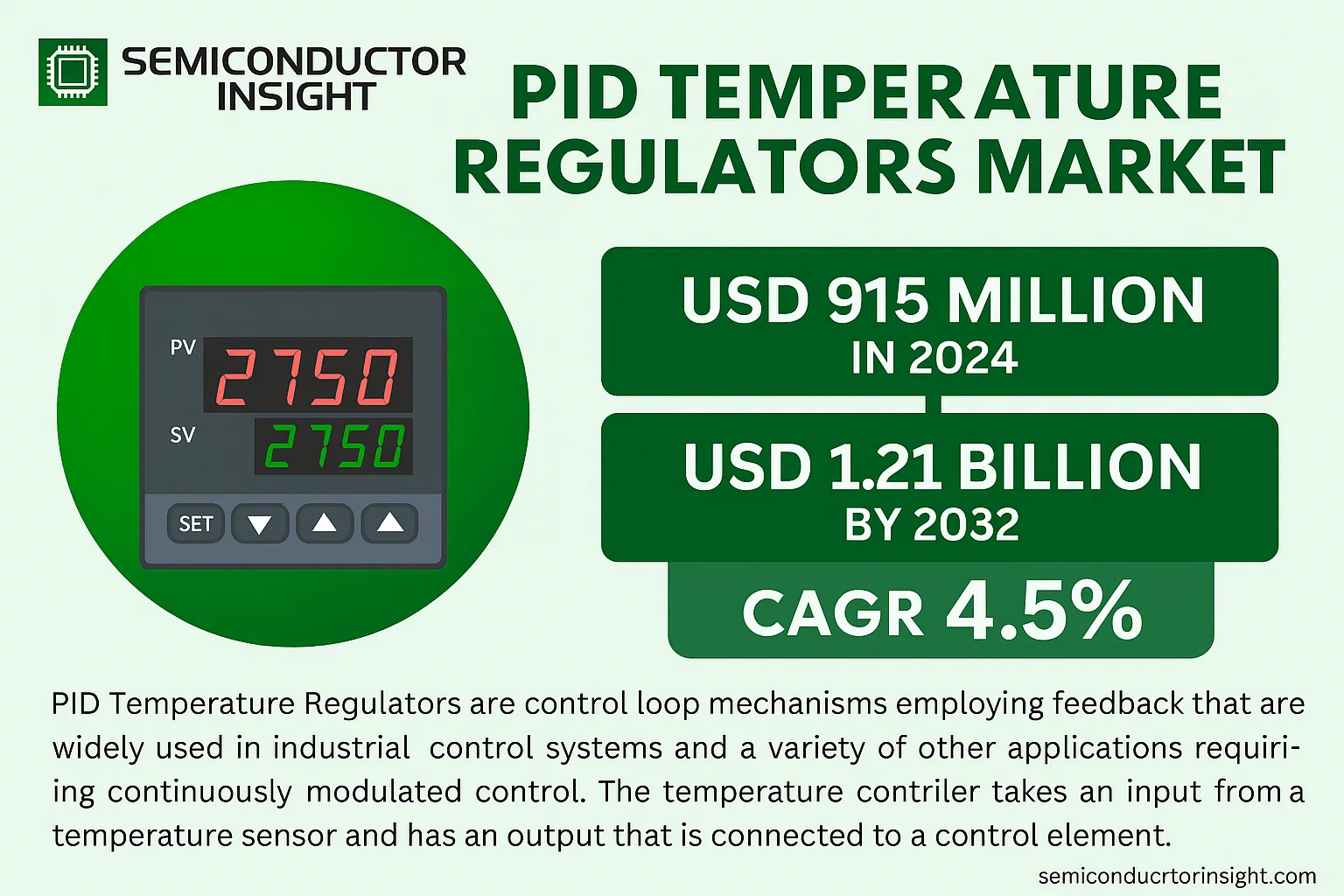
Global PID Temperature Regulators Market was valued at USD 915 million in 2024 and is projected to reach USD 1.21 billion by 2032, exhibiting a CAGR of 4.5% during the forecast period.
PID Temperature Regulators are control loop mechanisms employing feedback that are widely used in industrial control systems and a variety of other applications requiring continuously modulated control. The temperature controller takes an input from a temperature sensor and has an output that is connected to a control element. A PID controller continuously calculates an error value e(t) as the difference between a desired setpoint (SP) and a measured process variable (PV) and applies a correction based on proportional, integral, and derivative terms (denoted P, I, and D respectively).
The market is experiencing growth due to several factors, including the ongoing push for automation in industries like chemicals, plastics, and pharmaceuticals, which has led to an increasing need for precise temperature control. Industrial automation boosts demand for PID temperature controllers integrated with programmable logic controllers (PLCs) and industrial control systems. New models feature touch-screen interfaces, programmable settings, and adaptive control algorithms that allow automatic adjustment to varying process conditions, making these systems easier to use and more efficient.
We have surveyed the PID Temperature Regulators manufacturers, suppliers, distributors, and industry experts on this industry, involving the sales, revenue, demand, price change, product type, recent development and plan, industry trends, drivers, challenges, obstacles, and potential risks.
MARKET DRIVERS
Growing Demand for Precise Process Control
The global push for higher product quality and operational efficiency across manufacturing sectors is a primary driver for the PID temperature regulators market. Industries such as pharmaceuticals, food and beverage, and semiconductors require exceptionally stable and accurate temperature control to ensure product consistency, yield, and compliance with stringent regulatory standards. The superior performance of PID controllers in minimizing overshoot and maintaining setpoints is critical for these applications. This demand is further amplified by the trend towards miniaturization and complex formulations, where even minor temperature deviations can lead to significant losses.
Expansion of Industrial Automation and Industry 4.0
The ongoing adoption of Industry 4.0 principles and Industrial Internet of Things (IIoT) technologies is significantly propelling market growth. Modern PID regulators are increasingly equipped with advanced features like digital communication protocols (e.g., Profibus, Modbus, Ethernet/IP), data logging, and remote monitoring capabilities. This allows for seamless integration into automated control systems, enabling predictive maintenance, real-time optimization, and centralized management of thermal processes. The shift from standalone controllers to networked, intelligent systems is creating a sustained demand for upgraded and sophisticated PID solutions.
➤ The global industrial automation market is projected to grow at a CAGR of over 8%, directly influencing the adoption of advanced process control instruments like PID regulators.
Additionally, stringent energy efficiency regulations worldwide are compelling industries to optimize their energy consumption. PID controllers play a vital role in this by precisely managing heating and cooling cycles, thereby reducing energy waste and operational costs. This regulatory and economic pressure makes the investment in high-performance PID temperature regulators increasingly justifiable for a wide range of end-users.
MARKET CHALLENGES
Complexity of Tuning and Configuration
A significant challenge facing the wider adoption of PID temperature regulators, especially their advanced features, is the complexity involved in proper tuning. Optimal performance requires correctly setting the proportional, integral, and derivative parameters, which can be a non-intuitive process for operators without specialized training. Incorrect tuning can lead to process instability, cycling, or sluggish response, defeating the purpose of the advanced controller. This necessitates investment in training and support, potentially increasing the total cost of ownership for end-users.
Other Challenges
Integration with Legacy Systems
Many existing industrial facilities operate with aging control infrastructure that lacks the digital communication capabilities of modern PID regulators. Retrofitting these systems can be costly and complex, requiring additional hardware and software interfaces. This creates a barrier to adoption, as companies may delay upgrades due to the significant investment and potential downtime involved in system integration.
Price Sensitivity in Mature Markets
In highly competitive and mature market segments, there is considerable pressure on pricing. While advanced PID controllers offer superior performance, customers often compare them against simpler, cheaper on/off or proportional controllers. For applications where extreme precision is not critical, the higher cost of a PID regulator can be a deterrent, pushing customers toward lower-cost alternatives.
MARKET RESTRAINTS
High Initial Investment for Advanced Systems
The adoption of high-end PID temperature regulators with advanced communication, autotuning, and data analytics features involves a significant upfront cost. This includes not only the price of the controller itself but also potential costs for sensors, actuators, communication modules, and engineering services. For small and medium-sized enterprises (SMEs) or facilities with limited capital expenditure budgets, this high initial investment can act as a major restraint, slowing down market penetration in certain segments.
Availability of Alternative Control Technologies
The PID temperature regulator market faces competition from alternative control strategies, such as fuzzy logic controllers and model predictive control (MPC). For extremely complex, multi-variable processes, these advanced control methods can offer performance advantages over traditional PID control. While PID remains the dominant technology for a vast majority of single-loop temperature control applications, the existence of these alternatives restrains market growth in high-end, niche applications where superior performance justifies the added complexity and cost.
MARKET OPPORTUNITIES
Emerging Applications in Renewable Energy and EV Batteries
The rapid growth of the renewable energy sector and the electric vehicle (EV) industry presents substantial opportunities. PID temperature regulators are critical in the manufacturing processes for solar panels, wind turbine components, and particularly in the production and testing of lithium-ion batteries. Precise thermal management is essential during battery formation, cycling, and quality control to ensure safety, performance, and longevity. The expanding global capacity for battery production is creating a robust new demand stream for high-precision temperature control solutions.
Development of Intelligent and Adaptive PID Controllers
There is a significant opportunity for innovation in developing self-tuning and adaptive PID controllers. These next-generation systems can automatically adjust their parameters in response to changing process dynamics, eliminating the need for manual tuning and maintaining optimal performance under varying conditions. The integration of artificial intelligence and machine learning algorithms to predict and compensate for process disturbances represents the future of this market, offering a compelling value proposition for end-users seeking to maximize efficiency and reduce operational complexity.
Growth in Pharmaceuticals and Biotechnology
The pharmaceutical and biotechnology industries are experiencing strong growth, driven by factors such as an aging population and increased R&D spending. These industries rely heavily on precise temperature control for processes like fermentation, cell culture, lyophilization, and chemical synthesis, where stringent regulatory compliance (e.g., FDA, EMA) is mandatory. This creates a continuous and high-value market for reliable and validated PID temperature regulators, offering opportunities for suppliers who can meet the specific documentation and quality standards required.
PID Temperature Regulators Market Trends
Steady Growth Fueled by Industrial Automation
The global PID Temperature Regulators market is experiencing sustained expansion, with the market valued at $915 million in 2024 and projected to reach $1,211 million by 2032, representing a compound annual growth rate (CAGR) of 4.5%. This consistent growth trajectory is predominantly driven by the ongoing, widespread push for industrial automation across critical sectors. Industries such as chemicals, food and beverage, and pharmaceuticals increasingly require the precise temperature control that PID regulators provide to ensure product quality, optimize production processes, and enhance operational efficiency. The integration of these controllers with larger industrial control systems and programmable logic controllers (PLCs) is becoming standard practice.
Other Trends
Technological Advancements and User Interface Evolution
Recent product developments are marked by a significant improvement in user interface and control algorithms. Modern PID temperature regulators increasingly feature intuitive touch-screen interfaces and programmable settings that simplify operation and reduce setup time. Furthermore, the adoption of adaptive control algorithms is a key trend, allowing the systems to automatically adjust to varying process conditions without manual intervention. This enhances operational efficiency and ensures stability in complex industrial environments, making these advanced regulators more accessible and effective for a broader range of applications.
Regional and Product Segment Dynamics
Geographically, Europe stands as the largest market and production hub, holding approximately 30% of the global market share, followed by North America (25%) and the Asia-Pacific region (35%). In terms of product types, multi-loop PID temperature regulators dominate the market, accounting for over 55% of the share, as they offer greater control capability for complex processes. The Food & Beverage industry remains the largest application segment, with significant demand also coming from Biology & Chemical, Electrical and Electronics, and Water Treatment sectors. The competitive landscape is concentrated, with the top five manufacturers, including Omron, Yokogawa Electric, and Honeywell, collectively holding over 45% of the market.
COMPETITIVE LANDSCAPE
Key Industry Players
A Consolidated Market Led by Industrial Automation Giants and Specialists
The global PID Temperature Regulators market is characterized by a high degree of consolidation, with the top five manufacturers collectively holding over 45% of the market share. This dominance is led by major industrial automation and instrumentation corporations that leverage their extensive global distribution networks and broad product portfolios. Companies like Omron, Yokogawa Electric, Honeywell, and Schneider Electric are at the forefront, offering integrated control solutions that include advanced PID regulators with features like touch-screen interfaces and adaptive control algorithms. These market leaders cater to a wide array of demanding industrial applications, from chemical processing to food & beverage production, driving innovation and setting industry standards. The market’s largest segment is multi-loop PID regulators, which command over 55% share, reflecting the need for complex, multi-zone temperature control in modern industrial processes.
Beyond the dominant players, the market includes a range of significant niche and regional specialists that command strong positions. These companies, such as Watlow, known for its high-performance thermal solutions, and Gefran, a specialist in sensors and automation components, compete by offering high-precision products, specialized technical support, and tailored solutions for specific industries like semiconductor manufacturing or furnace control. Other notable players like ABB, RKC, and Delta Electronics also hold considerable shares, often focusing on specific geographies or application segments such as plastics or water treatment. This secondary tier of competitors ensures a dynamic market with continuous technological enhancements, particularly as demand grows for integration with PLCs and Industrial IoT platforms.
List of Key PID Temperature Regulators Companies Profiled
- Omron
- Yokogawa Electric Corporation
- Honeywell
- Schneider Electric
- Panasonic
- Gefran
- ABB
- Watlow
- West Control Solutions
- Delta Electronics
- BrainChild Electronic
- Durex
- RKC
- WIKA
- Xiamen Yudian
Segment Analysis:
| Segment Category | Sub-Segments | Key Insights |
| By Type |
|
Multi-loop PID temperature regulators is the leading segment, driven by the industry’s need for complex process control across multiple zones or parameters. These sophisticated systems offer superior efficiency for applications requiring simultaneous management of different thermal conditions, which is increasingly common in advanced manufacturing and industrial automation scenarios. The ability to centralize control and reduce hardware requirements provides significant operational advantages. |
| By Application |
|
Food & Beverage represents the leading application segment due to stringent hygiene standards and precise thermal processing requirements for safety and quality. PID regulators ensure consistent temperatures during pasteurization, fermentation, and sterilization processes. The Biology & Chemical sector also demonstrates strong demand for maintaining stable conditions in reactors and storage, while growing automation in Plastic manufacturing and water purification systems further expands the application scope. |
| By End User |
|
Large Enterprises are the dominant end users, leveraging these systems for extensive production lines and complex industrial processes where precision and reliability are paramount. These organizations invest in advanced PID controllers for integration with broader automation infrastructure. However, SMEs are increasingly adopting these technologies as they modernize operations, while Research & Development institutions utilize them for experimental processes requiring exact thermal control. |
| By Control Technology |
|
Advanced PID Controllers with Adaptive Algorithms are emerging as the leading technology segment, offering superior performance in dynamic industrial environments. These intelligent systems automatically adjust their control parameters in response to changing process conditions, minimizing overshoot and optimizing energy consumption. The integration of touch-screen interfaces and programmable settings enhances user experience, while network-enabled controllers facilitate seamless integration with Industrial IoT platforms for real-time monitoring and data analytics. |
| By Integration Level |
|
Integration with PLC/SCADA Systems represents the most significant growth area, driven by the industrial push towards comprehensive automation. These integrated solutions provide centralized control and monitoring capabilities that are essential for modern manufacturing facilities. The ability to seamlessly connect with programmable logic controllers and supervisory control systems allows for more sophisticated process optimization and fault diagnosis, making them highly valuable for industries prioritizing operational efficiency and data-driven decision making. |
Regional Analysis: PID Temperature Regulators Market
The region’s status as the world’s primary manufacturing center for automotive components and consumer electronics is a key driver. These industries require highly stable and precise thermal management during production processes, from semiconductor fabrication to plastic molding and paint curing, fueling the adoption of advanced multi-zone PID controllers.
Favorable government policies, particularly in China’s “Made in China 2025” initiative and similar programs in other nations, are aggressively promoting factory automation. This creates a regulatory and financial environment conducive to upgrading legacy control systems to modern digital PID regulators for improved productivity and quality control.
Significant growth in chemicals, pharmaceuticals, and food processing industries across Southeast Asia and India is generating substantial demand. PID regulators are critical for maintaining consistent product quality, ensuring safety in exothermic reactions, and meeting stringent regulatory standards in these sectors, leading to continuous market expansion.
A dense network of local manufacturers and component suppliers fosters intense competition, driving down costs and accelerating innovation in PID technology. This allows for the development of controllers tailored to specific regional needs and price points, making advanced temperature control accessible to a broader range of small and medium-sized enterprises.
North America
North America remains a highly mature and technologically advanced market for PID temperature regulators, characterized by a strong emphasis on replacing aging equipment with smart, connected solutions. The region’s well-established manufacturing base, particularly in specialized sectors like aerospace, medical devices, and precision engineering, demands controllers with high reliability and sophisticated features such as data logging and remote monitoring. Strict regulatory standards from bodies like the FDA and EPA compel industries to adopt precise temperature control for quality and environmental compliance. The strong presence of major automation solution providers drives continuous innovation, focusing on integration with Industrial Internet of Things platforms. The ongoing energy transition is also prompting industries to invest in highly efficient PID controllers to optimize fuel consumption and reduce carbon footprints in heating and cooling applications.
Europe
The European market for PID temperature regulators is defined by rigorous industrial standards, a strong focus on energy efficiency, and a leading position in high-value manufacturing. The region’s strict environmental regulations, such as the EU’s energy efficiency directives, are a primary market driver, pushing industries to upgrade to the most efficient control systems to minimize energy waste. Europe is a hub for advanced process industries like specialty chemicals, pharmaceuticals, and automotive OEMs, where precision and reliability are paramount. The adoption of Industry 4.0 principles is widespread, leading to growing demand for PID regulators that can seamlessly integrate into digital factory networks for predictive maintenance and process optimization. A highly skilled workforce and a culture of engineering excellence support the development and application of sophisticated control strategies tailored to complex industrial processes.
South America
The South American market for PID temperature regulators is emerging, with growth largely concentrated in specific industrial sectors and driven by economic development. The mining and mineral processing industry, particularly in Chile and Peru, represents a significant application area where PID controllers are used for smelting and refining processes. The food and beverage industry is another key driver, as countries like Brazil and Argentina have large agricultural sectors requiring temperature-controlled processing and storage. Market growth is often tied to infrastructure investments and economic stability, which influence capital expenditure on industrial automation. While adoption of advanced digital controllers is slower compared to other regions, there is a steady demand for robust and reliable PID solutions to improve operational efficiency in core industries, with potential for significant future growth as industrialization advances.
Middle East & Africa
The Middle East & Africa region presents a diverse and developing market for PID temperature regulators, with dynamics varying significantly between the oil-rich Gulf states and developing African nations. In the Middle East, the dominant driver is the massive petrochemical and oil & gas sector, where precise temperature control is critical for refining, gas processing, and chemical production. Investments in diversification into sectors like plastics, chemicals, and water desalination are creating additional demand. In Africa, the market is more nascent, with growth potential in mining, food processing, and power generation as infrastructure develops. The region shows a preference for durable and easy-to-maintain controllers suited for harsh environmental conditions. Overall, the market is characterized by project-driven demand linked to large-scale industrial developments.
Report Scope
This market research report provides a comprehensive analysis of the PID Temperature Regulators Market , covering the forecast period 2025–2032. It offers detailed insights into market dynamics, technological advancements, competitive landscape, and key trends shaping the industry.
Key focus areas of the report include:
- Market Overview: The report begins with an overview outlining its current market scenario, key growth indicators, and industry transformation drivers. It discusses macroeconomic factors, demand–supply balance, regulatory landscape, and the strategic role of PID Temperature Regulators in providing precise control for industrial processes across industries such as Food & Beverage, Biology & Chemical, Plastic, and Electrical and Electronics.
- Market Size & Forecast: Historical data and future projections for revenue, unit shipments, and market value across major regions and segments.
- Segmentation Analysis: Detailed breakdown by product type, technology, application, and end-user industry to identify high-growth segments and investment opportunities.
- Regional Insights: Insights into market performance across North America, Europe, Asia-Pacific, Latin America, and the Middle East & Africa, including country-level analysis where relevant.
- Competitive Landscape: Profiles of leading market participants, including their product offerings, R&D focus, manufacturing capacity, pricing strategies, and recent developments such as mergers, acquisitions, and partnerships.
- Technology Trends & Innovation: Assessment of emerging technologies, integration of touch-screen interfaces, programmable settings, adaptive control algorithms, and evolving industry standards.
- Market Drivers & Restraints: Evaluation of factors driving market growth along with challenges, supply chain constraints, regulatory issues, and market-entry barriers.
- Stakeholder Insights: Insights for component suppliers, OEMs, system integrators, investors, and policymakers regarding the evolving ecosystem and strategic opportunities.
Primary and secondary research methods are employed, including interviews with industry experts, data from verified sources, and real-time market intelligence to ensure the accuracy and reliability of the insights presented.
FREQUENTLY ASKED QUESTIONS:
What is the current market size of PID Temperature Regulators Market?
-> Global PID Temperature Regulators Market was valued at USD 915 million in 2024 and is projected to reach USD 1211 million by 2032, exhibiting a CAGR of 4.5% during the forecast period.
Which key companies operate in PID Temperature Regulators Market?
-> Key players include Omron, Yokogawa Electric, Honeywell, Panasonic, and Schneider Electric, among others. Global top five manufacturers hold a share over 45%.
What are the key growth drivers?
-> Key growth drivers include the ongoing push for automation in industries like chemicals, plastics, food & beverage, and pharmaceuticals, boosting demand for precise temperature control integrated with industrial control systems.
Which region dominates the market?
-> Europe is the largest market, holding a share of about 30%, followed by North America and Asia Pacific.
What are the emerging trends?
-> Emerging trends include new models featuring touch-screen interfaces, programmable settings, and adaptive control algorithms that allow automatic adjustment to varying process conditions.

Get Sample Report PDF for Exclusive Insights
Report Sample Includes
- Table of Contents
- List of Tables & Figures
- Charts, Research Methodology, and more...
 Download Sample Report PDF