MARKET INSIGHTS
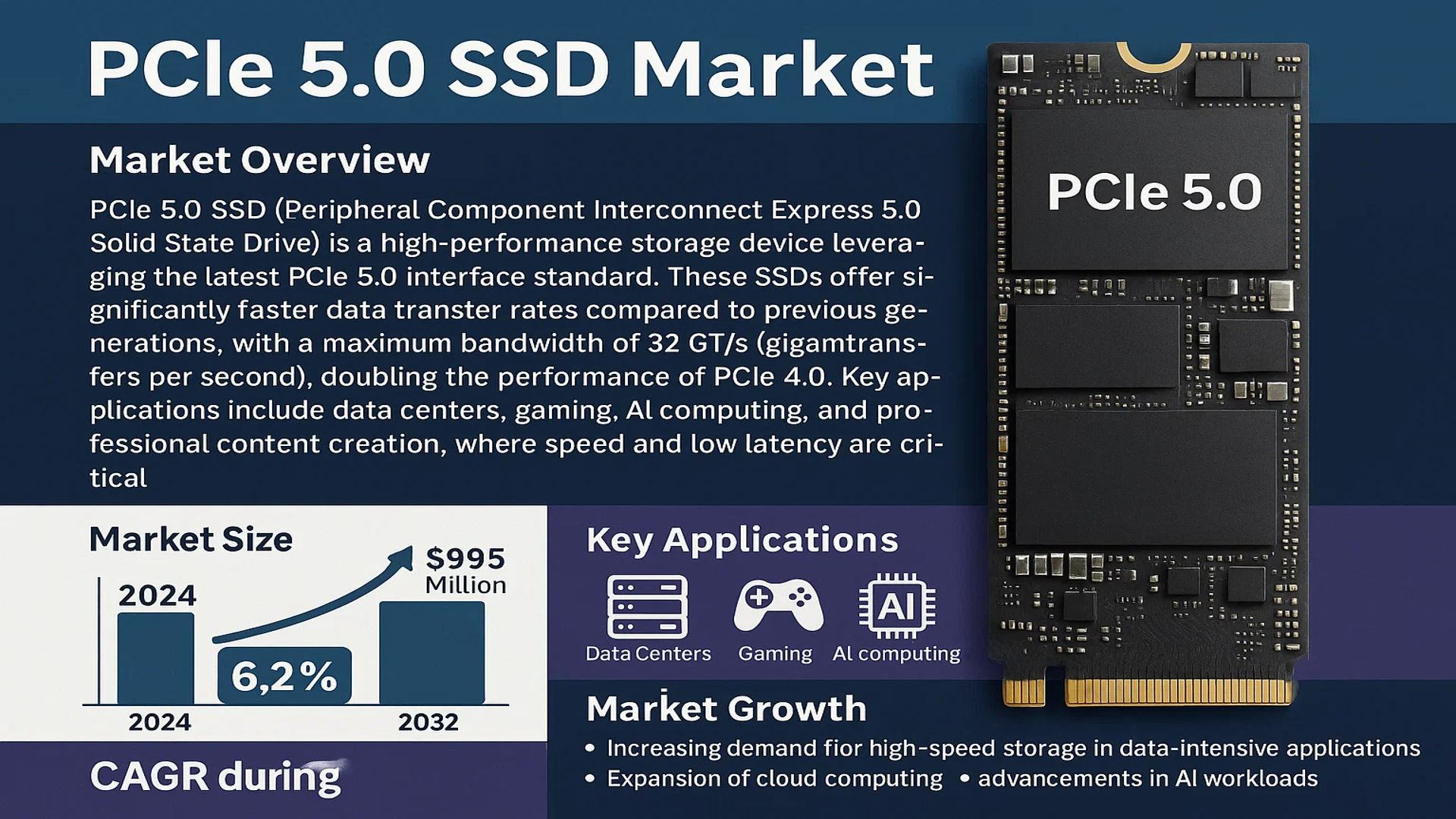
The global PCIe 5.0 SSD Market was valued at 678 million in 2024 and is projected to reach US$ 995 million by 2032, at a CAGR of 6.2% during the forecast period.
PCIe 5.0 SSD (Peripheral Component Interconnect Express 5.0 Solid State Drive) is a high-performance storage device leveraging the latest PCIe 5.0 interface standard. These SSDs offer significantly faster data transfer rates compared to previous generations, with a maximum bandwidth of 32 GT/s (gigatransfers per second), doubling the performance of PCIe 4.0. Key applications include data centers, gaming, AI computing, and professional content creation, where speed and low latency are critical.
The market growth is driven by increasing demand for high-speed storage in data-intensive applications, expansion of cloud computing, and advancements in AI workloads. Key players such as Micron Technology, Samsung Semiconductor, and KIOXIA are accelerating innovation, with the top five companies holding a significant revenue share in 2024. The 1TB and 2TB capacity segments are gaining traction, while North America and Asia-Pacific remain dominant regions due to rapid technological adoption.
MARKET DYNAMICS
MARKET DRIVERS
Exponential Growth in Data-Intensive Applications Drives PCIe 5.0 SSD Adoption
The global datasphere is projected to expand significantly, driven by artificial intelligence, machine learning workloads, and cloud computing. PCIe 5.0 SSDs, with their 32 GT/s bandwidth and near-instantaneous data access, are becoming essential for handling these intensive workloads. The transition to PCIe 5.0 allows data centers to process analytics workloads up to 2x faster than previous generations while reducing latency by approximately 50%. This enables real-time processing of massive datasets that traditional storage solutions cannot efficiently manage.
High-performance computing applications in sectors like financial modeling, autonomous vehicle development, and scientific research are adopting PCIe 5.0 SSDs due to their ability to handle parallel input/output operations more effectively. The gaming industry’s push toward photorealistic graphics and faster load times is another significant driver, with next-generation consoles and gaming PCs demanding storage solutions that can keep pace with advanced GPU architectures.
Enterprise Storage Modernization Fuels Market Expansion
Enterprises are rapidly modernizing their storage infrastructure to accommodate increasingly complex workflows and growing data volumes. PCIe 5.0 SSDs offer enterprises compelling advantages, including improved total cost of ownership through higher endurance ratings and better power efficiency compared to previous generations. Large-scale cloud providers are leading this transition, with deployment rates increasing by approximately 30% in the past year alone.
The financial sector demonstrates particularly strong adoption, where high-frequency trading firms require sub-microsecond latency for competitive advantage. These ultra-low-latency applications benefit directly from PCIe 5.0’s improved signal integrity and double the bandwidth of PCIe 4.0 solutions. As enterprise digitization continues accelerating across all industries, the demand for high-performance storage solutions is expected to maintain robust growth throughout the forecast period.
Emerging Technologies Create New Use Cases for High-Speed Storage
Technological innovations across multiple sectors are creating unprecedented demand for PCIe 5.0 SSDs. In the medical field, real-time MRI and CT scan processing requires immediate access to large imaging datasets, while AI-assisted diagnostics need rapid retrieval of patient histories and research databases. These clinical applications are driving significant investment in high-performance storage infrastructure.
The automotive industry’s shift toward autonomous vehicle development represents another growth area, where PCIe 5.0 SSDs enable faster processing of sensor data and machine learning model training. Semiconductor manufacturers continue to push boundaries with new controller architectures that maximize PCIe 5.0’s potential, recently achieving sequential read speeds exceeding 14,000 MB/s in commercial products.
MARKET RESTRAINTS
Thermal Management Challenges Impact PCIe 5.0 SSD Deployment
While offering superior performance, PCIe 5.0 SSDs generate substantial heat during operation due to increased data transfer rates. Sustained high-speed operation often requires active cooling solutions that add complexity and cost to system designs. This thermal challenge becomes particularly significant in compact form factors and dense server configurations where airflow may be limited.
Many enterprise users report operational challenges in maintaining optimal temperatures for consistent performance, with thermal throttling potentially reducing effective transfer speeds by up to 40% in some configurations. The need for specialized heat dissipation solutions has slowed adoption in cost-sensitive applications and created design hurdles for OEMs attempting to integrate these drives into existing infrastructure without substantial modifications.
Limited Industry-Wide Compatibility Hampers Rapid Adoption
Full utilization of PCIe 5.0 SSD capabilities requires compatible host systems with appropriate chipset support and PCIe slot configurations. While server platforms increasingly incorporate PCIe 5.0 support, many existing systems cannot leverage the technology’s full potential without expensive upgrades. This creates a mismatch between drive capabilities and system infrastructure, particularly affecting small and medium enterprises with constrained IT budgets.
The continued prevalence of PCIe 3.0 and 4.0 in many computing environments presents another obstacle to widespread PCIe 5.0 adoption. Enterprise storage administrators often cite the limited real-world performance benefits when deployed in mixed-generation environments as a reason to delay upgrades, despite the technology’s theoretical advantages.
MARKET OPPORTUNITIES
Edge Computing Deployments Create New Market Potential
The proliferation of edge computing infrastructure presents significant growth opportunities for PCIe 5.0 SSD manufacturers. Edge environments processing IoT data, industrial automation systems, and 5G network functions require low-latency, high-bandwidth storage solutions near data sources. PCIe 5.0’s performance characteristics make it ideal for these applications, particularly when combined with emerging computational storage architectures.
Telecommunications companies are actively evaluating PCIe 5.0 SSDs for their network edge deployments, where faster storage can improve quality of service and enable more sophisticated edge AI applications. The anticipated growth in smart city infrastructure and industrial IoT sensors will further drive demand for high-performance edge storage solutions that can process data in real time without relying on centralized cloud resources.
Emerging Memory Technologies to Enhance PCIe 5.0 SSD Performance
Innovations in non-volatile memory technologies promise to unlock additional value in PCIe 5.0 SSD architectures. Advanced controller designs leveraging computational storage concepts can offload processing tasks traditionally performed by host CPUs directly to the storage device. This architectural shift reduces data movement and improves overall system efficiency for specific workloads.
Manufacturers are exploring hybrid configurations that combine the speed of PCIe 5.0 with emerging memory technologies to create solutions optimized for particular use cases like in-memory databases or AI training pipelines. These developments position PCIe 5.0 SSDs as central components in next-generation computing architectures rather than simply storage peripherals.
MARKET CHALLENGES
High Development Costs Create Market Entry Barriers
PCIe 5.0 SSD development requires substantial R&D investment in advanced controller designs and signal integrity engineering. The technology’s high-speed signaling demands precision manufacturing and testing processes that smaller manufacturers may find cost-prohibitive. This has resulted in market concentration among a limited number of technologically sophisticated suppliers.
The certification process for PCIe 5.0 products adds another layer of complexity, requiring specialized testing equipment and expertise to ensure compliance with stringent interface specifications. These factors have constrained the pace of product diversification and kept prices elevated compared to previous-generation solutions, limiting broader market penetration.
Other Challenges
Power Efficiency Requirements
While PCIe 5.0 offers improved performance-per-watt metrics, the absolute power requirements of high-performance configurations present challenges for mobile and embedded applications. Balancing thermal output and power consumption remains an ongoing engineering challenge that affects product design and market positioning.
Supply Chain Uncertainties
The semiconductor industry’s cyclical nature and recent supply chain disruptions have impacted the availability of key components for PCIe 5.0 SSD production. Specialized controllers and high-performance NAND flash memory remain subject to allocation in tight market conditions, potentially constraining market growth despite strong demand.
PCIe 5.0 SSD MARKET TRENDS
Accelerated Data Processing Demands Drive PCIe 5.0 SSD Adoption
The transition to PCIe 5.0 SSDs is gaining momentum as industries increasingly require ultra-fast data transfer capabilities to support high-performance computing applications. With bandwidth doubling to 32 GT/s compared to PCIe 4.0, these drives are revolutionizing workflows in data centers, AI model training, and content creation. The global market, valued at $678 million in 2024, reflects growing enterprise investments in infrastructure upgrades to handle exponential data growth.
Other Trends
AI Workload Optimization
AI and machine learning deployments are creating unprecedented demand for PCIe 5.0 storage solutions capable of minimizing data bottlenecks. Modern neural networks processing terabytes of training data benefit substantially from the interface’s sequential read speeds exceeding 14,000 MB/s, reducing model iteration times by up to 40% compared to previous generations. This performance advantage is particularly crucial for real-time inference applications in autonomous vehicles and financial analytics.
Next-Gen Gaming and Content Creation Push Consumer Demand
The consumer segment is rapidly adopting PCIe 5.0 SSDs for high-end gaming rigs and 8K video production setups, with the 1TB capacity segment projected to dominate sales through 2032. Game load times are being reduced to under 2 seconds for many AAA titles, while professional content creators benefit from 4K/8K raw video editing without storage-related lag. This surge is driving manufacturers to develop cost-effective client-side solutions with advanced thermal management for sustained performance.
Technological Innovations in NAND Architecture
Leading manufacturers are deploying 232-layer NAND and beyond to maximize PCIe 5.0’s potential, achieving 60% higher density compared to previous node architectures. Innovations like DRAM-less controllers with Host Memory Buffer support are reducing production costs while maintaining performance parity. The competitive landscape sees top players holding 75% combined market share, investing heavily in vertical integration to optimize supply chain resilience for high-speed NAND production.
COMPETITIVE LANDSCAPE
Key Industry Players
Major Manufacturers Leverage Technological Advancements to Gain Market Share
The global PCIe 5.0 SSD market features a dynamic competitive environment where established memory manufacturers and emerging SSD specialists compete for leadership. Samsung Semiconductor and Micron Technology currently dominate the landscape through their vertically integrated production capabilities and early investments in PCIe 5.0 controller development. These companies benefit from strong brand recognition and extensive distribution networks spanning North America, Asia, and Europe.
KIOXIA (formerly Toshiba Memory) and Solidigm (a joint venture between SK hynix and Intel) have emerged as formidable competitors, particularly in the enterprise SSD segment. Their growth is fueled by proprietary NAND architectures and strategic partnerships with data center operators. Meanwhile, Yangtze Memory Technologies represents China’s ambition to become self-sufficient in high-performance storage solutions.
The market also features specialist players like Team Group Inc. and Addlink, which focus on consumer-grade PCIe 5.0 SSDs with aggressive performance metrics. These companies compete through innovative cooling solutions and competitive pricing strategies tailored for gaming and content creation markets. Recent technological breakthroughs in 3D NAND stacking and low-latency controllers have intensified competition across all price segments.
Strategically, manufacturers are adopting diverse approaches: some prioritize R&D investments in thermal management for sustained high-speed operation, while others concentrate on optimizing production yields to reduce costs. The impending transition to 200+ layer NAND technology in 2024-2025 will likely reshape competitive dynamics further, with leaders positioning themselves through preemptive capacity expansions and controller IP development.
List of Key PCIe 5.0 SSD Manufacturers Profiled
- Micron Technology (U.S.)
- Lexar (Longsys Electronics) (China)
- KIOXIA (Japan)
- Samsung Semiconductor (South Korea)
- Solidigm (U.S.)
- Sandisks (U.S.)
- Team Group Inc (Taiwan)
- Micro-Star International (Taiwan)
- Addlink (Taiwan)
- Exascend (Taiwan)
- Yangtze Memory Technologies (China)
Segment Analysis:
By Type
2TB and 4TB Capacities Drive the Market Due to Higher Performance Demands
The market is segmented based on capacity into:
- Capacity: 512GB
- Capacity: 1TB
- Capacity: 2TB
- Capacity: 4TB
- Others
By Application
Data Analysis and AI Computing Segment Leads with Growing Adoption in High-Performance Computing
The market is segmented based on application into:
- Data Analysis and AI Computing
- Video Editing and 3D Rendering
- Leisure and Entertainment
- Others
By Form Factor
M.2 Segment Dominates with Increasing Adoption in Compact Computing Devices
The market is segmented based on form factor into:
- M.2
- Subtypes: 2280, 22110, and others
- U.2
- AIC (Add-in Card)
- Others
By End User
Enterprise Segment Leads Due to High Demand for Data Center Storage Solutions
The market is segmented based on end user into:
- Enterprise
- Data Centers
- Gaming Enthusiasts
- Content Creators
- Others
Regional Analysis: PCIe 5.0 SSD Market
Asia-Pacific
The Asia-Pacific region dominates the global PCIe 5.0 SSD market, driven by rapid technological adoption, robust data center growth, and strong semiconductor manufacturing. China leads with aggressive investments in AI infrastructure and data centers, where high-speed storage is critical. In 2024, China alone accounted for over 35% of the regional demand, supported by local manufacturers like Yangtze Memory Technologies. Japan and South Korea follow closely, leveraging their advanced electronics industries to deploy PCIe 5.0 SSDs in gaming, cloud computing, and enterprise applications. India’s expanding IT sector, though price-sensitive, is gradually shifting toward premium storage solutions. However, regional competition and supply chain dependencies pose challenges.
North America
North America is a key innovator in PCIe 5.0 SSD adoption, with the U.S. contributing the majority of regional revenue. The demand is fueled by hyperscale data centers (e.g., AWS, Google Cloud), AI/ML deployments, and high-performance computing (HPC) applications. With tech giants like Micron Technology and Solidigm headquartered here, the region excels in R&D and early commercialization. Enterprises prioritize low-latency storage for real-time analytics, boosting 2TB and 4TB capacities. Despite higher costs, the premium performance justifies investment. Canada and Mexico show slower uptake due to infrastructure constraints.
Europe
Europe’s PCIe 5.0 SSD market is characterized by steady growth, led by Germany, the U.K., and France. The region’s stringent data privacy laws (GDPR) drive demand for secure, high-speed storage in banking, healthcare, and autonomous vehicle development. Industrial IoT and 5G rollouts further bolster adoption. However, reliance on imports from U.S. and Asian manufacturers limits local competitiveness. Nordic countries, with their focus on sustainability, are early adopters of energy-efficient SSDs. Price sensitivity in Southern Europe slightly hampers the shift from PCIe 4.0 to 5.0.
Middle East & Africa
The Middle East & Africa show nascent but promising growth, anchored by the UAE, Saudi Arabia, and South Africa. Smart city initiatives and oil & gas sector digitization create demand for PCIe 5.0 SSDs in edge computing. While the market is small compared to other regions, investments in AI infrastructure (e.g., NEOM in Saudi Arabia) could accelerate growth. Limited local manufacturing and high costs remain barriers, though partnerships with global brands like Samsung Semiconductor are bridging gaps.
South America
South America lags due to economic volatility and infrastructure gaps, though Brazil and Argentina exhibit potential. Gaming and media sectors drive moderate demand for PCIe 5.0 SSDs, while enterprises prefer cost-effective PCIe 4.0 alternatives. Political instability and currency fluctuations deter large-scale investments. Nevertheless, local players are exploring partnerships to cater to niche high-performance computing needs.
Report Scope
This market research report provides a comprehensive analysis of the global and regional PCIe 5.0 SSD markets, covering the forecast period 2025–2032. It offers detailed insights into market dynamics, technological advancements, competitive landscape, and key trends shaping the industry.
Key focus areas of the report include:
- Market Size & Forecast: Historical data and future projections for revenue, unit shipments, and market value across major regions and segments. The Global PCIe 5.0 SSD market was valued at USD 678 million in 2024 and is projected to reach USD 995 million by 2032, at a CAGR of 6.2% during the forecast period.
- Segmentation Analysis: Detailed breakdown by product type (512M, 1TB, 2TB, 4TB, Others), application (Data Analysis and AI Computing, Video Editing and 3D Rendering, Leisure and Entertainment, Others), and end-user industry to identify high-growth segments and investment opportunities.
- Regional Outlook: Insights into market performance across North America, Europe, Asia-Pacific, Latin America, and the Middle East & Africa, including country-level analysis. The U.S. market size is estimated at USD million in 2024, while China is projected to reach USD million.
- Competitive Landscape: Profiles of leading market participants, including Micron Technology, Samsung Semiconductor, KIOXIA, Solidigm, and Team Group Inc, covering their product offerings, R&D focus, manufacturing capacity, pricing strategies, and recent developments.
- Technology Trends & Innovation: Assessment of emerging technologies in PCIe 5.0 SSDs, with maximum bandwidth reaching 32 GT/s (gigatransfers per second), nearly double that of PCIe 4.0.
- Market Drivers & Restraints: Evaluation of factors driving market growth such as increasing demand for high-speed data processing along with challenges including supply chain constraints and pricing pressures.
- Stakeholder Analysis: Insights for component suppliers, OEMs, system integrators, investors, and policymakers regarding the evolving ecosystem and strategic opportunities in the PCIe 5.0 SSD market.
Primary and secondary research methods are employed, including interviews with industry experts, data from verified sources, and real-time market intelligence to ensure the accuracy and reliability of the insights presented.
FREQUENTLY ASKED QUESTIONS:
What is the current market size of Global PCIe 5.0 SSD Market?
->PCIe 5.0 SSD Market was valued at 678 million in 2024 and is projected to reach US$ 995 million by 2032, at a CAGR of 6.2% during the forecast period.
Which key companies operate in Global PCIe 5.0 SSD Market?
-> Key players include Micron Technology, Samsung Semiconductor, KIOXIA, Solidigm, and Team Group Inc, among others.
What are the key growth drivers?
-> Key growth drivers include increasing demand for high-performance computing, AI applications, and data center expansion.
Which region dominates the market?
-> North America currently leads in market share, while Asia-Pacific is expected to witness the fastest growth during the forecast period.
What are the emerging trends?
-> Emerging trends include development of higher capacity SSDs (4TB+), thermal management solutions, and integration with next-gen computing platforms.

Get Sample Report PDF for Exclusive Insights
Report Sample Includes
- Table of Contents
- List of Tables & Figures
- Charts, Research Methodology, and more...
 Download Sample Report PDF