Orbital angular momentum (OAM) multiplexing over free-space optics Market Insights
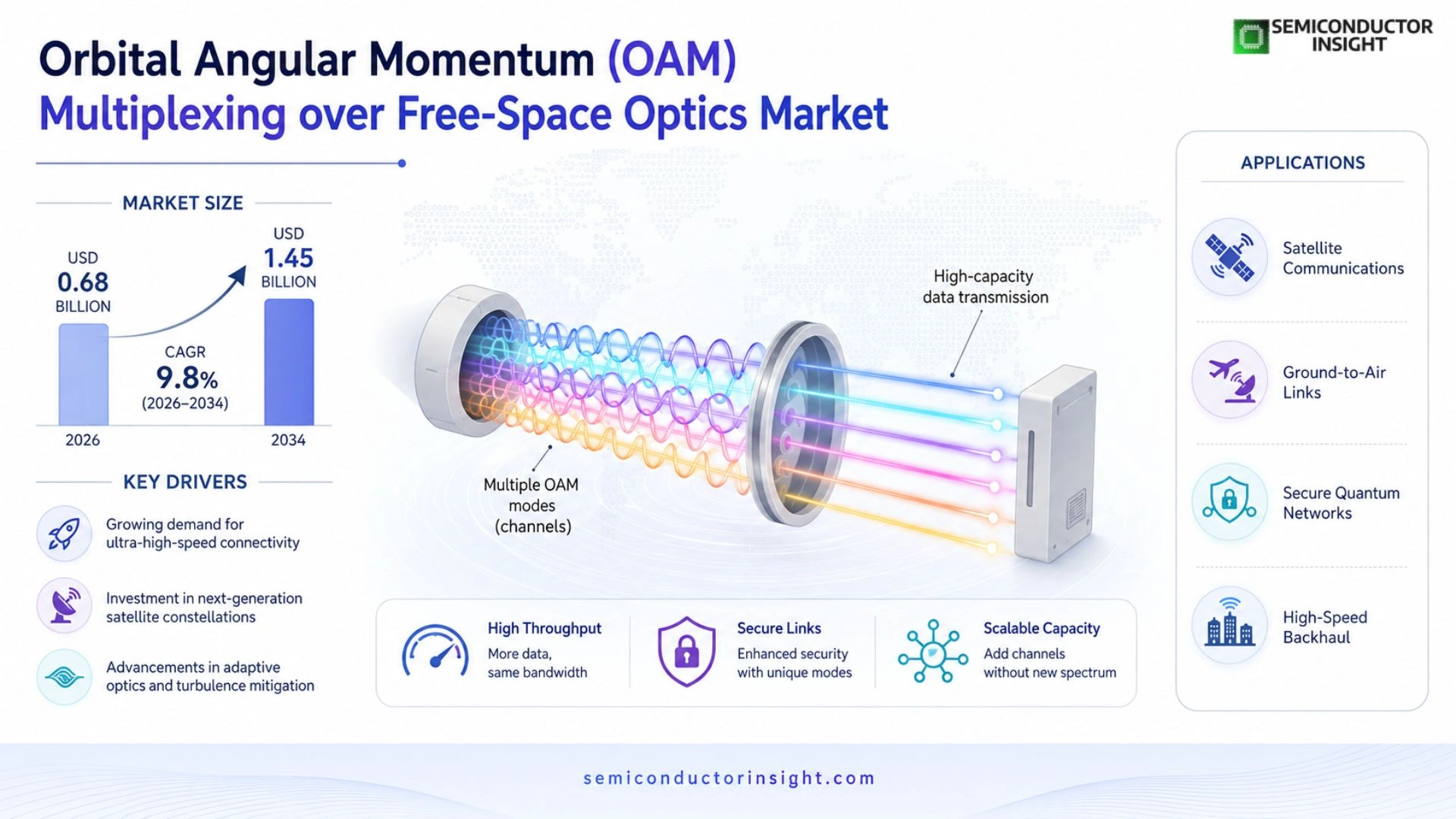
Global Orbital angular momentum (OAM) multiplexing over free-space optics market size was valued at USD 0.62 billion in 2025. The market is projected to grow from USD 0.68 billion in 2026 to USD 1.45 billion by 2034, exhibiting a CAGR of 9.8% during the forecast period.
Orbital angular momentum multiplexing leverages the helical phase front of light beams to encode multiple data channels simultaneously, enabling high‑capacity free‑space optical links without additional spectral bandwidth.
This technology enhances throughput for satellite communications, ground‑to‑air links, and secure quantum networks by exploiting distinct OAM modes as independent transmission pathways.
The market is experiencing rapid growth due to rising demand for ultra‑high‑speed backhaul, increased investment in next‑generation satellite constellations, and advancements in adaptive optics that mitigate atmospheric turbulence.
Furthermore, collaborations between photonics firms and aerospace manufacturers are accelerating commercial deployments, while government research programs are funding prototype demonstrations worldwide.
MARKET DRIVERS
Rising Data Traffic Demand
Orbital angular momentum (OAM) multiplexing over free-space optics Market is being propelled by exponential growth in broadband and back‑haul traffic, especially in urban megacities where fiber deployment faces physical constraints. Operators are seeking alternatives that can deliver terabit‑per‑second links without laying additional fiber, making OAM‑based free‑space channels an attractive solution.
Advancements in OAM Technology
Recent breakthroughs in spatial light modulators and mode‑division demultiplexers have reduced system complexity and cost, enabling commercial prototypes that achieve over 100 Gbps on a single optical beam. These technological gains are lowering entry barriers for telecom providers and government agencies.
➤ Industry pilots in Europe and Asia have demonstrated stable OAM links over distances exceeding 5 km under adverse weather conditions, confirming the technology’s maturity for real‑world deployment.
Another key driver is the strategic push for secure, line‑of‑sight communication in defense and satellite domains, where OAM multiplexing offers inherent resistance to eavesdropping due to its high‑dimensional encoding.
MARKET CHALLENGES
Atmospheric Turbulence Sensitivity
Free‑space optical links employing OAM are highly susceptible to atmospheric turbulence, which can cause mode crosstalk and degrade link reliability. Mitigating these effects requires adaptive optics or advanced error‑correction schemes, both of which increase system cost and power consumption.
Other Challenges
Alignment Sensitivity
Precise transmitter‑receiver alignment is essential for maintaining orthogonal OAM modes. Even minor misalignments can lead to significant performance loss, limiting the technology’s appeal for mobile or rapidly reconfigurable networks.
MARKET RESTRAINTS
High Capital Expenditure
The initial capital outlay for OAM‑enabled free‑space optics equipment remains higher than conventional RF or fiber solutions, discouraging early adoption among cost‑sensitive operators.
Regulatory and Spectrum Constraints
While free‑space optics avoid RF spectrum licensing, regulatory bodies are still formulating safety standards for high‑power laser transmissions, creating uncertainty that can delay project approvals.
Limited Industry Ecosystem
A relatively small pool of qualified vendors and a nascent supply chain result in longer lead times and limited post‑sale support, further restraining market growth.
MARKET OPPORTUNITIES
Integration with 5G/6G Backhaul
As 5G networks mature and 6G research accelerates, the need for ultra‑high‑capacity backhaul links intensifies. OAM multiplexing over free‑space optics can complement fiber by providing rapid, scalable capacity upgrades in dense urban corridors.
Satellite Constellation Enhancements
Low‑Earth‑orbit satellite constellations are exploring OAM‑based inter‑satellite links to increase data throughput without expanding antenna aperture, offering a clear growth avenue for the market.
Defense and Secure Communications
Defense agencies are investing in OAM technologies to achieve secure, high‑dimensional communication channels that are difficult to intercept or jam, opening a specialized but high‑value market segment.
Orbital angular momentum (OAM) multiplexing over free-space optics Market Trends
Rising Demand for Ultra‑High‑Speed Backhaul
Orbital angular momentum (OAM) multiplexing over free-space optics Market is being propelled by a clear need for higher capacity backhaul links in both terrestrial and satellite networks. Operators are seeking alternatives to traditional radio frequency solutions because OAM enables multiple data channels on a single optical beam without expanding spectral bandwidth. This capability directly addresses the bandwidth constraints of emerging 6G services, high‑definition video streaming, and data‑intensive Internet of Things deployments. Industry analysts note that the technology’s ability to deliver terabit‑per‑second throughput in a compact form factor is a decisive factor for telecom carriers and aerospace firms pursuing cost‑efficient, high‑performance connectivity.
Other Trends
Integration with Satellite Constellations
Recent collaborations between photonics companies and satellite manufacturers have accelerated the commercial rollout of OAM‑enabled free‑space links in low‑earth‑orbit constellations. By embedding OAM transmitters on satellite payloads, service providers are able to establish inter‑satellite links that bypass conventional RF interference and reduce latency. Prototype demonstrations have shown stable OAM mode transmission over distances exceeding 1,000 km in space, confirming the technology’s resilience to the vacuum environment and thermal cycling experienced in orbit. These developments are reinforcing the strategic shift toward optical inter‑satellite communication as a cornerstone of future global broadband services.
Advancements in Adaptive Optics
Adaptive optics solutions are increasingly being paired with OAM multiplexing to mitigate atmospheric turbulence that can degrade helical phase fronts during ground‑to‑air transmission. Real‑time wavefront correction algorithms, coupled with deformable mirror arrays, are now capable of preserving OAM mode integrity across variable weather conditions. Field trials in metropolitan areas have demonstrated up to a 30 % improvement in link reliability when adaptive optics are employed, making OAM‑based free‑space optics a viable option for secure quantum key distribution and high‑capacity point‑to‑point links. Continued investment in sensor technology and machine‑learning‑driven correction techniques is expected to further enhance system robustness, encouraging broader adoption across defense, research, and commercial sectors.
COMPETITIVE LANDSCAPE
Key Industry Players
Orbital Angular Momentum (OAM) Multiplexing Over Free‑Space Optics: Competitive Landscape Overview
OAM multiplexing market is presently anchored by a small cohort of vertically integrated photonics companies that combine high‑power laser emitters with adaptive‑optics correction modules. Thorlabs, with its extensive catalog of precision optics, offers complete turnkey OAM transceiver kits that have been adopted by major defence contractors and emerging satellite‑communication providers, effectively setting a de‑facto benchmark for laboratory‑to‑field deployments. Lumentum’s strategic acquisition of spin‑laser technology dedicated to OAM mode generation has unified source, modulator and detector functions under a single supply chain, allowing the firm to dominate high‑capacity backhaul link projects and to exert pricing pressure on smaller niche entrants. Both firms benefit from long‑term contracts with space‑agency research programs, which accelerate technology validation and lower entry barriers for commercial operators seeking terabit‑per‑second free‑space links.
In addition to the tier‑one hardware suppliers, a vibrant ecosystem of specialized vendors and aerospace integrators is expanding the application scope of OAM multiplexing. VividQ’s software‑defined OAM mode generators enable rapid prototyping and real‑time beam shaping, a capability that is increasingly valued by university‑based quantum‑network testbeds. NKT Photonics delivers customized fiber‑compatible OAM emitters that bridge the gap between fiber‑based and free‑space systems, facilitating pilot deployments of secure quantum‑key‑distribution links. IPG Photonics focuses on high‑power continuous‑wave lasers whose linewidth stability helps mitigate atmospheric turbulence during long‑range ground‑to‑air transmission. Early‑stage companies such as InnoPhase and RayTech are targeting niche markets that require ultra‑low‑latency, secure links for autonomous‑vehicle communication and defense‑grade data relays. Meanwhile, aerospace giants including Lockheed Martin, Raytheon Technologies, Northrop Grumman and SpaceX are integrating OAM modules into next‑generation satellite constellations, leveraging the technology to boost spectral efficiency without increasing payload mass. Government research initiatives in the United States, Europe and Japan continue to fund prototype demonstrations, which is accelerating standard‑setting activities across the sector.
List of Key Orbital Angular Momentum (OAM) Multiplexing over Free‑Space Optics Companies Profiled
- Thorlabs
- Lumentum
- VividQ
- NKT Photonics
- IPG Photonics
- InnoPhase
- RayTech
- Lockheed Martin
- Raytheon Technologies
- Northrop Grumman
- SpaceX
- Huawei
- Samsung
- Cohere Technologies
- II‑VI Incorporated
Segment Analysis:
| Segment Category | Sub-Segments | Key Insights |
| By Type |
|
Mode‑Based OAM is gaining traction because it directly leverages the inherent orthogonality of OAM modes, allowing simple generation and detection schemes.
|
| By Application |
|
Satellite Communications is the leading application, driven by the need for high‑throughput backhaul for next‑generation constellations.
|
| By End User |
|
Telecom Service Providers are adopting OAM‑enabled free‑space links to augment fiber capacity in ultra‑dense urban corridors.
|
| By Technology |
|
Active Adaptive Optics is emerging as the pivotal technology for stabilizing OAM modes across turbulent channels.
|
| By Deployment Scenario |
|
Space‑Based Constellations represent the most compelling scenario for OAM adoption, as they demand massive data rates between satellites and ground stations.
|
Regional Analysis: North America
North America
North America is emerging as a pivotal hub for Orbital angular momentum (OAM) multiplexing over free-space optics Market. The region’s robust technological infrastructure, significant investments in aerospace and defense sectors, and a strong ecosystem of research institutions are driving adoption. The demand for high-bandwidth communication solutions, particularly in military and government applications, fuels the growth of OAM multiplexing over free-space optics. Furthermore, the increasing focus on secure and resilient communication networks is a key driver.
The military sector represents a primary driver for OAM multiplexing over free-space optics, leveraging its potential for secure, long-range communication in tactical scenarios.
The telecommunications industry is exploring OAM multiplexing over free-space optics to augment existing fiber networks, particularly in remote or underserved areas, offering a cost-effective solution for backhaul connectivity.
The aerospace and satellite communication sectors are actively investigating OAM multiplexing over free-space optics for enhanced data transmission capabilities and improved link reliability in space-based applications.
Significant investments in academic and industrial research are contributing to advancements in OAM multiplexing over free-space optics technology, paving the way for wider commercial adoption.
Europe
Europe exhibits a strong emphasis on technological innovation and has a well-established industrial base, positioning it as a significant player in Orbital angular momentum (OAM) multiplexing over free-space optics Market. Several European countries are actively funding research and development initiatives in this field, with a focus on secure communication and satellite applications.
Asia-Pacific
The Asia-Pacific region is witnessing rapid growth in Orbital angular momentum (OAM) multiplexing over free-space optics Market, driven by increasing investments in telecommunications infrastructure and the expansion of 5G networks. The region’s burgeoning aerospace industry and the growing demand for high-bandwidth communication in emerging economies further contribute to this growth.
South America
South America presents a promising market for OAM multiplexing over free-space optics, particularly in addressing communication challenges in remote areas. The increasing need for reliable and cost-effective connectivity, coupled with government initiatives to expand infrastructure, is driving interest in this technology.
Middle East & Africa
The Middle East and Africa region is poised for substantial growth in Orbital angular momentum (OAM) multiplexing over free-space optics Market, driven by ongoing investments in telecommunications infrastructure and the development of smart city initiatives. The need for secure communication solutions in the region also contributes to market expansion.
Report Scope
This market research report provides a comprehensive analysis of the Orbital angular momentum (OAM) multiplexing over free-space optics Market , covering the forecast period 2026–2034. It offers detailed insights into market dynamics, technological advancements, competitive landscape, and key trends shaping the industry.
Key focus areas of the report include:
- Market Overview: The report begins with an overview outlining its current market scenario, key growth indicators, and industry transformation drivers. It discusses macroeconomic factors, demand–supply balance, regulatory landscape, and the strategic role of semiconductors in powering advancements across industries such as automotive, telecommunications, consumer electronics, and industrial automation.
- Market Size & Forecast: Historical data and future projections for revenue, unit shipments, and market value across major regions and segments.
- Segmentation Analysis: Detailed breakdown by product type, technology, application, and end-user industry to identify high-growth segments and investment opportunities.
- Regional Insights: Insights into market performance across North America, Europe, Asia-Pacific, Latin America, and the Middle East & Africa, including country-level analysis where relevant.
- Competitive Landscape: Profiles of leading market participants, including their product offerings, R&D focus, manufacturing capacity, pricing strategies, and recent developments such as mergers, acquisitions, and partnerships.
- Technology Trends & Innovation: Assessment of emerging technologies, integration of AI/IoT, semiconductor design trends, fabrication techniques, and evolving industry standards.
- Market Drivers & Restraints: Evaluation of factors driving market growth along with challenges, supply chain constraints, regulatory issues, and market-entry barriers.
- Stakeholder Insights: Insights for component suppliers, OEMs, system integrators, investors, and policymakers regarding the evolving ecosystem and strategic opportunities.
Primary and secondary research methods are employed, including interviews with industry experts, data from verified sources, and real-time market intelligence to ensure the accuracy and reliability of the insights presented.
FREQUENTLY ASKED QUESTIONS:
What is the current market size of Orbital angular momentum (OAM) multiplexing over free-space optics Market?
-> Orbital angular momentum (OAM) multiplexing over free-space optics Market was valued at USD 0.62 billion in 2025 and is expected to reach USD 1.45 billion by 2034.
Which key companies operate in Orbital angular momentum (OAM) multiplexing over free-space optics Market?
-> Key players include leading photonics and aerospace firms developing OAM solutions, as highlighted by collaborations between photonics companies and aerospace manufacturers.
What are the key growth drivers?
-> Key growth drivers include ultra‑high‑speed backhaul demand, investment in next‑generation satellite constellations, advancements in adaptive optics to mitigate atmospheric turbulence, and strong collaborations between photonics firms and aerospace manufacturers.
Which region dominates the market?
-> The market is globally distributed, with strong activity in North America, Europe, and Asia‑Pacific, though the source does not designate a single dominant region.
What are the emerging trends?
-> Emerging trends include the exploitation of OAM modes for secure quantum communications, integration of adaptive optics for turbulence mitigation, and the development of high‑capacity satellite constellations leveraging OAM multiplexing.
Get Sample Report PDF for Exclusive Insights
Report Sample Includes
- Table of Contents
- List of Tables & Figures
- Charts, Research Methodology, and more...
 Download Sample Report PDF