
Key Statistics
Key Takeaways
- Single-mode transceivers lead by type because long-reach carrier and data-center interconnect links favor low-loss single-mode fiber.
- Data centers are the leading application as cloud and AI clusters increase east-west traffic and accelerate migration to higher-rate optical modules.
- 400G is the leading data-rate segment in the source page, while 800G adoption and 1.6T product launches define the next technology transition.
- QSFP-based form factors are prominent because high front-panel density and modularity fit modern switch architectures.
- Asia Pacific leads at the regional level, while the source FAQ separately identifies China as the largest individual national market.
- Power and thermal limits are becoming strategic constraints as data rates rise, making DSP efficiency and watts per bit central to module selection.
Optical Transceivers Market Overview
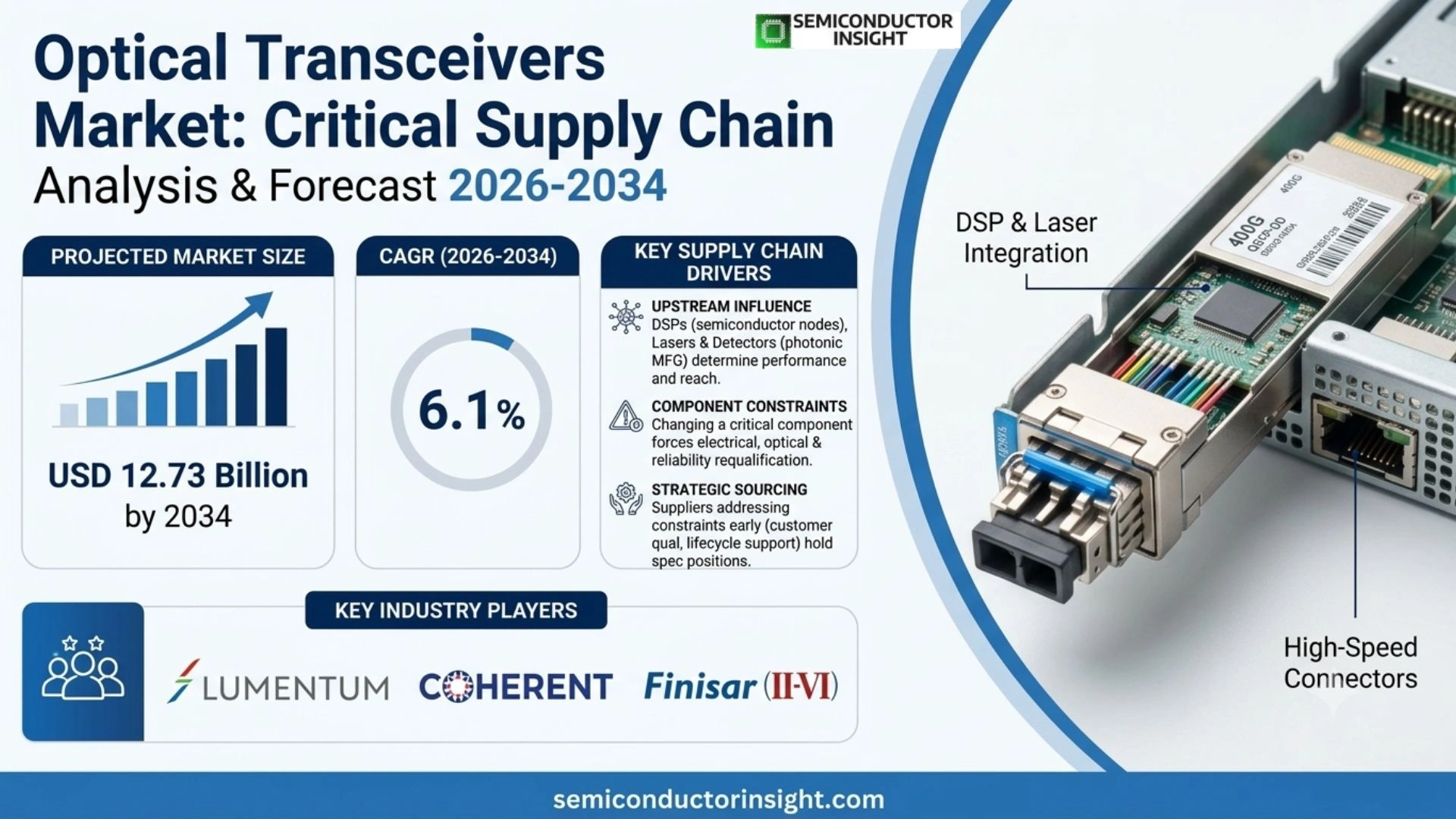
Optical Transceivers Market was valued at USD 7.49 billion in 2025 and is projected to reach USD 12.73 billion by 2034, representing a 6.1% CAGR during 2026–2034. The 2026 estimated market size is USD 7.94 billion. Asia Pacific is the largest region in the source regional analysis, supported by network investment and a dense optical-module manufacturing ecosystem.
An optical transceiver converts electrical data into optical signals for transmission over fiber and converts received light back into electrical data. The market spans pluggable modules used in data centers, carrier networks and enterprise infrastructure, with product value determined by reach, wavelength, lane rate, power consumption, form factor, diagnostics and interoperability with the host switch or transport system.
The source scope divides the market into single-mode and multi-mode transceivers and identifies single-mode as the leading type. Applications include data centers, telecommunication networks, enterprise networking and other uses, while additional segmentation covers cloud service providers, telecom operators and enterprises, SFP/SFP+, QSFP/QSFP+ and QSFP-DD form factors, and 100G, 400G and 800G data rates. For the optical transceivers, this mechanism matters commercially because customer qualification, integration effort, supply continuity, lifecycle support and total system economics influence purchasing decisions alongside unit price. Suppliers that address those constraints early can hold specification positions through multiple product cycles, while vendors that compete only on headline performance face greater substitution risk when programs move from engineering samples into volume deployment.
The market is now moving from a 400G-centered installed base toward wider 800G adoption and early 1.6T deployment. Marvell announced mass-volume shipments of a 1.6T optical DSP platform in 2026, while Coherent demonstrated a 1.6T-SR8 module using 200G-per-lane VCSEL technology in 2025. These developments show how AI data-center traffic is pushing both electrical lane speed and optical integration.
Segment Analysis: By Type
By type, the source page segments the market into Single-Mode Transceivers and Multi-Mode Transceivers and identifies single-mode products as the leader. Single-mode modules support longer reaches and lower modal dispersion, making them suitable for carrier networks, data-center interconnects and many campus links, while multi-mode products remain important for cost-sensitive short-reach connections inside data centers and enterprise environments. For the optical transceivers, this mechanism matters commercially because customer qualification, integration effort, supply continuity, lifecycle support and total system economics influence purchasing decisions alongside unit price. Suppliers that address those constraints early can hold specification positions through multiple product cycles, while vendors that compete only on headline performance face greater substitution risk when programs move from engineering samples into volume deployment.
| Type | Technical / purchasing role | Market position |
|---|---|---|
| Single-Mode Transceivers | Single-mode modules use single-mode fiber and laser sources optimized for longer reach, low loss and high-capacity links. They cover data-center interconnect, telecom access, metro and long-haul applications, with product differentiation based on reach, wavelength, DSP architecture, optical power budget and standards support. For the optical transceivers, this mechanism matters commercially because customer qualification, integration effort, supply continuity, lifecycle support and total system economics influence purchasing decisions alongside unit price. Suppliers that address those constraints early can hold specification positions through multiple product cycles, while vendors that compete only on headline performance face greater substitution risk when programs move from engineering samples into volume deployment. | The source page identifies single-mode transceivers as the leading type. Their addressable market spans both data-center and carrier infrastructure, giving suppliers access to multiple upgrade cycles as operators move toward 400G, 800G and coherent pluggable architectures while continuing to support established lower-rate networks. For the optical transceivers, this mechanism matters commercially because customer qualification, integration effort, supply continuity, lifecycle support and total system economics influence purchasing decisions alongside unit price. Suppliers that address those constraints early can hold specification positions through multiple product cycles, while vendors that compete only on headline performance face greater substitution risk when programs move from engineering samples into volume deployment. |
| Multi-Mode Transceivers | Multi-mode transceivers are optimized for short-reach links over multi-mode fiber, particularly within data centers where cost, power and front-panel density are critical. VCSEL-based architectures can provide attractive economics at short distances, and suppliers continue to raise lane rates to keep multi-mode viable as switch bandwidth increases. For the optical transceivers, this mechanism matters commercially because customer qualification, integration effort, supply continuity, lifecycle support and total system economics influence purchasing decisions alongside unit price. Suppliers that address those constraints early can hold specification positions through multiple product cycles, while vendors that compete only on headline performance face greater substitution risk when programs move from engineering samples into volume deployment. | Multi-mode products serve a narrower reach envelope but remain commercially important in dense data centers. Coherent’s 2025 demonstration of a 1.6T-SR8 module using 200G VCSELs shows that the architecture is still evolving, with suppliers seeking to preserve cost and power advantages at higher aggregate rates. For the optical transceivers, this mechanism matters commercially because customer qualification, integration effort, supply continuity, lifecycle support and total system economics influence purchasing decisions alongside unit price. Suppliers that address those constraints early can hold specification positions through multiple product cycles, while vendors that compete only on headline performance face greater substitution risk when programs move from engineering samples into volume deployment. |
Form factor and data-rate transition
The source page lists SFP/SFP+, QSFP/QSFP+ and QSFP-DD form factors and identifies QSFP-based modules as prominent for density and performance. By data rate it lists 100G, 400G and 800G, with 400G as the current leading segment. The technology roadmap is nevertheless advancing quickly: 800G is scaling in AI networks and official supplier announcements now position 1.6T pluggables as the next high-volume step.
Segment Analysis: By Application
By application, the source page lists Data Centers, Telecommunication Networks, Enterprise Networking and Others, and identifies Data Centers as the leading application. Hyperscale and AI clusters require large numbers of short-reach and campus optical links, while carrier networks remain a substantial market for single-mode and coherent modules used in access, metro, backbone and mobile fronthaul, midhaul and backhaul.
| Application | Demand characteristics |
|---|---|
| Data Centers | Data centers are the leading application because switch bandwidth and server-to-server traffic continue to rise with cloud and AI workloads. Operators upgrade from 100G to 400G, 800G and 1.6T links to increase rack and cluster bandwidth, but the purchasing decision also depends on power per bit, thermal headroom, link reliability and compatibility with selected switch ASICs. For the optical transceivers, this mechanism matters commercially because customer qualification, integration effort, supply continuity, lifecycle support and total system economics influence purchasing decisions alongside unit price. Suppliers that address those constraints early can hold specification positions through multiple product cycles, while vendors that compete only on headline performance face greater substitution risk when programs move from engineering samples into volume deployment. |
| Telecommunication Networks | Telecom operators use optical transceivers across access, fronthaul, midhaul, backhaul, metro and long-haul systems. Single-mode products dominate many of these links because of reach requirements, while coherent pluggables allow higher capacity over existing fiber. Carrier qualification emphasizes standards, environmental reliability, diagnostics and long lifecycle support. For the optical transceivers, this mechanism matters commercially because customer qualification, integration effort, supply continuity, lifecycle support and total system economics influence purchasing decisions alongside unit price. Suppliers that address those constraints early can hold specification positions through multiple product cycles, while vendors that compete only on headline performance face greater substitution risk when programs move from engineering samples into volume deployment. |
| Enterprise Networking | Enterprises deploy optical modules in campus cores, private data centers and high-speed connections between buildings. Volumes are lower than hyperscale cloud but product diversity is broad, and customers favor modules validated with common switching platforms. Migration is often incremental, so suppliers need to support multiple generations of Ethernet speed at the same time. For the optical transceivers, this mechanism matters commercially because customer qualification, integration effort, supply continuity, lifecycle support and total system economics influence purchasing decisions alongside unit price. Suppliers that address those constraints early can hold specification positions through multiple product cycles, while vendors that compete only on headline performance face greater substitution risk when programs move from engineering samples into volume deployment. |
| Others | Other applications include high-performance computing, research networks, industrial connectivity and specialized transport systems. These markets can require unusual reach, temperature or reliability characteristics, creating niches for vendors with flexible module designs and strong application engineering even when absolute volumes are smaller than data-center or telecom deployments. For the optical transceivers, this mechanism matters commercially because customer qualification, integration effort, supply continuity, lifecycle support and total system economics influence purchasing decisions alongside unit price. Suppliers that address those constraints early can hold specification positions through multiple product cycles, while vendors that compete only on headline performance face greater substitution risk when programs move from engineering samples into volume deployment. |
Regional Analysis
Asia Pacific leads the optical transceivers market at the regional level because it combines large telecom and cloud demand with the industry’s deepest module-manufacturing ecosystem. North America remains the innovation center for AI data-center architectures and early 1.6T qualification, while Europe is driven by fiber modernization and energy-efficient infrastructure. South America and the Middle East & Africa are earlier-stage but expanding connectivity markets.
How do regional demand and supplier-selection criteria differ across the optical transceivers market?
The regions buy optical transceivers for different reasons. Asia Pacific combines manufacturing scale with network expansion, North America pushes the highest-rate AI and cloud interconnects, Europe emphasizes carrier modernization and power efficiency, South America is building broadband and cloud capacity, and the Middle East & Africa are adding national digital infrastructure. These differences shape the balance between rate, reach, power, cost and support in each market.
| Region | Position | Growth outlook | Demand profile | What decides supplier selection |
|---|---|---|---|---|
| Asia Pacific | Largest | Strong | Data-center, telecom and manufacturing led | Module cost, manufacturing scale, interoperability and local supply-chain depth are central. China is both a major demand center and manufacturing hub, while Japan, South Korea, India and Southeast Asia add carrier, cloud and fiber-expansion demand across different performance tiers. For the optical transceivers, this mechanism matters commercially because customer qualification, integration effort, supply continuity, lifecycle support and total system economics influence purchasing decisions alongside unit price. Suppliers that address those constraints early can hold specification positions through multiple product cycles, while vendors that compete only on headline performance face greater substitution risk when programs move from engineering samples into volume deployment. |
| North America | Major established market | Strong | Hyperscale AI and cloud led | Customers emphasize high data rates, power efficiency, thermal behavior, link reliability and qualification with leading switching platforms. Early 800G and 1.6T adoption gives technology leaders a chance to win large platform programs, but engineering and volume-ramp requirements are demanding. For the optical transceivers, this mechanism matters commercially because customer qualification, integration effort, supply continuity, lifecycle support and total system economics influence purchasing decisions alongside unit price. Suppliers that address those constraints early can hold specification positions through multiple product cycles, while vendors that compete only on headline performance face greater substitution risk when programs move from engineering samples into volume deployment. |
| Europe | Established market | Steady to strong | Fiber and data-center modernization led | Interoperability, energy efficiency, standards alignment and lifecycle support shape procurement. Operators often manage mixed-vendor networks and long-lived infrastructure, so validated reach and stable software or diagnostics support can outweigh small differences in module purchase price. For the optical transceivers, this mechanism matters commercially because customer qualification, integration effort, supply continuity, lifecycle support and total system economics influence purchasing decisions alongside unit price. Suppliers that address those constraints early can hold specification positions through multiple product cycles, while vendors that compete only on headline performance face greater substitution risk when programs move from engineering samples into volume deployment. |
| South America | Emerging | Selective growth | Broadband and cloud led | Price, reach, compatibility with installed network equipment and local channel support are important. Operators often upgrade in stages, creating simultaneous demand for established rates and newer aggregation links rather than a single rapid transition to the highest available speed. For the optical transceivers, this mechanism matters commercially because customer qualification, integration effort, supply continuity, lifecycle support and total system economics influence purchasing decisions alongside unit price. Suppliers that address those constraints early can hold specification positions through multiple product cycles, while vendors that compete only on headline performance face greater substitution risk when programs move from engineering samples into volume deployment. |
| Middle East & Africa | Emerging growth region | Selective to strong | Data-center and telecom build-out led | Environmental reliability, optical reach, cost and field support vary by country. Gulf data centers can adopt high-rate global platforms quickly, while African carrier networks require robust single-mode products and dependable replacement availability across long geographic routes. For the optical transceivers, this mechanism matters commercially because customer qualification, integration effort, supply continuity, lifecycle support and total system economics influence purchasing decisions alongside unit price. Suppliers that address those constraints early can hold specification positions through multiple product cycles, while vendors that compete only on headline performance face greater substitution risk when programs move from engineering samples into volume deployment. |
Competitive Landscape
The optical transceivers market combines vertically integrated photonics suppliers, module specialists, networking equipment companies and semiconductor vendors. The source page profiles II-VI/Finisar, Broadcom, Cisco, Lumentum, Accelink, Eoptolink, Source Photonics, InnoLight, Marvell, AOI and other global participants. Competition is intensifying as module rates rise because vendors must coordinate lasers, photodiodes, DSPs, packaging, firmware and thermal design within fixed pluggable form factors.
Module suppliers compete on more than headline bit rate. A high-speed transceiver must meet the electrical and optical interface, remain within front-panel power and cooling limits, support diagnostics, pass reliability testing and interoperate with the selected switch or transport system. These requirements make customer qualification and engineering support important barriers to entry, especially in hyperscale deployments where a field issue can affect thousands of ports.
Semiconductor vendors influence the competitive structure through optical DSPs, drivers, TIAs and SerDes technology. Marvell’s 2026 1.6T portfolio shows how DSP architecture can differentiate module power, reliability and security. Module companies that secure leading silicon and optical components can move faster, while suppliers without access to competitive DSP or laser technology may struggle to meet next-generation power budgets.
Multi-mode and single-mode suppliers face different cost structures. VCSEL-based short-reach modules compete heavily on manufacturing cost and power, while longer-reach single-mode and coherent products carry more complex optics and signal processing. A company can therefore be strong in one segment without having equivalent economics in another, encouraging specialization and strategic component partnerships. For the optical transceivers, this mechanism matters commercially because customer qualification, integration effort, supply continuity, lifecycle support and total system economics influence purchasing decisions alongside unit price. Suppliers that address those constraints early can hold specification positions through multiple product cycles, while vendors that compete only on headline performance face greater substitution risk when programs move from engineering samples into volume deployment.
Manufacturing scale remains important because data-center customers can ramp new platforms quickly. Suppliers need automated assembly, optical alignment, calibration and final test capacity that can grow without sacrificing yield. This favors companies with mature high-volume operations in Asia as well as technology providers that can simplify module architecture and reduce the amount of precision assembly required per port.
Tier structure
- Data-center growth in Europe raises the importance of module power consumption because dense racks multiply even small per-port power differences across thousands of links. Suppliers therefore compete not only on nominal bit rate but also on DSP efficiency, thermal design and the ability to sustain performance within constrained front-panel power budgets. For the optical transceivers, this mechanism matters commercially because customer qualification, integration effort, supply continuity, lifecycle support and total system economics influence purchasing decisions alongside unit price. Suppliers that address those constraints early can hold specification positions through multiple product cycles, while vendors that compete only on headline performance face greater substitution risk when programs move from engineering samples into volume deployment.
- European customers frequently operate mixed-vendor networks, making interoperability testing and standards compliance a practical market-access gate. Transceiver vendors that can document link performance across switches and transport platforms reduce integration risk for operators, while unsupported or poorly characterized modules may be excluded even when their component-level specifications appear competitive. For the optical transceivers, this mechanism matters commercially because customer qualification, integration effort, supply continuity, lifecycle support and total system economics influence purchasing decisions alongside unit price. Suppliers that address those constraints early can hold specification positions through multiple product cycles, while vendors that compete only on headline performance face greater substitution risk when programs move from engineering samples into volume deployment.
| Competitive tier | Representative participants | How suppliers compete |
|---|---|---|
| Integrated technology leaders | II-VI/Finisar; Broadcom; Lumentum; Marvell; Cisco |
Competitive Landscape
The optical transceivers market combines vertically integrated photonics suppliers, module specialists, networking equipment companies and semiconductor vendors. The source page profiles II-VI/Finisar, Broadcom, Cisco, Lumentum, Accelink, Eoptolink, Source Photonics, InnoLight, Marvell, AOI and other global participants. Competition is intensifying as module rates rise because vendors must coordinate lasers, photodiodes, DSPs, packaging, firmware and thermal design within fixed pluggable form factors.
Module suppliers compete on more than headline bit rate. A high-speed transceiver must meet the electrical and optical interface, remain within front-panel power and cooling limits, support diagnostics, pass reliability testing and interoperate with the selected switch or transport system. These requirements make customer qualification and engineering support important barriers to entry, especially in hyperscale deployments where a field issue can affect thousands of ports.
Semiconductor vendors influence the competitive structure through optical DSPs, drivers, TIAs and SerDes technology. Marvell’s 2026 1.6T portfolio shows how DSP architecture can differentiate module power, reliability and security. Module companies that secure leading silicon and optical components can move faster, while suppliers without access to competitive DSP or laser technology may struggle to meet next-generation power budgets.
Multi-mode and single-mode suppliers face different cost structures. VCSEL-based short-reach modules compete heavily on manufacturing cost and power, while longer-reach single-mode and coherent products carry more complex optics and signal processing. A company can therefore be strong in one segment without having equivalent economics in another, encouraging specialization and strategic component partnerships. For the optical transceivers, this mechanism matters commercially because customer qualification, integration effort, supply continuity, lifecycle support and total system economics influence purchasing decisions alongside unit price. Suppliers that address those constraints early can hold specification positions through multiple product cycles, while vendors that compete only on headline performance face greater substitution risk when programs move from engineering samples into volume deployment.
Manufacturing scale remains important because data-center customers can ramp new platforms quickly. Suppliers need automated assembly, optical alignment, calibration and final test capacity that can grow without sacrificing yield. This favors companies with mature high-volume operations in Asia as well as technology providers that can simplify module architecture and reduce the amount of precision assembly required per port.
Tier structure
| Competitive tier | Representative participants | How suppliers compete |
|---|---|---|
| Integrated technology leaders | II-VI/Finisar; Broadcom; Lumentum; Marvell; Cisco |
Optical & semiconductor devices
Upstream suppliers determine much of the transceiver’s reach, sensitivity, modulation performance and power consumption. Leading-edge DSPs require advanced semiconductor nodes, while laser and detector performance depends on specialized photonic manufacturing. Supply concentration at this stage can constrain complete modules, and changing a critical component may force electrical, optical and reliability requalification. For the optical transceivers, this mechanism matters commercially because customer qualification, integration effort, supply continuity, lifecycle support and total system economics influence purchasing decisions alongside unit price. Suppliers that address those constraints early can hold specification positions through multiple product cycles, while vendors that compete only on headline performance face greater substitution risk when programs move from engineering samples into volume deployment.
Module assembly & packaging
Module manufacturers integrate optical and electronic components into SFP, QSFP or QSFP-DD packages with tight dimensional and thermal limits. Precision alignment, automated assembly and consistent coupling efficiency drive yield. As data rates rise, packaging becomes a performance function rather than a passive enclosure because signal integrity and heat removal affect whether the module can operate at full density.
Firmware, calibration & test
Each module must be calibrated and tested against transmitter, receiver, wavelength and link specifications. Firmware implements diagnostics and host interaction, while customer qualification verifies interoperability with selected switches or transport equipment. Test automation is a major scaling capability because manual calibration or low first-pass yield can become the bottleneck even when component and assembly supply are sufficient. For the optical transceivers, this mechanism matters commercially because customer qualification, integration effort, supply continuity, lifecycle support and total system economics influence purchasing decisions alongside unit price. Suppliers that address those constraints early can hold specification positions through multiple product cycles, while vendors that compete only on headline performance face greater substitution risk when programs move from engineering samples into volume deployment.
Network deployment & lifecycle
End users deploy qualified modules in large port counts and expect predictable replacement availability. Operators monitor failure rates, power and link performance over time, feeding field data back into future purchasing. A vendor that performs well in a platform can benefit from repeated orders as the network expands, while a reliability issue can remove a product from approved-vendor lists quickly.
Recent Developments in the Optical Transceivers Market
The most important recent optical-transceiver developments are concentrated around the transition to 1.6T. Marvell has introduced 1.6T DSP and coherent products for AI data-center links, while Coherent has demonstrated a 1.6T short-reach transceiver using 200G-per-lane VCSEL technology. Together these announcements show that both single-mode/coherent and multi-mode architectures are racing to provide higher bandwidth within existing pluggable form factors.
Marvell announced new 1.6T optical DSP products and stated that its 3nm Ara platform was shipping in mass volume to global customers. The portfolio includes transmit-retimed optics, reliability-focused DSP and gearbox functions, showing how suppliers are optimizing silicon for different link architectures rather than relying on one general-purpose DSP for every 1.6T module. For the optical transceivers, this mechanism matters commercially because customer qualification, integration effort, supply continuity, lifecycle support and total system economics influence purchasing decisions alongside unit price. Suppliers that address those constraints early can hold specification positions through multiple product cycles, while vendors that compete only on headline performance face greater substitution risk when programs move from engineering samples into volume deployment.
Marvell announced a 1.6T ZR/ZR+ pluggable and new coherent DSPs for secure AI scale-across interconnects. The development pushes pluggable optics into higher-capacity campus and metro applications and demonstrates how coherent processing, security and advanced semiconductor nodes are becoming integrated parts of the transceiver value proposition. For the optical transceivers, this mechanism matters commercially because customer qualification, integration effort, supply continuity, lifecycle support and total system economics influence purchasing decisions alongside unit price. Suppliers that address those constraints early can hold specification positions through multiple product cycles, while vendors that compete only on headline performance face greater substitution risk when programs move from engineering samples into volume deployment.
Coherent demonstrated a 1.6T-SR8 optical transceiver with eight 200G electrical and optical lanes using its VCSEL and photodiode technology. The announcement is significant for the multi-mode segment because it shows a path to 1.6T short-reach links while preserving the cost and power characteristics that have historically supported VCSEL-based data-center connections. For the optical transceivers, this mechanism matters commercially because customer qualification, integration effort, supply continuity, lifecycle support and total system economics influence purchasing decisions alongside unit price. Suppliers that address those constraints early can hold specification positions through multiple product cycles, while vendors that compete only on headline performance face greater substitution risk when programs move from engineering samples into volume deployment.
REPORT SCOPE & SEGMENTATION
The report scope preserves the source page’s single-mode and multi-mode type segmentation and its data-center, telecommunication-network, enterprise-networking and other applications. Additional segmentation covers cloud service providers, telecom operators and enterprises; SFP/SFP+, QSFP/QSFP+ and QSFP-DD form factors; and 100G, 400G and 800G rates. The financial series is standardized to 2025, 2026 and 2034 using the headline published size anchors.
| Report attribute | Coverage |
|---|---|
| Market | Optical Transceivers |
| Base year | 2025 |
| Estimated year | 2026 |
| Forecast period | 2026–2034 |
| 2025 market size | USD 7.49 billion |
| 2034 forecast size | USD 12.73 billion |
| CAGR | 6.1% during 2026–2034 |
| Largest market in 2025 | Asia Pacific |
| By Type | Single-Mode Transceivers; Multi-Mode Transceivers |
| By Application | Data Centers; Telecommunication Networks; Enterprise Networking; Others |
| Additional segmentation | By End User: Cloud Service Providers; Telecom Operators; Enterprises. By Form Factor: SFP/SFP+; QSFP/QSFP+; QSFP-DD. By Data Rate: 100G; 400G; 800G. |
| Regions | North America; Europe; Asia Pacific; South America; Middle East & Africa |
| Companies profiled | II-VI (Finisar); Broadcom (Avago); Cisco Systems; Lumentum; NeoPhotonics (Lumentum); Accelink Technologies; Eoptolink; Hisense Broadband; Source Photonics; InnoLight Technology; Marvell Technology; AOI (Applied Optoelectronics Inc.); Fujitsu Optical Components; Sumitomo Electric; Huawei Optics |
Frequently Asked Questions
What is the optical transceivers market size in 2025?
The global optical transceivers market is valued at USD 7.49 billion in 2025 in the standardized series used for this overview. For optical transceivers, the base-year figure anchors the segment, regional and competitive analysis and is carried unchanged wherever the 2025 value appears. The headline 2025 value is used because the source page contains a second market-size series with a different base, making explicit conflict handling essential for a coherent optical-transceiver row.
What is the forecast size of the optical transceivers market by 2034?
The optical transceivers market is projected to reach USD 12.73 billion by 2034. For this optical transceivers forecast, the endpoint follows the annual growth path implied by the published size anchors, keeping the 2025 base, 2026 estimate and 2034 forecast aligned. The 2034 figure extends the headline 2025-to-2033 size anchors by one year at their implied annual rate, preserving the source’s scope while aligning this workbook with a common 2034 endpoint.
What CAGR is expected for the optical transceivers market during 2026–2034?
The standardized optical transceivers outlook corresponds to a 6.1% CAGR during 2026–2034. The rate is the compound annual change implied by the market-size anchors used for this specific market series rather than a separate assumption. The anchor-implied rate is below the printed page label, and a second published anchor pair on the same page also supports a rate close to the standardized result used here.
Which region is the largest optical transceivers market in 2025?
Asia Pacific is identified as the largest optical transceivers market in 2025. Its position reflects the concentration of relevant manufacturing, infrastructure, customers or deployment activity in this product category. Asia Pacific combines major telecom and cloud demand with the industry’s deepest optical-module manufacturing base, while the source separately describes China as the largest individual national market. For the optical transceivers, this mechanism matters commercially because customer qualification, integration effort, supply continuity, lifecycle support and total system economics influence purchasing decisions alongside unit price. Suppliers that address those constraints early can hold specification positions through multiple product cycles, while vendors that compete only on headline performance face greater substitution risk when programs move from engineering samples into volume deployment.
Which product type leads the optical transceivers market?
Single-Mode Transceivers is the leading type identified in the optical transceivers source segmentation. Its position reflects the breadth of qualified use cases, installed customer requirements and system architectures that already support the segment. Single-mode products lead because their reach and low loss fit carrier networks, campus links and many data-center interconnects, giving the segment a broader reach envelope than short-distance multi-mode modules.
Which application is most important in the optical transceivers market?
Data Centers is the leading application identified in the optical transceivers source scope. Purchasing occurs when operators or equipment makers redesign platforms, add capacity or digitize workflows in ways that require the products covered by this market. Data centers lead as hyperscale cloud and AI clusters create rapid port growth and repeated migrations from 100G toward 400G, 800G and now early 1.6T optical connectivity.
Which region has the strongest growth outlook for the optical transceivers market?
Asia Pacific has the strongest growth profile in this optical transceivers overview. The growth mechanism is linked to the region’s specific investment, manufacturing and infrastructure pattern rather than replacement demand alone. Network investment and manufacturing reinforce each other in Asia Pacific, creating both a large consumption base and fast product-scaling environment for optical components and finished modules.
What are the main growth drivers for the optical transceivers market?
The principal optical transceivers growth drivers are AI and hyperscale expansion, 5G and fiber modernization, higher data-rate transitions and deeper integration of DSP and photonic functions inside pluggable modules. These forces translate technical adoption into sustained purchasing when customers move from evaluation into repeat deployment and require qualified suppliers, integration support and dependable lifecycle service. For the optical transceivers, this mechanism matters commercially because customer qualification, integration effort, supply continuity, lifecycle support and total system economics influence purchasing decisions alongside unit price. Suppliers that address those constraints early can hold specification positions through multiple product cycles, while vendors that compete only on headline performance face greater substitution risk when programs move from engineering samples into volume deployment.
What are the main restraints on the optical transceivers market?
The principal optical transceivers restraints are power and thermal density, high-speed design complexity, dependence on specialized optical components and interoperability or standards timing during new platform qualification. These factors can slow conversion of technical demand into revenue, especially for suppliers that lack established customer qualification, manufacturing scale, local service or access to the broader ecosystem needed for deployment.
Who are the key suppliers in the optical transceivers market?
The optical transceivers competitive landscape includes the companies listed in the source report scope together with ecosystem participants discussed in this overview. Competition spans module makers, photonics suppliers, DSP vendors and networking companies, so companies hold different positions across lasers, silicon, complete pluggables and system-level qualification. Supplier advantage therefore depends on application-specific performance, manufacturability, reliability, engineering support and the ability to remain qualified through platform transitions.
Research Sources & Evidence Base
Get Sample Report PDF for Exclusive Insights
Report Sample Includes
- Table of Contents
- List of Tables & Figures
- Charts, Research Methodology, and more...
 Download Sample Report PDF



