Key Statistics
Key Takeaways
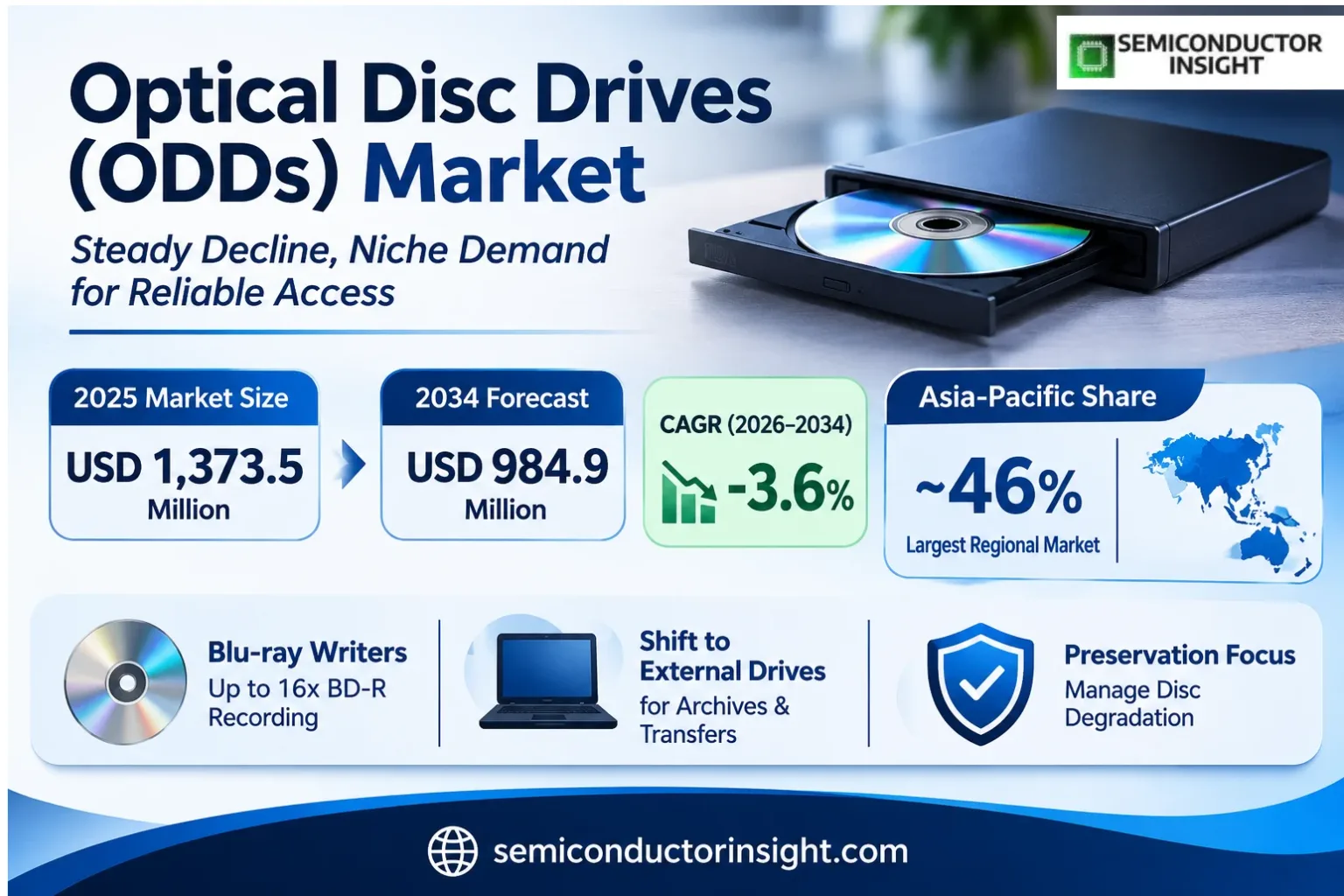
- Revenue outlook: Global optical disc drive revenue is estimated at USD 1,373.5 million in 2025 and projected at USD 984.9 million in 2034, implying a -3.6% annual change as downloadable software and streaming displace conventional computer drives while institutional disc retrieval survives.
- External drive formats: BD External ODD holds an estimated ~24% of 2025 value, compared with DVD External ODD at an estimated ~30%; USB-powered units serve computers that lack built-in disc bays and premium Blu-ray writers carry higher selling prices than ordinary DVD mechanisms.
- Desktop applications: Desktop computers account for an estimated ~55% of sales value, followed by laptop use at an estimated ~20%, mobile systems at an estimated ~7% and other specialist equipment at an estimated ~18%, reflecting the persistence of older workstations and institutional PCs.
- Asia-Pacific leadership: Asia-Pacific contributes an estimated ~46% of 2025 revenue, with North America at an estimated ~25% and Europe at an estimated ~19%; Japan and China combine manufacturing capacity with consumer disc-media ecosystems, although demand declines in each major region.
- Resilience and constraints: Records retrieval, DVD authoring, medical archives and installed-system support preserve some purchases, while thinner computers, cloud distribution, licensing changes and optical pickup supply consolidation depress new demand; several 2026 launches coexist with individual product discontinuations.
Optical Disc Drives (ODDs) Market Overview
Optical disc drives (ODDs) market was valued at USD 1,373.5 million in 2025 and is projected to reach USD 984.9 million by 2034, representing a CAGR of -3.6% across 2026–2034. Asia-Pacific is the largest regional market with an estimated ~46% share, supported by Japan-based optical media specialists, Chinese assembly operations and a sizeable installed base of desktop equipment still dependent on removable discs.
An optical disc drive is an electromechanical assembly that spins a CD, DVD or Blu-ray disc beneath a laser pickup, decodes reflected light and, in writable versions, controls a laser to alter the recording layer. The commercial market includes internal drives fitted to computer chassis and portable USB units sold as accessories. It excludes blank media, standalone entertainment players, complete personal computers, replacement cloud services and unrelated solid-state storage devices. Some institutional buyers still require a physical drive to retrieve collections created years before online delivery became routine.
The industry is no longer driven by the number of new notebooks shipped with optical bays. A buyer now typically acquires an external writer to open a specific archive, prepare an offline distribution package or transfer video from an older collection. This change shifts purchasing from automatic computer-bundle inclusion to discretionary replacement. Dell continues to list its 14-millimetre DW316 USB DVD writer, while Lenovo describes a 9.5-millimetre UltraSlim DVD mechanism for ThinkPad users, illustrating how compatibility accessories persist despite declining standard installations.
Blu-ray writers occupy a different commercial position from low-cost DVD peripherals. The ASUS BW-16D1X-U uses USB 3.0 and supports 16x BD-R recording; Buffalo and Verbatim list BDXL-compatible portable devices for high-capacity disc workflows. BDXL media can reach 100 GB in three layers and 128 GB in four layers, subject to compatible drives and recording software. These capabilities support film production, records transfer and selected cold-storage workflows, but neither high disc capacity nor long advertised media life guarantees permanent readability without suitable hardware.
Manufacturers face an unusual combination of falling volumes and continuing engineering requirements. Laser pickup alignment, disc rotation stability, error correction, thermal behavior, mechanical durability and software compatibility still need qualification, even when annual shipments shrink. A July 2026 price announcement from I-O DATA raised list prices for two portable Blu-ray models by 43.3% to 67.6%, citing component and transport costs. That supplier-specific change indicates pressure on remaining specialist production rather than evidence of comparable worldwide market-price growth.
Preservation institutions provide a technical reason to keep compatible readers available, although they do not guarantee rising hardware demand. The US National Archives cautions that optical discs can deteriorate and recommends suitable handling, storage and migration. ISO/IEC 16963 sets accelerated-aging tests for estimating recorded-disc information retention under controlled temperature and humidity. Those standards support careful archival planning; they do not imply that every stored disc will remain readable or that a new optical drive is the preferred option for every archive.
Segment Analysis: By Type
By type, the market covers BD External ODD, DVD External ODD, BD Internal ODD and DVD Internal ODD. External DVD models account for an estimated ~30% of 2025 revenue because affordable plug-in readers remain broadly compatible with desktop and notebook systems; external Blu-ray drives contribute an estimated ~24% and command higher prices when users need BDXL recording or protected-video playback. Internal DVD and Blu-ray units represent an estimated ~29% and ~17%, respectively, as built-in computer bays continue to disappear.
| Type | Function | Market position |
|---|---|---|
| BD External ODD | Portable or desktop Blu-ray drives connect through USB and read or record high-capacity BD-R, BD-RE and often CD/DVD media. Some units support BDXL three- and four-layer discs, Ultra HD playback under compatible software and external power where the USB port cannot provide sufficient current. They appeal to archivists, film enthusiasts and media-production teams that need removable high-capacity media. | Premium removable category, estimated ~24% share. ASUS, Buffalo and Verbatim list products with 6x to 16x Blu-ray writing capabilities, while device prices reflect optical pickup complexity, software bundles and licensing. Revenue erodes more slowly than many legacy mechanisms because specialist purchasers cannot substitute a DVD-only reader for existing Blu-ray collections. |
| DVD External ODD | Thin USB DVD/CD writers attach to laptops and desktops that omit a built-in tray. Their optical heads read and record DVD±R, DVD±RW and CD formats, and bus-powered designs remove the need for a separate AC adapter. Bundled software may provide disc authoring, data copying or basic playback, depending on operating-system and license support. | Largest type, estimated ~30% share. Dell DW316, Lenovo UltraSlim and LG GP65NB60 show continued retail availability across office and consumer channels. The large installed base supports low-cost replacement sales, but commodity DVD drives face intense price competition and a declining pool of disc-dependent software installations. |
| BD Internal ODD | Internal Blu-ray drives fit optical bays in tower workstations, older desktops and selected professional systems. SATA-connected mechanisms are useful where operators want an integrated disc tray, high sustained writing speed or a controlled workstation configuration. Replacement of an existing internal unit can avoid changes to a validated software environment, especially in specialist media-processing installations. | Specialist internal category, estimated ~17% share. Buyers value compatibility with existing desktop enclosures and firmware tools, while the absence of optical bays in compact new machines limits fresh installations. Higher-value internal burners retain demand among professional users, but long-run sales decline faster than premium external alternatives. |
| DVD Internal ODD | Built-in DVD/CD mechanisms are fitted to older office desktops, industrial PCs and replacement computer assemblies. They combine disc rotation motors, pickup optics and a tray or slot mechanism in a chassis-compatible form factor. Most new consumer laptops no longer include this configuration, leaving repair and legacy equipment as the principal sources of orders. | Legacy volume category, estimated ~29% share. The installed base remains substantial, particularly where software or operational procedures still rely on physical media. However, removal of drive bays, inexpensive USB peripherals and retirement of older PCs create the steepest revenue pressure among the four categories. |
Secondary segmentation: end-user
End-user demand ranges from household video transfer to tightly controlled institutional records access. Individual consumers represent an estimated ~36% of 2025 revenue, while corporate offices contribute an estimated ~22%, media and entertainment an estimated ~14%, educational institutions an estimated ~11%, government and military an estimated ~9%, and healthcare an estimated ~8%. The distinction matters because an occasional household purchase follows retail availability, whereas an institutional buyer may require an approved interface, documented firmware and a longer replacement-support period.
| Axis | Members | Commercial role |
|---|---|---|
| End-User | Individual Consumers; Corporate Offices; Media and Entertainment; Educational Institutions; Government and Military; Healthcare | Consumer purchases concentrate in portable DVD and Blu-ray products, while business and public-sector users buy for disc migration, controlled distribution and compatibility with older equipment. Medical and government applications often require procurement controls beyond consumer retail specifications. |
Segment Analysis: By Application
By application, Desktop equipment remains the largest use at an estimated ~55% of 2025 revenue. Laptop compatibility contributes an estimated ~20%, Mobile specialist devices an estimated ~7%, and Others an estimated ~18%. These categories describe the host system in which the drive is used rather than the recording medium itself; a single external Blu-ray unit may serve several computer classes over its operating life.
| Application | Demand characteristics |
|---|---|
| Laptop | Estimated ~20% share. Notebook owners use portable USB optical drives to read legacy software discs, recover family videos or access removable data received from clients. A compact accessory restores a capability that is absent from most slim notebooks, but demand depends on how frequently users encounter physical media and whether compatible playback software is available. |
| Desktop | Largest application, estimated ~55% share. Office workstations, tower PCs, recording studios and long-lived institutional desktops provide the broadest base for both internal and external drives. Their physical space accommodates tray mechanisms, while replacement purchases often preserve a working workflow rather than expand the number of systems using discs. |
| Mobile | Estimated ~7% share. Mobile carts, transportable media stations and portable equipment can use compact bus-powered drives when an operator needs to inspect or write discs away from a fixed desk. Power budgets, vibration tolerance and secure handling limit the addressable base, and flash media often offer a simpler field workflow. |
| Others | Estimated ~18% share. Specialist industrial terminals, public-sector kiosks, diagnostic equipment and media-transfer stations may retain optical readers because their software and archives were designed around physical discs. Purchases are episodic and can require form-factor matching, legacy interface adapters or documented operating-system support rather than the newest write speed. |
The application mix is changing as institutions consolidate disc-reading tasks into fewer workstations. A shared external reader can service several laptops or archival stations, lowering the number of mechanisms required even if the underlying stock of old discs remains large. Conversely, when a specialized workstation fails, the owner may pay a premium for a compatible replacement because revalidating its software would be costly. These two behaviors explain why accessory availability can remain visible while total market revenue declines.
Regional Analysis
Asia-Pacific is the largest regional optical disc drive market with an estimated ~46% of 2025 revenue, ahead of North America at an estimated ~25%, Europe at an estimated ~19%, South and Central America at an estimated ~6%, and the Middle East and Africa at an estimated ~4%. Every region faces structural substitution by online delivery, but the pace differs with the age of installed PCs, the importance of physical-media industries and the accessibility of replacement hardware.
Which regional customers still need optical disc drives despite digital substitution?
Demand follows the location of disc-dependent equipment and optical-hardware distribution rather than population alone. Asian suppliers manufacture many portable mechanisms and serve local recording cultures; North American buyers emphasize older business records and workstation accessories; European institutions retain media-conversion workflows; and customers in Latin America and the Middle East often purchase replacement drives for existing computers. An estimated ~46% Asia-Pacific position is consistent with the region being the largest manufacturing and consumption center, but unit shipments and average selling prices vary considerably by country.
| Region | Position | Growth outlook | Demand profile | What decides supplier selection |
|---|---|---|---|---|
| Asia-Pacific | Largest (~46%) | About ~-3.1% CAGR | China, Japan and regional device assembly | Optical-media culture and domestic hardware supply |
| North America | Second (~25%) | About ~-4.2% CAGR | Business archives and external USB accessories | Installed systems and software compatibility |
| Europe | Mature (~19%) | About ~-4.1% CAGR | Institutional records and professional media | Procurement standards and preservation requirements |
| South & Central America | Emerging (~6%) | About ~-2.9% CAGR | Legacy office and educational equipment | Replacement access and local import economics |
| Middle East & Africa | Specialist (~4%) | About ~-5.4% CAGR | Institutional PCs and offline records | Supply continuity and import dependence |
Key Optical Disc Drives (ODDs) Manufacturers and Competitive Landscape
The optical disc drive industry combines established optical-mechanism specialists with computer brands that resell compatible peripherals and regional accessory makers. Historic concentration in pickup and drive manufacturing is greater than the number of retail labels suggests. In 2019, HLDS and PLDS together accounted for more than 90% of reported drive revenue, but that historical figure should not be treated as a current market-share measurement. Competition today centers on model availability, recording formats, host compatibility, software bundles and warranty coverage.
HLDS and PLDS are important historical manufacturing platforms, while branded distribution increasingly determines what customers see in stores and computer accessory catalogues. LG, ASUS, Pioneer, I-O DATA, Buffalo, Dell, Lenovo, HP and Verbatim appear in different parts of the value chain. Some brands supply complete finished peripherals, while others integrate mechanisms sourced from specialist manufacturers. Brand listings therefore should not be interpreted as independent optical pickup production capacity or summed as if every label represented a separate factory.
Portable DVD drives compete largely on convenience and compatibility. A customer choosing between Dell DW316, Lenovo UltraSlim and LG GP65NB60 is likely to compare USB power, supported disc formats, playback software and support coverage rather than maximum recording speed alone. The resulting product differentiation is limited, making low-cost units vulnerable to price competition. Premium Blu-ray products can differentiate with BDXL support, protected-content playback capability and higher recording speeds, although the software and hardware chain can still limit practical use.
Japanese suppliers illustrate the tension between specialization and uncertain volumes. I-O DATA introduced several portable disc products in February 2026, then recorded a March production end for BRP-W1 while prioritizing another model. Its July 2026 list-price revision for selected Blu-ray drives indicates that component, materials and logistics costs matter even in a shrinking category. Buyers should assess the actual product lifecycle, not merely the existence of an announcement or a historical catalogue listing.
Professional buyers increasingly assess the risk of future incompatibility. A drive that can read a rare optical format may be worth more than a nominally faster device without the right firmware or playback rights. Preservation organizations may maintain several tested models for redundancy, while ordinary office users share one external drive between computers. This divergence supports a small premium specialist tier alongside a much larger, lower-priced replacement channel, even as the overall revenue pool contracts.
Tier structure
| Tier | Companies | Basis of competition |
|---|---|---|
| Mechanism specialists | HLDS, PLDS and legacy optical pickup manufacturers | These suppliers historically built the mechanisms and optical assemblies that appear under multiple finished-product labels. Their installed engineering knowledge matters for laser pickup design, servo control, firmware compatibility and qualification of shrinking production runs. |
| Branded optical specialists | ASUS, Pioneer, I-O DATA, Buffalo and Verbatim | These vendors differentiate recording capability, USB interface, industrial design and bundled applications. Their catalogues span portable DVD readers, BDXL writers and higher-priced professional products for media and archival workflows. |
| Computer accessory channels | Dell, Lenovo, HP and LG-branded retail products | Computer and consumer-electronics channels sell plug-and-play external drives for users whose current systems lack built-in optical bays. Compatibility lists, service policies and broad regional distribution are key purchasing factors. |
Key companies profiled
- HLDS
- PLDS
- ASUS
- Pioneer
- I-O DATA
- Buffalo
- Verbatim
- Dell Technologies
- Lenovo
- HP
- LG Electronics
Optical Disc Drives (ODDs) Production Capacity Analysis
Optical drive production depends on laser pickup components, miniature motors, mechanical loaders, control chips and firmware qualification. Assembly is concentrated in Asian electronics supply chains, while branded products are distributed globally. The decline in computer-bundled drives raises fixed costs per unit because specialized machinery, tooling and validation must be supported by fewer orders. Manufacturers respond by sharing mechanism platforms across several retail models and by prioritizing higher-value external Blu-ray and specialty replacement units.
A drive requires a spindle motor with stable speed control, an optical pickup with a laser and photodiodes, focus and tracking actuators, an error-correction processor and a tray or slot-loading mechanism. Blu-ray units add optical and control complexity relative to basic DVD writers because shorter-wavelength optics and multi-layer media require tight alignment. Recording media range from 4.7 GB DVD-R and 8.5 GB dual-layer DVD to 25 GB BD-R, 50 GB dual-layer Blu-ray, 100 GB BDXL and 128 GB four-layer discs; consumer writer specifications span 6x, 8x and 16x speeds. Assembly capacity cannot be inferred from the number of retail brands; multiple labels may depend on the same mechanism source. The declining installed base also makes long-term component procurement more challenging.
The manufacturing footprint is geographically uneven. China and neighboring Asian electronics hubs provide much of the assembly and component ecosystem, while Japanese firms retain product engineering, software integration and domestic distribution capabilities. HP specifications list China or Malaysia as possible countries of origin for an external DVD product, illustrating the role of cross-border assembly. A customer buying in Europe or North America therefore depends on imported optical components even when the peripheral carries a familiar local computer brand.
Capacity utilization is affected by changes in product mix rather than by a uniform collapse of every model. External DVD writers are simpler and cheaper, whereas portable Blu-ray devices can require dedicated playback licensing, software support and higher-performance optical components. I-O DATA raised list prices on selected portable Blu-ray products in August 2026 and ended one recently introduced model in March. These developments indicate active management of limited production resources, but they do not disclose total factory capacity or global output.
Optical Disc Drives (ODDs) Market Dynamics: Drivers, Restraints and Opportunities
The principal demand supports are archival retrieval, external compatibility accessories, professional Blu-ray recording, institutional replacement and controlled offline transfer. Their combined effect is outweighed by the disappearance of internal computer bays, the shift to streaming and downloads, falling demand for physical software and the cost of maintaining specialized mechanisms. The forecast therefore remains negative even though selected products and use cases continue to attract investment.
MARKET DRIVERS
Drivers Impact Analysis*
| Market Drivers | Impact Rank | CAGR Contribution (%) | 2026–2028 | 2029–2031 | 2032–2034 |
|---|---|---|---|---|---|
| Archive retrieval and migration projects | High | +0.80% | High | Medium | Low |
| USB accessory demand from bayless computers | Medium-High | +0.60% | High | Medium | Medium |
| Professional Blu-ray and BDXL workflows | Medium | +0.50% | Medium | Medium | Medium |
| Legacy industrial and institutional support | Medium | +0.40% | Medium | Medium | Low |
| Disc-based personal video recording | Low-Medium | +0.20% | Medium | Low | Low |
| Others (specialist field and education uses) | Low | +0.10% | Low | Low | Low |
Archives need working readers before content can be transferred
Libraries, corporate records offices and public institutions may hold CDs, DVDs and Blu-ray discs containing material that has not been migrated to modern repositories. A compatible drive is necessary to inspect these collections, assess unreadable media and capture files with their metadata. National Archives guidance notes that physical damage and material degradation can impair laser reading. This creates intermittent equipment orders for migration stations even though successful conversion ultimately lowers ongoing dependence on optical drives.
External USB units restore a missing function without redesigning computers
Slim laptops and compact desktops rarely provide room for a built-in optical mechanism, but a user may still need occasional access to an installation disc, recorded family video or older project archive. Portable readers sold by Dell, HP, Lenovo and LG provide this capability through USB. Shared peripherals are economical for organizations because one device can service several computers, which supports replacement sales while limiting the total number of units purchased.
High-capacity Blu-ray recording retains a professional niche
BDXL discs offer three- and four-layer capacities that exceed ordinary DVD storage, and ASUS, Buffalo and Verbatim list writers compatible with these media. A media-production company or archival service may require a high-capacity optical writer to access historical masters or deliver files to a client with an established disc workflow. The opportunity is narrower than general-purpose computer storage, but higher equipment prices can sustain a specialist segment after mainstream DVD demand has contracted.
Legacy workstations reward tested compatibility
Some industrial, medical and public-sector computer systems were validated with optical media as part of their software distribution or records workflow. Replacing the reader can be less disruptive than replacing the entire application environment, particularly when firmware and operating-system requirements are fixed. Suppliers with documented format support and stable mechanical designs may therefore win orders that are insensitive to the latest computer form factor. Such purchases are irregular, however, and do not represent broad new adoption.
MARKET RESTRAINTS
Restraints Impact Analysis*
| Market Restraints | Impact Rank | CAGR Contribution (%) | 2026–2028 | 2029–2031 | 2032–2034 |
|---|---|---|---|---|---|
| Streaming, cloud delivery and downloaded software | High | -2.40% | High | High | High |
| Removal of optical bays from new computers | Medium-High | -1.70% | High | High | Medium |
| Component costs and mechanism consolidation | Medium | -1.10% | Medium | Medium | High |
| Others (software rights and media deterioration) | Low | -1.00% | Medium | Medium | Medium |
Network distribution removes the original reason to install a drive
Software vendors increasingly deliver applications through online stores, video providers distribute films through streaming, and organizations exchange files through managed cloud services. These alternatives remove routine disc insertion from everyday computing. Even households that own large CD or DVD collections can digitize them once and then rely on digital playback. As the number of occasions requiring a disc falls, both new computer integration and repeat peripheral purchases decline.
New laptop and compact desktop designs have no optical bay
The physical thickness and moving parts of an optical drive conflict with the design priorities of modern thin computers. Manufacturers therefore omit internal mechanisms and leave customers to buy an external reader if needed. This design choice reduces automatic OEM orders and shifts remaining demand into a lower-volume accessory market. Older desktop systems may still accept internal replacements, but the number of compatible new chassis and regular installation workflows continues to shrink.
Specialist component economics make small production runs costly
Optical pickups, tracking motors, tray mechanisms and dedicated firmware still need precision manufacturing and testing. As demand falls, suppliers have fewer units over which to spread tooling, qualification and logistics costs. I-O DATA cited semiconductor parts, raw materials, transport and fuel when announcing steep list-price changes for selected Blu-ray drives in July 2026. Such pressures can narrow product choice and discourage low-margin replacements, even when a small number of customers still need them.
Playback restrictions and aging media can limit usable demand
A functional drive does not guarantee access to every disc. Protected Blu-ray video may require compatible graphics hardware, approved playback software and valid licensing, while scratched or chemically degraded media can be unreadable regardless of the reader. ISO aging tests cover defined environmental stresses but do not address every failure mechanism. Buyers may therefore invest in digital migration or alternative records handling instead of purchasing additional optical hardware.
MARKET OPPORTUNITIES
Managed migration services and validated readers
Archives and professional service providers can combine tested optical drives with media inspection, secure transfer, metadata capture and integrity verification. These projects require dependable readers across several disc generations and can support higher-value equipment orders. However, a completed migration also reduces future drive use, so the opportunity is strongest in services and replacement reliability rather than a permanently expanding hardware base.
Premium external Blu-ray products for creators
Film producers, music archivists and video enthusiasts may pay for portable drives that support BDXL, multiple recording formats and well-maintained software. Verbatim and ASUS offer USB-connected products for this niche, while I-O DATA continues to develop specialized consumer recording workflows. Vendors can compete through interface convenience, firmware updates and bundled applications, although demand remains vulnerable to digital distribution and licensing changes.
Legacy-equipment maintenance and industrial supply contracts
Operators of long-lived industrial PCs and diagnostic stations can benefit from stable replacement mechanisms, especially when equipment requalification is expensive. A supplier that documents interface, media and operating-system compatibility may command a service premium. The opportunity depends on maintaining parts availability and support rather than selling drives into new mass-market notebooks, making inventory planning and end-of-life notices important competitive tools.
Compact shared readers for institutional fleets
Universities, offices and public agencies can place a few external readers in controlled work areas instead of installing an optical mechanism in every computer. The devices can support occasional disc inspection, historical course material and evidence transfer without compromising thin-laptop deployment. This configuration preserves some peripheral demand, but its shared-use economics also reduce the number of devices required across an organization.
Optical Disc Drives (ODDs) Supply Chain Analysis
The optical drive value chain connects laser and motor components to precision mechanism assembly, firmware and recording software, finished USB or SATA peripherals, distributors and institutional or consumer users. Supply continuity is a strategic issue because declining volumes can lead to component obsolescence even while archives still require compatible readers. The most valuable services are reliable qualification, backward compatibility and support for the specific disc formats already held by customers.
Upstream. Optical drive components are specialized despite their small size. A laser pickup must track microscopic disc features while motors regulate rotation and actuators maintain focus. Semiconductor and precision-mechanical inputs compete for manufacturing resources with larger electronics markets, creating supply risk when orders for drives shrink. Component price pressure was visible in the 2026 I-O DATA price notice, although the announcement did not identify a single optical pickup supplier as the cause.
Assembly. Drive manufacturers integrate optics, mechanics and firmware, then test compatibility with recordable and pressed discs. Blu-ray mechanisms require more demanding optical control than basic DVD writers, while external models add USB interface electronics, enclosures and power management. A small number of underlying mechanism families may appear in products sold under many brand names. This makes the availability of a particular laser pickup or loader assembly more important than the number of retailers carrying the finished product.
Distribution. Finished units reach buyers through computer accessory catalogues, specialist media stores and regional electronics wholesalers. Dell, Lenovo and HP emphasize compatibility with their computer fleets, while ASUS, Buffalo, I-O DATA and Verbatim highlight format support and recording features. Product pages may remain accessible after manufacturing ends, so distributors and institutional buyers need current inventory and support confirmation before planning long-term deployment.
End users. The customer base divides between occasional consumers and organizations maintaining physical archives. A household may purchase one USB writer to transfer a collection of home videos; an archive may require several tested readers and controlled procedures to recover damaged or obsolete discs. Both groups need compatible software, but institutions additionally value traceable handling and secure storage. Once content is migrated successfully, the need for repeated hardware purchases often diminishes.
Recent Developments in the Optical Disc Drives (ODDs) Market
- 15 July 2026 Pricing
I-O DATA announced list-price revisions effective 3 August 2026 for two portable Blu-ray drive models, with increases ranging from 43.3% to 67.6%. The company attributed its broader cost challenge to semiconductor components, materials, transport and fuel. The announcement is a supplier-specific pricing event and does not establish a comparable global change in average selling prices. Source - 18 March 2026 Product lifecycle
I-O DATA recorded the end of BRP-W1 production on 18 March 2026, explaining that unexpectedly strong orders for another recording model led it to prioritize supply. The decision came shortly after the BRP-W1 announcement, illustrating the importance of tracking individual SKU status when assessing optical-drive availability and the stability of replacement inventory. Source - 4 February 2026 New product
I-O DATA introduced the BRP-W1 portable Blu-ray drive and DVRP-W1 portable DVD recorder for users wanting to write computer or smartphone videos to physical discs. The devices were described as USB bus-powered and bundled with downloadable recording software. The release demonstrates continuing investment in convenience features, despite the structural decline in general-purpose optical storage. Source - 4 February 2026 Recording workflow
The same Japanese supplier announced BRP-R1 and DVRP-R1 products that let users copy selected television recordings from hard disks to Blu-ray or DVD through a computer. This application targets a defined media-preservation workflow rather than new optical installation in mainstream laptops. Rights-management and software requirements remain important when evaluating whether the hardware can serve a particular recorded-content collection. Source - September 2025 Product availability
Buffalo listed the OP-BRXL/TW-B portable Blu-ray drive with USB 3.2 connectivity, BDXL support, recording software and auxiliary power provisions. The model shows that accessory suppliers continue to serve high-capacity disc users with portable hardware. Its publication date should be understood as product availability evidence, not as proof of expanding total shipments or a reversal of the market decline. Source - 2023 confirmation Technical standard
ISO confirmed that ISO/IEC 16963:2017 remained current after review in 2023. The standard specifies accelerated-aging procedures for estimating the retrievability of data recorded on optical discs under defined environmental conditions. This matters for archives choosing recording and storage processes, but does not guarantee indefinite disc life or establish the revenue outlook for optical-drive manufacturers. Source
REPORT SCOPE & SEGMENTATION
| Attribute | Details |
|---|---|
| Study Period | 2020–2034 |
| Base Year | 2025 |
| Estimated Year | 2026 |
| Forecast Period | 2026–2034 |
| Historical Period | 2020–2024 |
| Market Size 2025 | USD 1,373.5 million |
| Market Size 2026 | USD 1,323.6 million |
| Market Size 2034 | USD 984.9 million |
| Growth Rate | CAGR of -3.6% from 2026–2034 |
| Unit | Value (USD Million) |
| Segmentation | By Type, By Application, By End-User, and By Region |
| By Type | BD External ODD · DVD External ODD · BD Internal ODD · DVD Internal ODD |
| By Application | Laptop · Desktop · Mobile · Others |
| By End-User | Individual Consumers · Corporate Offices · Media and Entertainment · Educational Institutions · Government and Military · Healthcare |
| By Region | Each region reviewed by Type, Application, End-User and Country Asia-PacificChina, Japan, South Korea, India, Australia, Rest of APAC North AmericaUnited States, Canada, Mexico EuropeGermany, United Kingdom, France, Italy, Spain, Rest of Europe South & Central AmericaBrazil, Argentina, Chile, Rest of South and Central America Middle East & AfricaUnited Arab Emirates, Saudi Arabia, South Africa, Rest of Middle East and Africa |
| Key Companies Profiled | HLDS, PLDS, ASUS, Pioneer, I-O DATA, Buffalo, Verbatim, Dell Technologies, Lenovo, HP, LG Electronics |
| Customization Scope | Free report customization (equivalent to up to 4 analyst working days) with purchase. Addition or alteration to country, regional and segment scope. |
Frequently Asked Questions
What is the size of the optical disc drives market?
The global optical disc drives market was valued at USD 1,373.5 million in 2025 and is forecast to reach USD 984.9 million by 2034, representing a CAGR of -3.6% during 2026–2034. The contraction reflects declining routine disc use in computers and media distribution, partly moderated by replacement readers, offline archives and specialist Blu-ray recording.
Which region leads sales of optical disc drives?
Asia-Pacific holds an estimated ~46% of 2025 revenue because it combines a large computer and consumer-electronics installed base with major optical-drive manufacturing and retail ecosystems. Japan remains important for specialized recording products, while China supplies a significant assembly base. North America follows at an estimated ~25%, and Europe at an estimated ~19%, with institutional records and accessory purchases prominent in both.
What are the main types of optical disc drives?
The principal categories are BD External ODD, DVD External ODD, BD Internal ODD and DVD Internal ODD. External models connect through USB and serve computers without optical bays; internal versions are mounted in compatible desktop or industrial chassis. Blu-ray products can support higher-capacity discs and often cost more, while DVD writers remain a common low-cost option for reading and transferring older material.
Why are external DVD drives still sold?
A portable DVD reader allows a modern laptop or compact desktop to open an existing CD or DVD without a built-in optical bay. Dell, HP, Lenovo and LG list external products for this purpose. Buyers may need to retrieve software, transfer old photographs or read records from a physical archive. These occasional tasks sustain accessory availability even as daily disc usage falls.
How does BDXL affect the optical drive business?
BDXL supports recordable Blu-ray media with capacities of 100 GB in three layers and 128 GB in four layers, subject to drive and disc compatibility. ASUS, Buffalo and Verbatim market equipment that supports selected high-capacity formats. This capability helps professional recording and archival work, but does not make Blu-ray a universal substitute for network storage or eliminate the need for preservation planning.
What limits demand for internal optical drives?
Most new slim notebooks and many compact desktops omit optical bays to save space and reduce mechanical complexity. Software distribution, entertainment and document exchange have also shifted toward downloads, streaming and cloud services. Owners of older computers may still need internal replacement mechanisms, but the pool of compatible new machines is shrinking and external USB units are often easier to deploy.
Who are the principal optical drive suppliers?
Historic optical mechanism manufacturing includes HLDS and PLDS, while branded retail and accessory products are associated with ASUS, Pioneer, I-O DATA, Buffalo, Verbatim, Dell, Lenovo, HP and LG. These names occupy different positions in the supply chain, and the number of retail listings does not establish separate factory output. Buyers should verify current SKU status, supported disc formats and service terms.
Can optical discs be relied on for long-term preservation?
Optical media can preserve data when manufactured, recorded, handled and stored appropriately, but neither a disc nor its reader is immune to deterioration. ISO/IEC 16963 describes accelerated-aging tests under defined temperature and humidity conditions, and the US National Archives recommends careful handling and considering migration. Institutions should maintain verified copies and working readers while transferring valuable collections into managed storage.
Which applications create the most drive revenue?
Desktop systems account for an estimated ~55% of 2025 value because they support both internal replacement drives and shared external peripherals. Laptop compatibility contributes an estimated ~20%, mobile systems an estimated ~7%, and other specialized installations an estimated ~18%. These figures describe host applications rather than separate sales of optical media, and they reflect the long tail of older computer fleets.
What developments shaped the industry in 2026?
I-O DATA announced portable Blu-ray and DVD products in February 2026, discontinued the BRP-W1 model in March and disclosed substantial list-price increases for selected Blu-ray units in July. Together these events show ongoing product development alongside constrained manufacturing economics. They do not indicate that global optical drive revenue is growing, and individual SKU announcements cannot substitute for shipment data.
Research Sources & Evidence Base

Get Sample Report PDF for Exclusive Insights
Report Sample Includes
- Table of Contents
- List of Tables & Figures
- Charts, Research Methodology, and more...
 Download Sample Report PDF