NTN Communication Market Insights
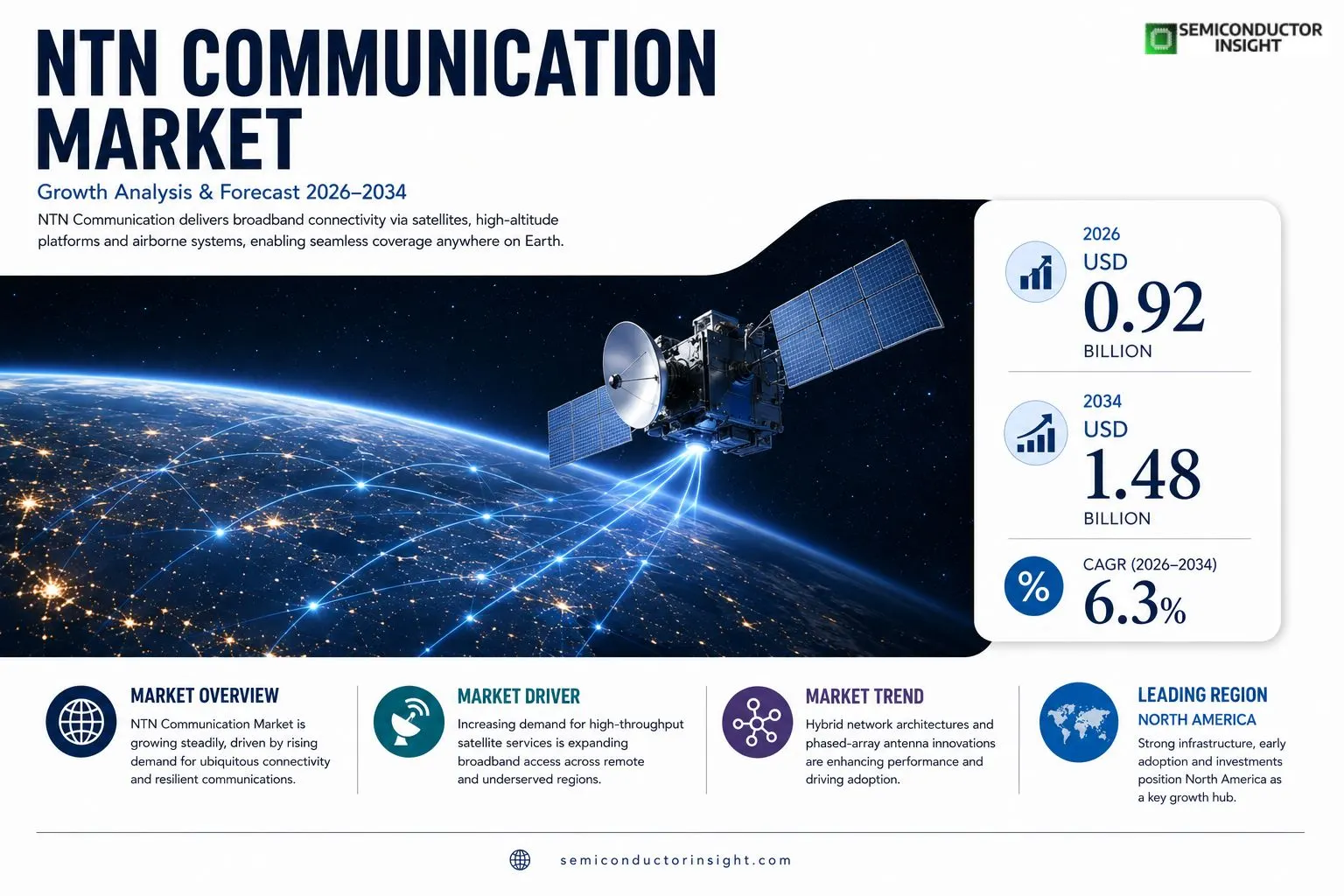
NTN Communication market size was valued at USD 0.86 billion in 2025. The market is projected to grow from USD 0.92 billion in 2026 to USD 1.48 billion by 2034, exhibiting a CAGR of 6.3% during the forecast period.
NTN Communication refers to non‑terrestrial network services that deliver broadband connectivity via satellites, high‑altitude platforms and airborne systems. These solutions enable seamless coverage in remote or underserved regions, support IoT deployments and provide resilient backhaul for disaster recovery.The market is experiencing robust expansion because telecom operators are investing heavily in satellite constellations, while enterprises seek reliable connectivity beyond terrestrial limits. Moreover, regulatory reforms and declining launch costs are accelerating adoption. Key players such as SpaceX (Starlink), OneWeb Ltd., SES S.A., and Telesat are driving innovation through new phased‑array antennas and hybrid network architectures.
MARKET DRIVERS
Increasing Demand for High‑Throughput Satellite Services
The surge in broadband appetite across Asia‑Pacific and Africa is prompting telecom operators to adopt high‑throughput satellite (HTS) solutions. NTN Communication Market players are capitalising on this trend by launching flexible payloads that deliver faster data rates at lower latency, directly supporting remote education and tele‑medicine initiatives.
Government Initiatives Supporting Remote Connectivity
National broadband plans in India, Brazil and Kenya allocate significant budgets for satellite‑based backhaul, creating a predictable pipeline of contracts for service providers. These policy‑driven investments boost confidence among investors and reduce the perceived risk of deploying new constellations.
➤ “By 2028, satellite‑enabled broadband is expected to serve over 350 million households ly, driving sustained revenue growth for NTN operators.”
Combined, these drivers are projected to push NTN Communication Market to a compound annual growth rate of roughly 7 % through 2032, outpacing many terrestrial alternatives.
MARKET CHALLENGES
Spectrum Allocation Constraints
Limited availability of Ka‑band frequencies in congested regions forces operators to compete for licensing, increasing acquisition costs and potentially delaying network roll‑outs. The scarcity of spectrum also limits the ability to scale capacity quickly.
Other Challenges
High Capital Expenditure
Building and launching large constellations requires multi‑billion‑dollar investments. While financing options have improved, the upfront outlay remains a deterrent for smaller entrants, narrowing the competitive landscape.
MARKET RESTRAINTS
Regulatory Lag in Emerging Regions
Many developing countries lack clear frameworks for licensing Non‑Terrestrial Network (NTN) services, creating uncertainty for investors and slowing market entry. Without harmonised regulations, cross‑border service provision becomes operationally complex.Additionally, export controls on advanced satellite technology can restrict the flow of critical components, further constraining growth in markets that rely on imported hardware.These regulatory and supply‑chain issues collectively act as a restraint, tempering the otherwise aggressive expansion outlook for NTN Communication Market.
MARKET OPPORTUNITIES
Growth in IoT Connectivity for Rural Areas
IoT deployments in agriculture, logistics and environmental monitoring increasingly require low‑cost, ubiquitous coverage that terrestrial networks cannot guarantee. NTN solutions can fill this gap, offering seamless connectivity to millions of sensors and devices in underserved locales.Furthermore, the emergence of lightweight, low‑power satellite terminals opens new revenue streams for equipment manufacturers and service providers, positioning NTN Communication Market to capture a sizable share of the next wave of digitalisation.
NTN Communication Market Trends
Accelerating Satellite Constellations and Hybrid Architectures
NTN Communication Market is witnessing a rapid upscale of satellite constellations, driven by carrier‑grade investments from players such as SpaceX, OneWeb, SES and Telesat. Between 2025 and 2034 the market value is projected to rise from USD 0.86 billion to approximately USD 1.48 billion, reflecting a compound annual growth rate of roughly 6.3 percent. The growth momentum stems from the convergence of three technology pillars: high‑throughput phased‑array antennas, low‑cost launch services, and software‑defined networking that enables seamless integration of space‑based links with terrestrial backbones. As a result, service providers can now deliver uninterrupted broadband to remote villages, maritime vessels, and disaster‑affected zones, while maintaining latency levels suitable for emerging IoT applications.
Other Trends
Regulatory Landscape and Cost Dynamics
Regulatory reforms across North America, Europe and parts of Asia have begun to streamline spectrum allocation for non‑terrestrial services, reducing licensing bottlenecks that previously limited commercial roll‑outs. Concurrently, the decline in launch costspartly due to reusable rocket technologyhas lowered the capital barrier for new satellite deployments. These policy and economic shifts are encouraging a broader set of enterprises to consider satellite‑backed connectivity as a viable alternative to expensive fiber extensions, especially in sparsely populated or geopolitically sensitive regions.
Enterprise Adoption of Resilient Backhaul Solutions
Enterprises with mission‑critical operations are increasingly adopting hybrid backhaul models that combine terrestrial fiber with space‑based links to achieve redundancy and geographic diversity. Case studies from the energy sector illustrate how oil‑field operators leverage NTN services to maintain real‑time monitoring and control despite harsh terrain and limited ground infrastructure. Similarly, logistics firms are integrating satellite connectivity into fleet management platforms to ensure continuous data flow for route optimization and asset tracking. This trend underscores a shift from treating satellite links as a fallback option toward recognizing them as integral components of resilient network architectures.
COMPETITIVE LANDSCAPEKey Industry Players
NTN Communication Market Competitive Overview
NTN Communication Market is dominated by a handful of vertically integrated satellite operators that combine constellation ownership, ground‑segment technologies, and service‑delivery platforms. SpaceX’s Starlink leads the space‑based broadband segment with over 4,000 active user terminals and a rapidly expanding low‑earth‑orbit (LEO) constellation that underpins a $0.86 billion valuation in 2025. OneWeb Ltd. follows closely, leveraging a 648‑satellite fleet focused on enterprise and government backhaul, while SES S.A. differentiates through hybrid GEO‑LEO services that target carrier‑grade connectivity. Telesat’s Lightspeed constellation is positioned to serve high‑capacity demand in remote regions, and Amazon’s Project Kuiper, though not yet operational, is expected to inject additional competitive pressure once its 3,200‑satellite network launches. Collectively these leaders shape a market structure where scale, phased‑array antenna innovation, and regulatory compliance drive bargaining power and margin expansion.Beyond the headline players, a diverse set of niche and regional firms contributes to the ecosystem’s depth. Airbus Defence & Space supplies satellite platforms and launch services to OneWeb, while Boeing’s subsidiary Boeing Satellite Systems provides both GEO and LEO payloads for a variety of customers. Viasat focuses on high‑throughput satellite (HTS) services that complement LEO offerings, and EchoStar delivers consumer‑grade satellite TV and broadband via its Ka‑band fleet. Emerging entrants such as LeoSat (targeting enterprise fiber‑replacement services) and Iridium (expanding its LEO voice and data network) broaden the application spectrum. Additionally, Chinese state‑backed operators like China Satellite Communications and European consortia such as the European Space Agency (ESA) contribute to the competitive milieu, fostering technology sharing and cross‑border market penetration.
List of Key NTN Communication Companies Profiled
- SpaceX
- OneWeb Ltd.
- SES S.A.
- Telesat
- Amazon (Project Kuiper)
- Airbus Defence & Space
- Boeing Satellite Systems
- Viasat
- EchoStar
- LeoSat
- Iridium Communications
- China Satellite Communications
- European Space Agency (ESA)
- Hughes Network Systems
- Rakuten Mobile (Rakuten Satellite)
Segment Analysis:
| Segment Category | Sub-Segments | Key Insights |
| By Type |
|
Satellite remains the dominant sub‑segment, driven by mature orbital assets and a growing ecosystem of ground terminals.
|
| By Application |
|
Broadband Internet is the leading application, reflecting the market’s focus on delivering high‑speed connectivity where terrestrial fiber is absent.
|
| By End User |
|
Telecom operators dominate the end‑user landscape, leveraging NTN services to augment their existing networks and to reach customers beyond fiber footprints.
|
| By Technology |
|
Phased‑array antennas are emerging as the pivotal technology, enabling rapid beam steering and supporting multi‑constellation access.
|
| By Service Offering |
|
Hybrid satellite‑terrestrial solutions attract the most attention, as they blend the reliability of space‑based links with the low‑latency of ground infrastructure.
|
Regional Analysis: North America
Ongoing investments in upgrading and expanding the communication infrastructure are crucial for supporting the growing demand for data and connectivity.
With increasing reliance on digital communication, cybersecurity remains a paramount concern, requiring robust security measures and protocols.
Evolving regulatory frameworks around data privacy and network management significantly influence NTN Communication Market.
The increasing adoption of cloud-based communication services is transforming the way businesses operate and interact with customers.
Europe
The European NTN Communication Market presents a diverse landscape shaped by varying levels of technological advancement and regulatory approaches across its member states. The focus is on fostering a unified digital infrastructure to enhance connectivity and bridge the digital divide. Sustainability is emerging as a key driver, with emphasis on energy-efficient networks and eco-friendly technologies. Government initiatives are playing a crucial role in stimulating investment and promoting innovation in the sector. While challenges remain in achieving complete harmonization, collaboration among European nations is driving progress towards a more interconnected and resilient communication ecosystem. The market is seeing a strong push towards open standards and interoperability.
Asia-Pacific
Asia-Pacific is witnessing explosive growth in NTN Communication Market, fueled by rapid urbanization, increasing internet penetration, and the proliferation of mobile devices. Countries like China and India are leading the way in deploying advanced communication technologies, creating significant opportunities for businesses. The demand for high-bandwidth services is soaring, driven by the rise of streaming media, online gaming, and remote work. Government support and significant private sector investments are propelling the region’s digital transformation. However, navigating complex regulatory environments and ensuring data security present key challenges.
South America
NTN Communication Market in South America is characterized by significant growth potential, particularly in underserved areas. Expanding broadband access and improving network infrastructure are major priorities for governments across the region. The adoption of mobile technologies is widespread, with increasing demand for data-intensive applications. Emerging economies in the region are presenting new opportunities for businesses to provide cost-effective communication solutions. Addressing the digital divide and promoting digital inclusion are crucial for realizing the full potential of the market.
Middle East & Africa
The Middle East & Africa region is undergoing a period of rapid digital transformation, with significant investments being made in communication infrastructure. The rollout of 5G networks is expected to drive substantial growth in NTN Communication Market, enabling new applications and services. Government initiatives aimed at promoting economic diversification and attracting foreign investment are further boosting the sector. While challenges related to infrastructure development and affordability remain, the long-term outlook for the region is positive.
Report Scope
This market research report provides a comprehensive analysis of the NTN Communication Market , covering the forecast period 2026–2034. It offers detailed insights into market dynamics, technological advancements, competitive landscape, and key trends shaping the industry.
Key focus areas of the report include:
- ✅ Market Overview: The report begins with an overview outlining its current market scenario, key growth indicators, and industry transformation drivers. It discusses macroeconomic factors, demand–supply balance, regulatory landscape, and the strategic role of semiconductors in powering advancements across industries such as automotive, telecommunications, consumer electronics, and industrial automation.
- ✅ Market Size & Forecast: Historical data and future projections for revenue, unit shipments, and market value across major regions and segments.
- ✅ Segmentation Analysis: Detailed breakdown by product type, technology, application, and end-user industry to identify high-growth segments and investment opportunities.
- ✅ Regional Insights: Insights into market performance across North America, Europe, Asia-Pacific, Latin America, and the Middle East & Africa, including country-level analysis where relevant.
- ✅ Competitive Landscape: Profiles of leading market participants, including their product offerings, R&D focus, manufacturing capacity, pricing strategies, and recent developments such as mergers, acquisitions, and partnerships.
- ✅ Technology Trends & Innovation: Assessment of emerging technologies, integration of AI/IoT, semiconductor design trends, fabrication techniques, and evolving industry standards.
- ✅ Market Drivers & Restraints: Evaluation of factors driving market growth along with challenges, supply chain constraints, regulatory issues, and market-entry barriers.
- ✅ Stakeholder Insights: Insights for component suppliers, OEMs, system integrators, investors, and policymakers regarding the evolving ecosystem and strategic opportunities.
Primary and secondary research methods are employed, including interviews with industry experts, data from verified sources, and real-time market intelligence to ensure the accuracy and reliability of the insights presented.
FREQUENTLY ASKED QUESTIONS:
What is the current market size of NTN Communication Market?
-> NTN Communication Market was valued at USD 0.86 billion in 2025 and is expected to reach USD 1.48 billion by 2034 with a CAGR of 6.3% during the forecast period.
Which key companies operate in NTN Communication Market?
-> Key players include SpaceX (Starlink), OneWeb Ltd., SES S.A., and Telesat.
What are the key growth drivers?
-> Key growth drivers include heavy investment by telecom operators in satellite constellations, enterprise demand for reliable beyond‑terrestrial connectivity, regulatory reforms, and declining launch costs.
Which region dominates the market?
-> The reference does not specify a single dominant region.
What are the emerging trends?
-> Emerging trends include development of phased‑array antennas, hybrid network architectures, and integration of AI/IoT for satellite services.

Get Sample Report PDF for Exclusive Insights
Report Sample Includes
- Table of Contents
- List of Tables & Figures
- Charts, Research Methodology, and more...
 Download Sample Report PDF