Key Statistics
Key Takeaways
- Voltage Buffer is the leading type on the source page because it is widely used to restore logic levels, isolate loads and increase drive strength without changing signal polarity. The detailed page segmentation also lists high-speed and low-power buffers, while its formal TOC reduces the type taxonomy to Voltage Buffer and Inverting Buffer; that source inconsistency is explicitly logged.
- Automatic Control System is the leading application because industrial controllers, sensor interfaces and distributed automation need clean logic transitions across capacitive loads, long PCB traces and noisy environments. IFR reported 542,000 industrial robots installed worldwide in 2024, with Asia representing 74% of new deployments.
- Asia Pacific is retained as the largest volume market because the source page assigns the region 48% of global volume. The same page says the U.S. leads in market size and describes North America as significant, so this article separates volume leadership from high-value design demand rather than silently choosing one contradictory statement.
- Automotive-grade mini logic is a current product-development focus. Texas Instruments added or refreshed multiple 2026 automotive single-gate buffers, including SN74LVC1G125B-Q1, SN74LVC1G17B-Q1 and SN74AC125-Q1, with AEC-Q100 qualification, small packages and wide voltage ranges.
- The published market-size anchors imply lower growth than the printed CAGR. USD 78 million in 2024 and USD 124 million in 2032 imply approximately 6.0% annual growth, not 6.8%; the anchor-derived series is therefore used for 2025, 2026 and 2034.
Noninverting Buffer Market Overview
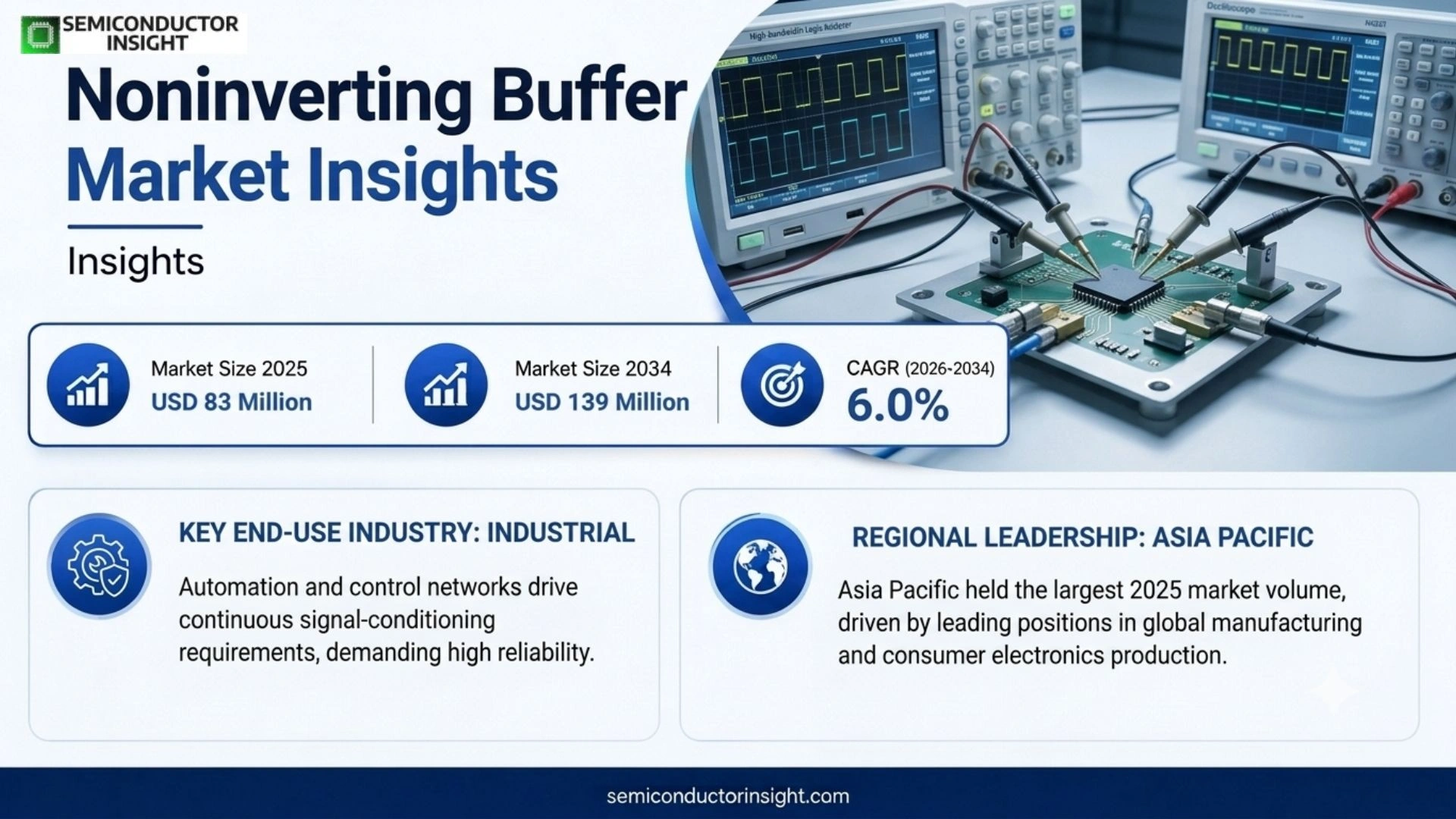
The global noninverting buffer market is rebased to USD 83 million in 2025, increases to an estimated USD 88 million in 2026, and is projected to reach USD 139 million by 2034. The selected source-page size anchors imply a 6.0% CAGR during 2026–2034. Asia Pacific is the largest volume market in 2025 based on the source page’s stated 48% global-volume share, while current demand is being reshaped by higher signal-integrity requirements in industrial automation, automotive electronics, edge devices and compact electronics, alongside demand for lower-voltage logic, Schmitt-trigger noise immunity, stronger output drive and smaller AEC-Q100-qualified packages.
Noninverting buffers are logic devices that reproduce the input logic state at the output while increasing drive capability, isolating stages, sharpening transitions or protecting a controller from heavy capacitive loads. They are used as basic signal-conditioning building blocks in industrial control, automotive electronics, medical systems, IoT nodes, displays and mixed-voltage digital boards. Commercial differentiation comes from propagation delay, output current, quiescent power, Schmitt-trigger behavior, input tolerance, partial-power-down protection, channel count and package footprint.
The market is technically broad despite the simple logic function. Standard CMOS buffers serve ordinary board-level fan-out, Schmitt-trigger variants clean slow or noisy edges, tri-state products disconnect shared buses, and open-drain outputs support wired logic and mixed-voltage interfaces. Texas Instruments’ current portfolio spans sub-1 V preview devices through 6 V automotive products, while Nexperia offers AEC-Q100 buffer families across 0.8 V-to-5.5 V supply ranges, showing that low-voltage scaling and automotive robustness are developing in parallel.
Demand is tied to electronic-system complexity rather than one headline end market. IFR’s World Robotics 2025 data recorded 542,000 industrial robot installations in 2024, with electronics representing 24% of installations and Asia 74% of deployments. Each automation cell, controller and sensor network adds logic interfaces where signal conditioning can be required. Vehicle electrification, ADAS, battery management and infotainment create a second durable demand pool because automotive designs must tolerate wide temperature, transients and mixed voltage domains.
Segment Analysis: By Type
The detailed source-page segmentation lists Voltage Buffer, Inverting Buffer, High-Speed Buffer, Low-Power Buffer and Others, while the formal Table of Contents lists only Voltage Buffer and Inverting Buffer. Because the workflow requires preserving source structure, the broader detailed segmentation is used as the main type table and the TOC inconsistency is disclosed in the workbook notes.
| Type | Technical / commercial role | Market position |
|---|---|---|
| Voltage Buffer | Voltage buffers reproduce the input logic state while increasing output drive or isolating a source from downstream loading. Single-channel and multi-channel products are used between microcontrollers, sensors, buses and distributed loads. Over-voltage-tolerant inputs can also permit limited level-interface use even where the device is not a dedicated translator. | Leading segment on the source page. Demand is broad across industrial, automotive and consumer boards because fan-out and line-drive issues appear whenever a controller must drive several inputs or long traces. Suppliers compete on package size, drive strength, input tolerance, standby current and qualification. |
| Inverting Buffer | Inverting buffers provide the same drive-strength and isolation benefits while changing output polarity. Although the report topic is noninverting buffers, the source page includes inverting devices in the competitive type taxonomy. These devices are often selected where signal inversion is already required by logic architecture and a separate gate can be eliminated. | Adjacent segment retained for source fidelity rather than presented as a strict noninverting product. Commercial overlap is high because the same logic families, package platforms and fabrication processes commonly support both inverting and noninverting functions. |
| High-Speed Buffer | High-speed buffers minimize propagation delay and edge distortion for clocking, fast control and high-frequency digital interfaces. At higher edge rates, package inductance, PCB impedance and receiver loading become more important, so board design can determine whether a nominally fast buffer actually improves signal integrity. | Premium performance niche. It serves industrial timing, communications and high-speed control systems where timing margin matters more than lowest price. Suppliers that combine low delay, strong output drive and compact packaging can defend higher ASPs than commodity single-gate logic. |
| Low-Power Buffer | Low-power devices reduce static and dynamic consumption for battery-powered sensors, wearables and always-on control logic. Nexperia’s AUP automotive buffer family specifies very low static current, while TI is previewing logic that operates below 1 V. These architectures matter as edge devices spend long periods in standby. | Growing design-in segment. The product value lies in minimizing leakage without compromising noise immunity or signal transition quality. Battery life, thermal density and partial-power-down behavior create purchasing criteria that differ from high-current industrial buffers. |
| Others | Other buffer products include open-drain outputs, specialized bus drivers, radiation-qualified parts and multi-function signal conditioners that combine buffering with translation or protection. These products are lower volume but can carry strong margins when the application requires unusual voltage, temperature, ESD or reliability specifications. | Niche but resilient. Qualification-heavy aerospace, medical and automotive programs can support long product lifecycles and reduce annual price erosion, although engineering and documentation requirements are higher than in general-purpose consumer logic. |
Secondary segmentation: By Technology
The source page divides the market into CMOS, BiCMOS, TTL and Others. CMOS dominates modern low-power logic because static consumption is low and fabrication is widely available. BiCMOS can combine CMOS logic with stronger bipolar output behavior, while TTL remains relevant mainly through legacy compatibility and defined input thresholds.
| Technology | Commercial implication |
|---|---|
| CMOS | CMOS is the principal technology for modern logic buffers because it scales across low supply voltages and supports very low static current. LVC, AHC, HCS and AUP families provide different balances of speed, power and input behavior. Suppliers can reuse mature CMOS processes across many package and channel variants, supporting large product portfolios. |
| BiCMOS | BiCMOS combines CMOS logic density with bipolar output devices where higher drive or analog performance is useful. It is less common in basic single-gate commodity buffers but can appear in high-speed or mixed-signal interface functions where output current and edge fidelity justify added process complexity. |
| TTL | TTL-style logic persists through interface compatibility and long-installed industrial systems. Modern devices often emulate TTL thresholds in CMOS processes rather than use classic bipolar TTL manufacturing. Demand is therefore linked to legacy system support and mixed-voltage interoperability more than new architecture growth. |
| Others | Other technologies include specialized high-speed logic families, radiation-hardened processes and integrated interface architectures. Their volumes are small but they address environments where ordinary CMOS voltage, radiation or timing performance is insufficient. |
Secondary segmentation: By End-Use Industry
The source page identifies Industrial, Automotive, Consumer Electronics, Healthcare and Others. Industrial is described as the largest end-use industry because automation and control networks create continuous signal-conditioning requirements, while automotive has one of the strongest qualification-driven growth profiles. For buffer suppliers, the commercial consequence is that qualification, package availability, signal integrity and lifecycle support determine design retention more directly than the nominal Boolean function itself.
| End-use industry | Demand characteristics |
|---|---|
| Industrial | PLCs, robot controllers, motor drives, sensor interfaces and distributed I/O use buffers to restore logic levels, isolate loads and improve noise immunity. Industrial equipment can remain in service for a decade or more, so buyers value long availability and stable qualification as much as leading-edge package size. |
| Automotive | ADAS, battery management, infotainment, body electronics and zonal controllers use logic buffers across mixed-voltage domains and noisy environments. AEC-Q100 qualification, -40°C to +125°C operation and partial-power-down features are common purchasing requirements, creating higher switching costs than consumer logic. |
| Consumer Electronics | Wearables, portable electronics, appliances and displays use small, low-cost buffer functions to distribute control signals and interface subsystem logic. Annual cost-down pressure is strong, so suppliers compete through ultra-small packages, low leakage and integration into multi-function logic devices. |
| Healthcare | Portable diagnostics, patient monitoring and laboratory equipment require clean digital interfaces in compact systems. Low power, signal integrity and traceability matter, while long certification cycles can make customers reluctant to change a qualified component after product release. |
| Others | Other uses include aerospace, defense, telecom infrastructure and instrumentation. These applications often require special temperature, radiation, lifetime or signal-integrity performance and can sustain premium pricing despite relatively low unit volume. |
Segment Analysis: By Application
By application, the source page segments demand into Automatic Control System, Medical Instruments, Vehicle Electronics, Industrial Automation and Others. Automatic Control System is identified as the leading application, while the overlapping Industrial Automation category is also listed separately. Both are preserved because the source page uses them independently even though their practical demand mechanisms partially overlap.
| Application | Demand characteristics |
|---|---|
| Automatic Control System | Control systems use buffers between controllers, sensors, relays, indicators and distributed logic loads. The device can sharpen a slow input, improve fan-out or isolate a microcontroller from a noisy or capacitive node. Industrial adoption scales with the number of control points and sensors rather than the size of one machine, making automation density an important demand mechanism. |
| Medical Instruments | Diagnostic and monitoring equipment uses buffers for digital sensor interfaces, display control and low-power subsystem isolation. Compact packages are useful in wearable and portable devices, while stable supply and documentation matter because redesigning a certified medical product can be expensive. |
| Vehicle Electronics | Automotive buffers appear in powertrain controllers, battery systems, infotainment, sensors and body electronics where wide-temperature operation and ESD robustness are essential. New 2026 TI automotive parts span small single-gate and quad-channel packages, validating continued product investment in this application. |
| Industrial Automation | Robotics, factory networks, machine vision and drive systems require noise-tolerant digital control under long cables and electromagnetic interference. Schmitt-trigger inputs and strong output drive can improve robustness, while partial-power-down protection supports modular machinery in which subsystems switch power independently. |
| Others | Other applications include telecom, consumer devices, laboratory instruments and embedded computing. These markets use buffers as inexpensive glue logic, but discrete demand can decline where microcontrollers or SoCs integrate the required fan-out and input-conditioning function. |
Regional Analysis
The source page reports that Asia Pacific accounts for 48% of global volume and is the fastest-growing region, while another passage says the U.S. leads in market size. This article therefore labels Asia Pacific the largest volume market rather than claiming an unsupported revenue share. North America remains a high-value design and automotive market, with the source page stating the U.S. represents more than 60% of regional demand.
Why can volume leadership and market-value leadership differ in logic buffers?
Low-cost logic devices are manufactured and assembled heavily in Asia, and the region also contains the world’s largest electronics and industrial-automation base, which supports unit-volume leadership. North America and Europe contribute a larger share of high-value automotive, medical and industrial design activity where qualification and technical performance matter. The result is a market in which revenue, design wins and production volume are not always concentrated in the same geography.
| Region | Position | Growth outlook | Demand profile | What decides supplier selection |
|---|---|---|---|---|
| Asia Pacific | Largest volume – 48% source-page share | High | Electronics manufacturing and automation-led | Cost, scale, local qualification and quality consistency |
| North America | High-value design market | Moderate to high | Automotive, industrial and IoT-led | AEC qualification, support and domestic supply resilience |
| Europe | Automotive/industrial specialist | Moderate | Automotive, medical and factory automation-led | Reliability, lifecycle and EMC performance |
| South America | Emerging | Moderate | Industrial and equipment-import-led | Distribution, landed cost and technical support |
| Middle East & Africa | Emerging | Moderate from small base | Telecom, industrial monitoring and smart-city-led | Availability, support and ruggedness |
Competitive Landscape
Competition is led by broad semiconductor vendors with large standard-logic portfolios rather than specialist buffer-only companies. Texas Instruments is identified by the source page as the largest participant, followed by STMicroelectronics, Infineon, NXP and Microchip, with Analog Devices, Renesas, onsemi, Nexperia/Wingtech, Toshiba, Diodes and others forming the wider competitive set.
Texas Instruments competes through breadth, automotive qualification and aggressive package scaling. Its current noninverting-buffer catalog includes low-voltage preview devices and active automotive LVC/AC families. Because customers often need only a few cents of logic but cannot risk a redesign, a broad pin-compatible portfolio and long availability can be more valuable than a unique function.
STMicroelectronics, Infineon and NXP are strong in European automotive and industrial ecosystems, while Microchip, Analog Devices, Renesas and onsemi leverage broader embedded or analog relationships. Nexperia is especially relevant in standard logic because it offers extensive AEC-Q100 buffer families with Schmitt-trigger, open-drain and partial-power-down options across established package platforms. Buyers therefore evaluate electrical limits, package geometry, approved-source status and long-term supply alongside unit price before standardizing a buffer across an automotive, industrial or medical platform.
The source page lists Cypress Semiconductor separately even though Infineon completed its acquisition of Cypress in 2020. It also labels Wingtech (Nexperia) as one participant. These historical ownership labels are preserved in the report scope but are not treated as independent current competitors where that would misrepresent the 2026 company structure.
| Competitive tier | Companies | Why they matter |
|---|---|---|
| Global standard-logic leaders | Texas Instruments; Nexperia; STMicroelectronics; NXP Semiconductors | These suppliers combine broad logic families, automotive qualifications and large distribution networks. Their advantage is portfolio depth and lifecycle support, allowing customers to standardize buffer functions across many boards and voltage domains. |
| Broad semiconductor challengers | Infineon; Microchip Technology; Analog Devices; Renesas Electronics; onsemi | These firms offer buffer and interface functions alongside microcontrollers, analog, timing or power portfolios. They can win designs through application-level relationships rather than standalone logic leadership. |
| Regional / specialty participants | Toshiba; Diodes Incorporated; LOGING ELECTRONICS; other regional logic vendors | These suppliers compete through specific package, price or regional availability niches. Their ability to gain share depends on matching established pinouts and providing qualification evidence strong enough to displace incumbent standard-logic families. |
Companies profiled in the report
The source page profiles Texas Instruments, STMicroelectronics, Infineon Technologies AG, NXP Semiconductors, Microchip Technology Inc., Analog Devices (Maxim Integrated), Renesas Electronics, onsemi, Cypress Semiconductor, Wingtech (Nexperia), Toshiba, Diodes Incorporated and LOGING ELECTRONICS. Cypress is retained as a source-page historical label although it is now part of Infineon. Through 2034, product families that combine low-voltage operation, noise immunity and qualified packaging can retain discrete demand even as processors integrate more basic logic functions.
Production Capacity Analysis
Production capacity for noninverting buffers uses mature logic and mixed-signal semiconductor fabs rather than leading-edge nodes. Effective capacity depends on wafer availability, package assembly, test and automotive qualification. Because individual die are small, a modest amount of mature-node wafer capacity can support very large unit volumes; supply disruptions often arise from competing demand for the same mature process, packaging line or qualification flow rather than insufficient transistor density.
Standard logic is typically fabricated on mature CMOS processes where cost, yield and long-term availability are more important than minimum geometry. Suppliers can place many small buffer die on each wafer, creating strong manufacturing leverage. This also means products can remain in production for decades, but only if fabs and package lines are maintained even when capital shifts toward higher-value semiconductor categories.
Automotive qualification adds effective capacity constraints because a device and its manufacturing flow must meet AEC-Q100 requirements, temperature grade, change-control and traceability expectations. TI’s 2026 automotive buffer releases show how new package and voltage options can require fresh qualification even when the underlying logic function is decades old. For buffer suppliers, the commercial consequence is that qualification, package availability, signal integrity and lifecycle support determine design retention more directly than the nominal Boolean function itself.
Packaging increasingly differentiates product economics. Single-gate buffers are offered in tiny X2SON or USON packages for dense electronics, while industrial and automotive customers may prefer leaded packages for inspection and board robustness. Suppliers need parallel assembly lines and package inventories, so practical product availability is determined by both wafer supply and backend mix.
Market Dynamics
The market is driven by automation, automotive electronics, edge devices and the need for robust signal integrity, but it is restrained by integration into SoCs, commodity price pressure and mature-node supply dependence. The strongest value creation occurs where a buffer solves a measurable board-level problem—fan-out, noise, voltage isolation or qualification—rather than serving as generic glue logic.
Market Drivers
| Driver | Directional impact* | Commercial mechanism |
|---|---|---|
| Industrial automation | High | Robot and control-system deployment adds sensors, controllers and distributed logic loads that require robust signal interfaces. |
| Automotive electronics | High | ADAS, EV and zonal architectures increase qualified logic content and emphasize wide temperature, ESD and partial-power-down behavior. |
| Low-power edge devices | Medium to High | Wearables and IoT nodes need sub-microamp standby current and small packages while maintaining clean signal transitions. |
| Mixed-voltage systems | Medium | Boards increasingly combine low-voltage and 5 V domains, supporting over-voltage-tolerant buffers and related interface functions. |
Automation increases the number of digital interfaces per machine
A modern robot cell contains controllers, safety I/O, sensors, drives and communication nodes. Even where the buffer is a tiny portion of BOM cost, long traces and capacitive loading can require local drive restoration. IFR’s 542,000 global robot installations in 2024 provide a credible quantitative mechanism for continuing industrial demand.
Automotive qualification protects discrete logic demand
Vehicle electronics cannot rely solely on minimum-cost consumer parts. AEC-Q100, wide-temperature operation, ESD robustness and long product lifecycles create a need for qualified glue logic even as processors integrate more functions. TI’s 2026 automotive buffer products demonstrate continued supplier investment in this otherwise mature category. This matters because a low-cost logic device can still force a board redesign if voltage range, package, timing or availability changes, giving established product families meaningful switching-cost protection.
Battery-powered systems reward ultra-low leakage
IoT and wearable products spend long periods in standby, making static current important. Nexperia’s AUP automotive buffer family specifies very low static power, while TI is previewing sub-1 V logic. These products allow designers to preserve a discrete conditioning function without undermining system battery life. Buyers therefore evaluate electrical limits, package geometry, approved-source status and long-term supply alongside unit price before standardizing a buffer across an automotive, industrial or medical platform.
Noise immunity matters as systems become denser
Slower edges, long traces and electromagnetic interference can cause ordinary CMOS inputs to oscillate or draw excessive current. Schmitt-trigger buffers convert uncertain analog transitions into clean logic levels, making them valuable in industrial and automotive environments where PCB density and cable complexity continue to increase. Through 2034, product families that combine low-voltage operation, noise immunity and qualified packaging can retain discrete demand even as processors integrate more basic logic functions.
Market Restraints
| Restraint | Directional impact* | Commercial mechanism |
|---|---|---|
| Function integration | High | Microcontrollers, SoCs and transceivers increasingly integrate fan-out and signal-conditioning functions, reducing standalone buffers in cost-sensitive designs. |
| Commodity pricing | Medium to High | Standard logic is highly price competitive and pin-compatible across suppliers, limiting ASP growth despite design complexity. |
| High-frequency limits | Medium | At multi-gigahertz edges, PCB transmission-line behavior and package parasitics can exceed the practical capability of simple buffer ICs. |
| Mature-node supply competition | Medium | Buffers share fabs and backend capacity with many automotive and industrial products, exposing availability to broader mature-node cycles. |
Integration can remove standalone buffers
Microcontrollers and SoCs increasingly include configurable I/O drive strength, Schmitt-trigger inputs and level interfaces. In cost-sensitive consumer products, designers may eliminate an external buffer if the integrated function is adequate. Discrete suppliers therefore need to target cases where current drive, noise immunity, isolation or qualification exceeds the processor’s native capability.
Standard logic faces annual cost-down pressure
Many buffer pinouts are available from several suppliers, giving OEMs strong purchasing leverage. Once a function becomes standardized, price competition can be intense. Vendors protect margin through tiny packages, automotive qualification, unusually low power or high-speed performance rather than basic Boolean functionality. For buffer suppliers, the commercial consequence is that qualification, package availability, signal integrity and lifecycle support determine design retention more directly than the nominal Boolean function itself.
Simple buffers do not solve every high-speed interface problem
At several gigahertz, transmission-line effects, connector loss and equalization become dominant. Designers may need redrivers, retimers or dedicated transceivers instead of a standard logic buffer. This caps the addressable market in leading data-center and communications interfaces. This matters because a low-cost logic device can still force a board redesign if voltage range, package, timing or availability changes, giving established product families meaningful switching-cost protection.
Mature process technology can still face allocation risk
Buffer die are small, but they compete for mature CMOS wafers and packaging with analog, automotive and industrial ICs. During a broad supply shortage, a low-ASP standard logic part can receive less capacity priority than higher-value products, extending lead times even though the technology itself is mature. Buyers therefore evaluate electrical limits, package geometry, approved-source status and long-term supply alongside unit price before standardizing a buffer across an automotive, industrial or medical platform.
Market Opportunities
Sub-1 V logic families
New processors and edge devices use lower core and I/O voltages. Buffer families that operate reliably below 1 V can create new design opportunities where legacy 1.8 V logic cannot interface directly without extra translation. Through 2034, product families that combine low-voltage operation, noise immunity and qualified packaging can retain discrete demand even as processors integrate more basic logic functions.
Automotive zonal architectures
Zonal controllers and distributed vehicle electronics increase mixed-voltage control signals and partial-power domains. Small AEC-qualified buffers with back-drive protection can become standard glue logic around sensors, power switches and local controllers. For buffer suppliers, the commercial consequence is that qualification, package availability, signal integrity and lifecycle support determine design retention more directly than the nominal Boolean function itself.
Schmitt-trigger noise conditioning
Industrial and automotive systems increasingly use long harnesses and compact layouts. Schmitt-trigger products can replace more complex analog conditioning when a digital threshold solution is sufficient, creating value beyond simple fan-out. This matters because a low-cost logic device can still force a board redesign if voltage range, package, timing or availability changes, giving established product families meaningful switching-cost protection.
Ultra-small packages for SiP and wearables
X2SON, USON and wafer-scale packages allow a discrete buffer to fit into designs that previously required function integration. Package innovation can therefore defend discrete logic content even as overall system footprints shrink. Buyers therefore evaluate electrical limits, package geometry, approved-source status and long-term supply alongside unit price before standardizing a buffer across an automotive, industrial or medical platform.
Supply Chain Analysis
Mature CMOS wafer fabrication
Wafer sort & backend packaging
Qualification & characterization
Distribution & board-level design-in
Mature CMOS wafer fabrication
Buffers are fabricated on mature CMOS or related logic processes optimized for low cost and stable yield. Device families can share wafers with other standard logic, making foundry and internal-fab allocation important during supply cycles. Through 2034, product families that combine low-voltage operation, noise immunity and qualified packaging can retain discrete demand even as processors integrate more basic logic functions.
Wafer sort & backend packaging
Small die are tested and assembled into packages ranging from tiny X2SON to TSSOP and QFN. Automotive wettable-flank or leaded packages require different backend processes and inspection criteria from consumer mini logic. For buffer suppliers, the commercial consequence is that qualification, package availability, signal integrity and lifecycle support determine design retention more directly than the nominal Boolean function itself.
Qualification & characterization
Suppliers characterize propagation delay, current drive, input thresholds, leakage, ESD and temperature performance. Automotive products require AEC-Q100 evidence and controlled change management before customers approve the part. This matters because a low-cost logic device can still force a board redesign if voltage range, package, timing or availability changes, giving established product families meaningful switching-cost protection.
Distribution & board-level design-in
Buffers are sold through broad authorized distribution and direct OEM channels. Design-in depends on package availability, pin compatibility and lifecycle support because redesign cost can far exceed the device purchase price. Buyers therefore evaluate electrical limits, package geometry, approved-source status and long-term supply alongside unit price before standardizing a buffer across an automotive, industrial or medical platform.
Recent Developments
Recent developments are concentrated in automotive-qualified, small-package and low-voltage logic rather than radical changes to the basic buffer function. Texas Instruments’ 2026 product documentation provides direct evidence that suppliers are refreshing this mature category around new voltage and packaging requirements. Through 2034, product families that combine low-voltage operation, noise immunity and qualified packaging can retain discrete demand even as processors integrate more basic logic functions.
June 16, 2026 — TI documented the SN74AC125-Q1 automotive quad buffer
Texas Instruments released a 2026 datasheet for the SN74AC125-Q1, an automotive four-channel noninverting buffer with three-state outputs. The device supports 1.5 V-to-6 V operation, drives 50-ohm transmission lines and is offered in TSSOP and wettable-flank QFN, illustrating how standard logic is being adapted to higher-current automotive board requirements. For buffer suppliers, the commercial consequence is that qualification, package availability, signal integrity and lifecycle support determine design retention more directly than the nominal Boolean function itself.
June 3, 2026 — TI documented the SN74LVC1G17B-Q1 Schmitt-trigger buffer
TI published 2026 documentation for an automotive single-gate Schmitt-trigger buffer in a very small X2SON package. The product targets slow or noisy digital inputs and demonstrates the continued value of dedicated signal conditioning in compact automotive control electronics. This matters because a low-cost logic device can still force a board redesign if voltage range, package, timing or availability changes, giving established product families meaningful switching-cost protection.
May 21, 2026 — TI documented the SN74LVC1G125B-Q1 automotive tri-state buffer
The SN74LVC1G125B-Q1 provides a single noninverting buffer with three-state output, 1.1 V-to-5.5 V operating range and AEC-Q100 qualification. Its small-package availability addresses dense mixed-voltage automotive boards where a discrete buffer must fit close to a controller or sensor interface. Buyers therefore evaluate electrical limits, package geometry, approved-source status and long-term supply alongside unit price before standardizing a buffer across an automotive, industrial or medical platform.
March 31, 2026 — TI documented the SN74LVC1G126B-Q1 automotive buffer
TI’s SN74LVC1G126B-Q1 combines a single three-state buffer with automotive qualification and operation down to 1.1 V. The device shows the migration of familiar 74LVC logic functions toward lower I/O voltages while preserving wide input tolerance and established standard-logic behavior. Through 2034, product families that combine low-voltage operation, noise immunity and qualified packaging can retain discrete demand even as processors integrate more basic logic functions.
Report Scope & Segmentation
| Attribute | Coverage |
|---|---|
| Market | Noninverting Buffer |
| Base Year | 2025 |
| Estimated Year | 2026 |
| Forecast Period | 2026–2034 |
| 2025 Market Size | USD 83 million |
| 2034 Forecast Size | USD 139 million |
| CAGR | 6.0% (2026–2034) |
| Largest Volume Market in 2025 | Asia Pacific |
| By Type | Voltage Buffer; Inverting Buffer; High-Speed Buffer; Low-Power Buffer; Others |
| By Application | Automatic Control System; Medical Instruments; Vehicle Electronics; Industrial Automation; Others |
| By Technology | CMOS; BiCMOS; TTL; Others |
| By End-Use Industry | Industrial; Automotive; Consumer Electronics; Healthcare; Others |
| Regions | Asia Pacific; North America; Europe; South America; Middle East & Africa |
| Companies Profiled | Texas Instruments; STMicroelectronics; Infineon Technologies AG; NXP Semiconductors; Microchip Technology Inc.; Analog Devices (Maxim Integrated); Renesas Electronics; onsemi; Cypress Semiconductor (historical source-page label, now part of Infineon); Wingtech (Nexperia); Toshiba; Diodes Incorporated; LOGING ELECTRONICS |
Frequently Asked Questions
What is the Noninverting Buffer market size in 2025?
The source page publishes USD 78 million in 2024 and USD 124 million in 2032. Those anchors imply a 2025 value of approximately USD 82.65 million. Applying the same compound factor gives an estimated USD 87.58 million in 2026 and approximately USD 139.24 million in 2034. For buffer suppliers, the commercial consequence is that qualification, package availability, signal integrity and lifecycle support determine design retention more directly than the nominal Boolean function itself.
What is the projected market size by 2034?
The rebased 2034 Noninverting Buffer market is approximately USD 139.24 million. This extends the source page’s 2024–2032 market-size series using the compound rate implied by the two published endpoints, keeping the requested 2025, 2026 and 2034 values internally consistent. This matters because a low-cost logic device can still force a board redesign if voltage range, package, timing or availability changes, giving established product families meaningful switching-cost protection.
Why is the CAGR 6.0% instead of the page’s 6.8%?
USD 78 million in 2024 and USD 124 million in 2032 imply approximately 5.97% compound annual growth over eight years. Because the printed 6.8% CAGR does not reconcile with the market-size anchors, the anchor-derived 6.0% rate is used throughout the article. Buyers therefore evaluate electrical limits, package geometry, approved-source status and long-term supply alongside unit price before standardizing a buffer across an automotive, industrial or medical platform.
Which buffer type leads the market?
The source page identifies Voltage Buffer as the leading type because it is widely used to improve signal integrity and output drive without changing polarity. The detailed page also lists high-speed and low-power buffers, although the formal TOC simplifies the type structure to Voltage Buffer and Inverting Buffer. Through 2034, product families that combine low-voltage operation, noise immunity and qualified packaging can retain discrete demand even as processors integrate more basic logic functions.
Which application is the largest?
Automatic Control System is the leading application on the source page. Industrial controllers, sensors and distributed I/O frequently need clean logic transitions, stronger fan-out and isolation from heavy loads, making basic buffer functions common across factory automation. For buffer suppliers, the commercial consequence is that qualification, package availability, signal integrity and lifecycle support determine design retention more directly than the nominal Boolean function itself.
Which region leads the market?
Asia Pacific is used as the largest volume market because the source page explicitly assigns it 48% of global volume and describes it as the fastest-growing region. The same page also says the U.S. leads in market size, so the article does not convert the 48% volume figure into an unsupported revenue share.
How does industrial automation affect demand?
IFR reported 542,000 industrial robot installations globally in 2024, with Asia accounting for 74% of deployments. Each automated system contains controllers, sensors, drives and logic interfaces, creating recurring demand for signal-conditioning and fan-out functions even when the buffer itself is a low-cost component. This matters because a low-cost logic device can still force a board redesign if voltage range, package, timing or availability changes, giving established product families meaningful switching-cost protection.
Why is automotive demand strategically important?
Automotive electronics require AEC-Q100 qualification, wide temperature, ESD robustness and long lifecycle support. Current 2026 TI products show continued investment in automotive single-gate and multi-channel buffers, indicating that standard logic remains important around ADAS, battery, infotainment and zonal controllers. Buyers therefore evaluate electrical limits, package geometry, approved-source status and long-term supply alongside unit price before standardizing a buffer across an automotive, industrial or medical platform.
Who are the major companies profiled?
The source page profiles Texas Instruments, STMicroelectronics, Infineon, NXP, Microchip, Analog Devices, Renesas, onsemi, Cypress Semiconductor, Wingtech/Nexperia, Toshiba, Diodes Incorporated and LOGING ELECTRONICS. Historical ownership labels are preserved where they appear on the source page. Through 2034, product families that combine low-voltage operation, noise immunity and qualified packaging can retain discrete demand even as processors integrate more basic logic functions.
What is the main strategic risk through 2034?
The biggest risk is functional integration. Microcontrollers and SoCs continue to absorb drive-strength, Schmitt-trigger and translation features that can remove standalone buffers in cost-sensitive products. Discrete suppliers therefore need to target automotive, industrial and specialty cases where qualification or signal integrity justifies a separate device. For buffer suppliers, the commercial consequence is that qualification, package availability, signal integrity and lifecycle support determine design retention more directly than the nominal Boolean function itself.
Get Sample Report PDF for Exclusive Insights
Report Sample Includes
- Table of Contents
- List of Tables & Figures
- Charts, Research Methodology, and more...
 Download Sample Report PDF